
Lymphatic System and Immunity Ch 14 Describe the
Lymphatic System and Immunity Ch 14
Describe the general functions of the lymphatic system. � Circulates body fluids; transports wastes, fats, etc. › Fluid inside is called lymph. � Fights infectious diseases; launches attacks against foreign objects.

Identify the locations of the major lymphatic pathways. Lymphatic capillaries – located near and around blood capillaries. � Pick up tissue fluid from the area and absorbs it into lymph. �
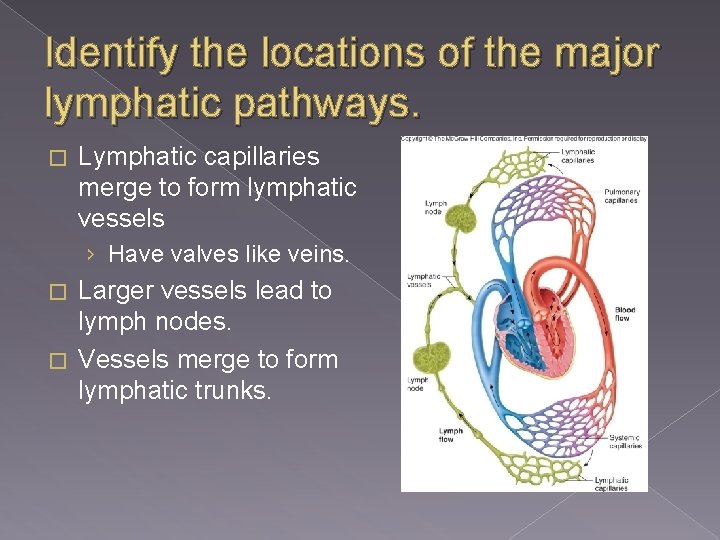
Identify the locations of the major lymphatic pathways. � Lymphatic capillaries merge to form lymphatic vessels › Have valves like veins. Larger vessels lead to lymph nodes. � Vessels merge to form lymphatic trunks. �
Identify the locations of the major lymphatic pathways. � Lymphatic trunks join with collecting ducts before being emptied into the veins. � Two collecting ducts › Thoracic › Right lymphatic
Two collecting ducts: � Thoracic – larger and longer › Lymph from lower limbs, abdominal region, left upper limb, left thorax, head, and neck. › Empties into the left subclavian vein. � Right Lymphatic – much smaller area › Lymph from right side of the head, right upper limb, right thorax. › Empties into the right subclavian vein.
Describe how tissue fluid and lymph fluid form. � Tissue fluid › Originates from blood plasma – water and dissolved substances that are released by blood capillaries. � Lymph fluid › Tissue fluid is pushed into the lymph capillaries where it becomes lymph.
Explain the function of lymph. � Transports proteins back to the blood. � Transports bacteria and other foreign objects into lymph nodes. � Basically, the purpose of lymph is to cleanse the blood plasma and return it to the cardiovascular system.
Explain how lymphatic circulation is maintained. � Lymph is driven into capillaries by hydrostatic pressure of the tissue fluid. � Once inside, it’s moved by muscle contractions (like in veins). � It is also moved by pressure changes that come along with breathing. � If lymph doesn’t move properly, it can back up and cause inflammation (edema).
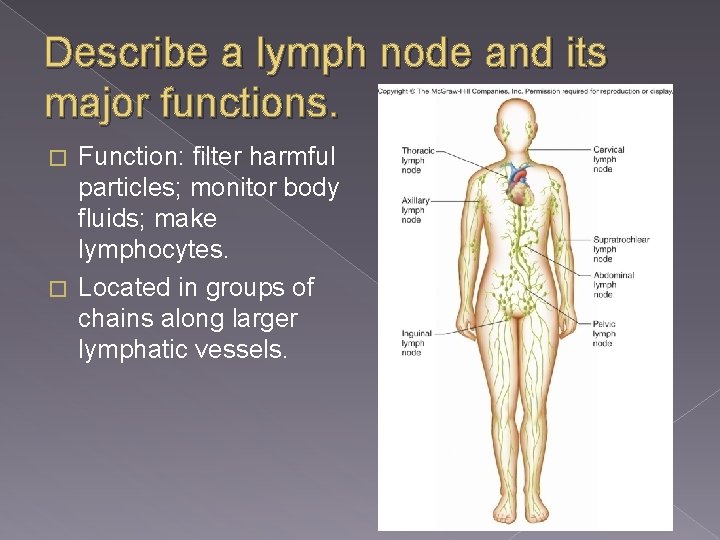
Describe a lymph node and its major functions. Function: filter harmful particles; monitor body fluids; make lymphocytes. � Located in groups of chains along larger lymphatic vessels. �
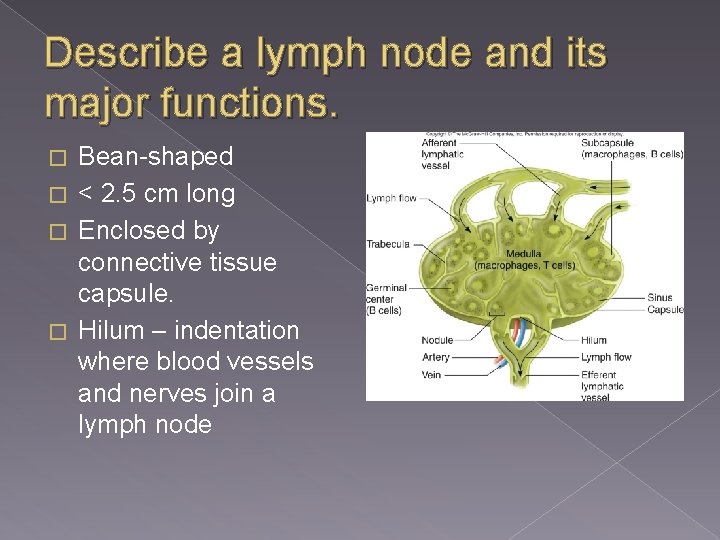
Describe a lymph node and its major functions. Bean-shaped � < 2. 5 cm long � Enclosed by connective tissue capsule. � Hilum – indentation where blood vessels and nerves join a lymph node �
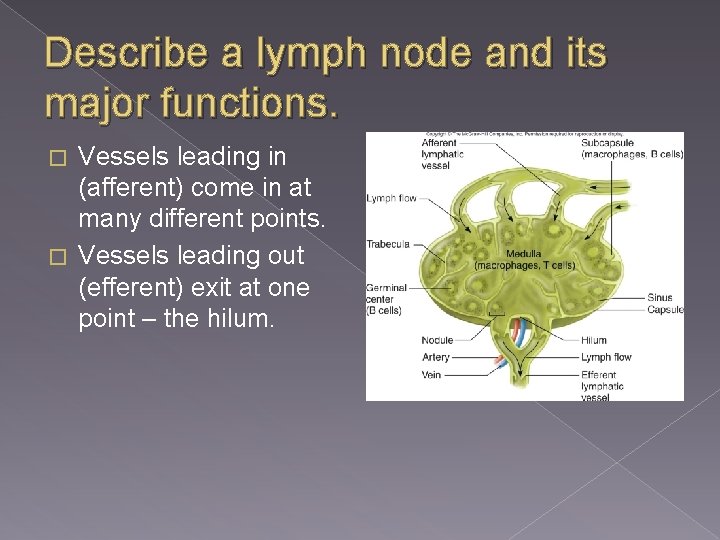
Describe a lymph node and its major functions. Vessels leading in (afferent) come in at many different points. � Vessels leading out (efferent) exit at one point – the hilum. �
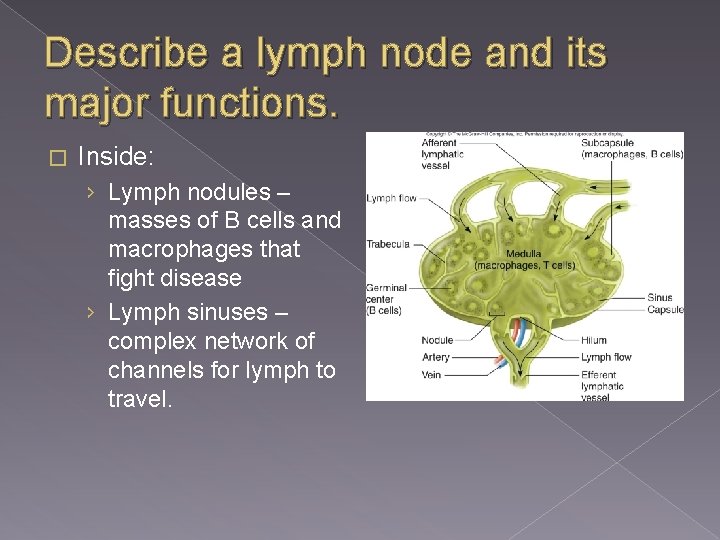
Describe a lymph node and its major functions. � Inside: › Lymph nodules – masses of B cells and macrophages that fight disease › Lymph sinuses – complex network of channels for lymph to travel.
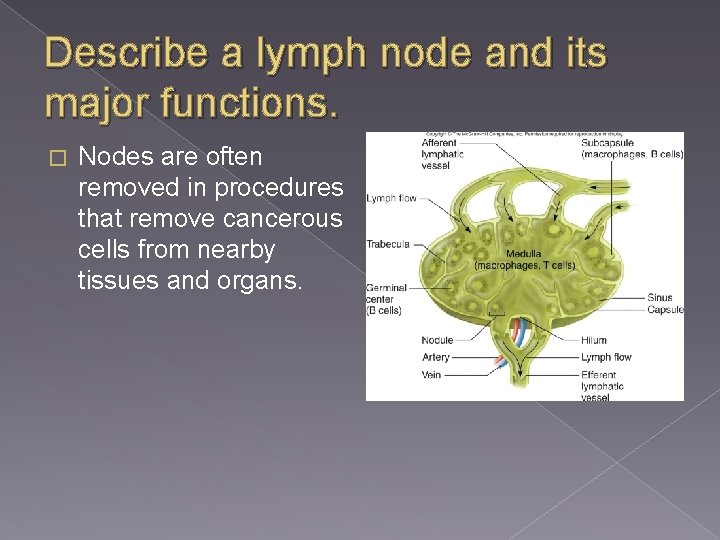
Describe a lymph node and its major functions. � Nodes are often removed in procedures that remove cancerous cells from nearby tissues and organs.
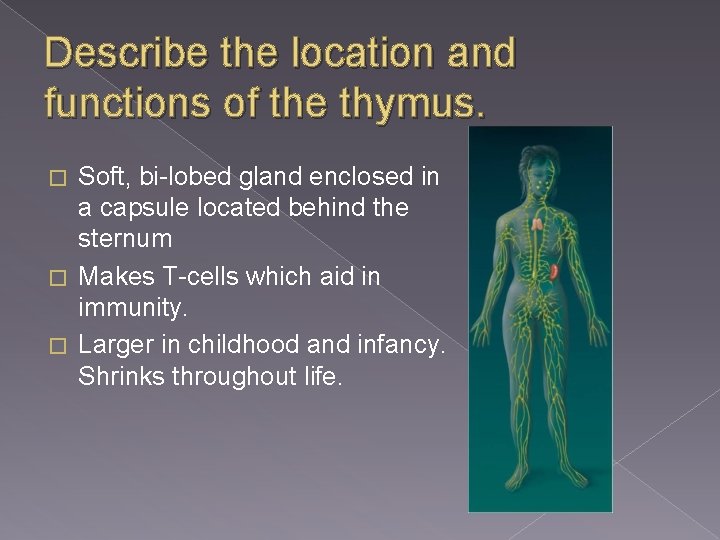
Describe the location and functions of the thymus. Soft, bi-lobed gland enclosed in a capsule located behind the sternum � Makes T-cells which aid in immunity. � Larger in childhood and infancy. Shrinks throughout life. �
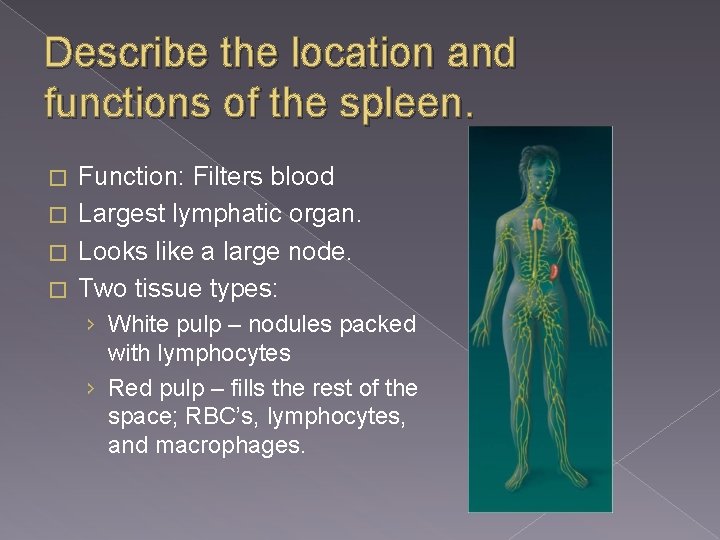
Describe the location and functions of the spleen. Function: Filters blood � Largest lymphatic organ. � Looks like a large node. � Two tissue types: � › White pulp – nodules packed with lymphocytes › Red pulp – fills the rest of the space; RBC’s, lymphocytes, and macrophages.
Distinguish between innate and adaptive defenses. � Both work together to fight infections. � Pathogens – disease-causing agents
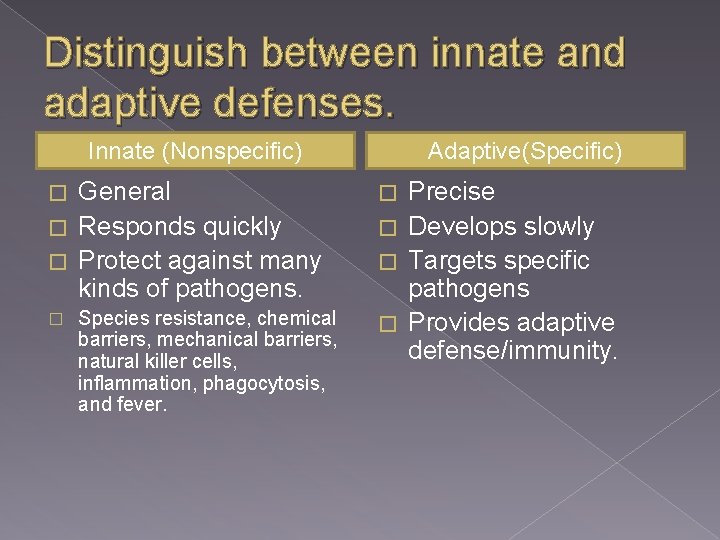
Distinguish between innate and adaptive defenses. Innate (Nonspecific) General � Responds quickly � Protect against many kinds of pathogens. � � Species resistance, chemical barriers, mechanical barriers, natural killer cells, inflammation, phagocytosis, and fever. Adaptive(Specific) Precise � Develops slowly � Targets specific pathogens � Provides adaptive defense/immunity. �
List and describe the actions of the seven innate body defense mechanisms. Type of Defense Species Resistance Mechanical Barriers Chemical Barriers Natural Killer (NK) cells Inflammation Phagocytosis Fever Description Example
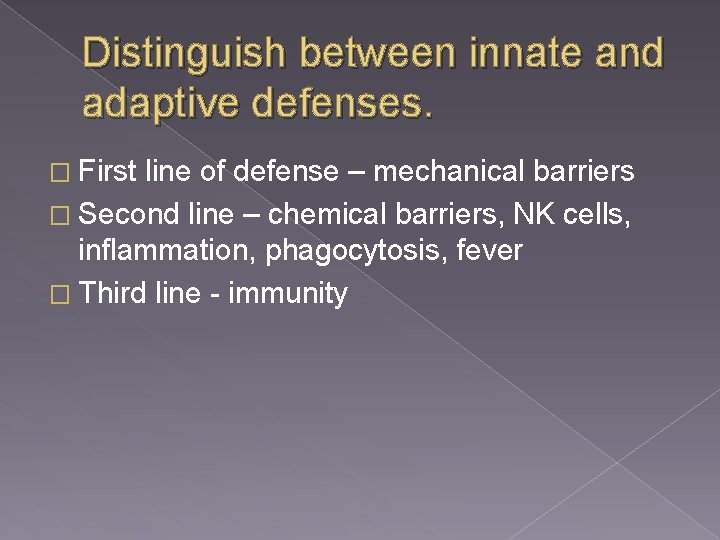
Distinguish between innate and adaptive defenses. � First line of defense – mechanical barriers � Second line – chemical barriers, NK cells, inflammation, phagocytosis, fever � Third line - immunity
Round three. . . The Enemy Antigens – large proteins and other molecules that invade the body. › The body recognizes and catalogues nonharmful substances before birth. � Large and complex antigens are more likely to illicit a response. � Hapten cells can aid in attacking the body; smaller; will not illicite a response on their own. �
Round three. . . The Remedy � Lymphocytes – T cells and B cells. � T-Cells – Originally formed in red bone marrow and mature in the thymus. � B-Cells – Formed and matured in red bone marrow. � Both reside in lymphatic organs.
Function of lymphocytes – cells T � Activation requires an antigen-presenting cell (macrophage or B cell. ) � T cells come in direct contact with cells (cellular immune response) � 3 kinds › Helper cells – stimulate B cells to attack › Cytotoxic cells – Attack tumor and viral cells › Memory cells – Remain to attack already dealtwith cells with a quicker response.
Function of lymphocytes – cells �B B cells activate and produce clones of themselves. � Most need helper T cells to activate. � Some become plasma cells that release antibodies. � Memory B cells – ready to respond to future encounters with the same antigen.
Actions of the five types of Immunoglobins/Antibodies � Antibodies/Immunoglobins � Antibodies – same thing! do three things: › Directly attack antigens › Activate complement › Stimulate localized changes (inflammation)
Actions of the five types of Immunoglobins/Antibodies � Immunoglobin G (Ig. G) – fights bacteria, viruses, and toxins � Ig. A – in breast milk, tears, nasal fluid, intestinal juice, urine, etc � Ig. M – fights food antigens and bacteria � Ig. D – mostly in infants; activates B cells � Ig E – associated with allergic reactions
Active vs Passive Immunity � Active immunity – longer term � Naturally acquired active immunity –when someone develops immunity based on their own body producing the antibodies needed. � Artificially acquired active immunity – when someone develops immunity because of a vaccine
Active vs Passive Immunity � Passive Immunity – shorter term � Artificially acquired passive immunity – individual receives a different individual’s antibodies � Naturally acquired passive immunity – passed from mother to child during pregnancy
Allergic Reactions � Immune response to a nonharmful substance � Unlike normal responses, they can damage tissue � Allergens – antigens that trigger an allergic response
Allergic Reactions � Delayed-reaction allergy – due to long exposure › Household chemicals, cosmetics, poison ivy � Immediate-reaction allergy – occurs within minutes › Tendency to overproduce Ig. E › Insect stings, penecillin
Tissue Rejection � Occur after organ transplants � Immunosuppressive drugs are used to avoid rejection � Rejection can take place years after the organ is transplanted.
Autoimmunity � The body can begin to attack itself. � About 5% of the population has an autoimmune disease › Diabetes, lupus, rheumatoid arthritis � How? Viruses can take on part of an immune system’s antibodies. Other antibodies kill the viral cells and recognize it (even the good part) as an invader
- Slides: 32