
Lymphatic System 2018 Pearson Education Inc Part I
- Slides: 126
Lymphatic System © 2018 Pearson Education, Inc.
Part I: The Lymphatic System § Consists of two semi-independent parts: 1. Lymphatic vessels 2. Lymphoid tissues and organs § Lymphatic system functions § Transports escaped fluids from the cardiovascular system back to the blood § Plays essential roles in body defense and resistance to disease © 2018 Pearson Education, Inc.
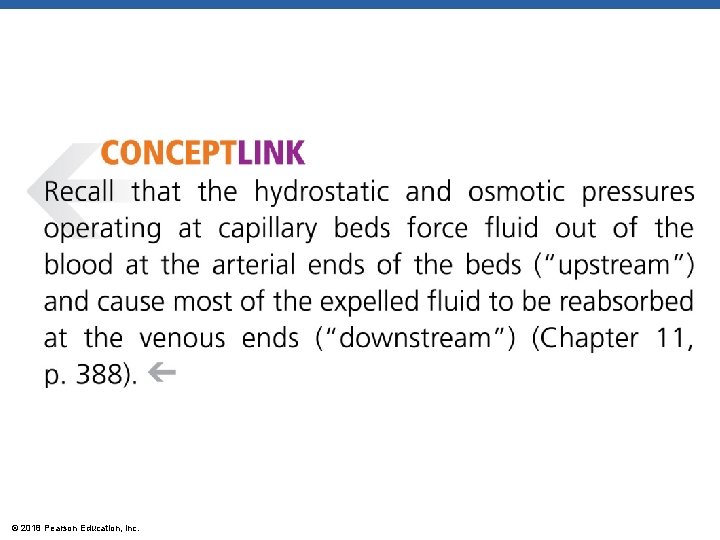
© 2018 Pearson Education, Inc.
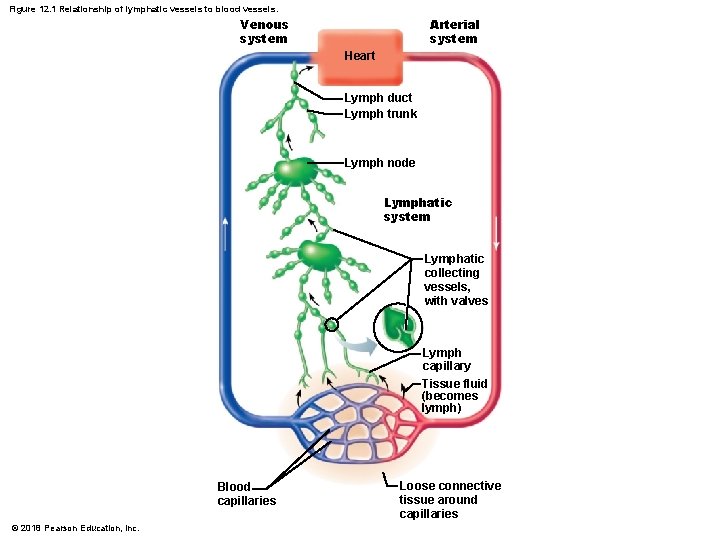
Lymphatic Vessels § Lymph consists of excess tissue fluid and plasma proteins carried by lymphatic vessels § If fluids are not picked up, edema occurs as fluid accumulates in tissues § Lymphatic vessels (lymphatics) pick up excess fluid (lymph) and return it to the blood © 2018 Pearson Education, Inc.
Figure 12. 1 Relationship of lymphatic vessels to blood vessels. Venous system Arterial system Heart Lymph duct Lymph trunk Lymph node Lymphatic system Lymphatic collecting vessels, with valves Lymph capillary Tissue fluid (becomes lymph) Blood capillaries © 2018 Pearson Education, Inc. Loose connective tissue around capillaries
Lymphatic Vessels § Lymphatic vessels (lymphatics) § Form a one-way system § Lymph flows only toward the heart © 2018 Pearson Education, Inc.
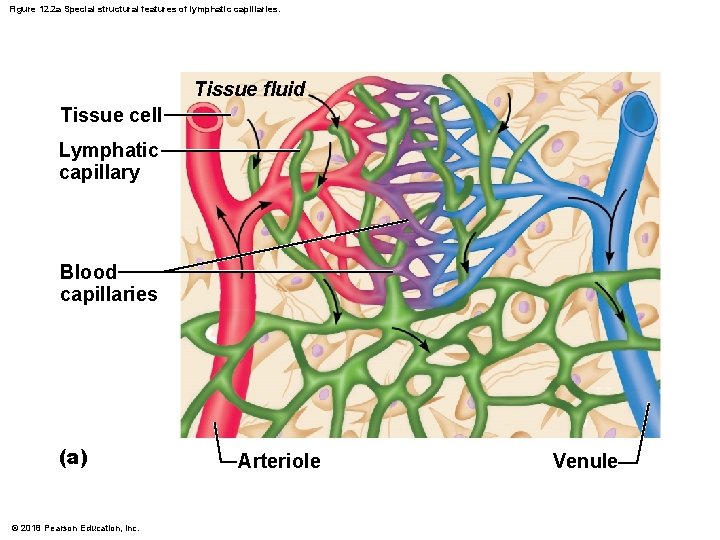
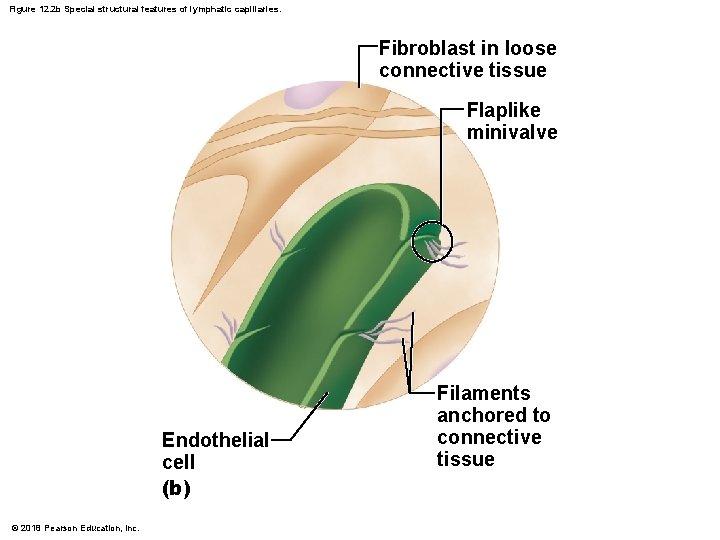
Lymphatic Vessels § Lymph capillaries § Weave between tissue cells and blood capillaries § Walls overlap to form flaplike minivalves § Fluid leaks into lymph capillaries § Capillaries are anchored to connective tissue by filaments § Higher pressure on the inside closes minivalves § Fluid is forced along the vessel © 2018 Pearson Education, Inc.
© 2018 Pearson Education, Inc.
Figure 12. 2 a Special structural features of lymphatic capillaries. Tissue fluid Tissue cell Lymphatic capillary Blood capillaries (a) © 2018 Pearson Education, Inc. Arteriole Venule
Figure 12. 2 b Special structural features of lymphatic capillaries. Fibroblast in loose connective tissue Flaplike minivalve Endothelial cell (b) © 2018 Pearson Education, Inc. Filaments anchored to connective tissue
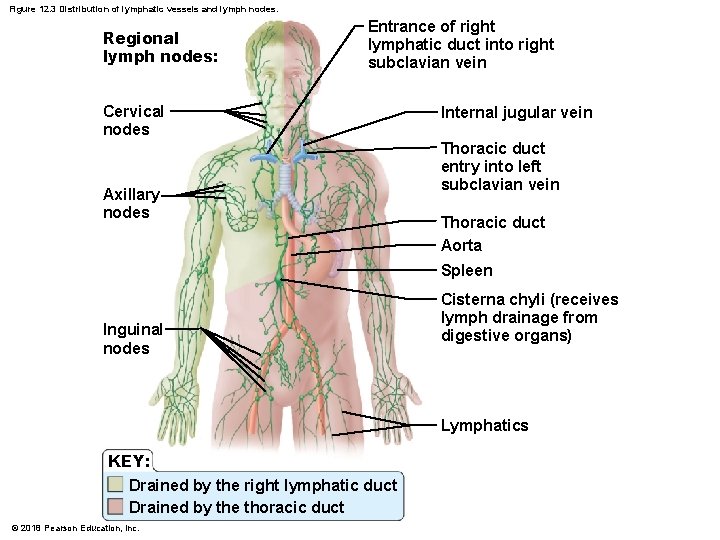
Lymphatic Vessels § Lymphatic collecting vessels § Collect lymph from lymph capillaries § Carry lymph to and away from lymph nodes § Return fluid to circulatory veins near the heart § Right lymphatic duct drains the lymph from the right arm and the right side of the head and thorax § Thoracic duct drains lymph from rest of body © 2018 Pearson Education, Inc.
Figure 12. 3 Distribution of lymphatic vessels and lymph nodes. Regional lymph nodes: Entrance of right lymphatic duct into right subclavian vein Cervical nodes Axillary nodes Internal jugular vein Thoracic duct entry into left subclavian vein Thoracic duct Aorta Spleen Inguinal nodes Cisterna chyli (receives lymph drainage from digestive organs) Lymphatics KEY: Drained by the right lymphatic duct Drained by the thoracic duct © 2018 Pearson Education, Inc.
Lymphatic Vessels § Lymphatic vessels are similar to veins of the cardiovascular system § Thin-walled § Larger vessels have valves § Low-pressure, pumpless system § Lymph transport is aided by: § Milking action of skeletal muscles § Pressure changes in thorax during breathing § Smooth muscle in walls of lymphatics © 2018 Pearson Education, Inc.
Lymph Nodes § Lymph nodes filter lymph before it is returned to the blood § Harmful materials that are filtered § Bacteria § Viruses § Cancer cells § Cell debris © 2018 Pearson Education, Inc.
Lymph Nodes § Defense cells within lymph nodes § Macrophages—engulf and destroy bacteria, viruses, and other foreign substances in lymph § Lymphocytes—respond to foreign substances in lymph © 2018 Pearson Education, Inc.
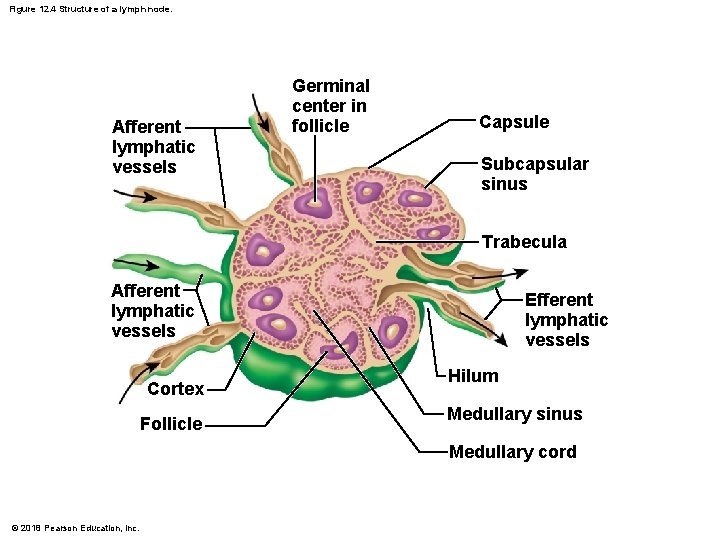
Lymph Nodes § Most lymph nodes are kidney-shaped, less than 1 inch long, and buried in connective tissue § Surrounded by a capsule § Divided into compartments by trabeculae § Cortex (outer part) § Contains follicles—collections of lymphocytes § Germinal centers enlarge when antibodies are released by plasma cells § Medulla (inner part) § Contains phagocytic macrophages © 2018 Pearson Education, Inc.
Figure 12. 4 Structure of a lymph node. Afferent lymphatic vessels Germinal center in follicle Capsule Subcapsular sinus Trabecula Afferent lymphatic vessels Cortex Follicle Efferent lymphatic vessels Hilum Medullary sinus Medullary cord © 2018 Pearson Education, Inc.
Lymph Nodes § Flow of lymph through nodes § Lymph enters the convex side through afferent lymphatic vessels § Lymph flows through a number of sinuses inside the node § Lymph exits through efferent lymphatic vessels § Because there are fewer efferent than afferent vessels, flow is slowed © 2018 Pearson Education, Inc.
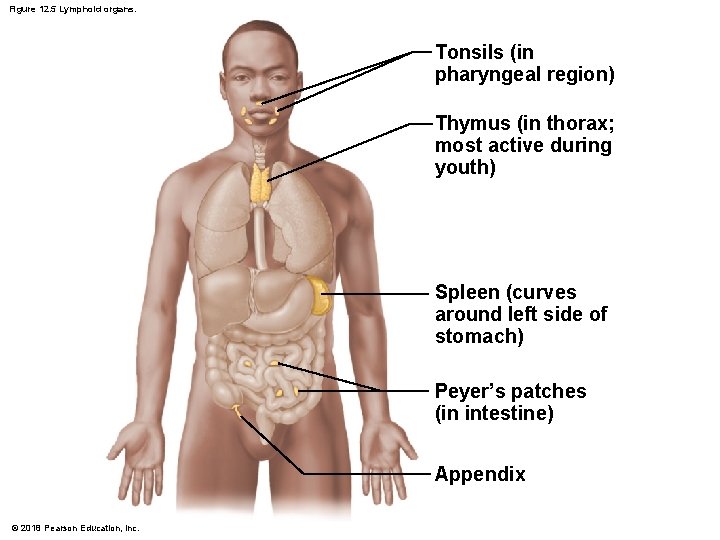
Other Lymphoid Organs § Several other lymphoid organs contribute to lymphatic function (in addition to the lymph nodes) § Spleen § Thymus § Tonsils § Peyer’s patches § Appendix © 2018 Pearson Education, Inc.
Figure 12. 5 Lymphoid organs. Tonsils (in pharyngeal region) Thymus (in thorax; most active during youth) Spleen (curves around left side of stomach) Peyer’s patches (in intestine) Appendix © 2018 Pearson Education, Inc.
Other Lymphoid Organs § Spleen § Located on the left side of the abdomen § Filters and cleans blood of bacteria, viruses, debris § Provides a site for lymphocyte proliferation and immune surveillance § Destroys worn-out blood cells § Forms blood cells in the fetus § Acts as a blood reservoir © 2018 Pearson Education, Inc.
Other Lymphoid Organs § Thymus § Found overlying the heart § Functions at peak levels only during youth © 2018 Pearson Education, Inc.
© 2018 Pearson Education, Inc.
Other Lymphoid Organs § Tonsils § Small masses of lymphoid tissue deep to the mucosa surrounding the pharynx (throat) § Trap and remove bacteria and other foreign pathogens § Tonsillitis results when the tonsils become congested with bacteria © 2018 Pearson Education, Inc.
Other Lymphoid Organs § Peyer’s patches § Found in the wall of the small intestine § Similar lymphoid follicles are found in the appendix § Macrophages capture and destroy bacteria in the intestine © 2018 Pearson Education, Inc.
Other Lymphoid Organs § Mucosa-associated lymphoid tissue (MALT) § Includes: § Peyer’s patches § Tonsils § Appendix § Acts as a sentinel to protect respiratory and digestive tracts © 2018 Pearson Education, Inc.
Part II: Body Defenses § Two mechanisms that make up the immune system defend us from foreign materials 1. Innate (nonspecific) defense system 2. Adaptive (specific) defense system § Immunity—specific resistance to disease § Immune system is a functional system rather than an organ system in an anatomical sense © 2018 Pearson Education, Inc.
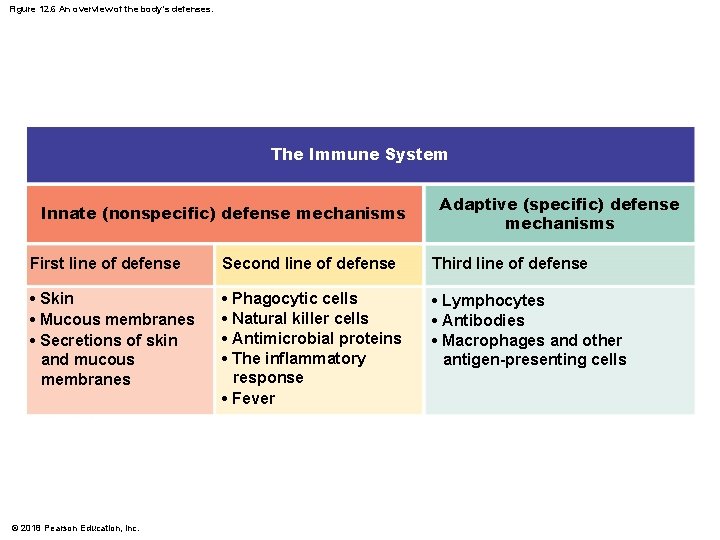
Figure 12. 6 An overview of the body’s defenses. The Immune System Innate (nonspecific) defense mechanisms Adaptive (specific) defense mechanisms First line of defense Second line of defense Third line of defense • Skin • Mucous membranes • Secretions of skin and mucous membranes • Phagocytic cells • Natural killer cells • Antimicrobial proteins • The inflammatory response • Fever • Lymphocytes • Antibodies • Macrophages and other antigen-presenting cells © 2018 Pearson Education, Inc.
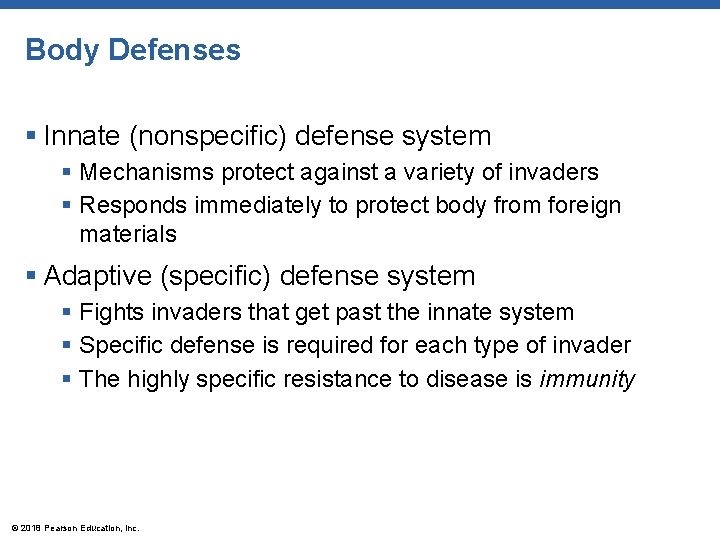
Body Defenses § Innate (nonspecific) defense system § Mechanisms protect against a variety of invaders § Responds immediately to protect body from foreign materials § Adaptive (specific) defense system § Fights invaders that get past the innate system § Specific defense is required for each type of invader § The highly specific resistance to disease is immunity © 2018 Pearson Education, Inc.
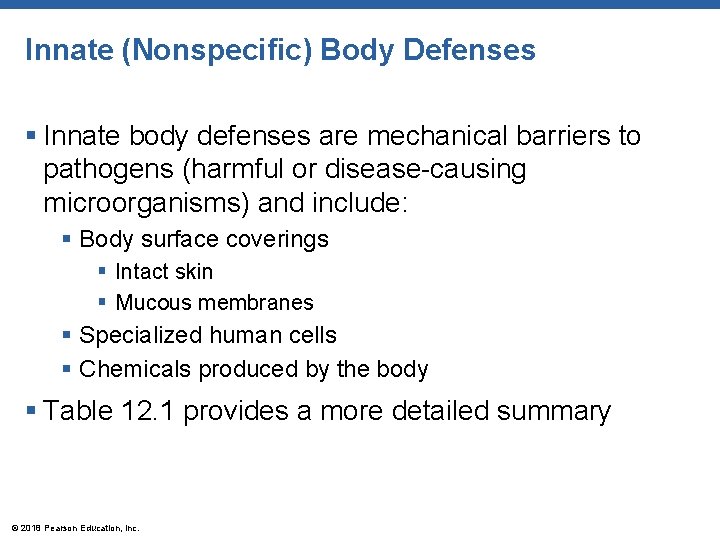
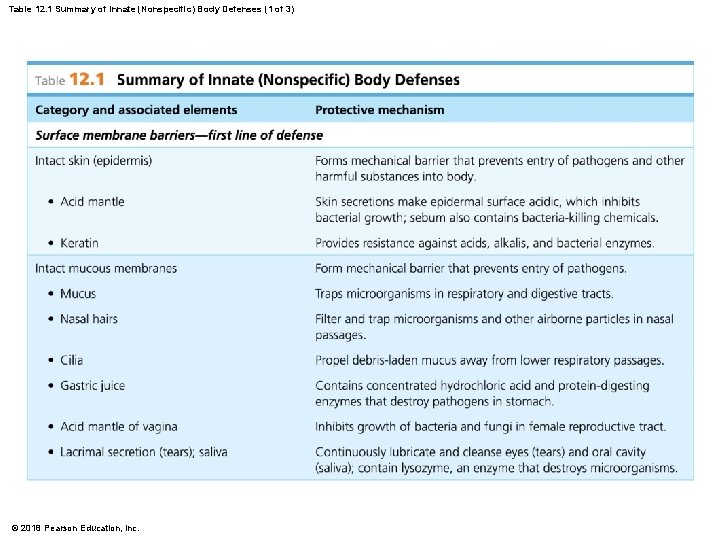
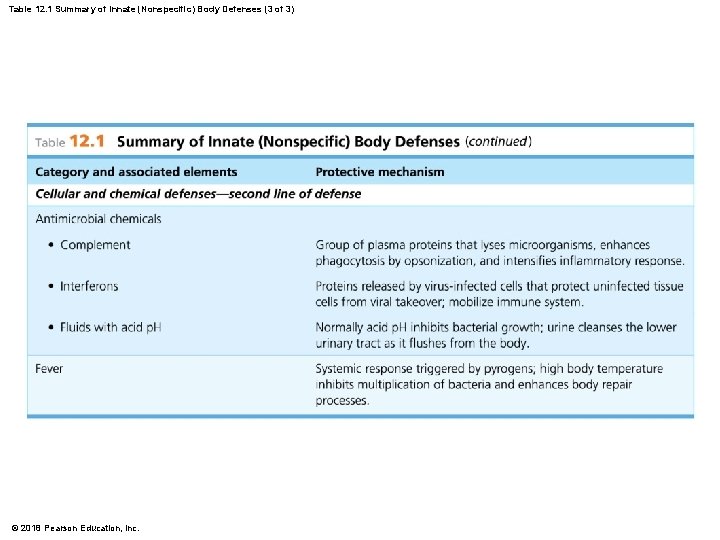
Innate (Nonspecific) Body Defenses § Innate body defenses are mechanical barriers to pathogens (harmful or disease-causing microorganisms) and include: § Body surface coverings § Intact skin § Mucous membranes § Specialized human cells § Chemicals produced by the body § Table 12. 1 provides a more detailed summary © 2018 Pearson Education, Inc.
Table 12. 1 Summary of Innate (Nonspecific) Body Defenses (1 of 3) © 2018 Pearson Education, Inc.
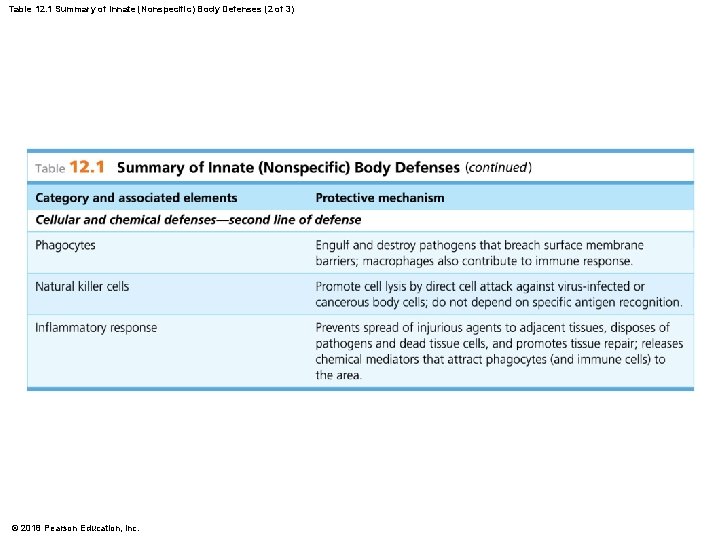
Table 12. 1 Summary of Innate (Nonspecific) Body Defenses (2 of 3) © 2018 Pearson Education, Inc.
Table 12. 1 Summary of Innate (Nonspecific) Body Defenses (3 of 3) © 2018 Pearson Education, Inc.
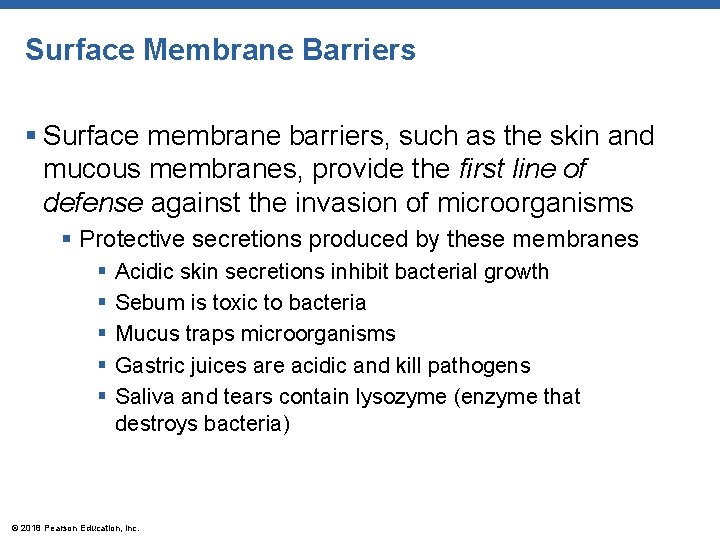
Surface Membrane Barriers § Surface membrane barriers, such as the skin and mucous membranes, provide the first line of defense against the invasion of microorganisms § Protective secretions produced by these membranes § § § Acidic skin secretions inhibit bacterial growth Sebum is toxic to bacteria Mucus traps microorganisms Gastric juices are acidic and kill pathogens Saliva and tears contain lysozyme (enzyme that destroys bacteria) © 2018 Pearson Education, Inc.
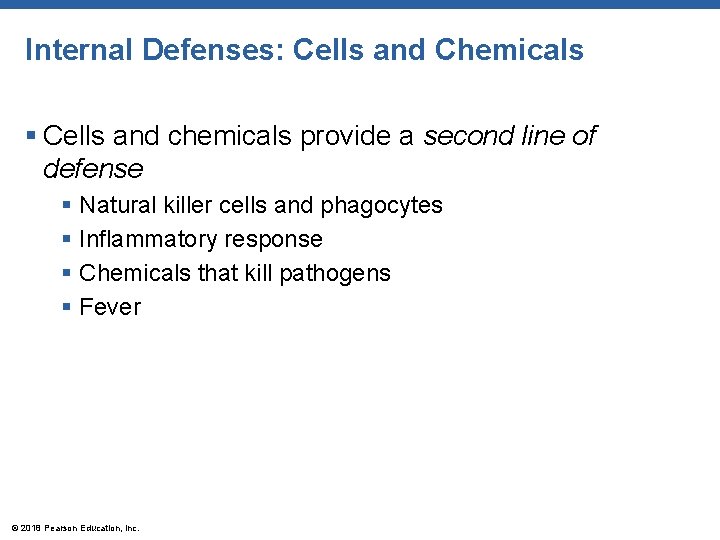
Internal Defenses: Cells and Chemicals § Cells and chemicals provide a second line of defense § Natural killer cells and phagocytes § Inflammatory response § Chemicals that kill pathogens § Fever © 2018 Pearson Education, Inc.
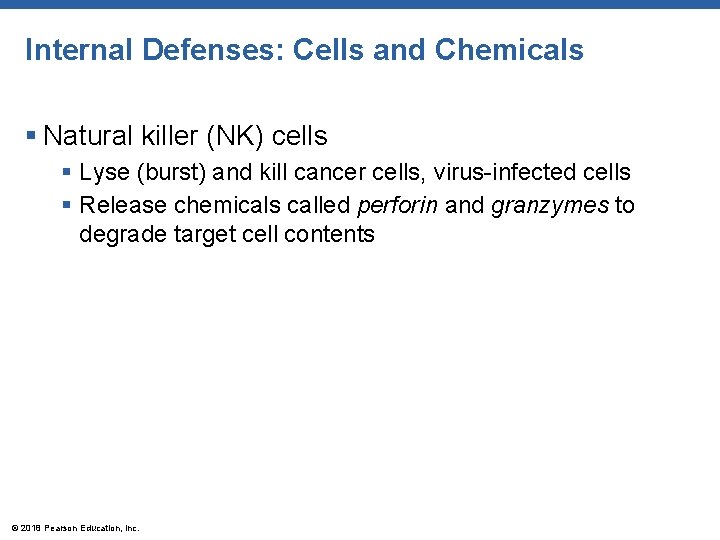
Internal Defenses: Cells and Chemicals § Natural killer (NK) cells § Lyse (burst) and kill cancer cells, virus-infected cells § Release chemicals called perforin and granzymes to degrade target cell contents © 2018 Pearson Education, Inc.
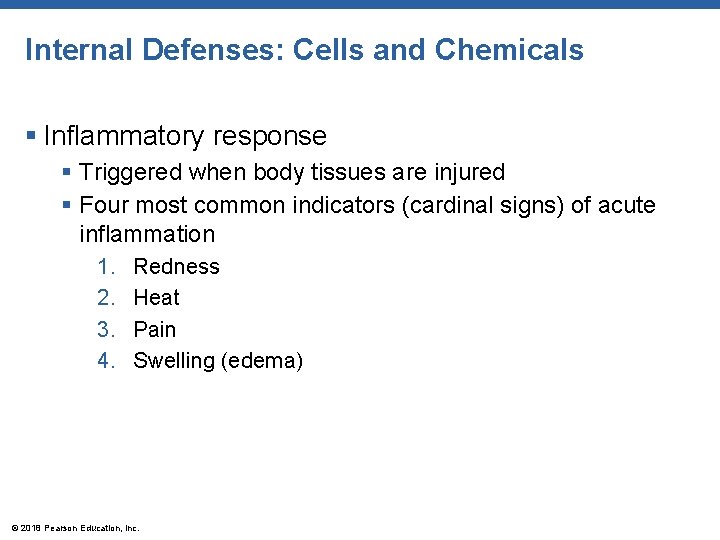
Internal Defenses: Cells and Chemicals § Inflammatory response § Triggered when body tissues are injured § Four most common indicators (cardinal signs) of acute inflammation 1. 2. 3. 4. Redness Heat Pain Swelling (edema) © 2018 Pearson Education, Inc.
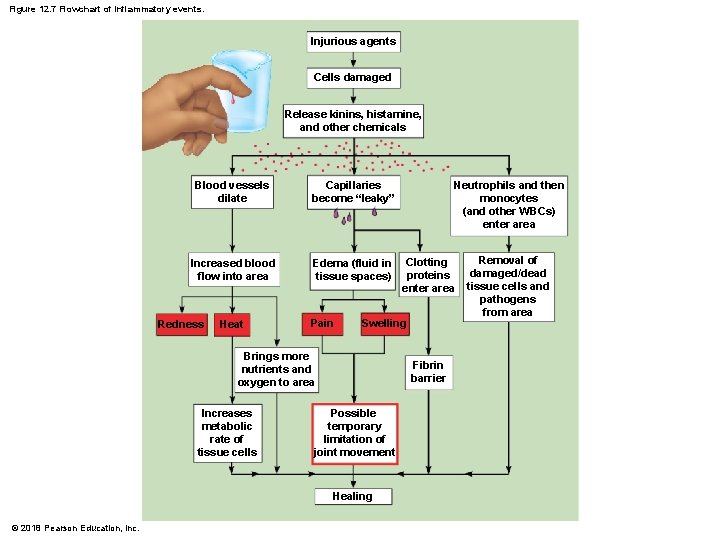
Figure 12. 7 Flowchart of inflammatory events. Injurious agents Cells damaged Release kinins, histamine, and other chemicals Blood vessels dilate Capillaries become “leaky” Increased blood flow into area Edema (fluid in tissue spaces) Redness Heat Pain Fibrin barrier Possible temporary limitation of joint movement Healing © 2018 Pearson Education, Inc. Clotting proteins enter area Swelling Brings more nutrients and oxygen to area Increases metabolic rate of tissue cells Neutrophils and then monocytes (and other WBCs) enter area Removal of damaged/dead tissue cells and pathogens from area
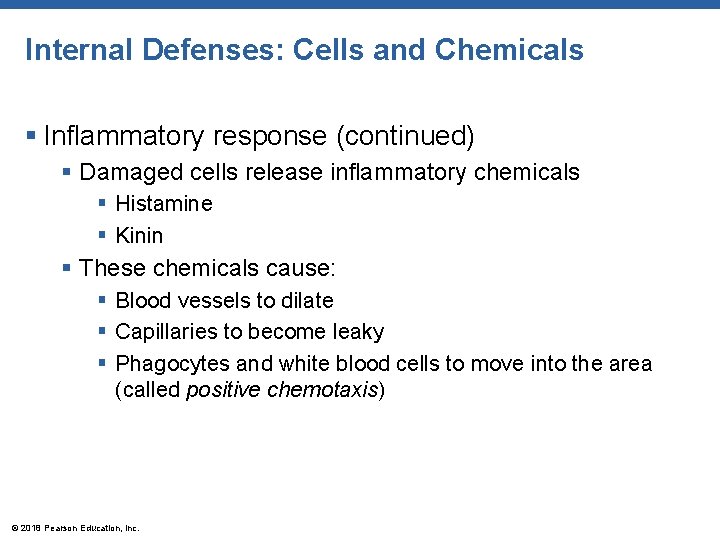
Internal Defenses: Cells and Chemicals § Inflammatory response (continued) § Damaged cells release inflammatory chemicals § Histamine § Kinin § These chemicals cause: § Blood vessels to dilate § Capillaries to become leaky § Phagocytes and white blood cells to move into the area (called positive chemotaxis) © 2018 Pearson Education, Inc.
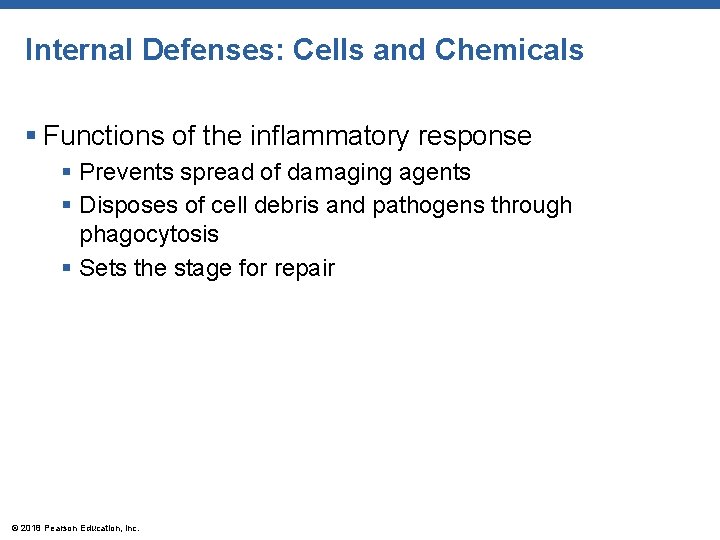
Internal Defenses: Cells and Chemicals § Functions of the inflammatory response § Prevents spread of damaging agents § Disposes of cell debris and pathogens through phagocytosis § Sets the stage for repair © 2018 Pearson Education, Inc.
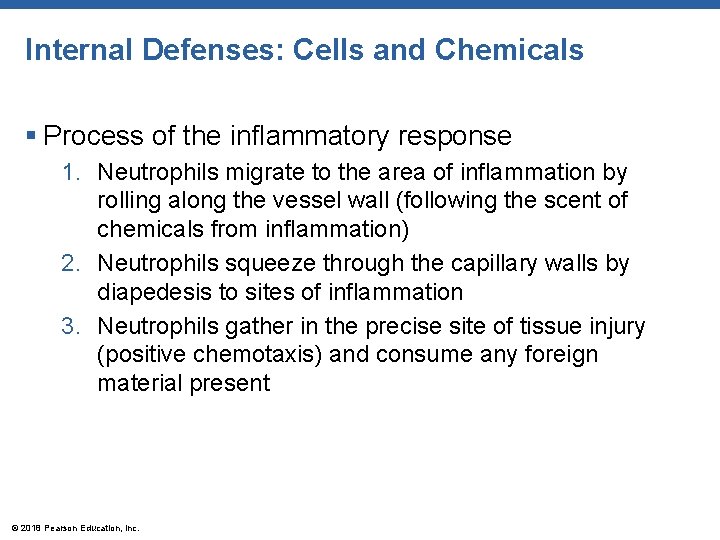
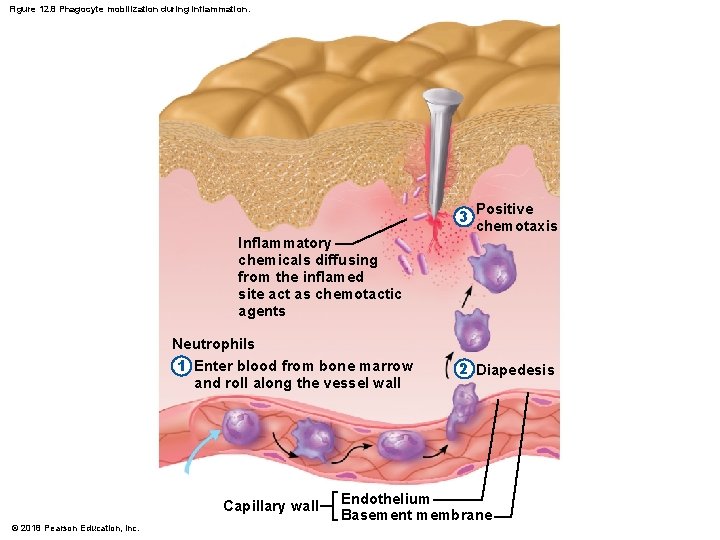
Internal Defenses: Cells and Chemicals § Process of the inflammatory response 1. Neutrophils migrate to the area of inflammation by rolling along the vessel wall (following the scent of chemicals from inflammation) 2. Neutrophils squeeze through the capillary walls by diapedesis to sites of inflammation 3. Neutrophils gather in the precise site of tissue injury (positive chemotaxis) and consume any foreign material present © 2018 Pearson Education, Inc.
Figure 12. 8 Phagocyte mobilization during inflammation. 3 Positive chemotaxis Inflammatory chemicals diffusing from the inflamed site act as chemotactic agents Neutrophils 1 Enter blood from bone marrow and roll along the vessel wall Capillary wall © 2018 Pearson Education, Inc. 2 Diapedesis Endothelium Basement membrane
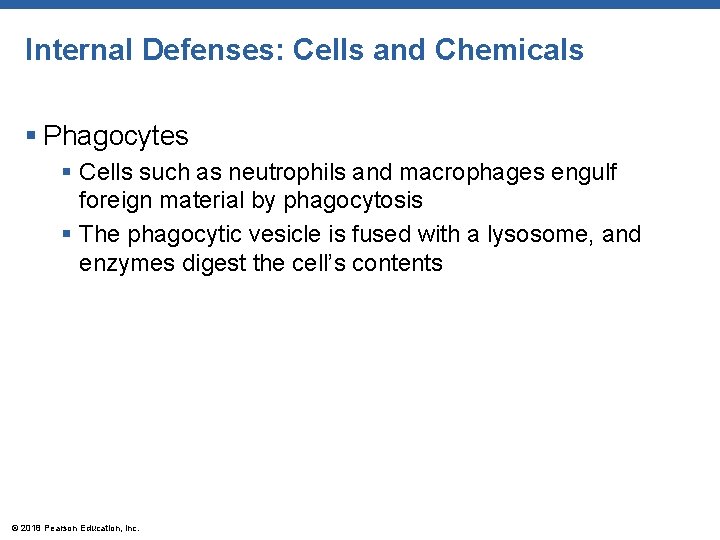
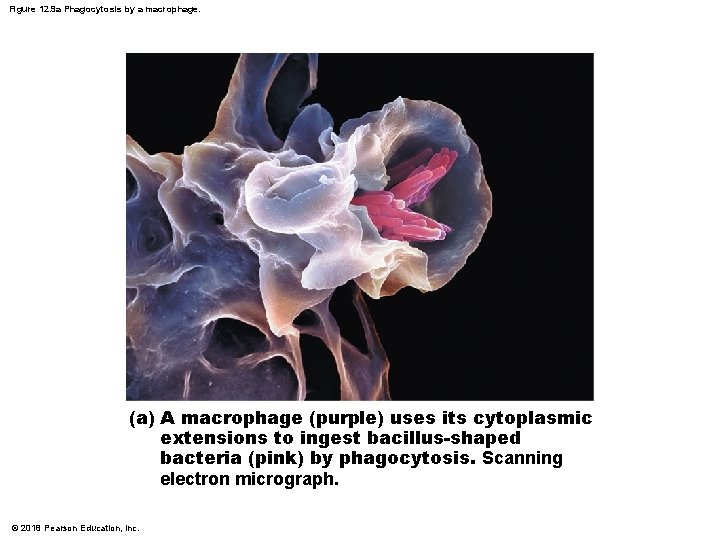
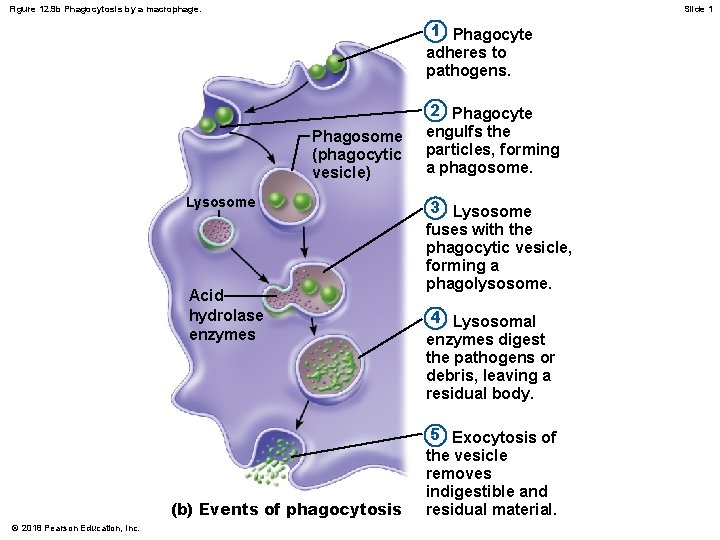
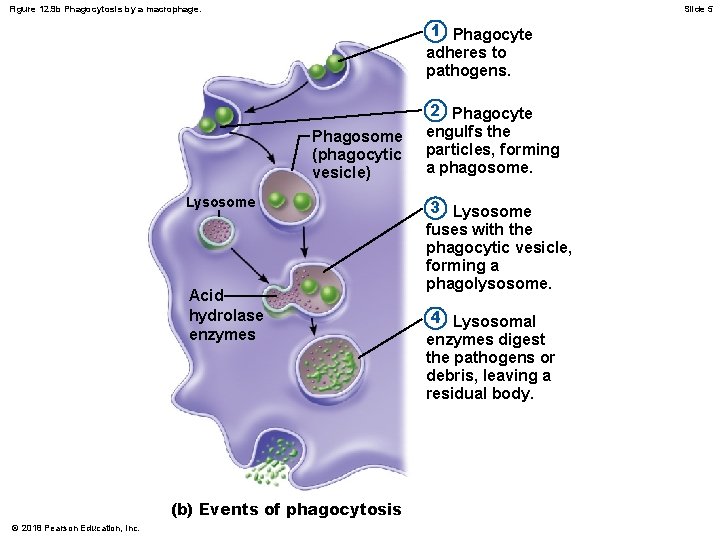
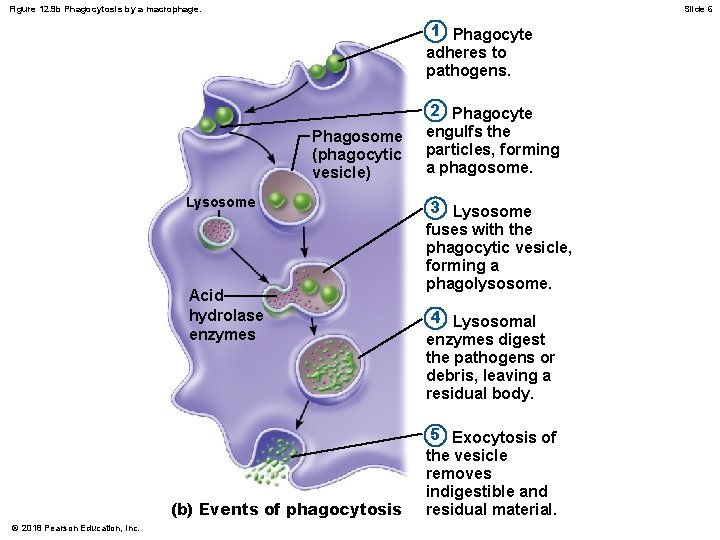
Internal Defenses: Cells and Chemicals § Phagocytes § Cells such as neutrophils and macrophages engulf foreign material by phagocytosis § The phagocytic vesicle is fused with a lysosome, and enzymes digest the cell’s contents © 2018 Pearson Education, Inc.
Figure 12. 9 a Phagocytosis by a macrophage. (a) A macrophage (purple) uses its cytoplasmic extensions to ingest bacillus-shaped bacteria (pink) by phagocytosis. Scanning electron micrograph. © 2018 Pearson Education, Inc.
Figure 12. 9 b Phagocytosis by a macrophage. Slide 1 1 Phagocyte adheres to pathogens. Phagosome (phagocytic vesicle) Lysosome Acid hydrolase enzymes (b) Events of phagocytosis © 2018 Pearson Education, Inc. 2 Phagocyte engulfs the particles, forming a phagosome. 3 Lysosome fuses with the phagocytic vesicle, forming a phagolysosome. 4 Lysosomal enzymes digest the pathogens or debris, leaving a residual body. 5 Exocytosis of the vesicle removes indigestible and residual material.
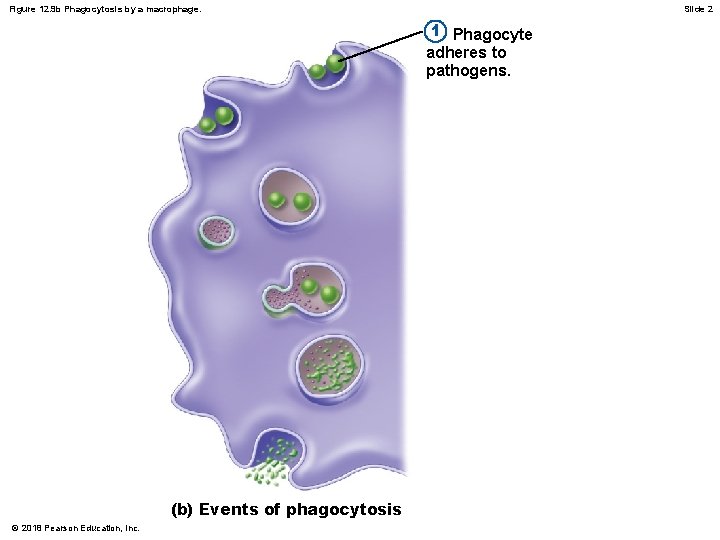
Figure 12. 9 b Phagocytosis by a macrophage. Slide 2 1 Phagocyte adheres to pathogens. (b) Events of phagocytosis © 2018 Pearson Education, Inc.
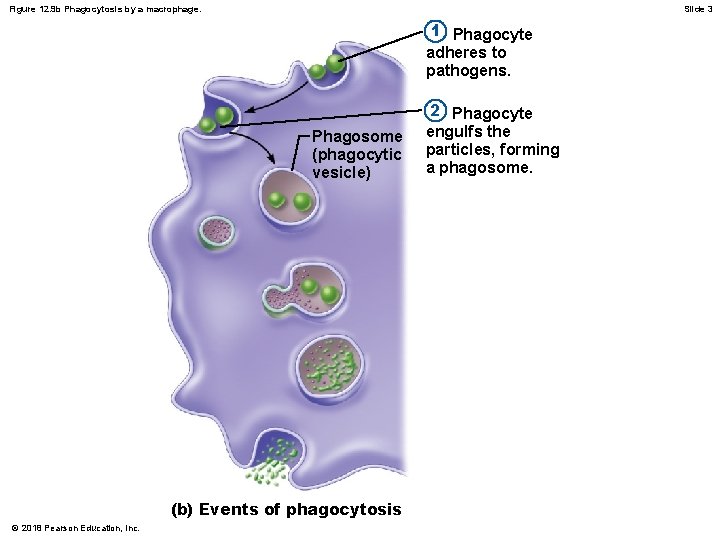
Figure 12. 9 b Phagocytosis by a macrophage. Slide 3 1 Phagocyte adheres to pathogens. Phagosome (phagocytic vesicle) (b) Events of phagocytosis © 2018 Pearson Education, Inc. 2 Phagocyte engulfs the particles, forming a phagosome.
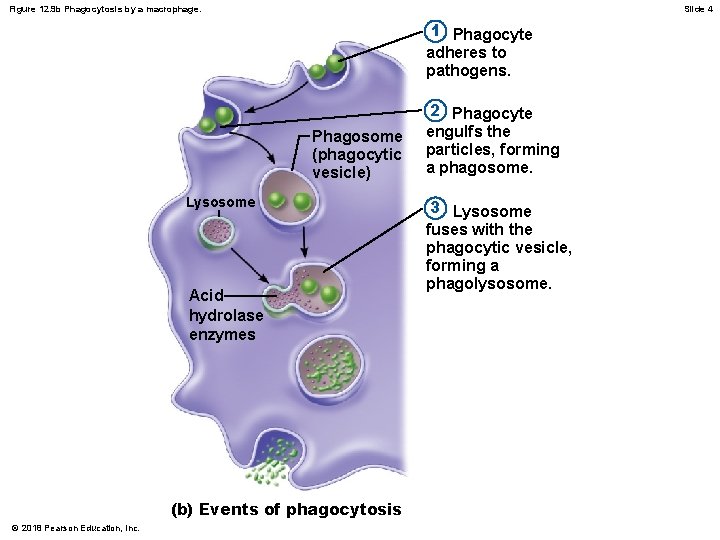
Figure 12. 9 b Phagocytosis by a macrophage. Slide 4 1 Phagocyte adheres to pathogens. Phagosome (phagocytic vesicle) Lysosome Acid hydrolase enzymes (b) Events of phagocytosis © 2018 Pearson Education, Inc. 2 Phagocyte engulfs the particles, forming a phagosome. 3 Lysosome fuses with the phagocytic vesicle, forming a phagolysosome.
Figure 12. 9 b Phagocytosis by a macrophage. Slide 5 1 Phagocyte adheres to pathogens. Phagosome (phagocytic vesicle) Lysosome Acid hydrolase enzymes (b) Events of phagocytosis © 2018 Pearson Education, Inc. 2 Phagocyte engulfs the particles, forming a phagosome. 3 Lysosome fuses with the phagocytic vesicle, forming a phagolysosome. 4 Lysosomal enzymes digest the pathogens or debris, leaving a residual body.
Figure 12. 9 b Phagocytosis by a macrophage. Slide 6 1 Phagocyte adheres to pathogens. Phagosome (phagocytic vesicle) Lysosome Acid hydrolase enzymes (b) Events of phagocytosis © 2018 Pearson Education, Inc. 2 Phagocyte engulfs the particles, forming a phagosome. 3 Lysosome fuses with the phagocytic vesicle, forming a phagolysosome. 4 Lysosomal enzymes digest the pathogens or debris, leaving a residual body. 5 Exocytosis of the vesicle removes indigestible and residual material.
Internal Defenses: Cells and Chemicals § Antimicrobial proteins § Enhance innate defenses by: § Attacking microorganisms directly § Hindering reproduction of microorganisms § Most important types § Complement proteins § Interferon © 2018 Pearson Education, Inc.
Internal Defenses: Cells and Chemicals § Antimicrobial proteins: complement proteins § Complement refers to a group of at least 20 plasma proteins that circulate in the plasma § Complement is activated when these plasma proteins encounter and attach to cells (known as complement fixation) © 2018 Pearson Education, Inc.
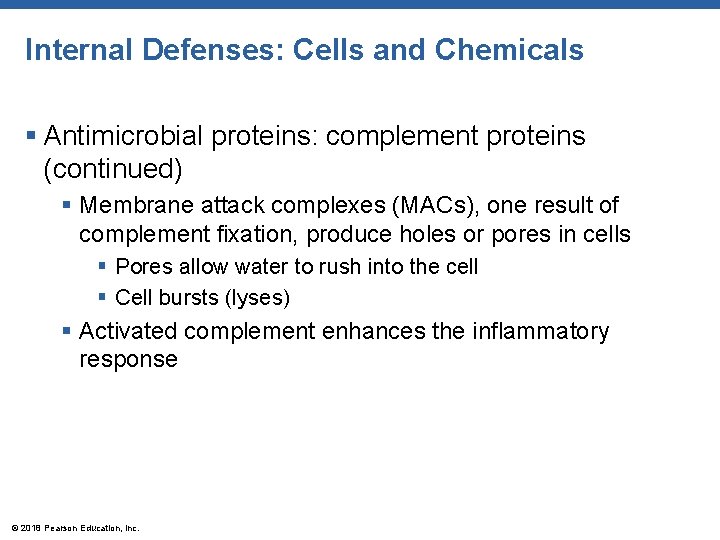
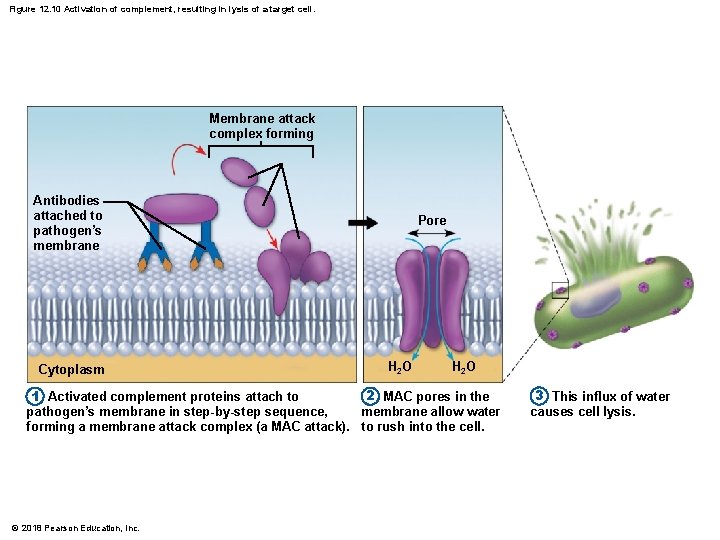
Internal Defenses: Cells and Chemicals § Antimicrobial proteins: complement proteins (continued) § Membrane attack complexes (MACs), one result of complement fixation, produce holes or pores in cells § Pores allow water to rush into the cell § Cell bursts (lyses) § Activated complement enhances the inflammatory response © 2018 Pearson Education, Inc.
Figure 12. 10 Activation of complement, resulting in lysis of a target cell. Membrane attack complex forming Antibodies attached to pathogen’s membrane Cytoplasm Pore H 2 O 2 MAC pores in the 1 Activated complement proteins attach to pathogen’s membrane in step-by-step sequence, membrane allow water forming a membrane attack complex (a MAC attack). to rush into the cell. © 2018 Pearson Education, Inc. 3 This influx of water causes cell lysis.
Internal Defenses: Cells and Chemicals § Antimicrobial proteins: interferons § Interferons are small proteins secreted by virusinfected cells § Interferons bind to membrane receptors on healthy cell surfaces to interfere with the ability of viruses to multiply © 2018 Pearson Education, Inc.
Internal Defenses: Cells and Chemicals § Fever § Abnormally high body temperature is a systemic response to invasion by microorganisms § Hypothalamus regulates body temperature at 37ºC (98. 6ºF) § The hypothalamus thermostat can be reset higher by pyrogens (secreted by white blood cells) § High temperatures inhibit the release of iron and zinc (needed by bacteria) from the liver and spleen § Fever also increases the speed of repair processes © 2018 Pearson Education, Inc.
Adaptive Body Defenses § Adaptive body defenses are the body’s specific defense system, or the third line of defense § Immune response is the immune system’s response to a threat § Antigens are targeted and destroyed by antibodies © 2018 Pearson Education, Inc.
Adaptive Body Defenses § Three aspects of adaptive defense § Antigen specific—the adaptive defense system recognizes and acts against particular foreign substances § Systemic—immunity is not restricted to the initial infection site § Memory—the adaptive defense system recognizes and mounts a stronger attack on previously encountered pathogens © 2018 Pearson Education, Inc.
Adaptive Body Defenses § Two arms of the adaptive defense system § Humoral immunity = antibody-mediated immunity § Provided by antibodies present in body fluids § Cellular immunity = cell-mediated immunity § Targets virus-infected cells, cancer cells, and cells of foreign grafts © 2018 Pearson Education, Inc.
Antigens § Antigens are any substance capable of exciting the immune system and provoking an immune response § Examples of common nonself antigens § § § Foreign proteins provoke the strongest response Nucleic acids Large carbohydrates Some lipids Pollen grains Microorganisms (bacteria, fungi, viruses) © 2018 Pearson Education, Inc.
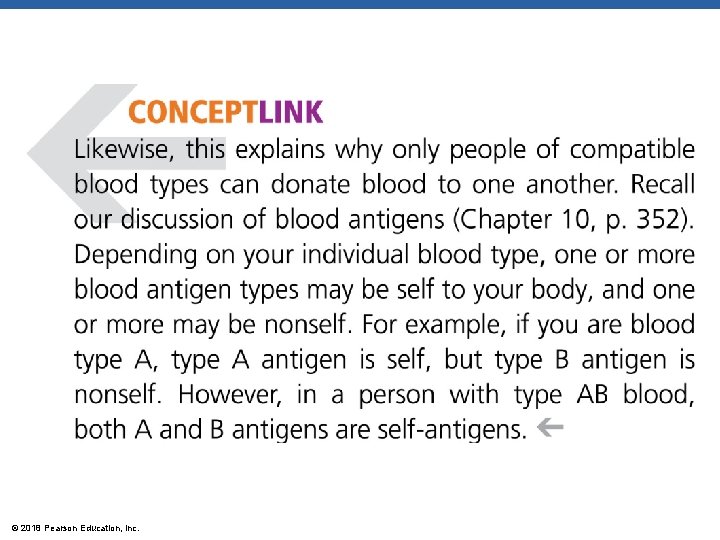
Antigens § Self-antigens § Human cells have many protein and carbohydrate molecules § Self-antigens do not trigger an immune response in us § The presence of our cells in another person’s body can trigger an immune response because they are foreign § Restricts donors for transplants © 2018 Pearson Education, Inc.
© 2018 Pearson Education, Inc.
Antigens § Haptens, or incomplete antigens, are not antigenic by themselves § When they link up with our own proteins, the immune system may recognize the combination as foreign and respond with an attack § Found in poison ivy, animal dander, detergents, hair dyes, cosmetics © 2018 Pearson Education, Inc.
Cells of the Adaptive Defense System: An Overview § Crucial cells of the adaptive system 1. Lymphocytes—respond to specific antigens § B lymphocytes (B cells) produce antibodies and oversee humoral immunity § T lymphocytes (T cells) constitute the cell-mediated arm of the adaptive defenses; do not make antibodies 2. Antigen-presenting cells (APCs)—help the lymphocytes but do not respond to specific antigens © 2018 Pearson Education, Inc.
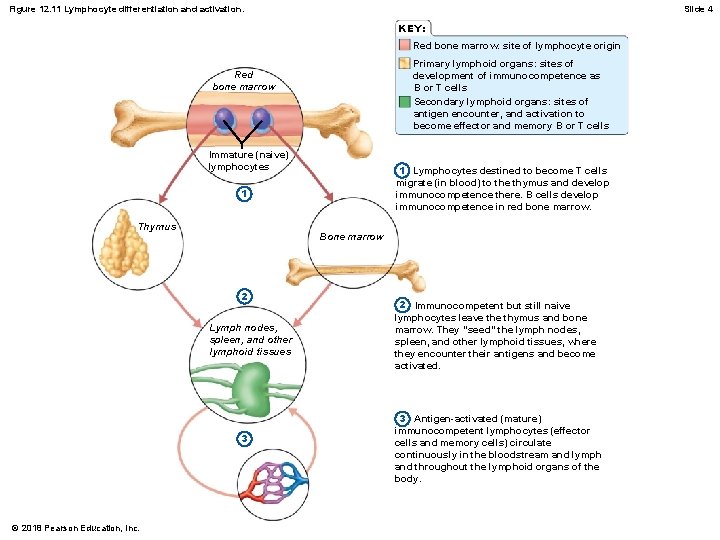
Cells of the Adaptive Defense System: An Overview § Lymphocytes § Arise from hemocytoblasts of bone marrow § Whether a lymphocyte matures into a B cell or T cell depends on where it becomes immunocompetent § Immunocompetence § The capability to respond to a specific antigen by binding to it with antigen-specific receptors that appear on the lymphocyte’s surface © 2018 Pearson Education, Inc.
Cells of the Adaptive Defense System: An Overview § Lymphocytes (continued) § T cells develop immunocompetence in the thymus and oversee cell-mediated immunity § Identify foreign antigens § Those that bind self-antigens are destroyed § Self-tolerance is important part of lymphocyte “education” § B cells develop immunocompetence in bone marrow and provide humoral immunity © 2018 Pearson Education, Inc.
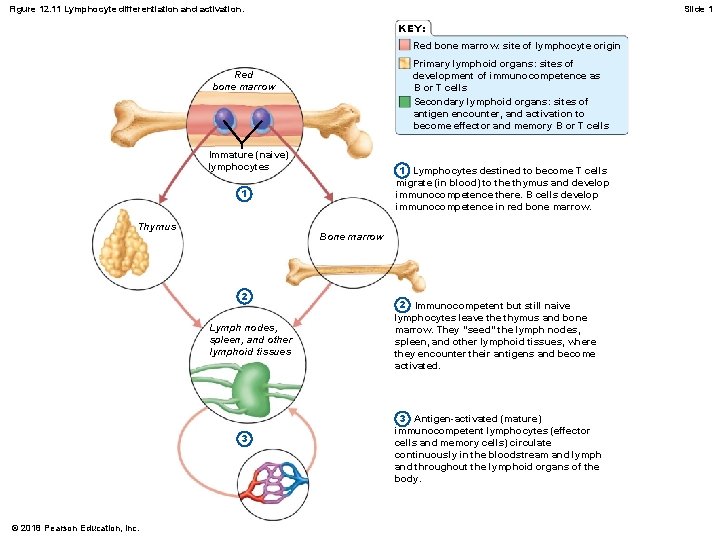
Cells of the Adaptive Defense System: An Overview § Immunocompetent T and B lymphocytes migrate to the lymph nodes and spleen, where encounters with antigens occur § Differentiation from naïve cells into mature lymphocytes is complete when they bind with recognized antigens § Mature lymphocytes (especially T cells) circulate continuously throughout the body © 2018 Pearson Education, Inc.
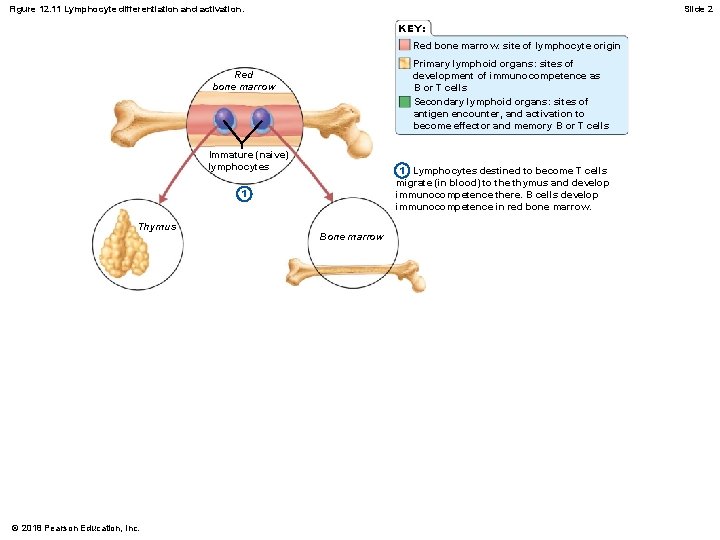
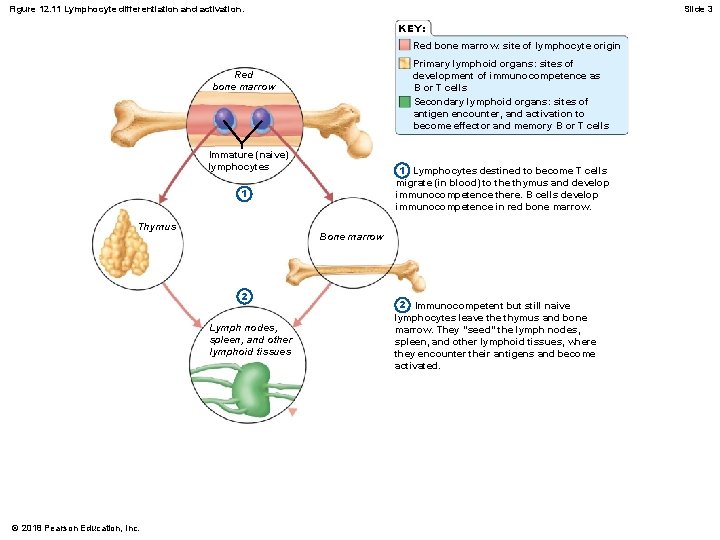
Figure 12. 11 Lymphocyte differentiation and activation. Slide 1 KEY: Red bone marrow: site of lymphocyte origin Primary lymphoid organs: sites of development of immunocompetence as B or T cells Secondary lymphoid organs: sites of antigen encounter, and activation to become effector and memory B or T cells Red bone marrow Immature (naive) lymphocytes 1 Lymphocytes destined to become T cells migrate (in blood) to the thymus and develop immunocompetence there. B cells develop immunocompetence in red bone marrow. 1 Thymus Bone marrow 2 Lymph nodes, spleen, and other lymphoid tissues 3 © 2018 Pearson Education, Inc. 2 Immunocompetent but still naive lymphocytes leave thymus and bone marrow. They “seed” the lymph nodes, spleen, and other lymphoid tissues, where they encounter their antigens and become activated. 3 Antigen-activated (mature) immunocompetent lymphocytes (effector cells and memory cells) circulate continuously in the bloodstream and lymph and throughout the lymphoid organs of the body.
Figure 12. 11 Lymphocyte differentiation and activation. Slide 2 KEY: Red bone marrow: site of lymphocyte origin Primary lymphoid organs: sites of development of immunocompetence as B or T cells Secondary lymphoid organs: sites of antigen encounter, and activation to become effector and memory B or T cells Red bone marrow Immature (naive) lymphocytes 1 Lymphocytes destined to become T cells migrate (in blood) to the thymus and develop immunocompetence there. B cells develop immunocompetence in red bone marrow. 1 Thymus © 2018 Pearson Education, Inc. Bone marrow
Figure 12. 11 Lymphocyte differentiation and activation. Slide 3 KEY: Red bone marrow: site of lymphocyte origin Primary lymphoid organs: sites of development of immunocompetence as B or T cells Secondary lymphoid organs: sites of antigen encounter, and activation to become effector and memory B or T cells Red bone marrow Immature (naive) lymphocytes 1 Lymphocytes destined to become T cells migrate (in blood) to the thymus and develop immunocompetence there. B cells develop immunocompetence in red bone marrow. 1 Thymus Bone marrow 2 Lymph nodes, spleen, and other lymphoid tissues © 2018 Pearson Education, Inc. 2 Immunocompetent but still naive lymphocytes leave thymus and bone marrow. They “seed” the lymph nodes, spleen, and other lymphoid tissues, where they encounter their antigens and become activated.
Figure 12. 11 Lymphocyte differentiation and activation. Slide 4 KEY: Red bone marrow: site of lymphocyte origin Primary lymphoid organs: sites of development of immunocompetence as B or T cells Secondary lymphoid organs: sites of antigen encounter, and activation to become effector and memory B or T cells Red bone marrow Immature (naive) lymphocytes 1 Lymphocytes destined to become T cells migrate (in blood) to the thymus and develop immunocompetence there. B cells develop immunocompetence in red bone marrow. 1 Thymus Bone marrow 2 Lymph nodes, spleen, and other lymphoid tissues 3 © 2018 Pearson Education, Inc. 2 Immunocompetent but still naive lymphocytes leave thymus and bone marrow. They “seed” the lymph nodes, spleen, and other lymphoid tissues, where they encounter their antigens and become activated. 3 Antigen-activated (mature) immunocompetent lymphocytes (effector cells and memory cells) circulate continuously in the bloodstream and lymph and throughout the lymphoid organs of the body.
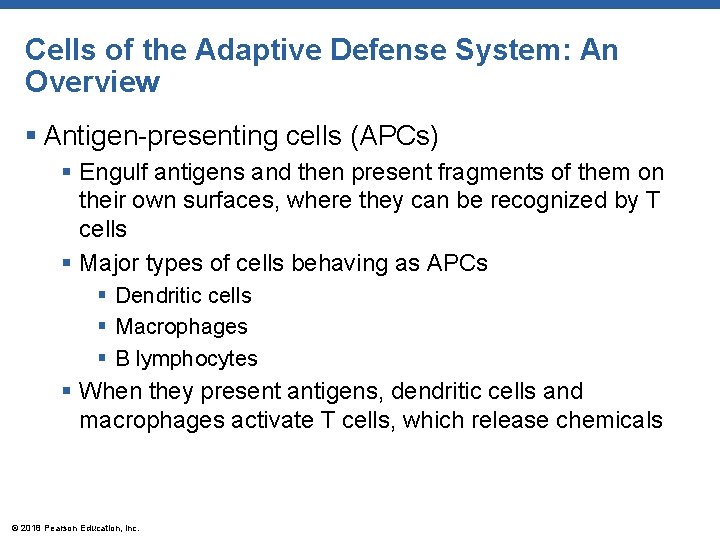
Cells of the Adaptive Defense System: An Overview § Antigen-presenting cells (APCs) § Engulf antigens and then present fragments of them on their own surfaces, where they can be recognized by T cells § Major types of cells behaving as APCs § Dendritic cells § Macrophages § B lymphocytes § When they present antigens, dendritic cells and macrophages activate T cells, which release chemicals © 2018 Pearson Education, Inc.
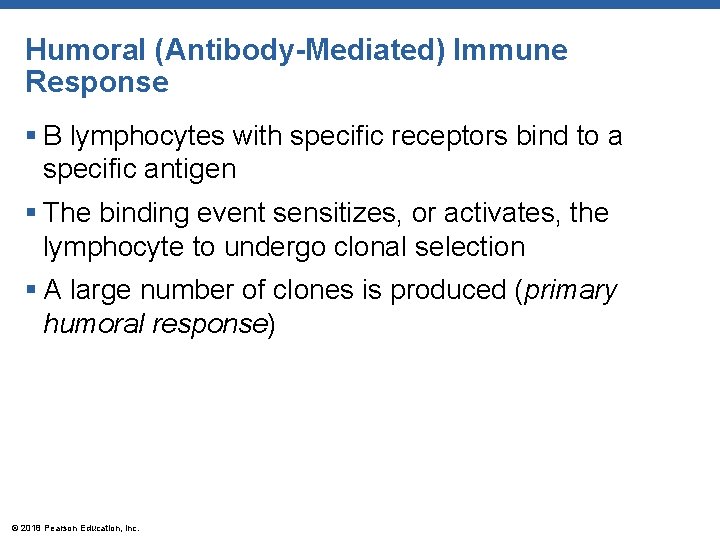
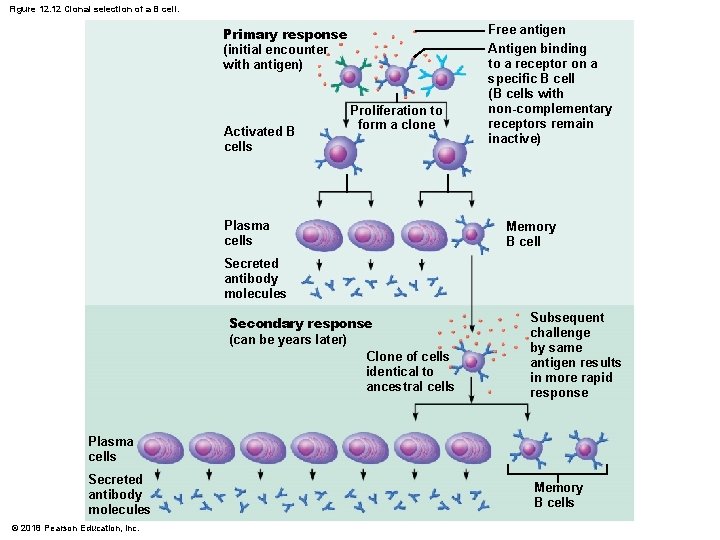
Humoral (Antibody-Mediated) Immune Response § B lymphocytes with specific receptors bind to a specific antigen § The binding event sensitizes, or activates, the lymphocyte to undergo clonal selection § A large number of clones is produced (primary humoral response) © 2018 Pearson Education, Inc.
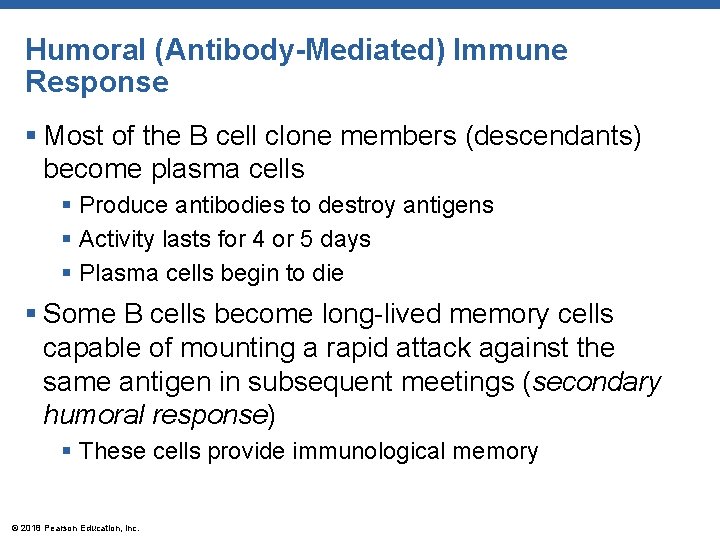
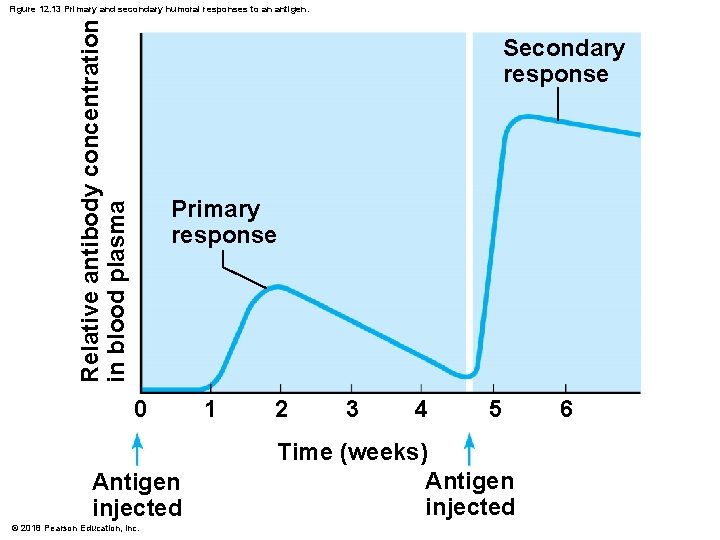
Humoral (Antibody-Mediated) Immune Response § Most of the B cell clone members (descendants) become plasma cells § Produce antibodies to destroy antigens § Activity lasts for 4 or 5 days § Plasma cells begin to die § Some B cells become long-lived memory cells capable of mounting a rapid attack against the same antigen in subsequent meetings (secondary humoral response) § These cells provide immunological memory © 2018 Pearson Education, Inc.
Figure 12. 12 Clonal selection of a B cell. Primary response (initial encounter with antigen) Activated B cells Proliferation to form a clone Plasma cells Free antigen Antigen binding to a receptor on a specific B cell (B cells with non-complementary receptors remain inactive) Memory B cell Secreted antibody molecules Secondary response (can be years later) Clone of cells identical to ancestral cells Subsequent challenge by same antigen results in more rapid response Plasma cells Secreted antibody molecules © 2018 Pearson Education, Inc. Memory B cells
Relative antibody concentration in blood plasma Figure 12. 13 Primary and secondary humoral responses to an antigen. Secondary response Primary response 0 Antigen injected © 2018 Pearson Education, Inc. 1 2 3 4 5 Time (weeks) Antigen injected 6
Humoral (Antibody-Mediated) Immune Response § Active immunity § Occurs when B cells encounter antigens and produce antibodies § Active immunity can be: § Naturally acquired during bacterial and viral infections § Artificially acquired from vaccines © 2018 Pearson Education, Inc.
Humoral (Antibody-Mediated) Immune Response § Passive immunity § Occurs when antibodies are obtained from someone else § Naturally acquired from a mother to her fetus or in the breast milk § Artificially acquired from immune serum or gamma globulin (donated antibodies) § Immunological memory does not occur § Protection is short-lived (2– 3 weeks) © 2018 Pearson Education, Inc.
Humoral (Antibody-Mediated) Immune Response § Passive immunity (continued) § Monoclonal antibodies § Antibodies prepared for clinical testing for diagnostic services § Produced from descendants of a single cell line § Exhibit specificity for only one antigen § Examples of uses for monoclonal antibodies § Cancer treatment § Diagnosis of pregnancy § Treatment after exposure to hepatitis and rabies © 2018 Pearson Education, Inc.
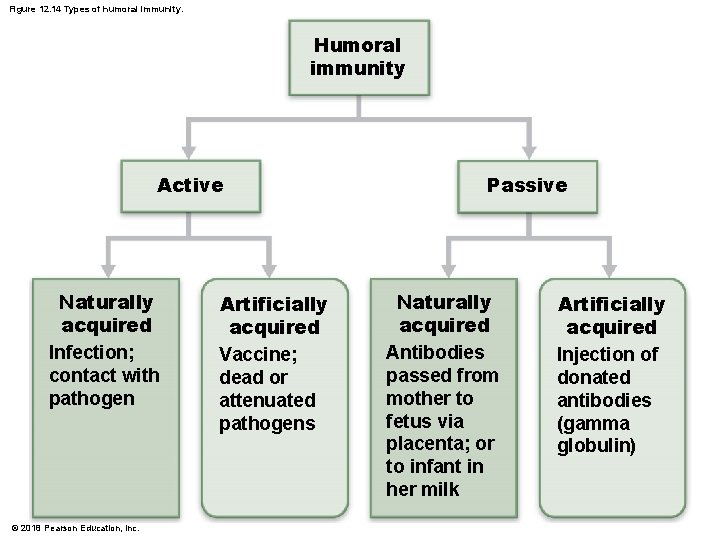
Figure 12. 14 Types of humoral immunity. Humoral immunity Active Naturally acquired Infection; contact with pathogen © 2018 Pearson Education, Inc. Artificially acquired Vaccine; dead or attenuated pathogens Passive Naturally acquired Antibodies passed from mother to fetus via placenta; or to infant in her milk Artificially acquired Injection of donated antibodies (gamma globulin)
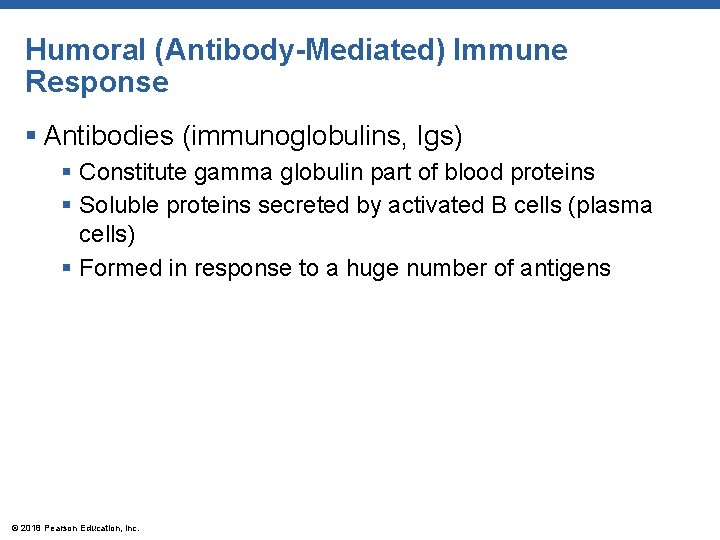
Humoral (Antibody-Mediated) Immune Response § Antibodies (immunoglobulins, Igs) § Constitute gamma globulin part of blood proteins § Soluble proteins secreted by activated B cells (plasma cells) § Formed in response to a huge number of antigens © 2018 Pearson Education, Inc.
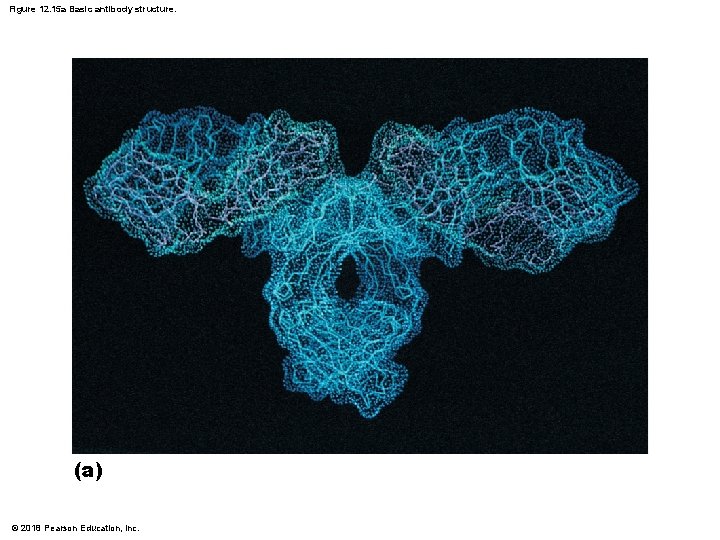
Figure 12. 15 a Basic antibody structure. (a) © 2018 Pearson Education, Inc.
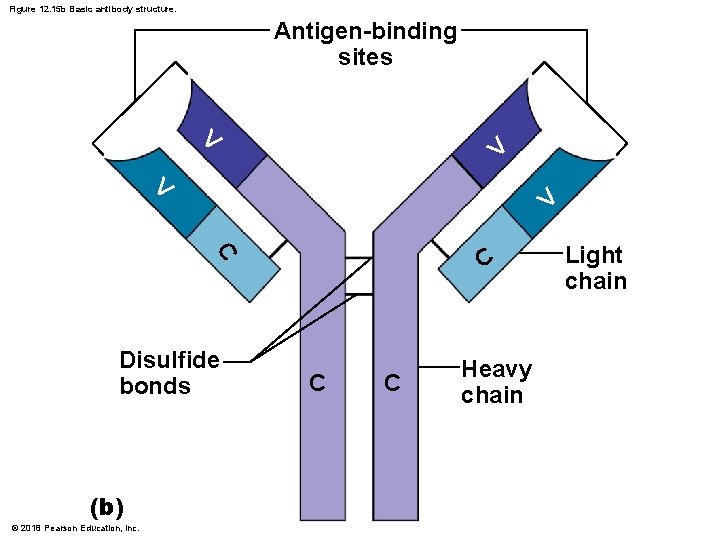
Humoral (Antibody-Mediated) Immune Response § Antibody structure § Four polypeptide chains, two heavy and two light, linked by disulfide bonds to form a T- or Y-shaped molecule § Each polypeptide chain has a variable (V) region and a constant (C) region § Variable regions form antigen-binding sites, one on each arm of the T or Y § Constant regions determine the type of antibody formed (antibody class) © 2018 Pearson Education, Inc.
Figure 12. 15 b Basic antibody structure. Antigen-binding sites V V C C Disulfide bonds (b) © 2018 Pearson Education, Inc. C C Heavy chain Light chain
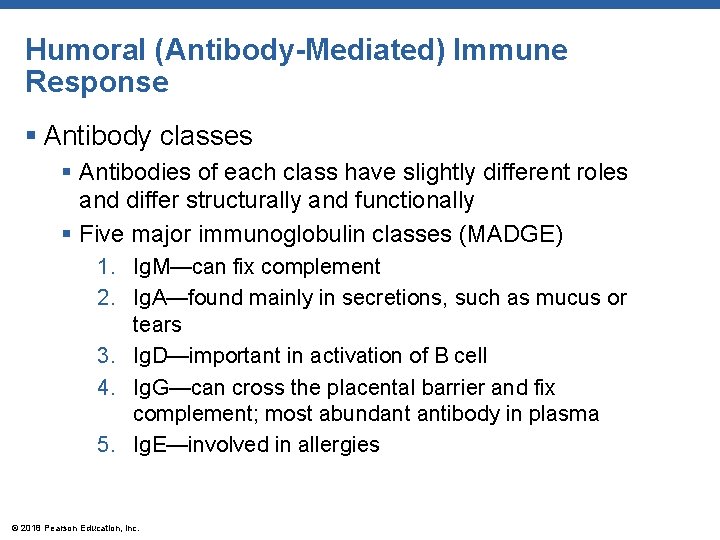
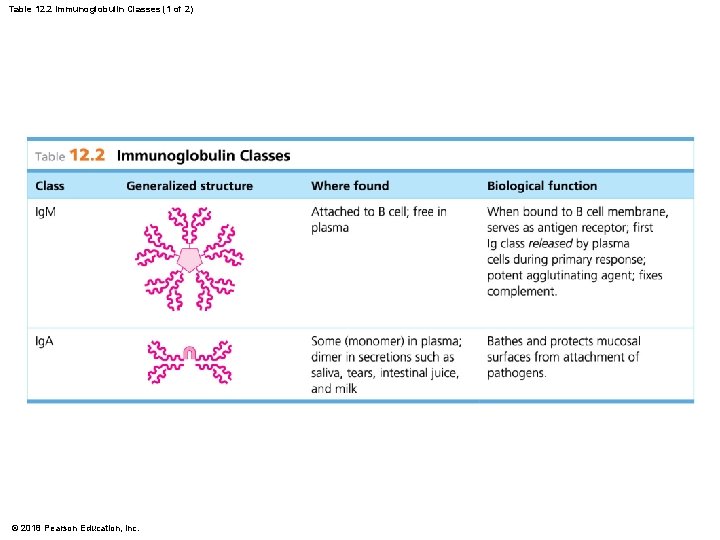
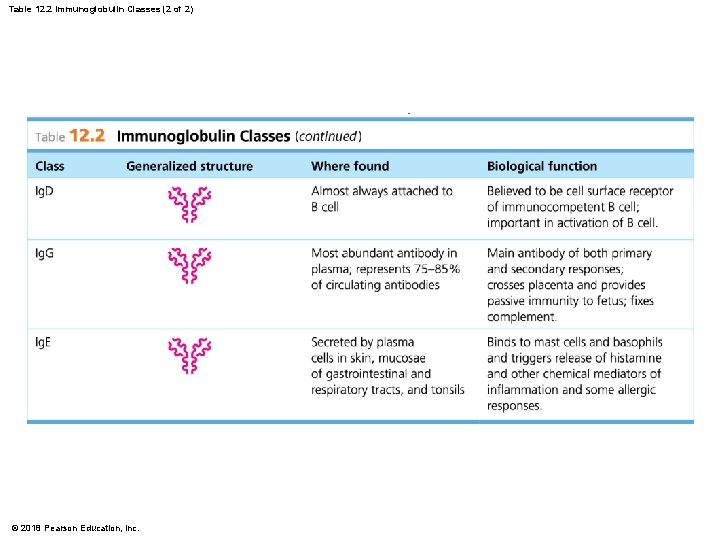
Humoral (Antibody-Mediated) Immune Response § Antibody classes § Antibodies of each class have slightly different roles and differ structurally and functionally § Five major immunoglobulin classes (MADGE) 1. Ig. M—can fix complement 2. Ig. A—found mainly in secretions, such as mucus or tears 3. Ig. D—important in activation of B cell 4. Ig. G—can cross the placental barrier and fix complement; most abundant antibody in plasma 5. Ig. E—involved in allergies © 2018 Pearson Education, Inc.
Table 12. 2 Immunoglobulin Classes (1 of 2) © 2018 Pearson Education, Inc.
Table 12. 2 Immunoglobulin Classes (2 of 2) © 2018 Pearson Education, Inc.
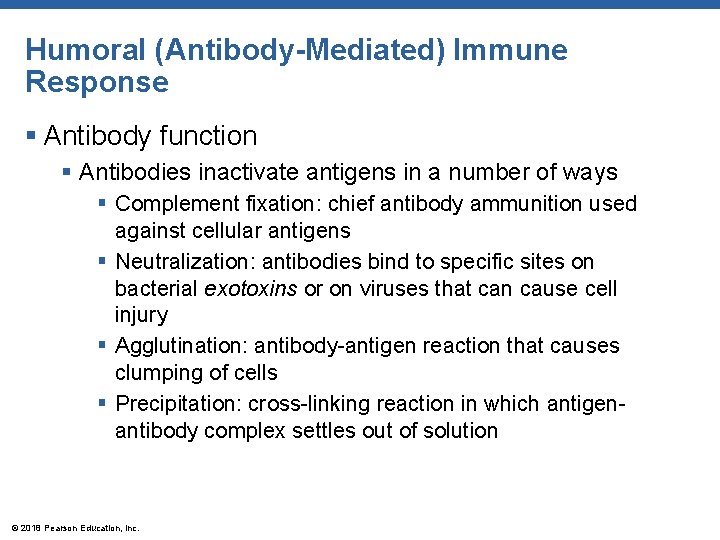
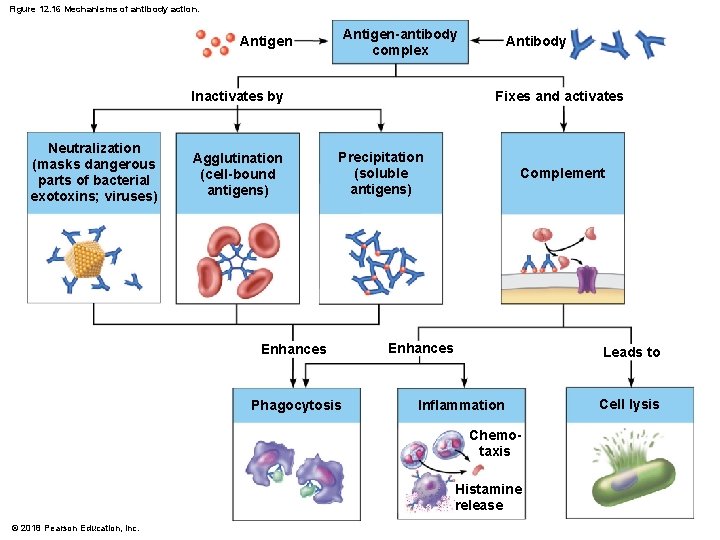
Humoral (Antibody-Mediated) Immune Response § Antibody function § Antibodies inactivate antigens in a number of ways § Complement fixation: chief antibody ammunition used against cellular antigens § Neutralization: antibodies bind to specific sites on bacterial exotoxins or on viruses that can cause cell injury § Agglutination: antibody-antigen reaction that causes clumping of cells § Precipitation: cross-linking reaction in which antigenantibody complex settles out of solution © 2018 Pearson Education, Inc.
Figure 12. 16 Mechanisms of antibody action. Antigen-antibody complex Antigen Inactivates by Neutralization (masks dangerous parts of bacterial exotoxins; viruses) Agglutination (cell-bound antigens) Antibody Fixes and activates Precipitation (soluble antigens) Enhances Phagocytosis Complement Enhances Leads to Inflammation Chemotaxis Histamine release © 2018 Pearson Education, Inc. Cell lysis
Cellular (Cell-Mediated) Immune Response § Main difference between two arms of the adaptive response § B cells secrete antibodies § T cells fight antigens directly © 2018 Pearson Education, Inc.
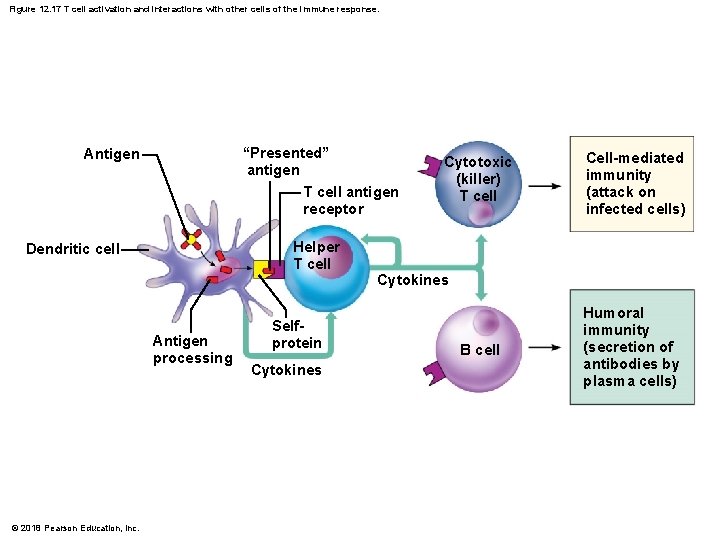
Cellular (Cell-Mediated) Immune Response § Like B cells, immunocompetent T cells are activated to form a clone by binding with a recognized antigen § Unlike B cells, T cells are unable to bind to free antigens § Antigens must be presented by a macrophage, and double recognition must occur § APC engulfs and presents the processed antigen in combination with a protein from the APC © 2018 Pearson Education, Inc.
Cellular (Cell-Mediated) Immune Response § Different classes of effector T cells § Helper T cells § Cytotoxic T cells § T cells must recognize nonself and self through the process of antigen presentation § Nonself—the antigen fragment presented by APC § Self—coupling with a specific glycoprotein on the APC’s surface at the same time © 2018 Pearson Education, Inc.
Figure 12. 17 T cell activation and interactions with other cells of the immune response. “Presented” antigen T cell antigen receptor Antigen Helper T cell Dendritic cell Antigen processing © 2018 Pearson Education, Inc. Selfprotein Cytokines Cytotoxic (killer) T cell Cell-mediated immunity (attack on infected cells) Cytokines B cell Humoral immunity (secretion of antibodies by plasma cells)
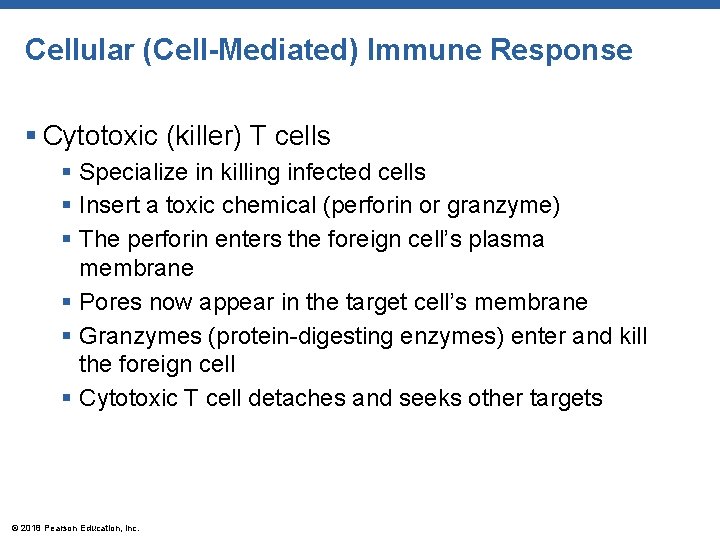
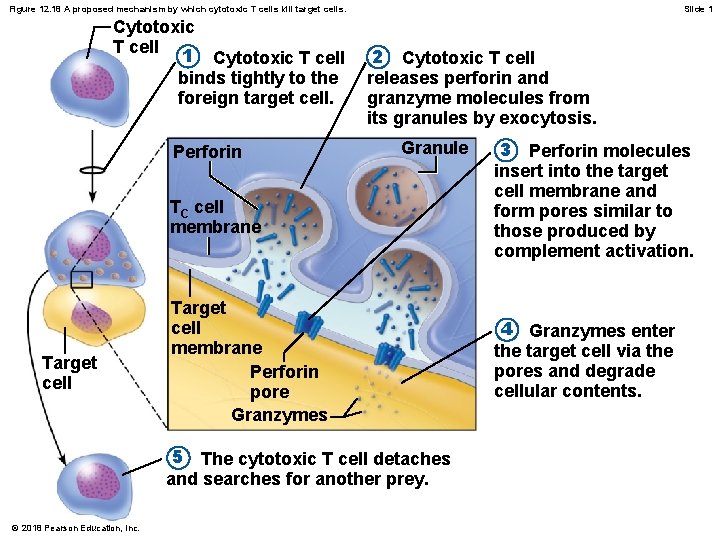
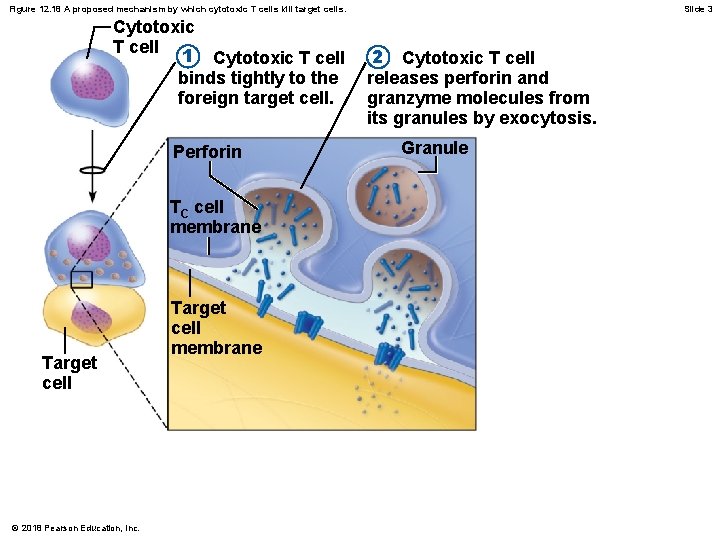
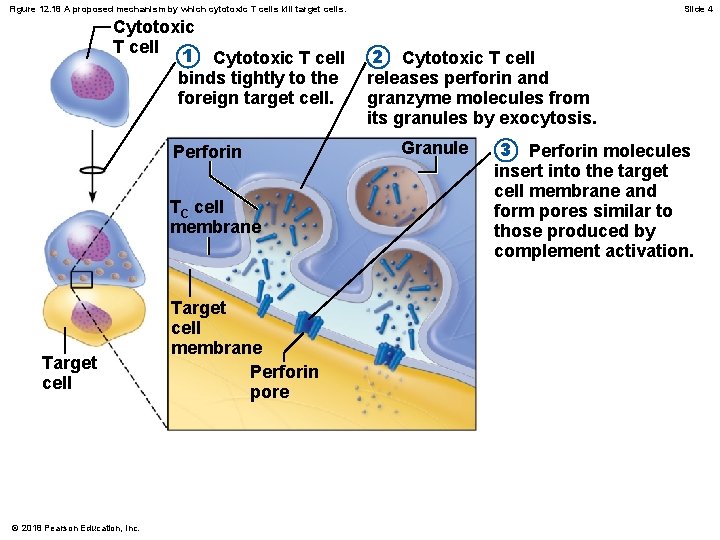
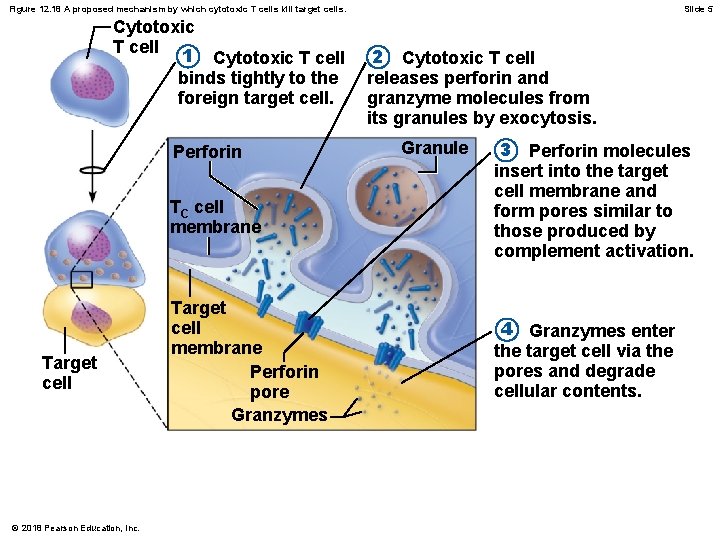
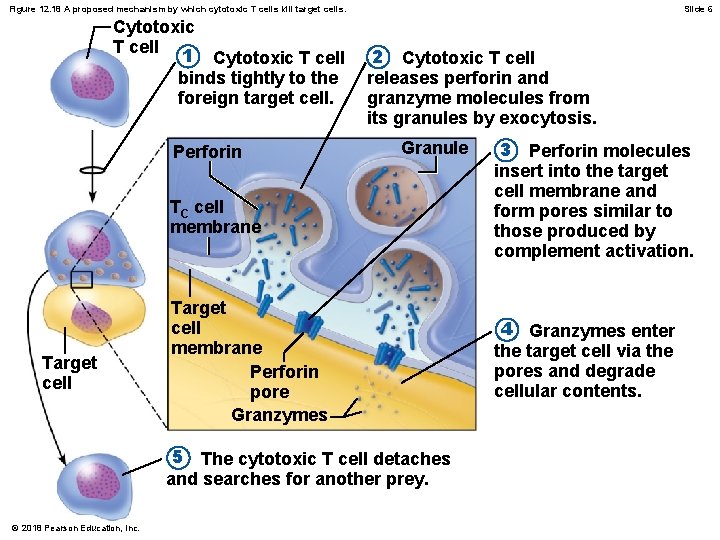
Cellular (Cell-Mediated) Immune Response § Cytotoxic (killer) T cells § Specialize in killing infected cells § Insert a toxic chemical (perforin or granzyme) § The perforin enters the foreign cell’s plasma membrane § Pores now appear in the target cell’s membrane § Granzymes (protein-digesting enzymes) enter and kill the foreign cell § Cytotoxic T cell detaches and seeks other targets © 2018 Pearson Education, Inc.
Figure 12. 18 A proposed mechanism by which cytotoxic T cells kill target cells. Cytotoxic T cell 1 Cytotoxic T cell binds tightly to the foreign target cell. Perforin Slide 1 2 Cytotoxic T cell releases perforin and granzyme molecules from its granules by exocytosis. Granule TC cell membrane Target cell membrane Perforin pore Granzymes 5 The cytotoxic T cell detaches and searches for another prey. © 2018 Pearson Education, Inc. 3 Perforin molecules insert into the target cell membrane and form pores similar to those produced by complement activation. 4 Granzymes enter the target cell via the pores and degrade cellular contents.
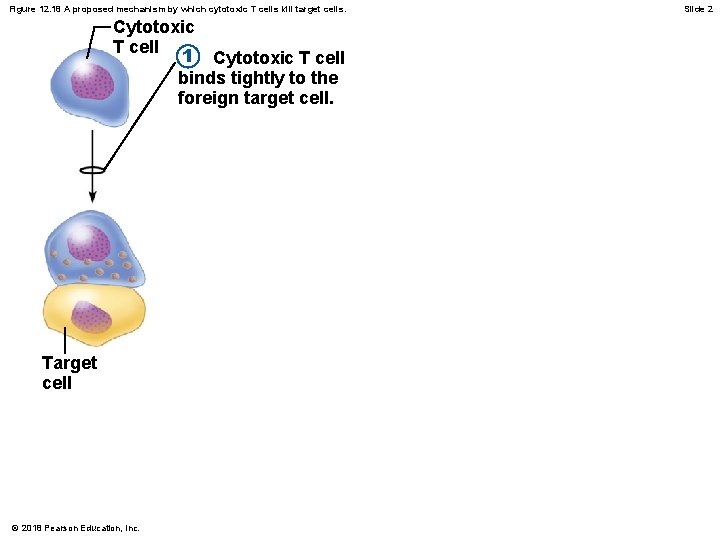
Figure 12. 18 A proposed mechanism by which cytotoxic T cells kill target cells. Cytotoxic T cell 1 Cytotoxic T cell binds tightly to the foreign target cell. Target cell © 2018 Pearson Education, Inc. Slide 2
Figure 12. 18 A proposed mechanism by which cytotoxic T cells kill target cells. Cytotoxic T cell 1 Cytotoxic T cell binds tightly to the foreign target cell. Perforin TC cell membrane Target cell © 2018 Pearson Education, Inc. Target cell membrane Slide 3 2 Cytotoxic T cell releases perforin and granzyme molecules from its granules by exocytosis. Granule
Figure 12. 18 A proposed mechanism by which cytotoxic T cells kill target cells. Cytotoxic T cell 1 Cytotoxic T cell binds tightly to the foreign target cell. Perforin TC cell membrane Target cell © 2018 Pearson Education, Inc. Target cell membrane Perforin pore Slide 4 2 Cytotoxic T cell releases perforin and granzyme molecules from its granules by exocytosis. Granule 3 Perforin molecules insert into the target cell membrane and form pores similar to those produced by complement activation.
Figure 12. 18 A proposed mechanism by which cytotoxic T cells kill target cells. Cytotoxic T cell 1 Cytotoxic T cell binds tightly to the foreign target cell. Perforin TC cell membrane Target cell © 2018 Pearson Education, Inc. Target cell membrane Perforin pore Granzymes Slide 5 2 Cytotoxic T cell releases perforin and granzyme molecules from its granules by exocytosis. Granule 3 Perforin molecules insert into the target cell membrane and form pores similar to those produced by complement activation. 4 Granzymes enter the target cell via the pores and degrade cellular contents.
Figure 12. 18 A proposed mechanism by which cytotoxic T cells kill target cells. Cytotoxic T cell 1 Cytotoxic T cell binds tightly to the foreign target cell. Perforin Slide 6 2 Cytotoxic T cell releases perforin and granzyme molecules from its granules by exocytosis. Granule TC cell membrane Target cell membrane Perforin pore Granzymes 5 The cytotoxic T cell detaches and searches for another prey. © 2018 Pearson Education, Inc. 3 Perforin molecules insert into the target cell membrane and form pores similar to those produced by complement activation. 4 Granzymes enter the target cell via the pores and degrade cellular contents.
Cellular (Cell-Mediated) Immune Response § Helper T cells § Recruit other cells to fight invaders § Interact directly with B cells bound to an antigen, prodding the B cells into clone production § Release cytokines, chemicals that act directly to rid the body of antigens © 2018 Pearson Education, Inc.
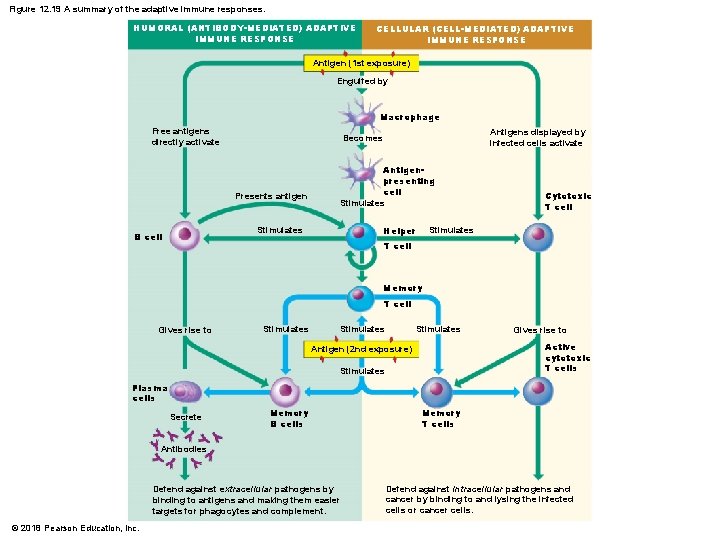
Cellular (Cell-Mediated) Immune Response § Regulatory T cells § Release chemicals to suppress the activity of T and B cells § Stop the immune response to prevent uncontrolled activity § A few members of each clone are memory cells § A summary of cells and molecules follows (Figure 12. 19) © 2018 Pearson Education, Inc.
Figure 12. 19 A summary of the adaptive immune responses. HUMORAL (ANTIBODY-MEDIATED) ADAPTIVE IMMUNE RESPONSE CELLULAR (CELL-MEDIATED) ADAPTIVE IMMUNE RESPONSE Antigen (1 st exposure) Engulfed by Macrophage Free antigens directly activate Presents antigen Antigenpresenting cell Stimulates Helper Stimulates B cell Antigens displayed by infected cells activate Becomes Cytotoxic T cell Stimulates T cell Memory T cell Gives rise to Stimulates Gives rise to Active cytotoxic T cells Antigen (2 nd exposure) Stimulates Plasma cells Secrete Memory B cells Memory T cells Antibodies Defend against extracellular pathogens by binding to antigens and making them easier targets for phagocytes and complement. © 2018 Pearson Education, Inc. Defend against intracellular pathogens and cancer by binding to and lysing the infected cells or cancer cells.
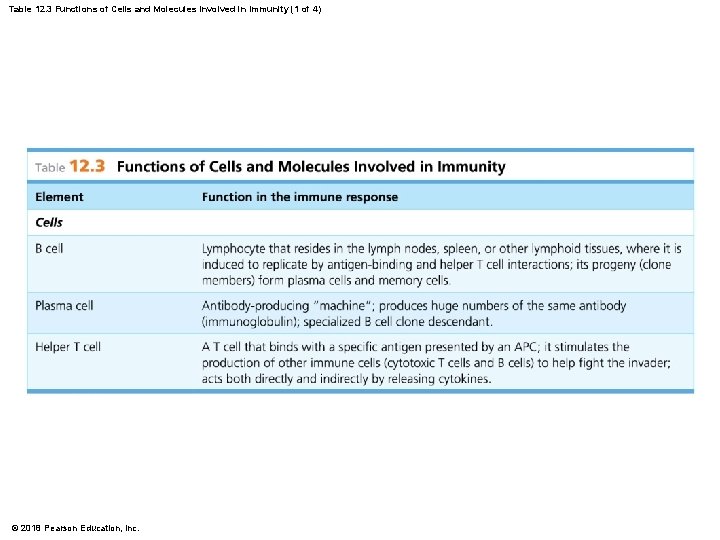
Table 12. 3 Functions of Cells and Molecules Involved in Immunity (1 of 4) © 2018 Pearson Education, Inc.
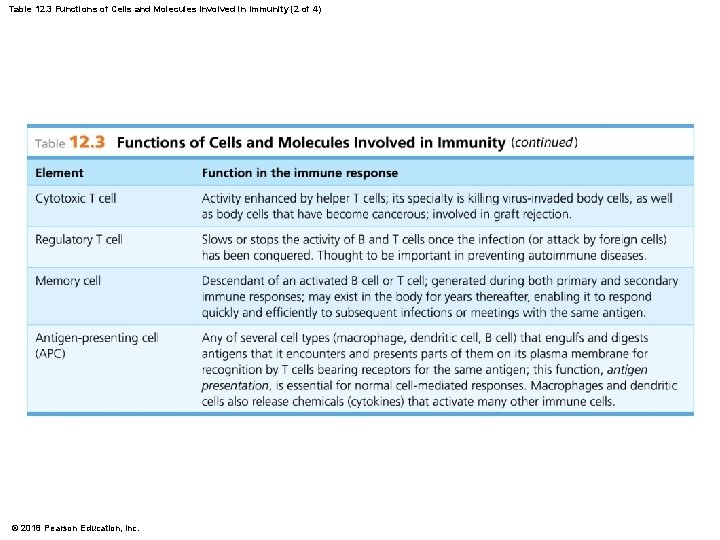
Table 12. 3 Functions of Cells and Molecules Involved in Immunity (2 of 4) © 2018 Pearson Education, Inc.
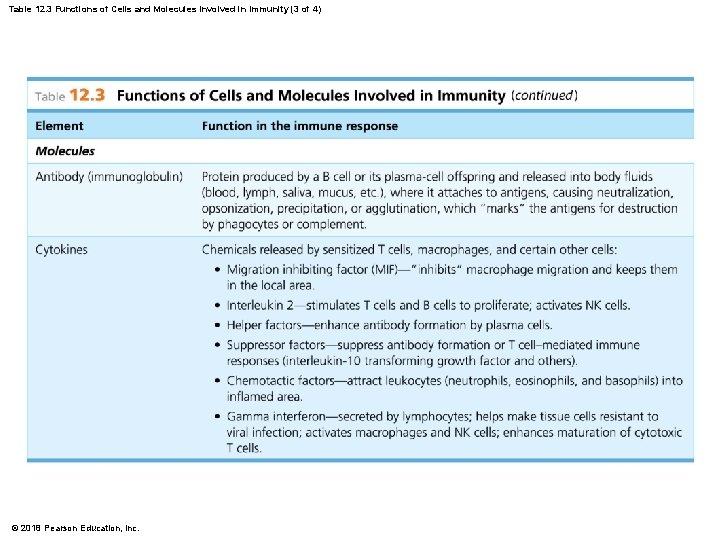
Table 12. 3 Functions of Cells and Molecules Involved in Immunity (3 of 4) © 2018 Pearson Education, Inc.
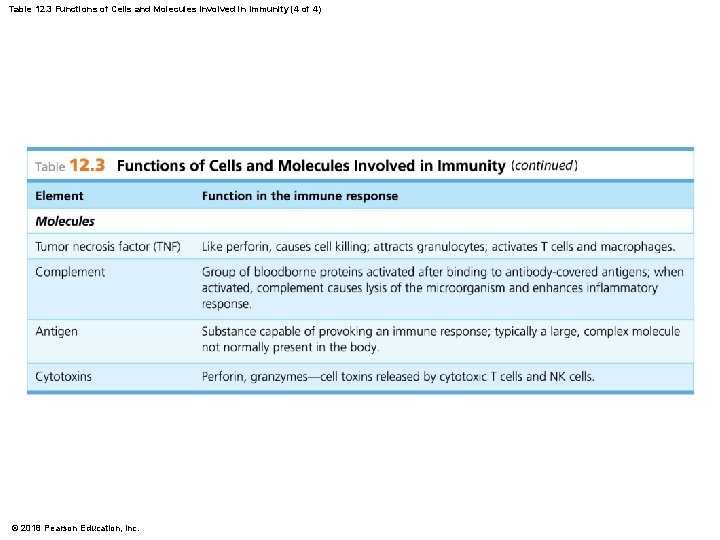
Table 12. 3 Functions of Cells and Molecules Involved in Immunity (4 of 4) © 2018 Pearson Education, Inc.
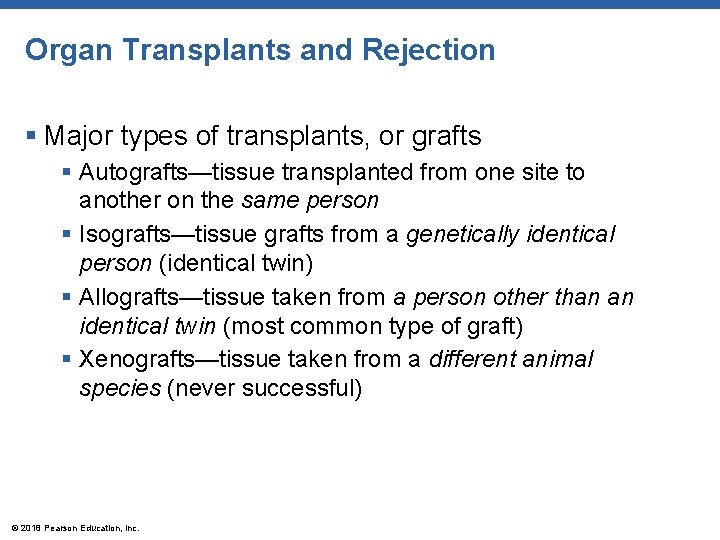
Organ Transplants and Rejection § Major types of transplants, or grafts § Autografts—tissue transplanted from one site to another on the same person § Isografts—tissue grafts from a genetically identical person (identical twin) § Allografts—tissue taken from a person other than an identical twin (most common type of graft) § Xenografts—tissue taken from a different animal species (never successful) © 2018 Pearson Education, Inc.
Organ Transplants and Rejection § Blood group and tissue matching is done to ensure the best match possible § 75% match is needed to attempt a graft § Organ transplant is followed by immunosuppressive therapy to prevent rejection © 2018 Pearson Education, Inc.
Disorders of Immunity § The most important disorders of the immune system § Allergies § Autoimmune diseases § Immunodeficiencies © 2018 Pearson Education, Inc.
Disorders of Immunity § Allergies, or hypersensitives, are abnormal, vigorous immune responses § The immune system overreacts to an otherwise harmless antigen, and tissue damage occurs © 2018 Pearson Education, Inc.
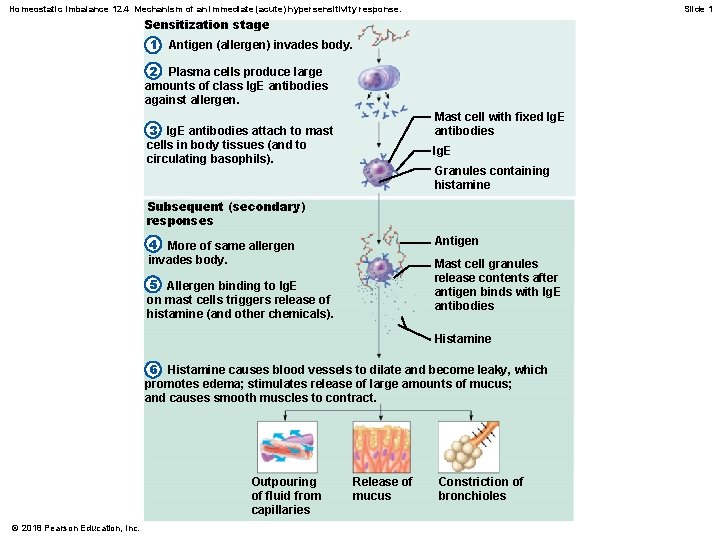
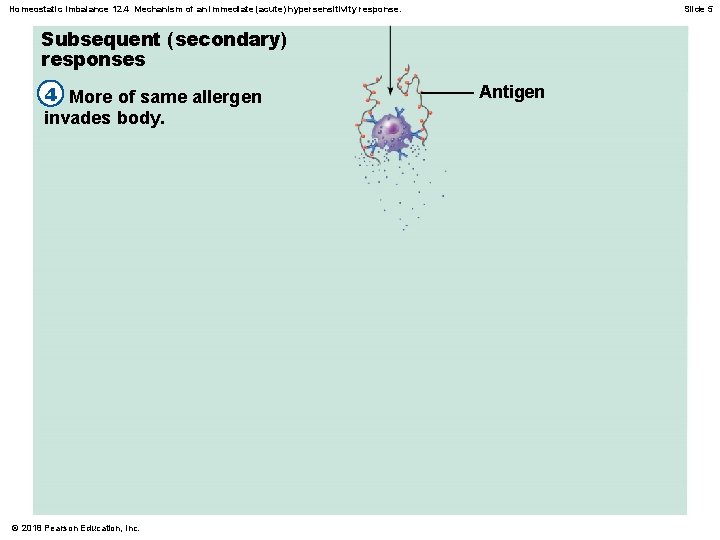
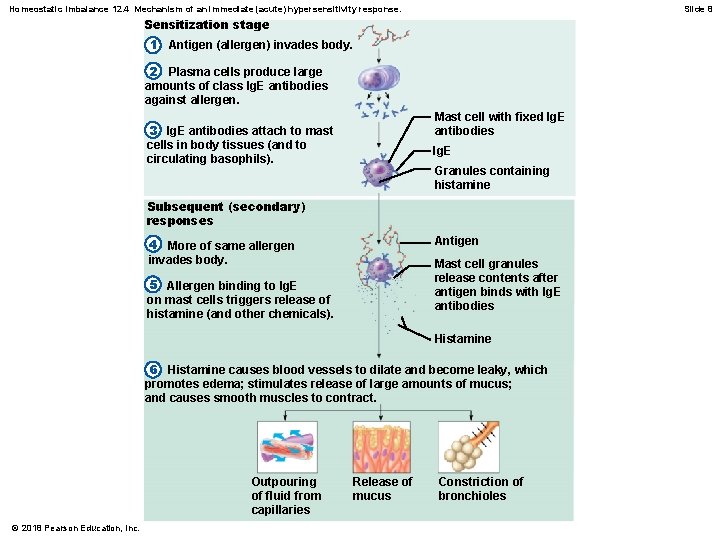
Disorders of Immunity § Types of allergies § Immediate (acute) hypersensitivity § Seen in hives and anaphylaxis § Due to Ig. E antibodies and histamine § Anaphylactic shock is systemic, acute allergic response and is rare § Delayed hypersensitivity § Reflects activity of T cells, macrophages, and cytokines § Symptoms usually appear 1– 3 days after contact with antigen § Allergic contact dermatitis (poison ivy, cosmetics) © 2018 Pearson Education, Inc.
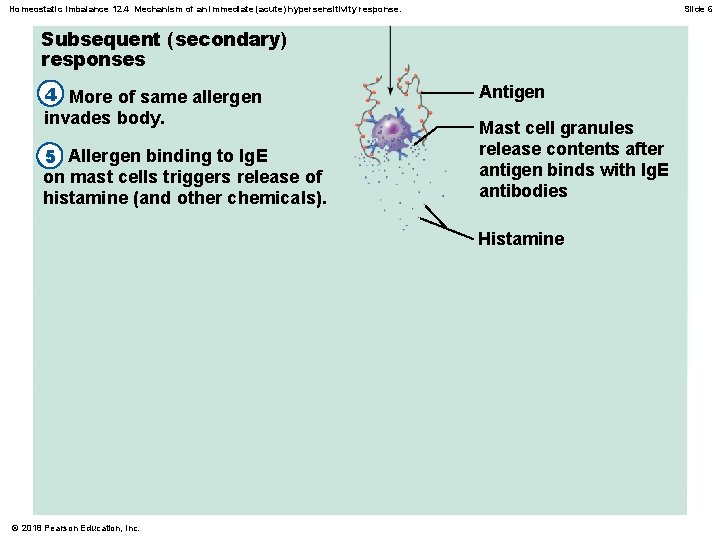
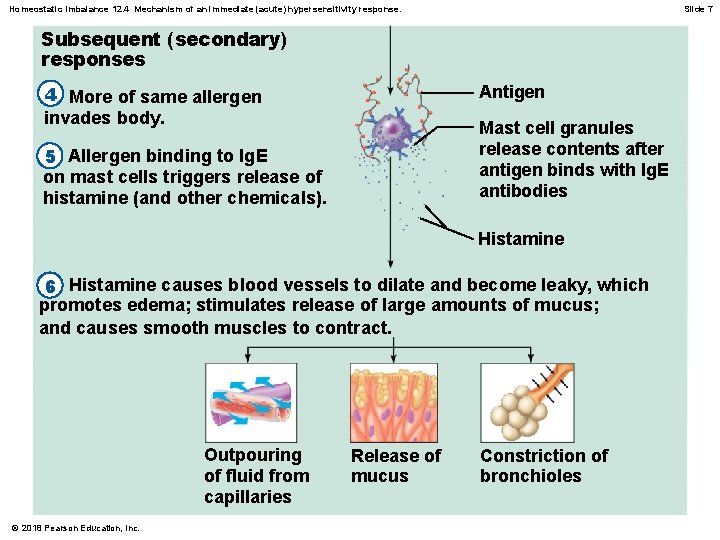
Homeostatic Imbalance 12. 4 Mechanism of an immediate (acute) hypersensitivity response. Slide 1 Sensitization stage 1 Antigen (allergen) invades body. 2 Plasma cells produce large amounts of class Ig. E antibodies against allergen. Mast cell with fixed Ig. E antibodies 3 Ig. E antibodies attach to mast cells in body tissues (and to circulating basophils). Ig. E Granules containing histamine Subsequent (secondary) responses Antigen 4 More of same allergen invades body. Mast cell granules release contents after antigen binds with Ig. E antibodies 5 Allergen binding to Ig. E on mast cells triggers release of histamine (and other chemicals). Histamine 6 Histamine causes blood vessels to dilate and become leaky, which promotes edema; stimulates release of large amounts of mucus; and causes smooth muscles to contract. Outpouring of fluid from capillaries © 2018 Pearson Education, Inc. Release of mucus Constriction of bronchioles
Homeostatic Imbalance 12. 4 Mechanism of an immediate (acute) hypersensitivity response. Sensitization stage 1 Antigen (allergen) invades body. © 2018 Pearson Education, Inc. Slide 2
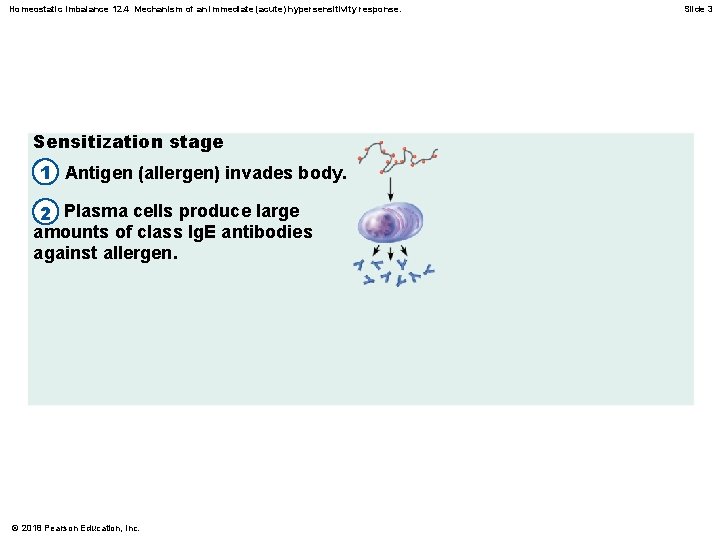
Homeostatic Imbalance 12. 4 Mechanism of an immediate (acute) hypersensitivity response. Sensitization stage 1 Antigen (allergen) invades body. 2 Plasma cells produce large amounts of class Ig. E antibodies against allergen. © 2018 Pearson Education, Inc. Slide 3
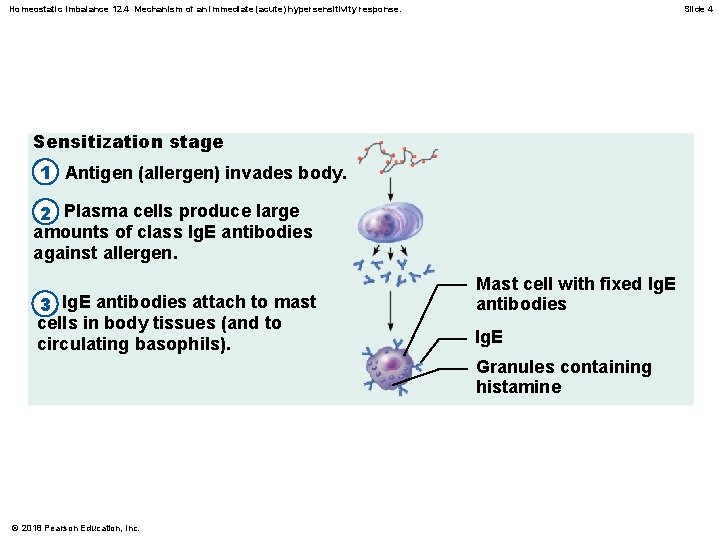
Homeostatic Imbalance 12. 4 Mechanism of an immediate (acute) hypersensitivity response. Slide 4 Sensitization stage 1 Antigen (allergen) invades body. 2 Plasma cells produce large amounts of class Ig. E antibodies against allergen. 3 Ig. E antibodies attach to mast cells in body tissues (and to circulating basophils). Mast cell with fixed Ig. E antibodies Ig. E Granules containing histamine © 2018 Pearson Education, Inc.
Homeostatic Imbalance 12. 4 Mechanism of an immediate (acute) hypersensitivity response. Slide 5 Subsequent (secondary) responses 4 More of same allergen invades body. © 2018 Pearson Education, Inc. Antigen
Homeostatic Imbalance 12. 4 Mechanism of an immediate (acute) hypersensitivity response. Slide 6 Subsequent (secondary) responses 4 More of same allergen invades body. 5 Allergen binding to Ig. E on mast cells triggers release of histamine (and other chemicals). Antigen Mast cell granules release contents after antigen binds with Ig. E antibodies Histamine © 2018 Pearson Education, Inc.
Homeostatic Imbalance 12. 4 Mechanism of an immediate (acute) hypersensitivity response. Slide 7 Subsequent (secondary) responses 4 More of same allergen invades body. Antigen Mast cell granules release contents after antigen binds with Ig. E antibodies 5 Allergen binding to Ig. E on mast cells triggers release of histamine (and other chemicals). Histamine 6 Histamine causes blood vessels to dilate and become leaky, which promotes edema; stimulates release of large amounts of mucus; and causes smooth muscles to contract. Outpouring of fluid from capillaries © 2018 Pearson Education, Inc. Release of mucus Constriction of bronchioles
Homeostatic Imbalance 12. 4 Mechanism of an immediate (acute) hypersensitivity response. Slide 8 Sensitization stage 1 Antigen (allergen) invades body. 2 Plasma cells produce large amounts of class Ig. E antibodies against allergen. Mast cell with fixed Ig. E antibodies 3 Ig. E antibodies attach to mast cells in body tissues (and to circulating basophils). Ig. E Granules containing histamine Subsequent (secondary) responses Antigen 4 More of same allergen invades body. Mast cell granules release contents after antigen binds with Ig. E antibodies 5 Allergen binding to Ig. E on mast cells triggers release of histamine (and other chemicals). Histamine 6 Histamine causes blood vessels to dilate and become leaky, which promotes edema; stimulates release of large amounts of mucus; and causes smooth muscles to contract. Outpouring of fluid from capillaries © 2018 Pearson Education, Inc. Release of mucus Constriction of bronchioles
Disorders of Immunity § Autoimmune diseases § Occurs when the body’s self-tolerance breaks down § The body produces auto-antibodies and sensitized T lymphocytes that attack its own tissues § Most forms of autoimmune disease result from the appearance of formerly hidden self-antigens or changes in the structure of self-antigens, and antibodies formed against foreign antigens that resemble self-antigens © 2018 Pearson Education, Inc.
Disorders of Immunity § Examples of autoimmune diseases § Rheumatoid arthritis—destroys joints § Myasthenia gravis—impairs communication between nerves and skeletal muscles § Multiple sclerosis—white matter of brain and spinal cord is destroyed § Graves’ disease—thyroid gland produces excess thyroxine © 2018 Pearson Education, Inc.
Disorders of Immunity § Examples of autoimmune diseases (continued) § Type I diabetes mellitus—destroys pancreatic beta cells, resulting in deficient insulin production § Systemic lupus erythematosus (SLE)—affects kidney, heart, lung, and skin § Glomerulonephritis—severe impairment of kidney function due to acute inflammation © 2018 Pearson Education, Inc.
Autoimmune Disease § Immunodeficiencies § May be congenital or acquired § Severe combined immunodeficiency disease (SCID) is a congenital disease § AIDS (acquired immune deficiency syndrome) is caused by a virus that attacks and cripples the helper T cells § Result from abnormalities in any immune element § Production or function of immune cells or complement is abnormal © 2018 Pearson Education, Inc.
Part III: Developmental Aspects of the Lymphatic System and Body Defenses § Lymphatic vessels form by budding off from veins § Lymph nodes present by fifth week of development § The thymus and the spleen are the first lymphoid organs to appear in the embryo § Other lymphoid organs are poorly developed before birth § The immune response develops around the time of birth © 2018 Pearson Education, Inc.
Part III: Developmental Aspects of the Lymphatic System and Body Defenses § The ability of immunocompetent cells to recognize foreign antigens is genetically determined § Stress appears to interfere with normal immune response § Efficiency of immune response wanes in old age, and infections, cancer, immunodeficiencies, and autoimmune diseases become more prevalent © 2018 Pearson Education, Inc.