
Lymphadenectomy in gastric adenocarcinoma Joint Hospital Surgical Grand

- Slides: 28
Lymphadenectomy in gastric adenocarcinoma Joint Hospital Surgical Grand Round 25 July 2009 Dr. David KW Leung Tseung Kwan O Hospital
Outline Introduction Lymphadenectomy Principle Definition and extent Literature review Conclusion
Introduction One of the most common cancers in the world Highest incidences in Eastern Asia (Japan and Korea) (70 per 100, 000), Southern & Central America, Eastern Europe (40 per 100, 000)
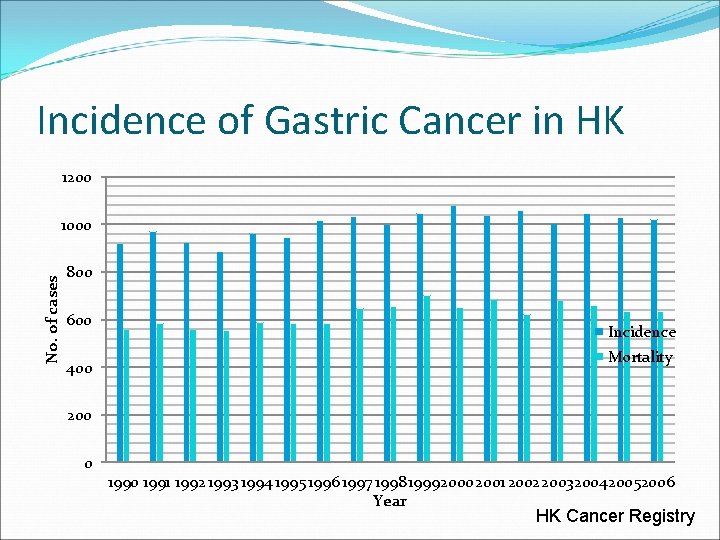
Incidence of Gastric Cancer in HK 1200 No. of cases 1000 800 600 400 Incidence Mortality 200 0 1991 1992 1993 1994 1995 1996 1997 1998 199920002001 20022003200420052006 Year HK Cancer Registry
Treatment - Surgery Adequate surgical resection offers best chance of cure or long term survival Principles Resection with adequate tumor-free margin (~5 cm) Subtotal/ total gastrectomy Regional lymph node clearance corresponding to the location of the primary tumor Safe and well-functioning anastomosis
Lymphadenectomy principles Lymph node metastasis is the commonest mode of spread Gastric cancer with regional LN involvement considered as localized disease in the absence of haematogenous spread Adequate lymphadenectomy can be curative
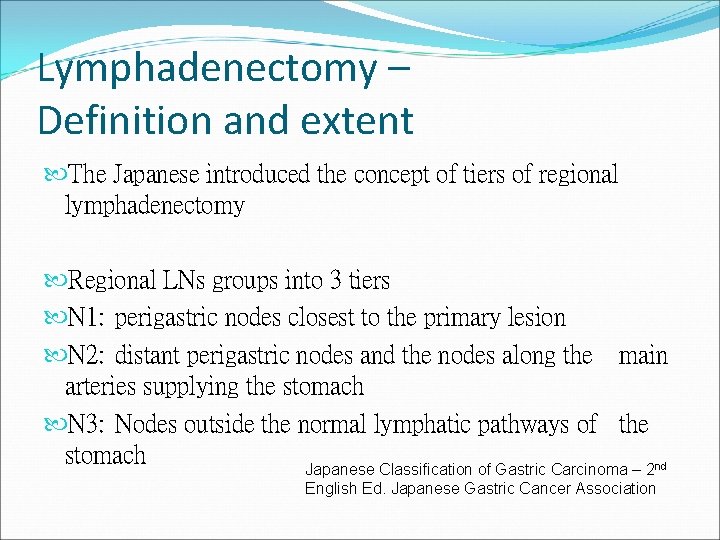
Lymphadenectomy – Definition and extent The Japanese introduced the concept of tiers of regional lymphadenectomy Regional LNs groups into 3 tiers N 1: perigastric nodes closest to the primary lesion N 2: distant perigastric nodes and the nodes along the main arteries supplying the stomach N 3: Nodes outside the normal lymphatic pathways of the stomach nd Japanese Classification of Gastric Carcinoma – 2 English Ed. Japanese Gastric Cancer Association
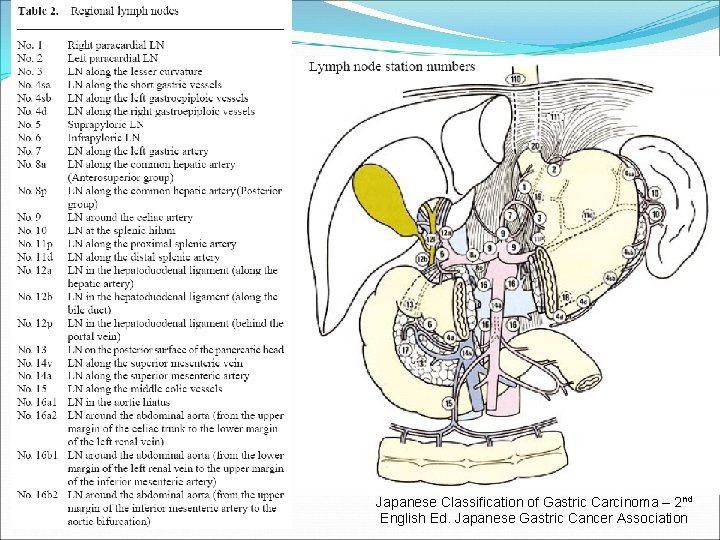
Japanese Classification of Gastric Carcinoma – 2 nd English Ed. Japanese Gastric Cancer Association
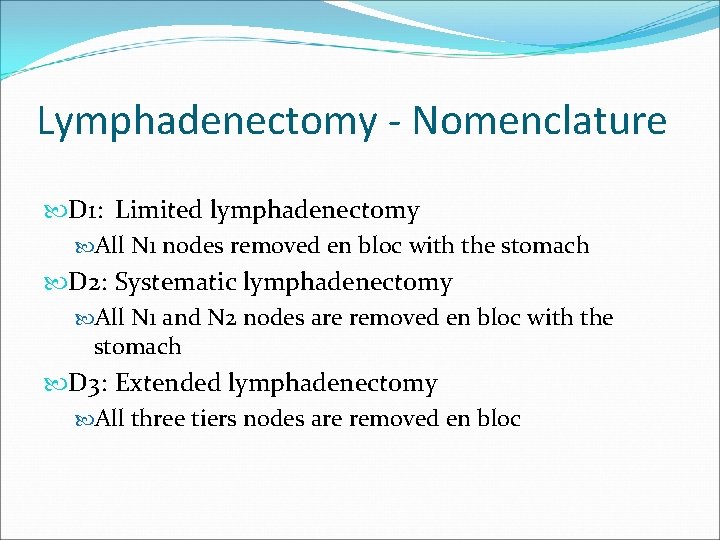
Lymphadenectomy - Nomenclature D 1: Limited lymphadenectomy All N 1 nodes removed en bloc with the stomach D 2: Systematic lymphadenectomy All N 1 and N 2 nodes are removed en bloc with the stomach D 3: Extended lymphadenectomy All three tiers nodes are removed en bloc
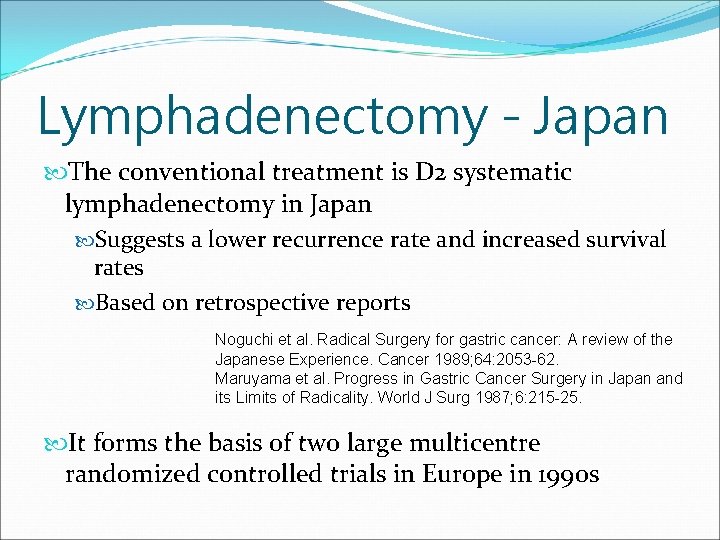
Lymphadenectomy - Japan The conventional treatment is D 2 systematic lymphadenectomy in Japan Suggests a lower recurrence rate and increased survival rates Based on retrospective reports Noguchi et al. Radical Surgery for gastric cancer: A review of the Japanese Experience. Cancer 1989; 64: 2053 -62. Maruyama et al. Progress in Gastric Cancer Surgery in Japan and its Limits of Radicality. World J Surg 1987; 6: 215 -25. It forms the basis of two large multicentre randomized controlled trials in Europe in 1990 s
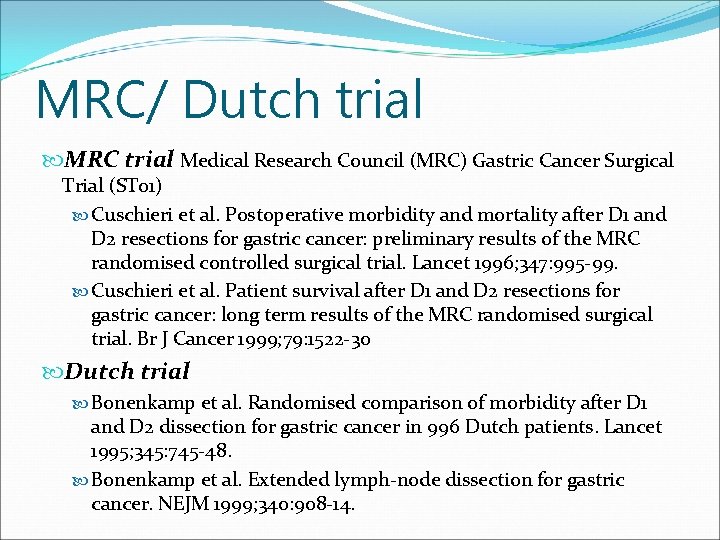
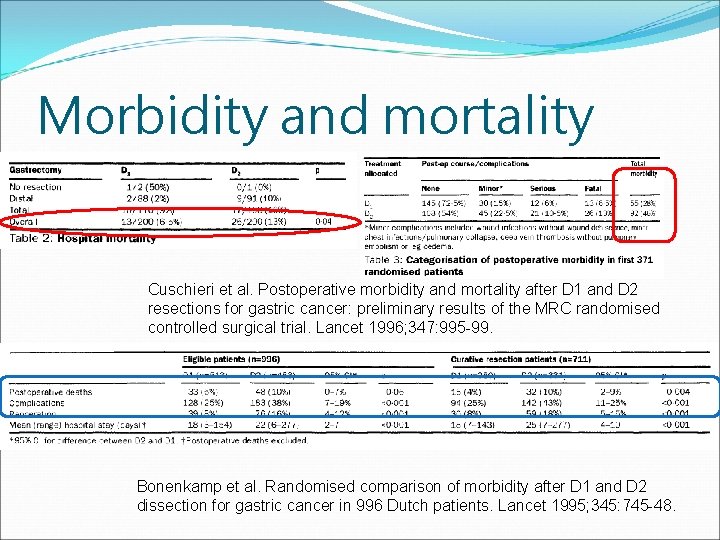
MRC/ Dutch trial MRC trial Medical Research Council (MRC) Gastric Cancer Surgical Trial (ST 01) Cuschieri et al. Postoperative morbidity and mortality after D 1 and D 2 resections for gastric cancer: preliminary results of the MRC randomised controlled surgical trial. Lancet 1996; 347: 995 -99. Cuschieri et al. Patient survival after D 1 and D 2 resections for gastric cancer: long term results of the MRC randomised surgical trial. Br J Cancer 1999; 79: 1522 -30 Dutch trial Bonenkamp et al. Randomised comparison of morbidity after D 1 and D 2 dissection for gastric cancer in 996 Dutch patients. Lancet 1995; 345: 745 -48. Bonenkamp et al. Extended lymph-node dissection for gastric cancer. NEJM 1999; 340: 908 -14.
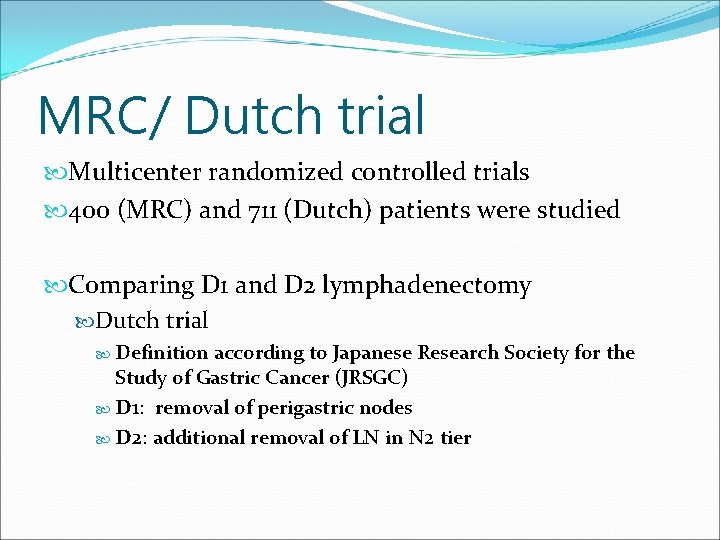
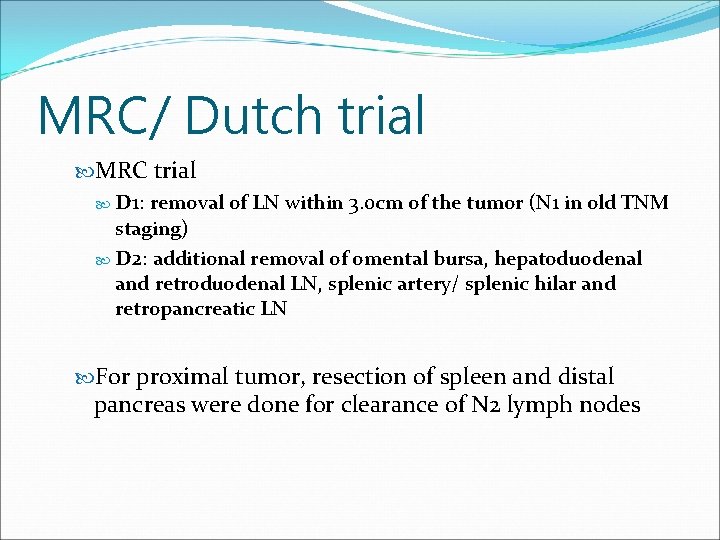
MRC/ Dutch trial Multicenter randomized controlled trials 400 (MRC) and 711 (Dutch) patients were studied Comparing D 1 and D 2 lymphadenectomy Dutch trial Definition according to Japanese Research Society for the Study of Gastric Cancer (JRSGC) D 1: removal of perigastric nodes D 2: additional removal of LN in N 2 tier
MRC/ Dutch trial MRC trial D 1: removal of LN within 3. 0 cm of the tumor (N 1 in old TNM staging) D 2: additional removal of omental bursa, hepatoduodenal and retroduodenal LN, splenic artery/ splenic hilar and retropancreatic LN For proximal tumor, resection of spleen and distal pancreas were done for clearance of N 2 lymph nodes
Morbidity and mortality Cuschieri et al. Postoperative morbidity and mortality after D 1 and D 2 resections for gastric cancer: preliminary results of the MRC randomised controlled surgical trial. Lancet 1996; 347: 995 -99. Bonenkamp et al. Randomised comparison of morbidity after D 1 and D 2 dissection for gastric cancer in 996 Dutch patients. Lancet 1995; 345: 745 -48.
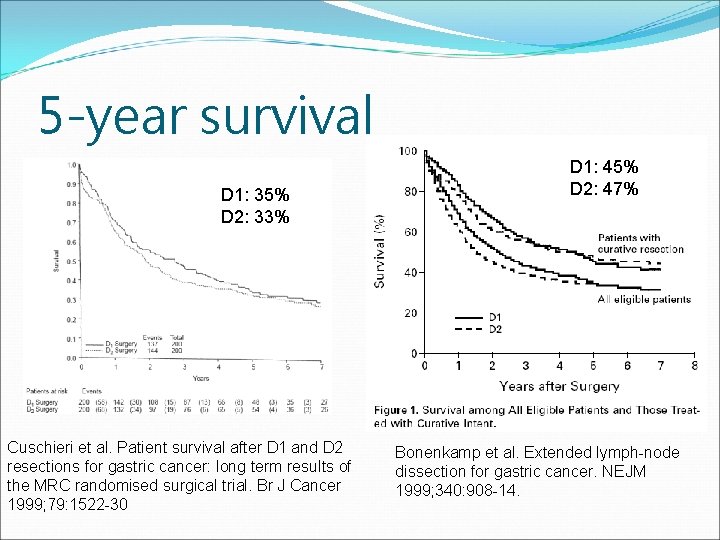
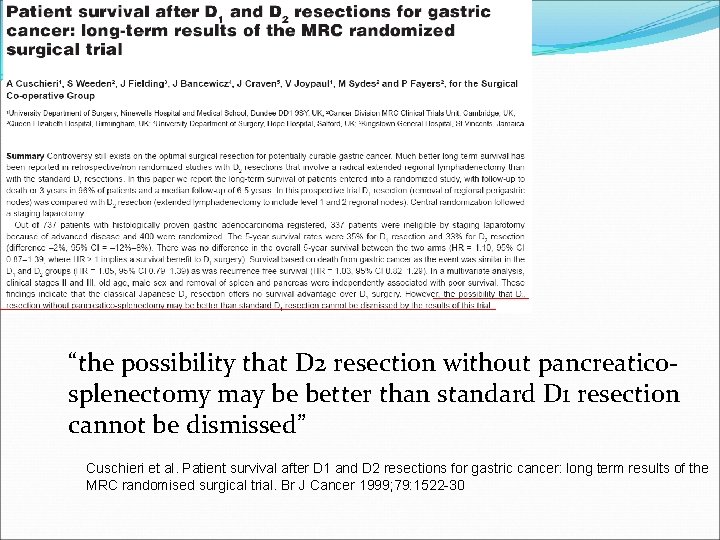
5 -year survival D 1: 35% D 2: 33% Cuschieri et al. Patient survival after D 1 and D 2 resections for gastric cancer: long term results of the MRC randomised surgical trial. Br J Cancer 1999; 79: 1522 -30 D 1: 45% D 2: 47% Bonenkamp et al. Extended lymph-node dissection for gastric cancer. NEJM 1999; 340: 908 -14.
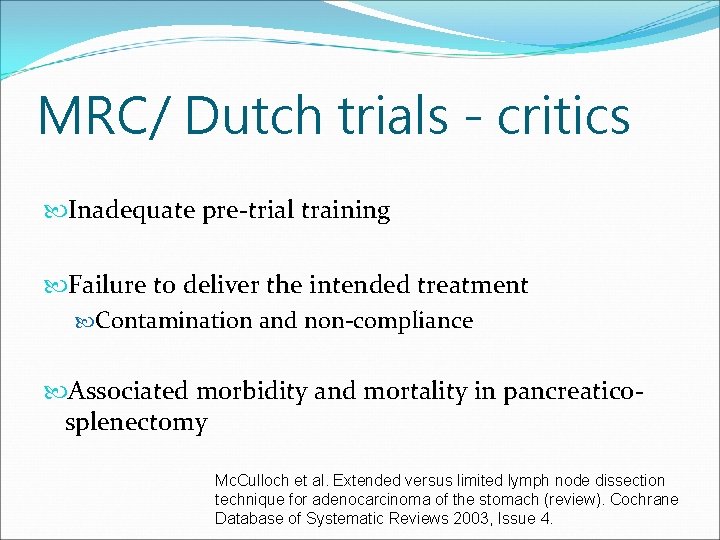
MRC/ Dutch trials - critics Inadequate pre-trial training Failure to deliver the intended treatment Contamination and non-compliance Associated morbidity and mortality in pancreaticosplenectomy Mc. Culloch et al. Extended versus limited lymph node dissection technique for adenocarcinoma of the stomach (review). Cochrane Database of Systematic Reviews 2003, Issue 4.
“the possibility that D 2 resection without pancreaticosplenectomy may be better than standard D 1 resection cannot be dismissed” Cuschieri et al. Patient survival after D 1 and D 2 resections for gastric cancer: long term results of the MRC randomised surgical trial. Br J Cancer 1999; 79: 1522 -30
Newer evidence D 2 total gastrectomy without splenectomy Csendes et al. A prospective randomized study comparing D 2 total gastrectomy versus D 2 total gastrectomy plus splenectomy in 187 patients with gastric carcinoma. Surgery 2002; 131: 401 -7. Yu et al. Randomized clinical trials of splenectomy versus splenic preservation in patients with proximal gastric cancer. Br J Surg 2006; 93: 559 -563. D 1 gastrectomy vs. D 2 gastrectomy without pancreatico-splenectomy Degiuli et al. Morbidity and mortality after D 1 and D 2 gastrectomy for cancer: Interim analysis of the Italian Gastric cancer Study Group (IGCSG) randomised surgical trial. Eur J Surg Onco 2004; 30: 303 -8.
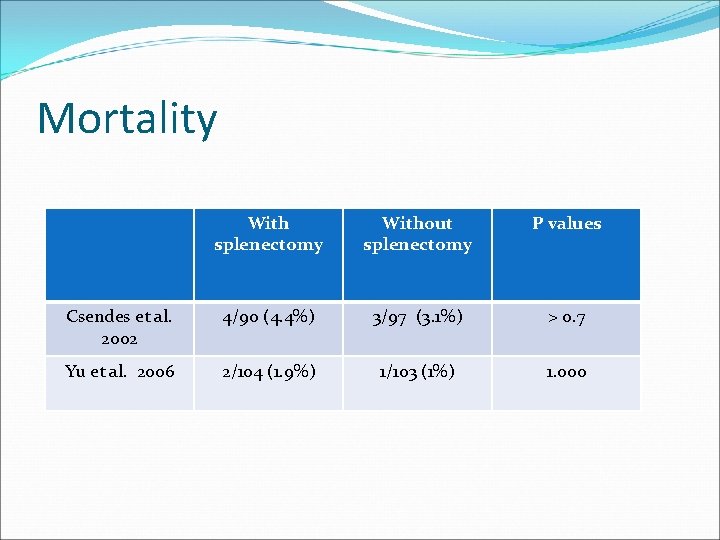
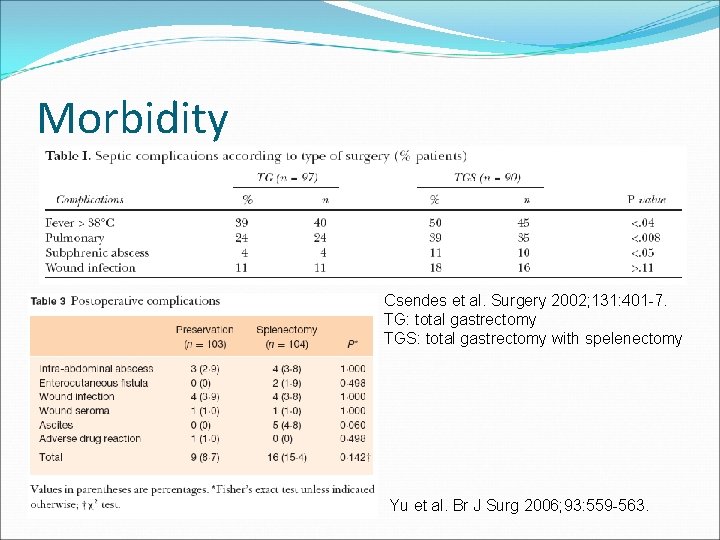
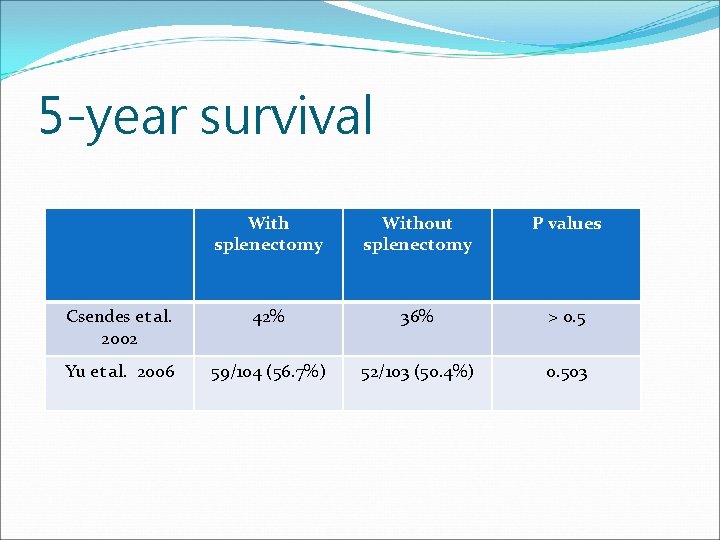
D 2 total gastrectomy without splenectomy Randomised controlled trials Total 187 (Csendes et al. ) and 207 (Yu et al. ) patients are included Csendes et al. A prospective randomized study comparing D 2 total gastrectomy versus D 2 total gastrectomy plus splenectomy in 187 patients with gastric carcinoma. Surgery 2002; 131: 401 -7. Yu et al. Randomized clinical trials of splenectomy versus splenic preservation in patients with proximal gastric cancer. Br J Surg 2006; 93: 559 -563.
D 2 total gastrectomy without splenectomy Compare D 2 total gastrectomy with or without splenectomy in proximal gastric cancers In spleen preservation group, the lymph nodes along the splenic artery (station 11) and at the hilum of spleen (station 10) are dissected without sacrificing the spleen and splenic vessels In splenectomy group, distal pancreas are not resected
Mortality With splenectomy Without splenectomy P values Csendes et al. 2002 4/90 (4. 4%) 3/97 (3. 1%) > 0. 7 Yu et al. 2006 2/104 (1. 9%) 1/103 (1%) 1. 000
Morbidity Csendes et al. Surgery 2002; 131: 401 -7. TG: total gastrectomy TGS: total gastrectomy with spelenectomy Yu et al. Br J Surg 2006; 93: 559 -563.
5 -year survival With splenectomy Without splenectomy P values Csendes et al. 2002 42% 36% > 0. 5 Yu et al. 2006 59/104 (56. 7%) 52/103 (50. 4%) 0. 503
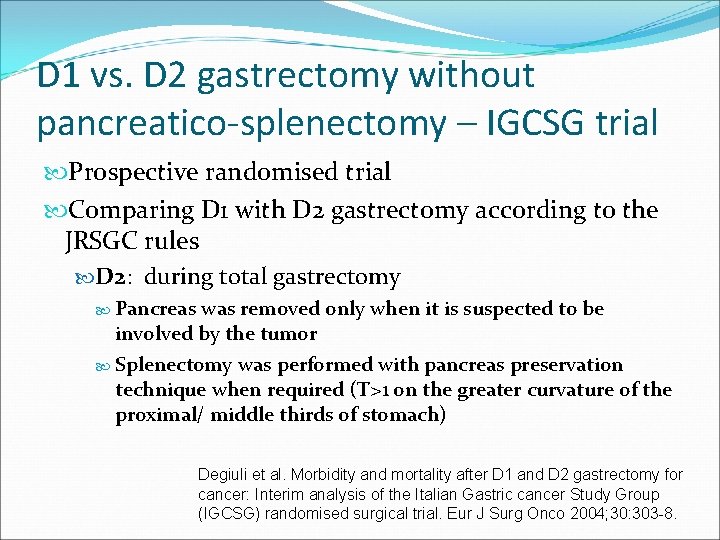
D 1 vs. D 2 gastrectomy without pancreatico-splenectomy – IGCSG trial Prospective randomised trial Comparing D 1 with D 2 gastrectomy according to the JRSGC rules D 2: during total gastrectomy Pancreas was removed only when it is suspected to be involved by the tumor Splenectomy was performed with pancreas preservation technique when required (T>1 on the greater curvature of the proximal/ middle thirds of stomach) Degiuli et al. Morbidity and mortality after D 1 and D 2 gastrectomy for cancer: Interim analysis of the Italian Gastric cancer Study Group (IGCSG) randomised surgical trial. Eur J Surg Onco 2004; 30: 303 -8.
D 1 vs. D 2 gastrectomy without pancreatico-splenectomy – IGCSG trial Quality control Restricted to 5 centers at which more than 25 D 2 dissections had been performed during earlier studies A minimum number of 25 retrieved nodes were required 162 patients (76 in D 1) and (86 in D 2) are included Splenectomy performed in 16 patients Distal pancreatectomy was done in 4 patients
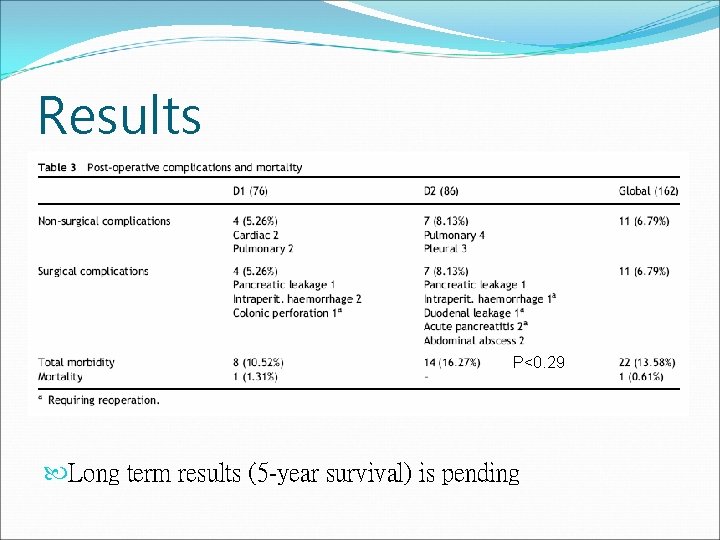
Results P<0. 29 Long term results (5 -year survival) is pending
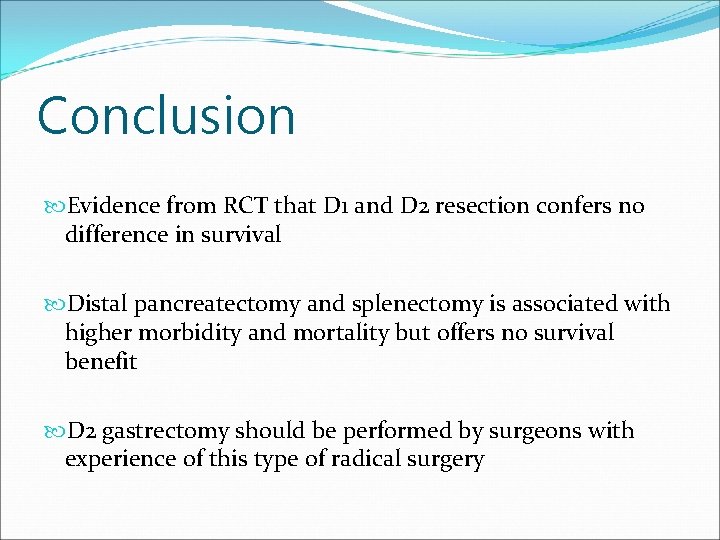
Conclusion Evidence from RCT that D 1 and D 2 resection confers no difference in survival Distal pancreatectomy and splenectomy is associated with higher morbidity and mortality but offers no survival benefit D 2 gastrectomy should be performed by surgeons with experience of this type of radical surgery
Thank you