
Lyman Alpha Spheres from the First Stars observed
Lyman Alpha Spheres from the First Stars observed in 21 cm Xuelei Chen (Beijing) Jordi Miralda Escudé (IEEC, Barcelona).
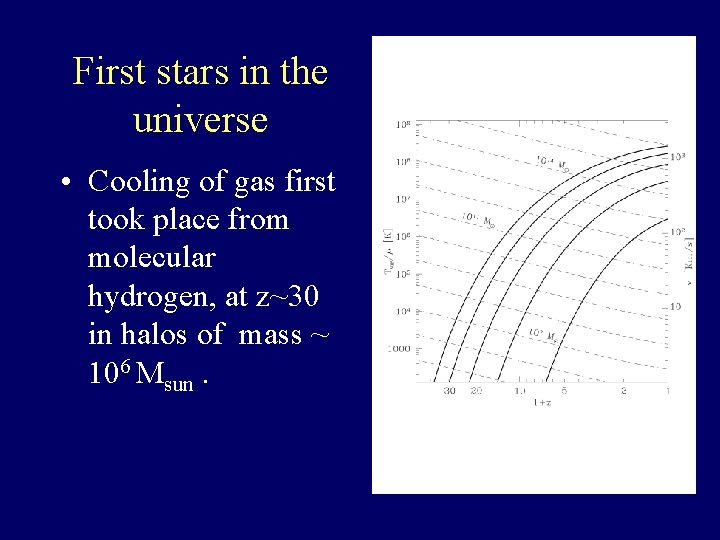
First stars in the universe • Cooling of gas first took place from molecular hydrogen, at z~30 in halos of mass ~ 106 Msun.
Properties of first metal-free stars • Central gas cools only to T ≈ 200 K. Molecular hydrogen lines can be collisionally deexcited at density n > 104 cm-3, making the cooling rate independent of density and inhibiting fragmentation. • Jeans mass ≈ 300 Msun. • Accretion rate ≈ cs 3/G ≈ 10 -3 Msun/yr • The first metal-free stars were massive, with L ≈ LEdd and T ≈ 105 K (Abel etal 2002, Bromm etal 2002, Schaerer 2002). Their lifetime is ~ 3 million years.
What is a first star? • All metal-free stars? Stars forming from matter that has never been in other stars. • Another possible definition: a star forming at a place and time where no light from another star has yet reached. – For CDMΛ model: first stars form at z ~ 40 from 6 sigma fluctuations. • Or: a star forming at a place and time where no light from other stars is substantially affecting any of its observable properties.
First ionized regions • Each metal-free star can produce about 105 ionizing photons per baryon it contains, creating an HII region of ~ 107 Msun of gas, of physical radius ~ 1 kpc at z=30. Probably one metal-free star forms per halo. • Star formation occurring after the HII region recombines and merges is probably from metal enriched gas.
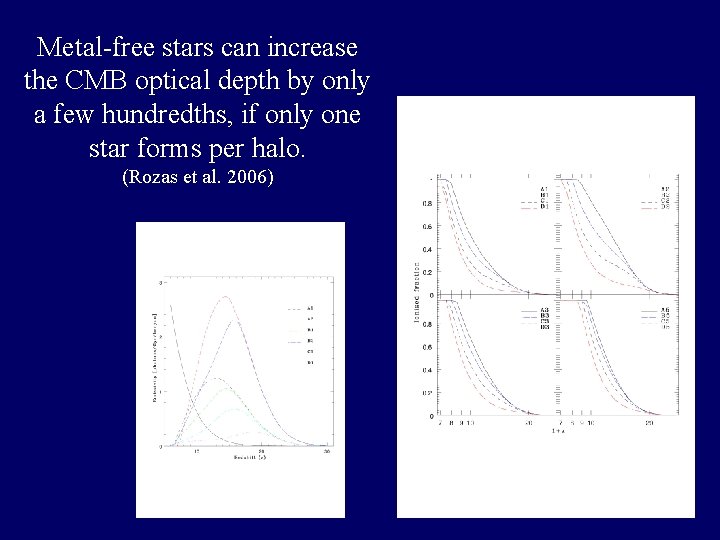
Metal-free stars can increase the CMB optical depth by only a few hundredths, if only one star forms per halo. (Rozas et al. 2006)
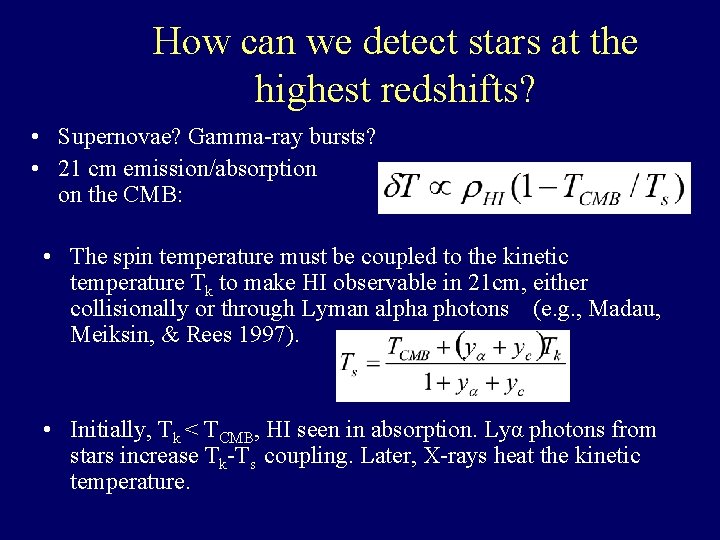
How can we detect stars at the highest redshifts? • Supernovae? Gamma-ray bursts? • 21 cm emission/absorption on the CMB: • The spin temperature must be coupled to the kinetic temperature Tk to make HI observable in 21 cm, either collisionally or through Lyman alpha photons (e. g. , Madau, Meiksin, & Rees 1997). • Initially, Tk < TCMB, HI seen in absorption. Lyα photons from stars increase Tk-Ts coupling. Later, X-rays heat the kinetic temperature.
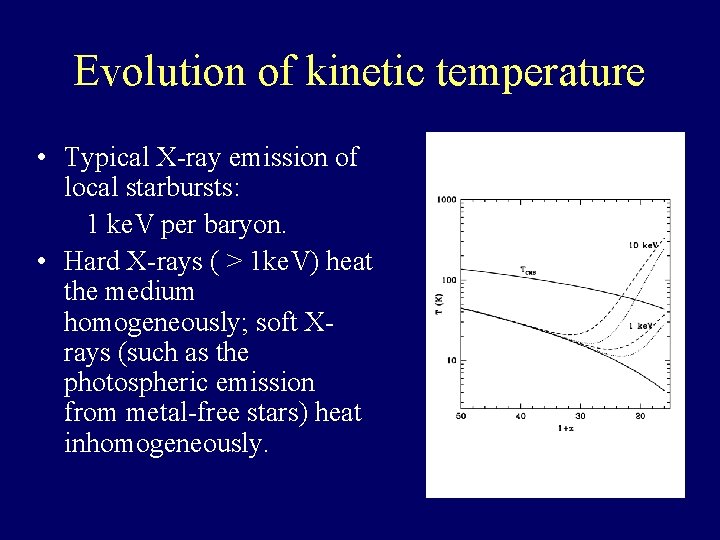
Evolution of kinetic temperature • Typical X-ray emission of local starbursts: 1 ke. V per baryon. • Hard X-rays ( > 1 ke. V) heat the medium homogeneously; soft Xrays (such as the photospheric emission from metal-free stars) heat inhomogeneously.
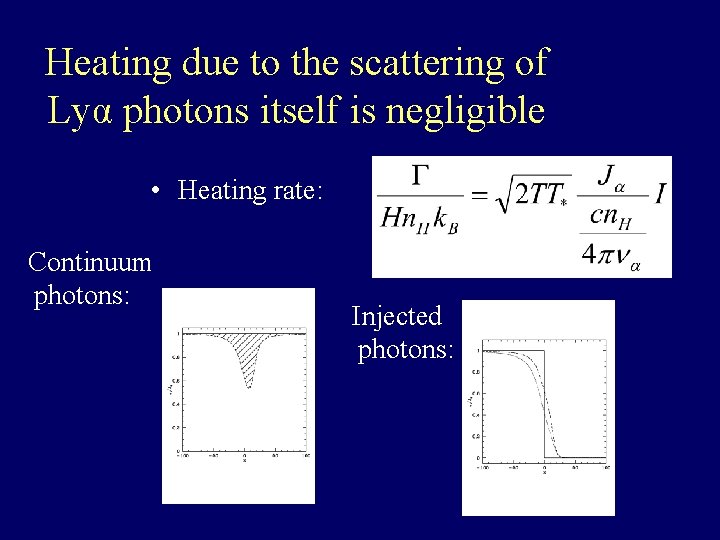
Heating due to the scattering of Lyα photons itself is negligible • Heating rate: Continuum photons: Injected photons:
What happens around one metal-free star? • Lyα photons couple the spin and kinetic temperatures out to a radius much larger than the HII region. • X-rays from the stellar photosphere heat the medium. • X-ray ionizations also produce injected Lyα photons, which turn out to dominate for the surface temperatures of metal-free stars. These yields a dominant absorption signal from a ``Lyα sphere’’ around a metal-free star.
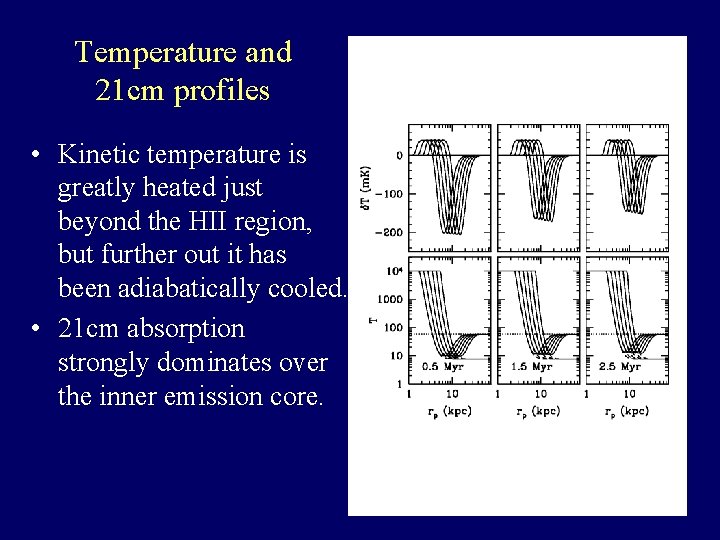
Temperature and 21 cm profiles • Kinetic temperature is greatly heated just beyond the HII region, but further out it has been adiabatically cooled. • 21 cm absorption strongly dominates over the inner emission core.
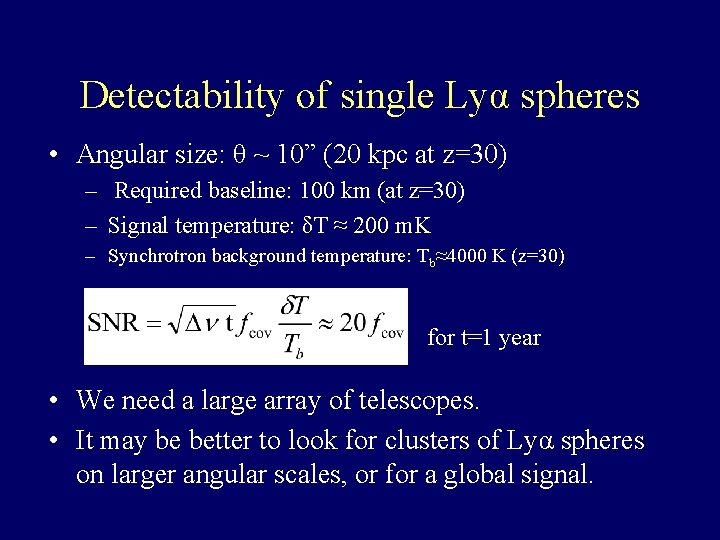
Detectability of single Lyα spheres • Angular size: θ ~ 10” (20 kpc at z=30) – Required baseline: 100 km (at z=30) – Signal temperature: δT ≈ 200 m. K – Synchrotron background temperature: Tb≈4000 K (z=30) for t=1 year • We need a large array of telescopes. • It may be better to look for clusters of Lyα spheres on larger angular scales, or for a global signal.
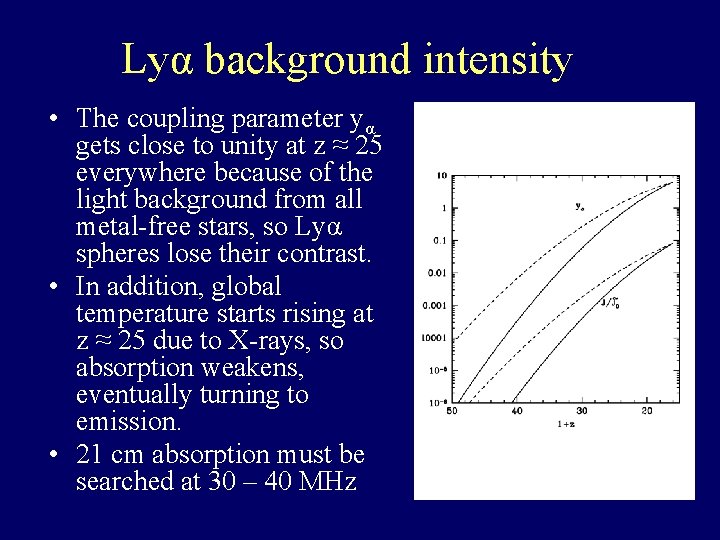
Lyα background intensity • The coupling parameter yα gets close to unity at z ≈ 25 everywhere because of the light background from all metal-free stars, so Lyα spheres lose their contrast. • In addition, global temperature starts rising at z ≈ 25 due to X-rays, so absorption weakens, eventually turning to emission. • 21 cm absorption must be searched at 30 – 40 MHz
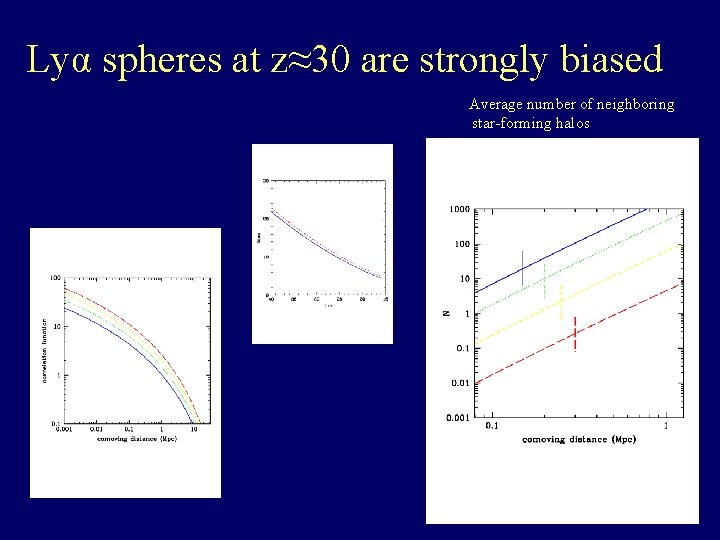
Lyα spheres at z≈30 are strongly biased Average number of neighboring star-forming halos
Conclusions • The Lyα sphere of a metal-free star produces a strong 21 cm absorption which is an unmistakable signature of a first star. • Detection of Lyα spheres would tell us about formation history, mass function, clustering… of the first stars. • Hard to detect! They are at very high redshift (very low frequency) and require ~ 100 km apertures.
- Slides: 15