
Lx I The sounds of German Lecture 4













- Slides: 52
Lx I The sounds of German Lecture 4 – Week 5 I. Syllable structure, phonotactics and sonorance II. Nasals, approximants and diphthongs
I. Syllable structure, phonotactics and sonorance II. (or why fglob and rforf are not possible words in German)
why fglob and rforf are not possible words in German • To answer that question, we need to be able to talk about syllables • what is a syllable? How many syllables in the word syllable? • what about: banana, sausage, cooperate, hmmm
A syllable is …. • a vowel sound optionally preceded or followed by one of more consonants: • e. g. o!, au!, alt, kalt, Draht, Haus, Klo
A syllable is …. • more precisely: a vowel sound or vowelequivalent optionally preceded or followed by one of more consonants: • A “vowel equivalent” would be, e. g. a syllabic m in Hmmm, or in Mbeki (President of South Africa) or in some pronunciation of words like essen • (NB if a consonant is “syllabic” we indicate it with a small vertical line underneath: ) m
Excursion: Syllabification in German spelling …. • Sometimes it can be hard to decide where to hyphenate a word because you are not sure where one syllable ends and the next one begins • the general principle: each syllable within a word should begin with a single consonant (except at start of the word): Ru -der, Knos-pen, Chi-na, Kas-ten, Har-ke
Excursion: Syllabification in German spelling …. • NB ch, ck, sch represent a single sound so should be kept together: Mi-schen, bu-chen, Zu-cker • And in borrowed words: ph, th, etc. as in Proph-et, ar-thri-tisch
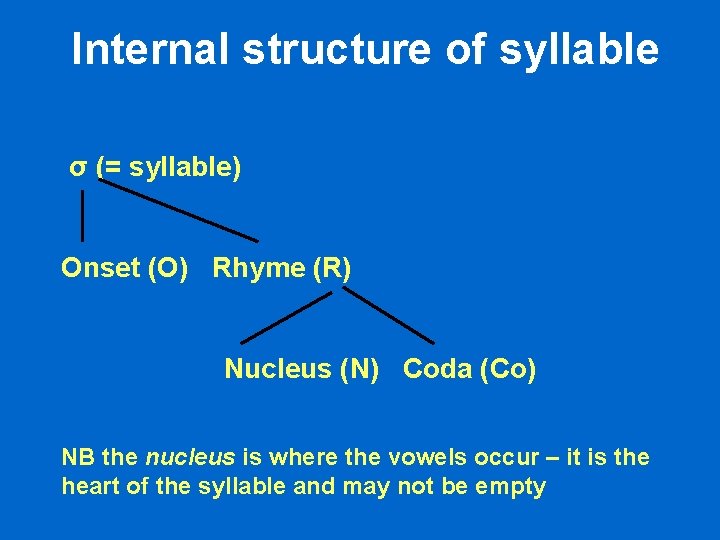
Back to syllables in phonology … • Our definition of a syllable is: a vowel sound or vowel-equivalent optionally preceded or followed by one of more consonants • It can be useful to further sub-divide the syllable to talk about what phonemes can occur where in it
Internal structure of syllable σ (= syllable) Onset (O) Rhyme (R) Nucleus (N) Coda (Co) NB the nucleus is where the vowels occur – it is the heart of the syllable and may not be empty
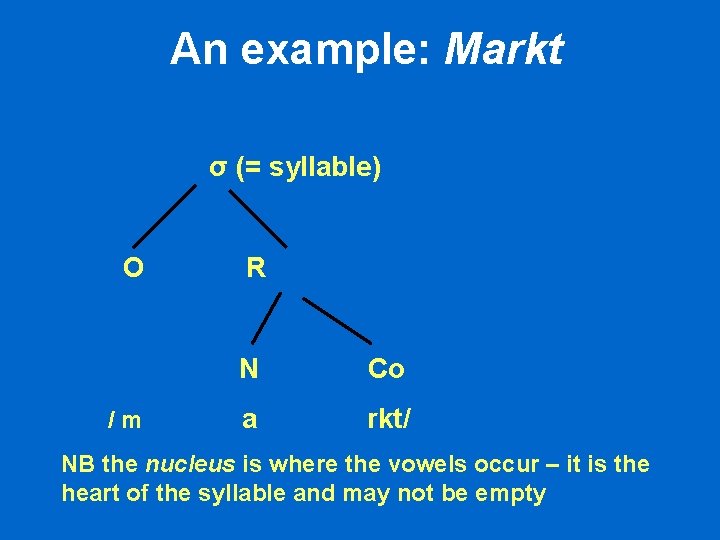
An example: Markt σ (= syllable) O /m R N Co a rkt/ NB the nucleus is where the vowels occur – it is the heart of the syllable and may not be empty
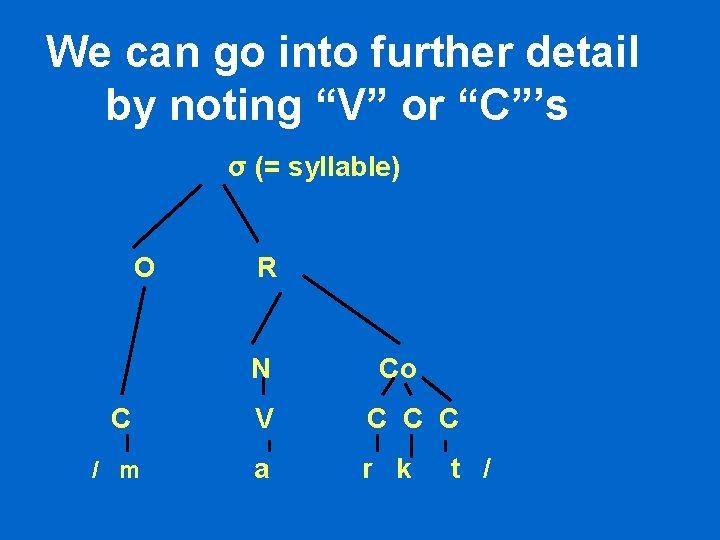
We can go into further detail by noting “V” or “C”’s σ (= syllable) O R N Co C V C C C / m a r k t /
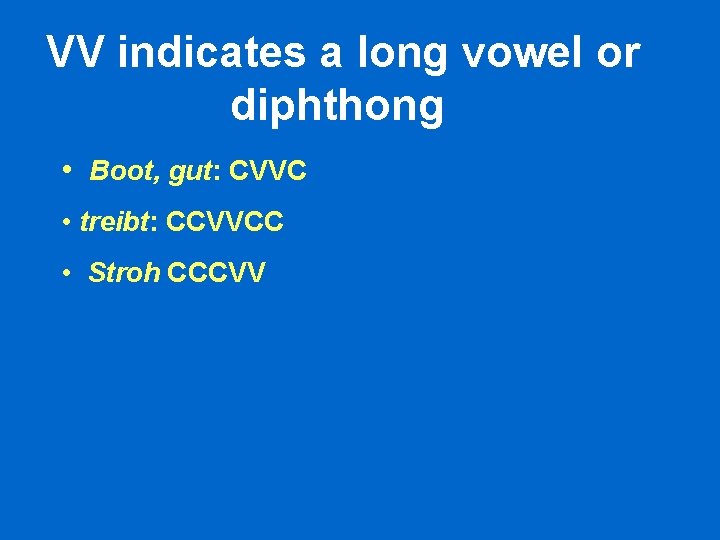
VV indicates a long vowel or diphthong • Boot, gut: CVVC • treibt: CCVVCC • Stroh CCCVV
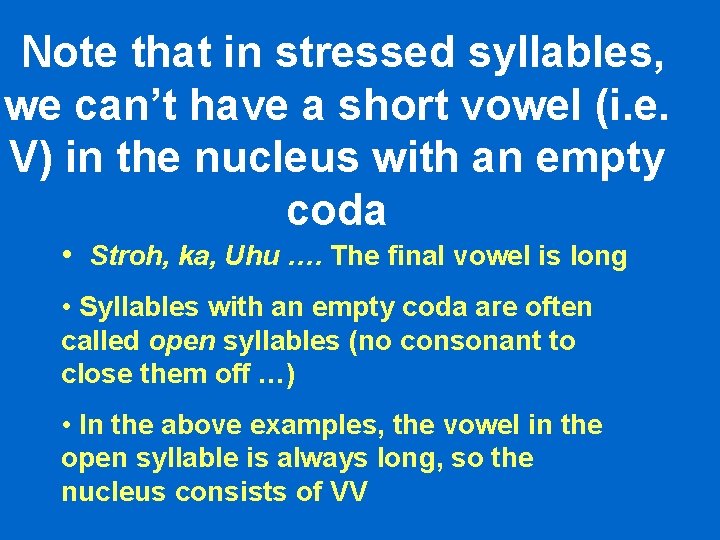
Note that in stressed syllables, we can’t have a short vowel (i. e. V) in the nucleus with an empty coda • Stroh, ka, Uhu …. The final vowel is long • Syllables with an empty coda are often called open syllables (no consonant to close them off …) • In the above examples, the vowel in the open syllable is always long, so the nucleus consists of VV
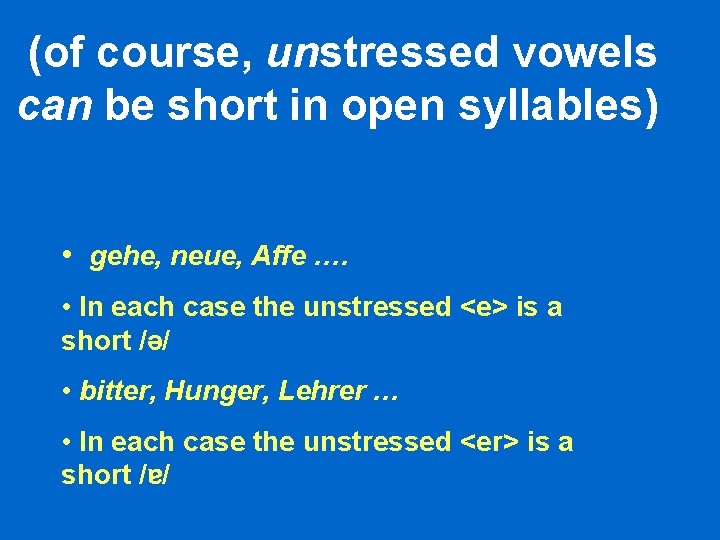
(of course, unstressed vowels can be short in open syllables) • gehe, neue, Affe …. • In each case the unstressed <e> is a short /ə/ • bitter, Hunger, Lehrer … • In each case the unstressed <er> is a short /ɐ/
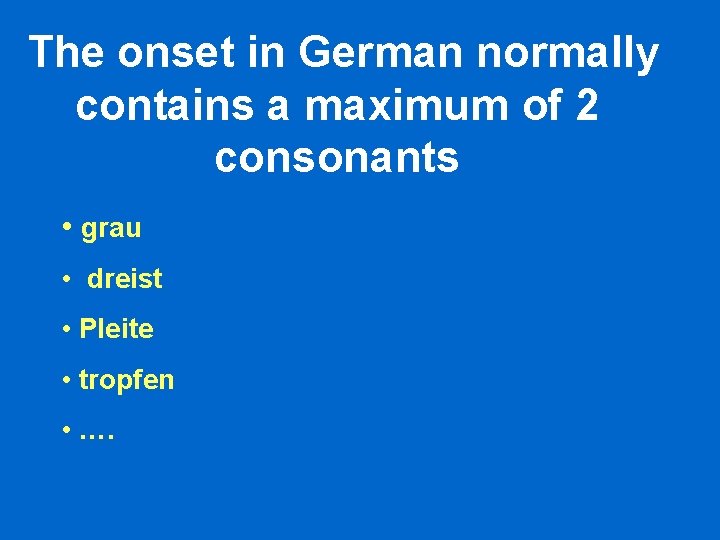
The onset in German normally contains a maximum of 2 consonants • grau • dreist • Pleite • tropfen • ….
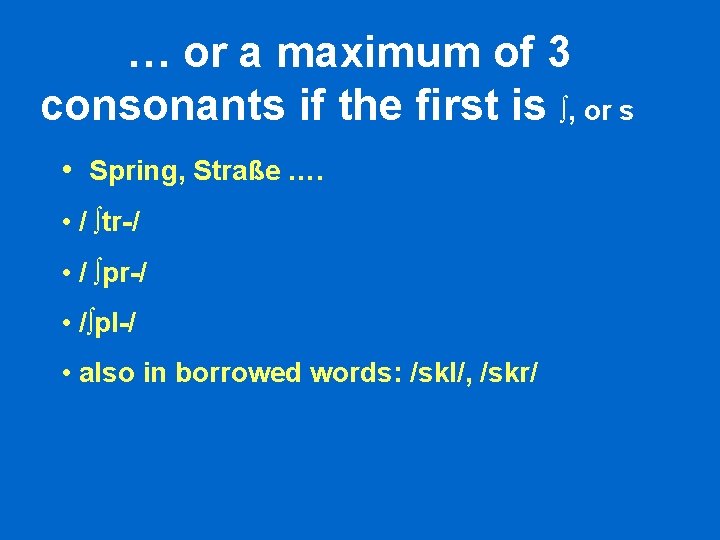
… or a maximum of 3 consonants if the first is ∫, or s • Spring, Straße …. • / ∫tr-/ • / ∫pr-/ • /∫pl-/ • also in borrowed words: /skl/, /skr/
The coda in German can have a maximum of 4 consonants • Herbst, ernst
Phonotactics • the rules describing possible sound combinations in a given language • vary from language to language: compare German and English (Knauf) or German and Russian (vstr-) • can you think of any more phonotactic differences between German and English? • / ∫tr-/ ? ?
Phonotactic “Constraints” … • Many consonant clusters can occur, but consonants of the same class (eg 2 stops, 2 fricatives, 2 nasals) cannot normally form a cluster: • e. g */-pk/ , */tp-/ */s∫-/ …. . • * = ungrammatical
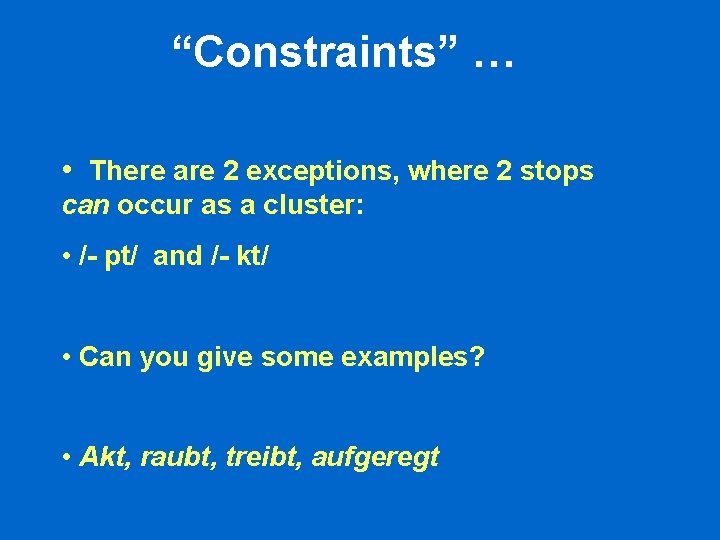
“Constraints” … • There are 2 exceptions, where 2 stops can occur as a cluster: • /- pt/ and /- kt/ • Can you give some examples?
“Constraints” … • There are 2 exceptions, where 2 stops can occur as a cluster: • /- pt/ and /- kt/ • Can you give some examples? • Akt, raubt, treibt, aufgeregt
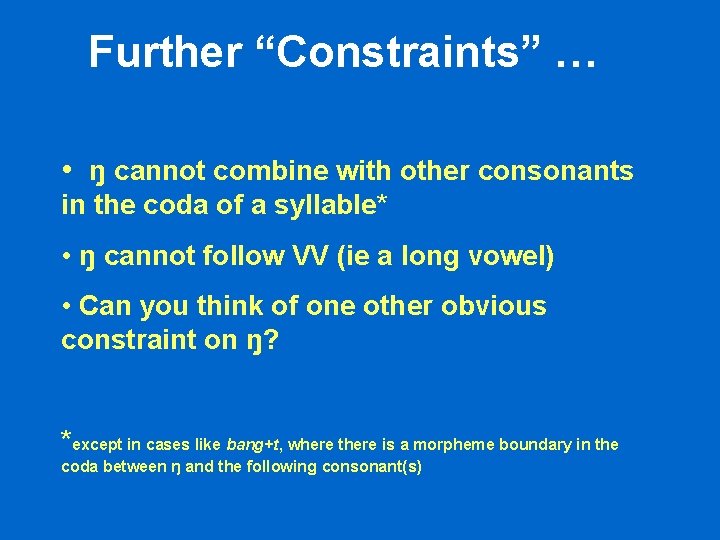
Further “Constraints” … • ŋ cannot combine with other consonants in the coda of a syllable* • ŋ cannot follow VV (ie a long vowel) • Can you think of one other obvious constraint on ŋ? *except in cases like bang+t, where there is a morpheme boundary in the coda between ŋ and the following consonant(s)
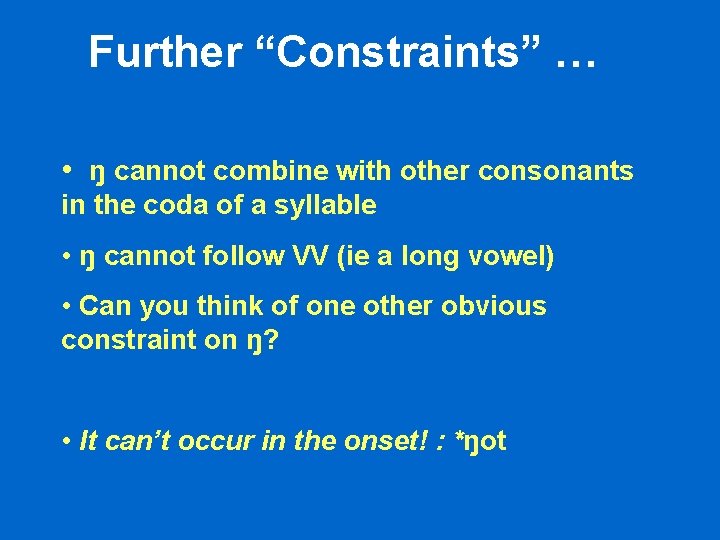
Further “Constraints” … • ŋ cannot combine with other consonants in the coda of a syllable • ŋ cannot follow VV (ie a long vowel) • Can you think of one other obvious constraint on ŋ? • It can’t occur in the onset! : *ŋot
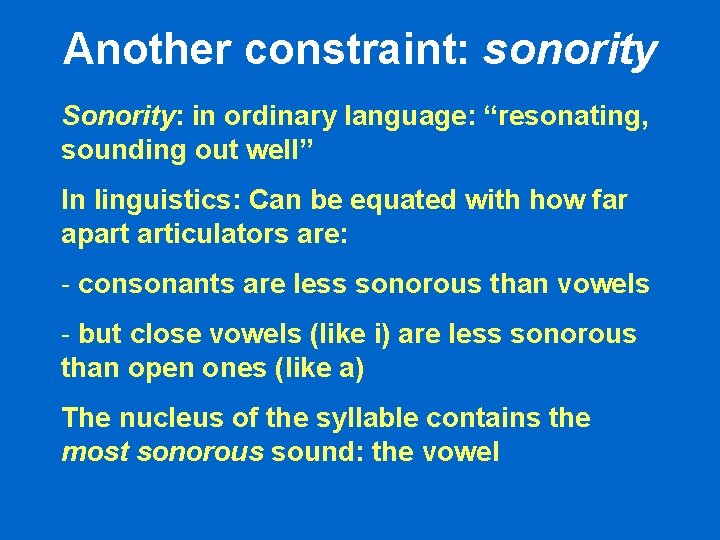
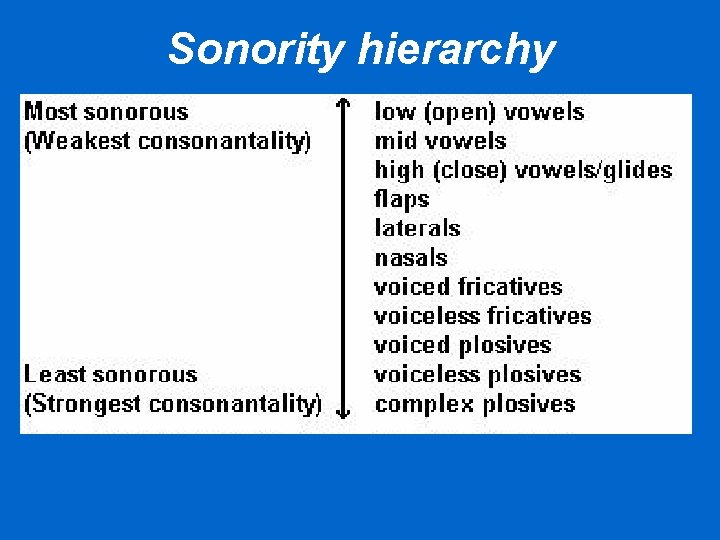
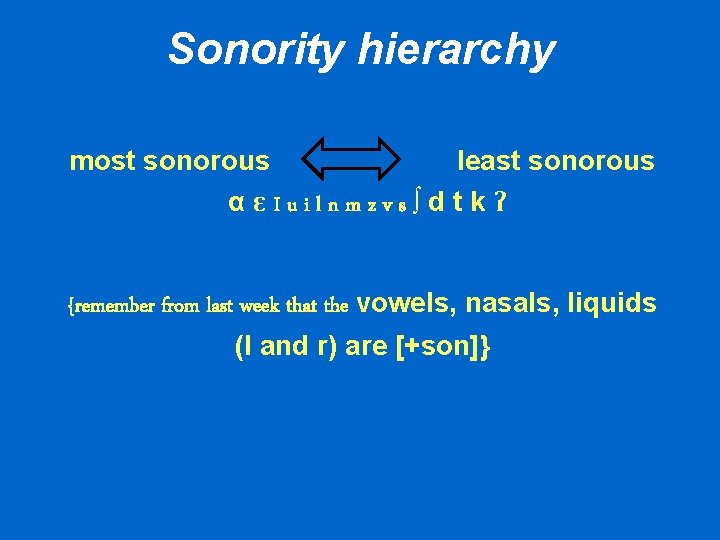
Another constraint: sonority Sonority: in ordinary language: “resonating, sounding out well” In linguistics: Can be equated with how far apart articulators are: - consonants are less sonorous than vowels - but close vowels (like i) are less sonorous than open ones (like a) The nucleus of the syllable contains the most sonorous sound: the vowel
Sonority hierarchy
Sonority hierarchy most sonorous least sonorous αɛIuilnmzvs∫dtkʔ {remember from last week that the vowels, nasals, liquids (l and r) are [+son]}
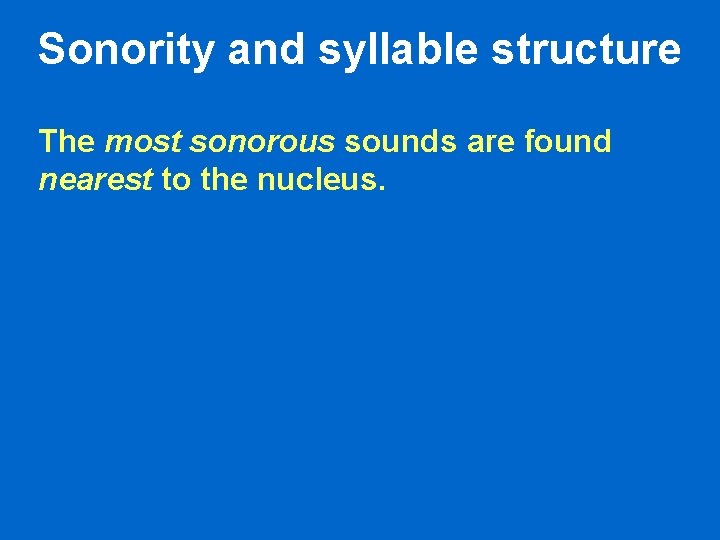
Sonority and syllable structure The most sonorous sounds are found nearest to the nucleus.
Sonority and syllable structure • An exception to this general principle is clusters with /∫/ and /s/ in the onset: • e. g. stoppen, where the fricative /∫/ is more sonorous than the stop /t/, but is found nearer the edge of the syllable. • This type of exception seems to be common in the Germanic languages (eg English, Dutch, Swedish, Norwegain) – cf. Eng. Stop • Can you give some more examples of this type of exception in German (both with s and ∫)?
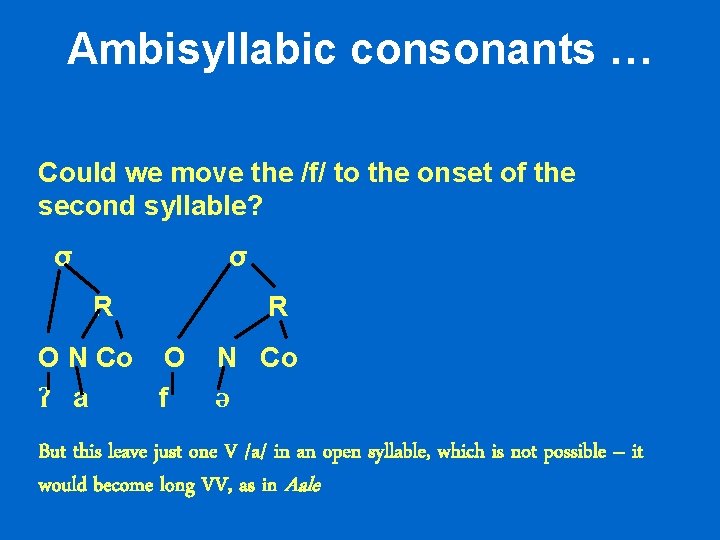
Ambisyllabic consonants We know that any syllable that doesn’t have a consonant in the onset will have a glottal stop before the vowel, as in Affe: σ σ R O N Co ʔ a f R O N Co ə But what about the empty onset before ə? Here no ʔ is possible ….
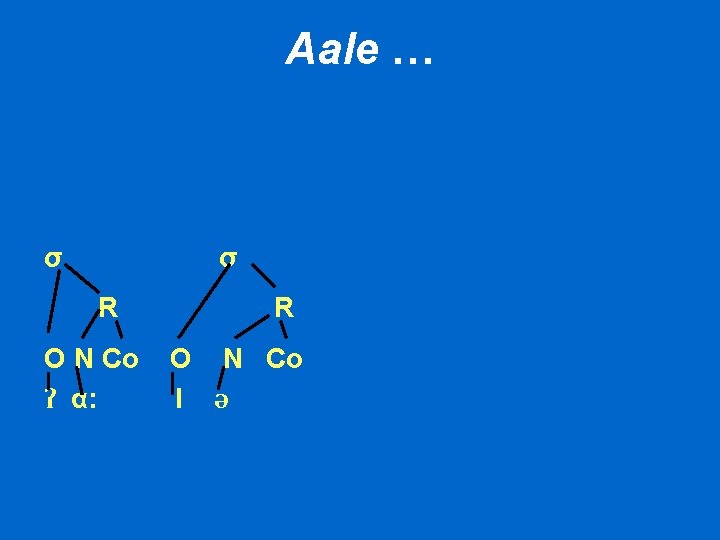
Ambisyllabic consonants … Could we move the /f/ to the onset of the second syllable? σ σ R O N Co O ʔ a f R N Co ə But this leave just one V /a/ in an open syllable, which is not possible – it would become long VV, as in Aale
Aale … σ σ R O N Co ʔ α: R O N Co l ə
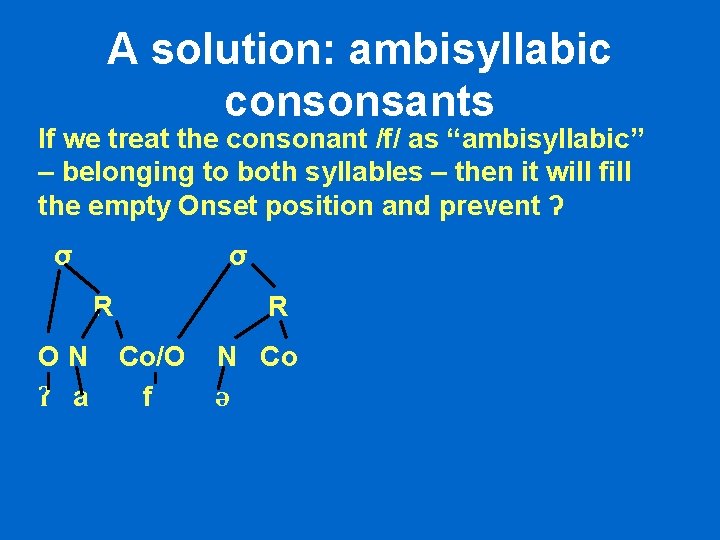
A solution: ambisyllabic consonsants If we treat the consonant /f/ as “ambisyllabic” – belonging to both syllables – then it will fill the empty Onset position and prevent ʔ σ σ R ON ʔ a R Co/O f N Co ə
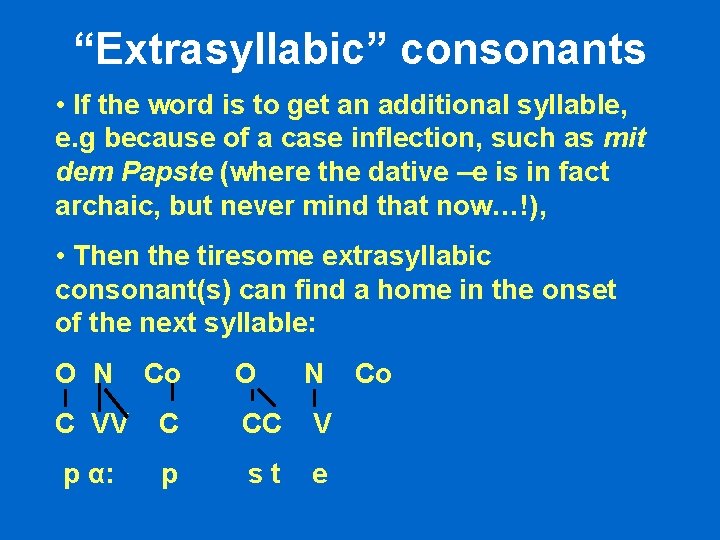
“Extrasyllabic” consonants Another violation of the sonority hierarchy seems to occur in words like Papst /Pα: pst/ Here the /s/ in the coda is more sonorous than the /p/ but it is further from the nucleus than is the /p/ One solution is to treat them as “extrasyllabic” – not given a place in the underlying syllable structure, but just “ignored” and only assigned a place later. O N Co extrasyllabic: CVV CC p α: C p st
“Extrasyllabic” consonants • If the word is to get an additional syllable, e. g because of a case inflection, such as mit dem Papste (where the dative –e is in fact archaic, but never mind that now…!), • Then the tiresome extrasyllabic consonant(s) can find a home in the onset of the next syllable: O N Co O N C VV C CC V p α: p st e Co
Exercises 1. Represent the syllable structure for the following words: (NB remember that the bottom “tier” of the diagram should be phonemic script, rather than normal spelling) Kopf , beobachten, strikt, stank, Kraft Muße, Rätsel, Hunger
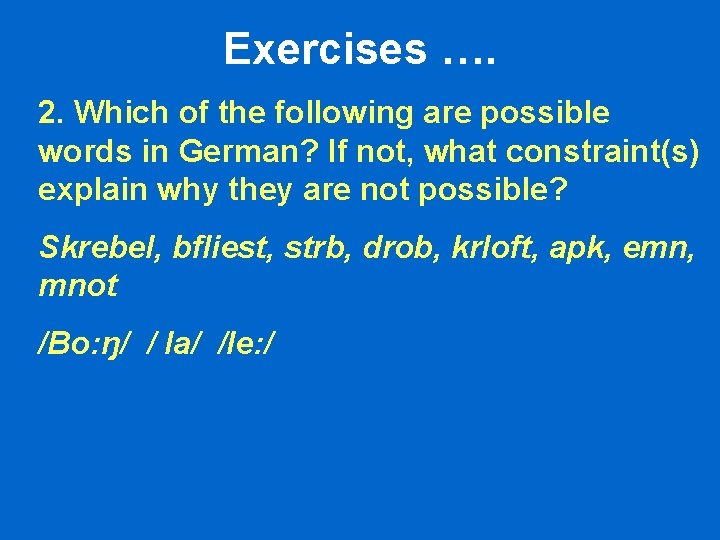
Exercises …. 2. Which of the following are possible words in German? If not, what constraint(s) explain why they are not possible? Skrebel, bfliest, strb, drob, krloft, apk, emn, mnot /Bo: ŋ/ / la/ /le: /
Approximants, nasals and diphthongs We’ve already met the nasal stops /m, n, ŋ/ : Where the velum (soft palate) is lowered so air escapes through nasal cavity Bilabial …. Alveolar …. Velar ….
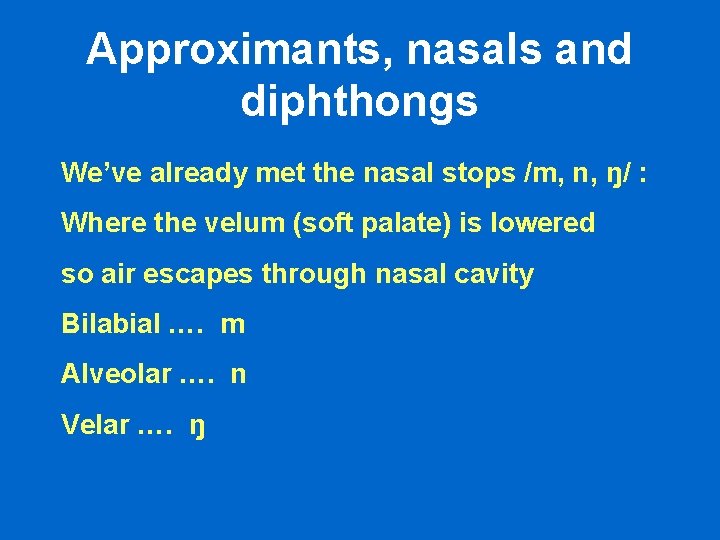
Approximants, nasals and diphthongs We’ve already met the nasal stops /m, n, ŋ/ : Where the velum (soft palate) is lowered so air escapes through nasal cavity Bilabial …. m Alveolar …. n Velar …. ŋ
n in German and English Like light and dark /l/, /n/ in German differs phonetically from English /n/ -In German the body of the tongue is in the position for the vowel /i/ Eg. Jens, Wein
Velar nasal ŋ • NB The exact tongue position for the velar nasal varies depending on whether it follows a front or back vowel. • Compare: hing , bang • After a front vowel, the closure is in fact palatal vs. middle of velum for back vowels • This is an example of co-articulation, where the articulation needed for one sound influences that of a preceding or following sound
Co-articulation … Cf. also the other velar consonants: compare the /k/’s in Kit-Kat! • Historically, co-articulation also explains the alternation between palatal /ç/ and velar /x/ after front and back vowels • compare: ich vs. ach; Bücher vs. Buch
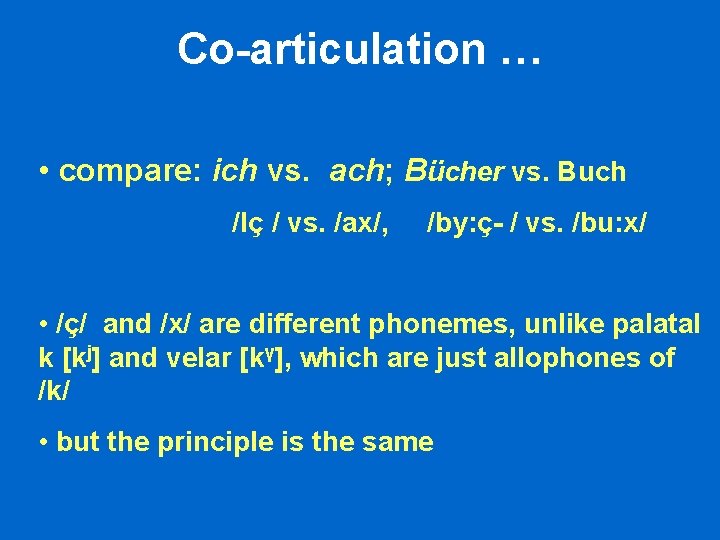
Co-articulation … • compare: ich vs. ach; Bücher vs. Buch /Iç / vs. /ax/, /by: ç- / vs. /bu: x/ • /ç/ and /x/ are different phonemes, unlike palatal k [kj] and velar [kγ], which are just allophones of /k/ • but the principle is the same
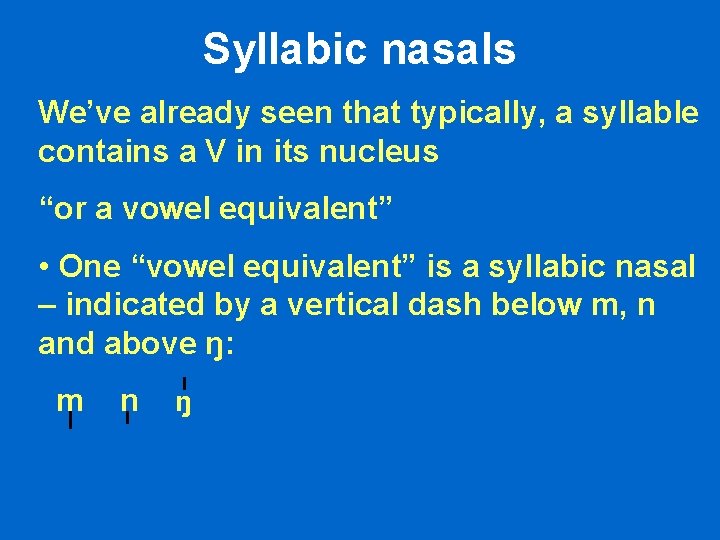
Syllabic nasals We’ve already seen that typically, a syllable contains a V in its nucleus “or a vowel equivalent” • One “vowel equivalent” is a syllabic nasal – indicated by a vertical dash below m, n and above ŋ: m n ŋ
Syllabic nasals Syllabic n is frequent in German • After fricatives: essen, hoffen, Reisender • After stops (plosives): reden, treiben, warten
Syllabic nasals In very careful speech, we might hear: /ən/, - but usually /ə/ is deleted, and we hear /n/ Cf. English sudden, happen (but NB in Dutch, unstressed –en becomes /ə/ and the /n/ is deleted – to use syllabic /n/ is a giveaway of a German accent!. e. g. eten, zullen)
Syllabic nasals … Always: assimilation of syllabic n to ŋ after a velar stop (/k, g/): fragen, sagen, Haken: -[gŋ], [kŋ] • Frequent in normal speech: assimilation of syllabic n to m - After a bilabial stop /m, p/ : leben, neben, Mappen [bm], [pm]
Approximants (or semi-vowels) • Articulators are closer together than for full vowels, but not close enough to cause frication: In English: • Voiced labial velar approximant /w/ (will) (NB where it is on IPA chart) • Voiced palatal approximant /j/ (you) • Voiced alveolar approximant /upside down r/ (car, red)
Approximants (or semi-vowels) • Articulators are closer together than for full vowels, but not close enough to cause frication: In German: • Voiced palatal approximant /j/ (ja) (or sometimes the fricative /curly j/) • Avoid the other English approximants when you see <w> and <r>! (rot, war …)
Diphthongs • TWO vowel-sounds in a single syllable • Three diphthongs in German: aɪ, aʊ, ɔY /maɪn/ <ei> , <ai> mein, Kaiser, Seite, Saite /haʊs/ <au> Haus, Maus. . . /hɔYzɐ/ <aü>, <eu> Haüser, Freude (more rounded than English boy, less emphasis on second part)
Diphthongs … • TWO vowel-sounds in a single syllable • In fact: one stable element, followed by a glide towards another vowel sound (considerable variation, so often also variation in transcription) • see booklet, p. 6
Falling vs. rising diphthongs … • all German diphthongs are falling, i. e. The first vowel sound is longest and gets most emphasis • In fact: one stable element, followed by a glide towards another vowel sound (considerable variation, so often also variation in transcription) • see booklet, p. 6
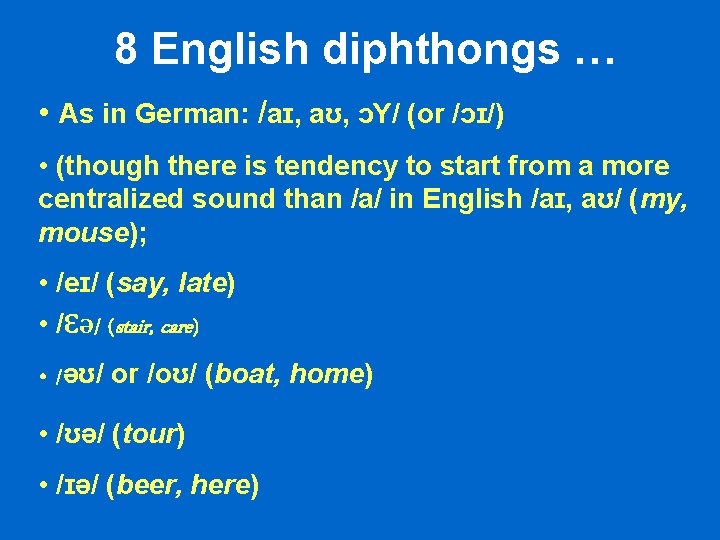
8 English diphthongs … • As in German: /aɪ, aʊ, ɔY/ (or /ɔɪ/) • (though there is tendency to start from a more centralized sound than /a/ in English /aɪ, aʊ/ (my, mouse); • /eɪ/ (say, late) • /Ɛə/ (stair, care) • /əʊ/ or /oʊ/ (boat, home) • /ʊə/ (tour) • /ɪə/ (beer, here)