
LWR ON BRIDGES RAIL STRUCTURE INTERACTION BASED ON
LWR ON BRIDGES RAIL STRUCTURE INTERACTION BASED ON UIC 774 -3 R G S Yadav Professor Bridge IRICEN 742004112 gsyadav@iricen. gov. in 1
BASIC LWR THEORY v Rail and sleeper work as frame v There is no relative movement between rail and sleeper. This is ensured by providing elastic ( creep resistant) fastenings v Resistance to longitudinal movement of track is provided by ballast resistance (longitudinal resistance between rail and sleeper is higher than the resistance mobilized by ballast) v Ballast resistance depends upon consolidation state of ballast. v Ballast resistance also depends upon live load on track. v Ballast resistance is less in newly deep screened track and more in track with consolidated ballast. v Ballast resistance also falls considerable if ballast bed is 2 moved suddenly beyond a limit
LWR ON BRIDGES LWR MANUAL PROVISIONS v LWR/CWR can be continued over bridges without bearings like slabs, box culverts and arches. v LWR manual allows LWR over bridges with bearings when track is laid with Rail Free Fastenings v But provision of Rail Free Fastenings results in severe restriction on length of bridge over which LWR can be laid. v If LWRs are laid on bridges with ballasted deck with bearings and with elastic fastenings, then detailed calculations to calculate effect of coupling of track with bridge needs to be carried out. 3

PRINCIPLE BEHIND PROVISIONS OF LWR MANUAL What happens in case of fracture ? 4
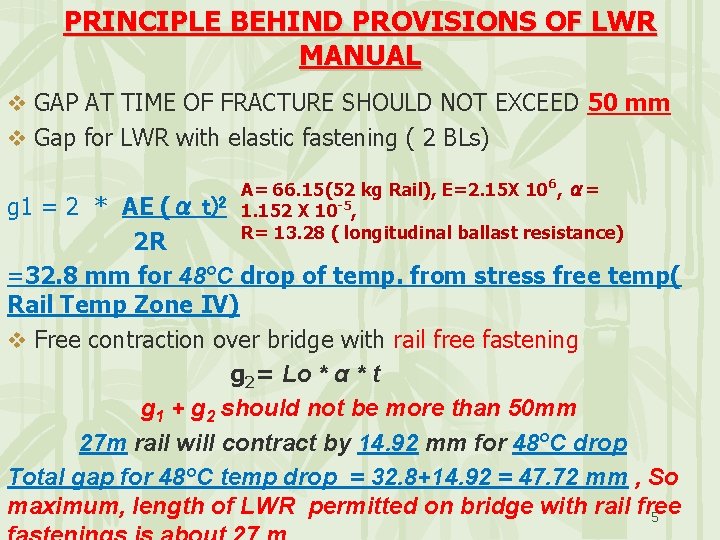
PRINCIPLE BEHIND PROVISIONS OF LWR MANUAL v GAP AT TIME OF FRACTURE SHOULD NOT EXCEED 50 mm v Gap for LWR with elastic fastening ( 2 BLs) A= 66. 15(52 kg Rail), E=2. 15 X 106, α= t)2 1. 152 X 10 -5, R= 13. 28 ( longitudinal ballast resistance) g 1 = 2 * AE (α 2 R =32. 8 mm for 48 o. C drop of temp. from stress free temp( Rail Temp Zone IV) v Free contraction over bridge with rail free fastening g 2= Lo * α * t g 1 + g 2 should not be more than 50 mm 27 m rail will contract by 14. 92 mm for 48 o. C drop Total gap for 48 o. C temp drop = 32. 8+14. 92 = 47. 72 mm , So maximum, length of LWR permitted on bridge with rail free 5

LWR MANUAL PROVISIONS 8

10
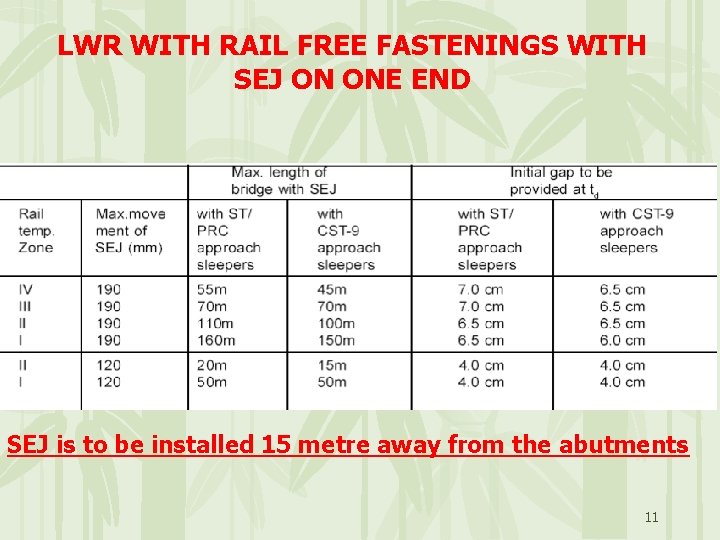
LWR WITH RAIL FREE FASTENINGS WITH SEJ ON ONE END SEJ is to be installed 15 metre away from the abutments 11

LWR MANUAL PROVISIONS v SEJ on both approaches v Welded rails may be provided over a Single span bridge with rail free fastenings and 1. SEJs at 30 m away from both abutments. 2. The rail shall be box anchored on four sleepers at the fixed end of the bridge if bridge is supported on rollers on one side and rockers on other side. In case of bridge supported on sliding bearings on both sides, the central portion of the welded rails shall be box anchored on four sleepers. 3. The length of single span bridge permitted temperature zonewise shall be as under 12

LWR MANUAL PROVISIONS v SEJ on each Pier v Welded rails may be provided from pier to pier with rail-free fastenings and with SEJ on each pier. v The rail shall be box-anchored on four sleepers at the fixed end of the girder is supported on rollers on one side and rockers on other side. v In case of girder supported on sliding bearings on both sides, the central portion of the welded rails over each span shall be box-anchored on four sleepers. 13

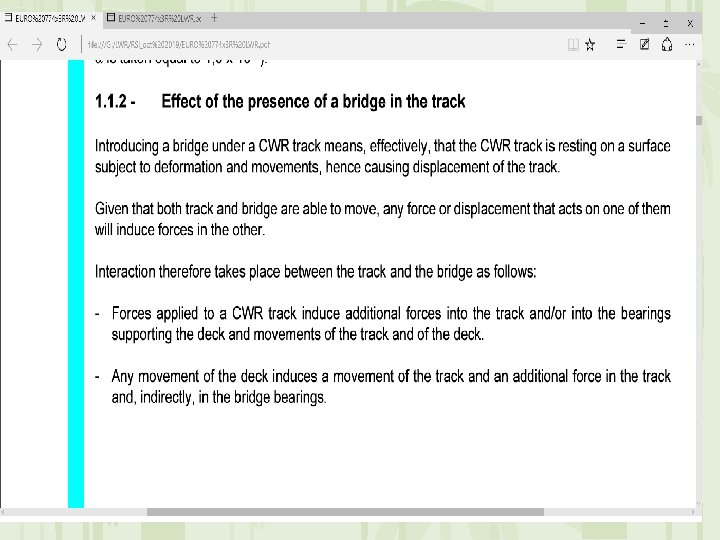
v So while laying down provisions of LWR manual we have assumed that rail and bridge are not linked together. This is achieved through rail free fastenings v This places severe restriction over length of bridge over which we can lay LWR v So if we have to lay LWR over longer bridges we have to use elastic fastenings ( to reduce gap at fracture) v Bridge and Track with elastic fastenings are linked through ballast …. the displacement of bridge deck is resisted by presence of ballasted track. This results in forces in both track as well as bridge substructure v This phenomenon is known as RSI (Rail Structure Interaction) 14
15

Concept Of Load Paths v All loads applied to structures have to be v v transferred to the mother earth Bridge is in contact with earth at the level of foundation and on approaches So the loads applied to bridge have to either go to foundations or approaches or both Stiffer paths carry more loads Difference between road bridges and rail bridges 16

Concept Of Load Paths v IN ROAD BRIDGES : v the loads are applied directly to the bridge deck. Vertical loads are transferred to the earth through bridge deck, bearings , substructure and foundations v Longitudinal loads are also transferred to earth in the same manner in case of non-integral bridges, because expansion joints have negligible stiffness in longitudinal direction 17

Transfer of Longitudinal force in Road Bridge 18
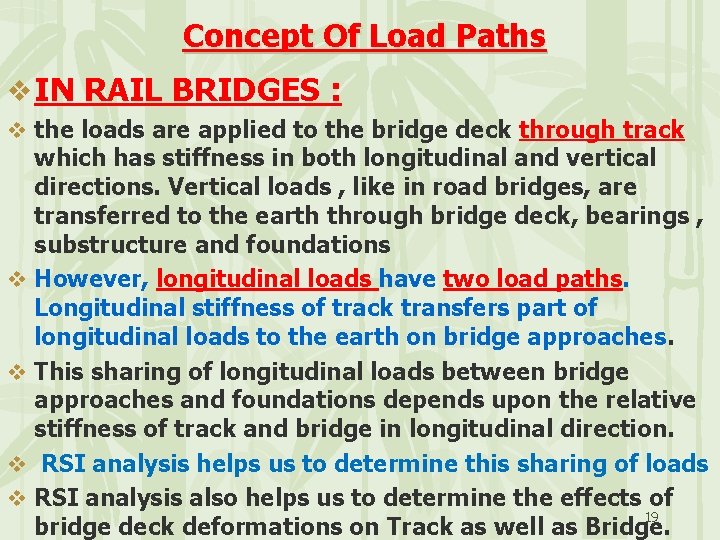
Concept Of Load Paths v IN RAIL BRIDGES : v the loads are applied to the bridge deck through track v v which has stiffness in both longitudinal and vertical directions. Vertical loads , like in road bridges, are transferred to the earth through bridge deck, bearings , substructure and foundations However, longitudinal loads have two load paths. Longitudinal stiffness of track transfers part of longitudinal loads to the earth on bridge approaches. This sharing of longitudinal loads between bridge approaches and foundations depends upon the relative stiffness of track and bridge in longitudinal direction. RSI analysis helps us to determine this sharing of loads RSI analysis also helps us to determine the effects of 19 bridge deck deformations on Track as well as Bridge.

Transfer of Longitutinal Forces in Rail Bridge ( TE/BF) LF Longitudinal Forces Cause deflection in substructure and induce stresses in rail

ISSUES WITH LWRS ON BRIDGES v Rail fracture v Gap not to exceed 50 mm as per IR practice (relevant for bridges with rail free fastenings) v Excessive displacement of ballast v Causes reduced lateral resistance v Transfer of force from track to bridge and vice-versa v Increases rail stress v Increases stress in bridge bearing and substructure 21
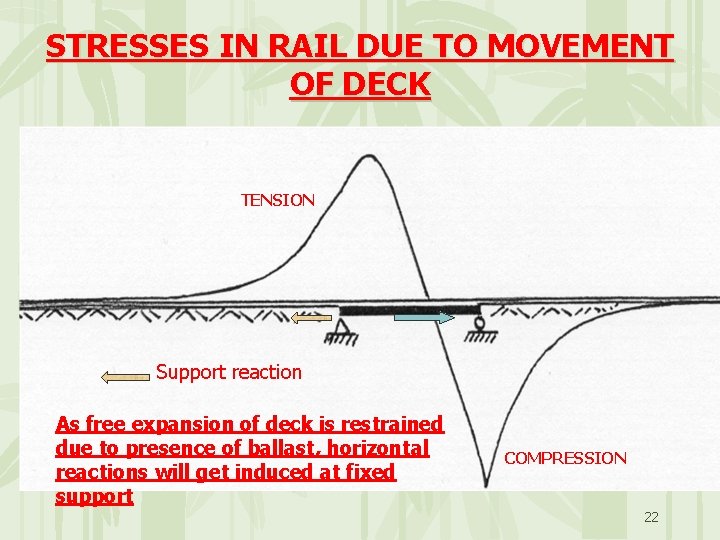
STRESSES IN RAIL DUE TO MOVEMENT OF DECK TENSION Support reaction As free expansion of deck is restrained due to presence of ballast, horizontal reactions will get induced at fixed support COMPRESSION 22
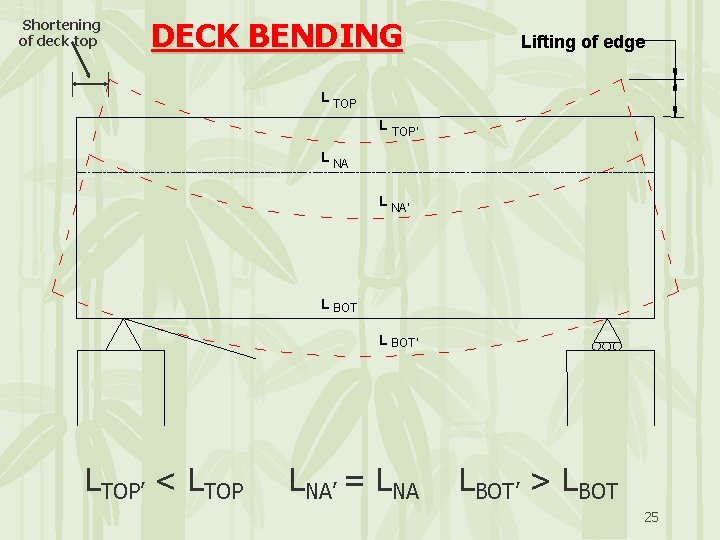
Shortening of deck top DECK BENDING Lifting of edge L TOP’ L NA' L BOT' LTOP’ < LTOP LNA’ = LNA LBOT’ > LBOT 25
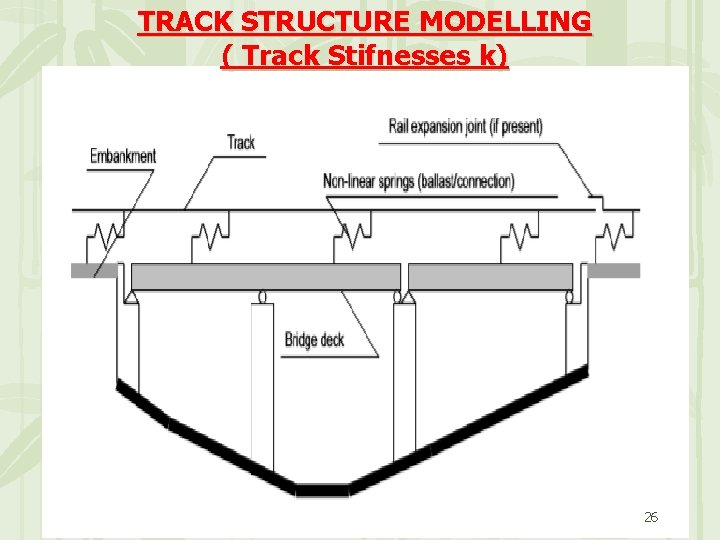
TRACK STRUCTURE MODELLING ( Track Stifnesses k) 26

Model Showing Both Track and Support Stiffness 28
Bridge and Track Parameters v Expansion length of bridge L : is the distance between thermal centrepoint and opposite end of the deck. Position of thermal centre point depends upon type of bearings. Expansion length determines thermal expansion effects v Span Length : length from one support to next support. Span length determines the vertical bending effects 29

30
Bridge and Track Parameters v Support Stiffness : Total stiffness of supports determines the resistance of deck to horizontal displacement. Total support stiffness is composed of stiffness of each support. Stiffness of each support is composed of stiffness of bearings and of the various components of support ( the pier , the base, the foundations and the supporting soil) v Bending Stiffness of Deck : determines vertical deformation of the deck. Vertical deformation displaces the top corners of the deck in horizontal and vertical direction 31

Bridge and Track Parameters v Track Resistance : the resistance k of track per unit length to longitudinal displacement u. Two values – for loaded and unloaded tracks are used in analysis. 32

TRACK RESISTANCE OR TRACK STIFFNESS (k) : resistance of track to longitudinal displacements increases rapidly while the displacement remains low, but remains virtually constant once the displacement has reached a certain magnitude. Resistance is higher on loaded track than on unloaded. 20/40 KN/m 2 mm 33
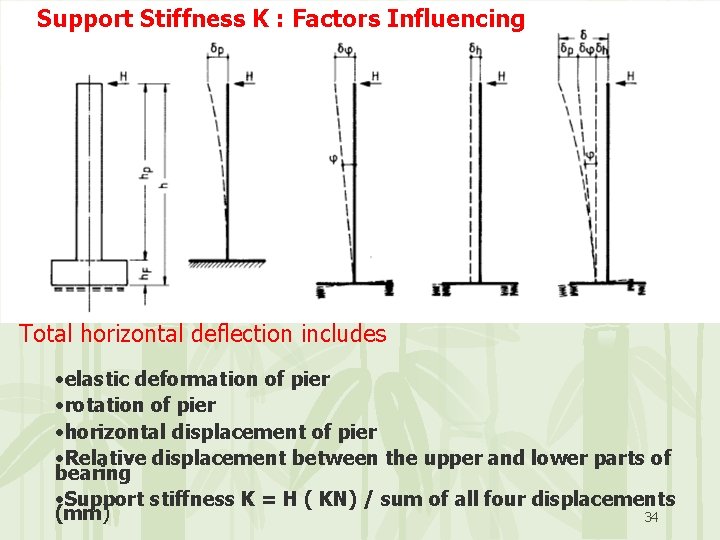
Support Stiffness K : Factors Influencing Total horizontal deflection includes • elastic deformation of pier • rotation of pier • horizontal displacement of pier • Relative displacement between the upper and lower parts of bearing • Support stiffness K = H ( KN) / sum of all four displacements (mm) 34
v INTERACTION EFFECTS : v Due to thermal movement of Deck/Rail v Due to TE/BF v Due to deck Bending 35
DECK BENDING v. Deck Bending Issues v. Horizontal Displacement between the top of deck end and the embankment or between two deck ends due to deck bending v. Lifting of deck ends v. Interaction effects depend primarily on the flexibility of deck and on position of neutral axis 36
DISPLACEMENT OF DECK v Maximum absolute displacement of deck due to tractive/breaking forces is limited as it comes in suddenly and can disturb ballast and hence reduce lateral stability of Track v In case of one rocker and one roller bearing, deck displacement is equal to movement of fixed end pier/abutment by same amount v Can be controlled by having stiffer pier 37
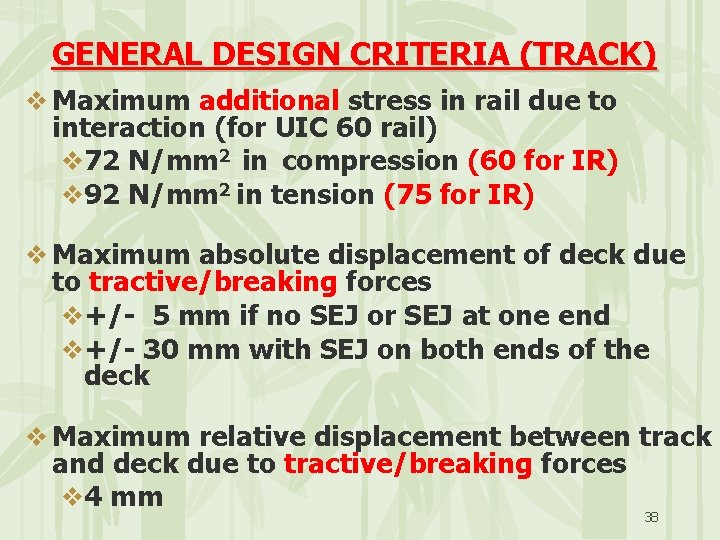
GENERAL DESIGN CRITERIA (TRACK) v Maximum additional stress in rail due to interaction (for UIC 60 rail) v 72 N/mm 2 in compression (60 for IR) v 92 N/mm 2 in tension (75 for IR) v Maximum absolute displacement of deck due to tractive/breaking forces v+/- 5 mm if no SEJ or SEJ at one end v+/- 30 mm with SEJ on both ends of the deck v Maximum relative displacement between track and deck due to tractive/breaking forces v 4 mm 38
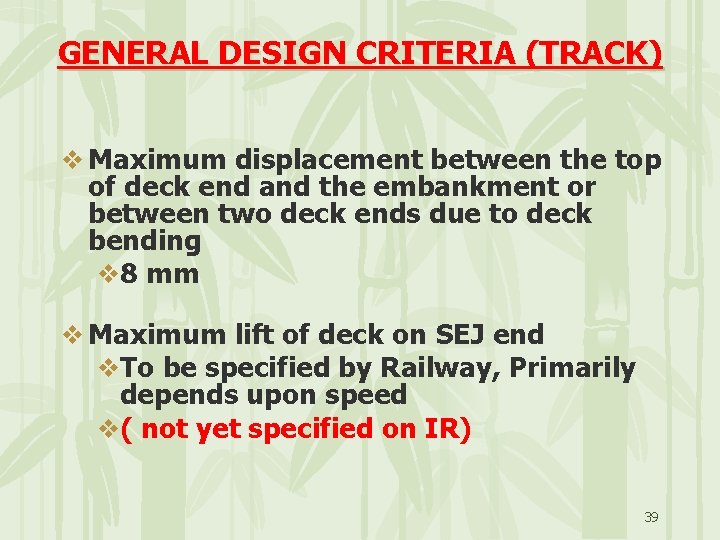
GENERAL DESIGN CRITERIA (TRACK) v Maximum displacement between the top of deck end and the embankment or between two deck ends due to deck bending v 8 mm v Maximum lift of deck on SEJ end v. To be specified by Railway, Primarily depends upon speed v( not yet specified on IR) 39
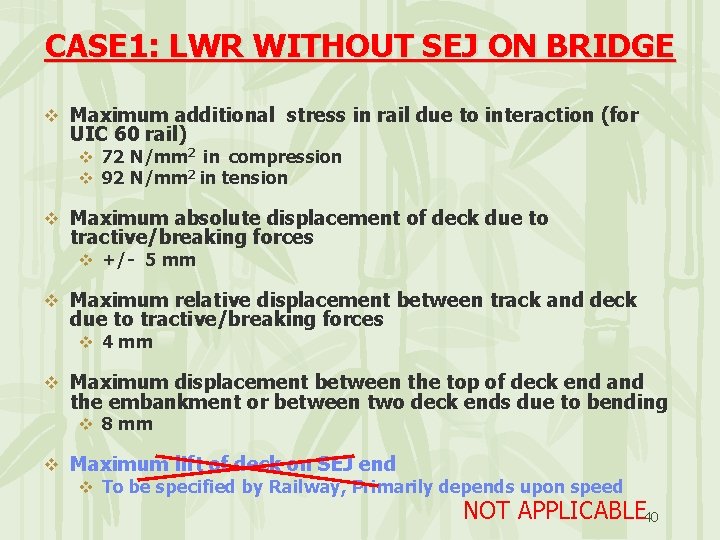
CASE 1: LWR WITHOUT SEJ ON BRIDGE v Maximum additional stress in rail due to interaction (for UIC 60 rail) v 72 N/mm 2 in compression v 92 N/mm 2 in tension v Maximum absolute displacement of deck due to tractive/breaking forces v +/- 5 mm v Maximum relative displacement between track and deck due to tractive/breaking forces v 4 mm v Maximum displacement between the top of deck end and the embankment or between two deck ends due to bending v 8 mm v Maximum lift of deck on SEJ end v To be specified by Railway, Primarily depends upon speed NOT APPLICABLE 40
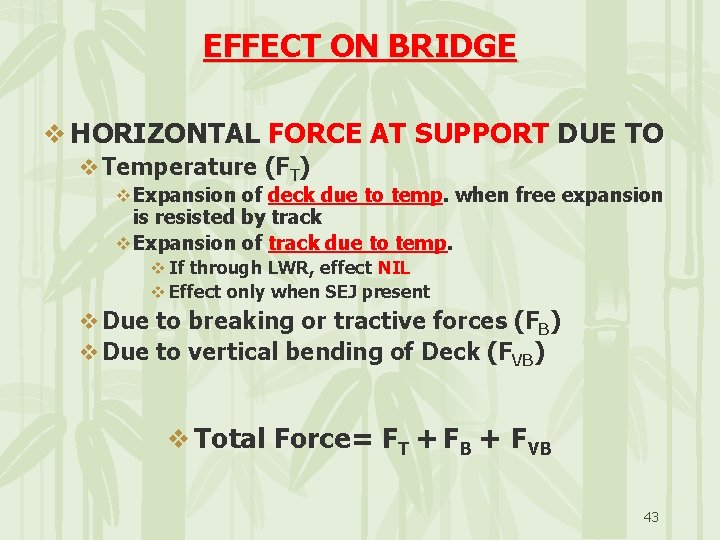
EFFECT ON BRIDGE v HORIZONTAL FORCE AT SUPPORT DUE TO v Temperature (FT) v Expansion of deck due to temp. when free expansion is resisted by track v Expansion of track due to temp. v If through LWR, effect NIL v Effect only when SEJ present v Due to breaking or tractive forces (FB) v Due to vertical bending of Deck (FVB) v Total Force= FT + FB + FVB 43
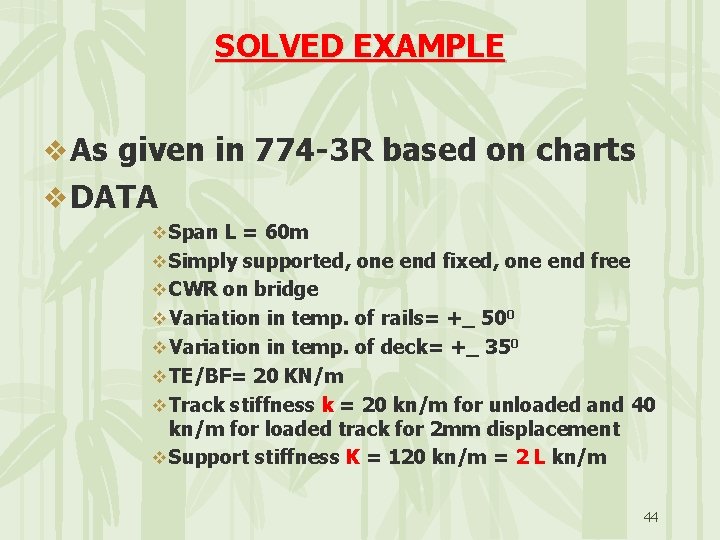
SOLVED EXAMPLE v As given in 774 -3 R based on charts v DATA v Span L = 60 m v Simply supported, one end fixed, one end free v CWR on bridge v Variation in temp. of rails= +_ 500 v Variation in temp. of deck= +_ 350 v TE/BF= 20 KN/m v Track stiffness k = 20 kn/m for unloaded and 40 kn/m for loaded track for 2 mm displacement v Support stiffness K = 120 kn/m = 2 L kn/m 44
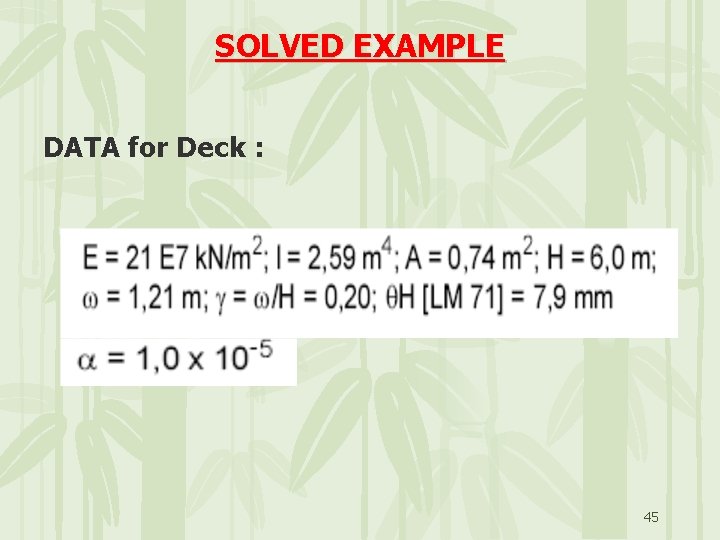
SOLVED EXAMPLE DATA for Deck : 45
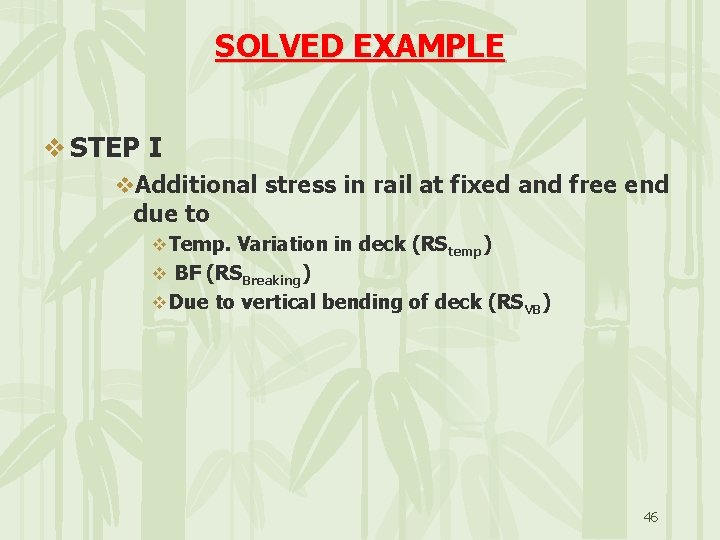
SOLVED EXAMPLE v STEP I v. Additional stress in rail at fixed and free end due to v Temp. Variation in deck (RStemp) v BF (RSBreaking) v Due to vertical bending of deck (RSVB) 46
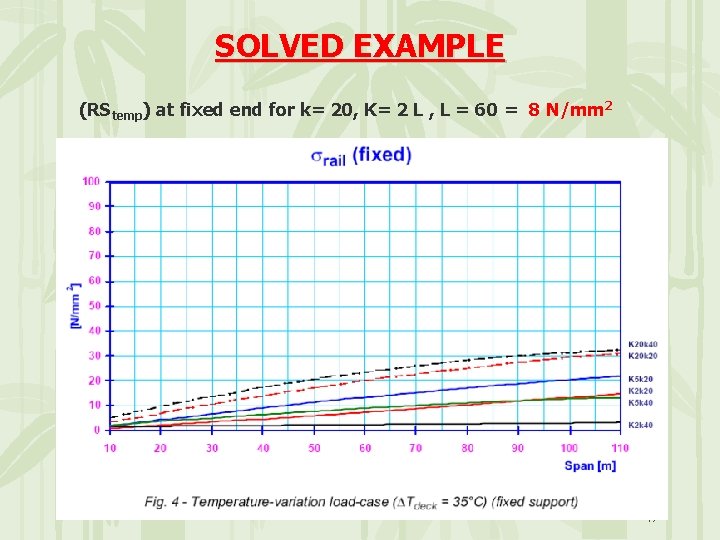
SOLVED EXAMPLE (RStemp) at fixed end for k= 20, K= 2 L , L = 60 = 8 N/mm 2 47
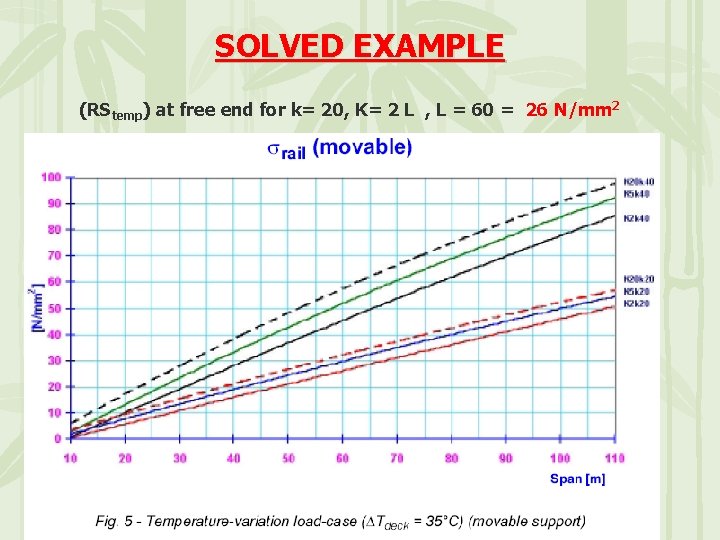
SOLVED EXAMPLE (RStemp) at free end for k= 20, K= 2 L , L = 60 = 26 N/mm 2 48
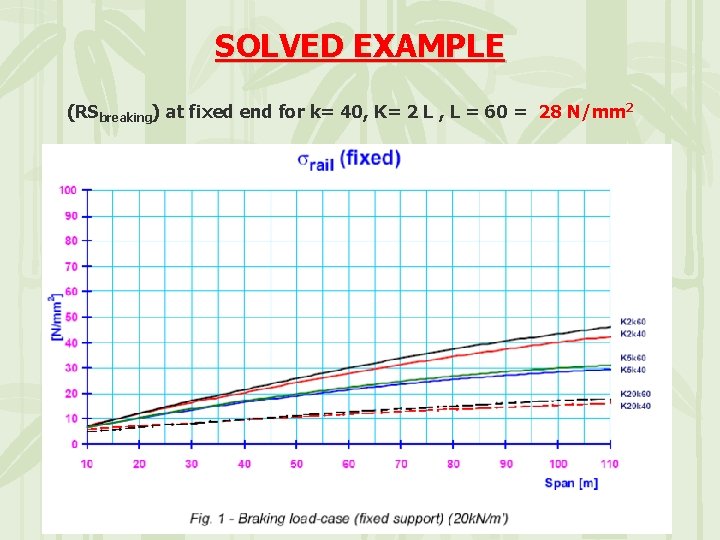
SOLVED EXAMPLE (RSbreaking) at fixed end for k= 40, K= 2 L , L = 60 = 28 N/mm 2 49
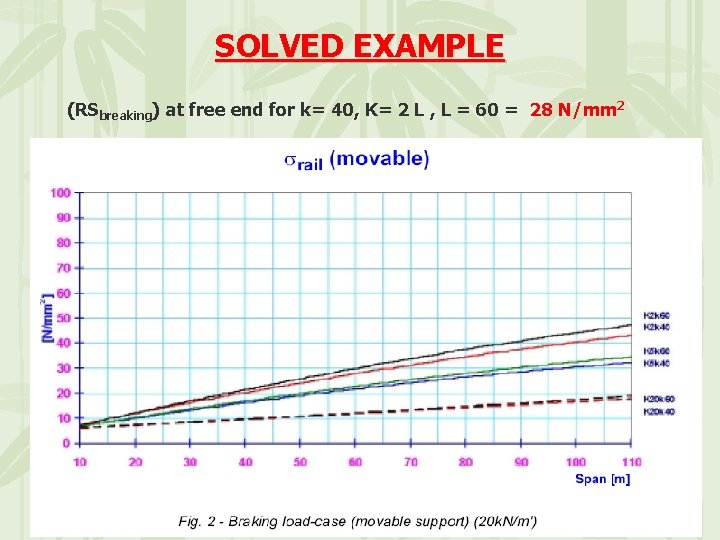
SOLVED EXAMPLE (RSbreaking) at free end for k= 40, K= 2 L , L = 60 = 28 N/mm 2 50
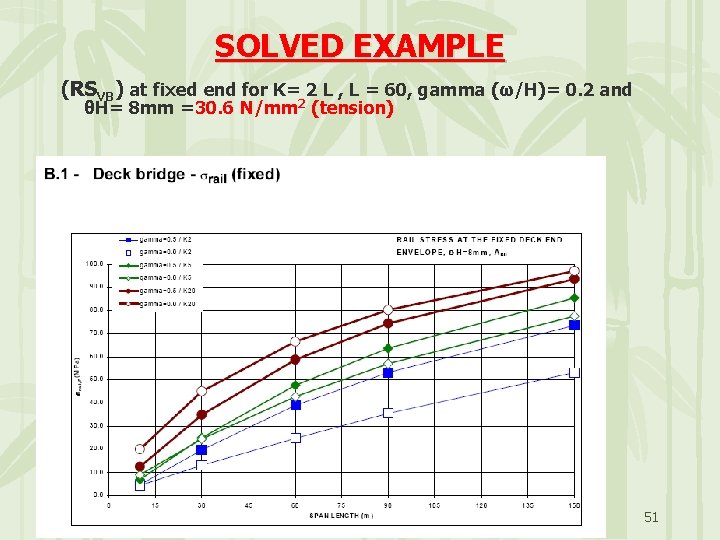
SOLVED EXAMPLE (RSVB) at fixed end for K= 2 L , L = 60, gamma (ω/H)= 0. 2 and θH= 8 mm =30. 6 N/mm 2 (tension) = 51
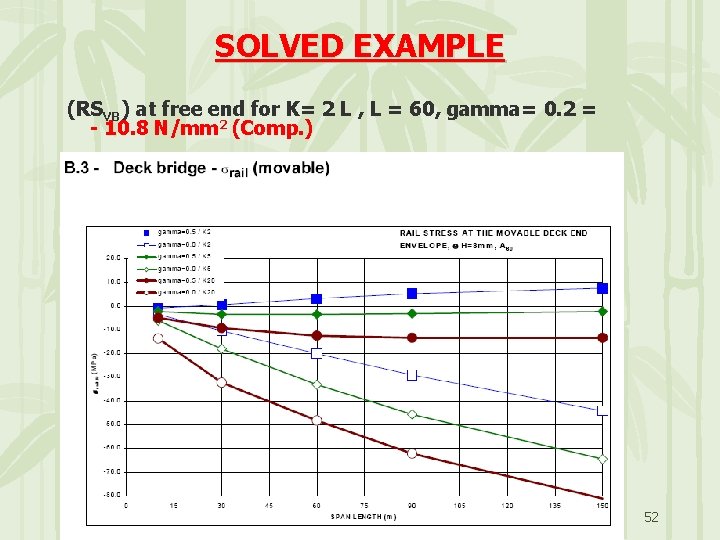
SOLVED EXAMPLE (RSVB) at free end for K= 2 L , L = 60, gamma= 0. 2 = - 10. 8 N/mm 2 (Comp. ) 52
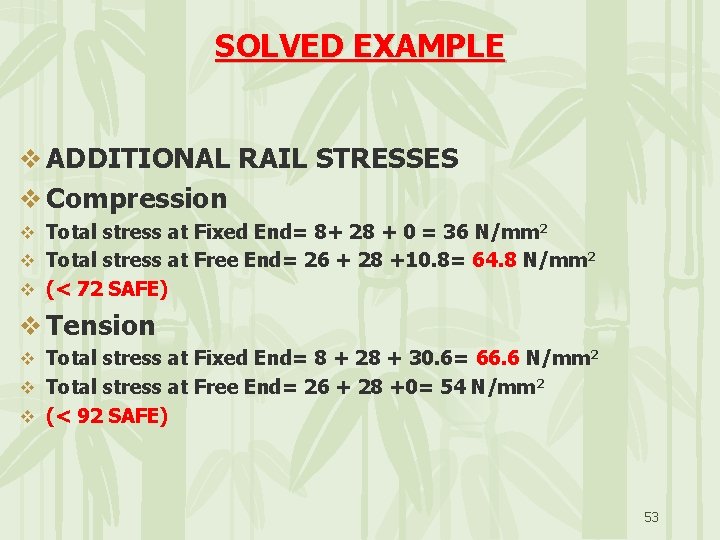
SOLVED EXAMPLE v ADDITIONAL RAIL STRESSES v Compression v Total stress at Fixed End= 8+ 28 + 0 = 36 N/mm 2 v Total stress at Free End= 26 + 28 +10. 8= 64. 8 N/mm 2 v (< 72 SAFE) v Tension v Total stress at Fixed End= 8 + 28 + 30. 6= 66. 6 N/mm 2 v Total stress at Free End= 26 + 28 +0= 54 N/mm 2 v (< 92 SAFE) 53
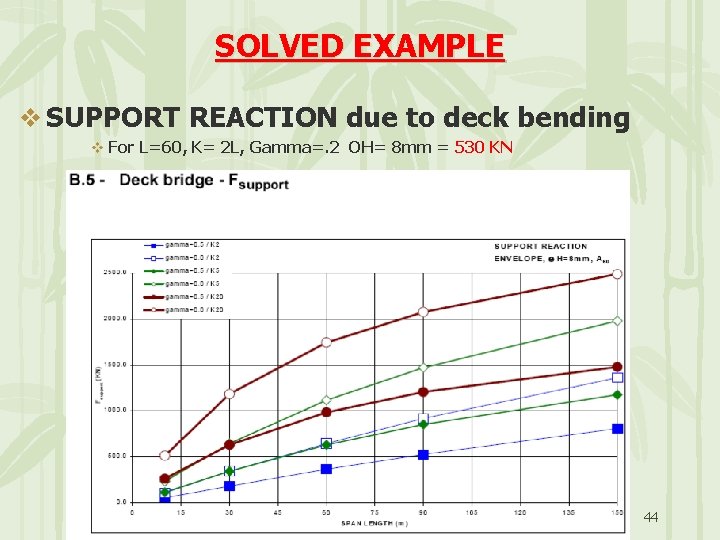
SOLVED EXAMPLE v SUPPORT REACTION due to deck bending v For L=60, K= 2 L, Gamma=. 2 OH= 8 mm = 530 KN 44
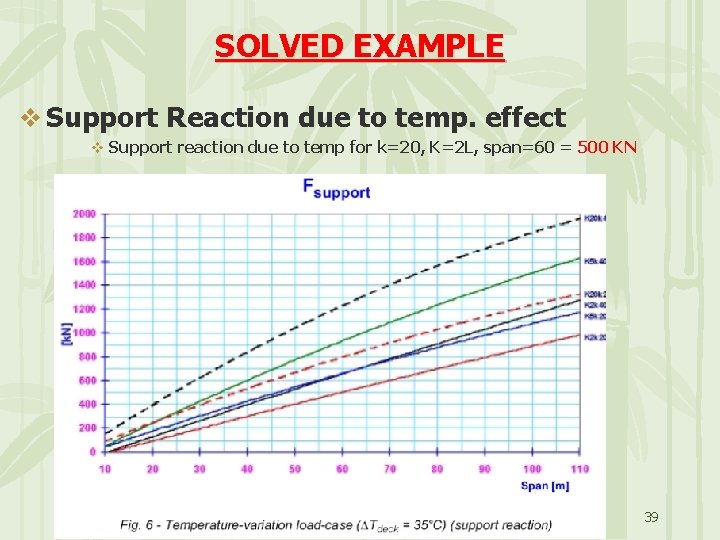
SOLVED EXAMPLE v Support Reaction due to temp. effect v Support reaction due to temp for k=20, K=2 L, span=60 = 500 KN 39
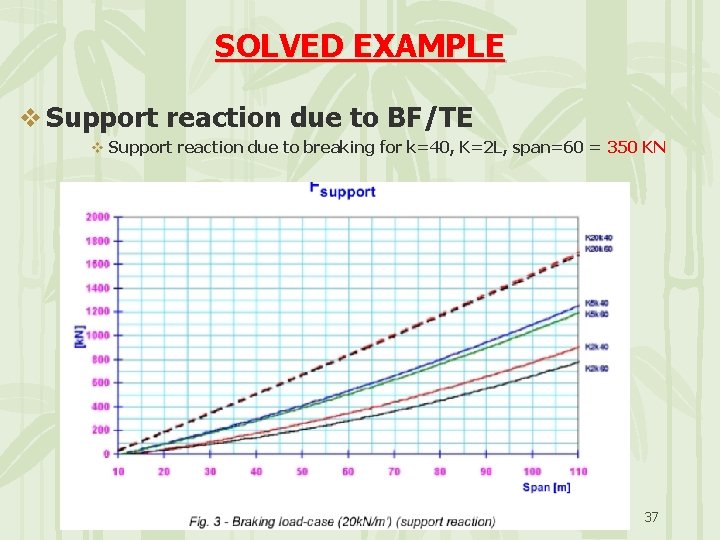
SOLVED EXAMPLE v Support reaction due to BF/TE v Support reaction due to breaking for k=40, K=2 L, span=60 = 350 KN 37
SOLVED EXAMPLE v Check for deck displacement due to BF v Deck displacement due to BF= Support reaction due to BF/Stiffness= 350/120= 2. 9 mm < 5 mm (OK) v Total Support Reaction v. Reaction due to deck bending= 530 KN v. Reaction due to temp= 500 KN v. Reaction due to breaking = 350 v. Total = 1380 KN v For any other data than given for variation in rail/deck temp, ϴH, rail section, BF, double track: corrections can be applied to results obtained from charts ( para 2. 1. 3 of UIC Code) 57

MULTISPAN BRIDGES v Calculations to be made v Simplified rules given in para 3. 3 of UIC Code and can be normally applied 58

59
- Slides: 51