
LVAD Wireless Power Transfer Test Rig P 12022
- Slides: 1
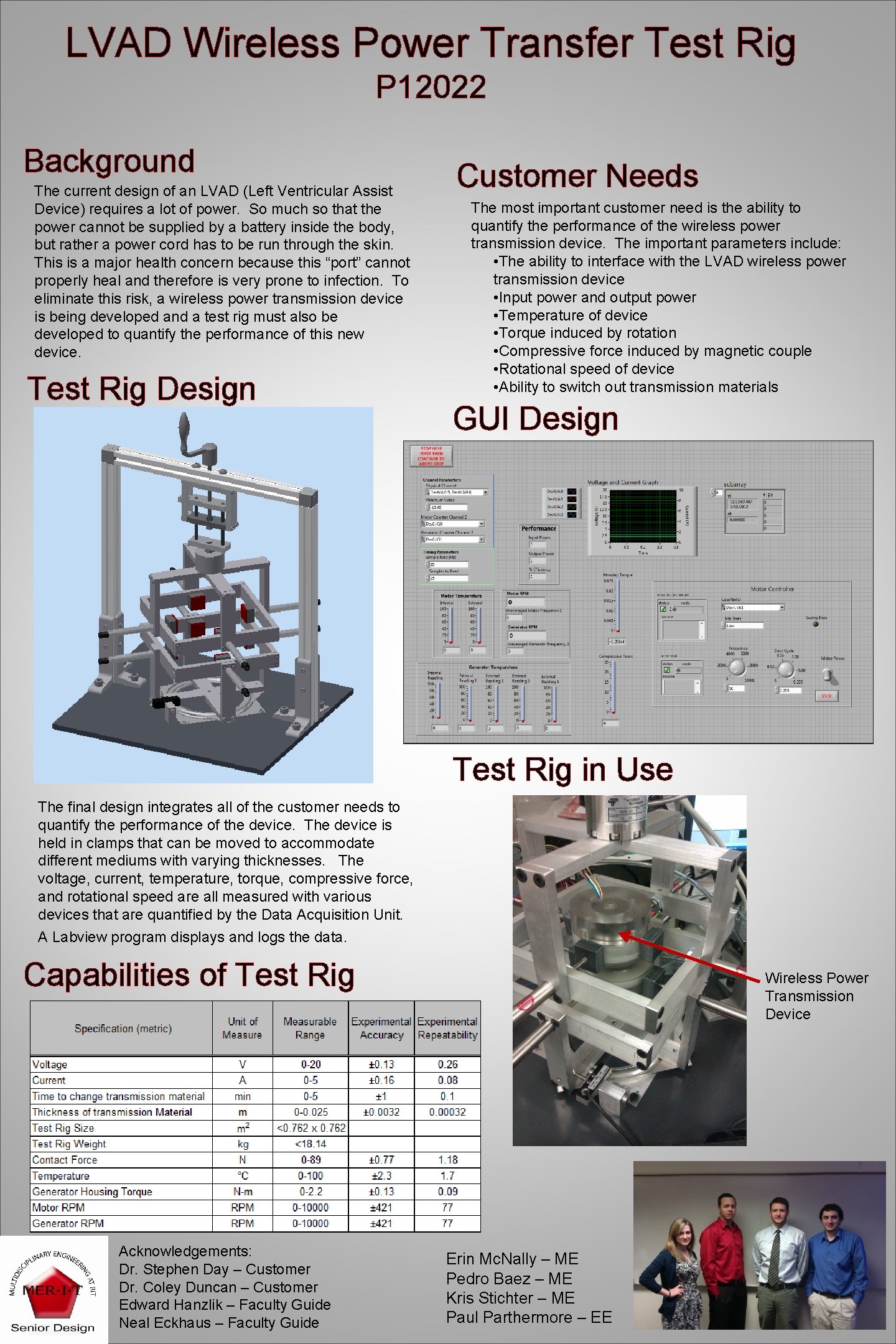
LVAD Wireless Power Transfer Test Rig P 12022 Background The current design of an LVAD (Left Ventricular Assist Device) requires a lot of power. So much so that the power cannot be supplied by a battery inside the body, but rather a power cord has to be run through the skin. This is a major health concern because this “port” cannot properly heal and therefore is very prone to infection. To eliminate this risk, a wireless power transmission device is being developed and a test rig must also be developed to quantify the performance of this new device. Test Rig Design Customer Needs The most important customer need is the ability to quantify the performance of the wireless power transmission device. The important parameters include: • The ability to interface with the LVAD wireless power transmission device • Input power and output power • Temperature of device • Torque induced by rotation • Compressive force induced by magnetic couple • Rotational speed of device • Ability to switch out transmission materials GUI Design Test Rig in Use The final design integrates all of the customer needs to quantify the performance of the device. The device is held in clamps that can be moved to accommodate different mediums with varying thicknesses. The voltage, current, temperature, torque, compressive force, and rotational speed are all measured with various devices that are quantified by the Data Acquisition Unit. A Labview program displays and logs the data. Capabilities of Test Rig Acknowledgements: Dr. Stephen Day – Customer Dr. Coley Duncan – Customer Edward Hanzlik – Faculty Guide Neal Eckhaus – Faculty Guide Wireless Power Transmission Device Erin Mc. Nally – ME Pedro Baez – ME Kris Stichter – ME Paul Parthermore – EE