
Lutron Wireless Sensors Sustainability Energy Savings for new
Lutron Wireless Sensors Sustainability & Energy Savings for new & existing spaces
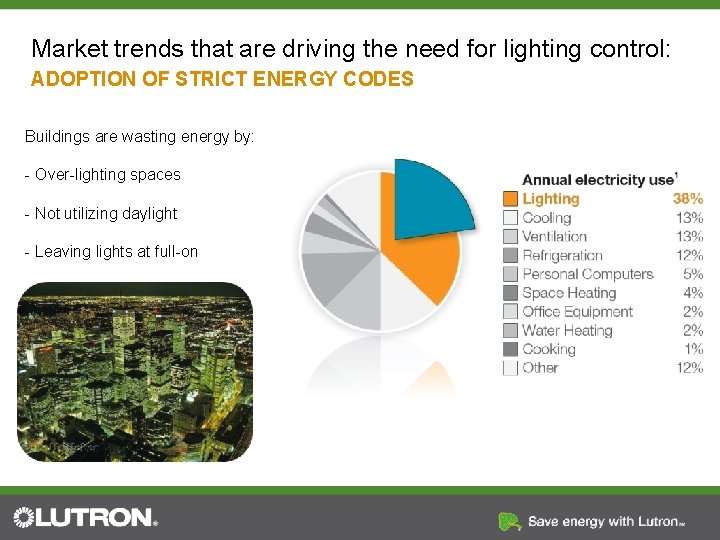
Market trends that are driving the need for lighting control: ADOPTION OF STRICT ENERGY CODES Buildings are wasting energy by: - Over-lighting spaces - Not utilizing daylight - Leaving lights at full-on
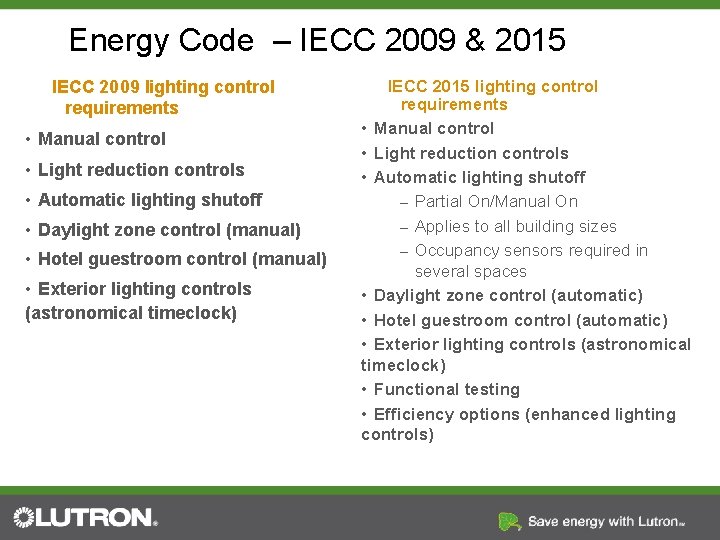
Energy Code – IECC 2009 & 2015 IECC 2009 lighting control requirements • Manual control • Light reduction controls • Automatic lighting shutoff • Daylight zone control (manual) • Hotel guestroom control (manual) • Exterior lighting controls (astronomical timeclock) IECC 2015 lighting control requirements • Manual control • Light reduction controls • Automatic lighting shutoff – Partial On/Manual On – Applies to all building sizes – Occupancy sensors required in several spaces • Daylight zone control (automatic) • Hotel guestroom control (automatic) • Exterior lighting controls (astronomical timeclock) • Functional testing • Efficiency options (enhanced lighting controls)
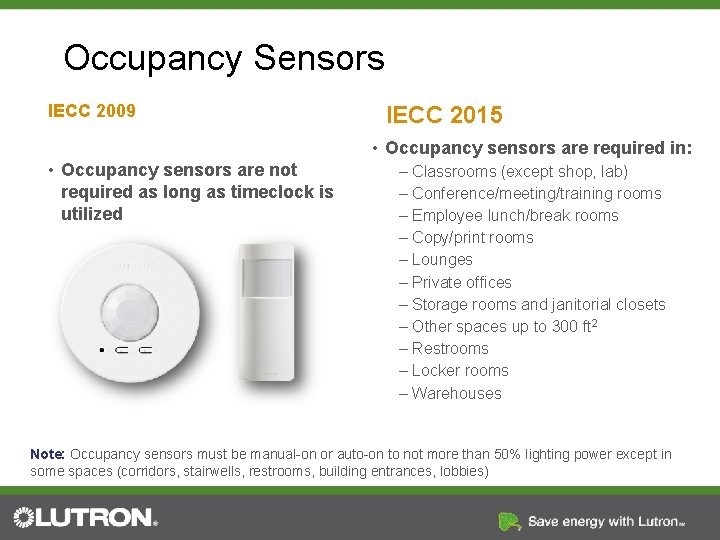
Occupancy Sensors IECC 2009 IECC 2015 • Occupancy sensors are required in: • Occupancy sensors are not required as long as timeclock is utilized – Classrooms (except shop, lab) – Conference/meeting/training rooms – Employee lunch/break rooms – Copy/print rooms – Lounges – Private offices – Storage rooms and janitorial closets – Other spaces up to 300 ft 2 – Restrooms – Locker rooms – Warehouses Note: Occupancy sensors must be manual-on or auto-on to not more than 50% lighting power except in some spaces (corridors, stairwells, restrooms, building entrances, lobbies)
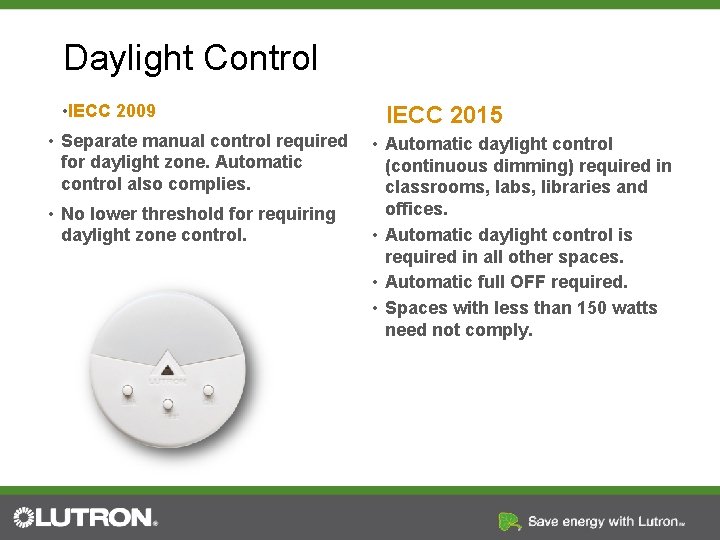
Daylight Control • IECC 2009 • Separate manual control required for daylight zone. Automatic control also complies. • No lower threshold for requiring daylight zone control. IECC 2015 • Automatic daylight control (continuous dimming) required in classrooms, labs, libraries and offices. • Automatic daylight control is required in all other spaces. • Automatic full OFF required. • Spaces with less than 150 watts need not comply.
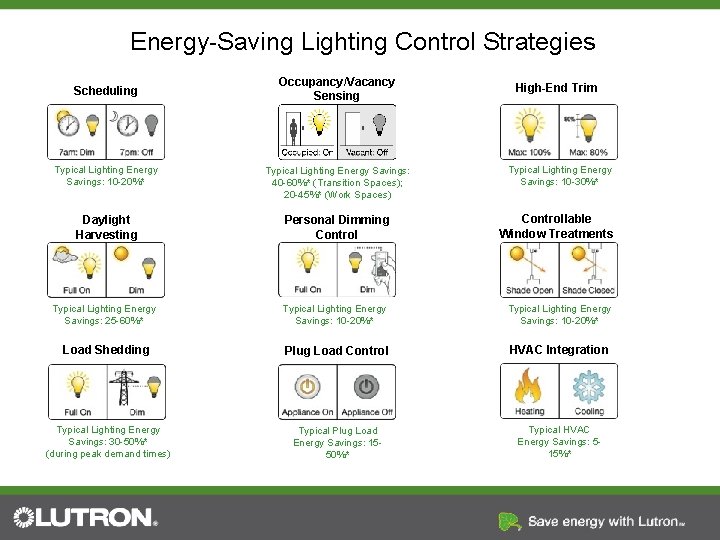
Energy-Saving Lighting Control Strategies Scheduling Occupancy/Vacancy Sensing High-End Trim Typical Lighting Energy Savings: 10 -20%* Typical Lighting Energy Savings: 40 -60%* (Transition Spaces); 20 -45%* (Work Spaces) Typical Lighting Energy Savings: 10 -30%* Daylight Harvesting Personal Dimming Controllable Window Treatments Typical Lighting Energy Savings: 25 -60%* Typical Lighting Energy Savings: 10 -20%* Load Shedding Plug Load Control HVAC Integration Typical Lighting Energy Savings: 30 -50%* (during peak demand times) Typical Plug Load Energy Savings: 1550%* Typical HVAC Energy Savings: 515%*
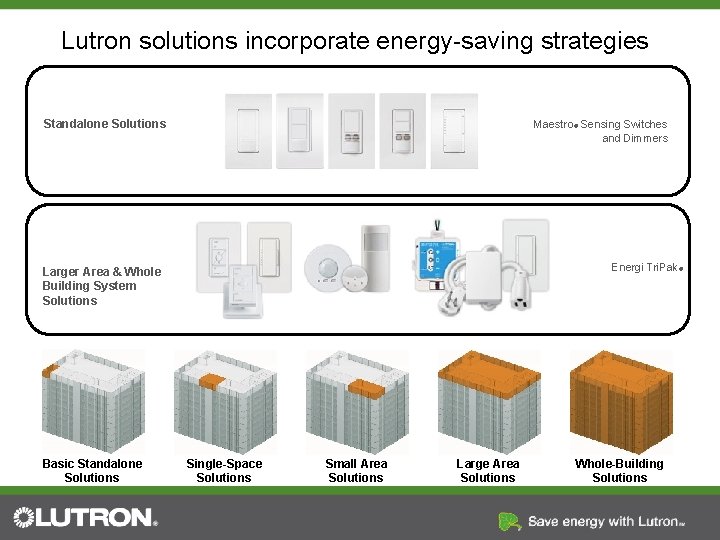
Lutron solutions incorporate energy-saving strategies Standalone Solutions Maestro® Sensing Switches and Dimmers Small Area System Solutions Energi Tri. Pak® Larger Area & Whole Building System Solutions Basic Standalone Solutions Single-Space Solutions Small Area Solutions Large Area Solutions Whole-Building Solutions
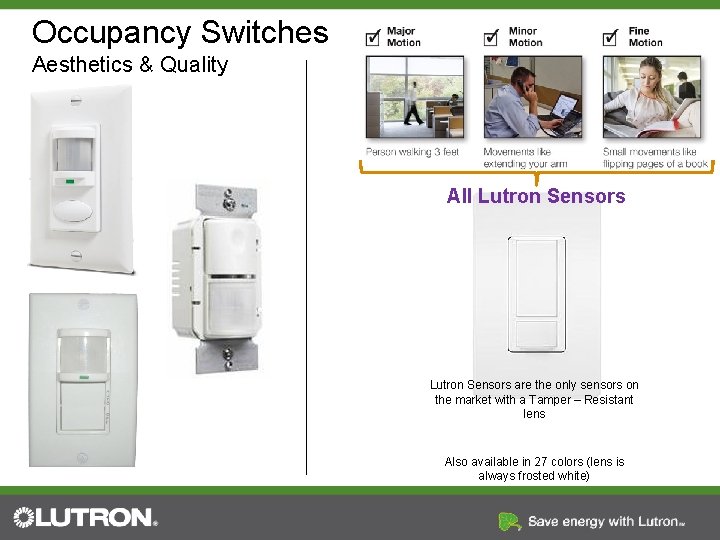
Occupancy Switches Aesthetics & Quality All Lutron Sensors are the only sensors on the market with a Tamper – Resistant lens Also available in 27 colors (lens is always frosted white)
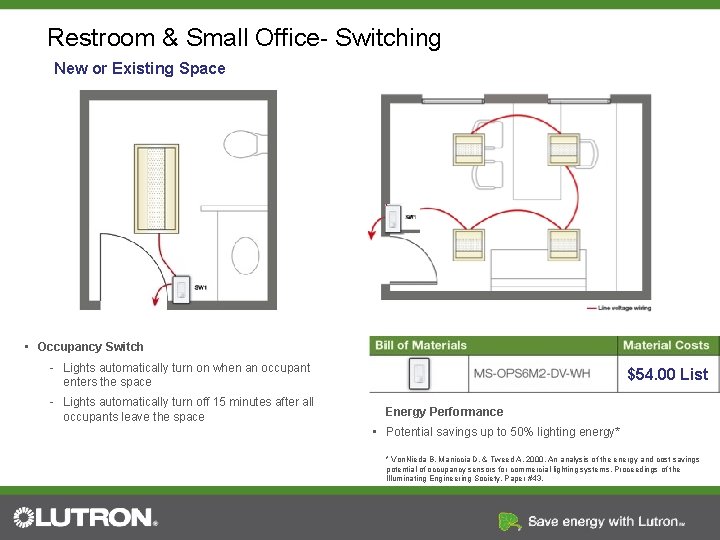
Restroom & Small Office- Switching New or Existing Space • Occupancy Switch - Lights automatically turn on when an occupant enters the space - Lights automatically turn off 15 minutes after all occupants leave the space $54. 00 List Energy Performance • Potential savings up to 50% lighting energy* * Von. Nieda B, Maniccia D, & Tweed A. 2000. An analysis of the energy and cost savings potential of occupancy sensors for commercial lighting systems. Proceedings of the Illuminating Engineering Society. Paper #43.
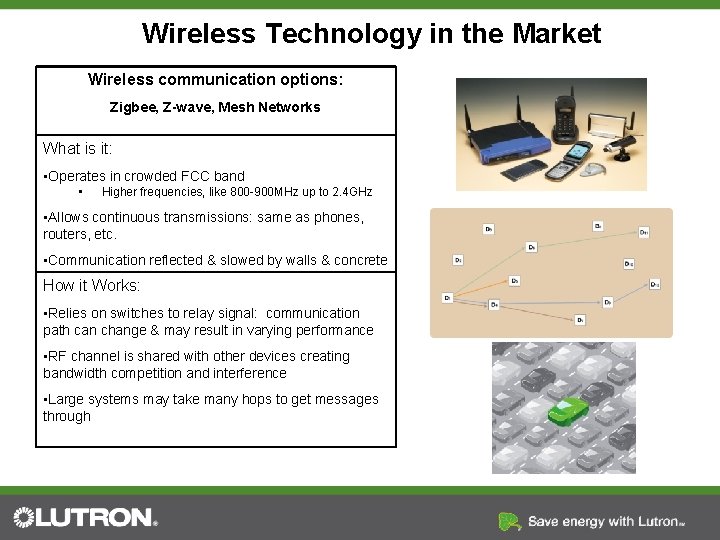
Wireless Technology in the Market Wireless communication options: Zigbee, Z-wave, Mesh Networks What is it: • Operates in crowded FCC band • Higher frequencies, like 800 -900 MHz up to 2. 4 GHz • Allows continuous transmissions: same as phones, routers, etc. • Communication reflected & slowed by walls & concrete How it Works: • Relies on switches to relay signal: communication path can change & may result in varying performance • RF channel is shared with other devices creating bandwidth competition and interference • Large systems may take many hops to get messages through
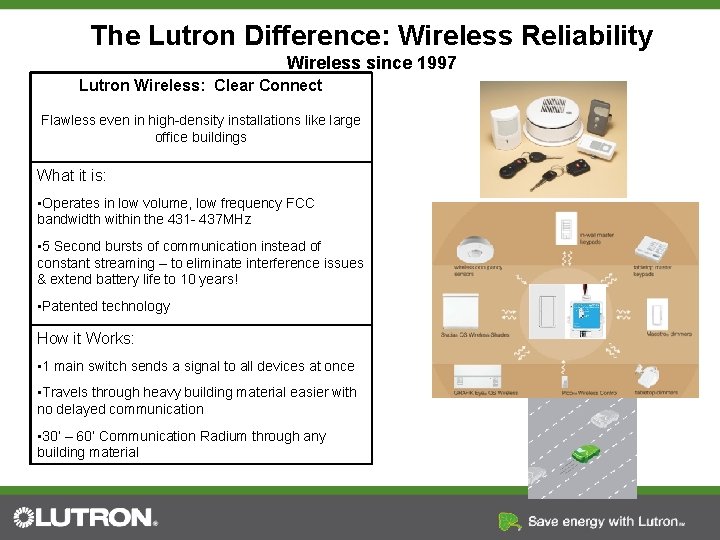
The Lutron Difference: Wireless Reliability Wireless since 1997 Lutron Wireless: Clear Connect Flawless even in high-density installations like large office buildings What it is: • Operates in low volume, low frequency FCC bandwidth within the 431 - 437 MHz • 5 Second bursts of communication instead of constant streaming – to eliminate interference issues & extend battery life to 10 years! • Patented technology How it Works: • 1 main switch sends a signal to all devices at once • Travels through heavy building material easier with no delayed communication • 30’ – 60’ Communication Radium through any building material
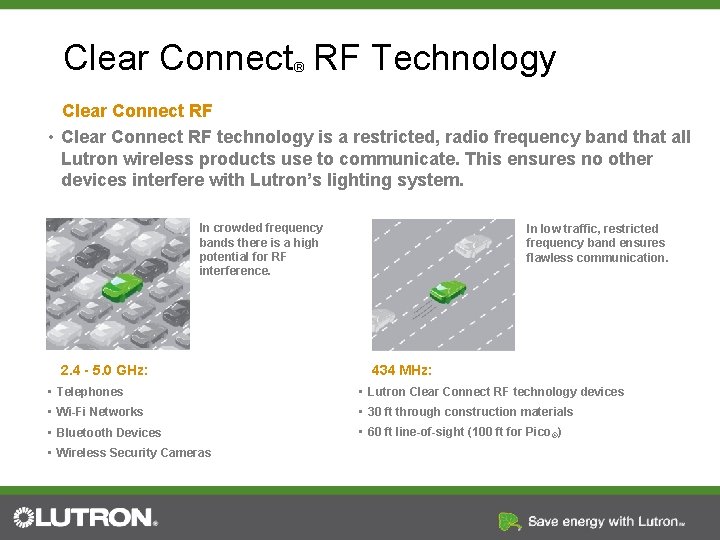
Clear Connect RF Technology ® Clear Connect RF • Clear Connect RF technology is a restricted, radio frequency band that all Lutron wireless products use to communicate. This ensures no other devices interfere with Lutron’s lighting system. In crowded frequency bands there is a high potential for RF interference. 2. 4 - 5. 0 GHz: In low traffic, restricted frequency band ensures flawless communication. 434 MHz: • Telephones • Lutron Clear Connect RF technology devices • Wi-Fi Networks • 30 ft through construction materials • Bluetooth Devices • 60 ft line-of-sight (100 ft for Pico ®) • Wireless Security Cameras
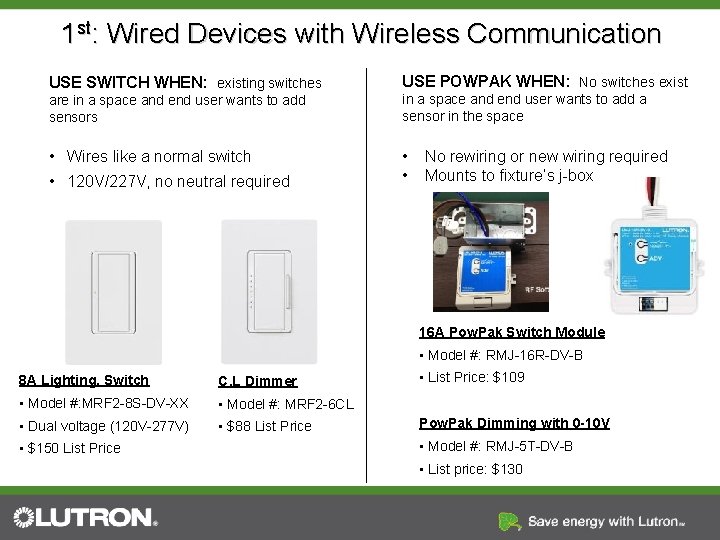
1 st: Wired Devices with Wireless Communication USE SWITCH WHEN: existing switches USE POWPAK WHEN: No switches exist are in a space and end user wants to add sensors in a space and end user wants to add a sensor in the space • Wires like a normal switch • • • 120 V/227 V, no neutral required No rewiring or new wiring required Mounts to fixture’s j-box 16 A Pow. Pak Switch Module • Model #: RMJ-16 R-DV-B 8 A Lighting, Switch C. L Dimmer • Model #: MRF 2 -8 S-DV-XX • Model #: MRF 2 -6 CL • Dual voltage (120 V-277 V) • $88 List Price • $150 List Price • List Price: $109 Pow. Pak Dimming with 0 -10 V • Model #: RMJ-5 T-DV-B • List price: $130
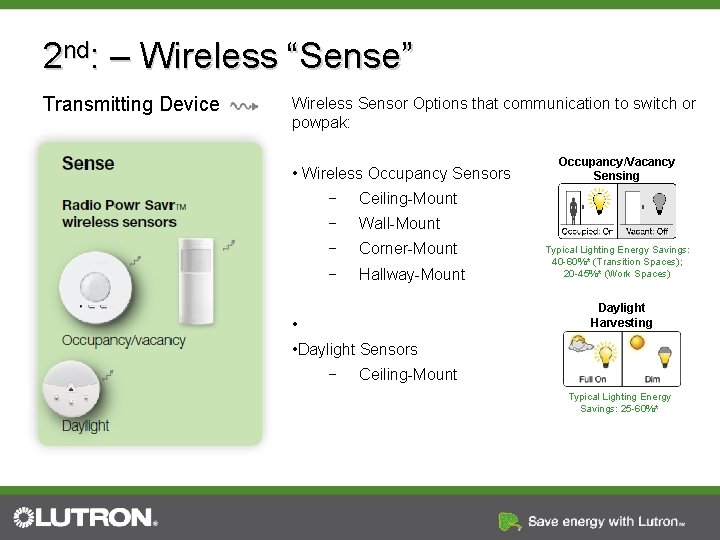
2 nd: – Wireless “Sense” Transmitting Device Wireless Sensor Options that communication to switch or powpak: • Wireless Occupancy Sensors − Ceiling-Mount − Wall-Mount − Corner-Mount − Hallway-Mount Occupancy/Vacancy Sensing Typical Lighting Energy Savings: 40 -60%* (Transition Spaces); 20 -45%* (Work Spaces) Daylight Harvesting • • Daylight Sensors − Ceiling-Mount Typical Lighting Energy Savings: 25 -60%*
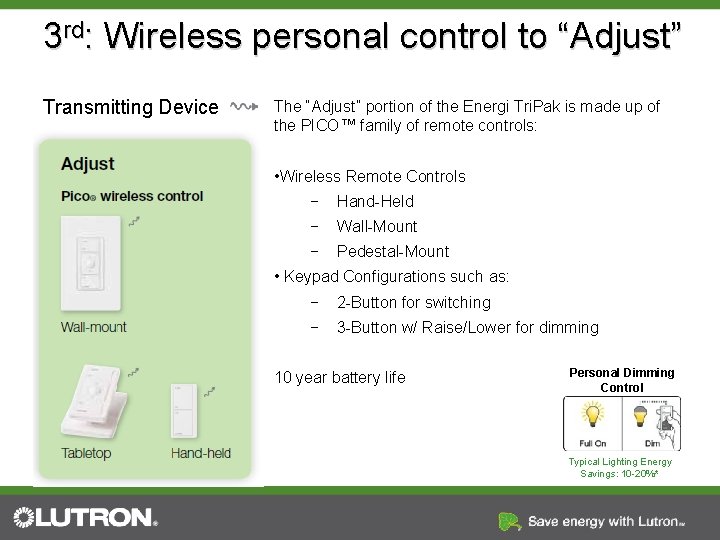
3 rd: Wireless personal control to “Adjust” Transmitting Device The “Adjust” portion of the Energi Tri. Pak is made up of the PICO™ family of remote controls: • Wireless Remote Controls − Hand-Held − Wall-Mount − Pedestal-Mount • Keypad Configurations such as: − 2 -Button for switching − 3 -Button w/ Raise/Lower for dimming 10 year battery life Personal Dimming Control Typical Lighting Energy Savings: 10 -20%*
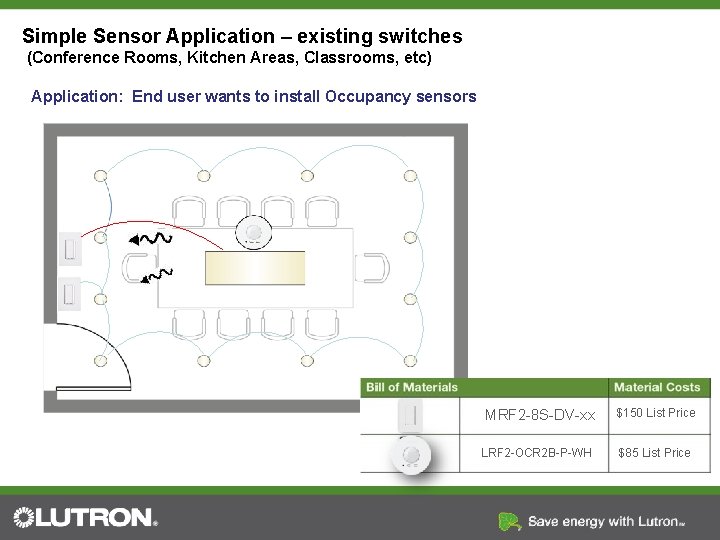
Simple Sensor Application – existing switches (Conference Rooms, Kitchen Areas, Classrooms, etc) Application: End user wants to install Occupancy sensors MRF 2 -8 S-DV-xx $150 List Price LRF 2 -OCR 2 B-P-WH $85 List Price
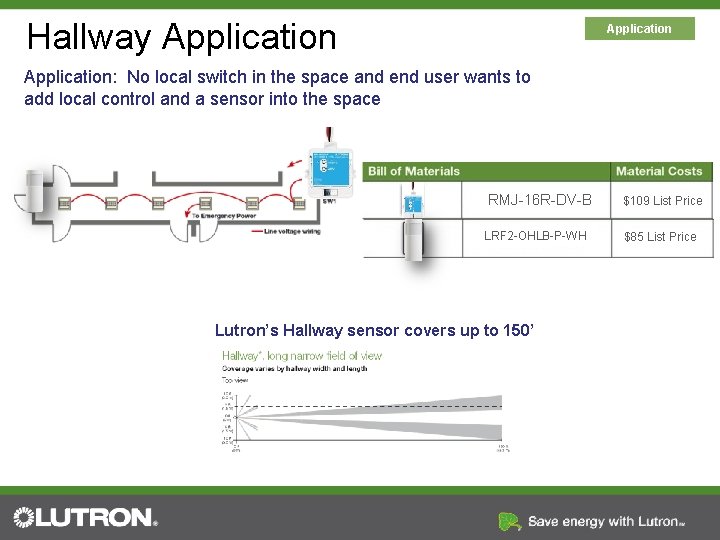
Hallway Application: No local switch in the space and end user wants to add local control and a sensor into the space RMJ-16 R-DV-B $109 List Price LRF 2 -OHLB-P-WH $85 List Price Lutron’s Hallway sensor covers up to 150’
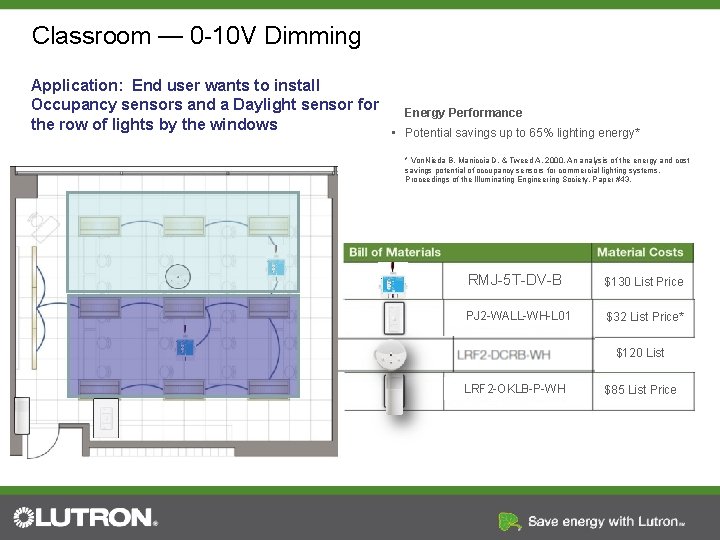
Classroom — 0 -10 V Dimming Application: End user wants to install Occupancy sensors and a Daylight sensor for the row of lights by the windows Energy Performance • Potential savings up to 65% lighting energy* * Von. Nieda B, Maniccia D, & Tweed A. 2000. An analysis of the energy and cost savings potential of occupancy sensors for commercial lighting systems. Proceedings of the Illuminating Engineering Society. Paper #43. RMJ-5 T-DV-B $130 List Price PJ 2 -WALL-WH-L 01 $32 List Price* $120 List LRF 2 -OKLB-P-WH $85 List Price
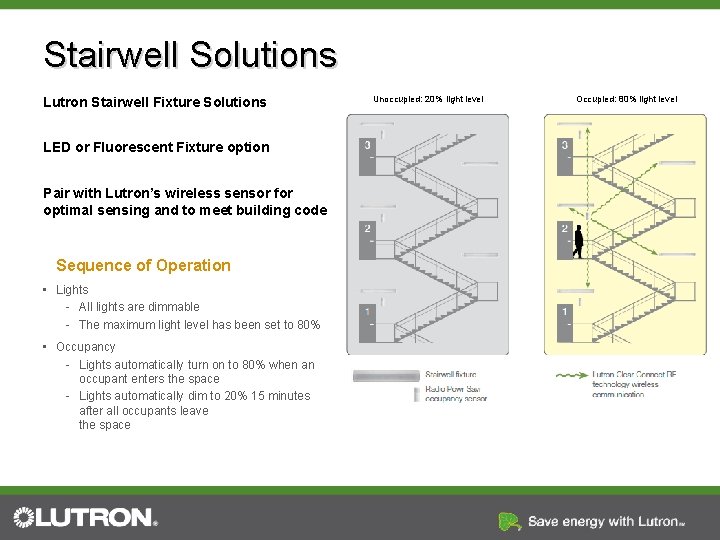
Stairwell Solutions Lutron Stairwell Fixture Solutions LED or Fluorescent Fixture option Pair with Lutron’s wireless sensor for optimal sensing and to meet building code Sequence of Operation • Lights - All lights are dimmable - The maximum light level has been set to 80% • Occupancy - Lights automatically turn on to 80% when an occupant enters the space - Lights automatically dim to 20% 15 minutes after all occupants leave the space Unoccupied: 20% light level Occupied: 80% light level
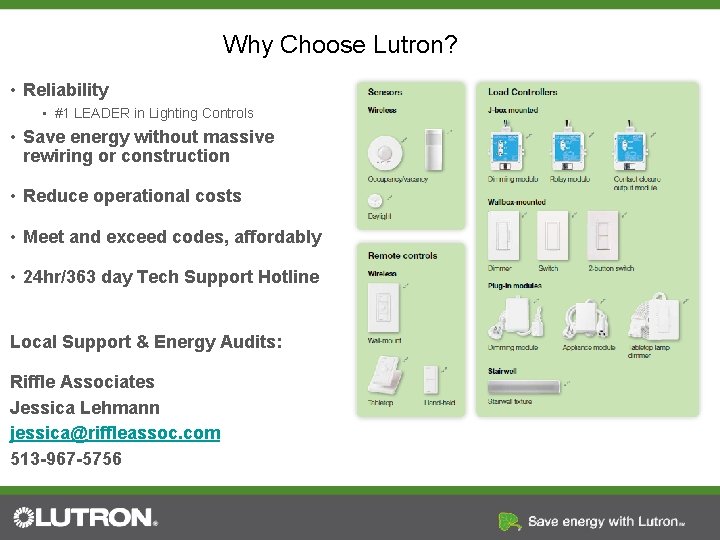
Why Choose Lutron? • Reliability • #1 LEADER in Lighting Controls • Save energy without massive rewiring or construction • Reduce operational costs • Meet and exceed codes, affordably • 24 hr/363 day Tech Support Hotline Local Support & Energy Audits: Riffle Associates Jessica Lehmann jessica@riffleassoc. com 513 -967 -5756
- Slides: 20