
LUSTRE OVERVIEW Nirmal Seenu Fermilab Lustre Features Shared

LUSTRE OVERVIEW Nirmal Seenu Fermilab
Lustre Features Shared POSIX file system Key Characteristics � Aggregates many servers into one file system � Scales I/O throughput and capacity � Handles 10, 000’s of clients Built-in storage networking, including routing No special hardware required � Any block device is supported as backend storage Open source
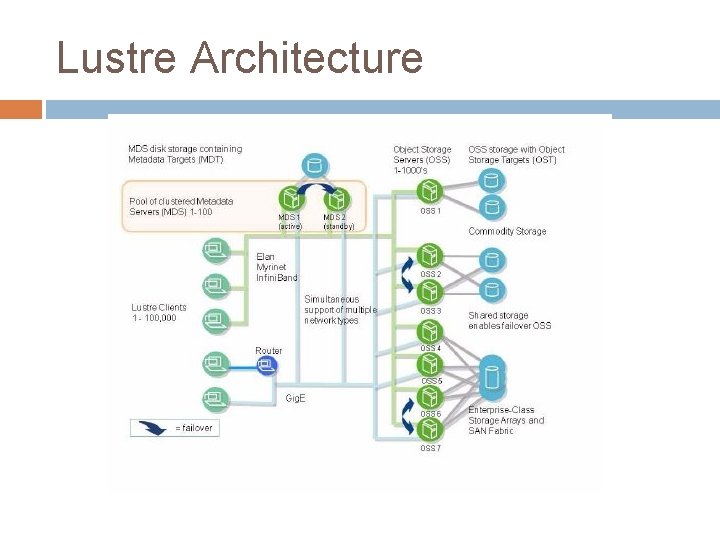
Lustre Components Management Server(MGS) � The MGS stores configuration information for all Lustre file systems in a cluster � Each Lustre target contacts the MGS to provide information, and Lustre clients contact the MGS to retrieve information � The MGS requires its own disk for storage, but it could be collocated with a MDT � Multiple Lustre file systems can be managed by a single MGS
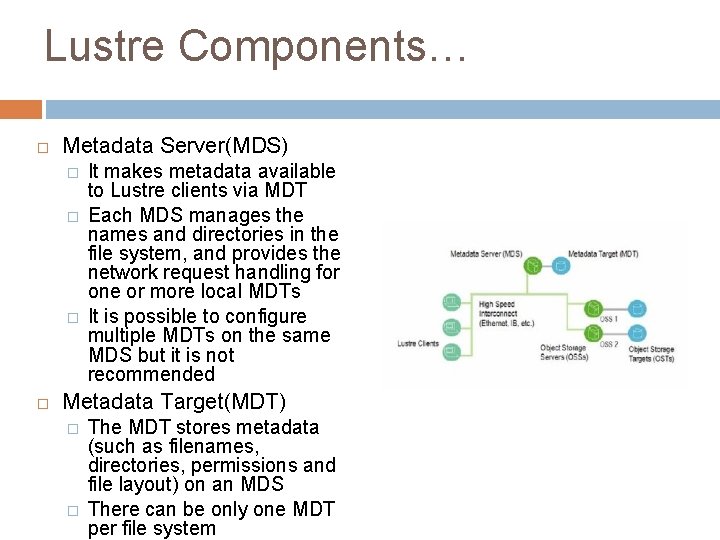
Lustre Components… Metadata Server(MDS) � � � It makes metadata available to Lustre clients via MDT Each MDS manages the names and directories in the file system, and provides the network request handling for one or more local MDTs It is possible to configure multiple MDTs on the same MDS but it is not recommended Metadata Target(MDT) � � The MDT stores metadata (such as filenames, directories, permissions and file layout) on an MDS There can be only one MDT per file system
Lustre Components… Object Storage Servers(OSS) � The OSS provides file I/O service, and network request handling for one or more local OSTs Object Storage Target(OST) � The OST stores file data � A single Lustre file system can have multiple OSTs, each serving a subset of file data � To optimize performance, a file may be spread over many OSTs. A Logical Object Volume (LOV), manages file striping across many OSTs
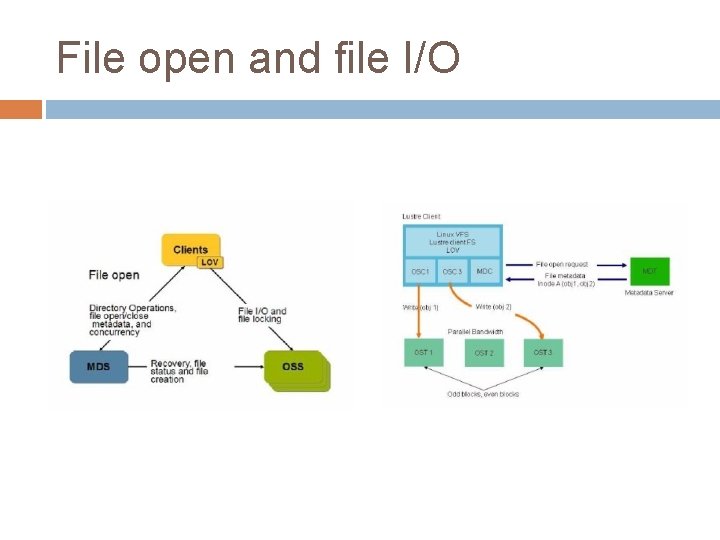
Lustre Components… Lustre Clients � The Lustre client software consists of an interface between the Linux Virtual File System and the Lustre servers � Each target has a client counterpart: Metadata Client (MDC), Object Storage Client (OSC), and a Management Client (MGC) � A group of OSCs are wrapped into a single LOV, and they provide transparent access to the file system � Clients which mount the Lustre file system see a single, coherent, synchronized namespace at all times � Different clients can write to different parts of the same file at the same time, while other clients can read from the file

Lustre Components… Lustre Networking (LNET) � It is an API that handles metadata and file I/O data for file system servers and clients � It supports multiple, heterogeneous interfaces on clients and servers � Lustre Network Drivers (LNDs) are available for a number of commodity and high-end networks, including TCP/IP, Infiniband, Myrinet (MX and GM) and Cray
File open and file I/O
Additional Lustre Features Interoperability � � � Access control list (ACL) � � The Lustre security model follows a UNIX file system, enhanced with POSIX ACLs It supports root squash and restriction of connections to privileged ports Quotas � Lustre runs on many CPU architectures (x 86, IA-64, x 86 -64 (EM 64 and AMD 64, Power PC architectures [clients only], and mixed-endian clusters; clients and servers are interoperable between these platforms Lustre supports various distributions of Linux Lustre provides interoperability between adjacent software releases. Versions 1. 4. x (x > 7), 1. 6. x, and 1. 8. x can interoperate with mixed clients and servers User and group quotas OSS addition � The capacity of a Lustre file system and aggregate cluster bandwidth can be increased without interrupting any operations by adding a new OSS with OSTs to the cluster
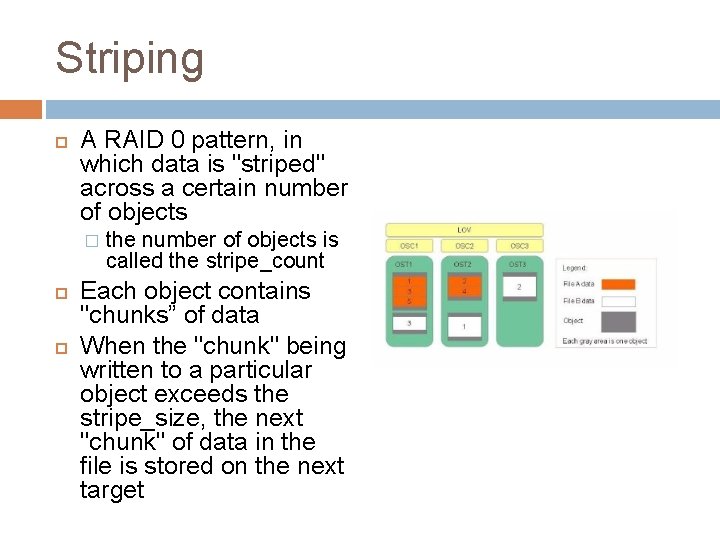
Striping A RAID 0 pattern, in which data is "striped" across a certain number of objects � the number of objects is called the stripe_count Each object contains "chunks” of data When the "chunk" being written to a particular object exceeds the stripe_size, the next "chunk" of data in the file is stored on the next target
Stripping… Controlled striping � The file system has a default setting that is determined at format time � The default stripe count and stripe size can be tuned Directories can be given an attribute so that all files under that directory (and recursively under any sub-directory) have a striping pattern determined by the attribute Utilities and application libraries are provided to control the striping of an individual file at creation time � To change the stripe of a current file Create a new directory with required stripe setting Copy the file into the new directory Move it back to the original location
Installing Lustre Servers Download the Lustre patched kernel from SUN’s website. Typical installation needs the following rpms � � � � kernel-lustre-smp-2. 6. 18 -92. 1. 17. el 5_lustre. 1. 6. 7. 1. x 86_64 kernel-lustre-source-2. 6. 18 -92. 1. 17. el 5_lustre. 1. 6. 7. 1. x 86_64 lustre-modules-1. 6. 7. 1 -2. 6. 18_92. 1. 17. el 5_lustre. 1. 6. 7. 1 smp. x 86_64 lustre-ldiskfs-3. 0. 7. 1 -2. 6. 18_92. 1. 17. el 5_lustre. 1. 6. 7. 1 smp. x 86_64 lustre-source-1. 6. 7. 1 -2. 6. 18_92. 1. 17. el 5_lustre. 1. 6. 7. 1 smp. x 86_64 kernel-ib-1. 3. 1 -2. 6. 18_92. 1. 17. el 5_lustre. 1. 6. 7. 1 smp. x 86_64 kernel-ib-devel-1. 3. 1 -2. 6. 18_92. 1. 17. el 5_lustre. 1. 6. 7. 1 smp. x 86_64 lustre-1. 6. 7. 1 -2. 6. 18_92. 1. 17. el 5_lustre. 1. 6. 7. 1 smp. x 86_64 Patch the vanilla kernel. org kernel � � � Download the supported kernel. org kernel Download the Lustre Source Install quilt and patch the kernel as described in Lustre Manual
Formatting Lustre Servers Format the MGS partition � Its recommended that you create a small(1 GB) MGS partition � � mkfs. lustre --mgs --mkfsoptions="-m 0“ /dev/md 2 tune 2 fs -m 0 -i 0 -c 0 /dev/md 2 Format the MDT partition � � Multiple Lustre file systems can be managed by a single MGS mkfs. lustre --fsname=lqcdproj --mdt --mgsnode=iblustre 1@tcp 1 -param lov. stripecount=1 --mkfsoptions="-m 0" /dev/lustre 1_volume/mds_lv tune 2 fs -m 0 -i 0 -c 0 /dev/lustre 1_volume/mds_lv Format all the OSTs � � mkfs. lustre --fsname=lqcdproj --mkfsoptions="-m 0" --ost -mgsnode=iblustre 1@tcp 1 --param ost. quota_type=ug /dev/sdc 1 tune 2 fs -m 0 -i 0 -c 0 /dev/sdc 1
Lustre Server and Client Options The default options are specified as a part of mkfs. lustre command � � The run time options are specified in /etc/modprobe. conf � � options lnet networks=tcp(eth 1) options ksocklnd tx_buffer_size=1073741824 rx_buffer_size=1073741824 enable_irq_affinity=1 Lustre Client mount options are specified in /etc/fstab � It can be tuned later with tunefs. lustre if needed tune 2 fs can be used for ext 3 tuning lustre 3@tcp: /lustre defaults, flock, _netdev Live parameter tuning can be done using the lctl command � � lctl conf_param lustre. sys. timeout=600 These changes get pushed out to all the clients and they are persistent
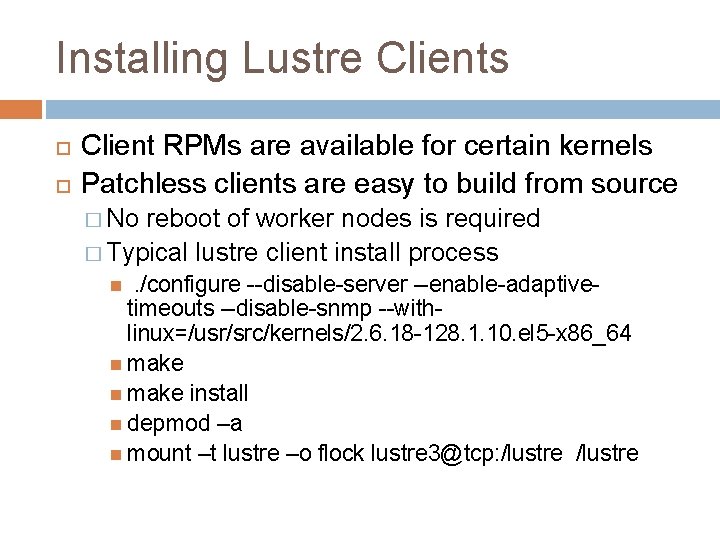
Installing Lustre Clients Client RPMs are available for certain kernels Patchless clients are easy to build from source � No reboot of worker nodes is required � Typical lustre client install process. /configure --disable-server --enable-adaptivetimeouts --disable-snmp --withlinux=/usr/src/kernels/2. 6. 18 -128. 1. 10. el 5 -x 86_64 make install depmod –a mount –t lustre –o flock lustre 3@tcp: /lustre
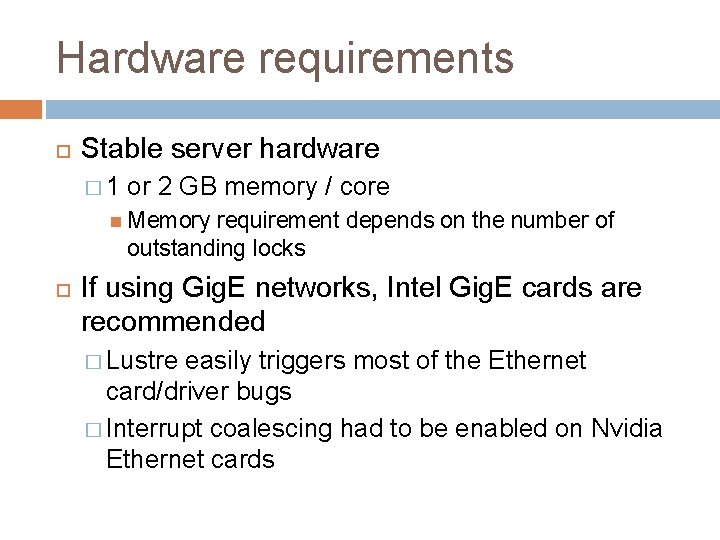
Hardware requirements Stable server hardware � 1 or 2 GB memory / core Memory requirement depends on the number of outstanding locks If using Gig. E networks, Intel Gig. E cards are recommended � Lustre easily triggers most of the Ethernet card/driver bugs � Interrupt coalescing had to be enabled on Nvidia Ethernet cards
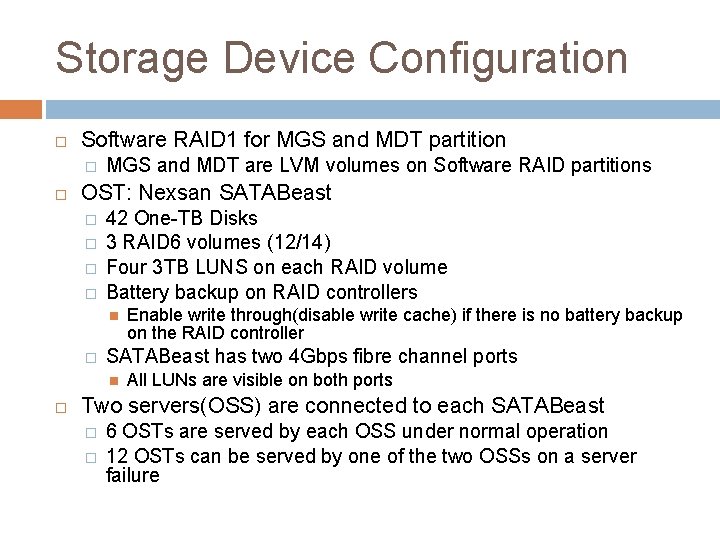
Storage Device Configuration Software RAID 1 for MGS and MDT partition � MGS and MDT are LVM volumes on Software RAID partitions OST: Nexsan SATABeast � � 42 One-TB Disks 3 RAID 6 volumes (12/14) Four 3 TB LUNS on each RAID volume Battery backup on RAID controllers � SATABeast has two 4 Gbps fibre channel ports Enable write through(disable write cache) if there is no battery backup on the RAID controller All LUNs are visible on both ports Two servers(OSS) are connected to each SATABeast � � 6 OSTs are served by each OSS under normal operation 12 OSTs can be served by one of the two OSSs on a server failure
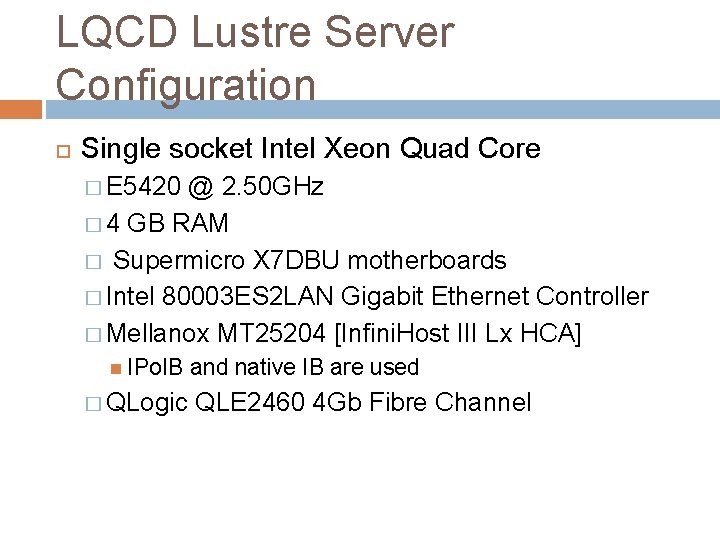
LQCD Lustre Server Configuration Single socket Intel Xeon Quad Core � E 5420 @ 2. 50 GHz � 4 GB RAM � Supermicro X 7 DBU motherboards � Intel 80003 ES 2 LAN Gigabit Ethernet Controller � Mellanox MT 25204 [Infini. Host III Lx HCA] IPo. IB � QLogic and native IB are used QLE 2460 4 Gb Fibre Channel
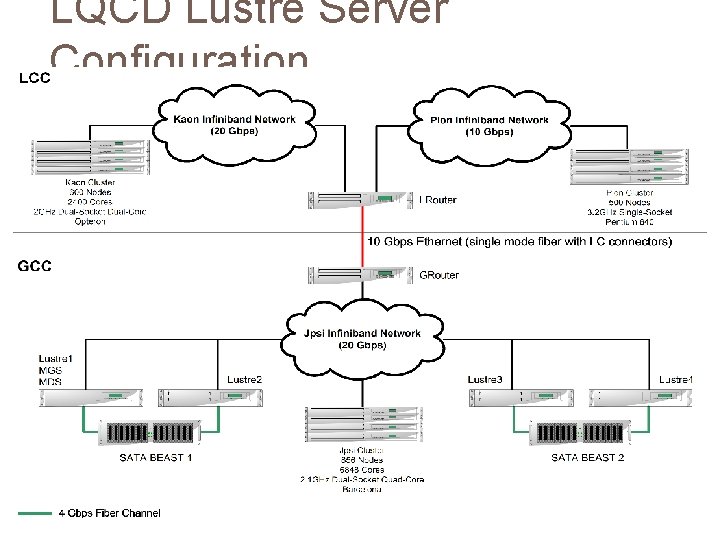
LQCD Lustre Server Configuration
CC Lustre Server Configuration Dual socket AMD Barcelona Quad Core � AMD Opteron 2350 @ 2 GHz � 16 GB RAM � Supermicro H 8 DMT motherboards � n. Vidia MCP 55 Ethernet � QLogic QLE 2460 4 Gb Fibre Channel
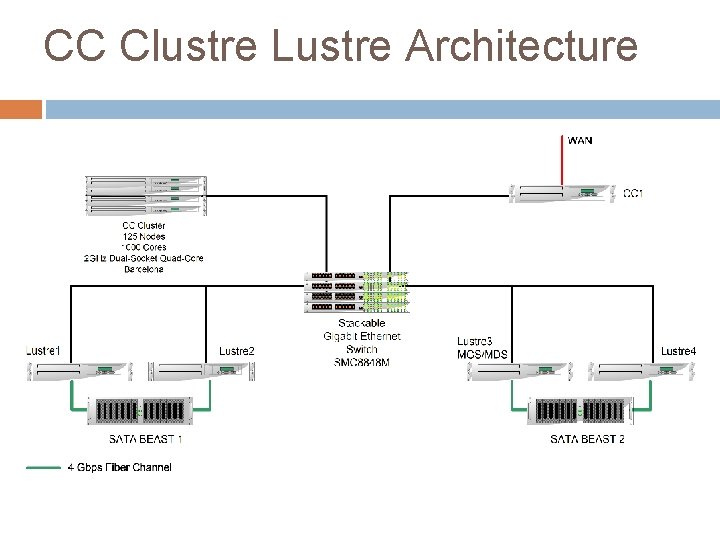
CC Clustre Lustre Architecture
Backup Metadata backup � Our Metadata servers are 40 GB(unformatted) in size � Create the LVM Snapshots � /bin/dd if=/dev/lustre 1_volume/mdtsnapshot | gzip -c > /mnt/mdtbackup/mdt-backup. img. gz Remove the Snapshot /usr/sbin/lvcreate -L 40 G -s -n mdtsnapshot /dev/lustre 1_volume/mds_lv Create the Backup Image for MDT � The unused portions of the disk was ‘zero’ed out to enable better compression dd if=/dev/zero of=/mnt/mdt/tmp/gbfile bs=128 k count=8192 /usr/sbin/lvremove -f /dev/lustre 1_volume/mdtsnapshot >> $LOGFILE 2>&1 User data Backup � � Its hard to take a valid/consistent snapshot across all OSTs Done from a lustre client using regular backup tools
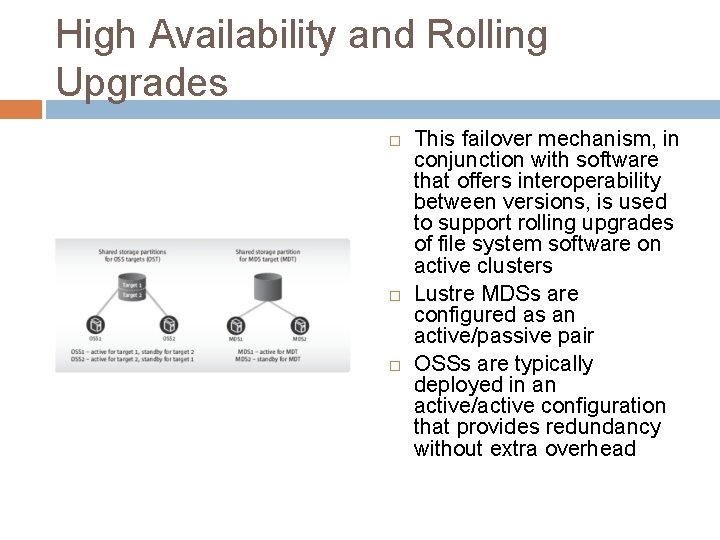
High Availability and Rolling Upgrades This failover mechanism, in conjunction with software that offers interoperability between versions, is used to support rolling upgrades of file system software on active clusters Lustre MDSs are configured as an active/passive pair OSSs are typically deployed in an active/active configuration that provides redundancy without extra overhead
Scalability and Performance LQCD - Lustre file system has ~2000 clients running with IPo. IB without any problem � Mounting ~2000 clients takes a few seconds � Un-mounting clients takes a little longer depending on the usage pattern on the clients � Performance is limited by the amount of data that can be transferred in and out of SATABeast CC – Lustre file system � Performance is limited by the Gig. E network
Data Safety and Replication The client-OST connection guarantees data integrity Clients caches transactions and replays failed transactions if needed Client cache is released on write acknowledgement from the MDS No support for data replication. It might be available in the future versions
Monitoring and Admin tools Statistics and health information is available in the /proc file system on Lustre Server and Clients: � /proc/sys/lustre � /proc/fs/lustre “lfs check servers” list the status of all servers Checking for the presence of a file on the lustre client seems to be sufficient in most cases. Periodic checking for “Call Trace” in the dmesg output.
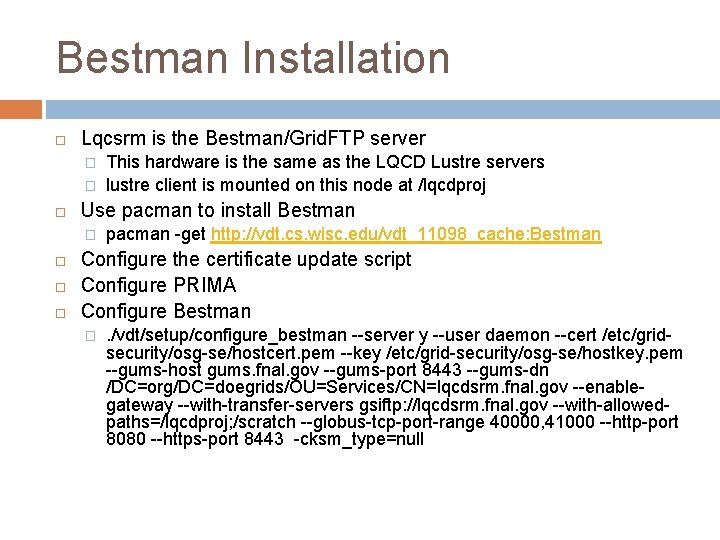
Bestman Installation Lqcsrm is the Bestman/Grid. FTP server � � Use pacman to install Bestman � This hardware is the same as the LQCD Lustre servers lustre client is mounted on this node at /lqcdproj pacman -get http: //vdt. cs. wisc. edu/vdt_11098_cache: Bestman Configure the certificate update script Configure PRIMA Configure Bestman � . /vdt/setup/configure_bestman --server y --user daemon --cert /etc/gridsecurity/osg-se/hostcert. pem --key /etc/grid-security/osg-se/hostkey. pem --gums-host gums. fnal. gov --gums-port 8443 --gums-dn /DC=org/DC=doegrids/OU=Services/CN=lqcdsrm. fnal. gov --enablegateway --with-transfer-servers gsiftp: //lqcdsrm. fnal. gov --with-allowedpaths=/lqcdproj; /scratch --globus-tcp-port-range 40000, 41000 --http-port 8080 --https-port 8443 -cksm_type=null
Backup Slides
![/proc/sys/lustre [root@lustre 3 lustre]# ls -l -rw-r--r-- 1 root 0 Jun 12 10: 29](http://slidetodoc.com/presentation_image_h/7af80bf37a430e4c9b44f4cf32956feb/image-29.jpg "/proc/sys/lustre [root@lustre 3 lustre]# ls -l -rw-r--r-- 1 root 0 Jun 12 10: 29")
/proc/sys/lustre [root@lustre 3 lustre]# ls -l -rw-r--r-- 1 root 0 Jun 12 10: 29 alloc_fail_rate -rw-r--r-- 1 root 0 Jun 12 10: 29 debug_peer_on_timeout -rw-r--r-- 1 root 0 Jun 12 10: 29 dump_on_eviction -rw-r--r-- 1 root 0 Jun 12 10: 29 dump_on_timeout -rw-r--r-- 1 root 0 Jun 12 10: 29 fail_loc -rw-r--r-- 1 root 0 Jun 12 10: 29 fail_val -rw-r--r-- 1 root 0 Jun 12 10: 29 ldlm_timeout -rw-r--r-- 1 root 0 Jun 12 10: 29 max_dirty_mb -r--r--r-- 1 root 0 Jun 12 10: 29 memused_max -r--r--r-- 1 root 0 Jun 12 10: 29 pagesused_max -rw-r--r-- 1 root 0 Jun 12 10: 29 timeout
![/proc/fs/lustre [root@lustre 3 lustre]# ls -l -r--r--r-- 1 root 0 Jun 12 10: 28](http://slidetodoc.com/presentation_image_h/7af80bf37a430e4c9b44f4cf32956feb/image-30.jpg "/proc/fs/lustre [root@lustre 3 lustre]# ls -l -r--r--r-- 1 root 0 Jun 12 10: 28")
/proc/fs/lustre [root@lustre 3 lustre]# ls -l -r--r--r-- 1 root 0 Jun 12 10: 28 devices -r--r--r-- 1 root 0 Jun 12 10: 28 health_check dr-xr-xr-x 4 root 0 Jun 12 10: 28 ldlm dr-xr-xr-x 2 root 0 Jun 12 10: 28 llite dr-xr-xr-x 3 root 0 Jun 12 10: 28 lov dr-xr-xr-x 9 root 0 Jun 12 10: 28 lquota dr-xr-xr-x 2 root 0 Jun 12 10: 28 mdc dr-xr-xr-x 3 root 0 Jun 12 10: 28 mds dr-xr-xr-x 3 root 0 Jun 12 10: 28 mdt dr-xr-xr-x 3 root 0 Jun 12 10: 28 mgc dr-xr-xr-x 3 root 0 Jun 12 10: 28 mgs dr-xr-xr-x 8 root 0 Jun 12 10: 28 obdfilter dr-xr-xr-x 26 root 0 Jun 12 10: 28 osc dr-xr-xr-x 3 root 0 Jun 12 10: 28 ost -r--r--r-- 1 root 0 Jun 12 10: 28 pinger -r--r--r-- 1 root 0 Jun 12 10: 28 version
![/proc/fs/lustre/obdfilter/lustre-OST 0012 [root@lustre 3 lustre-OST 0012]# ls –l -r--r--r-- 1 root 0 Jun 12](http://slidetodoc.com/presentation_image_h/7af80bf37a430e4c9b44f4cf32956feb/image-31.jpg "/proc/fs/lustre/obdfilter/lustre-OST 0012 [root@lustre 3 lustre-OST 0012]# ls –l -r--r--r-- 1 root 0 Jun 12")
/proc/fs/lustre/obdfilter/lustre-OST 0012 [root@lustre 3 lustre-OST 0012]# ls –l -r--r--r-- 1 root 0 Jun 12 10: 38 blocksize -r--r--r-- 1 root 0 Jun 12 10: 38 brw_stats -rw-r--r-- 1 root 0 Jun 12 10: 38 client_cache_count -rw-r--r-- 1 root 0 Jun 12 10: 38 client_cache_seconds --w------- 1 root 0 Jun 12 10: 38 evict_client dr-xr-xr-x 129 root 0 Jun 12 10: 38 exports -r--r--r-- 1 root 0 Jun 12 10: 38 mntdev -r--r--r-- 1 root 0 Jun 12 10: 38 num_exports -rw-r--r-- 1 root 0 Jun 12 10: 38 quota_btune_sz -rw-r--r-- 1 root 0 Jun 12 10: 38 quota_bunit_sz -rw-r--r-- 1 root 0 Jun 12 10: 38 quota_itune_sz -rw-r--r-- 1 root 0 Jun 12 10: 38 quota_iunit_sz -r--r--r-- 1 root 0 Jun 12 10: 38 filegroups -rw-r--r-- 1 root 0 Jun 12 10: 38 quota_switch_seconds -r--r--r-- 1 root 0 Jun 12 10: 38 filesfree -rw-r--r-- 1 root 0 Jun 12 10: 38 quota_type -r--r--r-- 1 root 0 Jun 12 10: 38 filestotal -rw-r--r-- 1 root 0 Jun 12 10: 38 readcache_max_filesize -r--r--r-- 1 root 0 Jun 12 10: 38 fstype -r--r--r-- 1 root 0 Jun 12 10: 38 hash_stats -r--r--r-- 1 root 0 Jun 12 10: 38 recovery_status -rw-r--r-- 1 root 0 Jun 12 10: 38 stats -r--r--r-- 1 root 0 Jun 12 10: 38 kbytesavail -r--r--r-- 1 root 0 Jun 12 10: 38 tot_dirty -r--r--r-- 1 root 0 Jun 12 10: 38 kbytesfree -r--r--r-- 1 root 0 Jun 12 10: 38 tot_granted -r--r--r-- 1 root 0 Jun 12 10: 38 kbytestotal -r--r--r-- 1 root 0 Jun 12 10: 38 tot_pending -r--r--r-- 1 root 0 Jun 12 10: 38 last_id -r--r--r-- 1 root 0 Jun 12 10: 38 uuid
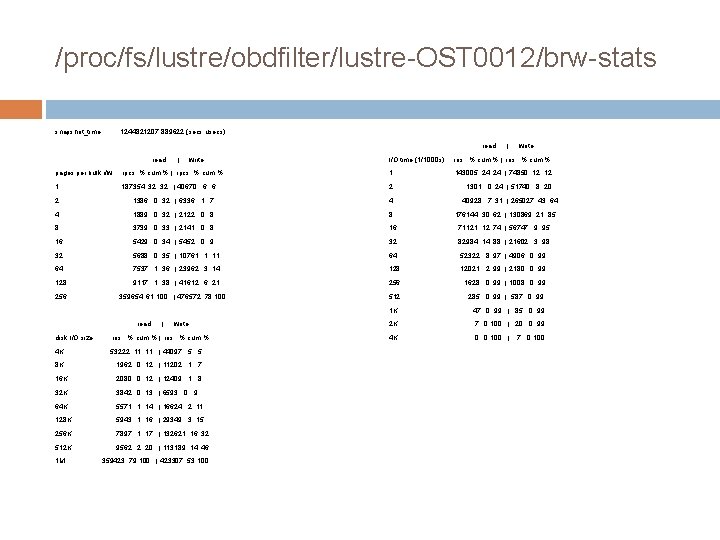
/proc/fs/lustre/obdfilter/lustre-OST 0012/brw-stats snapshot_time: 1244821207. 889622 (secs. usecs) read I/O time (1/1000 s) ios % cum % | ios % cum % rpcs % cum % | rpcs % cum % 1: 143005 24 24 | 74850 12 12 1: 187354 32 32 | 40670 6 6 2: 1301 0 24 | 51740 8 20 2: 1386 0 32 | 6336 1 7 4: 40928 7 31 | 265027 43 64 4: 1889 0 32 | 2122 0 8 8: 176144 30 62 | 130869 21 85 8: 3739 0 33 | 2141 0 8 16: 71121 12 74 | 56747 9 95 16: 5429 0 34 | 5452 0 9 32: 82984 14 88 | 21602 3 98 32: 5688 0 35 | 10761 1 11 64: 52322 8 97 | 4906 0 99 64: 7537 1 36 | 23962 3 14 128: 12021 2 99 | 2180 0 99 9117 1 38 | 41612 6 21 256: 1628 0 99 | 1008 0 99 512: 285 0 99 | 587 0 99 256: 359654 61 100 | 476572 78 100 read disk I/O size write pages per bulk r/w 128: | | | write ios % cum % | ios % cum % 4 K: 53222 11 11 | 44097 5 5 8 K: 1962 0 12 | 11202 1 7 16 K: 2080 0 12 | 12409 1 8 32 K: 3842 0 13 | 6593 0 9 64 K: 5571 1 14 | 16624 2 11 128 K: 5943 1 16 | 29349 3 15 256 K: 7897 1 17 | 132621 16 32 512 K: 1 M: 9562 2 20 | 113189 14 46 359423 79 100 | 423307 53 100 1 K: 47 0 99 | 85 0 99 2 K: 7 0 100 | 20 0 99 4 K: 0 0 100 | 7 0 100

Upgrade Experiences… A clean shutdown of all Lustre servers and clients is preferred on upgrades � Automatic recovery process take a long time if clients weren’t shutdown cleanly � Recovery process can be cancelled All the cached transactions on the client side are cancelled
Lustre Architecture
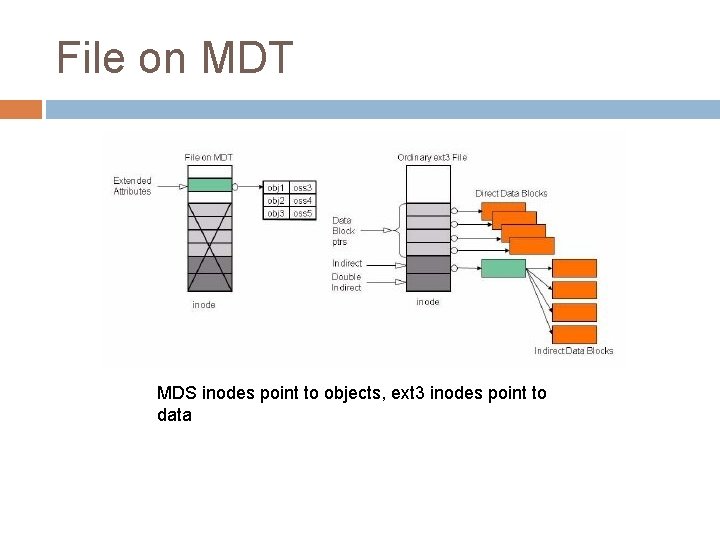
File on MDT MDS inodes point to objects, ext 3 inodes point to data
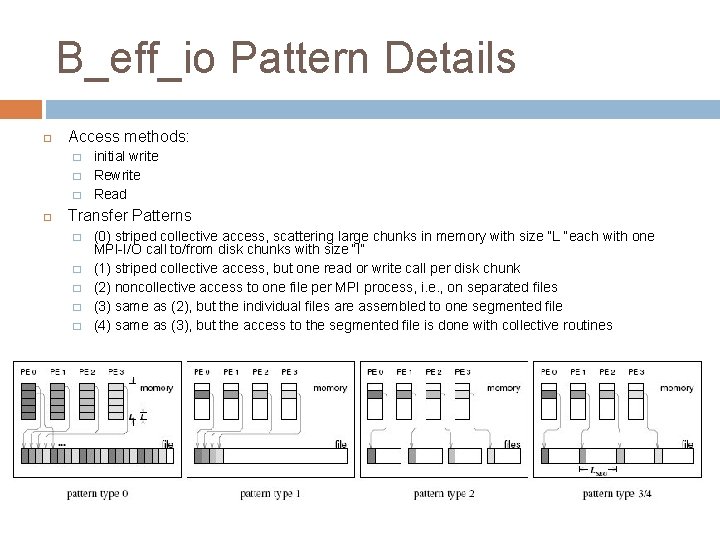
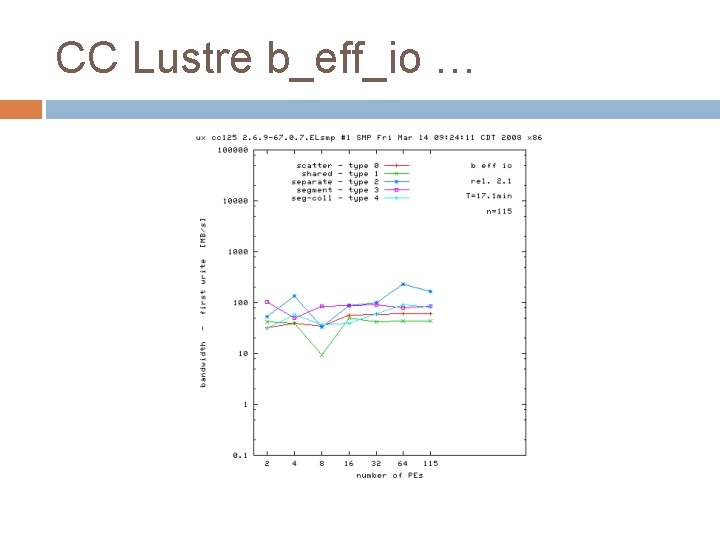
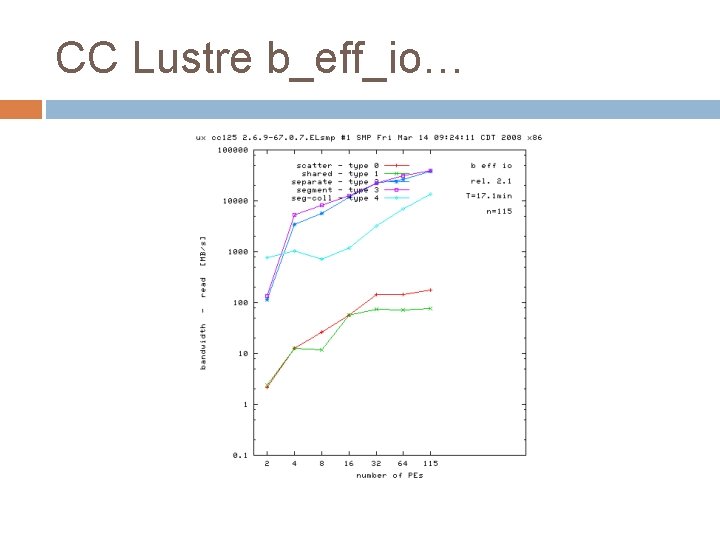
B_eff_io Pattern Details Access methods: � � � initial write Read Transfer Patterns � � � (0) striped collective access, scattering large chunks in memory with size “L “each with one MPI-I/O call to/from disk chunks with size “l” (1) striped collective access, but one read or write call per disk chunk (2) noncollective access to one file per MPI process, i. e. , on separated files (3) same as (2), but the individual files are assembled to one segmented file (4) same as (3), but the access to the segmented file is done with collective routines
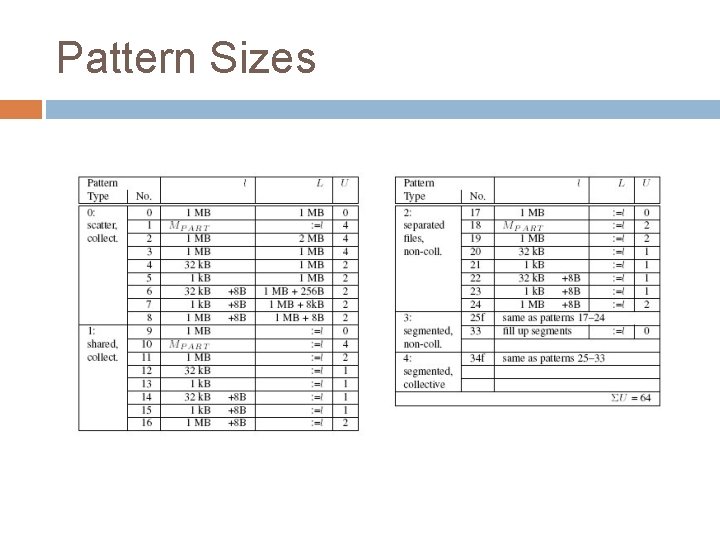
Pattern Sizes
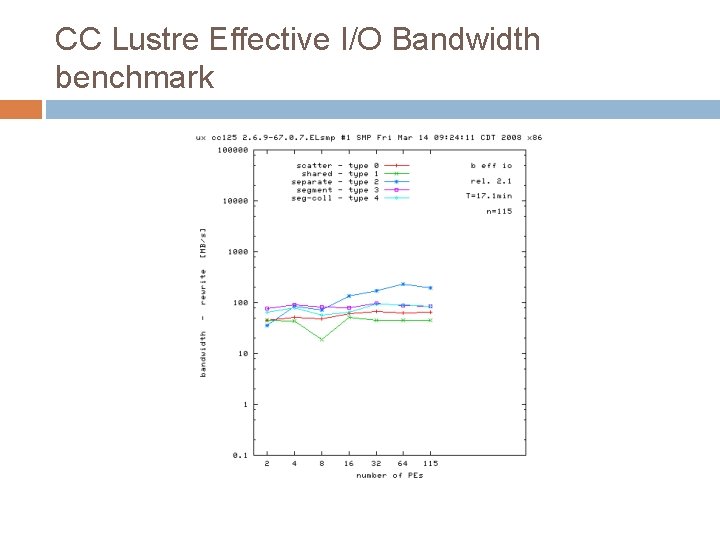
CC Lustre Effective I/O Bandwidth benchmark
CC Lustre b_eff_io …
CC Lustre b_eff_io…
- Slides: 40