
Lung Ultrasound Content 1 Basic Principle of LUS
Lung Ultrasound

Content 1 Basic Principle of LUS 2 Basic signs of LUS 3 Blue Protocol 4 Sono. Scape Solutions for LUS

Basic Principle of LUS Probe Convex Probe Low frequency The preferred probe for LUS Larger view and good penetration Preset: ABD Linear Probe High frequency probe Good resolution for pleural surface and abnormality Lower penetration (depth 4 cm) Preset: Choose Small Parts/ Superficial

Basic Principle of LUS Normal Lung , the lung parenchyma is irrelevant in transmitting ultrasound and in fact it appears as full of gas, ultrasound will be totally reflected and generate artifacts. (100) (99) (98) Interstitial syndrome (95) ···· consolidation pleural effusion (10) (0) Gas Proportion % Pneumothorax normal lung COPD
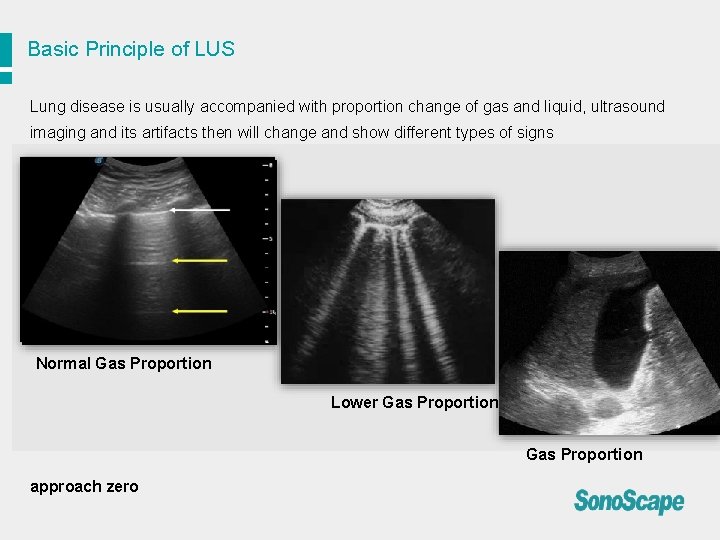
Basic Principle of LUS Lung disease is usually accompanied with proportion change of gas and liquid, ultrasound imaging and its artifacts then will change and show different types of signs Normal Gas Proportion Lower Gas Proportion approach zero
Basic Principle of LUS Preset • Lung preset should turn off the various smoothing and artefact minimization algorithms routinely used. • To highlight lung sliding and B-lines your focal point should be at the pleural surface. • An initial depth setting on the curvilinear transducer of around 12 cm is reasonable. • An initial depth setting on the linear transducer of around 5 cm is reasonable.

Basic signs of LUS Ten Basic signs of Lung Ultrasound Bat sign Normal lung: lung sliding sign/ sandbeach sign Normal lung: A line Pleural Effusion: Quad sign and sinusoid sign lung consolidation: The shred sign and tissue-like signs B lines: Lung rocket Stratosphere sign Lung point
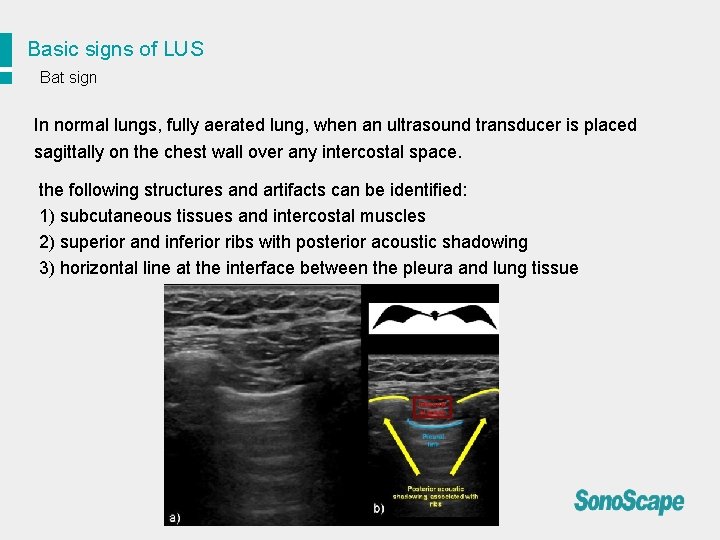
Basic signs of LUS Bat sign In normal lungs, fully aerated lung, when an ultrasound transducer is placed sagittally on the chest wall over any intercostal space. the following structures and artifacts can be identified: 1) subcutaneous tissues and intercostal muscles 2) superior and inferior ribs with posterior acoustic shadowing 3) horizontal line at the interface between the pleura and lung tissue
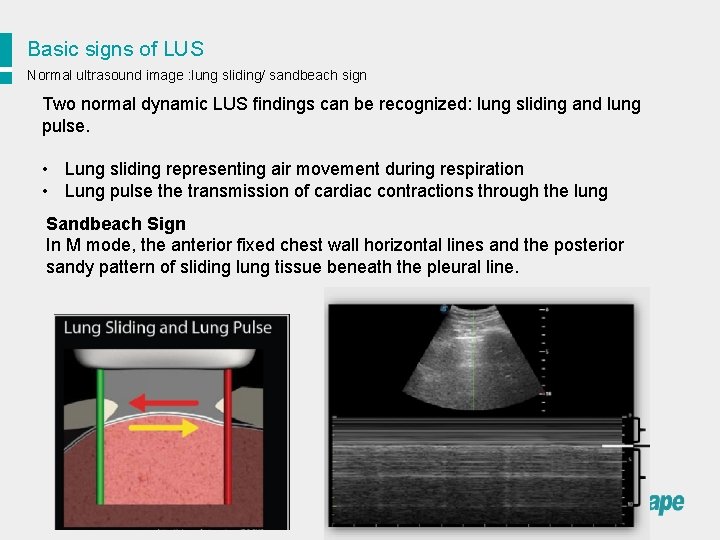
Basic signs of LUS Normal ultrasound image : lung sliding/ sandbeach sign Two normal dynamic LUS findings can be recognized: lung sliding and lung pulse. • Lung sliding representing air movement during respiration • Lung pulse the transmission of cardiac contractions through the lung Sandbeach Sign In M mode, the anterior fixed chest wall horizontal lines and the posterior sandy pattern of sliding lung tissue beneath the pleural line.
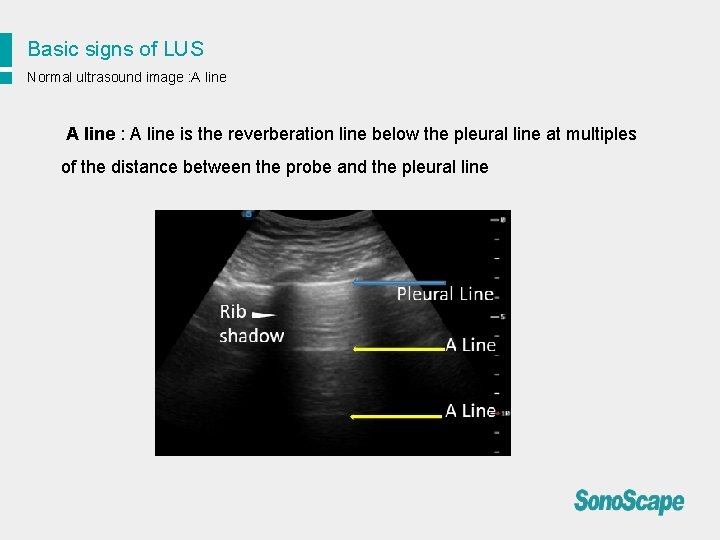
Basic signs of LUS Normal ultrasound image : A line is the reverberation line below the pleural line at multiples of the distance between the probe and the pleural line

Basic signs of LUS Abnormal ultrasound image Quad sign and sinusoid sign: The quad sign is a static sonographic sign observed in pleural effusion. It consists of four lines representing the pleura, rib, fluid, and lung Sinusoid sign moving line in M-mode, representing line underneath is the lung moving towards and away from the parietal pleura with time.

Basic signs of LUS Lung consolidation lung consolidation: The shred sign and tissue-like signs Tissue sign is seen in translobar consolidation as it looks like liver parenchyma Shred sign corresponds to non-translobar consolidations, with an irregular border between aerated and consolidated lung regions Tissue-like signs Shred sign

Basic signs of LUS B lines, defined as ‘‘Lung rocket, vertical, hyperechoic artifacts that arise from the pleural line, extend to the bottom of the screen without fading, and move synchronously with lung sliding
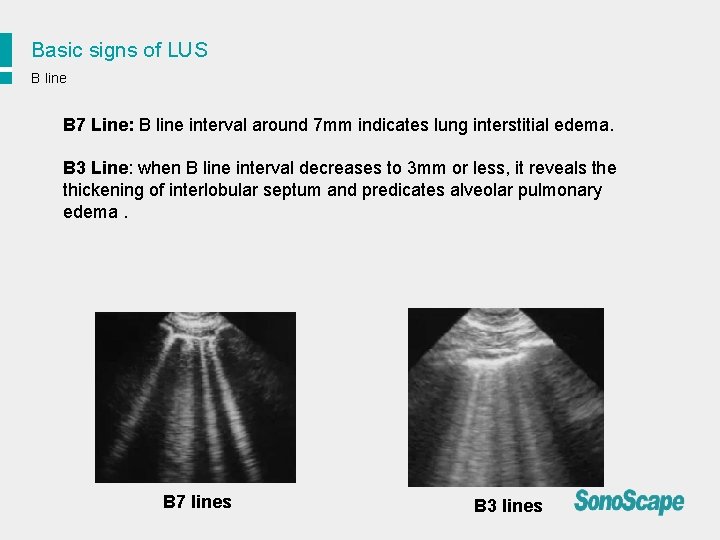
Basic signs of LUS B line B 7 Line: B line interval around 7 mm indicates lung interstitial edema. B 3 Line: when B line interval decreases to 3 mm or less, it reveals the thickening of interlobular septum and predicates alveolar pulmonary edema. B 7 lines B 3 lines
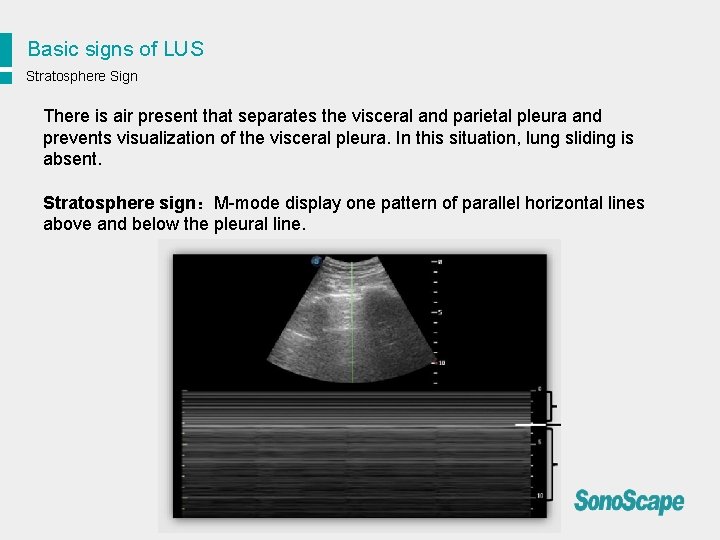
Basic signs of LUS Stratosphere Sign There is air present that separates the visceral and parietal pleura and prevents visualization of the visceral pleura. In this situation, lung sliding is absent. Stratosphere sign:M-mode display one pattern of parallel horizontal lines above and below the pleural line.
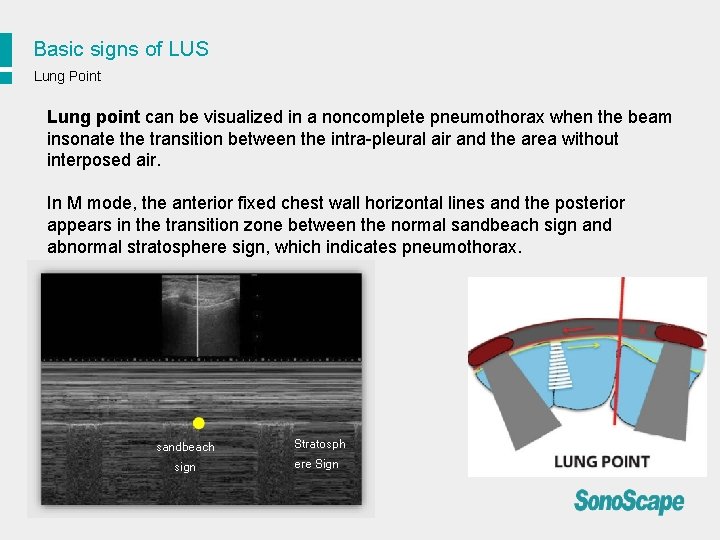
Basic signs of LUS Lung Point Lung point can be visualized in a noncomplete pneumothorax when the beam insonate the transition between the intra-pleural air and the area without interposed air. In M mode, the anterior fixed chest wall horizontal lines and the posterior appears in the transition zone between the normal sandbeach sign and abnormal stratosphere sign, which indicates pneumothorax. sandbeach Stratosph sign ere Sign
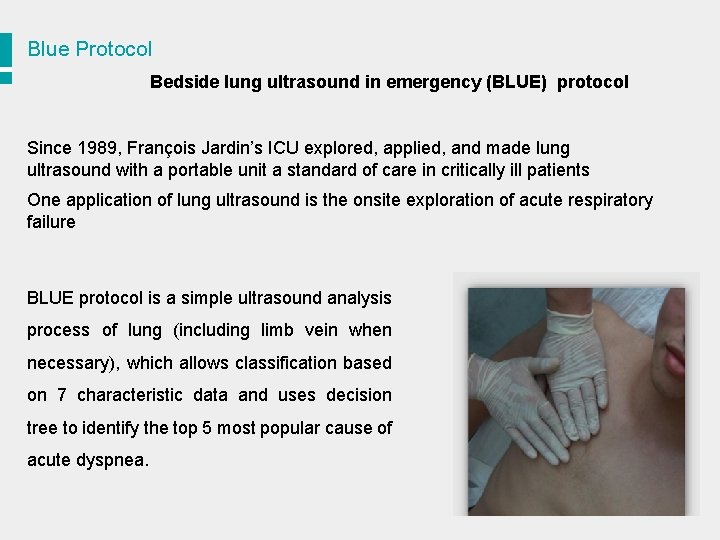
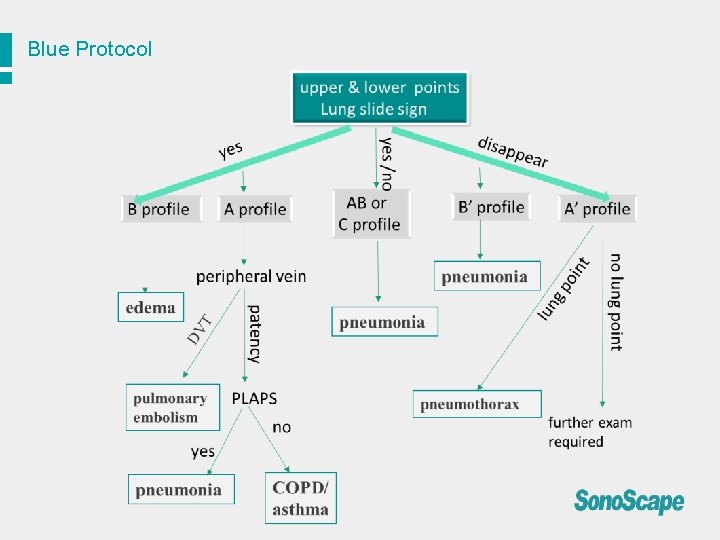
Blue Protocol Bedside lung ultrasound in emergency (BLUE) protocol Since 1989, François Jardin’s ICU explored, applied, and made lung ultrasound with a portable unit a standard of care in critically ill patients One application of lung ultrasound is the onsite exploration of acute respiratory failure BLUE protocol is a simple ultrasound analysis process of lung (including limb vein when necessary), which allows classification based on 7 characteristic data and uses decision tree to identify the top 5 most popular cause of acute dyspnea.
Blue Protocol Bedside lung ultrasound in emergency (BLUE) protocol 7 characteristics sign in BLUE Protocol: 1. lung slide sign 2. A-Line: bilateral A-line with lung slide 3. A’ profile: bilateral A-line without lung slide 4. B profile: diffuse bilateral B-Line symptom with lung slide; 5. B’profile: diffuse bilateral B-Line symptom without lung slide; 6. AB profile/ C profile: AB profile: A-line one side, meanwhile B-line another side; C profile: Lung consolidation 7. lung point
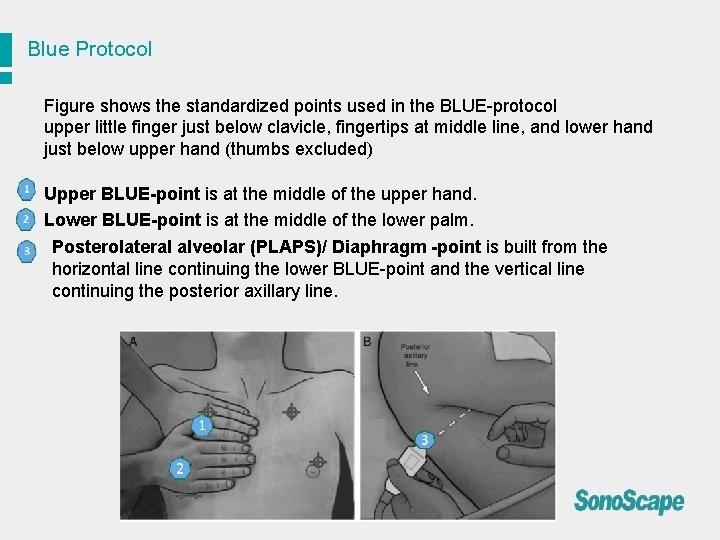
Blue Protocol Figure shows the standardized points used in the BLUE-protocol upper little finger just below clavicle, fingertips at middle line, and lower hand just below upper hand (thumbs excluded) Upper BLUE-point is at the middle of the upper hand. Lower BLUE-point is at the middle of the lower palm. Posterolateral alveolar (PLAPS)/ Diaphragm -point is built from the horizontal line continuing the lower BLUE-point and the vertical line continuing the posterior axillary line.
Blue Protocol
Sono. Scape Solutions for LUS P 20 E 2 X 3
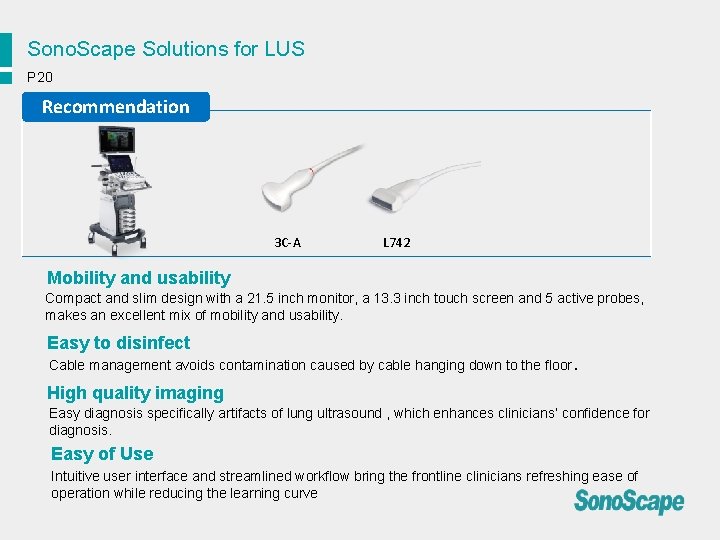
Sono. Scape Solutions for LUS P 20 Recommendation 3 C-A L 742 Mobility and usability Compact and slim design with a 21. 5 inch monitor, a 13. 3 inch touch screen and 5 active probes, makes an excellent mix of mobility and usability. Easy to disinfect Cable management avoids contamination caused by cable hanging down to the floor. High quality imaging Easy diagnosis specifically artifacts of lung ultrasound , which enhances clinicians’ confidence for diagnosis. Easy of Use Intuitive user interface and streamlined workflow bring the frontline clinicians refreshing ease of operation while reducing the learning curve
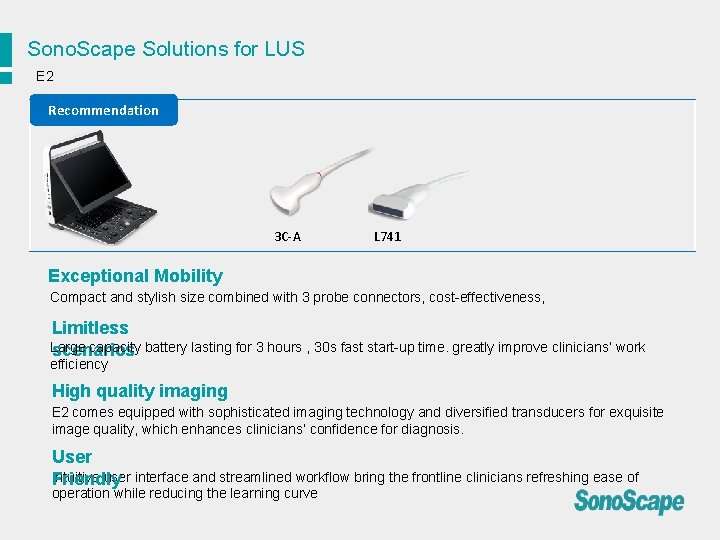
Sono. Scape Solutions for LUS E 2 Recommendation 3 C-A L 741 Exceptional Mobility Compact and stylish size combined with 3 probe connectors, cost-effectiveness, Limitless Large capacity battery lasting for 3 hours , 30 s fast start-up time. greatly improve clinicians’ work scenarios efficiency High quality imaging E 2 comes equipped with sophisticated imaging technology and diversified transducers for exquisite image quality, which enhances clinicians’ confidence for diagnosis. User Intuitive user interface and streamlined workflow bring the frontline clinicians refreshing ease of Friendly operation while reducing the learning curve
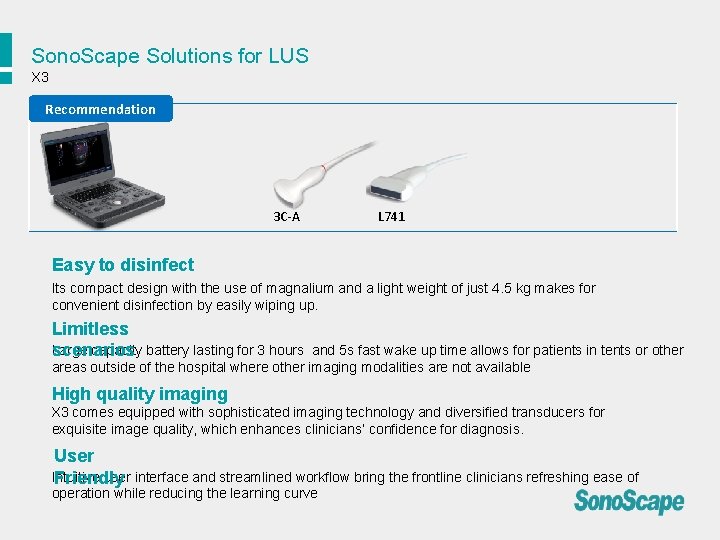
Sono. Scape Solutions for LUS X 3 Recommendation 3 C-A L 741 Easy to disinfect Its compact design with the use of magnalium and a light weight of just 4. 5 kg makes for convenient disinfection by easily wiping up. Limitless Large capacity battery lasting for 3 hours scenarios and 5 s fast wake up time allows for patients in tents or other areas outside of the hospital where other imaging modalities are not available High quality imaging X 3 comes equipped with sophisticated imaging technology and diversified transducers for exquisite image quality, which enhances clinicians’ confidence for diagnosis. User Intuitive user interface and streamlined workflow bring the frontline clinicians refreshing ease of Friendly operation while reducing the learning curve

Thank you!
- Slides: 25