
LUNG FUNCTION TEST INTRODUCTION Assessment of respiratory function

- Slides: 14
LUNG FUNCTION TEST
INTRODUCTION • Assessment of respiratory function requires good knowledge of mechanical properties of the lungs & chest wall. • Primary function the lungs is gaseous exchange. • The ease of achieving this function depends on these mechanical properties. • Lungs mechanics is divided into 2: v. Static mechanics – Mechanical properties when volume is not changing with time e. g. Lung vol. & capacities v. Dynamic mechanics – Mech. Properties of a lung whose volume is changing with time e. g. Experatory flow rates & volume.
LUNG VOLUMES & CAPAITIES • Very important in clinical evaluation of lung function • The correct interpretation of factors involved is key • Lung volumes are fractions of total lung capacity (TLC) • TLC = Total vol. of air that can be contained in lungs • Lung capacity = 2 or more lung volumes • Most lung vols. are recorded using a spirometer
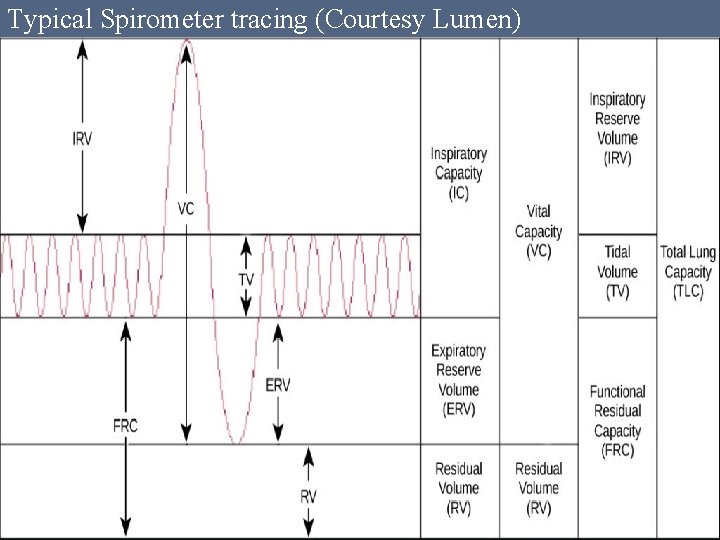
Typical Spirometer tracing (Courtesy Lumen)
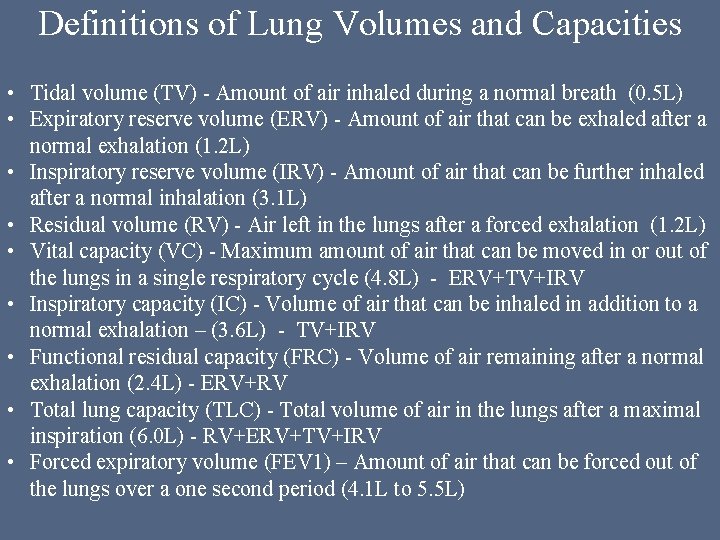
Definitions of Lung Volumes and Capacities • Tidal volume (TV) - Amount of air inhaled during a normal breath (0. 5 L) • Expiratory reserve volume (ERV) - Amount of air that can be exhaled after a normal exhalation (1. 2 L) • Inspiratory reserve volume (IRV) - Amount of air that can be further inhaled after a normal inhalation (3. 1 L) • Residual volume (RV) - Air left in the lungs after a forced exhalation (1. 2 L) • Vital capacity (VC) - Maximum amount of air that can be moved in or out of the lungs in a single respiratory cycle (4. 8 L) - ERV+TV+IRV • Inspiratory capacity (IC) - Volume of air that can be inhaled in addition to a normal exhalation – (3. 6 L) - TV+IRV • Functional residual capacity (FRC) - Volume of air remaining after a normal exhalation (2. 4 L) - ERV+RV • Total lung capacity (TLC) - Total volume of air in the lungs after a maximal inspiration (6. 0 L) - RV+ERV+TV+IRV • Forced expiratory volume (FEV 1) – Amount of air that can be forced out of the lungs over a one second period (4. 1 L to 5. 5 L)
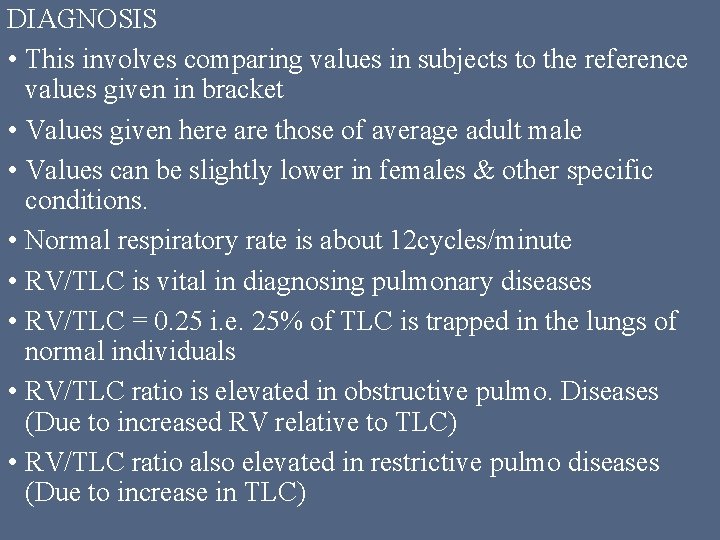
DIAGNOSIS • This involves comparing values in subjects to the reference values given in bracket • Values given here are those of average adult male • Values can be slightly lower in females & other specific conditions. • Normal respiratory rate is about 12 cycles/minute • RV/TLC is vital in diagnosing pulmonary diseases • RV/TLC = 0. 25 i. e. 25% of TLC is trapped in the lungs of normal individuals • RV/TLC ratio is elevated in obstructive pulmo. Diseases (Due to increased RV relative to TLC) • RV/TLC ratio also elevated in restrictive pulmo diseases (Due to increase in TLC)
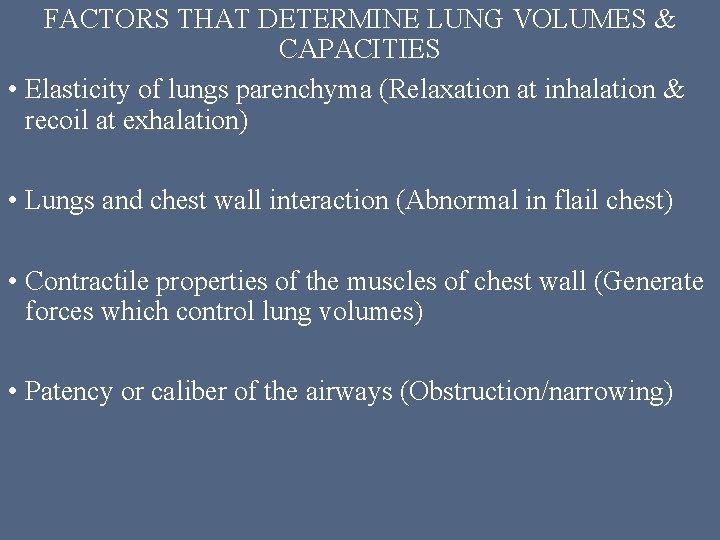
FACTORS THAT DETERMINE LUNG VOLUMES & CAPACITIES • Elasticity of lungs parenchyma (Relaxation at inhalation & recoil at exhalation) • Lungs and chest wall interaction (Abnormal in flail chest) • Contractile properties of the muscles of chest wall (Generate forces which control lung volumes) • Patency or caliber of the airways (Obstruction/narrowing)
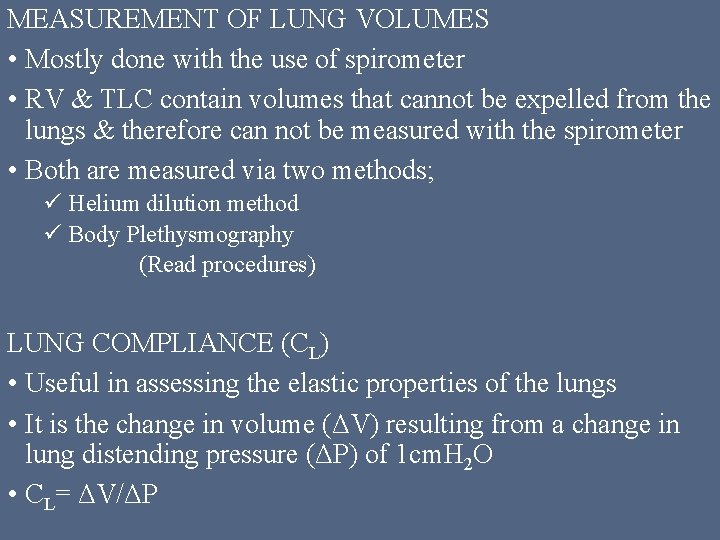
MEASUREMENT OF LUNG VOLUMES • Mostly done with the use of spirometer • RV & TLC contain volumes that cannot be expelled from the lungs & therefore can not be measured with the spirometer • Both are measured via two methods; ü Helium dilution method ü Body Plethysmography (Read procedures) LUNG COMPLIANCE (CL) • Useful in assessing the elastic properties of the lungs • It is the change in volume (ΔV) resulting from a change in lung distending pressure (ΔP) of 1 cm. H 2 O • CL= ΔV/ΔP
COMPLIANCE CONT’D • Unit of measurement is L/cm. H 2 O or ml/cm. H 2 O • Normal value is 0. 2 L/cm. H 2 O • Compliance is increased in OBSTRUCTIVE lung diseases like emphysema and decreased in RESTRICTIVE lung diseases like lung fibrosis • Measurement requires placement of eosophageal pressure balloons & so not often done.
MEASUREMENT OF EXPIRATORY FLOW • Procedure involve; ü Done with the use of a spirometer üAsk patient to inhale maximally to level of TLC ü Quickly fix the mouth piece of spirometer to his/her mouth üAsk patient to exhale as rapidly and completely as possible (i. e. from TLC to RV) üTest result is seen on a tracing called spirogram
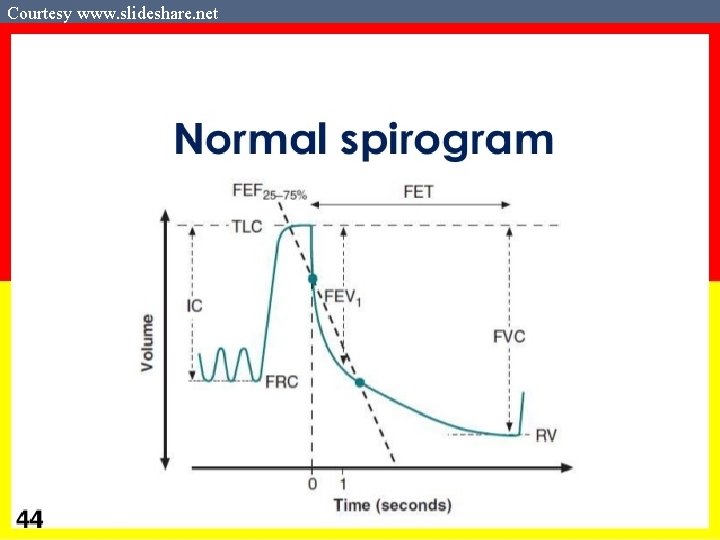
ü Four important parameters can be extracted from the spirogram: 1. Forced vital capacity (FVC) – The total volume of air exhaled from TLC to RV 2. Forced rxpiratory volume in 1 second (FEV 1) – Volume of air exhaled in the first second 3. FEV 1/FVC ratio 4. The average mid-maximal expiratory flow (FEF 25 -75) – The forced expiratory flow from 25% of VC to 75% of VC. Calculated from the spirogram or gotten automatically from modern spirometers
Courtesy www. slideshare. net
DIAGNOSIS • Tracing from patient is compared to the normal • Abnormal tracing can predate symptoms, so spirogram can be used as a screening tool for respiratory diseases • Normal values varies with age, gender, race, height and even weight sometimes • Normal individuals should exhale atleast 72% of FVC in the first second i. e. FEV 1/FVC ≥ 0. 72 • Any FEV 1/FVC ˂ 0. 72 suggests obstruction to air outflow
THANK YOU