
Lung Cancer Surveillance After Definitive CurativeIntent Therapy ASCO
- Slides: 18
Lung Cancer Surveillance After Definitive Curative-Intent Therapy: ASCO Guideline Schneider et al. www. asco. org/thoracic-cancer-guidelines ©American Society of Clinical Oncology 2019. All rights reserved. For licensing opportunities, contact licensing@asco. org
Introduction § Patients with localized non-small cell lung cancer (NSCLC) or small cell lung cancer (SCLC) are treated with intent to cure, however the optimal surveillance of these patients for cancer recurrence and new primary lung cancers after potentially curative therapy is controversial. § The assumption by patients and providers that early detection and treatment of recurrence may lead to better clinical outcomes has resulted in increased imagebased surveillance strategies, some of which may not be evidence-based. § The purpose of this guideline is to provide recommendations to practicing clinicians and other stakeholders within the health care team on the appropriate lung cancer surveillance of patients after potentially curative treatment. www. asco. org/thoracic-cancer-guidelines ©American Society of Clinical Oncology 2019. All rights reserved. For licensing opportunities, contact licensing@asco. org
ASCO Guideline Development Methodology The ASCO Clinical Practice Guidelines Committee guideline process includes: • a systematic literature review by ASCO guidelines staff • an expert panel provides critical review and evidence interpretation to inform guideline recommendations • final guideline approval by ASCO CPGC The full ASCO Guideline methodology manual can be found at: www. asco. org/guideline-methodology www. asco. org/thoracic-cancer-guidelines ©American Society of Clinical Oncology 2019. All rights reserved. For licensing opportunities, contact licensing@asco. org
Clinical Questions This clinical practice guideline addresses five overarching clinical questions: (1) What should be the frequency of surveillance imaging? (2) What is the optimal imaging modality? (3) Are there any patient factors such as performance status or age limits that would preclude surveillance? (4) Is there a role for circulating biomarkers in surveillance? (5) What is the role of brain MRI imaging for surveillance in curatively treated NSCLC & SCLC? www. asco. org/thoracic-cancer-guidelines ©American Society of Clinical Oncology 2019. All rights reserved. For licensing opportunities, contact licensing@asco. org
Target Population and Audience Target Population Patients with curatively treated stage I-III NSCLC & SCLC Target Audience Medical, surgical, and radiation oncologists; oncology nurses and physician assistants; pulmonologists; radiologists; general practitioners; and patients www. asco. org/thoracic-cancer-guidelines ©American Society of Clinical Oncology 2019. All rights reserved. For licensing opportunities, contact licensing@asco. org
Summary of Recommendations NOTE: § These recommendations apply to patients with curatively treated stage I-III NSCLC and SCLC with no clinical suspicion of recurrent disease. This includes patients treated with surgery, stereotactic body radiotherapy and chemoradiation. Please refer to the recommendation discussion section for further details on specific patient subpopulations. § These recommendations pertain only to routine surveillance strategies. Imaging to evaluate symptoms and follow-up on previous findings are not addressed by this guideline. § These recommendations do not address the frequency of the clinical evaluation www. asco. org/thoracic-cancer-guidelines ©American Society of Clinical Oncology 2019. rights reserved. (history and physical exam) for either the. Allsuspicion of recurrence and/or to provide For licensing opportunities, contact licensing@asco. org reassurance.
Summary of Recommendations CLINICAL QUESTION 1 What should be the frequency of surveillance imaging? Recommendation 1. 1. Patients should undergo surveillance imaging for recurrence every 6 months for 2 years. (Type: informal consensus; Evidence Quality: low; Strength of Recommendation: moderate) Recommendation 1. 2. Patients should undergo surveillance imaging for detection of new primary lung cancers annually after the first 2 years. (Type: evidence based; Evidence Quality: intermediate; Strength of Recommendation: moderate) www. asco. org/thoracic-cancer-guidelines ©American Society of Clinical Oncology 2019. All rights reserved. For licensing opportunities, contact licensing@asco. org
Summary of Recommendations CLINICAL QUESTION 2 What is the optimal imaging modality? Recommendation 2. 1. Clinicians should use a diagnostic chest CT that includes the adrenals, with contrast (preferred) or without contrast when conducting surveillance for recurrence during the first two years post-treatment. (Type: informal consensus; Evidence Quality: low; Strength of Recommendation: moderate) Qualifying statement. There is no evidence of added benefit for a CT of the abdomen and pelvis over a chest CT through the adrenals as a surveillance imaging modality for recurrence www. asco. org/thoracic-cancer-guidelines ©American Society of Clinical Oncology 2019. All rights reserved. For licensing opportunities, contact licensing@asco. org
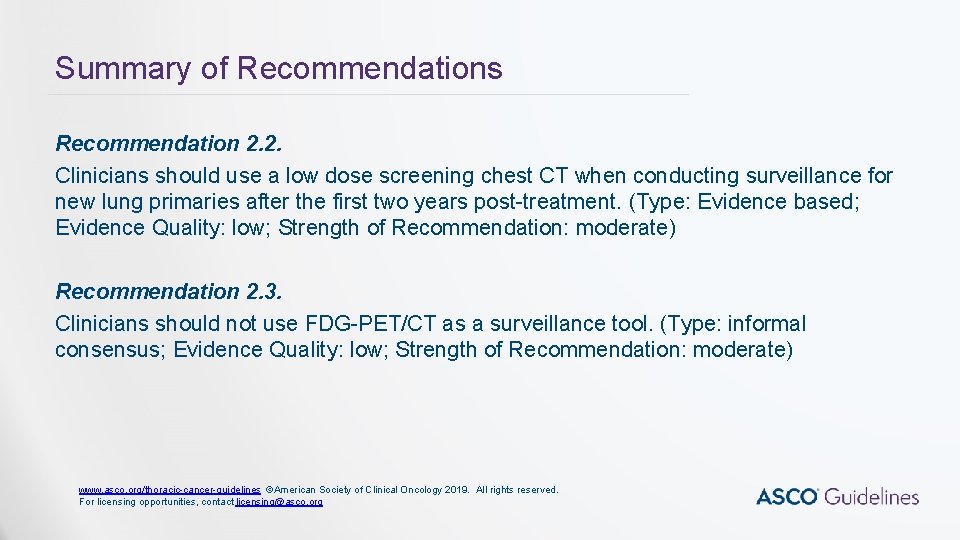
Summary of Recommendations Recommendation 2. 2. Clinicians should use a low dose screening chest CT when conducting surveillance for new lung primaries after the first two years post-treatment. (Type: Evidence based; Evidence Quality: low; Strength of Recommendation: moderate) Recommendation 2. 3. Clinicians should not use FDG-PET/CT as a surveillance tool. (Type: informal consensus; Evidence Quality: low; Strength of Recommendation: moderate) www. asco. org/thoracic-cancer-guidelines ©American Society of Clinical Oncology 2019. All rights reserved. For licensing opportunities, contact licensing@asco. org
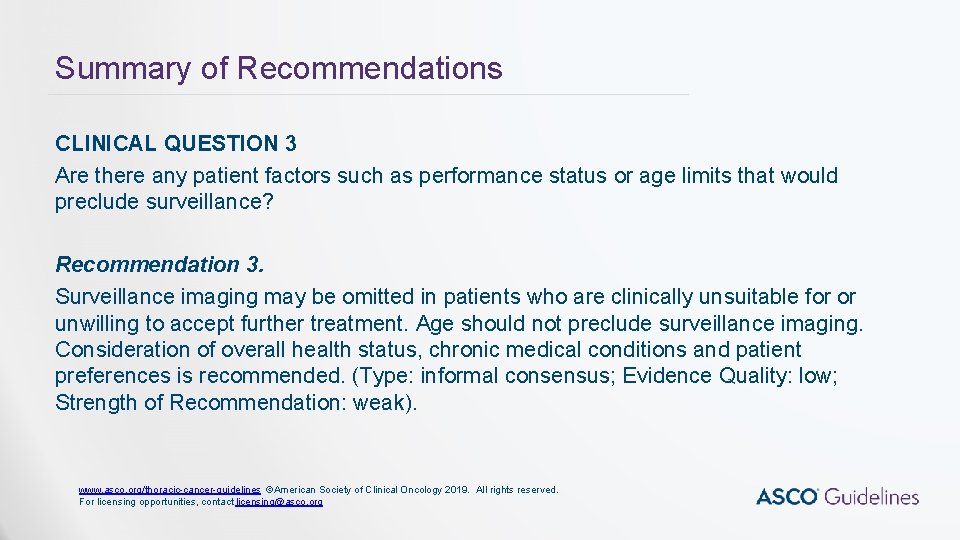
Summary of Recommendations CLINICAL QUESTION 3 Are there any patient factors such as performance status or age limits that would preclude surveillance? Recommendation 3. Surveillance imaging may be omitted in patients who are clinically unsuitable for or unwilling to accept further treatment. Age should not preclude surveillance imaging. Consideration of overall health status, chronic medical conditions and patient preferences is recommended. (Type: informal consensus; Evidence Quality: low; Strength of Recommendation: weak). www. asco. org/thoracic-cancer-guidelines ©American Society of Clinical Oncology 2019. All rights reserved. For licensing opportunities, contact licensing@asco. org
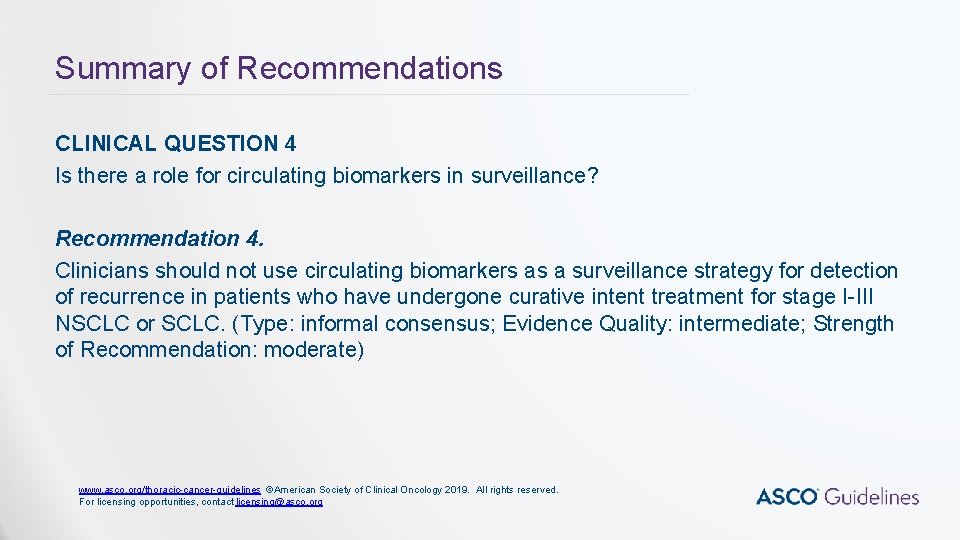
Summary of Recommendations CLINICAL QUESTION 4 Is there a role for circulating biomarkers in surveillance? Recommendation 4. Clinicians should not use circulating biomarkers as a surveillance strategy for detection of recurrence in patients who have undergone curative intent treatment for stage I-III NSCLC or SCLC. (Type: informal consensus; Evidence Quality: intermediate; Strength of Recommendation: moderate) www. asco. org/thoracic-cancer-guidelines ©American Society of Clinical Oncology 2019. All rights reserved. For licensing opportunities, contact licensing@asco. org
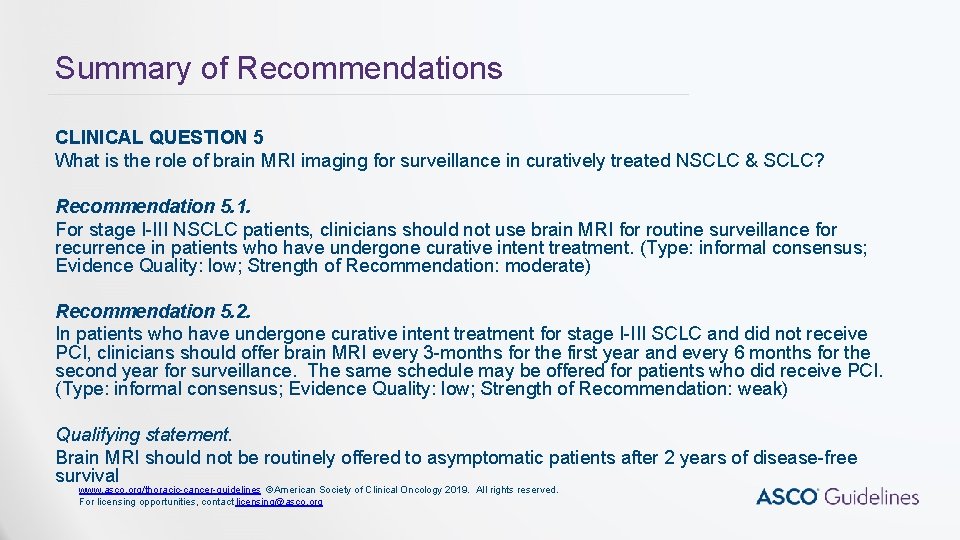
Summary of Recommendations CLINICAL QUESTION 5 What is the role of brain MRI imaging for surveillance in curatively treated NSCLC & SCLC? Recommendation 5. 1. For stage I-III NSCLC patients, clinicians should not use brain MRI for routine surveillance for recurrence in patients who have undergone curative intent treatment. (Type: informal consensus; Evidence Quality: low; Strength of Recommendation: moderate) Recommendation 5. 2. In patients who have undergone curative intent treatment for stage I-III SCLC and did not receive PCI, clinicians should offer brain MRI every 3 -months for the first year and every 6 months for the second year for surveillance. The same schedule may be offered for patients who did receive PCI. (Type: informal consensus; Evidence Quality: low; Strength of Recommendation: weak) Qualifying statement. Brain MRI should not be routinely offered to asymptomatic patients after 2 years of disease-free survival www. asco. org/thoracic-cancer-guidelines ©American Society of Clinical Oncology 2019. All rights reserved. For licensing opportunities, contact licensing@asco. org
Patient and Clinician Communication § Clear and detailed communication among the patient, caregivers and physician is essential for optimal care. § A careful discussion of both the patient and physician goals of care is critical to deliver best treatment and obtain a favorable outcome. § This may be complicated as be each patient differs with respect to disease biology, stage, social environment, culture, resources and many other factors. § The Expert Panel emphasizes that care of the cancer patient continues after the completion of definitive treatment for potentially curable NSCLC. www. asco. org/thoracic-cancer-guidelines ©American Society of Clinical Oncology 2019. All rights reserved. For licensing opportunities, contact licensing@asco. org
Health Disparities § Lung cancer carries a poor prognosis even in patients who receive potentially curative therapy. § Despite the improvements of lung cancer treatment that have led to increased survival advantages in locally advanced and metastatic disease, limited access to these therapies play an important role in the outcome of cancer patients. § Lower socioeconomic status (SES) is often associated with the lack of health insurance and studies have demonstrated that lower SES correlates with reduced OS in lung cancer patients. www. asco. org/thoracic-cancer-guidelines ©American Society of Clinical Oncology 2019. All rights reserved. For licensing opportunities, contact licensing@asco. org
Multiple Chronic Conditions § Before the development of a surveillance program for the patient after potentially curative therapy, clinicians should review all other chronic conditions present in the patient and take those conditions into account. § Older adult patients are more vulnerable to treatment specific toxicities and often have more difficulty recovering from adverse event when compared to younger patients. Hence, a geriatric assessment is crucial to mitigate these treatment effects. § A geriatric assessment can also assist with treatment decisions when used as a risk assessment tool and stratify cancer patients prior to the development of a post-treatment surveillance program. § Hence, the management of patients with significant chronic conditions is a challenge, but the use of the geriatric assessment in clinical practice may avoid unnecessary radiographic imaging and testing that ultimately reduces the patient’s quality of life. § The Expert Panel notes that physicians must make surveillance decisions based on physiologic age rather than chronological age, so the optimal program can be developed. www. asco. org/thoracic-cancer-guidelines ©American Society of Clinical Oncology 2019. All rights reserved. For licensing opportunities, contact licensing@asco. org
Additional Resources More information, including a Data Supplement, slide sets, and clinical tools and resources, is available at www. asco. org/thoracic-cancer-guidelines Patient information is available at www. cancer. net www. asco. org/thoracic-cancer-guidelines ©American Society of Clinical Oncology 2019. All rights reserved. For licensing opportunities, contact licensing@asco. org
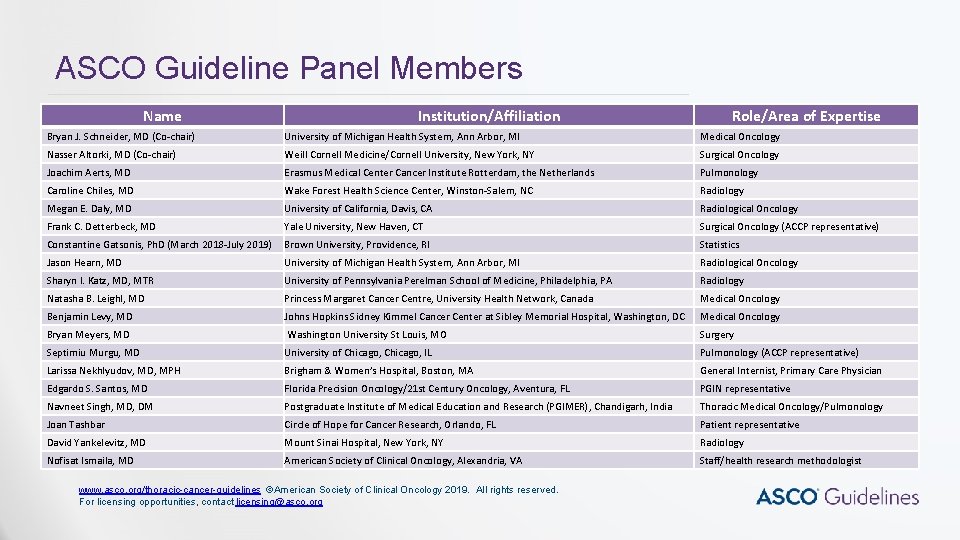
ASCO Guideline Panel Members Name Institution/Affiliation Role/Area of Expertise Bryan J. Schneider, MD (Co-chair) University of Michigan Health System, Ann Arbor, MI Medical Oncology Nasser Altorki, MD (Co-chair) Weill Cornell Medicine/Cornell University, New York, NY Surgical Oncology Joachim Aerts, MD Erasmus Medical Center Cancer Institute Rotterdam, the Netherlands Pulmonology Caroline Chiles, MD Wake Forest Health Science Center, Winston-Salem, NC Radiology Megan E. Daly, MD University of California, Davis, CA Radiological Oncology Frank C. Detterbeck, MD Yale University, New Haven, CT Surgical Oncology (ACCP representative) Constantine Gatsonis, Ph. D (March 2018 -July 2019) Brown University, Providence, RI Statistics Jason Hearn, MD University of Michigan Health System, Ann Arbor, MI Radiological Oncology Sharyn I. Katz, MD, MTR University of Pennsylvania Perelman School of Medicine, Philadelphia, PA Radiology Natasha B. Leighl, MD Princess Margaret Cancer Centre, University Health Network, Canada Medical Oncology Benjamin Levy, MD Johns Hopkins Sidney Kimmel Cancer Center at Sibley Memorial Hospital, Washington, DC Medical Oncology Bryan Meyers, MD Washington University St Louis, MO Surgery Septimiu Murgu, MD University of Chicago, IL Pulmonology (ACCP representative) Larissa Nekhlyudov, MD, MPH Brigham & Women’s Hospital, Boston, MA General Internist, Primary Care Physician Edgardo S. Santos, MD Florida Precision Oncology/21 st Century Oncology, Aventura, FL PGIN representative Navneet Singh, MD, DM Postgraduate Institute of Medical Education and Research (PGIMER), Chandigarh, India Thoracic Medical Oncology/Pulmonology Joan Tashbar Circle of Hope for Cancer Research, Orlando, FL Patient representative David Yankelevitz, MD Mount Sinai Hospital, New York, NY Radiology Nofisat Ismaila, MD American Society of Clinical Oncology, Alexandria, VA Staff/health research methodologist www. asco. org/thoracic-cancer-guidelines ©American Society of Clinical Oncology 2019. All rights reserved. For licensing opportunities, contact licensing@asco. org
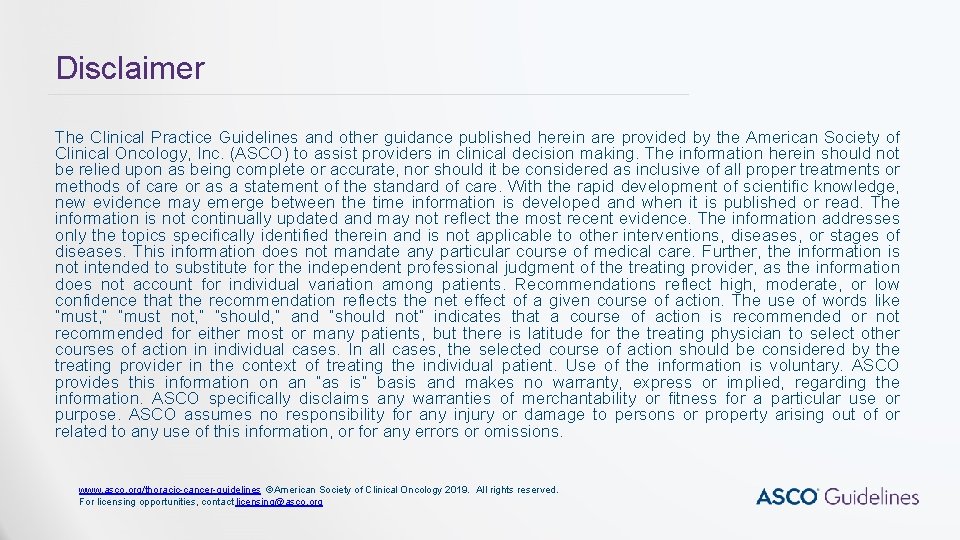
Disclaimer The Clinical Practice Guidelines and other guidance published herein are provided by the American Society of Clinical Oncology, Inc. (ASCO) to assist providers in clinical decision making. The information herein should not be relied upon as being complete or accurate, nor should it be considered as inclusive of all proper treatments or methods of care or as a statement of the standard of care. With the rapid development of scientific knowledge, new evidence may emerge between the time information is developed and when it is published or read. The information is not continually updated and may not reflect the most recent evidence. The information addresses only the topics specifically identified therein and is not applicable to other interventions, diseases, or stages of diseases. This information does not mandate any particular course of medical care. Further, the information is not intended to substitute for the independent professional judgment of the treating provider, as the information does not account for individual variation among patients. Recommendations reflect high, moderate, or low confidence that the recommendation reflects the net effect of a given course of action. The use of words like “must, ” “must not, ” “should, ” and “should not” indicates that a course of action is recommended or not recommended for either most or many patients, but there is latitude for the treating physician to select other courses of action in individual cases. In all cases, the selected course of action should be considered by the treating provider in the context of treating the individual patient. Use of the information is voluntary. ASCO provides this information on an “as is” basis and makes no warranty, express or implied, regarding the information. ASCO specifically disclaims any warranties of merchantability or fitness for a particular use or purpose. ASCO assumes no responsibility for any injury or damage to persons or property arising out of or related to any use of this information, or for any errors or omissions. www. asco. org/thoracic-cancer-guidelines ©American Society of Clinical Oncology 2019. All rights reserved. For licensing opportunities, contact licensing@asco. org