
Lunds Curve of Conflict Remember the Stages of
Lund’s Curve of Conflict

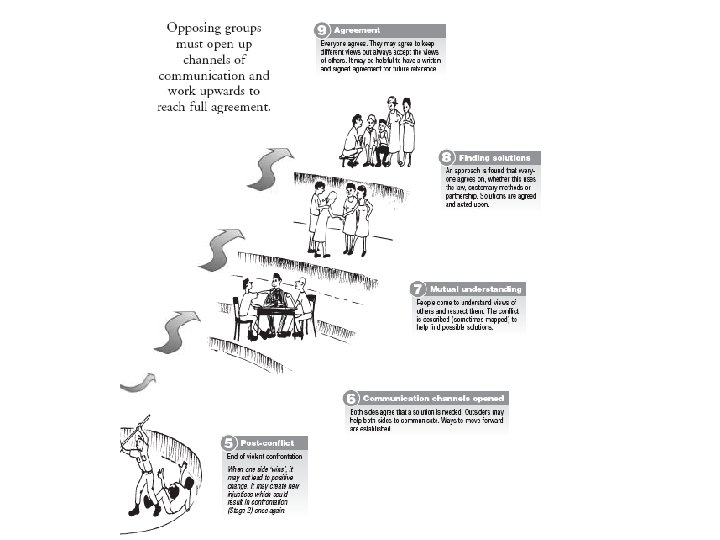
Remember the “Stages” of Conflict? • They Looked like stairs or steps.


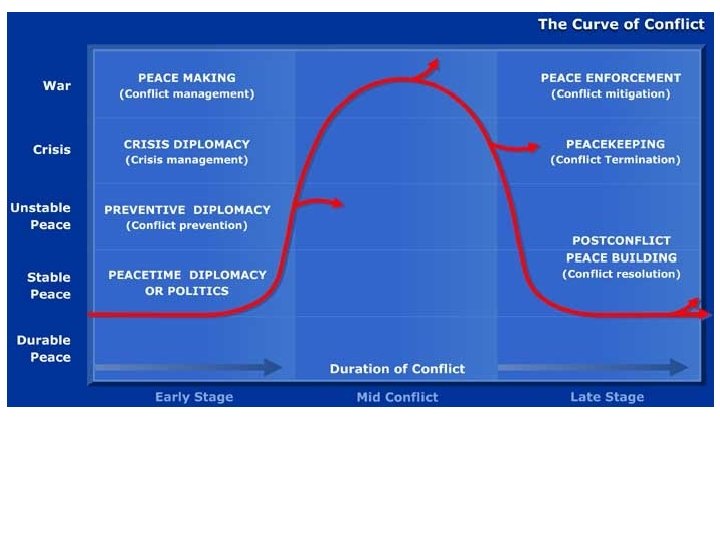
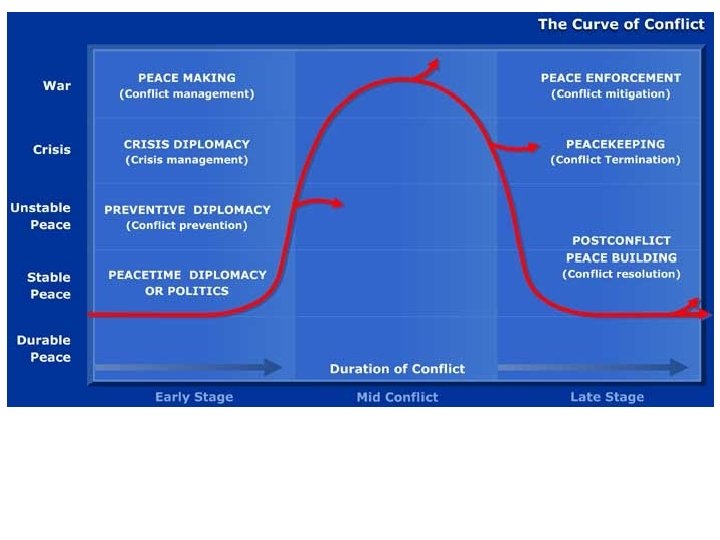
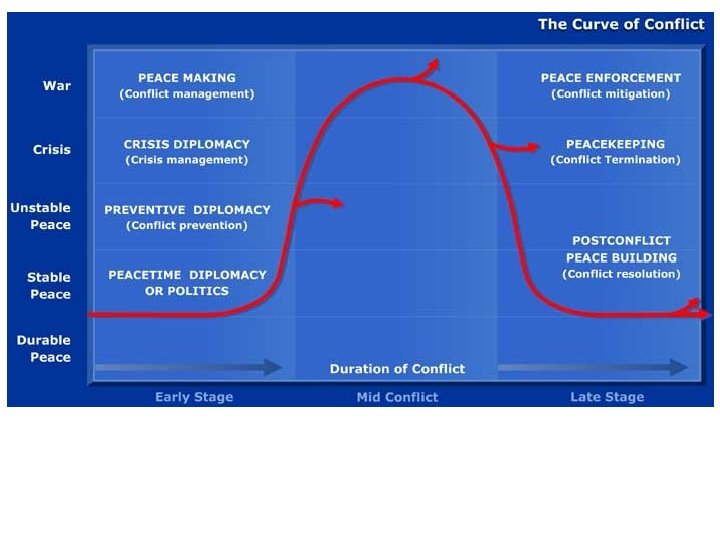
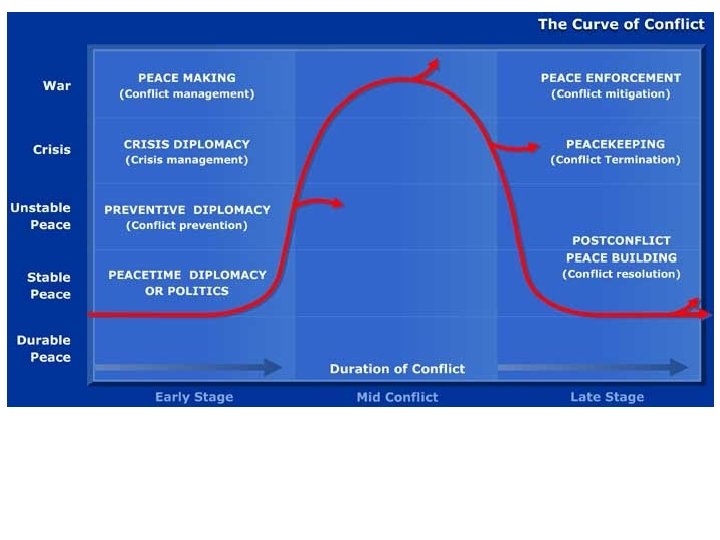
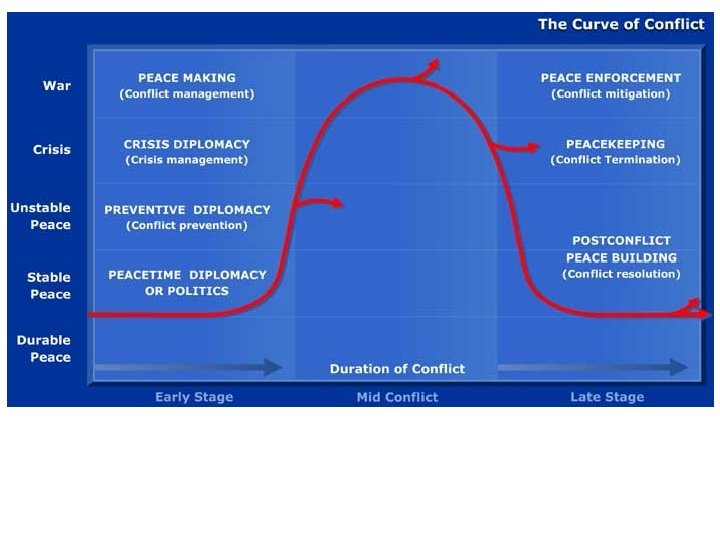
Lund’s Curve of Conflict • Preventing Violent Conflicts: A Strategy for Preventive Diplomacy by Michael S. Lund • The curve of conflict is a visual tool that helps illustrate how conflicts tend to evolve over time. • The curve helps in conceptualizing how different phases of conflict relate to one another, as well as to associated kinds of third-party intervention. • Practitioners use this knowledge in the determination of effective strategies for intervention, along with the timing of those strategies.

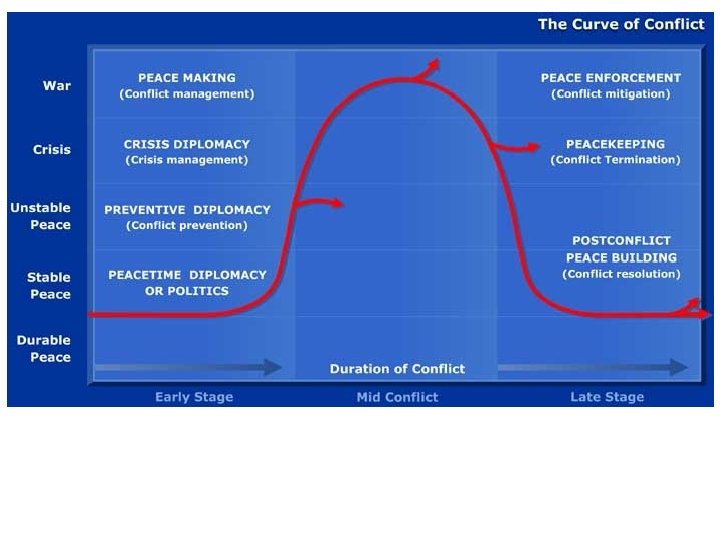
Lund’s Curve of Conflict • The line that forms an arc from left to right the course of a conflict as it rises and falls in intensity over time. Its smoothly curving bell shape is oversimplified to characterize an 'ideal type' life history. As suggested by the arrows that deviate from the line, the course of actual conflicts can exhibit many different long and short life history trajectories, thresholds, reversals, and durations. Even conflicts that have abated can re-escalate. • Nevertheless, the model has a value in allowing us to make certain useful distinctions among the conflict management interventions that relate to different levels of intensity.

Lund’s Curve of Conflict • The column on the left describes relations between parties to the dispute and is divided into various phases of peace or conflict, Durable Peace, Stable Peace, Unstable Peace, Crisis, and War—with lower intensity phases characterized by what Lund calls interactive, mutually accommodative behavior, such as debates and negotiations and higher intensity phases characterized by unilateral, coercive behavior, such as ultimatums, sanctions and physical force.
Durable Peace • Durable Peace is the first phase on the curve. As its name implies, durable peace is a lasting peace. Plotted over time, it is represented as a relatively long, flat line. • Lund explains, Durable Peace involves a high level of reciprocity and cooperation, and the virtual absence of self-defense measures among parties, although it may include their military alliance against a common threat. A ‘positive peace’ prevails based on shared values, goals, and institutions (e. g. democratic political systems and rule of law), economic interdependence, and a sense of international community. • Can you name an example of durable peace in the world today?

Durable Peace • Examples: – US and Canada • There’s a lot of communication, reciprocity. Conflicts are resolved in a political way. There’s no hint of violence that’s involved. All problems, and there are problems in every relationship, usually are resolved -- or not resolved -- but don’t complicate the basic relationship. – European Union
Durable Peace • Even in a state of durable peace, disagreements will arise on any number of issues, but these disputes will be resolved through Peacetime Diplomacy or Politics, whose objectives include maintaining and strengthening stable relations and institutions.

Stable Peace • The term Stable Peace describes a state of relations that is higher in its degree of tension that of durable peace. • As Lund explains, Stable Peace is a relationship of wary communication and limited cooperation (e. g. trade) within an overall context of basic order ornational stability. Value or goal differences exist and no military cooperation is established, but disputes are generally worked out in nonviolent, more or less predictable ways. The prospect for war is low.

Stable Peace • Examples: – US-Soviet detente in the late 1960 s – Current US-Russian relations – India and Nepal
Stable Peace • To some extent, it’s rather hard to distinguish between stable peace and durable peace. • These are constructs that Lund has created to begin to give a sense of the dynamism that you have to come to grips with when trying to analyze conflict. • Stable peace in Lund’s vocabulary obviously is a peace that’s working fine but doesn’t have the deep roots for whatever reason that a durable peace would have, and where analysis might reveal some potential trouble spots that would have to be watched to understand if that stable peace is beginning to move into a stage of instability.
Unstable Peace • If disputes remain unresolved and tensions continue to rise, the conflict may over time enter a phase known as Unstable Peace. • Lund states, Unstable Peace is a situation in which tension and suspicion among parties run high, but violence is either absent or only sporadic. A ‘negative peace’ prevails because although armed force is not deployed [or employed], the parties perceive one another as enemies and maintain deterrent military capabilities. . . A balance of power may discourage aggression, but crisis and war are still possible.

Unstable Peace • Examples: – India and Pakistan

Unstable Peace • Initiatives taken to defuse tension during a period of unstable peace are termed Preventive Diplomacy and Conflict Prevention, whose objectives include reducing tensions, resolving disputes, defusing conflicts and heading off crises. • If the efforts are successful, tensions will subside.
Crisis • However, if preventive diplomacy and crisis prevention are not successful, tensions may continue to rise. Through various types of confrontation, relations may reach the phase of Crisis. • As Lund explains, Crisis is tense confrontation between armed forces that are mobilized and ready to fight and may be engaged in threats and occasional low-level skirmishes but have not exerted any significant amount of force. The probability of the outbreak of war is high.
Crisis • Examples: – Cuban missile crisis in 1962 – Relations in Bosnia in 1996
Crisis • Initiatives taken to diffuse tension during a period of crisis are termed Crisis Diplomacy and Crisis Management, whose objectives include containing crises and stopping violent or coercive behavior. • After unstable peace is crisis. It’s a tense confrontation, and people are ready to fight. In a crisis situation you are not quite at war, but everybody’s ready to go.
War • If efforts at crisis diplomacy are not successful, there may be an outbreak of violence, and the conflict may enter the phase of War. • Lund explains, War is sustained fighting between organized armed forces. It may vary from low-intensity but continuing conflict or civil anarchy…to all-out ‘hot’ war. Once significant use of violence or armed force occurs, conflicts are very susceptible to entering a spiral of escalating violence. • Each side feels increasingly justified to use violence because the other side is. So the threshold to armed conflict or war is especially important.
War • Efforts by outside parties at ending hostilities are known as Peacemaking or Conflict Management. If an agreement to end hostilities has been reached, such outside parties might then engage in Peace Enforcement or Conflict Mitigation.
Post-War • If efforts at peacemaking and peace enforcement are successful, fighting will subside. There may be a cease-fire, which may help reduce tensions and move the relationship from a state of war back simply to a state of crisis. • At this point, efforts to keep the conflict from re-escalating are typically called Peacekeeping and Conflict Termination.
Post-War • As the result of a settlement, the parties may begin the difficult processes of Conflict Resolution and Post-Conflict Peace Building. Through such efforts, tensions can be reduced to a point where the relationship can be described as a stable peace or even a durable peace.
Post-War • However, as Lund has pointed out, hardwon arrangements can also unravel. For any number of reasons, tensions can and often do re-escalate. • The skills of the practitioner are just as important in consolidating peace and preventing recurrence of violence as they are in keeping a conflict from growing violent in the first place.
To Note • The Curve of Conflict reminds us that few, if any, violent conflicts suddenly erupt out of nowhere. They have precursors in less violent and even non-violent disputes and tensions. • Interventions are generally most effective when addressing disputes before they erupt into violence.
- Slides: 32