
Lunar Regolith Definition Importance of the regolith Nature
- Slides: 37
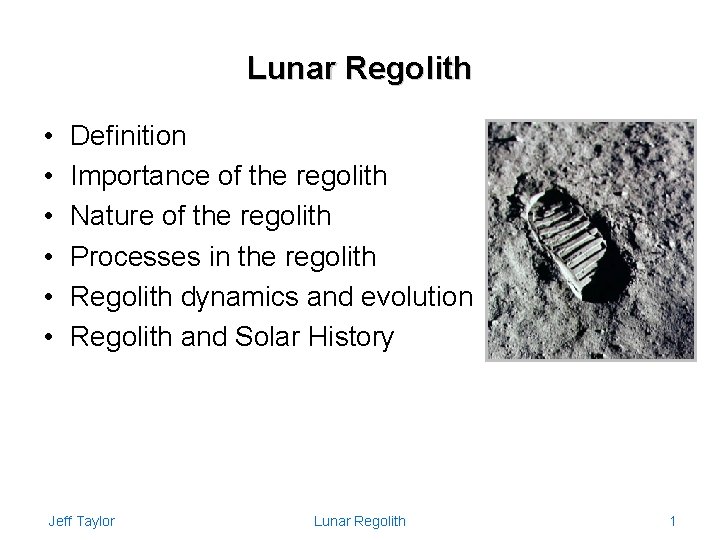
Lunar Regolith • • • Definition Importance of the regolith Nature of the regolith Processes in the regolith Regolith dynamics and evolution Regolith and Solar History Jeff Taylor Lunar Regolith 1
Definitions • Regolith: “…a general term for the layer…of fragmental and unconsolidated rock material, whether residual or transported and of highly varied character, that nearly everywhere forms the surface of the land overlies or covers bedrock. ” Dictionary of Geology, Bates and Jackson • Soil: To some people, soils must contain organic material. In lunar science, soil usually refers to the finer grained portion of the regolith, say finer than 1 mm • Megaregolith: Because of early heavy bombardment, the upper crust in the highlands (including highlands beneath maria), is a pile of debris, or a regolith. – But it is not fine-grained and does not contain solar-wind components (H, He, C, N, Ne, etc. ) – Because it extends many kilometers (some suggest up to 40 km, but that is debatable), many call it the megaregolith Jeff Taylor Lunar Regolith 2
Importance of the Regolith-1 • Record’s history of the Sun • It is what our instruments see when we analyze the Moon remotely – Visible-IR reflectance (upper 20 microns) – X-ray fluorescence (upper 1 mm) – Gamma-ray spectroscopy (upper 10 -20 cm) • All lunar samples were collected from the regolith • Basis for comparison with regolith development on other airless bodies such as Mercury and asteroids Jeff Taylor Lunar Regolith 3
Importance of the Regolith-2 • Rare and distant rock types found only in the regolith: – Magma ocean idea sprung from discovery of anorthosites in Apollo 11 mare regolith – VLT mare basalts were first discovered in the Apollo 17 high-Ti regolith – Some rocks types have been found only in the regolith so far (e. g. , KREEP basalts) • Records part of the lunar bombardment history • Geophysical instruments were implanted in it: – Heat flow probes – Seismometers Jeff Taylor Lunar Regolith 4
Importance of the Regolith-3 • Regolith will be a major resource at a lunar base – Oxygen – Volatiles (H, 3 He, C, N) – Shielding • It engineering (geotechnical properties) are important in planning lunar base activities – Construction – Mining – Materials processing Jeff Taylor Lunar Regolith 5
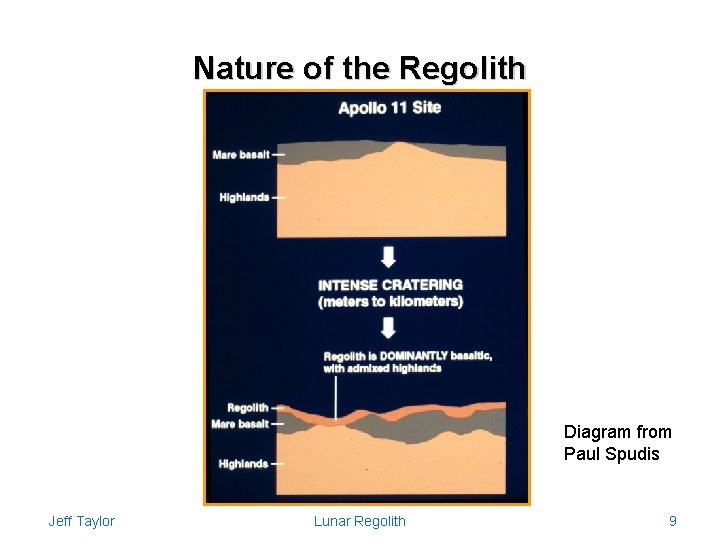
Nature of the Regolith • Blankets virtually the entire Moon to a depth of about 3 -10 m • Composed of: – – Underlying bedrock (usually more than one type) Materials thrown in by distant impacts Degraded bedrock (crushed, melted, shocked) New impact products such as agglutintes Jeff Taylor Lunar Regolith 6
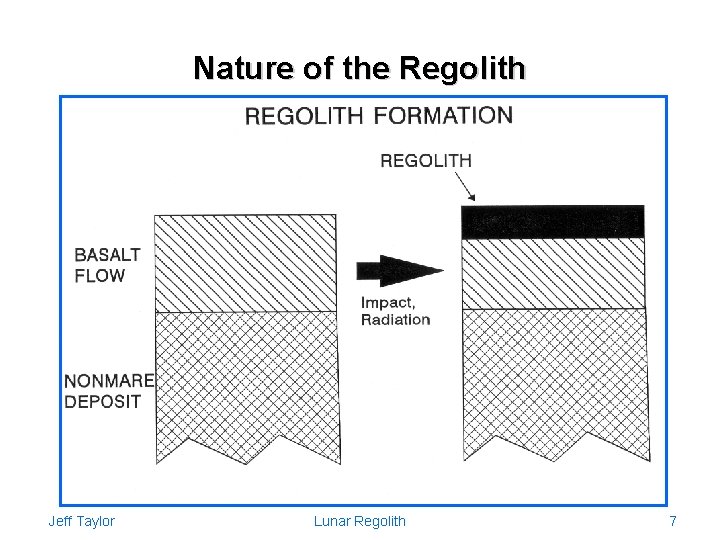
Nature of the Regolith Jeff Taylor Lunar Regolith 7
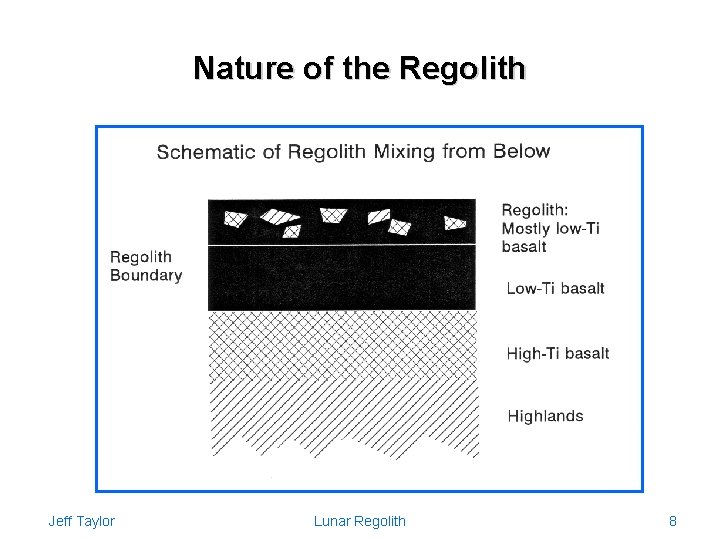
Nature of the Regolith Jeff Taylor Lunar Regolith 8
Nature of the Regolith Diagram from Paul Spudis Jeff Taylor Lunar Regolith 9
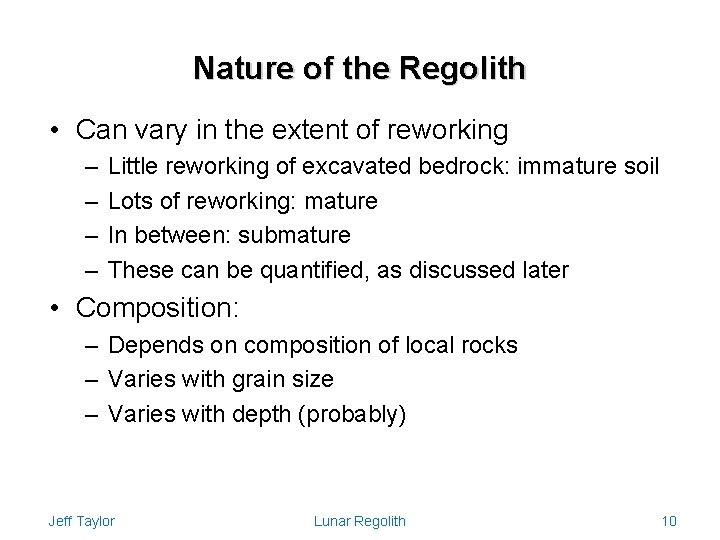
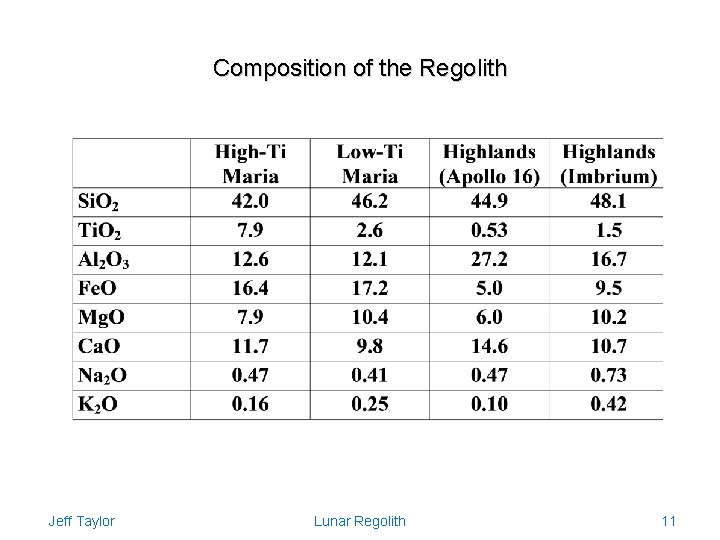
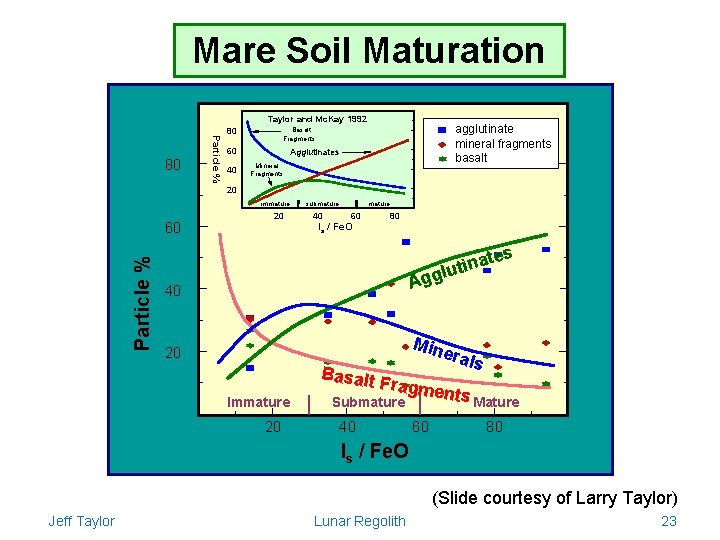
Nature of the Regolith • Can vary in the extent of reworking – – Little reworking of excavated bedrock: immature soil Lots of reworking: mature In between: submature These can be quantified, as discussed later • Composition: – Depends on composition of local rocks – Varies with grain size – Varies with depth (probably) Jeff Taylor Lunar Regolith 10
Composition of the Regolith Jeff Taylor Lunar Regolith 11
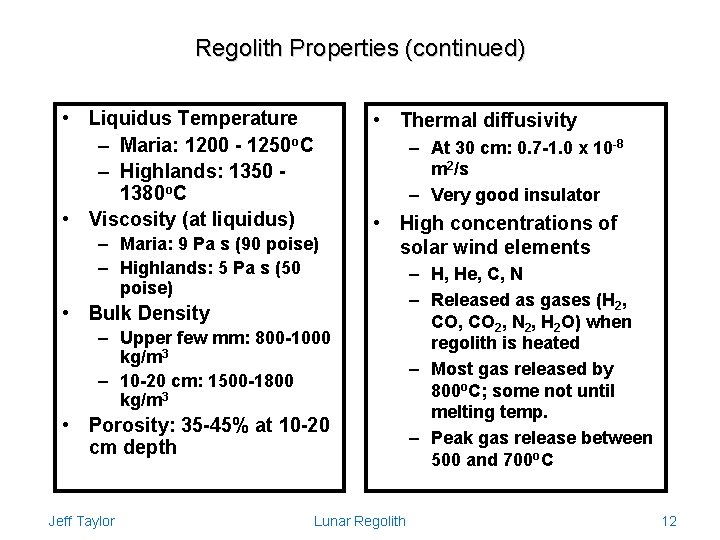
Regolith Properties (continued) • Liquidus Temperature – Maria: 1200 - 1250 o. C – Highlands: 1350 1380 o. C • Viscosity (at liquidus) • Thermal diffusivity – At 30 cm: 0. 7 -1. 0 x 10 -8 m 2/s – Very good insulator – Maria: 9 Pa s (90 poise) – Highlands: 5 Pa s (50 poise) • High concentrations of solar wind elements • Bulk Density – Upper few mm: 800 -1000 kg/m 3 – 10 -20 cm: 1500 -1800 kg/m 3 • Porosity: 35 -45% at 10 -20 cm depth Jeff Taylor Lunar Regolith – H, He, C, N – Released as gases (H 2, CO 2, N 2, H 2 O) when regolith is heated – Most gas released by 800 o. C; some not until melting temp. – Peak gas release between 500 and 700 o. C 12
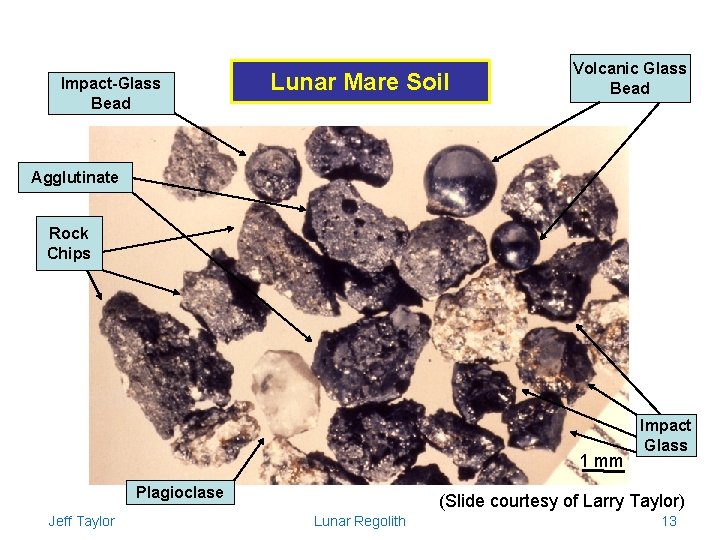
Impact-Glass Bead Lunar Mare Soil Volcanic Glass Bead Agglutinate Rock Chips 1 mm Plagioclase Jeff Taylor Impact Glass (Slide courtesy of Larry Taylor) Lunar Regolith 13
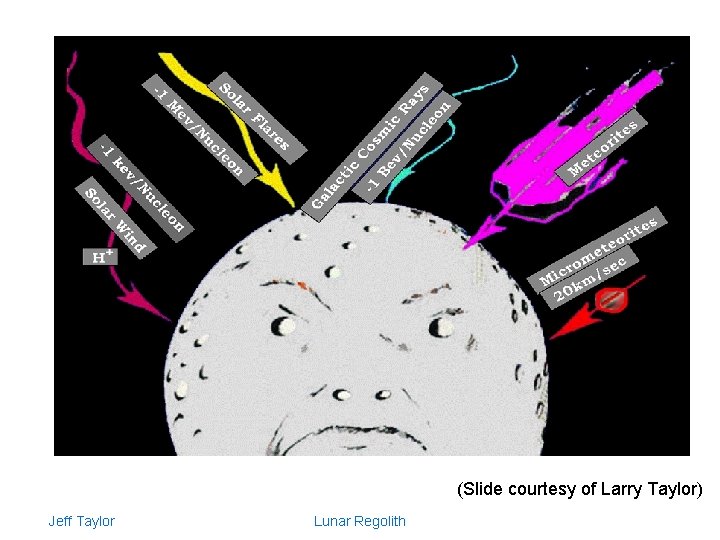
Our Unhappy Moon (Slide courtesy of Larry Taylor) Jeff Taylor Lunar Regolith
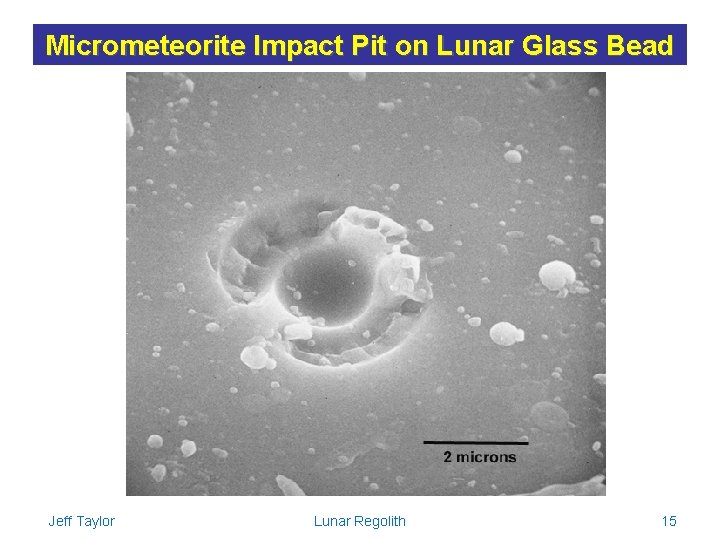
Micrometeorite Impact Pit on Lunar Glass Bead Jeff Taylor Lunar Regolith 15
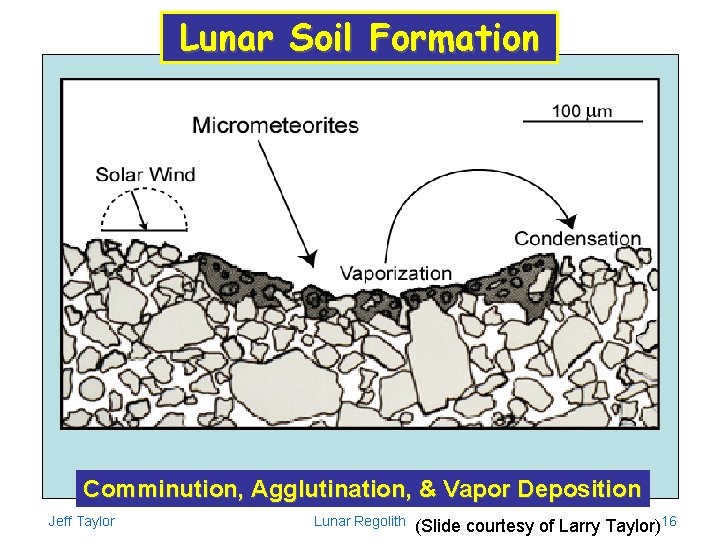
Lunar Soil Formation Comminution, Agglutination, & Vapor Deposition Jeff Taylor Lunar Regolith (Slide courtesy of Larry Taylor)16
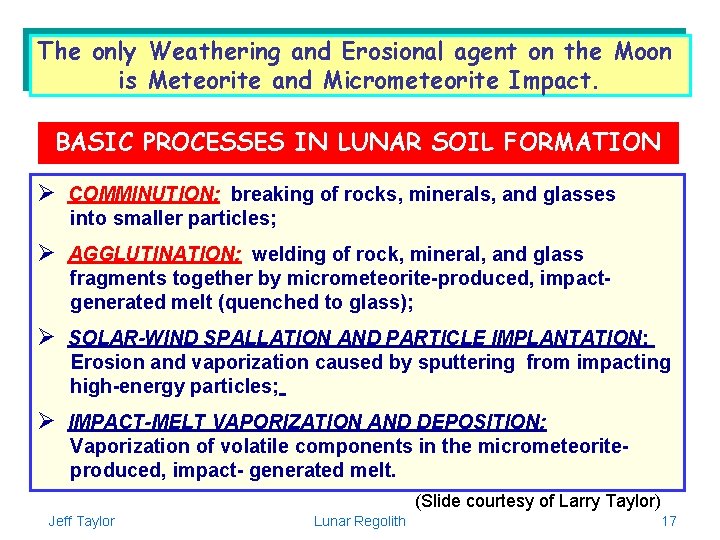
The only Weathering and Erosional agent on the Moon is Meteorite and Micrometeorite Impact. BASIC PROCESSES IN LUNAR SOIL FORMATION Ø COMMINUTION: breaking of rocks, minerals, and glasses into smaller particles; Ø AGGLUTINATION: welding of rock, mineral, and glass fragments together by micrometeorite-produced, impactgenerated melt (quenched to glass); Ø SOLAR-WIND SPALLATION AND PARTICLE IMPLANTATION: Erosion and vaporization caused by sputtering from impacting high-energy particles; Ø IMPACT-MELT VAPORIZATION AND DEPOSITION: Vaporization of volatile components in the micrometeoriteproduced, impact- generated melt. (Slide courtesy of Larry Taylor) Jeff Taylor Lunar Regolith 17
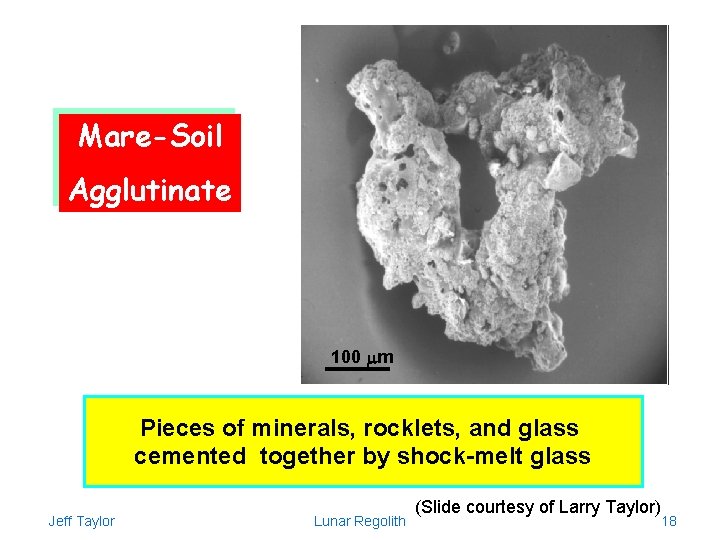
Mare-Soil Agglutinate 100 m Pieces of minerals, rocklets, and glass cemented together by shock-melt glass Jeff Taylor Lunar Regolith (Slide courtesy of Larry Taylor) 18
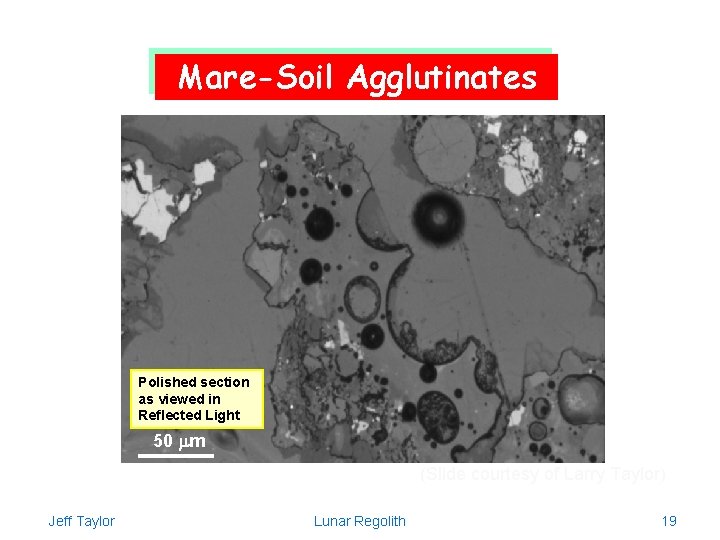
Mare-Soil Agglutinates Polished section as viewed in Reflected Light 50 m (Slide courtesy of Larry Taylor) Jeff Taylor Lunar Regolith 19
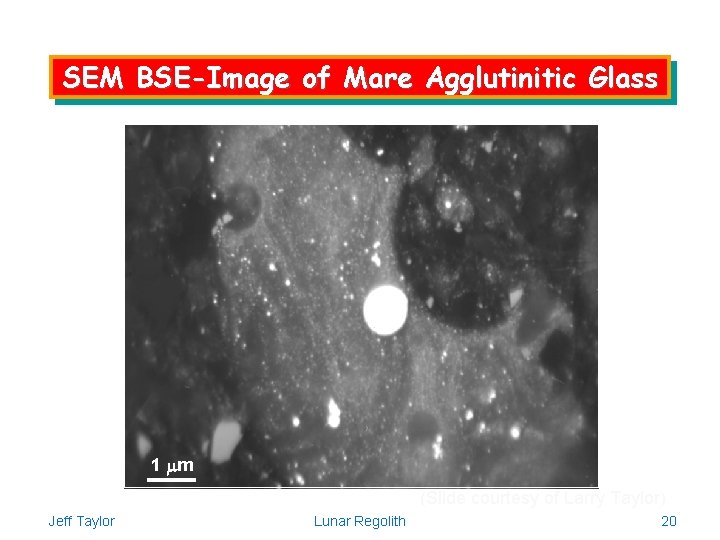
SEM BSE-Image of Mare Agglutinitic Glass 1 m (Slide courtesy of Larry Taylor) Jeff Taylor Lunar Regolith 20
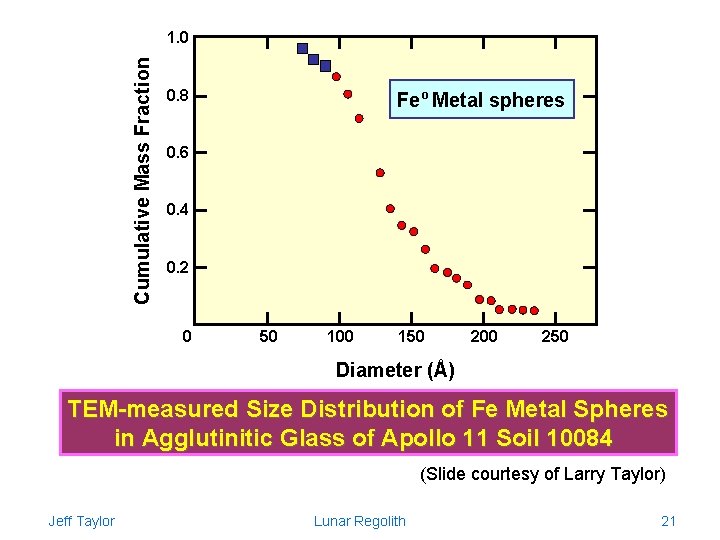
Cumulative Mass Fraction 1. 0 0. 8 Feo Metal spheres 0. 6 0. 4 0. 2 0 50 100 150 200 250 Diameter (Å) TEM-measured Size Distribution of Fe Metal Spheres in Agglutinitic Glass of Apollo 11 Soil 10084 (Slide courtesy of Larry Taylor) Jeff Taylor Lunar Regolith 21
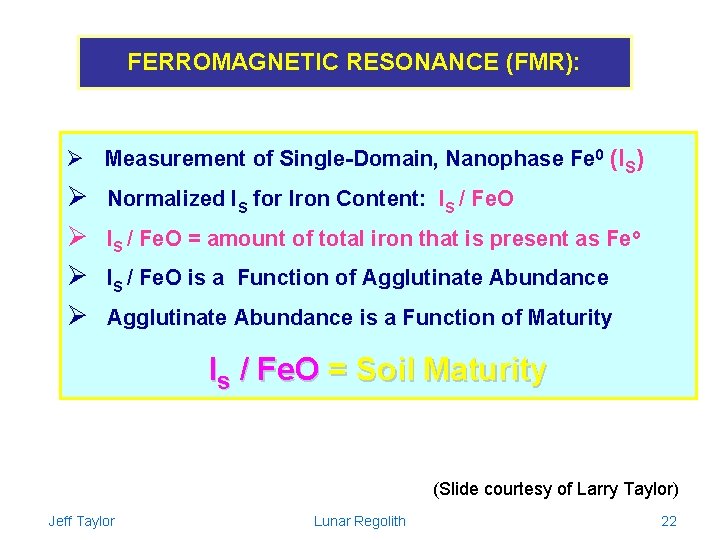
FERROMAGNETIC RESONANCE (FMR): Ø Measurement of Single-Domain, Nanophase Fe 0 (IS) Ø Ø Normalized IS for Iron Content: IS / Fe. O = amount of total iron that is present as Feo IS / Fe. O is a Function of Agglutinate Abundance is a Function of Maturity Is / Fe. O = Soil Maturity (Slide courtesy of Larry Taylor) Jeff Taylor Lunar Regolith 22
Mare Soil Maturation Taylor and Mc. Kay 1992 Particle % 80 80 60 40 agglutinate mineral fragments basalt Basalt Fragments Agglutinates Mineral Fragments 20 immature Particle % 60 20 submature 40 mature 60 80 Is / Fe. O at lutin 40 Agg 20 Min Basalt Immature 20 es eral s Fragme nts Mature Submature 40 60 80 Is / Fe. O (Slide courtesy of Larry Taylor) Jeff Taylor Lunar Regolith 23
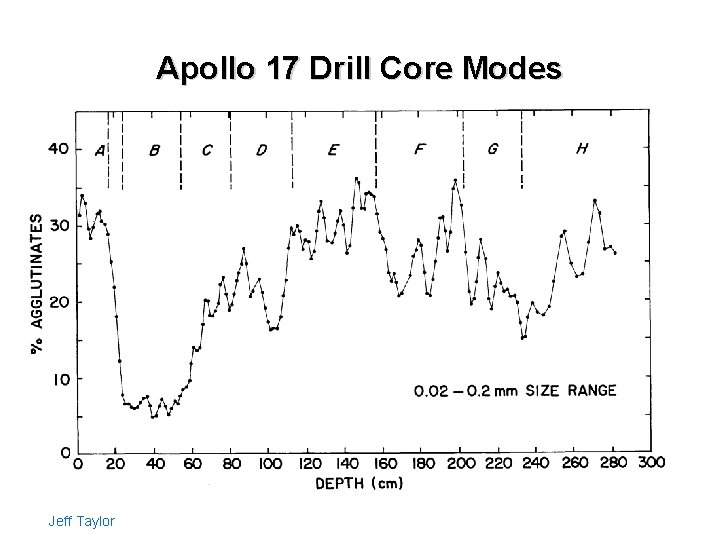
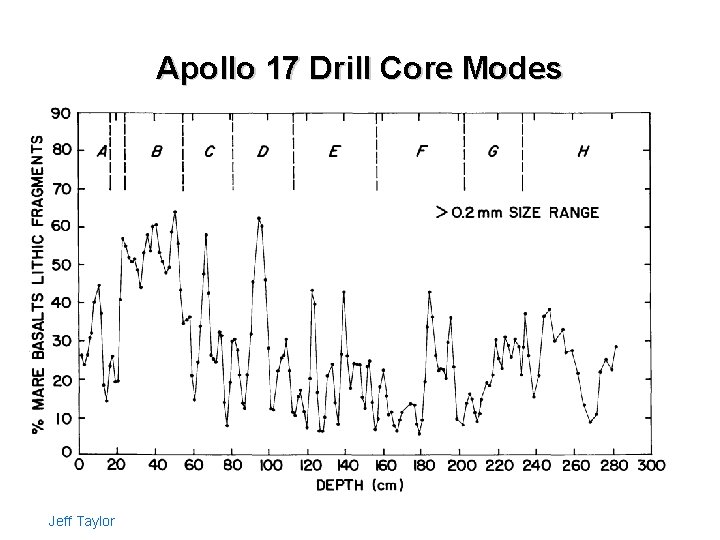
Apollo 17 Drill Core Modes Jeff Taylor
Apollo 17 Drill Core Modes Jeff Taylor
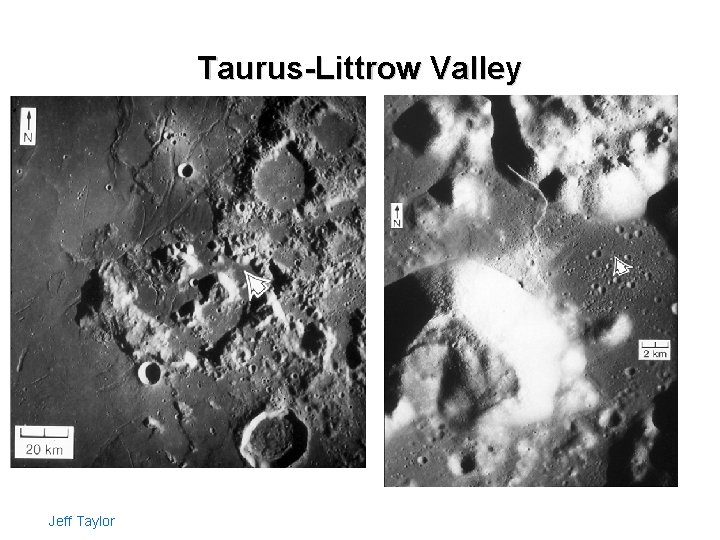
Taurus-Littrow Valley Jeff Taylor
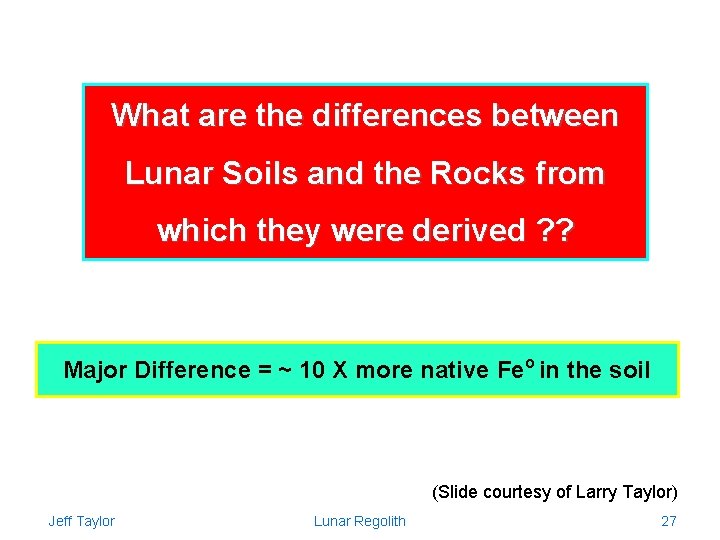
What are the differences between Lunar Soils and the Rocks from which they were derived ? ? Major Difference = ~ 10 X more native Feo in the soil (Slide courtesy of Larry Taylor) Jeff Taylor Lunar Regolith 27
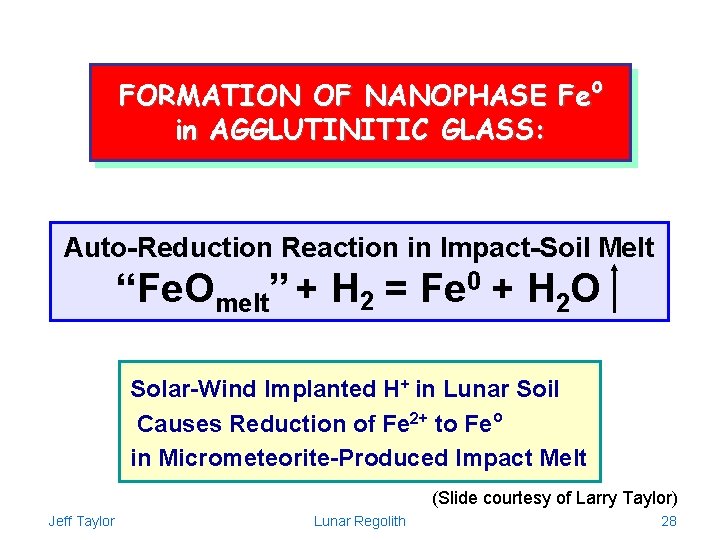
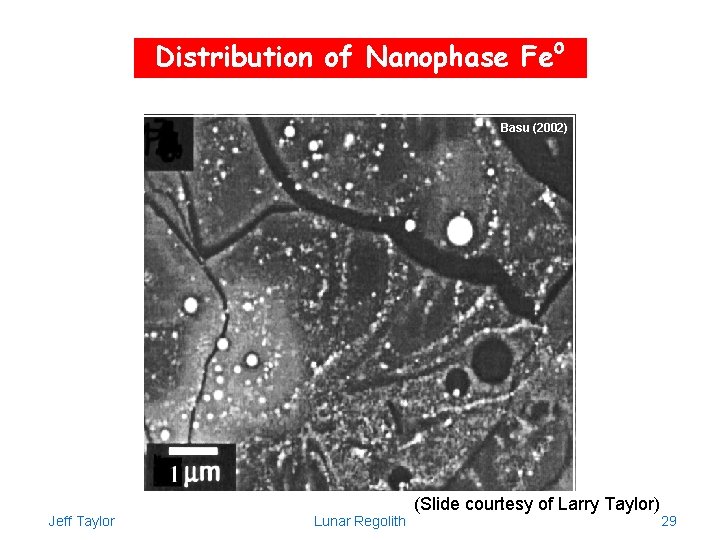
FORMATION OF NANOPHASE Feo in AGGLUTINITIC GLASS: Auto-Reduction Reaction in Impact-Soil Melt “Fe. Omelt” + H 2 = Fe 0 + H 2 O Solar-Wind Implanted H+ in Lunar Soil Causes Reduction of Fe 2+ to Feo in Micrometeorite-Produced Impact Melt (Slide courtesy of Larry Taylor) Jeff Taylor Lunar Regolith 28
Distribution of Nanophase Feo Basu (2002) Jeff Taylor Lunar Regolith (Slide courtesy of Larry Taylor) 29
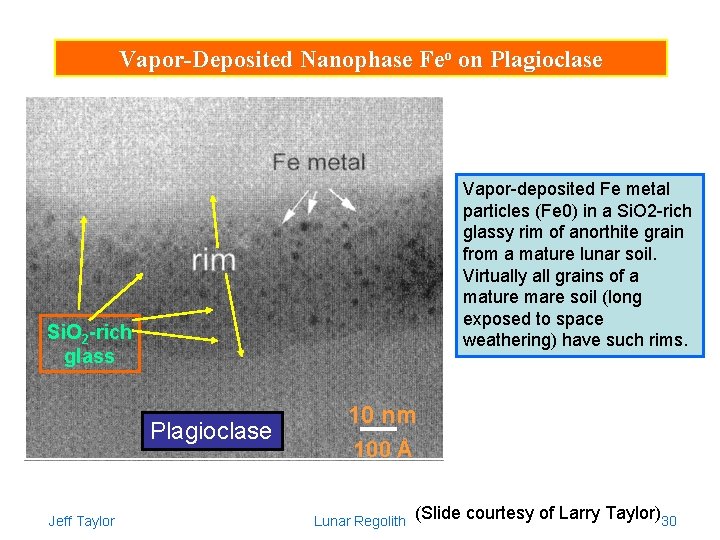
Vapor-Deposited Nanophase Feo on Plagioclase Vapor-deposited Fe metal particles (Fe 0) in a Si. O 2 -rich glassy rim of anorthite grain from a mature lunar soil. Virtually all grains of a mature mare soil (long exposed to space weathering) have such rims. Si. O 2 -rich glass Plagioclase Jeff Taylor 10 nm 100 Å Lunar Regolith (Slide courtesy of Larry Taylor)30
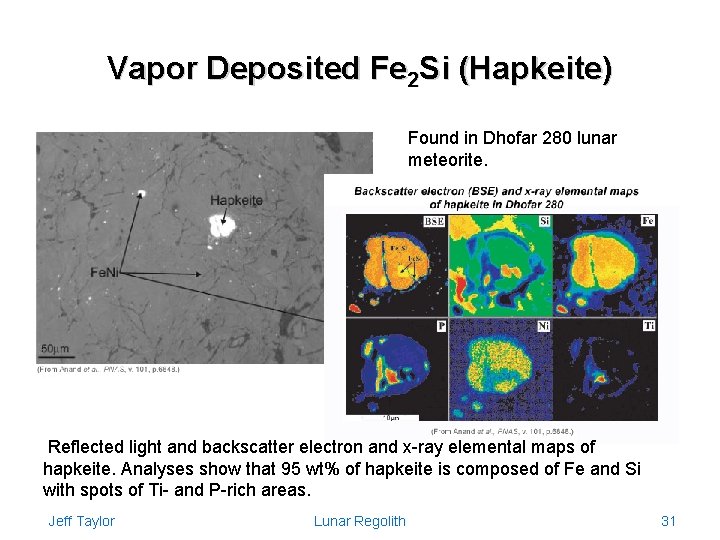
Vapor Deposited Fe 2 Si (Hapkeite) Found in Dhofar 280 lunar meteorite. Reflected light and backscatter electron and x-ray elemental maps of hapkeite. Analyses show that 95 wt% of hapkeite is composed of Fe and Si with spots of Ti- and P-rich areas. Jeff Taylor Lunar Regolith 31
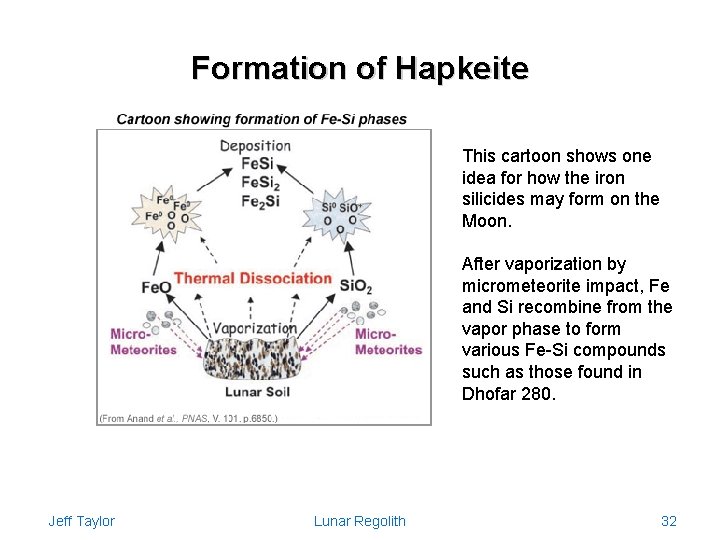
Formation of Hapkeite This cartoon shows one idea for how the iron silicides may form on the Moon. After vaporization by micrometeorite impact, Fe and Si recombine from the vapor phase to form various Fe-Si compounds such as those found in Dhofar 280. Jeff Taylor Lunar Regolith 32
MAGNETIC PROPERTIES OF LUNAR SOILS • Magnetic Susceptibility of Soil Particles Increases as Grain Size Decreases; • Effects of Vapor-Deposited Nanophase Feo are a Direct Function of Surface Area and Most Pronounced in the Finest Grain Sizes; • Virtually All <10 m Particles are Easily Attracted by a Simple Hand-held Magnet, Plg, Pyx, Ol, and Agglutinitic Glass alike. Jeff Taylor Lunar Regolith (Slide courtesy of Larry Taylor) 33
Adverse Lunar Dust Properties must be Addressed before any Commercial Presence on the Moon can be Fully Evaluated. ü Abrasiveness, with regards to friction-bearing surfaces; ü Potential for coatings, on seals, gaskets, optical lens, windows, electrical components, et cetera; ü Potential for settling on all thermal and optical surfaces, such as Solar cells and mirrors; and ü Physiological effects on humans, especially with respect to the lungs, the lymph system, and potentially the cardiovascular system, in the case of extremely fine particles. SOLUTION: Magnetic brushes ? ? (Slide courtesy of Larry Taylor) Jeff Taylor Lunar Regolith 34
Regolith Dynamics • Lots of interesting modeling done to understand regolith dynamics and evolution, but we won’t go into it • Some conclusions, from models and from studies of rock exposure histories infilling of boulder tracks: – Erosion rate at Hadley rille: 8 ± 3 mm/My – Rate of infill of boulder tracks is 2 -8 cm/My – This means that a 1 -cm footprint will last a few hundred thousand years – Horizontal transport (not including rays): • Most material comes from 100 m away • 1% from 10 km – Rock survival: depends on rock size of course, but a kg-sized boulder lasts < 100 My – Turnover (“gardening”): • Upper 1 mm turned over thousands of times on average, but material beneath 10 cm rarely turned over • Rare large events play an important role in producing specific layers in regolith Jeff Taylor Lunar Regolith 35
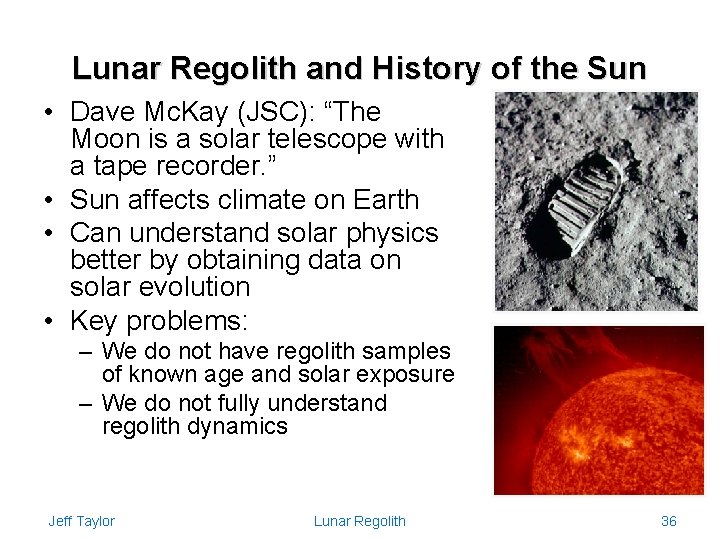
Lunar Regolith and History of the Sun • Dave Mc. Kay (JSC): “The Moon is a solar telescope with a tape recorder. ” • Sun affects climate on Earth • Can understand solar physics better by obtaining data on solar evolution • Key problems: – We do not have regolith samples of known age and solar exposure – We do not fully understand regolith dynamics Jeff Taylor Lunar Regolith 36
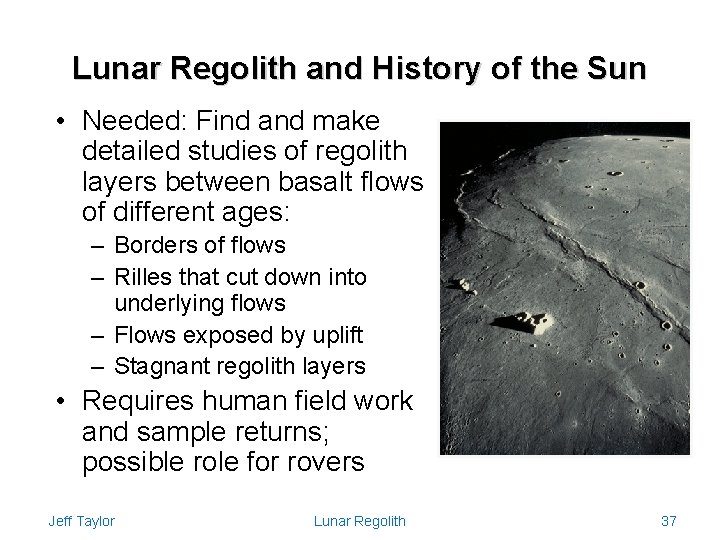
Lunar Regolith and History of the Sun • Needed: Find and make detailed studies of regolith layers between basalt flows of different ages: – Borders of flows – Rilles that cut down into underlying flows – Flows exposed by uplift – Stagnant regolith layers • Requires human field work and sample returns; possible role for rovers Jeff Taylor Lunar Regolith 37