
Lunar Phases Eclipses Apparent motion The Moons orbit
Lunar Phases Eclipses
Apparent motion: The Moon’s orbit: The phases of the Moon • Every object in the solar system is always light on one side and dark on the other. ___________________ • If we sometimes see the bright side of an object, and sometimes see the dark side, then the object will appear to go through ______ phases • This is what causes the phases of the Moon • The Moon takes about 27. 3 days to go once Sidereal Period around the Earth - _________ • Because of Earth’s orbit the Moon takes 29. 5 days to get back to the same place relative to the Synodic Period (Lunar Month) Sun - _________
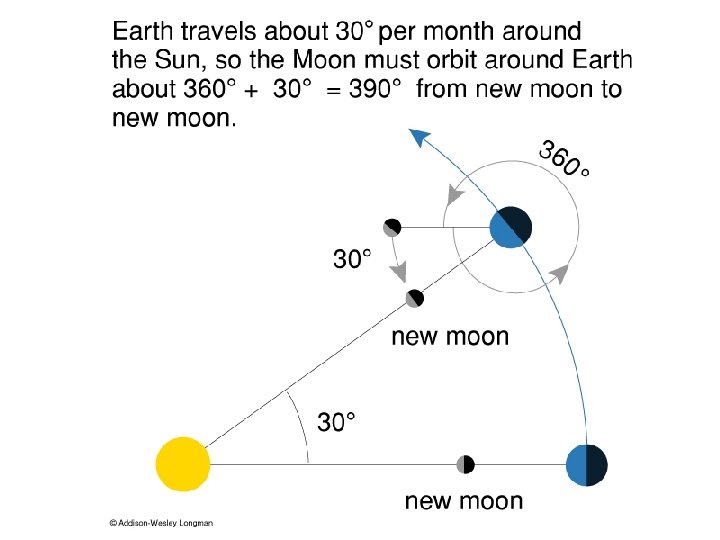
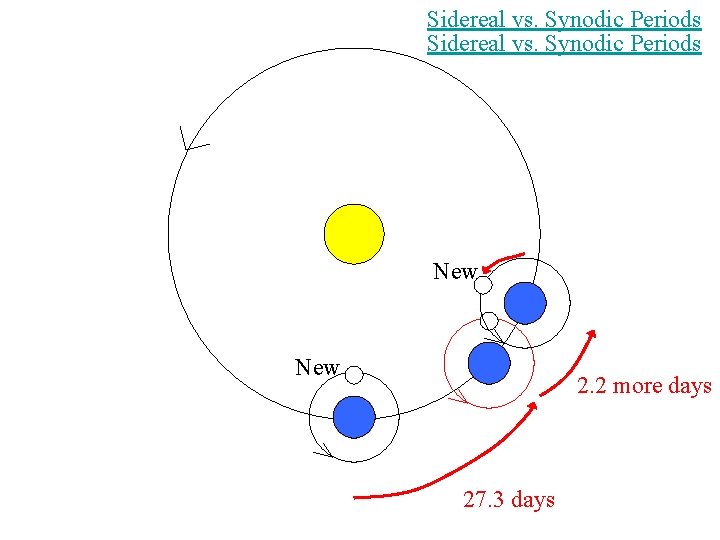
Sidereal vs. Synodic Periods New 2. 2 more days 27. 3 days
The Moon • Moon phases cycle over a period of 29. 5 days • Always has the same “face” to Earth, which rotate means it MUST _______ on its own axis! • Moon phases - result of Moon Sun and the _______, Earth _____ positions relative to each other • Moon rises later and later as the month goes on 50 min/day ________ • Plane of Moon’s orbit almost the same as 5 o tilt Earth’s orbit - _______
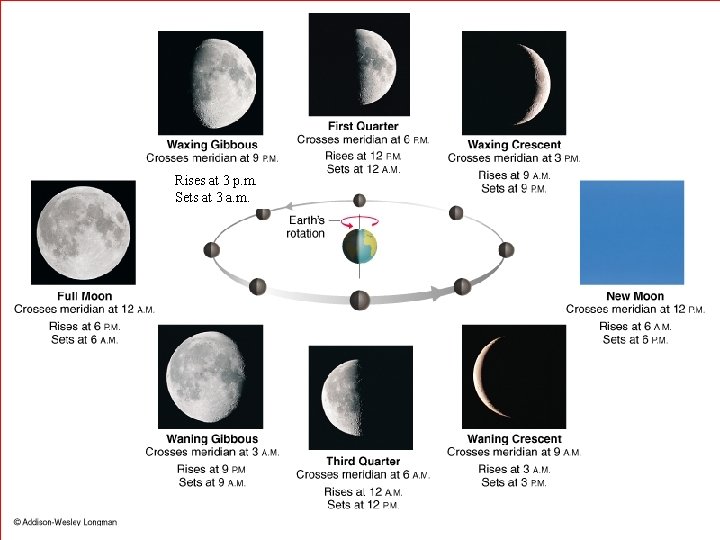
Rises at 3 p. m. Sets at 3 a. m.
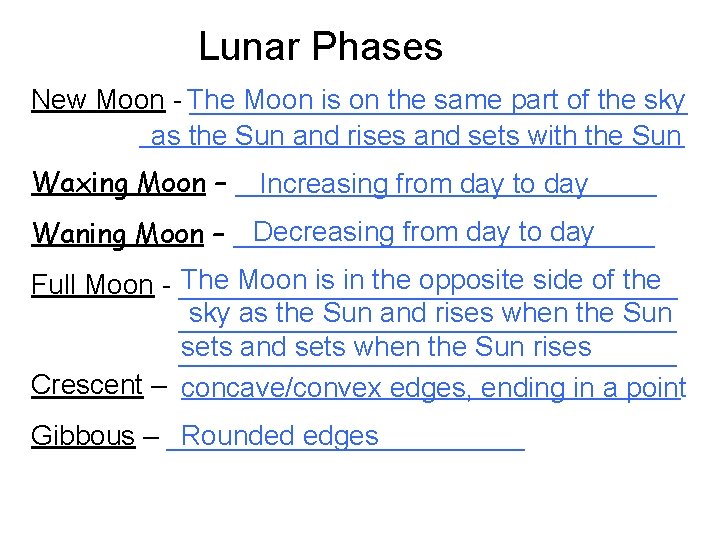
Lunar Phases Moon is on the same part of the sky New Moon - The ___________________________________ as the Sun and rises and sets with the Sun Waxing Moon – ____________ Increasing from day to day Decreasing from day to day Waning Moon – ____________ The Moon is in the opposite side of the Full Moon - ________________ sky as the Sun and rises when the Sun ________________ sets and sets when the Sun rises ________________ Crescent – concave/convex ________________ edges, ending in a point Gibbous – ____________ Rounded edges
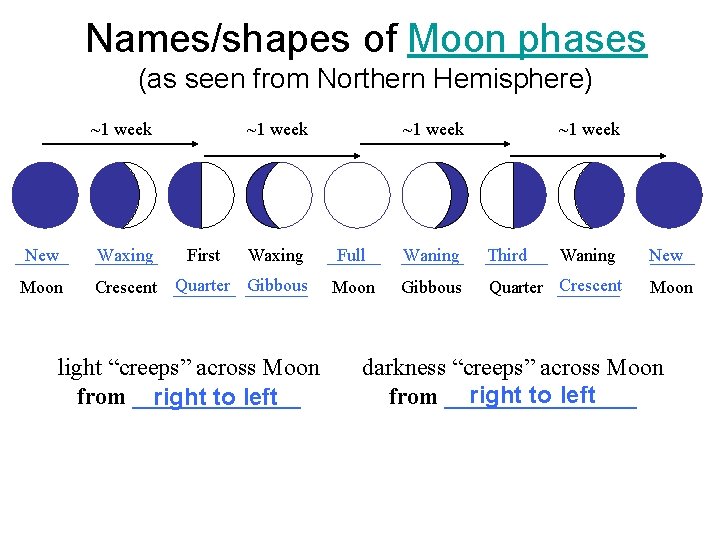
Names/shapes of Moon phases (as seen from Northern Hemisphere) ~1 week ______ New Moon _______ Waxing ~1 week First Waxing Quarter _______ Gibbous Crescent _______ light “creeps” across Moon from _______ right to left ~1 week ______ Full _______ Waning _______ Third Waning New _____ Moon Gibbous Crescent Quarter _______ Moon darkness “creeps” across Moon right to left from ________
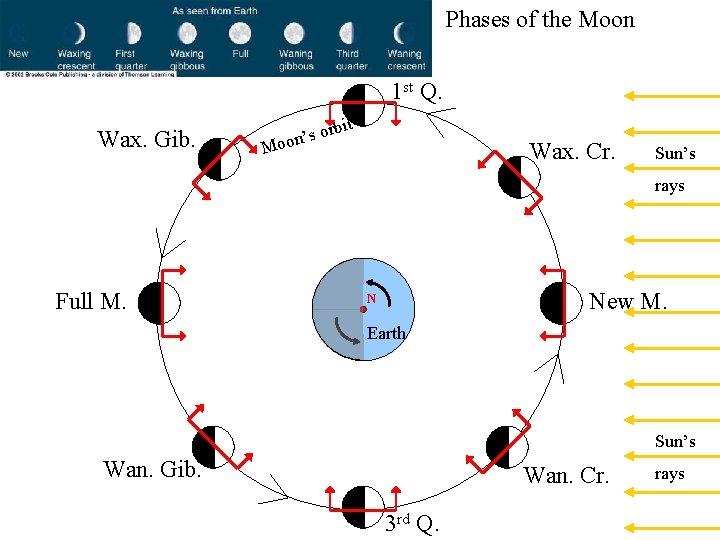
Phases of the Moon 1 st Q. Wax. Gib. it s orb ’ n o Mo Wax. Cr. Sun’s rays Full M. New M. N Earth Sun’s Wan. Gib. Wan. Cr. 3 rd Q. rays
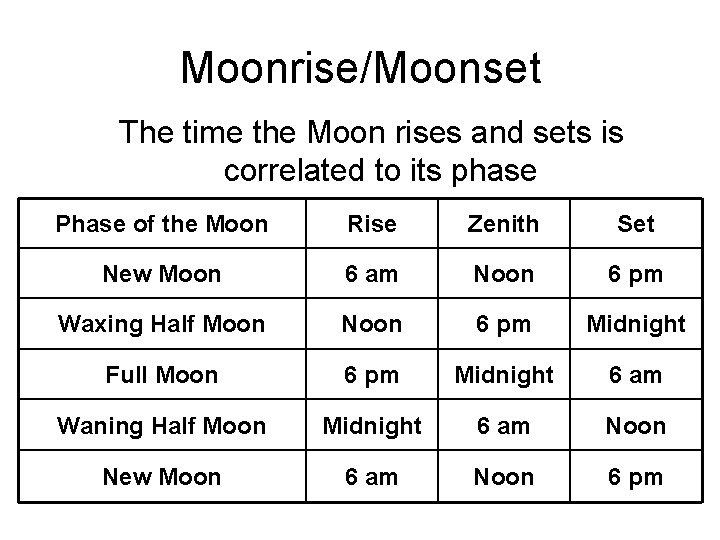
Moonrise/Moonset The time the Moon rises and sets is correlated to its phase Phase of the Moon Rise Zenith Set New Moon 6 am Noon 6 pm Waxing Half Moon Noon 6 pm Midnight Full Moon 6 pm Midnight 6 am Waning Half Moon Midnight 6 am Noon New Moon 6 am Noon 6 pm
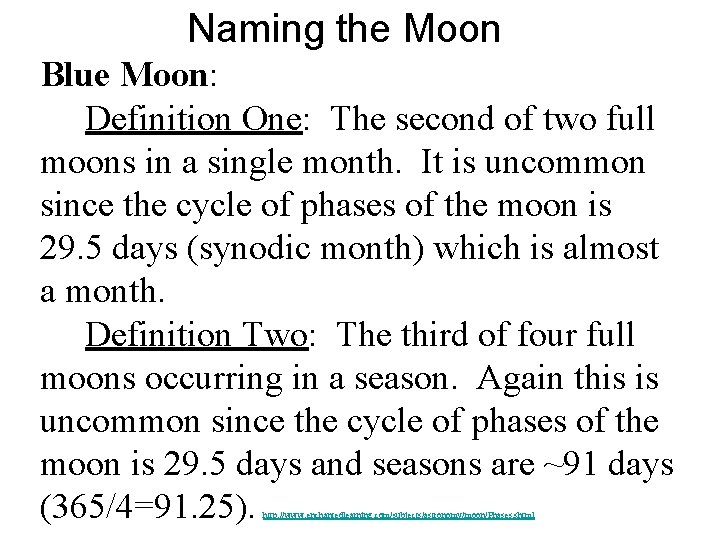
Naming the Moon Blue Moon: Definition One: The second of two full moons in a single month. It is uncommon since the cycle of phases of the moon is 29. 5 days (synodic month) which is almost a month. Definition Two: The third of four full moons occurring in a season. Again this is uncommon since the cycle of phases of the moon is 29. 5 days and seasons are ~91 days (365/4=91. 25). http: //www. enchantedlearning. com/subjects/astronomy/moon/Phases. shtml
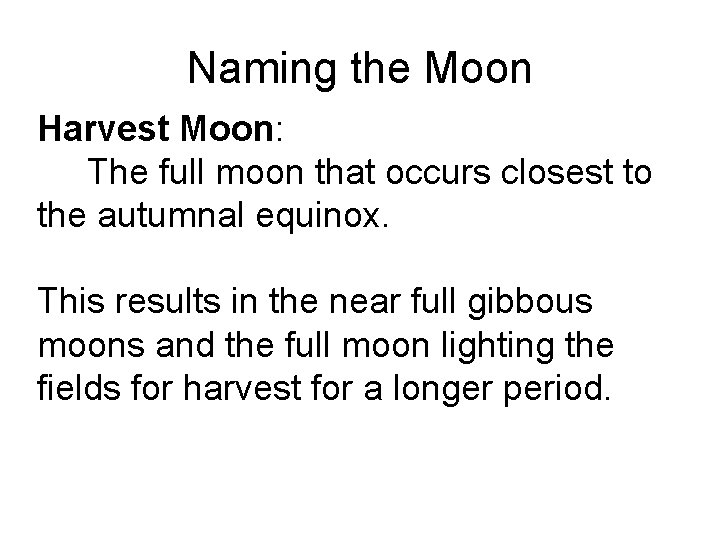
Naming the Moon Harvest Moon: The full moon that occurs closest to the autumnal equinox. This results in the near full gibbous moons and the full moon lighting the fields for harvest for a longer period.
Eclipses
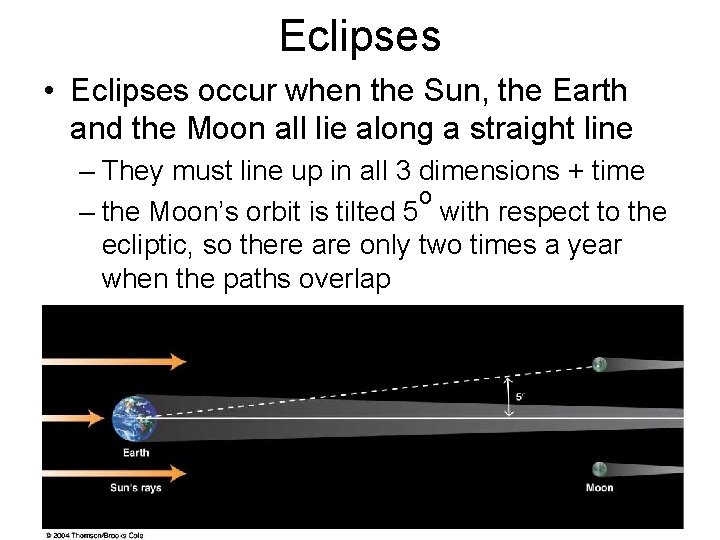
Eclipses • Eclipses occur when the Sun, the Earth and the Moon all lie along a straight line – They must line up in all 3 dimensions + time o – the Moon’s orbit is tilted 5 with respect to the ecliptic, so there are only two times a year when the paths overlap
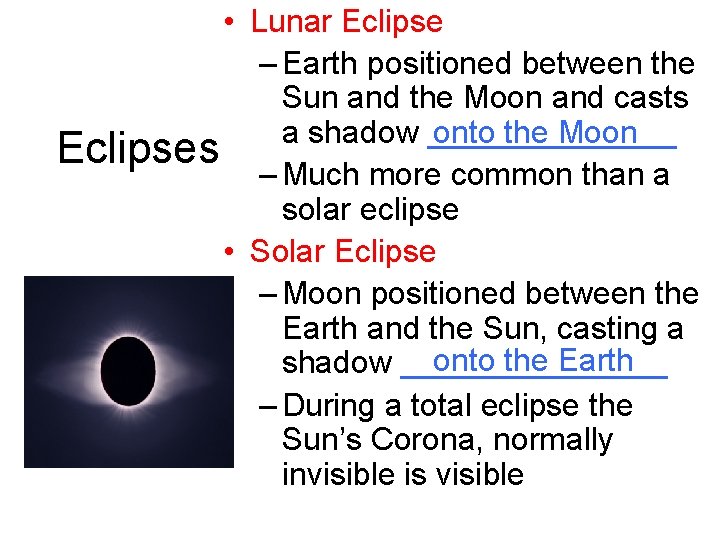
• Lunar Eclipse – Earth positioned between the Sun and the Moon and casts onto the Moon a shadow _______ Eclipses – Much more common than a solar eclipse • Solar Eclipse – Moon positioned between the Earth and the Sun, casting a onto the Earth shadow ________ – During a total eclipse the Sun’s Corona, normally invisible is visible
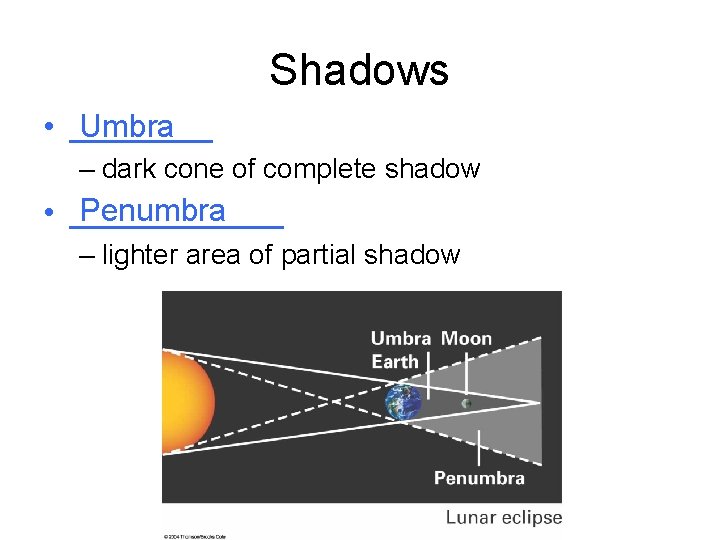
Shadows • ____ Umbra – dark cone of complete shadow Penumbra • ______ – lighter area of partial shadow
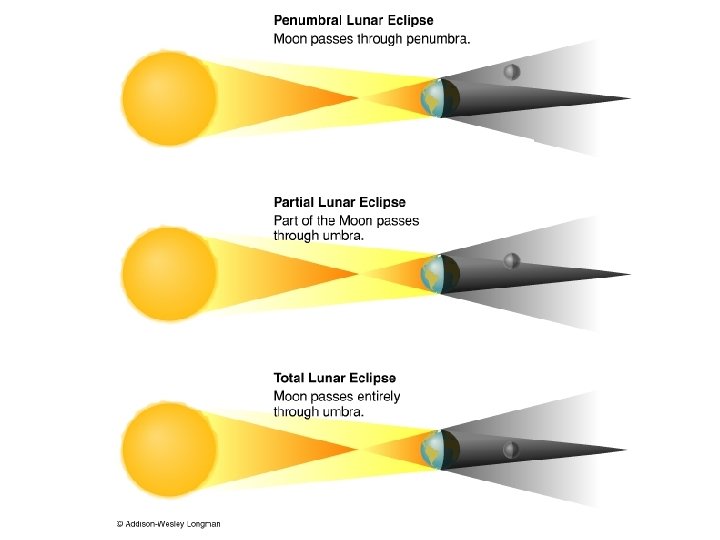
Apparent motion: The Moon’s orbit: Eclipses • When the Moon is in its Full Moon phase, it might pass through Earth’s shadow • When this happens it will be at least partially blocked from our view • This is known as a Lunar Eclipse • Three kinds of lunar eclipse (of interest to us): Moon in Earth’s Penumbra – Penumbral eclipse – ____________ – Partial eclipse - _____________ Moon in part of Earth’s Umbra – Total eclipse – ______________ Moon totally in Earth’s Umbra
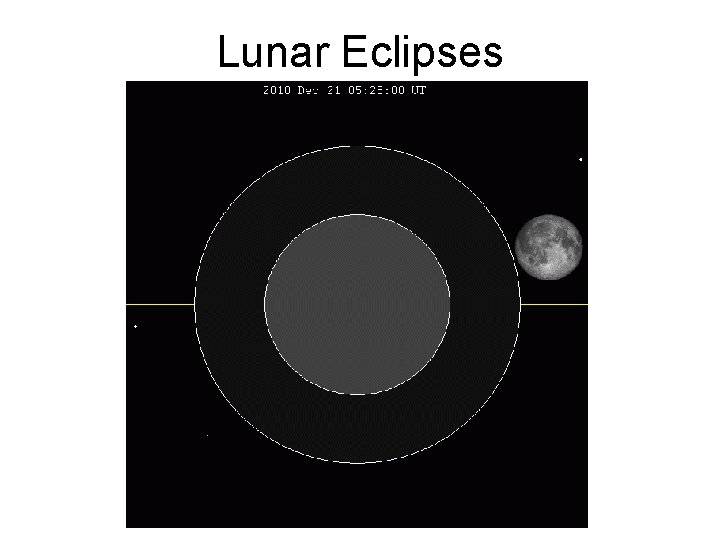
Lunar Eclipses
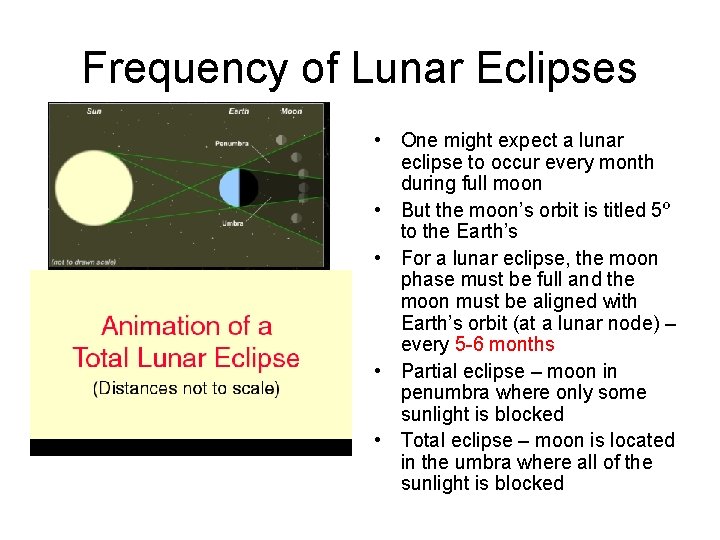
Frequency of Lunar Eclipses • One might expect a lunar eclipse to occur every month during full moon • But the moon’s orbit is titled 5º to the Earth’s • For a lunar eclipse, the moon phase must be full and the moon must be aligned with Earth’s orbit (at a lunar node) – every 5 -6 months • Partial eclipse – moon in penumbra where only some sunlight is blocked • Total eclipse – moon is located in the umbra where all of the sunlight is blocked
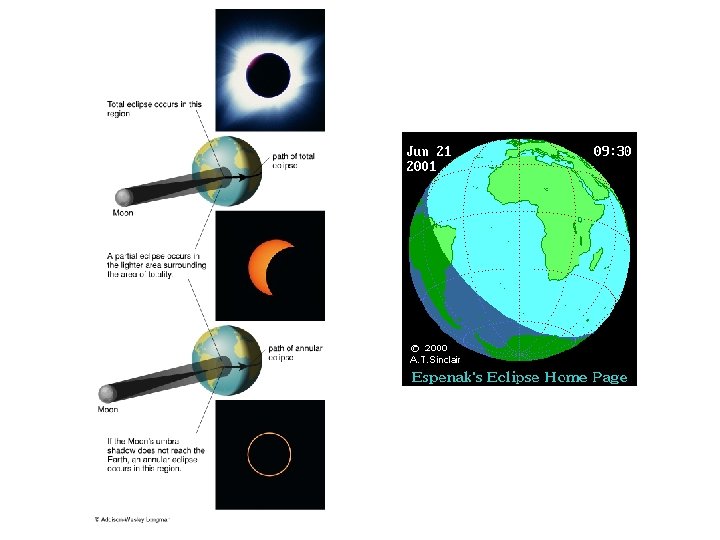
Apparent motion: The Moon’s orbit: Eclipses • When the Moon is in its New Moon phase, it might pass directly between us and the Sun • When this happens it will at least partially block the Sun from our view • This is known as a Solar Eclipses – Three kinds of solar eclipse: Total coverage • Total eclipse – __________ Moon not covering all Sun • Partial eclipse - ___________ Moon too far from Earth • Annular eclipse – _______________
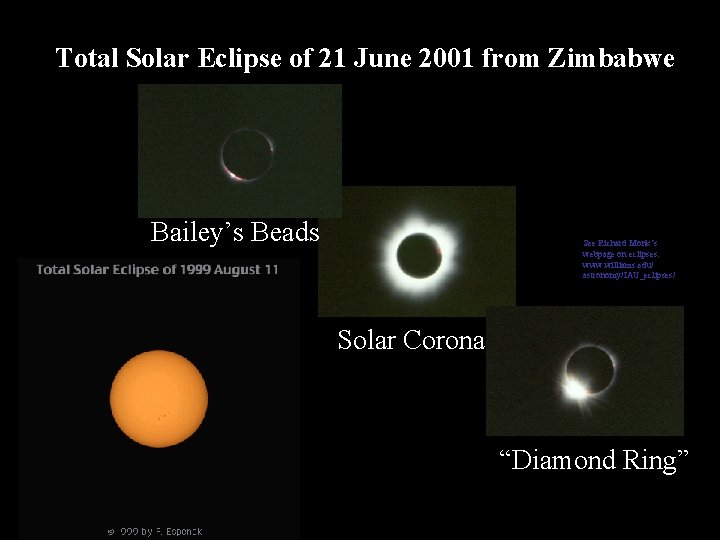
Total Solar Eclipse of 21 June 2001 from Zimbabwe Bailey’s Beads See Richard Monk’s webpage on eclipses: www. williams. edu/ astronomy/IAU_eclipses/ Solar Corona “Diamond Ring”
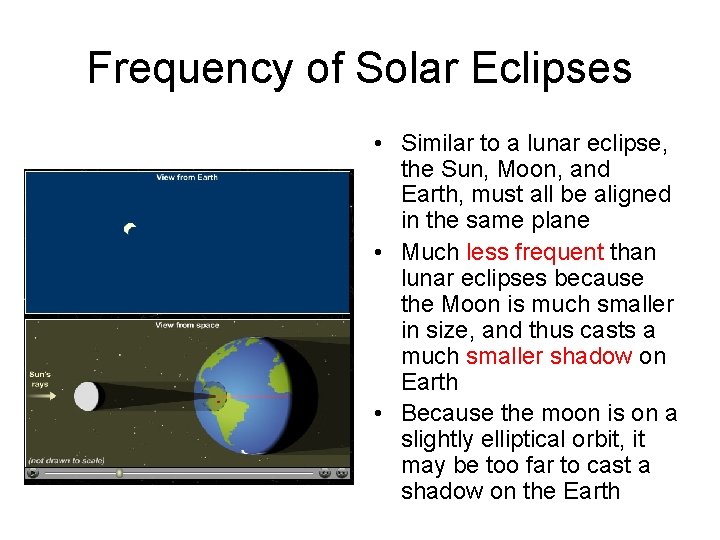
Frequency of Solar Eclipses • Similar to a lunar eclipse, the Sun, Moon, and Earth, must all be aligned in the same plane • Much less frequent than lunar eclipses because the Moon is much smaller in size, and thus casts a much smaller shadow on Earth • Because the moon is on a slightly elliptical orbit, it may be too far to cast a shadow on the Earth
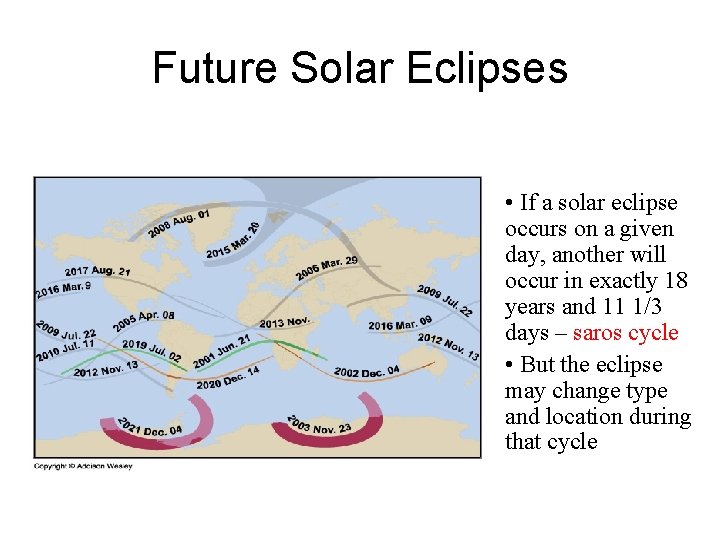
Future Solar Eclipses • If a solar eclipse occurs on a given day, another will occur in exactly 18 years and 11 1/3 days – saros cycle • But the eclipse may change type and location during that cycle
Upcoming Solar and Lunar Eclipses Solar Eclipses: Mar 20, 2015 (Total) – Europe, N/E Asia, W/W Africa, West in North America, Atlantic, Arctic Sep 13, 2015 (Partial) – S in Africa, Atlantic, Indian Ocean Mar 8/9, 2016 (Total) – SE Asia, NE Australia, Pacific, Indian Ocean Aug 21, 2017 (Total) – Much of North America Lunar Eclipses: Apr 4, 2015 (Partial) – Asia, Australia, Much of North Amer. and SA, Pacific, Atlantic, Indian Ocean, Arctic, Antarctica Sep 28, 2015 (Total) – Europe SE Asia, Africa, Much of NA and SA, Pacific, Atlantic, Indian Ocean, Arctic, Antarctic Mar 23, 2016 (Penumbral) Much Asia, Much NA and SA, Pacific, Atlantic, Indian Ocean, Arctic, Antarctic
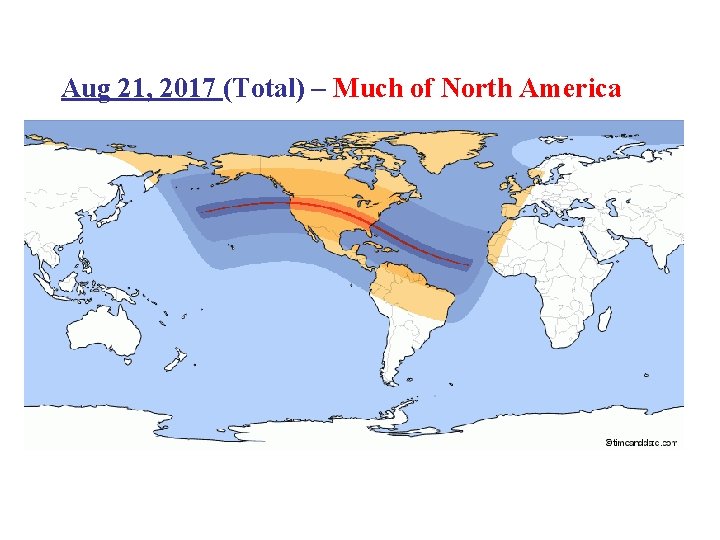
Aug 21, 2017 (Total) – Much of North America
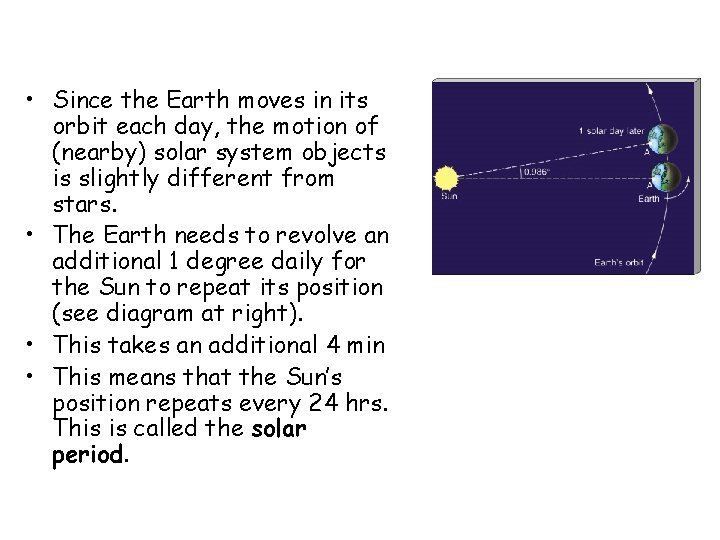
Motion of the Sun: Solar vs. Sidereal period • Since the Earth moves in its orbit each day, the motion of (nearby) solar system objects is slightly different from stars. • The Earth needs to revolve an additional 1 degree daily for the Sun to repeat its position (see diagram at right). • This takes an additional 4 min • This means that the Sun’s position repeats every 24 hrs. This is called the solar period.
Length of the Year • It takes the Earth 365. 242199 days to go from one vernal equinox to the next – NOT an integer number – But the extra is close to ¼ = 0. 25 • So every 4 years (leap year) we add an extra day to the calendar (Feb. 29) – But this is too much (we’ve added 0. 25!) • So every 100 years (on the century) we don’t add the extra day (no leap year) • But this isn’t right either, so every 4 th 100 years, we do include the leap year • This is why 2000 was a leap year

www. hep. fsu. edu/~tadams/courses/ spr 04/ast 1002 -2/Lecture 011404. ppt
- Slides: 30