
LUNAR LASER RANGING TECHNOLOGICAL ADVANCES AND NEW APPLICATIONS

- Slides: 11
LUNAR LASER RANGING: TECHNOLOGICAL ADVANCES AND NEW APPLICATIONS By: Rubi Almanza & Raymond Cheung EPR PARADOX
Lunar Laser Ranging
Significance � LLR precise measurements of the Earth. Moon distance have been used in a variety of fields to perform important tests in areas such as General Relativity.
Performance � Recently, the performance of LLR equipment on the Moon has been affected by adverse phenomena such as solar rays and lunar librations. � This has triggered the development of new equipment to counteract the negative effects of such phenomena.
Research on the field � Current research on the field has targeted primarily the effects of solar rays. � Several prototypes have been designed which under a series of thermal simulations show a significantly reduction of the effects of this phenomenon.
Future Research � In order to ensure the maximum performance of the LLR equipment, additional research targeting the negative effects of lunar librations is needed. � Furthermore, additional research to design emplacement methods for the prototypes is also needed since none, once created, has been sent to the Moon.
EPR Paradox
Current Status of Quantum Theory � As indicated in the paper by Einstein, Podolsky, and Rosen, there is still a glaring oversight in quantum theory.
Attempts � There have been no shortage of attempts to resolve the paradox. �Page �Hall �Ballentine �Kuntsman
Solutions? � Perhaps what is needed is more time for technology to be sufficiently advanced enough so that we may study these events firsthand. � The incompleteness of quantum theory can lead to many regions of science to be discovered.
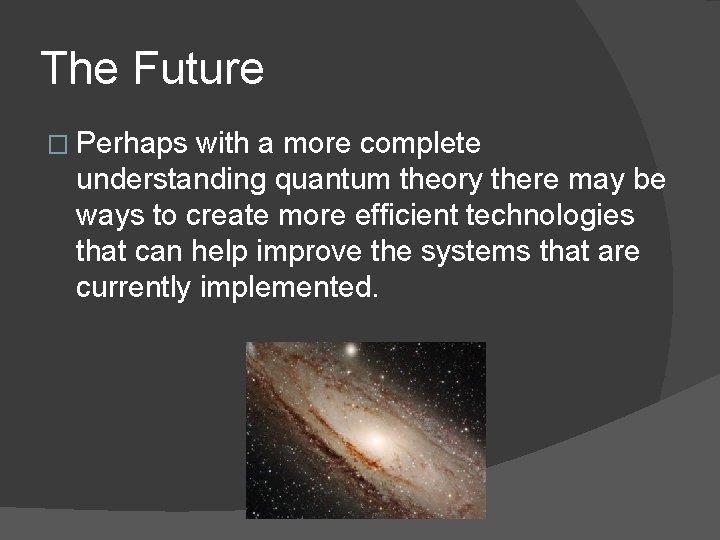
The Future � Perhaps with a more complete understanding quantum theory there may be ways to create more efficient technologies that can help improve the systems that are currently implemented.