
Lunar Imaging and Ionospheric Calibration for the Lunar
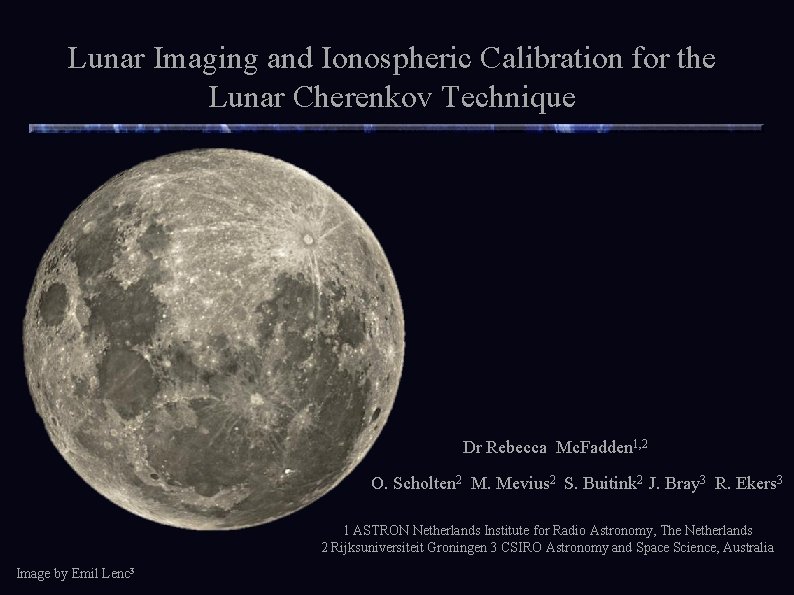
Lunar Imaging and Ionospheric Calibration for the Lunar Cherenkov Technique Dr Rebecca Mc. Fadden 1, 2 O. Scholten 2 M. Mevius 2 S. Buitink 2 J. Bray 3 R. Ekers 3 1 ASTRON Netherlands Institute for Radio Astronomy, The Netherlands 2 Rijksuniversiteit Groningen 3 CSIRO Astronomy and Space Science, Australia Image by Emil Lenc 3
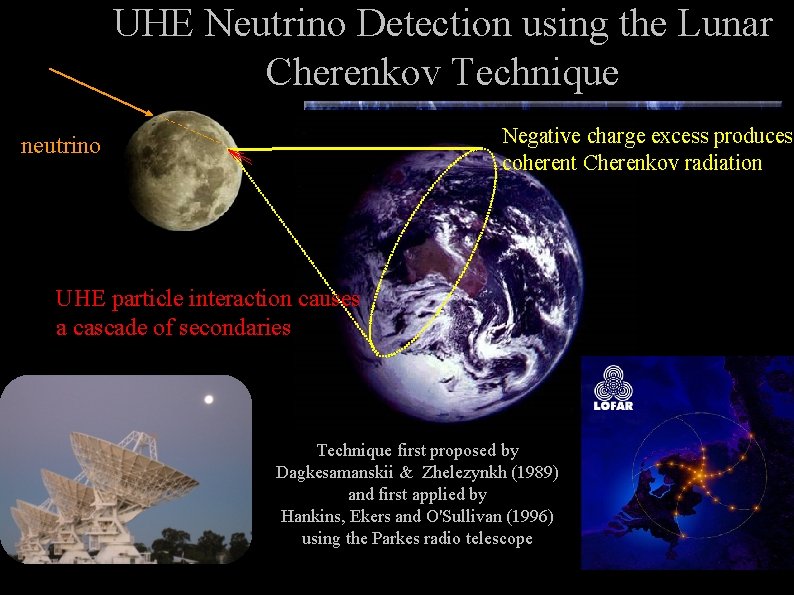
UHE Neutrino Detection using the Lunar Cherenkov Technique Negative charge excess produces coherent Cherenkov radiation neutrino UHE particle interaction causes a cascade of secondaries Technique first proposed by Dagkesamanskii & Zhelezynkh (1989) and first applied by Hankins, Ekers and O'Sullivan (1996) using the Parkes radio telescope
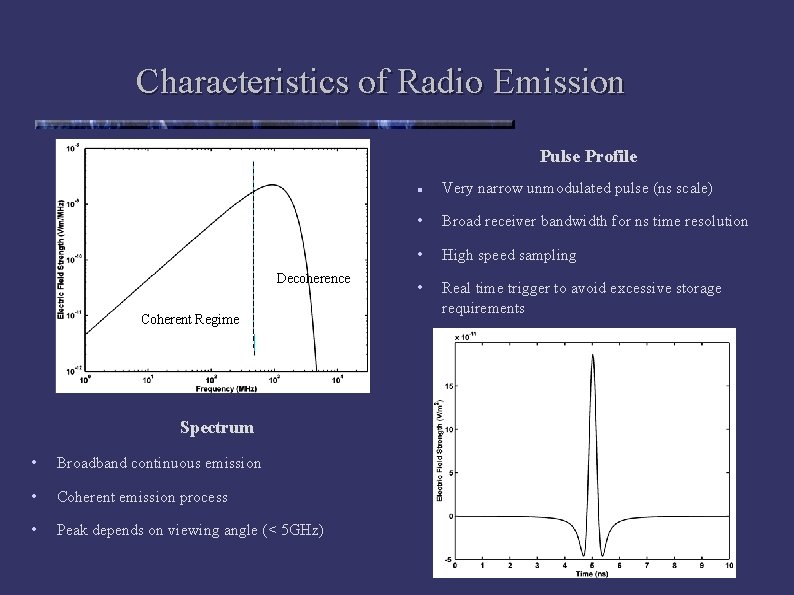
Characteristics of Radio Emission Pulse Profile Decoherence Coherent Regime Spectrum • Broadband continuous emission • Coherent emission process • Peak depends on viewing angle (< 5 GHz) l Very narrow unmodulated pulse (ns scale) • Broad receiver bandwidth for ns time resolution • High speed sampling • Real time trigger to avoid excessive storage requirements
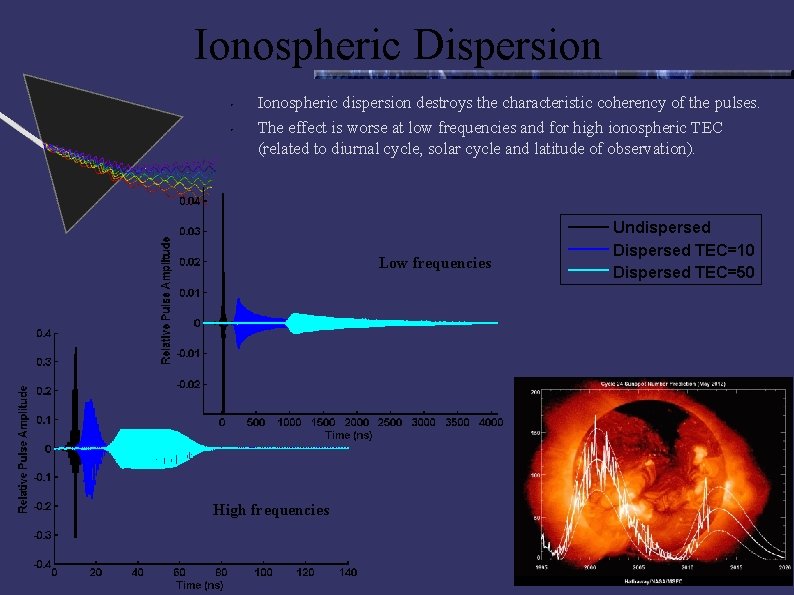
Ionospheric Dispersion • • Ionospheric dispersion destroys the characteristic coherency of the pulses. The effect is worse at low frequencies and for high ionospheric TEC (related to diurnal cycle, solar cycle and latitude of observation). Low frequencies High frequencies
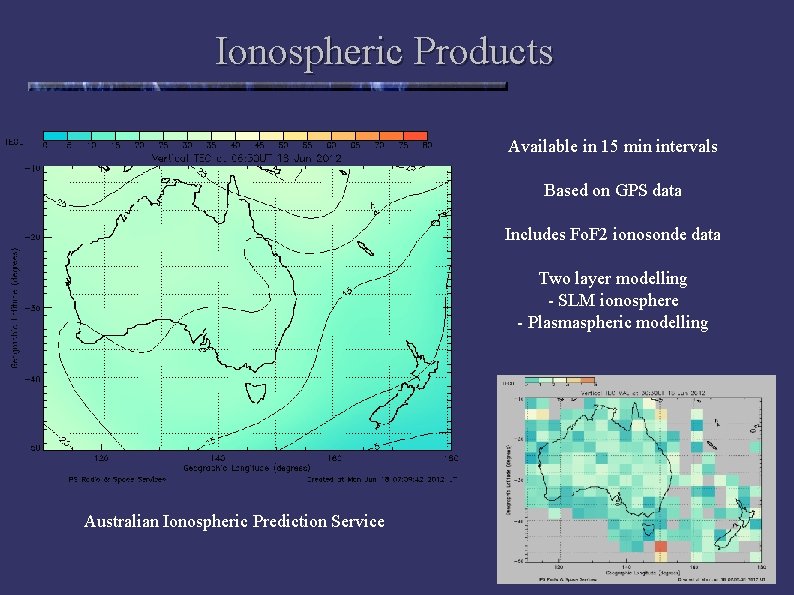
Ionospheric Products Available in 15 min intervals Based on GPS data Includes Fo. F 2 ionosonde data Two layer modelling - SLM ionosphere - Plasmaspheric modelling Australian Ionospheric Prediction Service
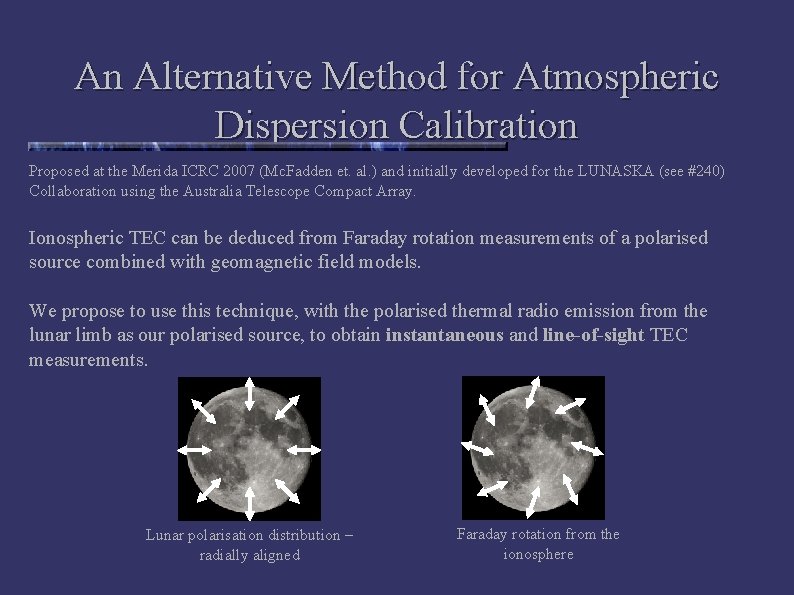
An Alternative Method for Atmospheric Dispersion Calibration Proposed at the Merida ICRC 2007 (Mc. Fadden et. al. ) and initially developed for the LUNASKA (see #240) Collaboration using the Australia Telescope Compact Array. Ionospheric TEC can be deduced from Faraday rotation measurements of a polarised source combined with geomagnetic field models. We propose to use this technique, with the polarised thermal radio emission from the lunar limb as our polarised source, to obtain instantaneous and line-of-sight TEC measurements. Lunar polarisation distribution – radially aligned Faraday rotation from the ionosphere
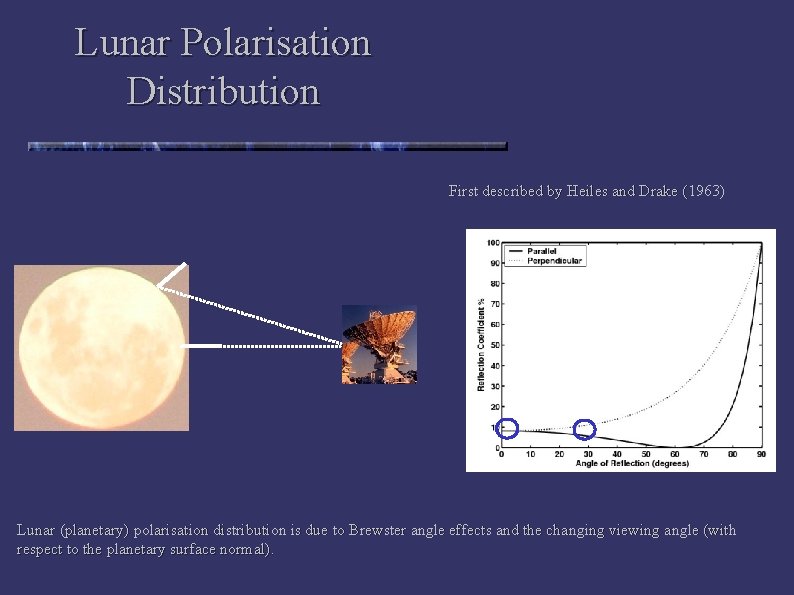
Lunar Polarisation Distribution First described by Heiles and Drake (1963) Lunar (planetary) polarisation distribution is due to Brewster angle effects and the changing viewing angle (with respect to the planetary surface normal).
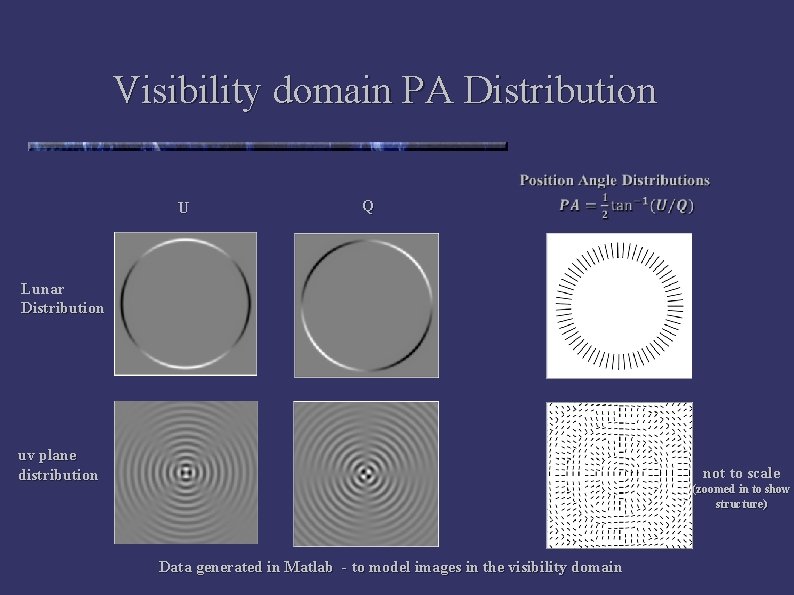
Visibility domain PA Distribution U Q Lunar Distribution uv plane distribution not to scale (zoomed in to show structure) Data generated in Matlab - to model images in the visibility domain
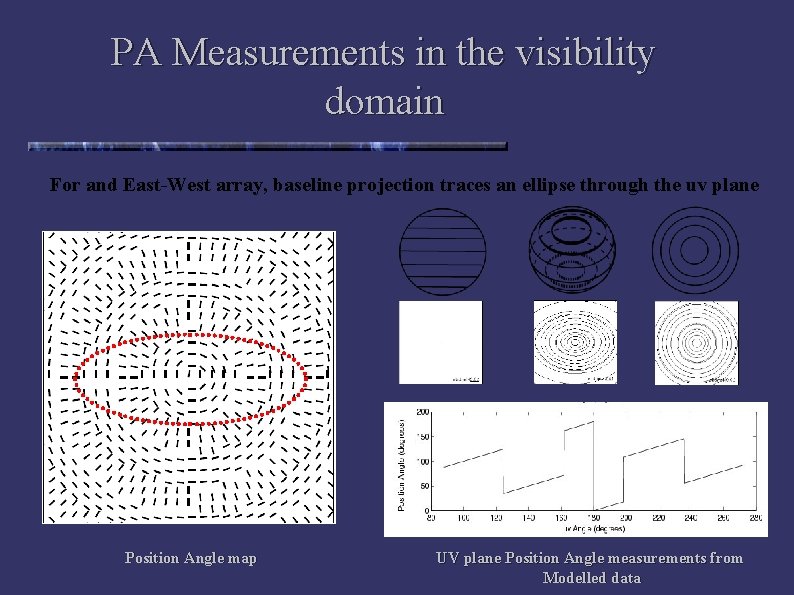
PA Measurements in the visibility domain For and East-West array, baseline projection traces an ellipse through the uv plane Position Angle map UV plane Position Angle measurements from Modelled data
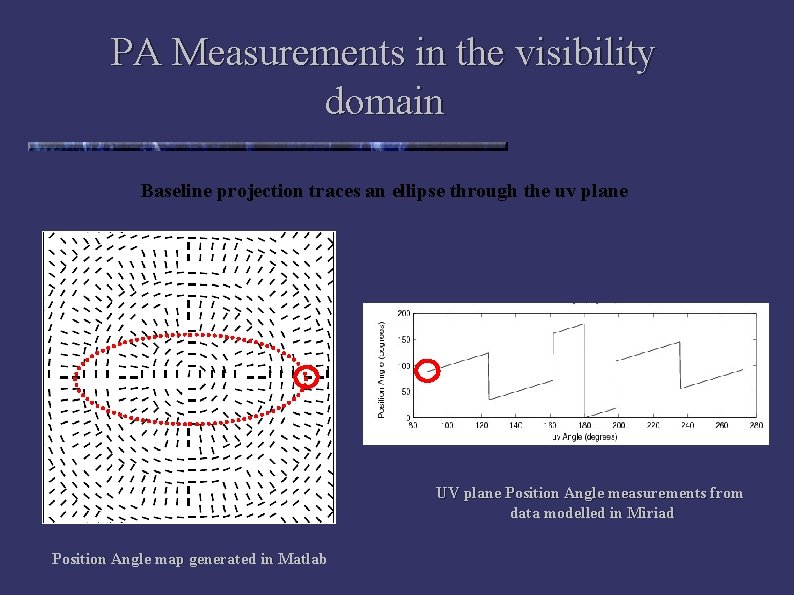
PA Measurements in the visibility domain Baseline projection traces an ellipse through the uv plane UV plane Position Angle measurements from data modelled in Miriad Position Angle map generated in Matlab
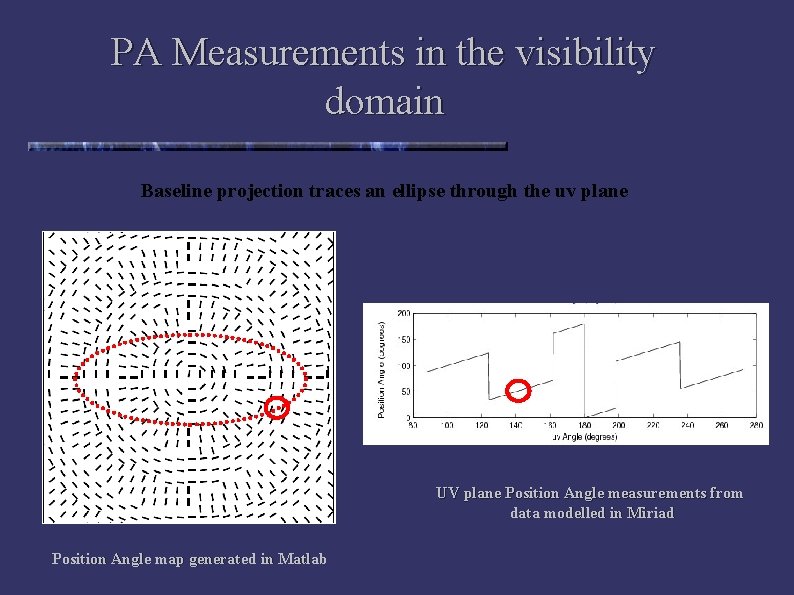
PA Measurements in the visibility domain Baseline projection traces an ellipse through the uv plane UV plane Position Angle measurements from data modelled in Miriad Position Angle map generated in Matlab
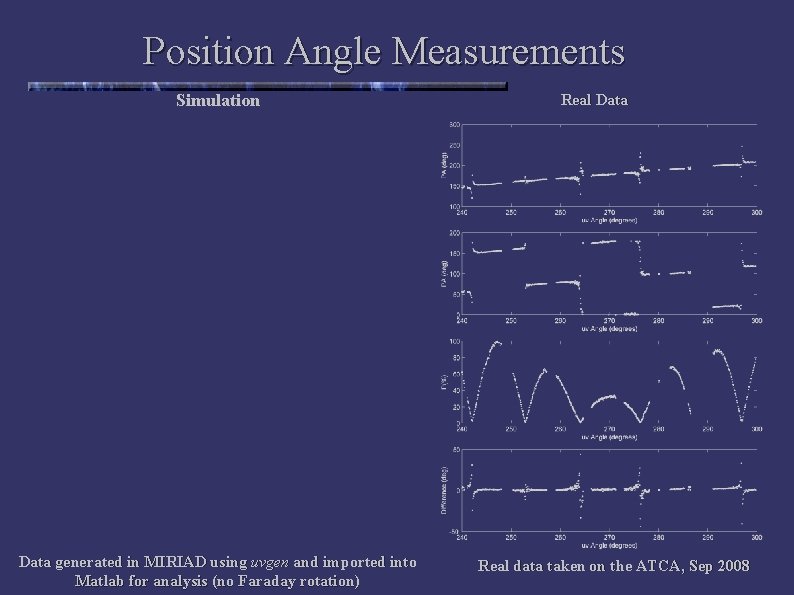
Position Angle Measurements Simulation Data generated in MIRIAD using uvgen and imported into Matlab for analysis (no Faraday rotation) Real Data Real data taken on the ATCA, Sep 2008
GPS Comparison (TEC)
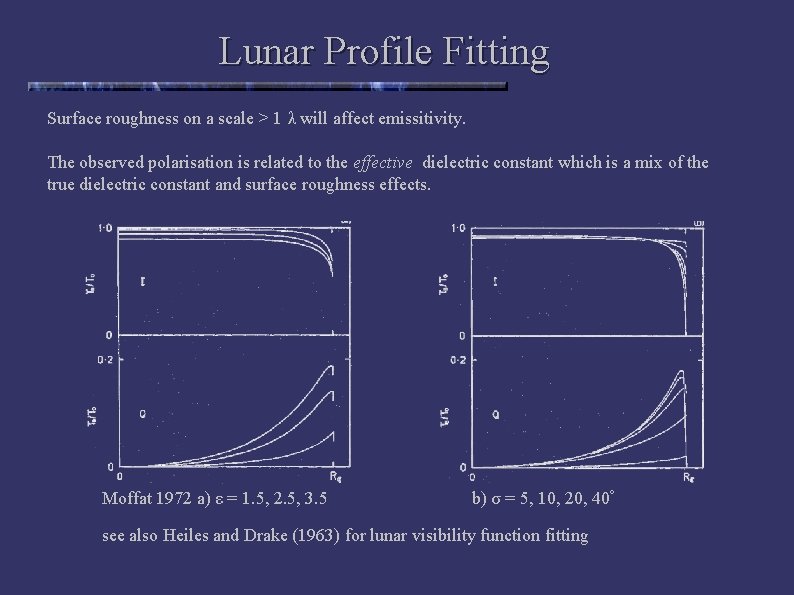
Lunar Profile Fitting Surface roughness on a scale > 1 λ will affect emissitivity. The observed polarisation is related to the effective dielectric constant which is a mix of the true dielectric constant and surface roughness effects. Moffat 1972 a) ε = 1. 5, 2. 5, 3. 5 b) σ = 5, 10, 20, 40° see also Heiles and Drake (1963) for lunar visibility function fitting
Lunar Imaging Intensity image Moffat 1972, 1. 4 GHz, 10 K contours Polarisation image SPORT collaboration 2002 8. 3 GHz
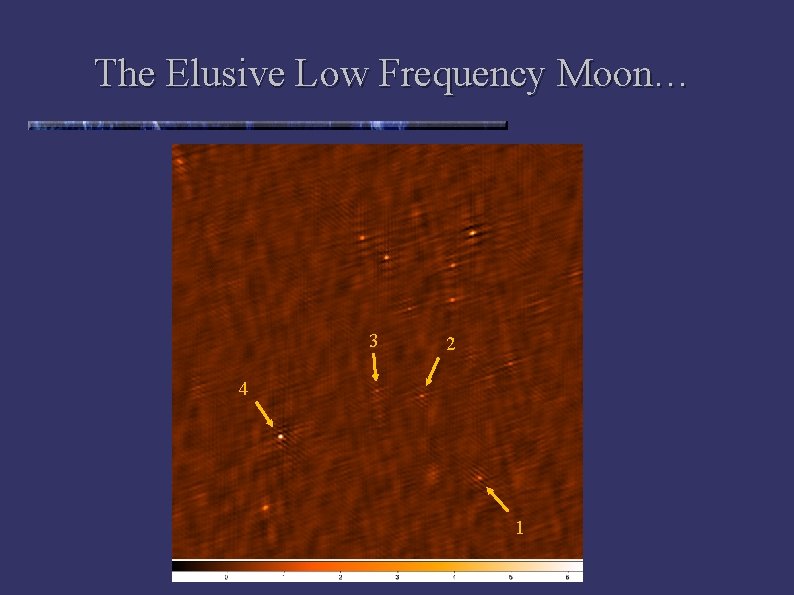
The Elusive Low Frequency Moon… 3 2 4 1
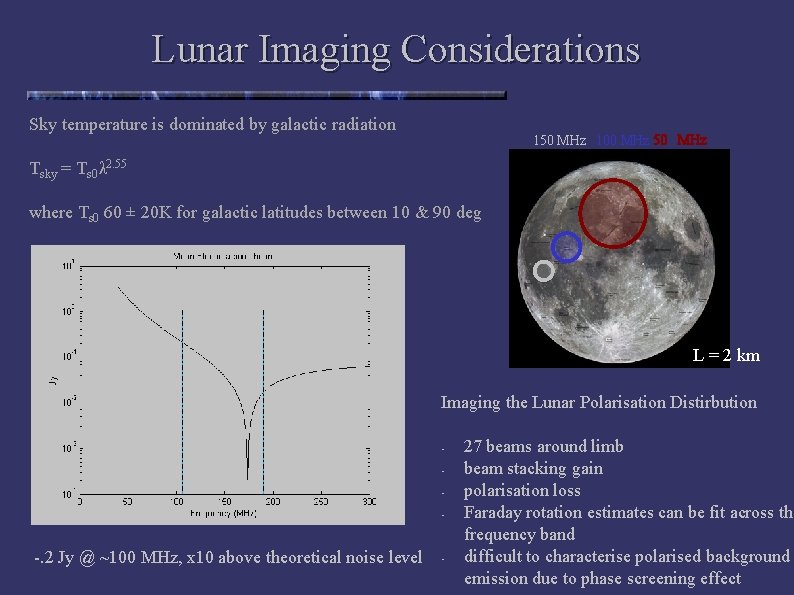
Lunar Imaging Considerations Sky temperature is dominated by galactic radiation 150 MHz 100 MHz 50 MHz Tsky = Ts 0λ 2. 55 where Ts 0 60 ± 20 K for galactic latitudes between 10 & 90 deg L = 2 km Imaging the Lunar Polarisation Distirbution • • -. 2 Jy @ ~100 MHz, x 10 above theoretical noise level • 27 beams around limb beam stacking gain polarisation loss Faraday rotation estimates can be fit across the frequency band difficult to characterise polarised background emission due to phase screening effect
Future Work • Calibration and imaging at 100 MHz continues • Extend to polarisation imaging and estimate Faraday rotation • Repeat visibility domain studies with Westerbork data (1. 4 GHz) • Polarisation analysis to determine and map lunar surface properties at low frequencies
Future Work • Calibration and imaging at 100 MHz continues • Extend to polarisation imaging and estimate Faraday rotation • Repeat visibility domain studies with Westerbork data (1. 4 GHz) • Polarisation analysis to determine and map lunar surface properties at low frequencies James 15 months
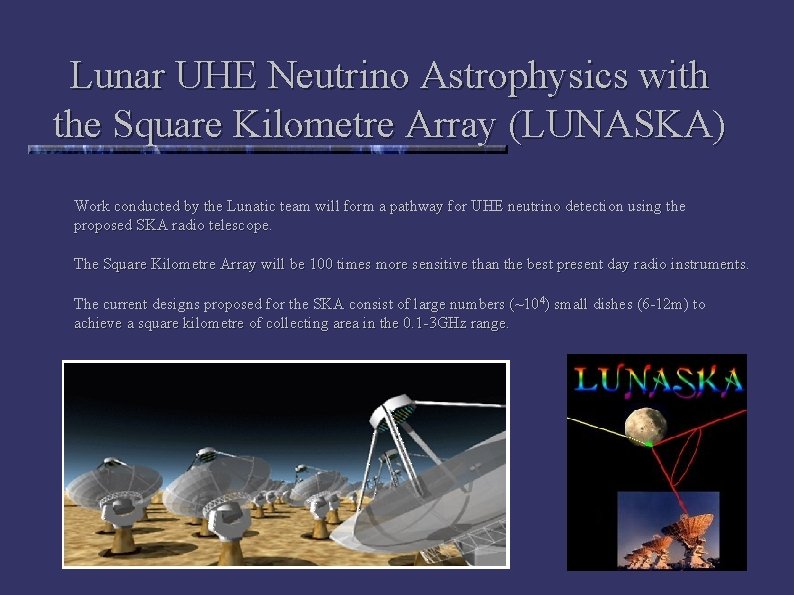
Lunar UHE Neutrino Astrophysics with the Square Kilometre Array (LUNASKA) Work conducted by the Lunatic team will form a pathway for UHE neutrino detection using the proposed SKA radio telescope. The Square Kilometre Array will be 100 times more sensitive than the best present day radio instruments. The current designs proposed for the SKA consist of large numbers (~104) small dishes (6 -12 m) to achieve a square kilometre of collecting area in the 0. 1 -3 GHz range.
UHE Neutrinos (~1020 e. V) Cosmic Ray energy spectrum extends from below 1010 e. V to at least 1020 Ge. V In the rest frame of an UHECR proton, the CMB are blue shifted to gamma ray energies and the threshold for Bethe-Heitler pair production and pion photoproduction is reached. The origin of UHECR above this threshold (GZK cut-off) is not fully understood. For extragalactic UHECR almost all spectral information above the GZK cut-off is lost however significant information is preserved in the spectrum of neutrinos. UHE neutrino astronomy will be able to provide more insight into the origin of UHECR.
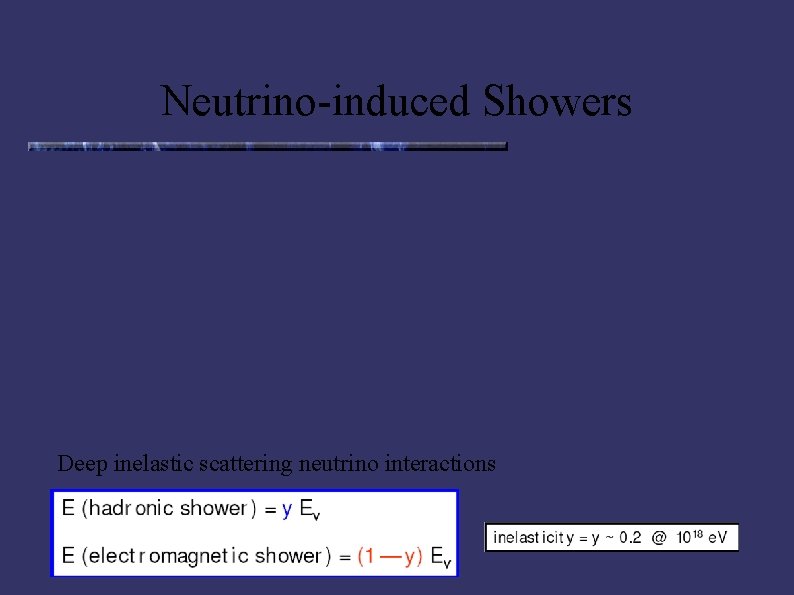
Neutrino-induced Showers Deep inelastic scattering neutrino interactions
- Slides: 22