
Lunar Ice Cube Orbiter Lunar Volatile Dynamics from
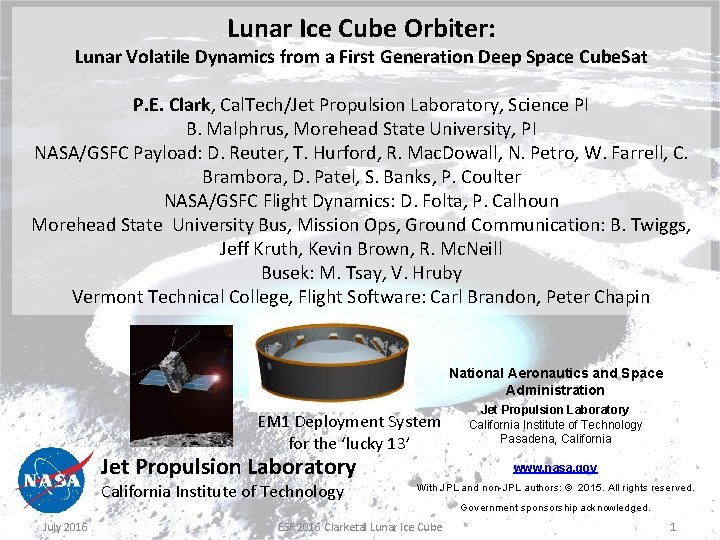
Lunar Ice Cube Orbiter: Lunar Volatile Dynamics from a First Generation Deep Space Cube. Sat P. E. Clark, Cal. Tech/Jet Propulsion Laboratory, Science PI B. Malphrus, Morehead State University, PI NASA/GSFC Payload: D. Reuter, T. Hurford, R. Mac. Dowall, N. Petro, W. Farrell, C. Brambora, D. Patel, S. Banks, P. Coulter NASA/GSFC Flight Dynamics: D. Folta, P. Calhoun Morehead State University Bus, Mission Ops, Ground Communication: B. Twiggs, Jeff Kruth, Kevin Brown, R. Mc. Neill Busek: M. Tsay, V. Hruby Vermont Technical College, Flight Software: Carl Brandon, Peter Chapin National Aeronautics and Space Administration EM 1 Deployment System for the ‘lucky 13’ Jet Propulsion Laboratory California Institute of Technology Pasadena, California www. nasa. gov With JPL and non-JPL authors: © 2015. All rights reserved. Government sponsorship acknowledged. July 2016 ESF 2016 Clarketal Lunar Ice Cube 1
July 2016 ESF 2016 Clarketal Lunar Ice Cube 2
July 2016 ESF 2016 Clarketal Lunar Ice Cube 3
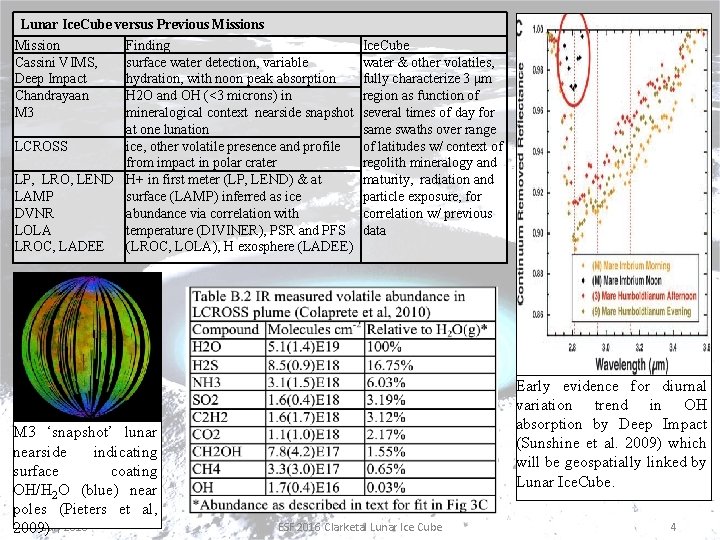
Lunar Ice. Cube versus Previous Mission Finding Cassini VIMS, surface water detection, variable Deep Impact hydration, with noon peak absorption Chandrayaan H 2 O and OH (<3 microns) in M 3 mineralogical context nearside snapshot at one lunation LCROSS ice, other volatile presence and profile from impact in polar crater LP, LRO, LEND H+ in first meter (LP, LEND) & at LAMP surface (LAMP) inferred as ice DVNR abundance via correlation with LOLA temperature (DIVINER), PSR and PFS LROC, LADEE (LROC, LOLA), H exosphere (LADEE) M 3 ‘snapshot’ lunar nearside indicating surface coating OH/H 2 O (blue) near poles (Pieters et al, 2009)July 2016 Ice. Cube water & other volatiles, fully characterize 3 μm region as function of several times of day for same swaths over range of latitudes w/ context of regolith mineralogy and maturity, radiation and particle exposure, for correlation w/ previous data Early evidence for diurnal variation trend in OH absorption by Deep Impact (Sunshine et al. 2009) which will be geospatially linked by Lunar Ice. Cube. ESF 2016 Clarketal Lunar Ice Cube 4
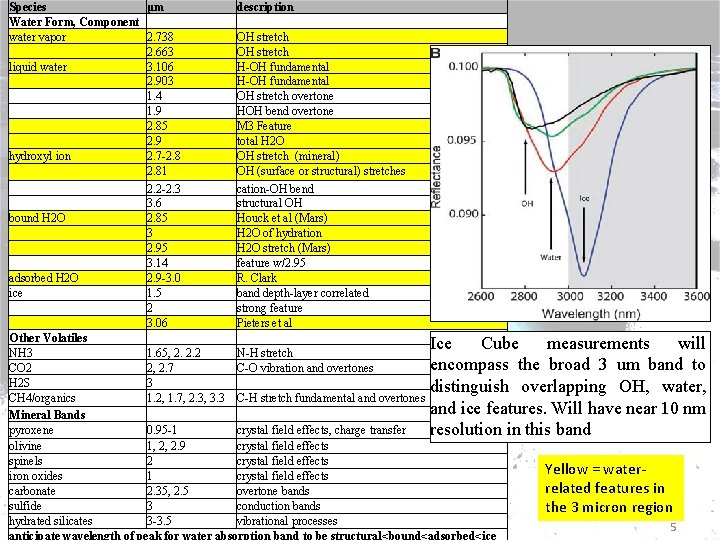
Species Water Form, Component water vapor liquid water hydroxyl ion bound H 2 O adsorbed H 2 O ice Other Volatiles NH 3 CO 2 H 2 S CH 4/organics Mineral Bands pyroxene olivine spinels iron oxides carbonate sulfide hydrated silicates July 2016 μm 2. 738 2. 663 3. 106 2. 903 1. 4 1. 9 2. 85 2. 9 2. 7 -2. 81 2. 2 -2. 3 3. 6 2. 85 3 2. 95 3. 14 2. 9 -3. 0 1. 5 2 3. 06 1. 65, 2. 2. 2 2, 2. 7 3 1. 2, 1. 7, 2. 3, 3. 3 0. 95 -1 1, 2, 2. 9 2 1 2. 35, 2. 5 3 3 -3. 5 description OH stretch H-OH fundamental OH stretch overtone HOH bend overtone M 3 Feature total H 2 O OH stretch (mineral) OH (surface or structural) stretches cation-OH bend structural OH Houck et al (Mars) H 2 O of hydration H 2 O stretch (Mars) feature w/2. 95 R. Clark band depth-layer correlated strong feature Pieters et al Ice Cube measurements will N-H stretch encompass the broad 3 um band to C-O vibration and overtones distinguish overlapping OH, water, C-H stretch fundamental and overtones and ice features. Will have near 10 nm crystal field effects, charge transfer resolution in this band crystal field effects Yellow = watercrystal field effects related features in overtone bands conduction bands the 3 micron region vibrational processes ESF 2016 Clarketal Lunar Ice Cube 5
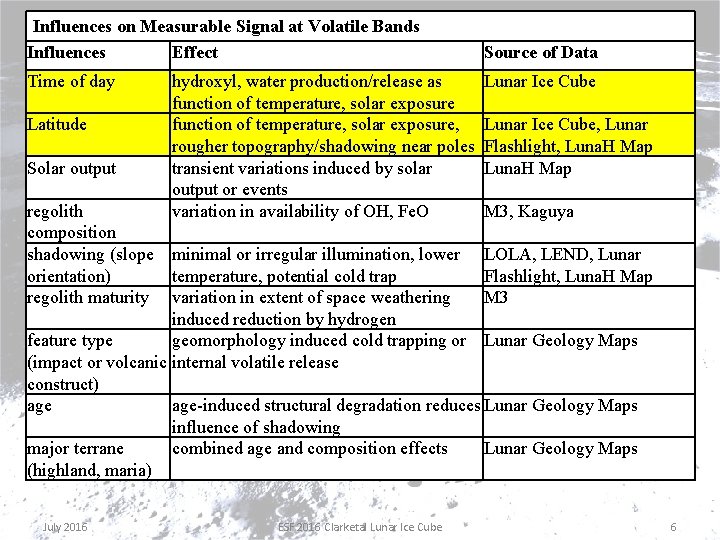
Influences on Measurable Signal at Volatile Bands Influences Effect Source of Data Time of day Lunar Ice Cube Latitude Solar output hydroxyl, water production/release as function of temperature, solar exposure, rougher topography/shadowing near poles transient variations induced by solar output or events variation in availability of OH, Fe. O Lunar Ice Cube, Lunar Flashlight, Luna. H Map regolith M 3, Kaguya composition shadowing (slope minimal or irregular illumination, lower LOLA, LEND, Lunar orientation) temperature, potential cold trap Flashlight, Luna. H Map regolith maturity variation in extent of space weathering M 3 induced reduction by hydrogen feature type geomorphology induced cold trapping or Lunar Geology Maps (impact or volcanic internal volatile release construct) age-induced structural degradation reduces Lunar Geology Maps influence of shadowing major terrane combined age and composition effects Lunar Geology Maps (highland, maria) July 2016 ESF 2016 Clarketal Lunar Ice Cube 6
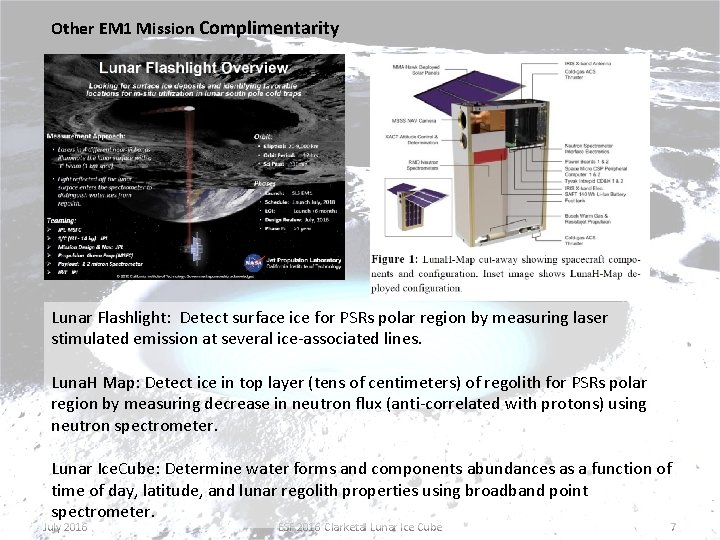
Other EM 1 Mission Complimentarity Lunar Flashlight: Detect surface ice for PSRs polar region by measuring laser stimulated emission at several ice-associated lines. Luna. H Map: Detect ice in top layer (tens of centimeters) of regolith for PSRs polar region by measuring decrease in neutron flux (anti-correlated with protons) using neutron spectrometer. Lunar Ice. Cube: Determine water forms and components abundances as a function of time of day, latitude, and lunar regolith properties using broadband point spectrometer. July 2016 ESF 2016 Clarketal Lunar Ice Cube 7
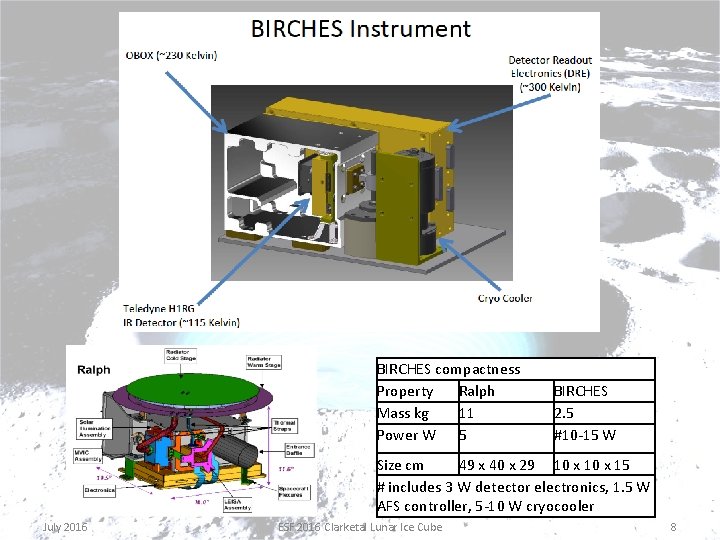
BIRCHES compactness Property Ralph Mass kg 11 Power W 5 BIRCHES 2. 5 #10 -15 W Size cm 49 x 40 x 29 10 x 15 # includes 3 W detector electronics, 1. 5 W AFS controller, 5 -10 W cryocooler July 2016 ESF 2016 Clarketal Lunar Ice Cube 8
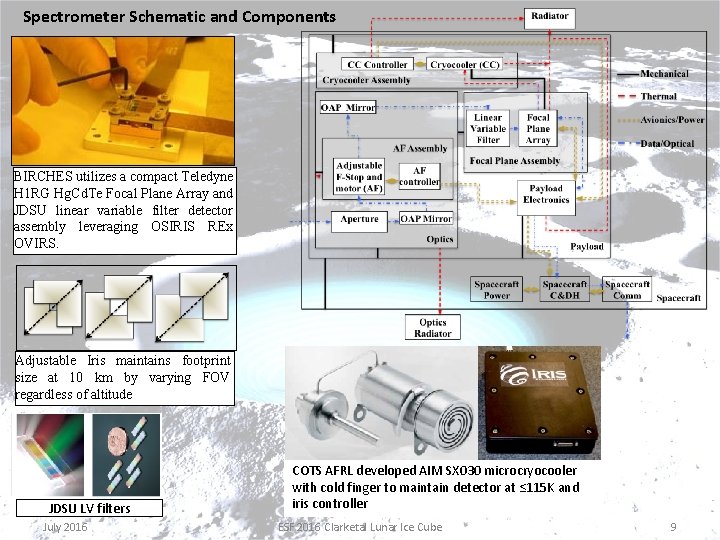
Spectrometer Schematic and Components BIRCHES utilizes a compact Teledyne H 1 RG Hg. Cd. Te Focal Plane Array and JDSU linear variable filter detector assembly leveraging OSIRIS REx OVIRS. Adjustable Iris maintains footprint size at 10 km by varying FOV regardless of altitude JDSU LV filters July 2016 COTS AFRL developed AIM SX 030 microcryocooler with cold finger to maintain detector at ≤ 115 K and iris controller ESF 2016 Clarketal Lunar Ice Cube 9
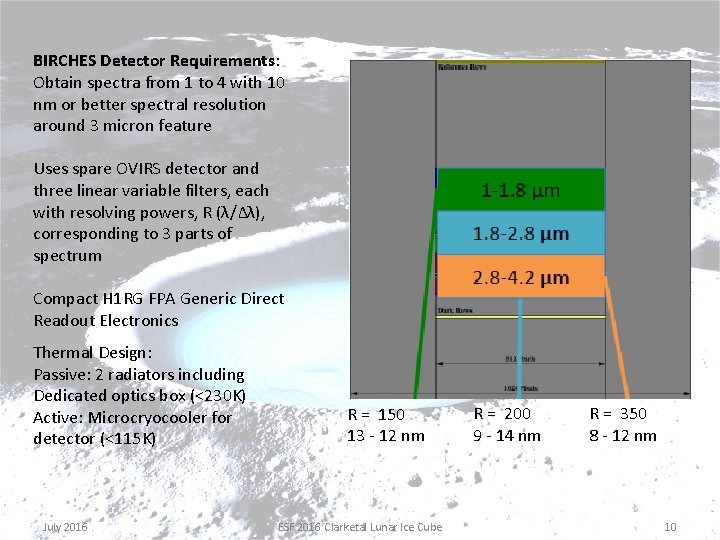
BIRCHES Detector Requirements: Obtain spectra from 1 to 4 with 10 nm or better spectral resolution around 3 micron feature Uses spare OVIRS detector and three linear variable filters, each with resolving powers, R (λ/Δλ), corresponding to 3 parts of spectrum Compact H 1 RG FPA Generic Direct Readout Electronics Thermal Design: Passive: 2 radiators including Dedicated optics box (<230 K) Active: Microcryocooler for detector (<115 K) July 2016 R = 150 13 - 12 nm ESF 2016 Clarketal Lunar Ice Cube R = 200 9 - 14 nm R = 350 8 - 12 nm 10
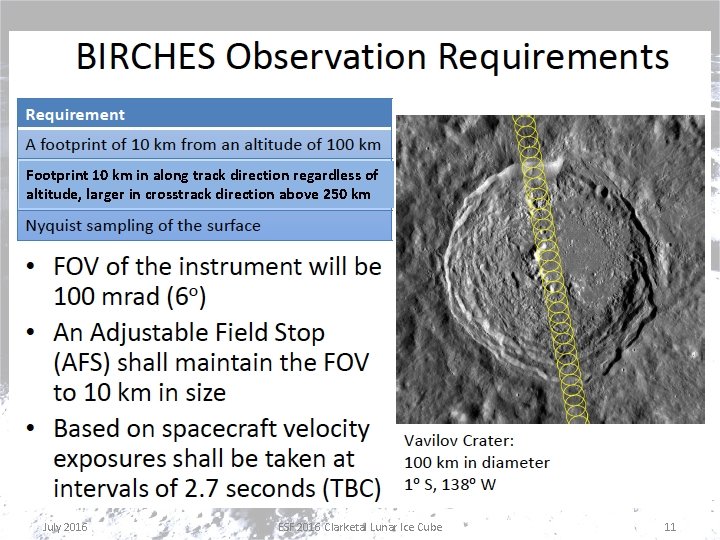
Footprint 10 km in along track direction regardless of altitude, larger in crosstrack direction above 250 km July 2016 ESF 2016 Clarketal Lunar Ice Cube 11
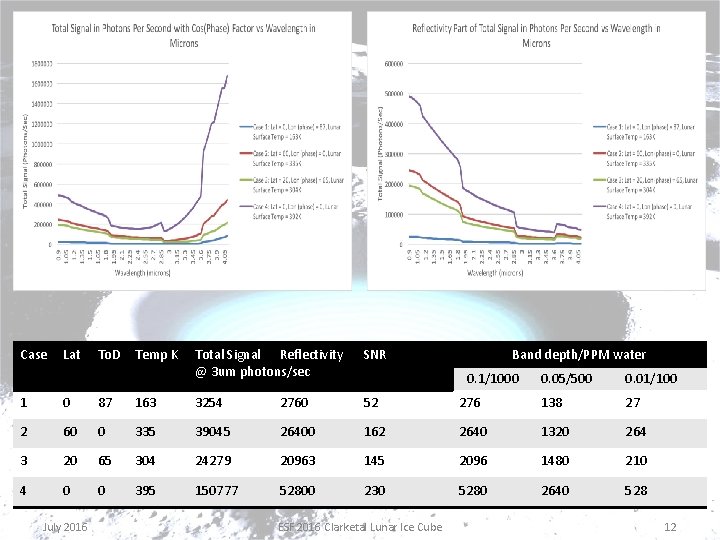
Case Lat To. D Temp K Total Signal Reflectivity @ 3 um photons/sec SNR Band depth/PPM water 0. 1/1000 0. 05/500 0. 01/100 1 0 87 163 3254 2760 52 276 138 27 2 60 0 335 39045 26400 162 2640 1320 264 3 20 65 304 24279 20963 145 2096 1480 210 4 0 0 395 150777 52800 230 5280 2640 528 July 2016 ESF 2016 Clarketal Lunar Ice Cube 12
July 2016 ESF 2016 Clarketal Lunar Ice Cube 13
July 2016 ESF 2016 Clarketal Lunar Ice Cube 14
July 2016 ESF 2016 Clarketal Lunar Ice Cube 15
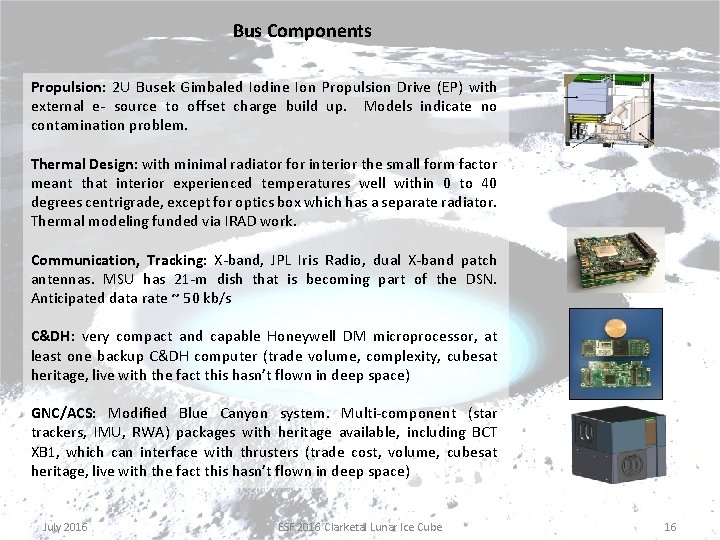
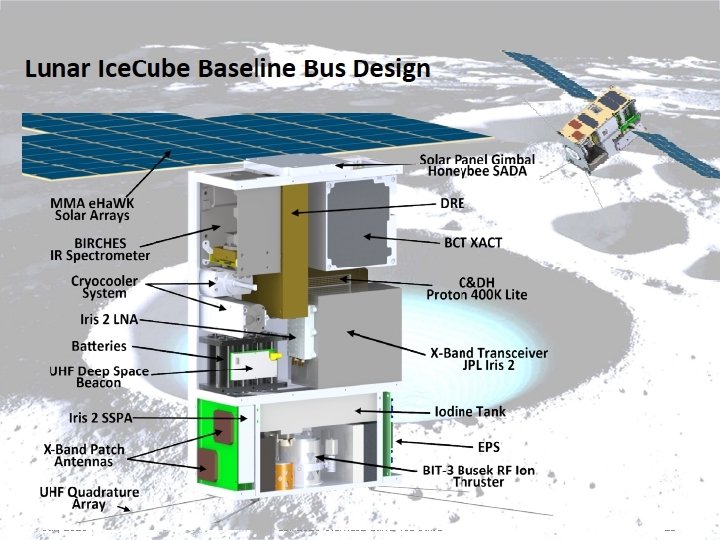
Bus Components Propulsion: 2 U Busek Gimbaled Iodine Ion Propulsion Drive (EP) with external e- source to offset charge build up. Models indicate no contamination problem. Thermal Design: with minimal radiator for interior the small form factor meant that interior experienced temperatures well within 0 to 40 degrees centrigrade, except for optics box which has a separate radiator. Thermal modeling funded via IRAD work. Communication, Tracking: X-band, JPL Iris Radio, dual X-band patch antennas. MSU has 21 -m dish that is becoming part of the DSN. Anticipated data rate ~ 50 kb/s C&DH: very compact and capable Honeywell DM microprocessor, at least one backup C&DH computer (trade volume, complexity, cubesat heritage, live with the fact this hasn’t flown in deep space) GNC/ACS: Modified Blue Canyon system. Multi-component (star trackers, IMU, RWA) packages with heritage available, including BCT XB 1, which can interface with thrusters (trade cost, volume, cubesat heritage, live with the fact this hasn’t flown in deep space) July 2016 ESF 2016 Clarketal Lunar Ice Cube 16
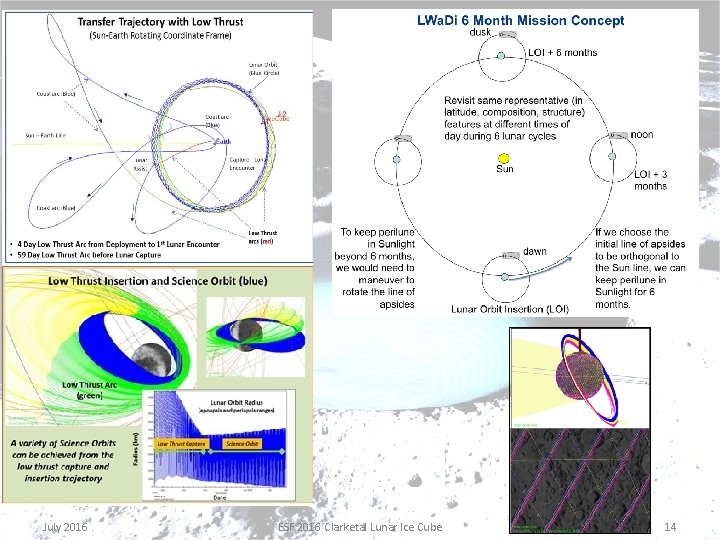
Current status and issues Data Access and Archiving: subsidized cubesat tool developed underway for stream-lined pipelining and archiving process. Volume: A chronic problem. Accommodations needed for instrument for more robust microcryocooler and adjustable field stop controllers and propulsion systems especially. Very high Vibration and Shock survival in original requirements documents: deployer design will mitigate considerably and original margins were very high Very large survival temperature range in requirements documents: partially mitigated by ‘rolling’ spacecraft once Orion deployed +1. 5 hours) Radiation issue: Deployment opportunity starts in the second lobe of the Van Allen Belt: 8 to 11 hours to get out…however only relatively small Total Ionizing Dose to deal with. Communication, navigation and tracking: DSN developing new capabilities for multiplexing communication. Iris version 2 provides much improved bandwidth at expense of power. Thermal Design: major cubesat challenge. Using dedicated radiator to minimize temperature of optics box <230 K. Using microcryocooler to maintain detector <115 K. July 2016 ESF 2016 Clarketal Lunar Ice Cube 17
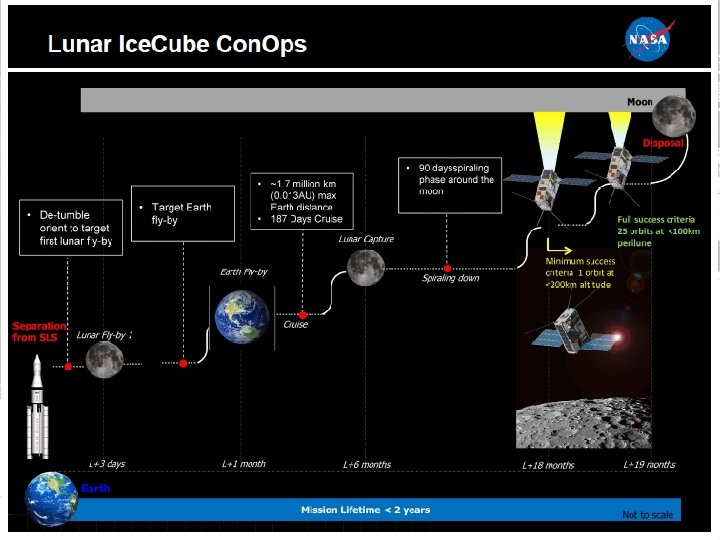
Conclusions • Ice. Cube to place an IR spectrometer in lunar orbit to look for surface OH, water, other volatiles • Examine changes in surface volatile content to get at dynamics issues! (like Sunshine et al. , 2009 observation) • Utilizes MSU cubesat bus with Busek propulsion and commercial subsystems modified for deep space, GSFC payload and flight dynamics expertise with low energy manifolds to lunar capture, and JPL science PI and deep space communication expertise • Creating a tailored solution with a standard platform July 2016 ESF 2016 Clarketal Lunar Ice Cube 18
Questions? www. lunarworkshops. com pamela. e. clark@jpl. nasa. gov July 2016 ESF 2016 Clarketal Lunar Ice Cube 19
- Slides: 19