
Lunar Calibration based on SELENESP data Toru Kouyama
Lunar Calibration based on SELENE/SP data Toru Kouyama (AIST) Matsunaga, Nakamura, Yamamoto, Yokota and Ishihara SELENE/SP Team ・SP lunar reflectance model ・Basic characteristics of SP model ・Our recent lunar calibration activities using SP model 1
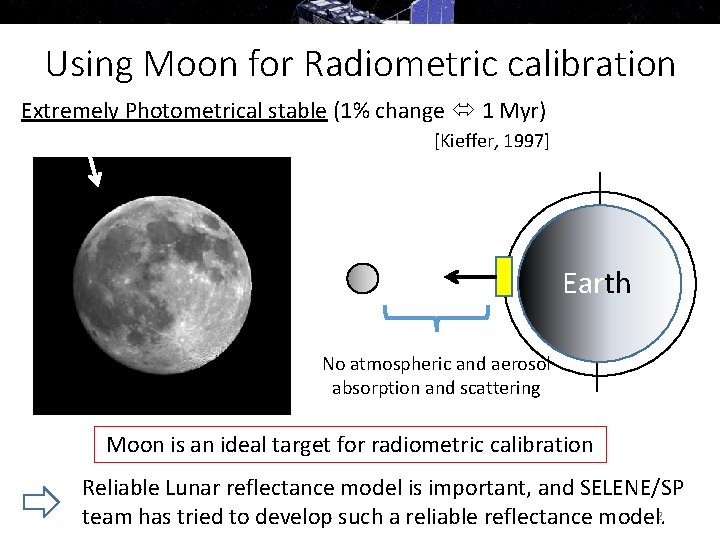
Using Moon for Radiometric calibration Extremely Photometrical stable (1% change 1 Myr) [Kieffer, 1997] Earth No atmospheric and aerosol absorption and scattering Moon is an ideal target for radiometric calibration Reliable Lunar reflectance model is important, and SELENE/SP team has tried to develop such a reliable reflectance model. 2
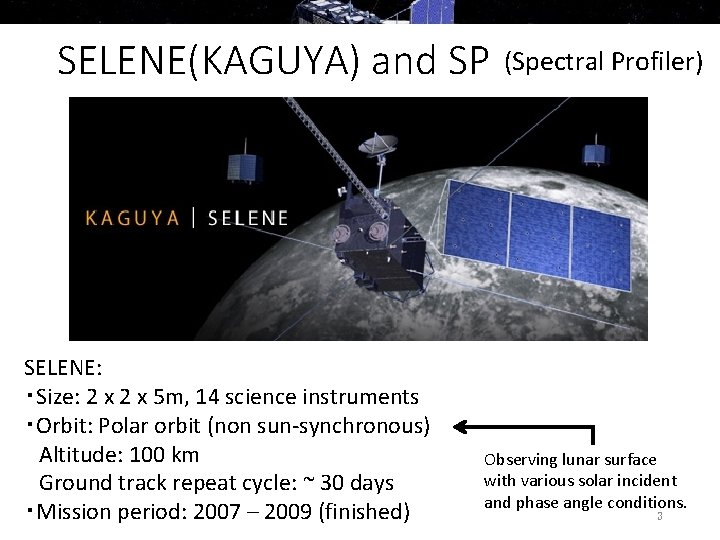
SELENE(KAGUYA) and SP SELENE: ・Size: 2 x 5 m, 14 science instruments ・Orbit: Polar orbit (non sun-synchronous) Altitude: 100 km Ground track repeat cycle: ~ 30 days ・Mission period: 2007 – 2009 (finished) (Spectral Profiler) Observing lunar surface with various solar incident and phase angle conditions. 3
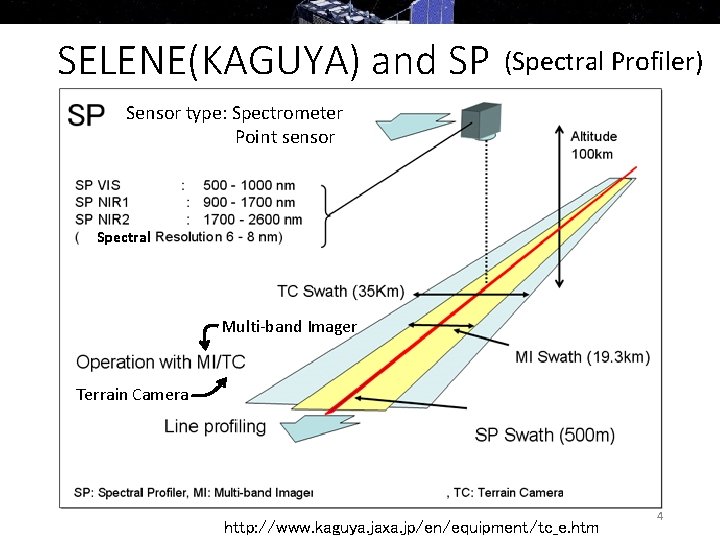
SELENE(KAGUYA) and SP (Spectral Profiler) Sensor type: Spectrometer Point sensor Spectral Multi-band Imager Terrain Camera http: //www. kaguya. jaxa. jp/en/equipment/tc_e. htm 4
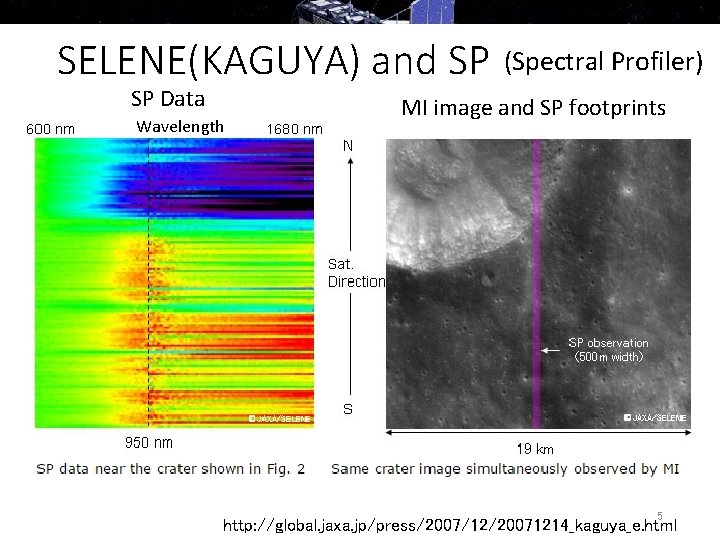
SELENE(KAGUYA) and SP SP Data Wavelength (Spectral Profiler) MI image and SP footprints 5 http: //global. jaxa. jp/press/2007/12/20071214_kaguya_e. html
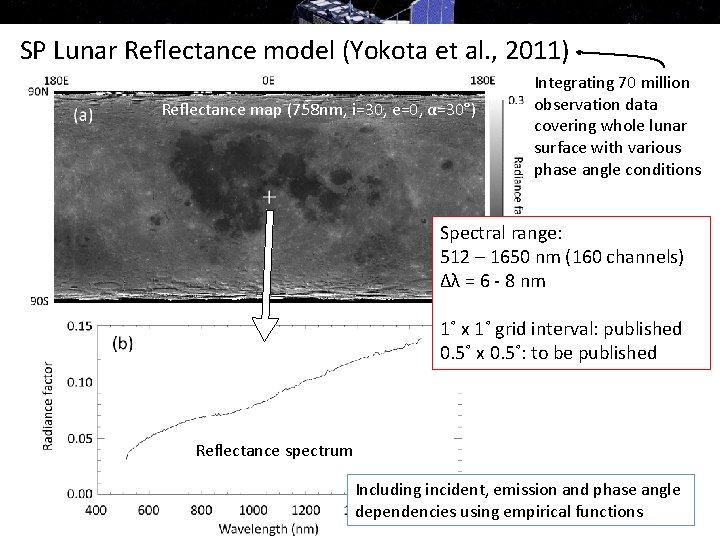
SP Lunar Reflectance model (Yokota et al. , 2011) Reflectance map (758 nm, i=30, e=0, α=30°) Integrating 70 million observation data covering whole lunar surface with various phase angle conditions Spectral range: 512 – 1650 nm (160 channels) Δλ = 6 - 8 nm 1˚ x 1˚ grid interval: published 0. 5˚ x 0. 5˚: to be published Reflectance spectrum Including incident, emission and phase angle dependencies using empirical functions 6
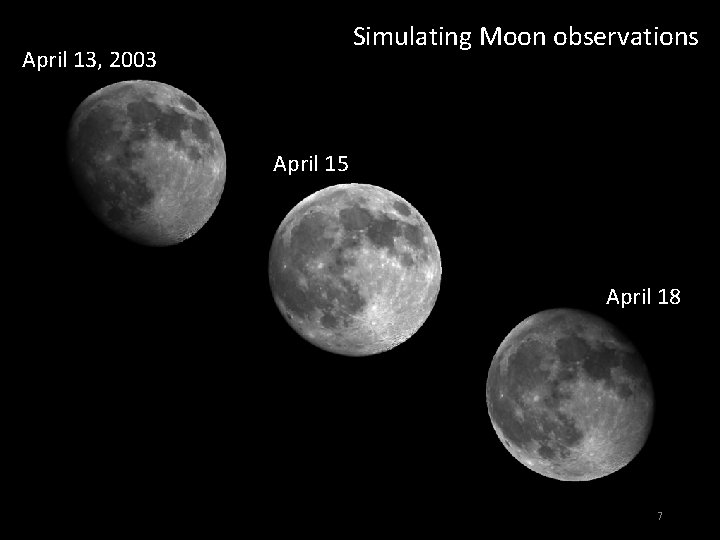
Simulating Moon observations April 13, 2003 April 15 April 18 7
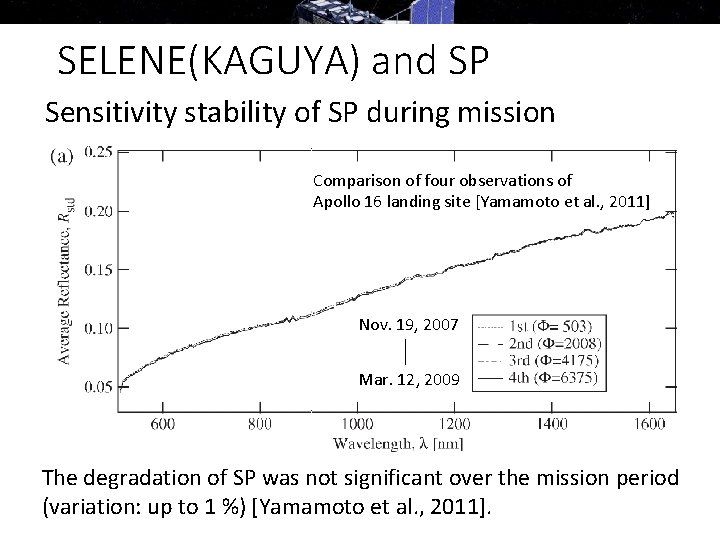
SELENE(KAGUYA) and SP Sensitivity stability of SP during mission Comparison of four observations of Apollo 16 landing site [Yamamoto et al. , 2011] Nov. 19, 2007 Mar. 12, 2009 The degradation of SP was not significant over the mission period (variation: up to 1 %) [Yamamoto et al. , 2011].
・SP model characteristics Comparing with actual Moon observation data Terra / ASTER
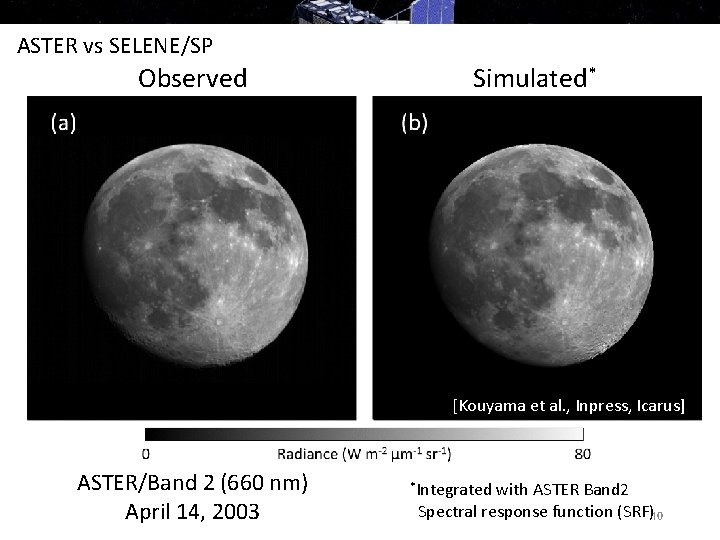
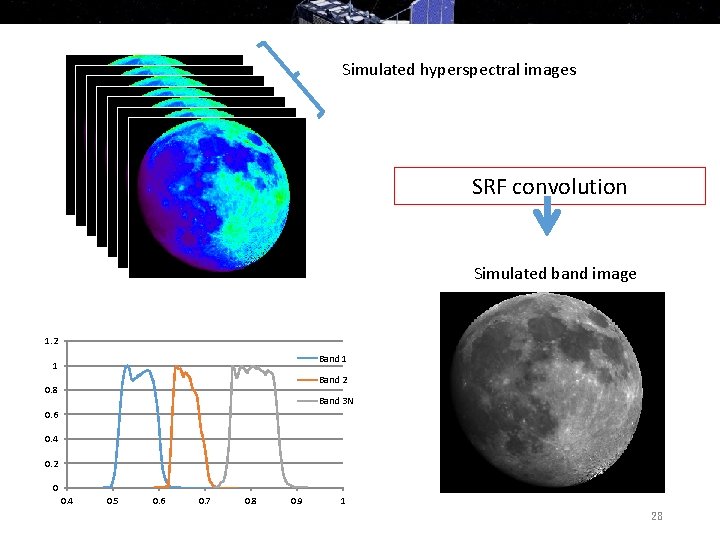
ASTER vs SELENE/SP Observed Simulated* [Kouyama et al. , Inpress, Icarus] ASTER/Band 2 (660 nm) April 14, 2003 *Integrated with ASTER Band 2 Spectral response function (SRF)10
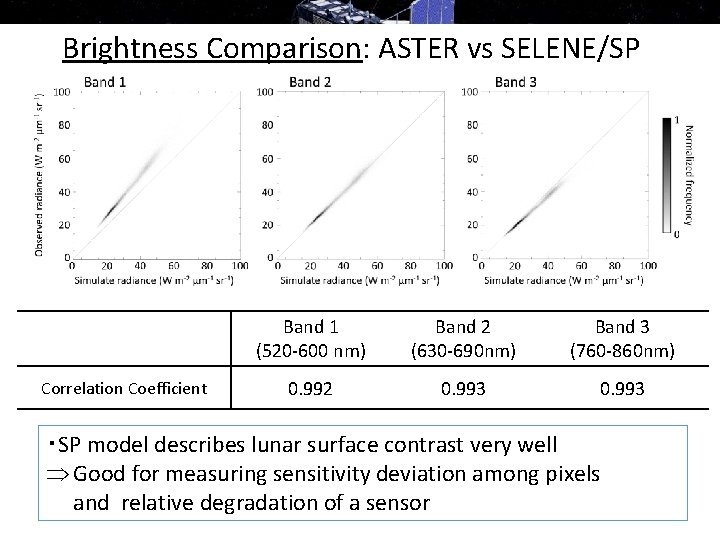
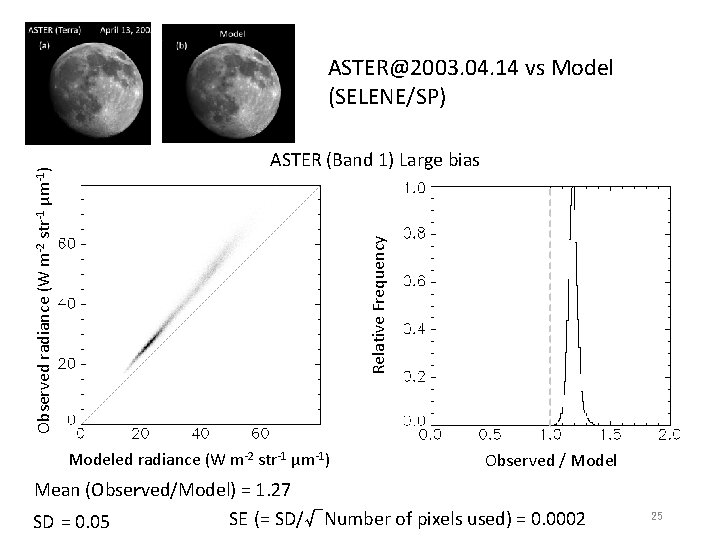
Brightness Comparison: ASTER vs SELENE/SP Correlation Coefficient Band 1 (520 -600 nm) Band 2 (630 -690 nm) Band 3 (760 -860 nm) 0. 992 0. 993 ・SP model describes lunar surface contrast very well Þ Good for measuring sensitivity deviation among pixels and relative degradation of a sensor 11
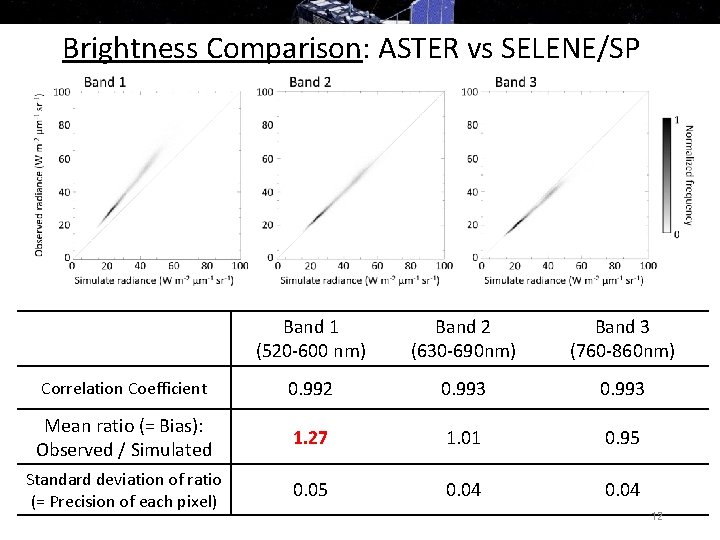
Brightness Comparison: ASTER vs SELENE/SP Band 1 (520 -600 nm) Band 2 (630 -690 nm) Band 3 (760 -860 nm) Correlation Coefficient 0. 992 0. 993 Mean ratio (= Bias): Observed / Simulated 1. 27 1. 01 0. 95 Standard deviation of ratio (= Precision of each pixel) 0. 05 0. 04 12
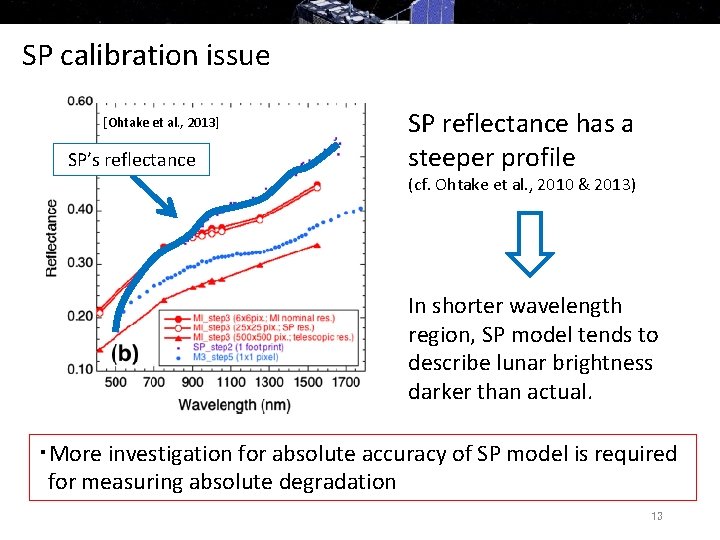
SP calibration issue [Ohtake et al. , 2013] SP’s reflectance SP reflectance has a steeper profile (cf. Ohtake et al. , 2010 & 2013) In shorter wavelength region, SP model tends to describe lunar brightness darker than actual. ・More investigation for absolute accuracy of SP model is required for measuring absolute degradation 13
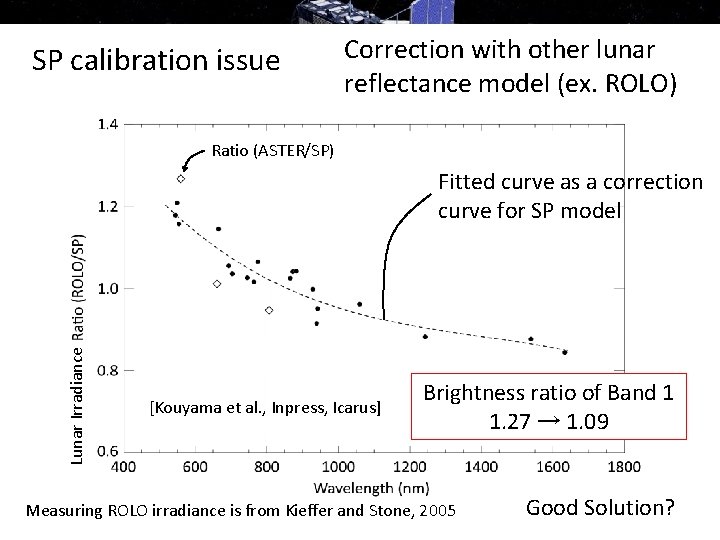
SP calibration issue Correction with other lunar reflectance model (ex. ROLO) Ratio (ASTER/SP) Lunar Irradiance Fitted curve as a correction curve for SP model [Kouyama et al. , Inpress, Icarus] Brightness ratio of Band 1 1. 27 → 1. 09 Measuring ROLO irradiance is from Kieffer and Stone, 2005 Good Solution?
Lunar calibration for planetary explorers ©JAXA Hayabusa 2
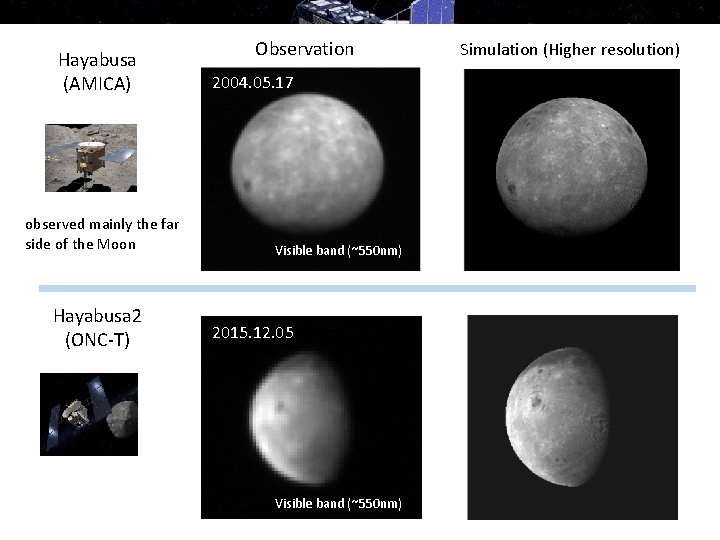
Hayabusa (AMICA) observed mainly the far side of the Moon Hayabusa 2 (ONC-T) Observation 2004. 05. 17 Visible band (~550 nm) 2015. 12. 05 Visible band (~550 nm) Simulation (Higher resolution)
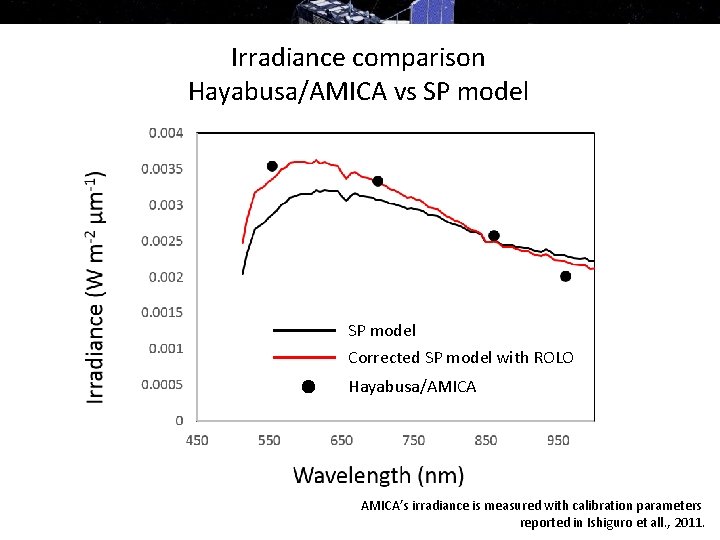
Irradiance comparison Hayabusa/AMICA vs SP model Corrected SP model with ROLO Hayabusa/AMICA’s irradiance is measured with calibration parameters reported in Ishiguro et all. , 2011.
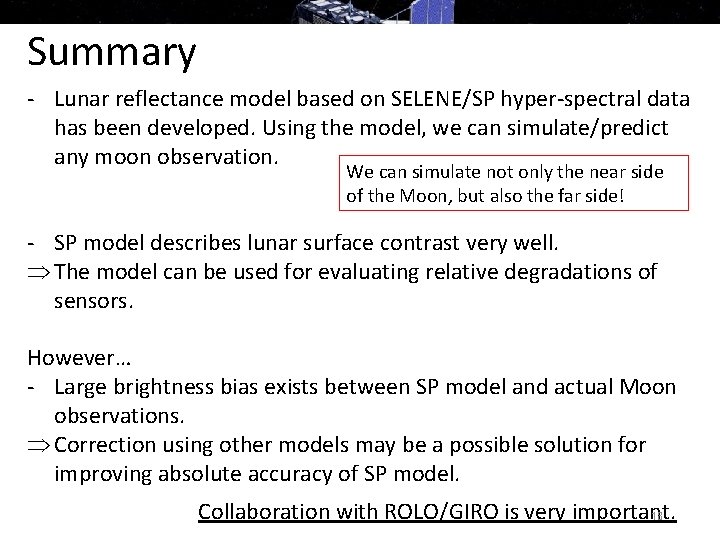
Summary - Lunar reflectance model based on SELENE/SP hyper-spectral data has been developed. Using the model, we can simulate/predict any moon observation. We can simulate not only the near side of the Moon, but also the far side! - SP model describes lunar surface contrast very well. Þ The model can be used for evaluating relative degradations of sensors. However… - Large brightness bias exists between SP model and actual Moon observations. Þ Correction using other models may be a possible solution for improving absolute accuracy of SP model. Collaboration with ROLO/GIRO is very important. 18
• Supplement slides
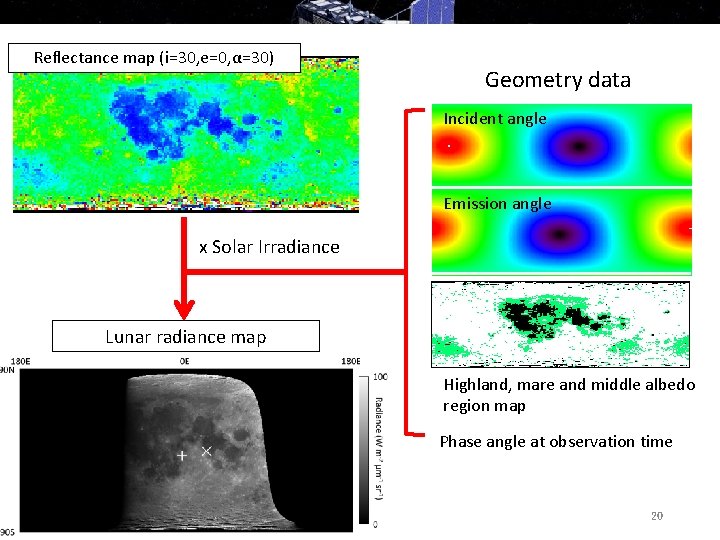
Reflectance map (i=30, e=0, α=30) Geometry data Incident angle Emission angle x Solar Irradiance Lunar radiance map Highland, mare and middle albedo region map Phase angle at observation time 20
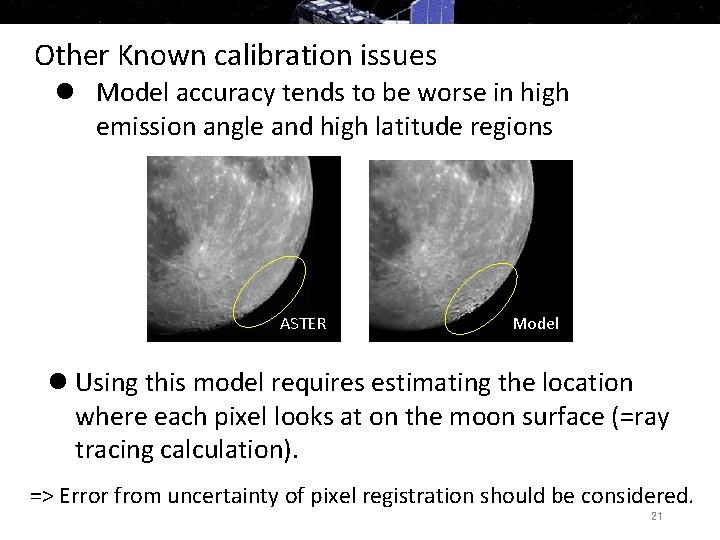
Other Known calibration issues l Model accuracy tends to be worse in high emission angle and high latitude regions ASTER Model l Using this model requires estimating the location where each pixel looks at on the moon surface (=ray tracing calculation). => Error from uncertainty of pixel registration should be considered. 21
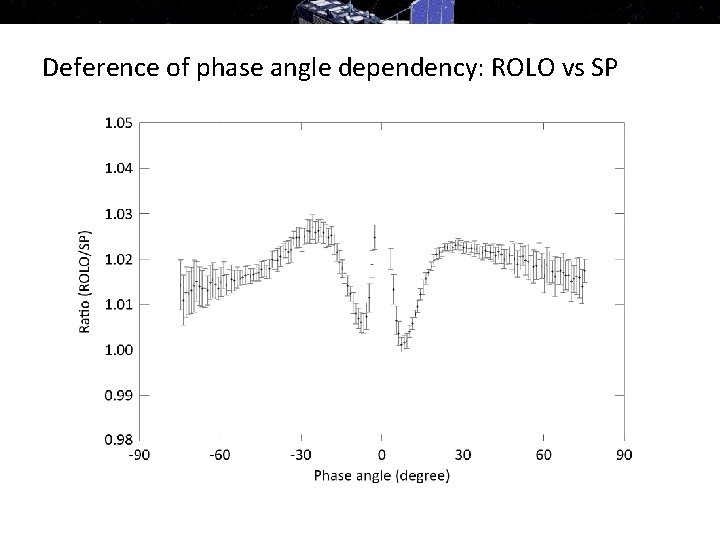
Deference of phase angle dependency: ROLO vs SP
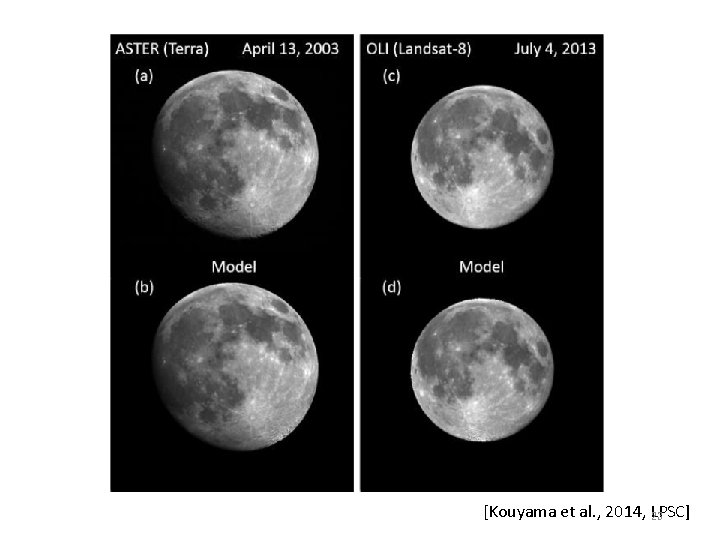
[Kouyama et al. , 2014, LPSC] 23
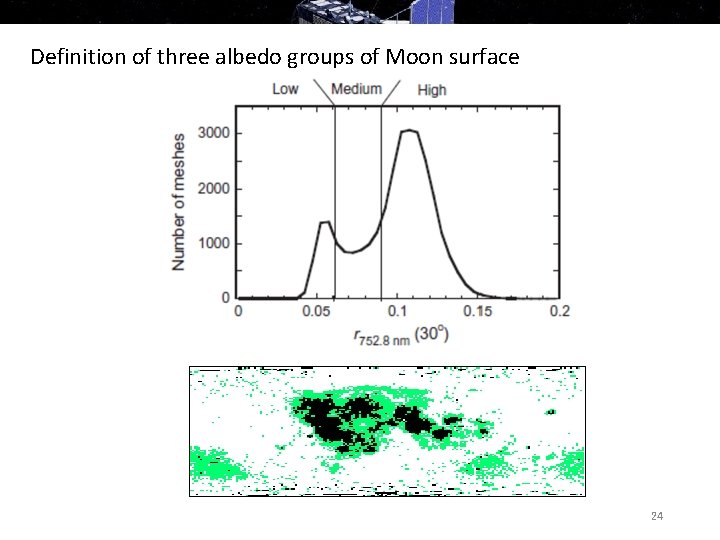
Definition of three albedo groups of Moon surface 24
ASTER (Band 1) Large bias Relative Frequency Observed radiance (W m-2 str-1 μm-1) ASTER@2003. 04. 14 vs Model (SELENE/SP) Modeled radiance (W m-2 str-1 μm-1) Observed / Model Mean (Observed/Model) = 1. 27 SE (= SD/√Number of pixels used) = 0. 0002 SD = 0. 05 25
ASTER/VNIR degradation curves 1. 0 Band 3 0. 9 0. 8 0. 7 Band 1 0 Band 2 Day since launch 3000 26
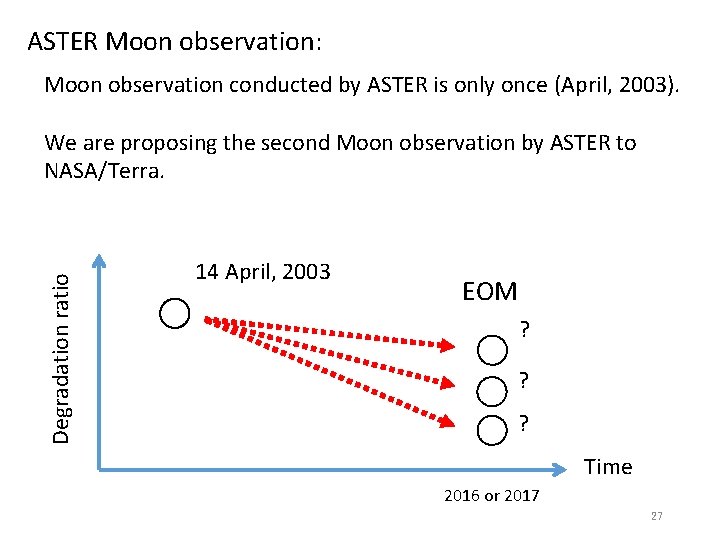
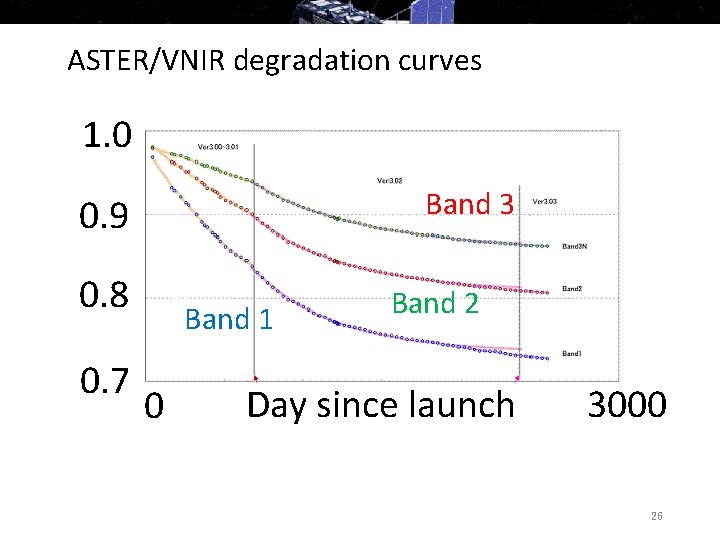
ASTER Moon observation: Moon observation conducted by ASTER is only once (April, 2003). Degradation ratio We are proposing the second Moon observation by ASTER to NASA/Terra. 14 April, 2003 EOM ? ? ? Time 2016 or 2017 27
Simulated hyperspectral images SRF convolution Simulated band image 1. 2 Band 1 1 Band 2 0. 8 Band 3 N 0. 6 0. 4 0. 2 0 0. 4 0. 5 0. 6 0. 7 0. 8 0. 9 1 28
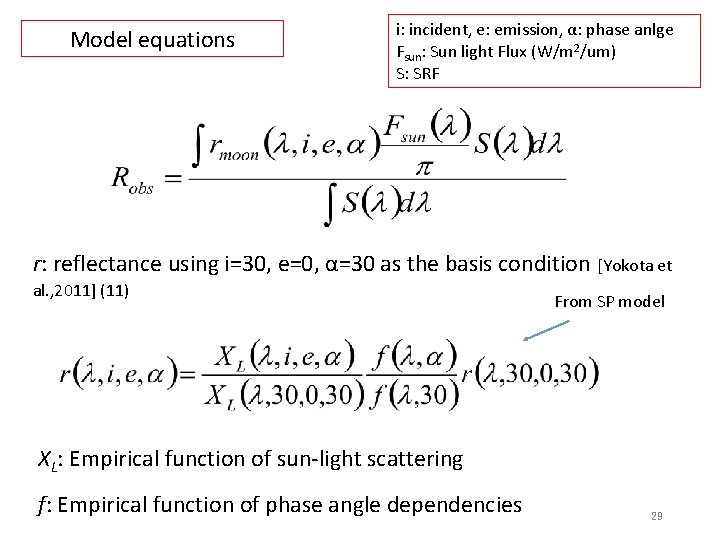
Model equations i: incident, e: emission, α: phase anlge Fsun: Sun light Flux (W/m 2/um) S: SRF r: reflectance using i=30, e=0, α=30 as the basis condition [Yokota et al. , 2011] (11) From SP model XL: Empirical function of sun-light scattering f: Empirical function of phase angle dependencies 29
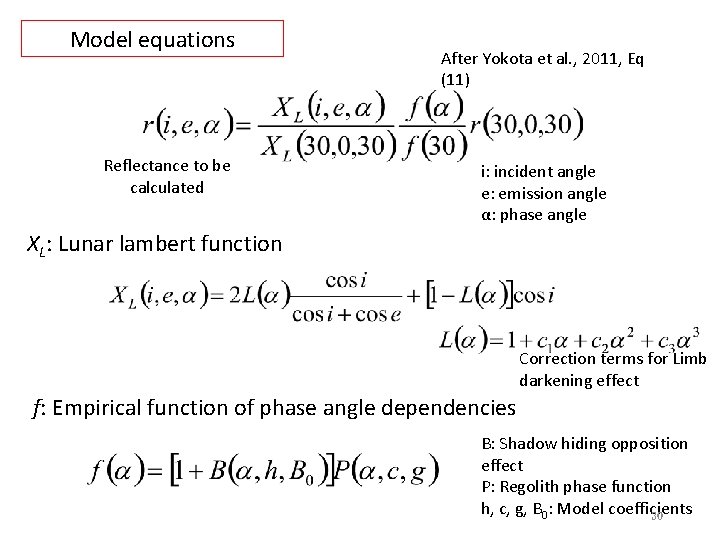
Model equations Reflectance to be calculated After Yokota et al. , 2011, Eq (11) i: incident angle e: emission angle α: phase angle XL: Lunar lambert function Correction terms for Limb darkening effect f: Empirical function of phase angle dependencies B: Shadow hiding opposition effect P: Regolith phase function h, c, g, B 0: Model coefficients 30
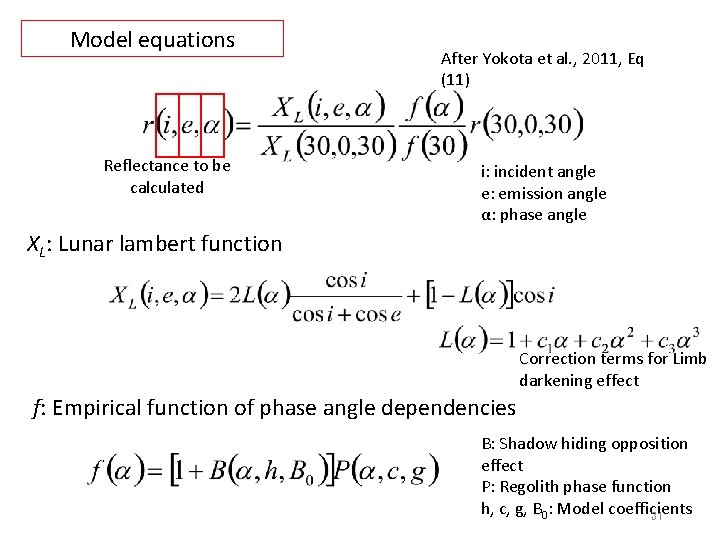
Model equations Reflectance to be calculated After Yokota et al. , 2011, Eq (11) i: incident angle e: emission angle α: phase angle XL: Lunar lambert function Correction terms for Limb darkening effect f: Empirical function of phase angle dependencies B: Shadow hiding opposition effect P: Regolith phase function h, c, g, B 0: Model coefficients 31
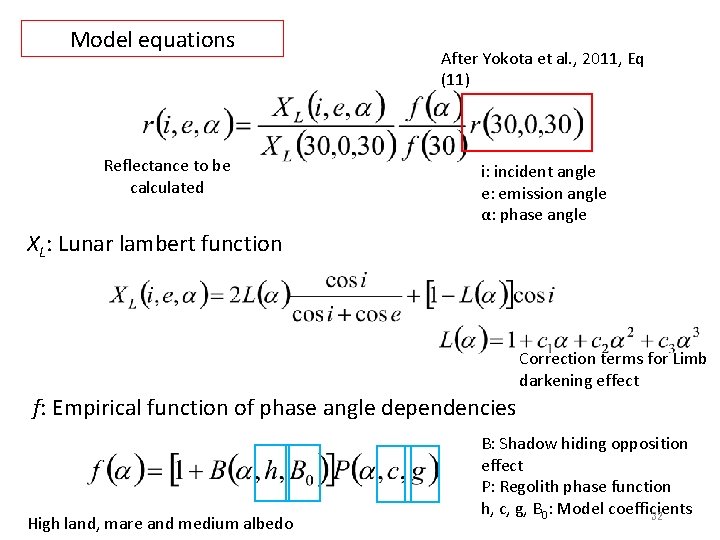
Model equations Reflectance to be calculated After Yokota et al. , 2011, Eq (11) i: incident angle e: emission angle α: phase angle XL: Lunar lambert function Correction terms for Limb darkening effect f: Empirical function of phase angle dependencies High land, mare and medium albedo B: Shadow hiding opposition effect P: Regolith phase function h, c, g, B 0: Model coefficients 32
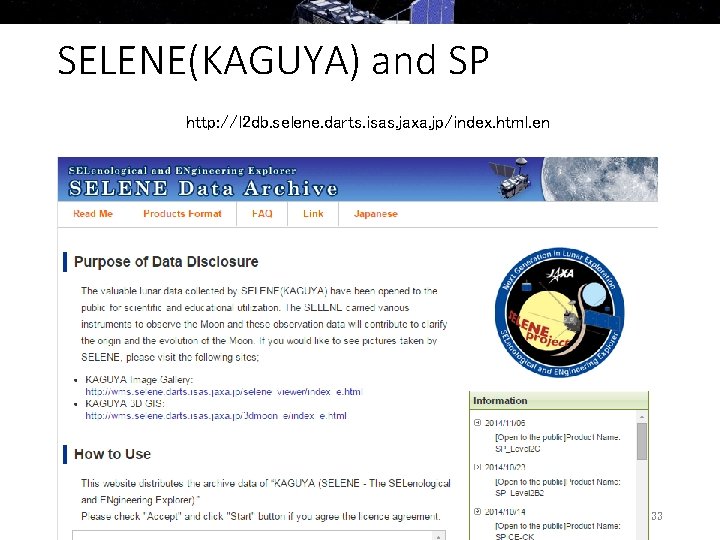
SELENE(KAGUYA) and SP http: //l 2 db. selene. darts. isas. jaxa. jp/index. html. en 33
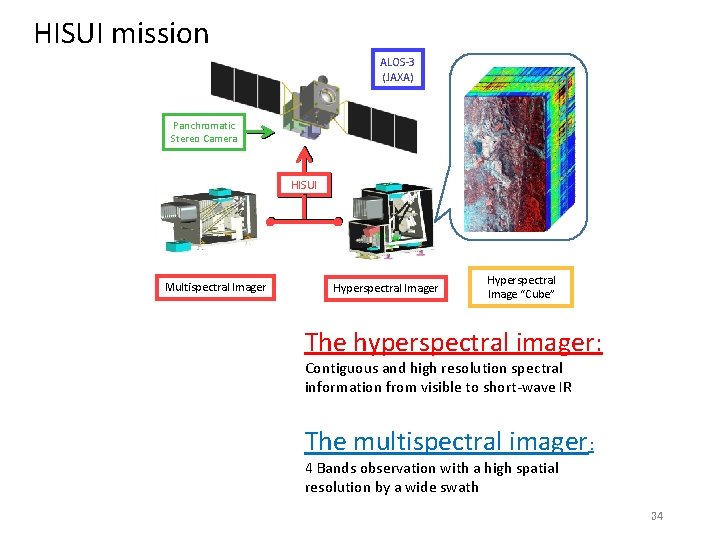
HISUI mission ALOS-3 (JAXA) Panchromatic Stereo Camera HISUI Multispectral Imager Hyperspectral Image “Cube” The hyperspectral imager: Contiguous and high resolution spectral information from visible to short-wave IR The multispectral imager: 4 Bands observation with a high spatial resolution by a wide swath 34
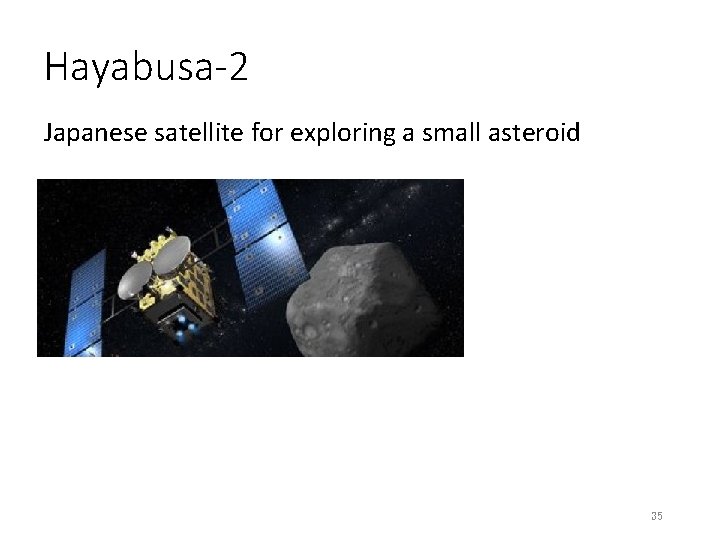
Hayabusa-2 Japanese satellite for exploring a small asteroid 35
- Slides: 35