
Lunar calibration and Himawari8 AHI monitoring Meteorological satellite
Lunar calibration and Himawari-8 AHI monitoring Meteorological satellite center, JMA OKUYAMA Arata Lunar calibration workshop, 19 November 2020, online meeting
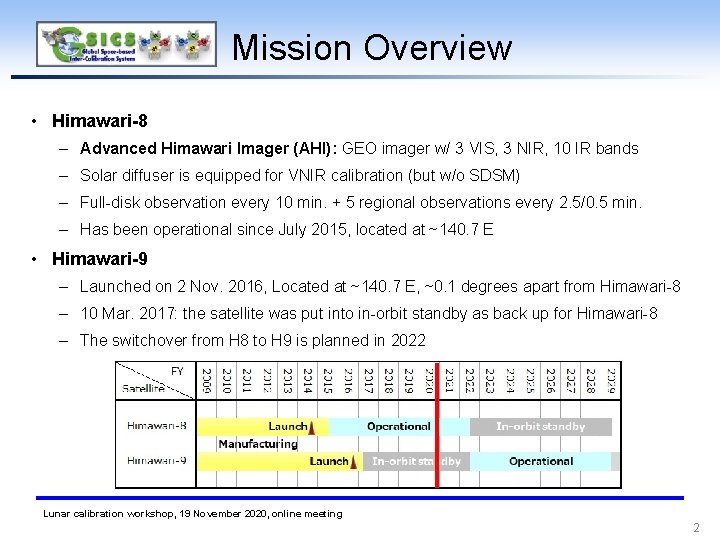
Mission Overview • Himawari-8 – Advanced Himawari Imager (AHI): GEO imager w/ 3 VIS, 3 NIR, 10 IR bands – Solar diffuser is equipped for VNIR calibration (but w/o SDSM) – Full-disk observation every 10 min. + 5 regional observations every 2. 5/0. 5 min. – Has been operational since July 2015, located at ~140. 7 E • Himawari-9 – Launched on 2 Nov. 2016, Located at ~140. 7 E, ~0. 1 degrees apart from Himawari-8 – 10 Mar. 2017: the satellite was put into in-orbit standby as back up for Himawari-8 – The switchover from H 8 to H 9 is planned in 2022 Lunar calibration workshop, 19 November 2020, online meeting 2
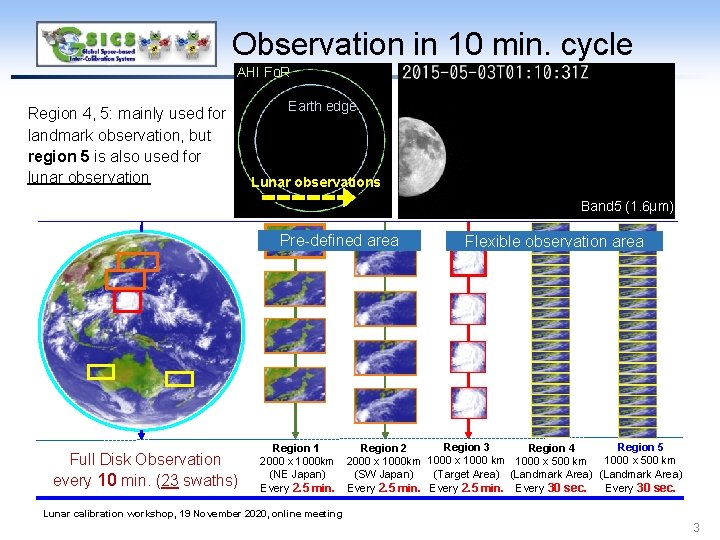
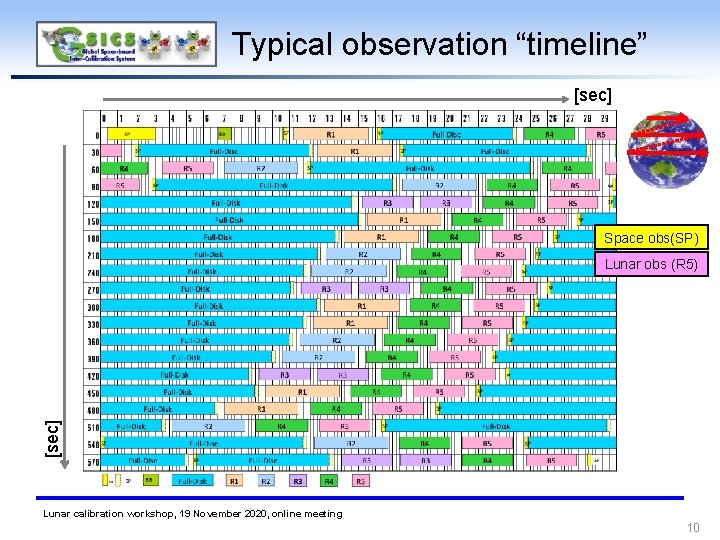
Observation in 10 min. cycle AHI Fo. R Region 4, 5: mainly used for landmark observation, but region 5 is also used for lunar observation Earth edge Lunar observations Band 5 (1. 6μm) Pre-defined area Full Disk Observation every 10 min. (23 swaths) Region 1 2000 x 1000 km (NE Japan) Every 2. 5 min. Flexible observation area Region 3 Region 5 Region 2 Region 4 1000 x 500 km 2000 x 1000 km 1000 x 1000 km 1000 x 500 km (Target Area) (Landmark Area) (SW Japan) Every 30 sec. Every 2. 5 min. Every 30 sec. Lunar calibration workshop, 19 November 2020, online meeting 3
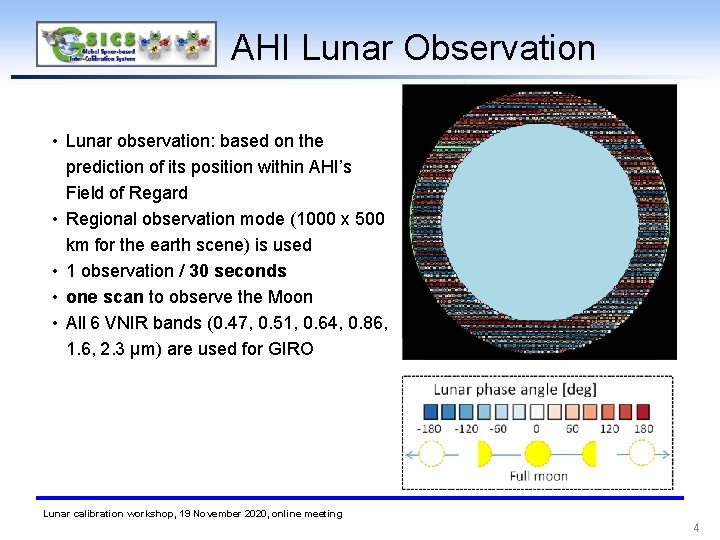
AHI Lunar Observation • Lunar observation: based on the prediction of its position within AHI’s Field of Regard • Regional observation mode (1000 x 500 km for the earth scene) is used • 1 observation / 30 seconds • one scan to observe the Moon • All 6 VNIR bands (0. 47, 0. 51, 0. 64, 0. 86, 1. 6, 2. 3 µm) are used for GIRO Lunar calibration workshop, 19 November 2020, online meeting 4
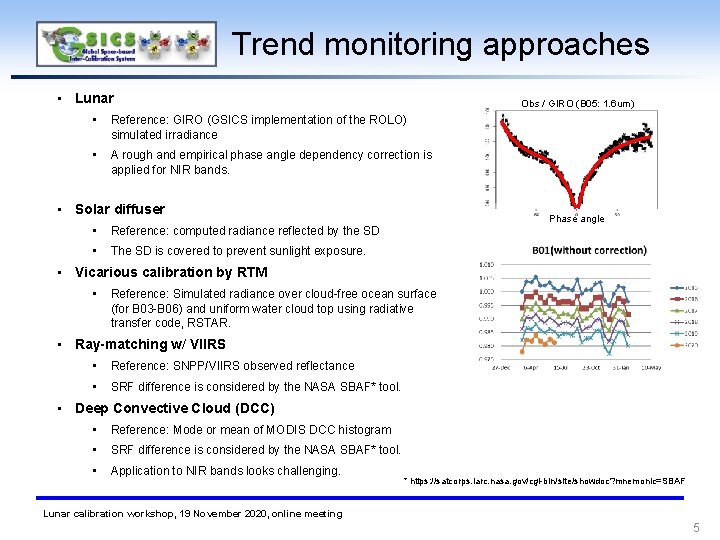
Trend monitoring approaches • Lunar Obs / GIRO (B 05: 1. 6 um) • Reference: GIRO (GSICS implementation of the ROLO) simulated irradiance • A rough and empirical phase angle dependency correction is applied for NIR bands. • Solar diffuser • Reference: computed radiance reflected by the SD • The SD is covered to prevent sunlight exposure. Phase angle • Vicarious calibration by RTM • Reference: Simulated radiance over cloud-free ocean surface (for B 03 -B 06) and uniform water cloud top using radiative transfer code, RSTAR. • Ray-matching w/ VIIRS • Reference: SNPP/VIIRS observed reflectance • SRF difference is considered by the NASA SBAF* tool. • Deep Convective Cloud (DCC) • Reference: Mode or mean of MODIS DCC histogram • SRF difference is considered by the NASA SBAF* tool. • Application to NIR bands looks challenging. * https: //satcorps. larc. nasa. gov/cgi-bin/site/showdoc? mnemonic=SBAF Lunar calibration workshop, 19 November 2020, online meeting 5
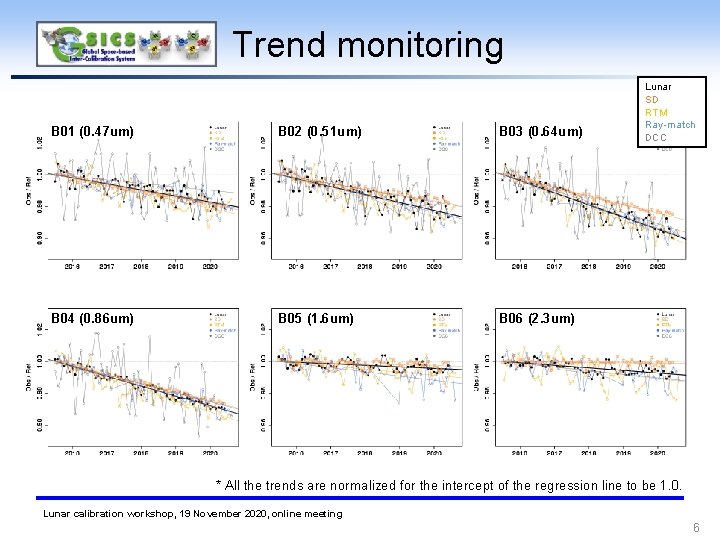
Trend monitoring B 01 (0. 47 um) B 02 (0. 51 um) B 03 (0. 64 um) B 04 (0. 86 um) B 05 (1. 6 um) B 06 (2. 3 um) Lunar SD RTM Ray-match DCC * All the trends are normalized for the intercept of the regression line to be 1. 0. Lunar calibration workshop, 19 November 2020, online meeting 6
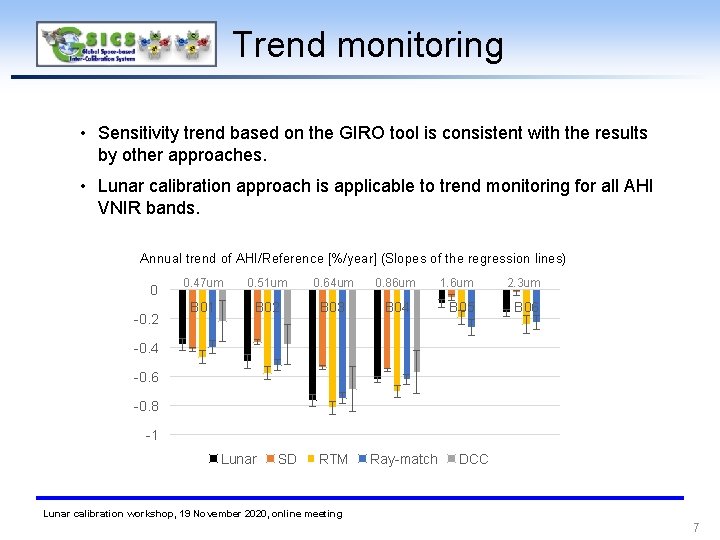
Trend monitoring • Sensitivity trend based on the GIRO tool is consistent with the results by other approaches. • Lunar calibration approach is applicable to trend monitoring for all AHI VNIR bands. Annual trend of AHI/Reference [%/year] (Slopes of the regression lines) 0 -0. 2 0. 47 um 0. 51 um 0. 64 um 0. 86 um B 01 B 02 B 03 B 04 1. 6 um 2. 3 um B 05 B 06 -0. 4 -0. 6 -0. 8 -1 Lunar SD RTM Ray-match DCC Lunar calibration workshop, 19 November 2020, online meeting 7
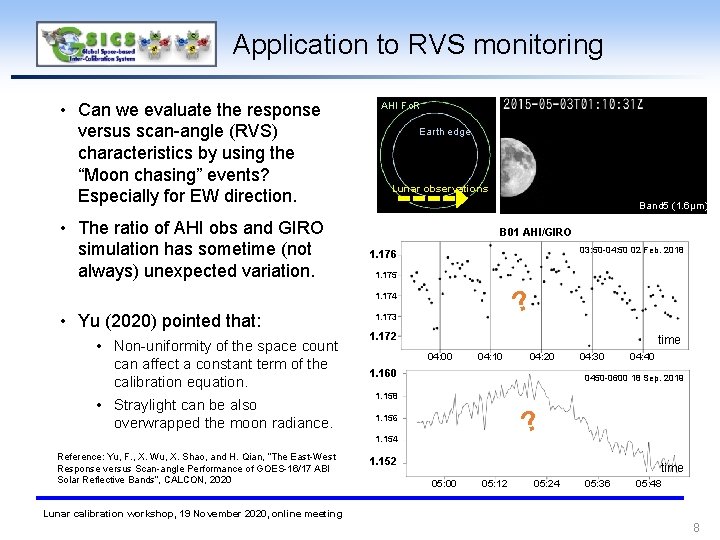
Application to RVS monitoring • Can we evaluate the response versus scan-angle (RVS) characteristics by using the “Moon chasing” events? Especially for EW direction. • The ratio of AHI obs and GIRO simulation has sometime (not always) unexpected variation. AHI Fo. R Earth edge Lunar observations Band 5 (1. 6μm) B 01 AHI/GIRO 03: 50 -04: 50 02 Feb. 2018 1. 176 1. 175 ? 1. 174 • Yu (2020) pointed that: • Non-uniformity of the space count can affect a constant term of the calibration equation. • Straylight can be also overwrapped the moon radiance. 1. 173 1. 172 time 04: 00 04: 10 1. 160 04: 30 04: 40 0450 -0600 18 Sep. 2019 1. 158 ? 1. 156 1. 154 Reference: Yu, F. , X. Wu, X. Shao, and H. Qian, “The East-West Response versus Scan-angle Performance of GOES-16/17 ABI Solar Reflective Bands”, CALCON, 2020 04: 20 1. 152 time 05: 00 05: 12 05: 24 05: 36 05: 48 Lunar calibration workshop, 19 November 2020, online meeting 8
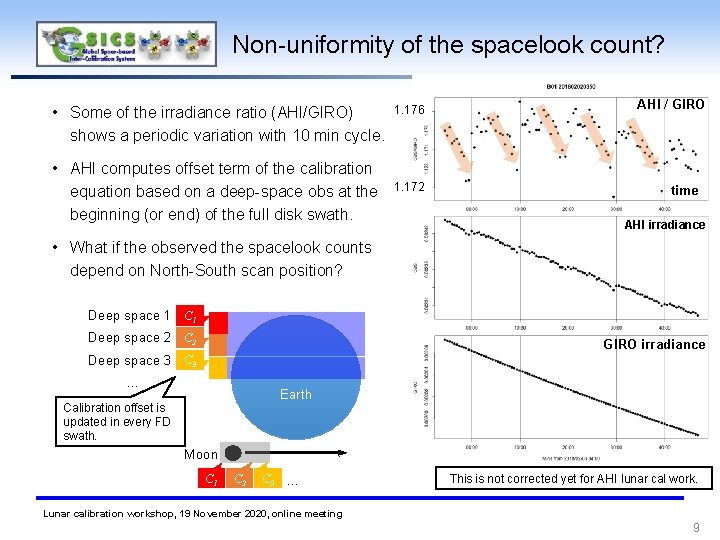
Non-uniformity of the spacelook count? 1. 176 • Some of the irradiance ratio (AHI/GIRO) shows a periodic variation with 10 min cycle. • AHI computes offset term of the calibration equation based on a deep-space obs at the beginning (or end) of the full disk swath. 1. 172 AHI / GIRO time AHI irradiance • What if the observed the spacelook counts depend on North-South scan position? Deep space 1 C 1 Deep space 2 C 2 GIRO irradiance Deep space 3 C 3 … Earth Calibration offset is updated in every FD swath. Moon C 1 C 2 C 3 … This is not corrected yet for AHI lunar cal work. Lunar calibration workshop, 19 November 2020, online meeting 9
Typical observation “timeline” [sec] Space obs(SP) [sec] Lunar obs (R 5) Lunar calibration workshop, 19 November 2020, online meeting 10
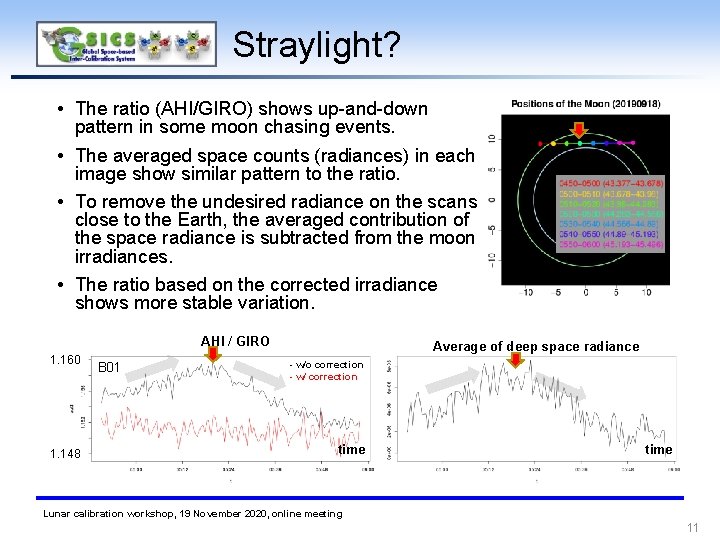
Straylight? • The ratio (AHI/GIRO) shows up-and-down pattern in some moon chasing events. • The averaged space counts (radiances) in each image show similar pattern to the ratio. • To remove the undesired radiance on the scans close to the Earth, the averaged contribution of the space radiance is subtracted from the moon irradiances. • The ratio based on the corrected irradiance shows more stable variation. AHI / GIRO 1. 160 1. 148 B 01 Average of deep space radiance - w/o correction - w/ correction time Lunar calibration workshop, 19 November 2020, online meeting 11
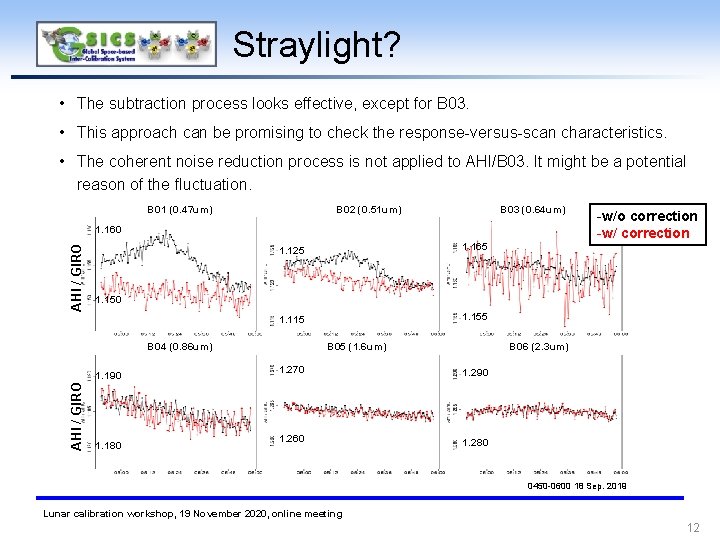
Straylight? • The subtraction process looks effective, except for B 03. • This approach can be promising to check the response-versus-scan characteristics. • The coherent noise reduction process is not applied to AHI/B 03. It might be a potential reason of the fluctuation. B 01 (0. 47 um) B 02 (0. 51 um) B 03 (0. 64 um) AHI / GIRO 1. 160 1. 125 1. 165 1. 115 1. 150 B 04 (0. 86 um) 1. 190 AHI / GIRO - w/o correction - w/ correction 1. 180 B 05 (1. 6 um) B 06 (2. 3 um) 1. 270 1. 290 1. 260 1. 280 0450 -0600 18 Sep. 2019 Lunar calibration workshop, 19 November 2020, online meeting 12
Summary • Sensitivity trend based on the GIRO tool is consistent with other results. • “Moon chasing” event will be a good opportunity to evaluate RVS characteristics, if the straylight and the non-uniformity of the spacelook count (if exists) are corrected adequately. • Future issues: • non-uniformity of the space count • OFAR(B 01 -B 03) • Acknowledgement • The presentation by Dr. Yu in CALCON 2020 gave me good suggestions. Lunar calibration workshop, 19 November 2020, online meeting 13
Back up Lunar calibration workshop, 19 November 2020, online meeting 14
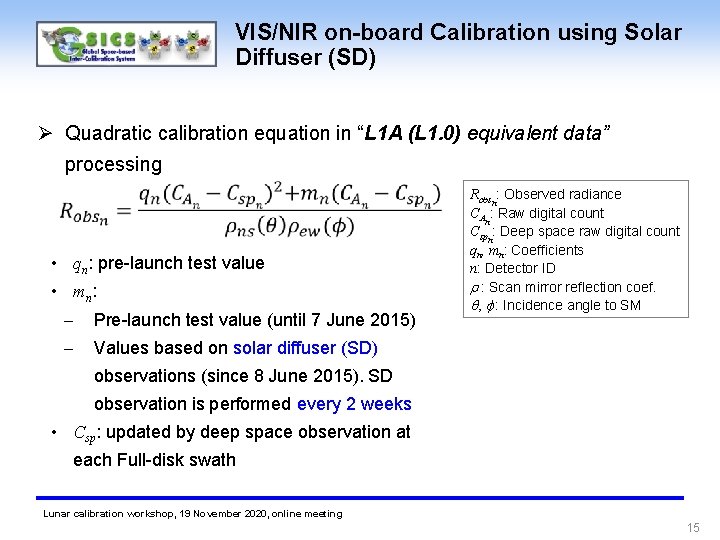
VIS/NIR on-board Calibration using Solar Diffuser (SD) Ø Quadratic calibration equation in “L 1 A (L 1. 0) equivalent data” processing • qn: pre-launch test value • mn : – Pre-launch test value (until 7 June 2015) – Values based on solar diffuser (SD) Robs : Observed radiance n CAn: Raw digital count Cspn: Deep space raw digital count qn, mn: Coefficients n: Detector ID r : Scan mirror reflection coef. q, f : Incidence angle to SM observations (since 8 June 2015). SD observation is performed every 2 weeks • Csp: updated by deep space observation at each Full-disk swath a a Lunar calibration workshop, 19 November 2020, online meeting 15
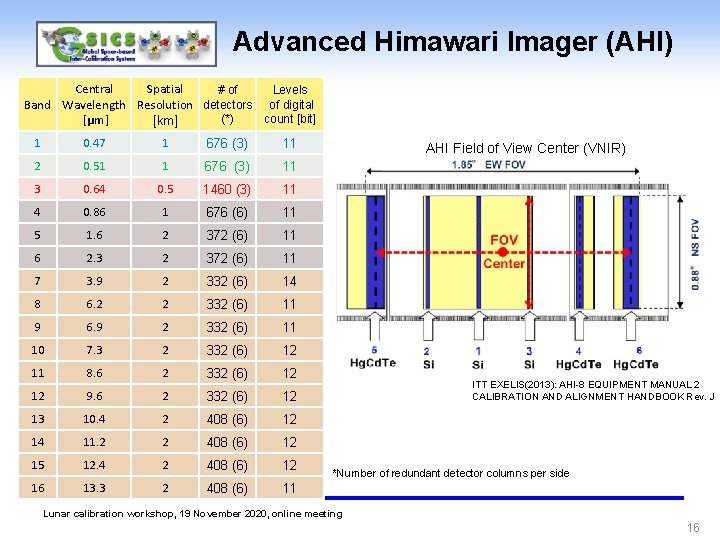
Advanced Himawari Imager (AHI) Spatial Central # of Levels Band Wavelength Resolution detectors of digital (*) count [bit] [μm] [km] 1 0. 47 1 676 (3) 11 2 0. 51 1 676 (3) 11 3 0. 64 0. 5 1460 (3) 11 4 0. 86 1 676 (6) 11 5 1. 6 2 372 (6) 11 6 2. 3 2 372 (6) 11 7 3. 9 2 332 (6) 14 8 6. 2 2 332 (6) 11 9 6. 9 2 332 (6) 11 10 7. 3 2 332 (6) 12 11 8. 6 2 332 (6) 12 12 9. 6 2 332 (6) 12 13 10. 4 2 408 (6) 12 14 11. 2 2 408 (6) 12 15 12. 4 2 408 (6) 12 16 13. 3 2 408 (6) 11 AHI Field of View Center (VNIR) ITT EXELIS(2013): AHI-8 EQUIPMENT MANUAL 2 CALIBRATION AND ALIGNMENT HANDBOOK Rev. J *Number of redundant detector columns per side Lunar calibration workshop, 19 November 2020, online meeting 16
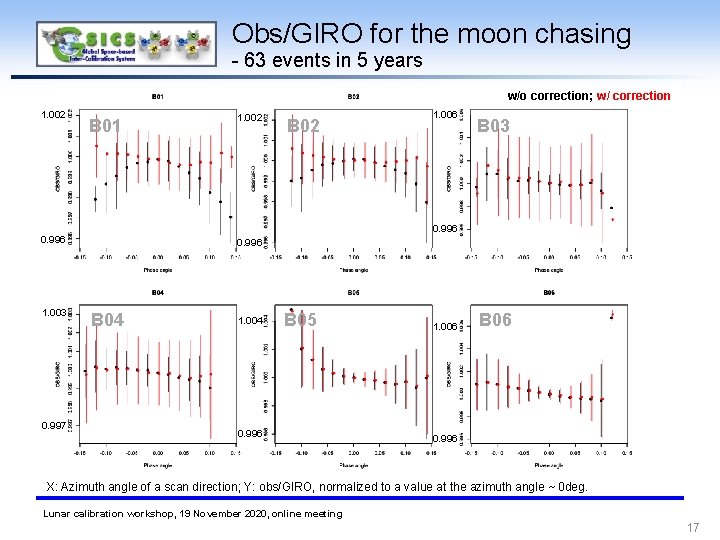
Obs/GIRO for the moon chasing - 63 events in 5 years w/o correction; w/ correction 1. 002 B 01 0. 997 B 02 1. 006 B 03 0. 996 1. 003 1. 002 0. 996 B 04 1. 004 B 05 0. 996 1. 006 B 06 0. 996 X: Azimuth angle of a scan direction; Y: obs/GIRO, normalized to a value at the azimuth angle ~ 0 deg. Lunar calibration workshop, 19 November 2020, online meeting 17
- Slides: 17