
Lunar Bombardment History Was There a Terminal Lunar
Lunar Bombardment History: Was There a Terminal Lunar “Cataclysm”? • • The concept The importance if it happened The evidence Problems with the evidence: arguments against a cataclysm and counter arguments • Testing the idea Jeff Taylor Lunar cataclysm 1
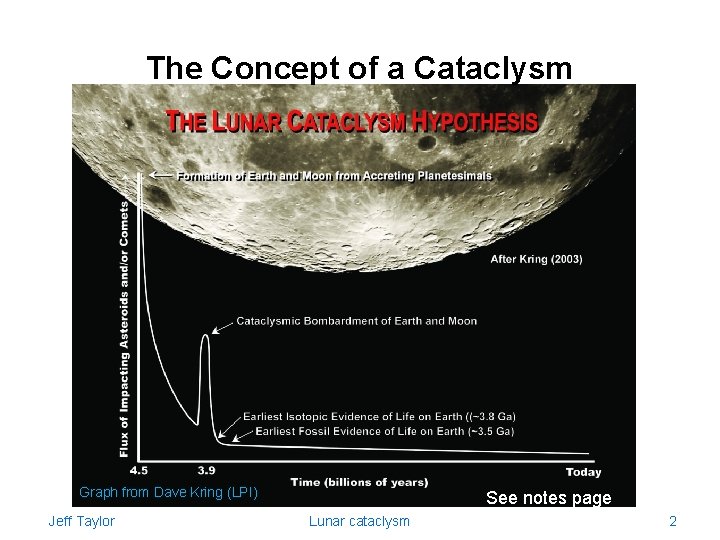
The Concept of a Cataclysm Graph from Dave Kring (LPI) Jeff Taylor See notes page Lunar cataclysm 2
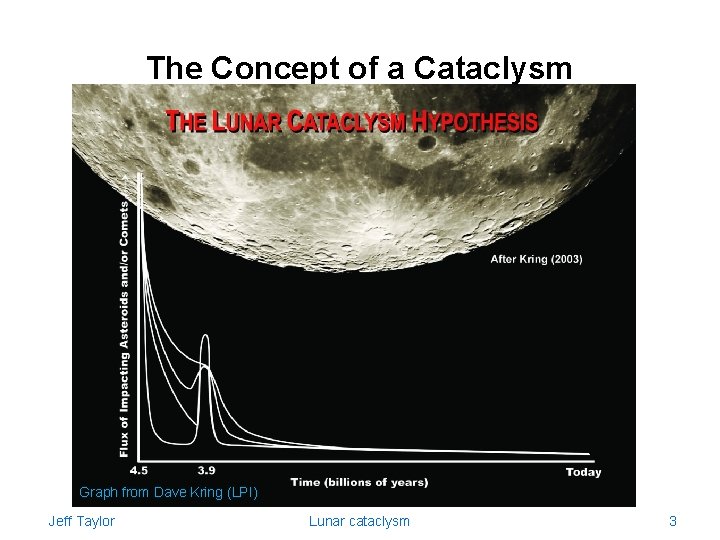
The Concept of a Cataclysm Graph from Dave Kring (LPI) Jeff Taylor See notes page Lunar cataclysm 3
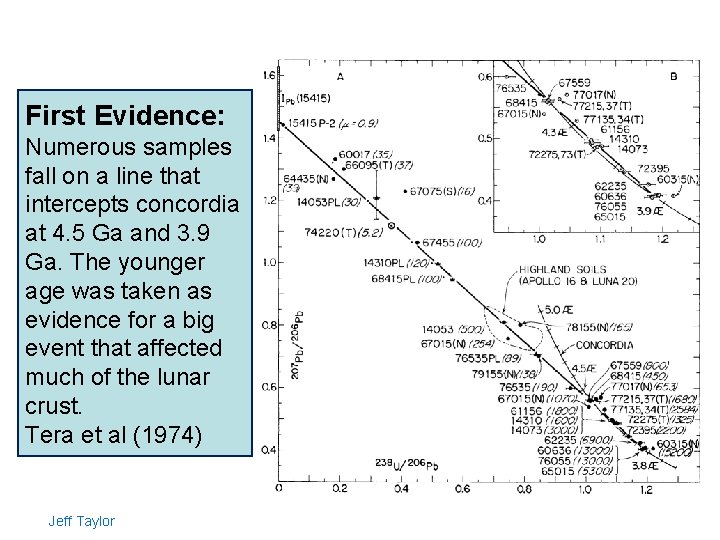
First Evidence: Numerous samples fall on a line that intercepts concordia at 4. 5 Ga and 3. 9 Ga. The younger age was taken as evidence for a big event that affected much of the lunar crust. Tera et al (1974) Jeff Taylor
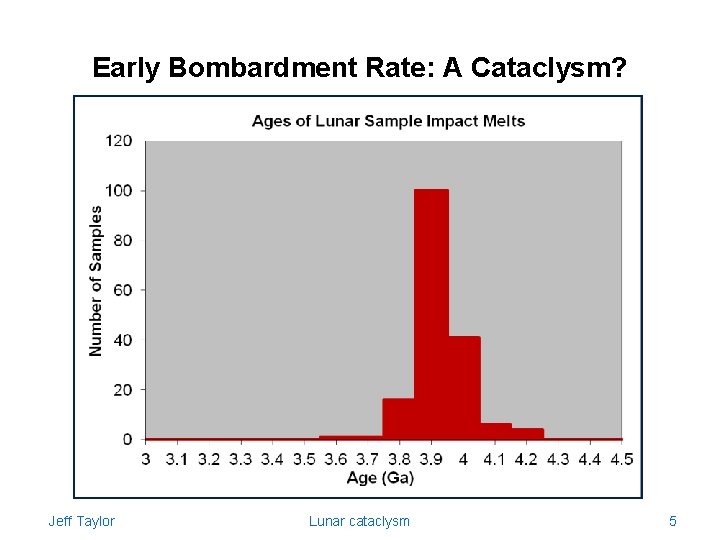
Early Bombardment Rate: A Cataclysm? Huge implications for early history of the Solar System Jeff Taylor Lunar cataclysm 5
Importance of the Concept • Numerous imaginative ideas to explain early bombardment and cataclysm (if it happened): – Left over debris from formation of terrestrial planets – Late formation of Uranus and Neptune, which scatters nearby planetesimals – Break-up of a large main-belt asteroid – Asteroid scattering by 2 -3 planets in the region that is now the asteroid belt – Comet shower caused by close passage of a star – Cataclysm confined to Earth-Moon system • Which ever one is correct, there are important implications for how planets formed, and some are wrong if there was or was not a cataclysm. Jeff Taylor Lunar cataclysm 6
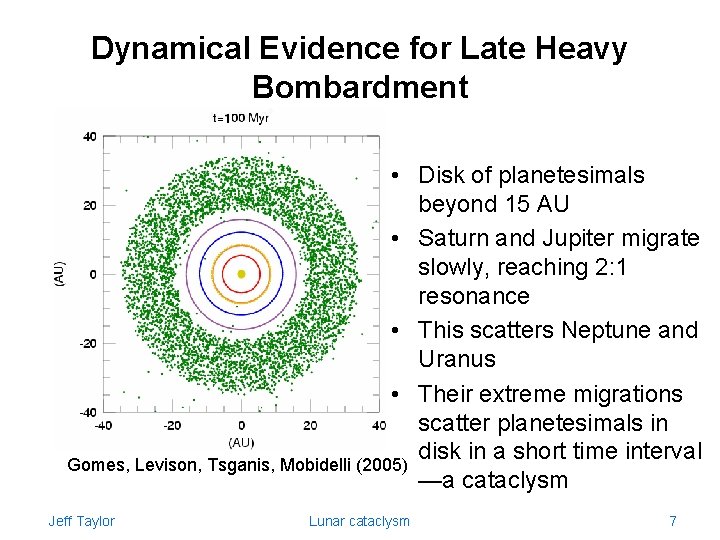
Dynamical Evidence for Late Heavy Bombardment • Disk of planetesimals beyond 15 AU • Saturn and Jupiter migrate slowly, reaching 2: 1 resonance • This scatters Neptune and Uranus • Their extreme migrations scatter planetesimals in disk in a short time interval Gomes, Levison, Tsganis, Mobidelli (2005) —a cataclysm Jeff Taylor Lunar cataclysm 7
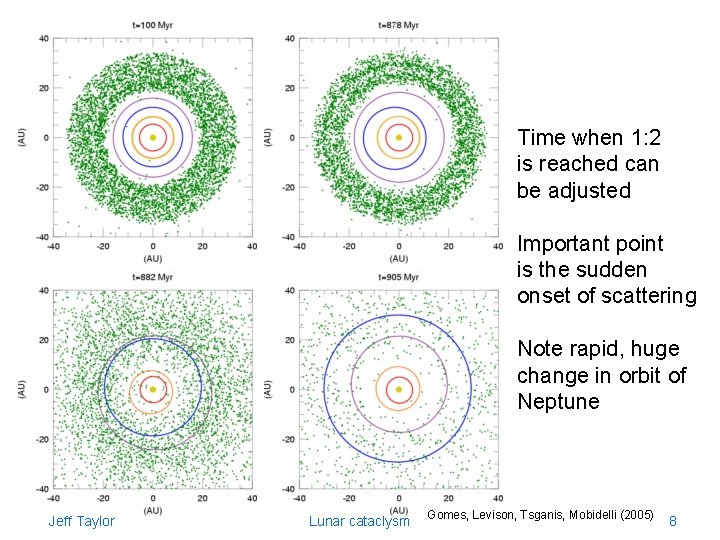
Time when 1: 2 is reached can be adjusted Important point is the sudden onset of scattering Note rapid, huge change in orbit of Neptune Jeff Taylor Lunar cataclysm Gomes, Levison, Tsganis, Mobidelli (2005) 8
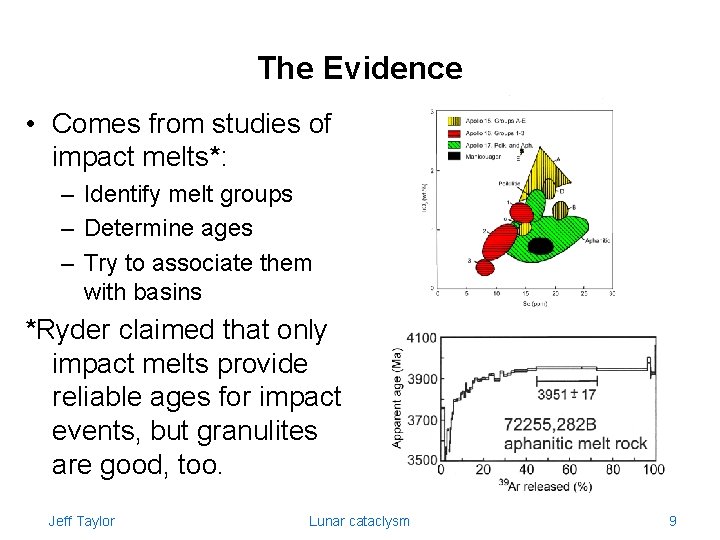
The Evidence • Comes from studies of impact melts*: – Identify melt groups – Determine ages – Try to associate them with basins *Ryder claimed that only impact melts provide reliable ages for impact events, but granulites are good, too. Jeff Taylor Lunar cataclysm Dalrymple and Ryder (1996) 9
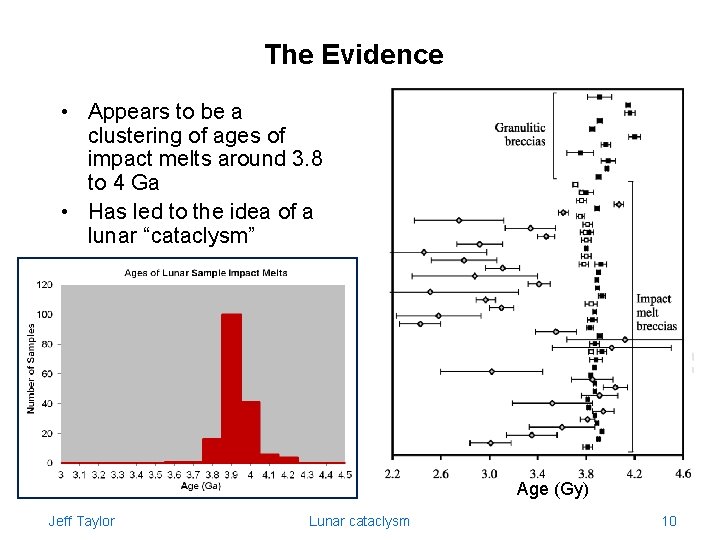
The Evidence • Appears to be a clustering of ages of impact melts around 3. 8 to 4 Ga • Has led to the idea of a lunar “cataclysm” Age (Gy) Jeff Taylor Lunar cataclysm 10
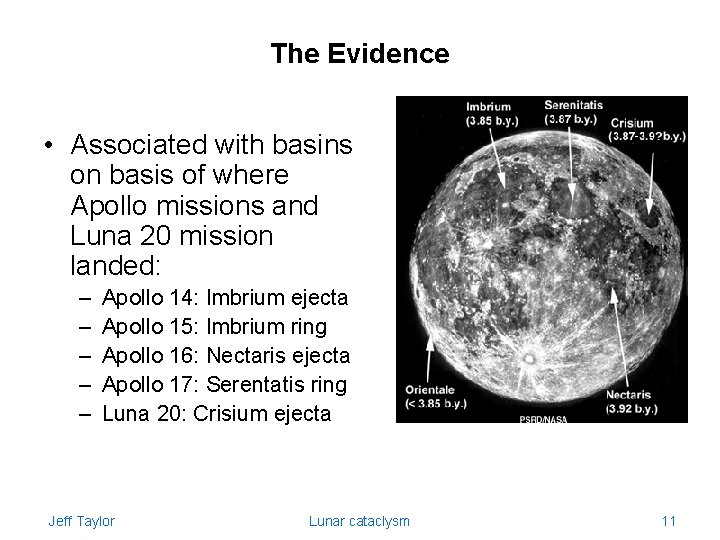
The Evidence • Associated with basins on basis of where Apollo missions and Luna 20 mission landed: – – – Apollo 14: Imbrium ejecta Apollo 15: Imbrium ring Apollo 16: Nectaris ejecta Apollo 17: Serentatis ring Luna 20: Crisium ejecta Jeff Taylor Lunar cataclysm 11
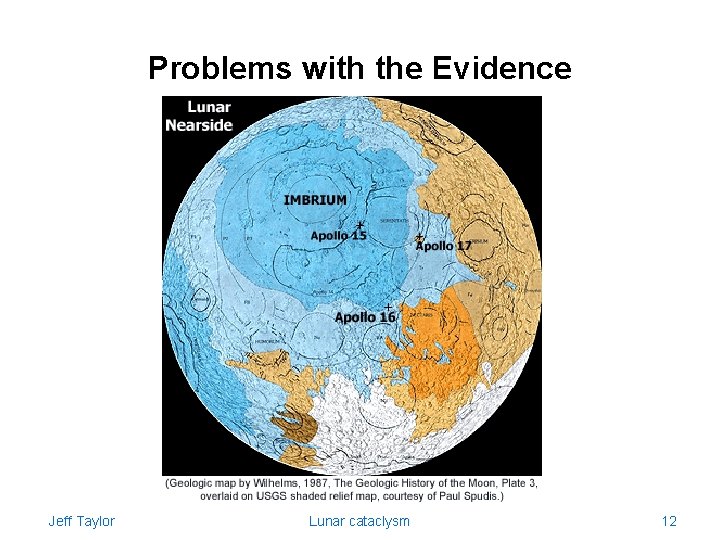
Problems with the Evidence Jeff Taylor Lunar cataclysm 12
Problems with the Evidence • Everything is from Imbrium—we are dating only one event – Samples all from near side, all sites within reach of Imbrium ejecta – Imbrium area focus of high Th (hence REE etc. ), characteristic of most LKFM (which is what is dated) • Counter argument: – Melts have different chemical compositions and compositional clusters [But maybe basin-sized impact melts vary in composition more than smaller terrestrial craters that have been studied] – Melts groups have different ages [but maybe trapped Ar in some] Jeff Taylor Lunar cataclysm 13
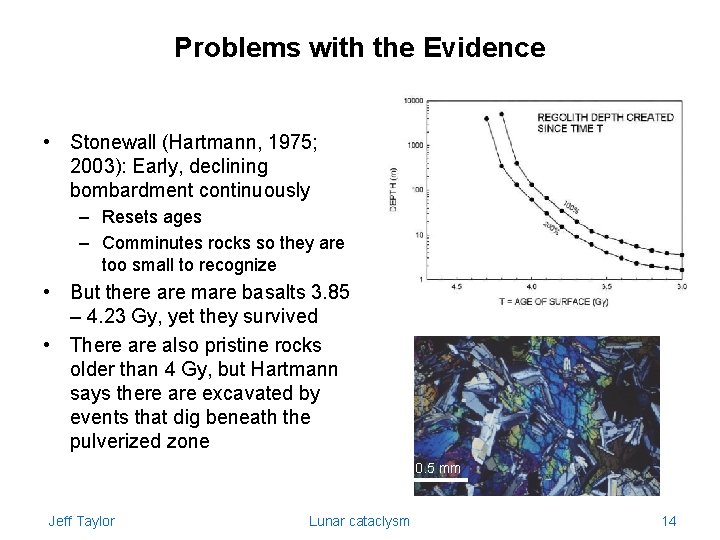
Problems with the Evidence • Stonewall (Hartmann, 1975; 2003): Early, declining bombardment continuously – Resets ages – Comminutes rocks so they are too small to recognize • But there are mare basalts 3. 85 – 4. 23 Gy, yet they survived • There also pristine rocks older than 4 Gy, but Hartmann says there are excavated by events that dig beneath the pulverized zone Hartmann (2003) 0. 5 mm 14053, 3. 95 Ga Jeff Taylor Lunar cataclysm 14
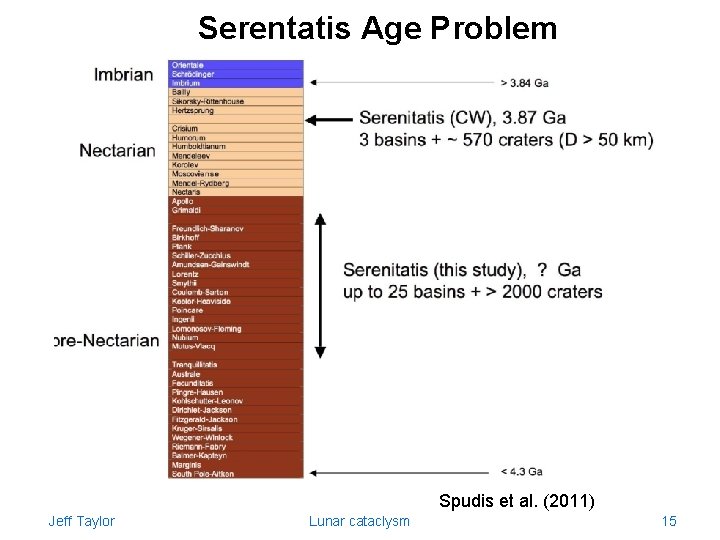
Serentatis Age Problem Spudis et al. (2011) Jeff Taylor Lunar cataclysm 15
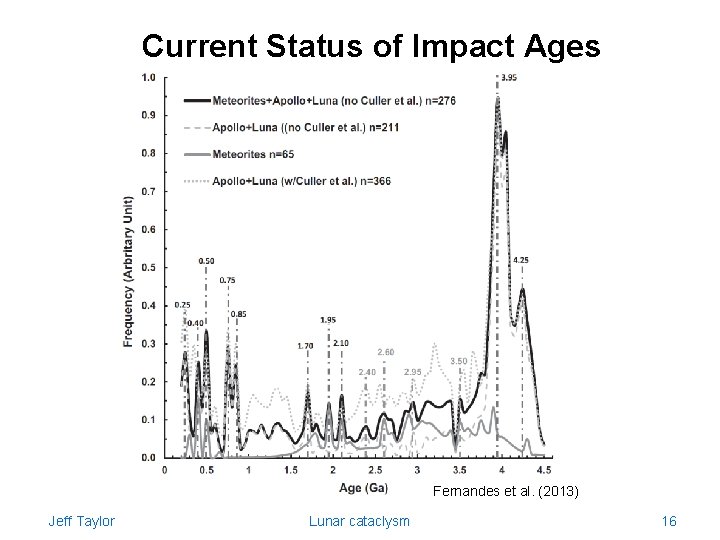
Current Status of Impact Ages Fernandes et al. (2013) Jeff Taylor Lunar cataclysm 16
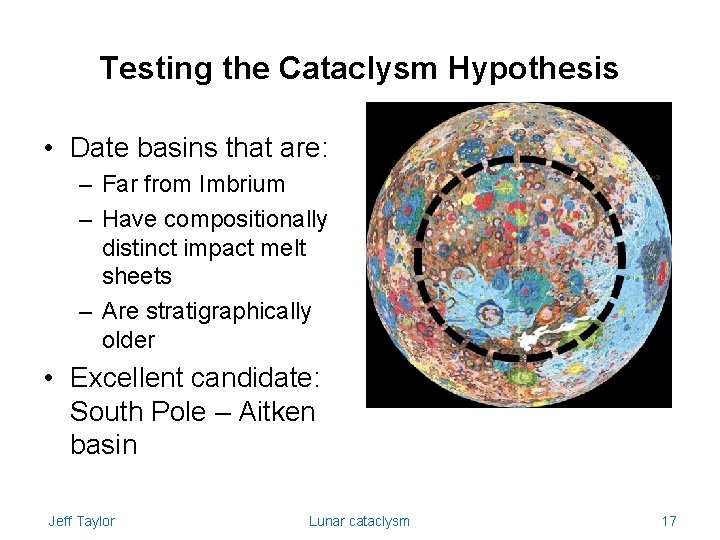
Testing the Cataclysm Hypothesis • Date basins that are: – Far from Imbrium – Have compositionally distinct impact melt sheets – Are stratigraphically older • Excellent candidate: South Pole – Aitken basin Jeff Taylor Geological Map of SPA basin. Note superimposed basins Lunar cataclysm 17
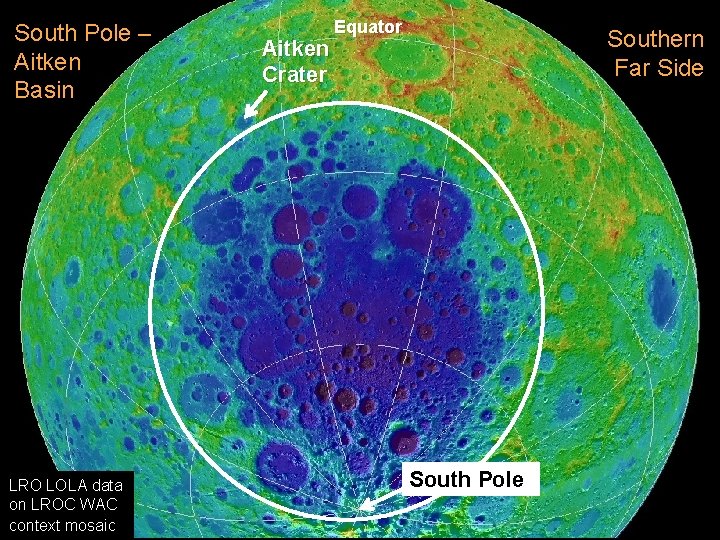
South Pole – Aitken Basin LRO LOLA data on LROC WAC Jeffmosaic Taylor context Aitken Crater Equator Southern Far Side South Pole
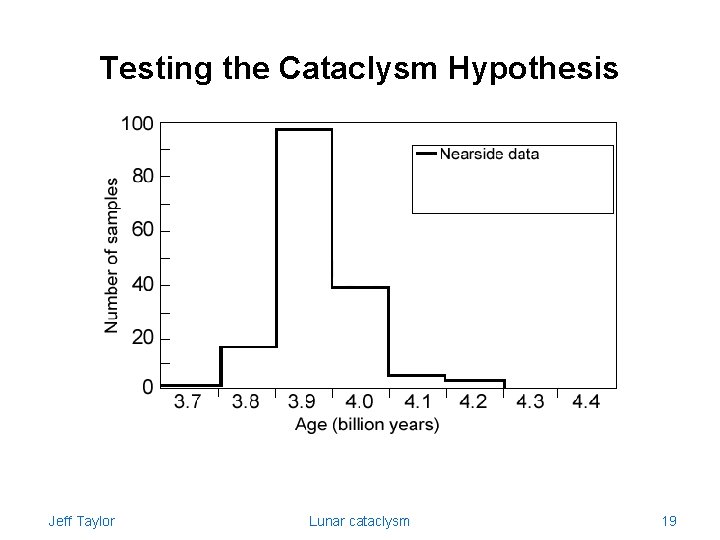
Testing the Cataclysm Hypothesis Jeff Taylor Lunar cataclysm 19
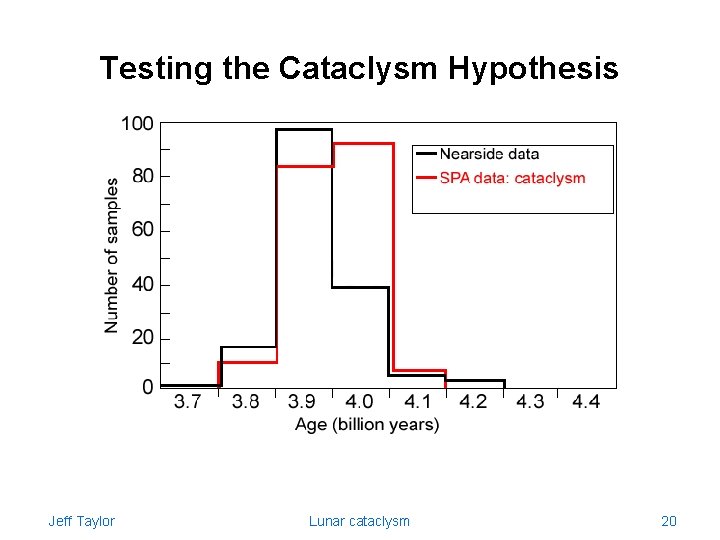
Testing the Cataclysm Hypothesis Jeff Taylor Lunar cataclysm 20
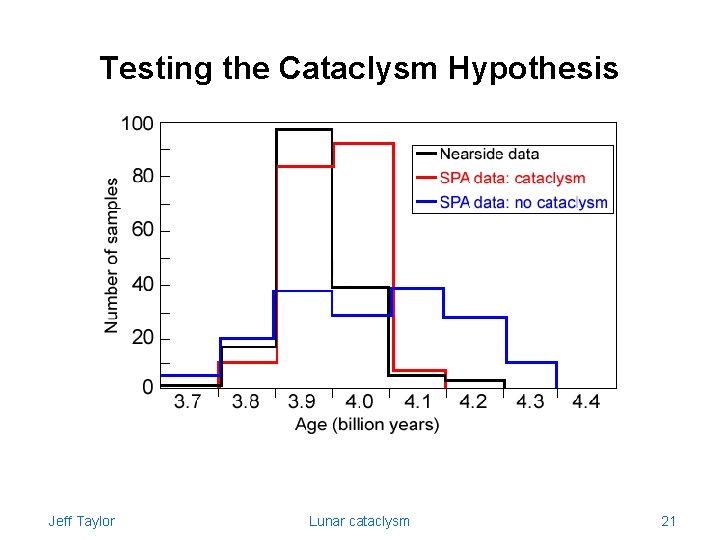
Testing the Cataclysm Hypothesis Jeff Taylor Lunar cataclysm 21
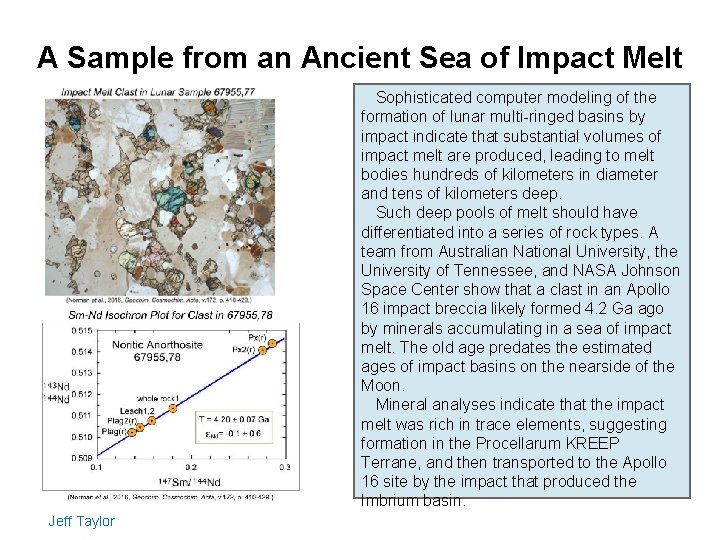
A Sample from an Ancient Sea of Impact Melt Sophisticated computer modeling of the formation of lunar multi-ringed basins by impact indicate that substantial volumes of impact melt are produced, leading to melt bodies hundreds of kilometers in diameter and tens of kilometers deep. Such deep pools of melt should have differentiated into a series of rock types. A team from Australian National University, the University of Tennessee, and NASA Johnson Space Center show that a clast in an Apollo 16 impact breccia likely formed 4. 2 Ga ago by minerals accumulating in a sea of impact melt. The old age predates the estimated ages of impact basins on the nearside of the Moon. Mineral analyses indicate that the impact melt was rich in trace elements, suggesting formation in the Procellarum KREEP Terrane, and then transported to the Apollo 16 site by the impact that produced the Imbrium basin. Jeff Taylor
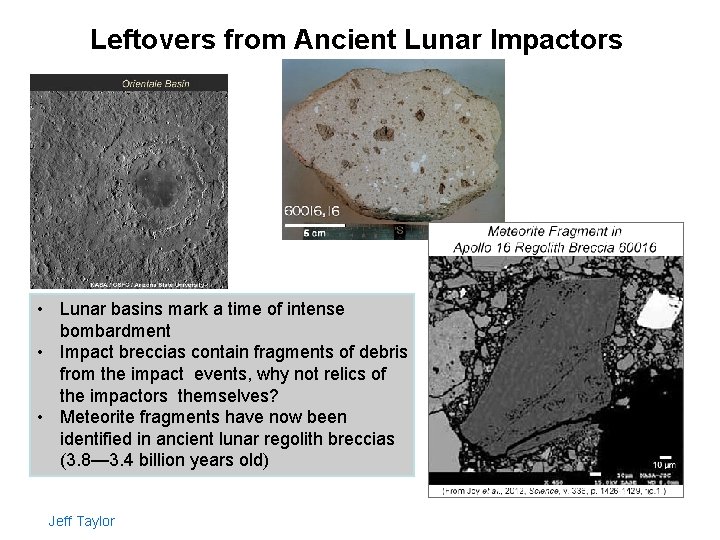
Leftovers from Ancient Lunar Impactors • Lunar basins mark a time of intense bombardment • Impact breccias contain fragments of debris from the impact events, why not relics of the impactors themselves? • Meteorite fragments have now been identified in ancient lunar regolith breccias (3. 8— 3. 4 billion years old) Jeff Taylor
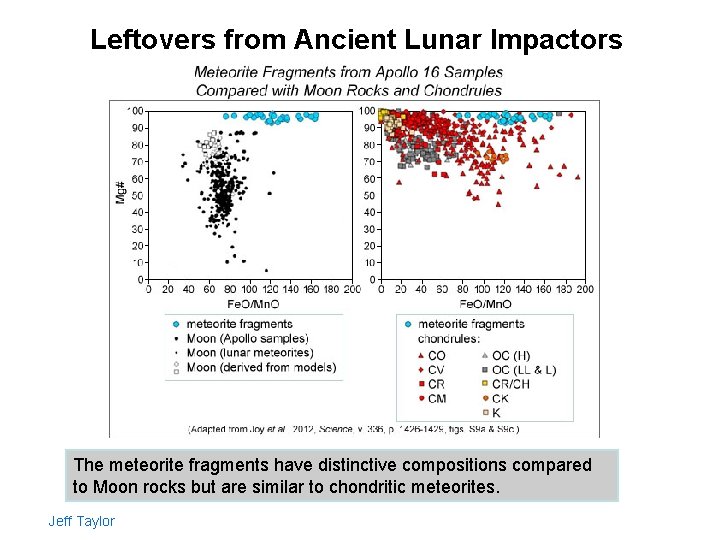
Leftovers from Ancient Lunar Impactors The meteorite fragments have distinctive compositions compared to Moon rocks but are similar to chondritic meteorites. Jeff Taylor
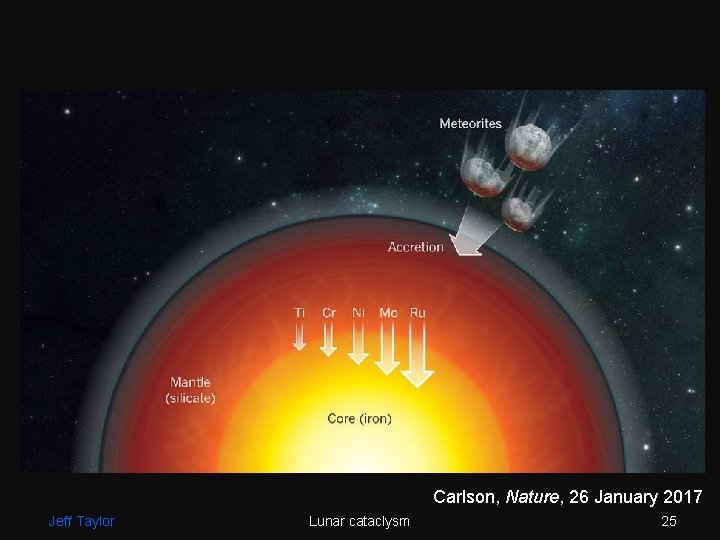
Carlson, Nature, 26 January 2017 Jeff Taylor Lunar cataclysm 25
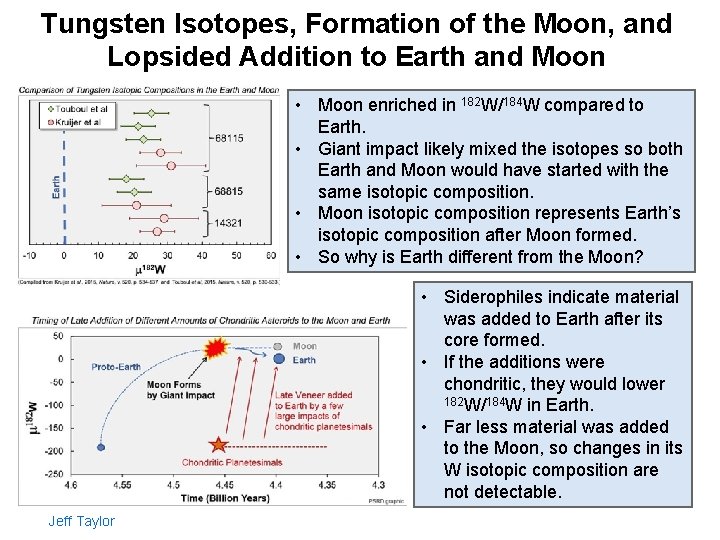
Tungsten Isotopes, Formation of the Moon, and Lopsided Addition to Earth and Moon • Moon enriched in 182 W/184 W compared to Earth. • Giant impact likely mixed the isotopes so both Earth and Moon would have started with the same isotopic composition. • Moon isotopic composition represents Earth’s isotopic composition after Moon formed. • So why is Earth different from the Moon? • Siderophiles indicate material was added to Earth after its core formed. • If the additions were chondritic, they would lower 182 W/184 W in Earth. • Far less material was added to the Moon, so changes in its W isotopic composition are not detectable. Jeff Taylor
- Slides: 26