
Luminosity Every particle Physics experiment needs to know
- Slides: 3
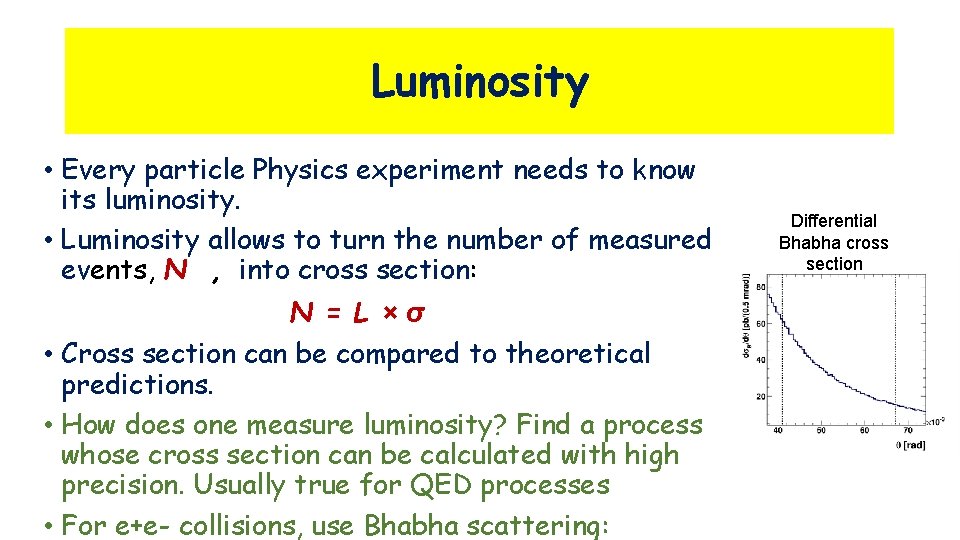
Luminosity • Every particle Physics experiment needs to know its luminosity. • Luminosity allows to turn the number of measured events, N , into cross section: N = L ×σ • Cross section can be compared to theoretical predictions. • How does one measure luminosity? Find a process whose cross section can be calculated with high precision. Usually true for QED processes • For e+e- collisions, use Bhabha scattering: Differential Bhabha cross section
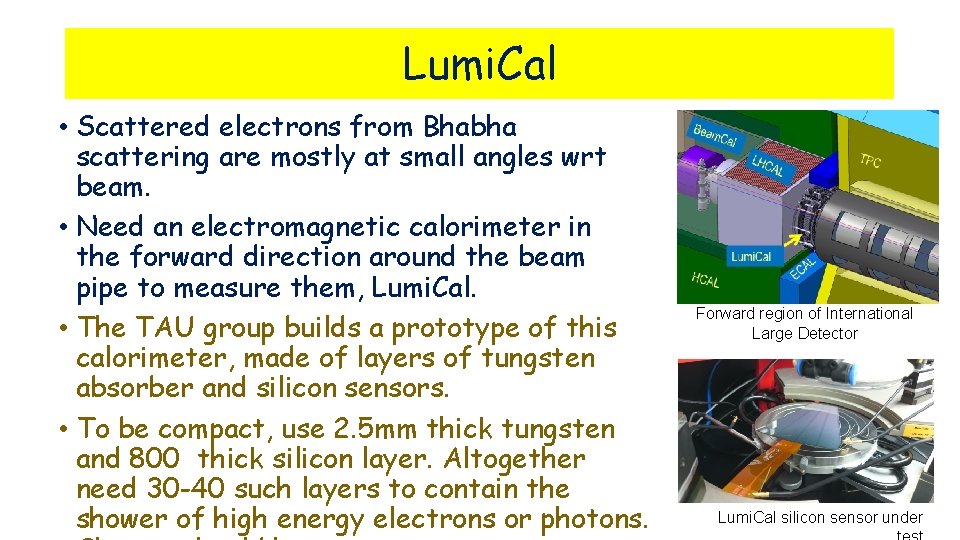
Lumi. Cal • Scattered electrons from Bhabha scattering are mostly at small angles wrt beam. • Need an electromagnetic calorimeter in the forward direction around the beam pipe to measure them, Lumi. Cal. • The TAU group builds a prototype of this calorimeter, made of layers of tungsten absorber and silicon sensors. • To be compact, use 2. 5 mm thick tungsten and 800 thick silicon layer. Altogether need 30 -40 such layers to contain the shower of high energy electrons or photons. Forward region of International Large Detector Lumi. Cal silicon sensor under
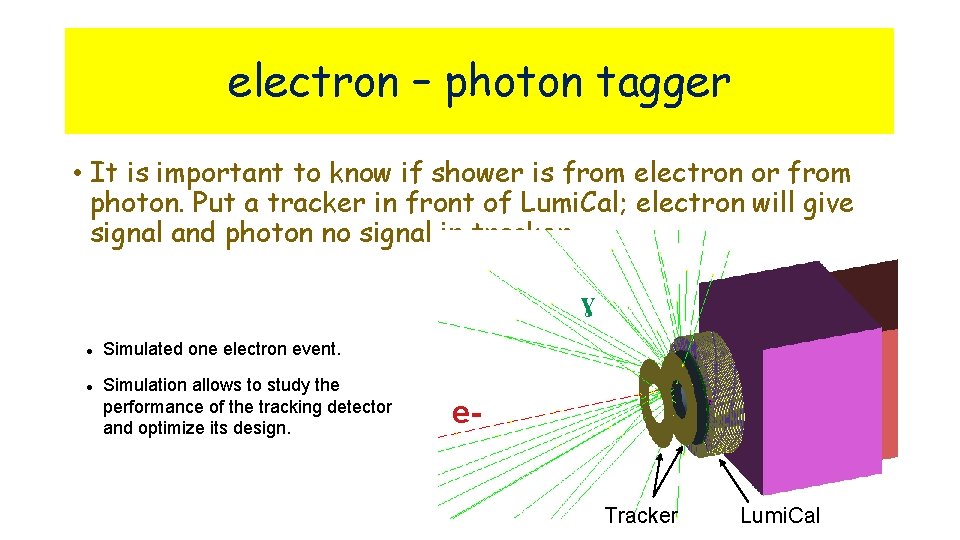
electron – photon tagger • It is important to know if shower is from electron or from photon. Put a tracker in front of Lumi. Cal; electron will give signal and photon no signal in tracker. ɣ Simulated one electron event. Simulation allows to study the performance of the tracking detector and optimize its design. e. Tracker Lumi. Cal