
Luminal intestinal flagellates lagellate Disease Giardiasis lambliasis Epidemiology

Luminal & intestinal flagellates lagellate). Disease : Giardiasis (lambliasis). Epidemiology: It has worldwide distribution. It is the most common protozoan intestinal disease in disease. This parasite more prevalence in children under 10 years old. Habitat→→ duodenum and upper jejunum. Infective stage → → Mature quadrinucleate cyst. Pathogenic stage → →Active trophozoite. Diagnostic stage → → Mature cyst and trophozoite in stool sample. Mode of infection → → Contamination of food and water with cyst. Route of entry → → is mouth or orally.
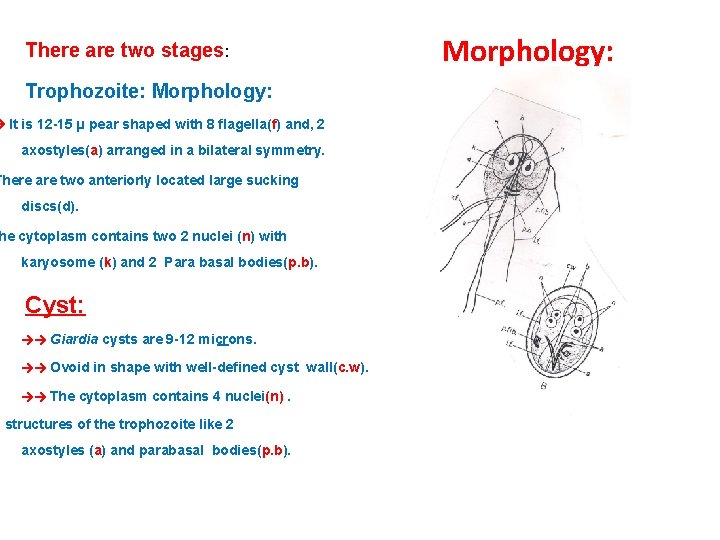
There are two stages: Trophozoite: Morphology: → It is 12 -15 µ pear shaped with 8 flagella(f) and, 2 axostyles(a) arranged in a bilateral symmetry. There are two anteriorly located large sucking discs(d). he cytoplasm contains two 2 nuclei (n) with karyosome (k) and 2 Para basal bodies(p. b). Cyst: →→ Giardia cysts are 9 -12 microns. →→ Ovoid in shape with well-defined cyst wall(c. w). →→ The cytoplasm contains 4 nuclei(n). y structures of the trophozoite like 2 axostyles (a) and parabasal bodies(p. b). Morphology:
Life cycle of G. Lamblia → Life cycle: Infection occurs by ingestion of cysts, usually in contaminated water. ystation occurs in duodenum and trophozoites onize the duodenum where they may swim freely attach to the sub-mucosal epithelium via the ventral suction disc. →→ The free trophozoites encysted in the colon. →→ The cysts are passed in the stool. n is the primary host and some animals(e. g. pigs monkeys, mice…. . etc) are also infected and serve rvoirs. →→ Afterrward, person-to-person transmission is possible.

Life cycle of Giardia lambelia
Symptoms & Pathology: Symptoms: The early symptoms include →→ abdominal pain and distension, nausea and fatty diarrhea (steatorrhea). → The stool contains excessive lipids but very rarely ny blood or necrotic tissue. The more chronic e is associated with vitamins A and B 12 Malabsorption, disaccharides deficiency. Pathology: Covering of the epithelium by the trophozoite causing malabsorption of nutrients.
Diagnosis: by Symptoms, history, epidemiology. Distinct from other dysentery due to lack of mucus, and od in the stool, lack of increased PMN leukocytes in ol and lipids droplets & lack of high fever. in the stool and trophs in duodenal content obtained using a string device (Enterotest R). e must be distinguished from the ogenic flagellate Trichomona hominis, an asymmetrical flagellate with an undulating membrane.

GIARDIA Treatment: Keep the child hydrated. If it is dehydrated: Using drugs 1 -Metronidazole(Flagyle). 2 -Tinidazole a new Giardia alternative drugs but it has a shorter treatment course) used for under 3 years children.
LUMINAL flagellates men-dwelling F: Flagellates found in the lumen of alimentary canal and UGT. Genus : Trichomonas. General characters. →→ The genus Trichomonas consists of 3 main species which infect man. →→ All 3 spps. have direct life cycle. ichomonas posses 3 to 5 anterior flagella, an undulating membrane, and a recurrent flagellum attached to the edge of the undulating membrane. → An axostyle extended along the length of the body and extends from posterior. →→ reproduce by longitudinal binary division. →→ A cyst stage is not known for this genus.

Trichomonas There are three species of genus Trichomonas 1 -Trichomonas tenax →→Living in the mouth and teeth pockets. →→ Moving vigorously by flagellum through saliva, feeding on food debris. The tissue destruction has been done by toxins produced by this and other pathogens at the site of infection. 2 -Trichomonas hominis. →→ Lives in the intestine. →→ It is cosmopolitan in distribution. It is thought to be non-pathogenic although it has been associated with diarrheic stools.

3 -Trichomonas vaginalis $ $→ → Trichomoniasis disease. $ $→ → It is sexually transmitted disease. Epidemiology: It has a world-wide. Morphology: Trophozoite: half pear shaped with a single nucleus and 4 anterior flagella and a lateral flagellum attached by an undulating membrane, 2 axostyles arranged asymmetrically. The organism does not encysted
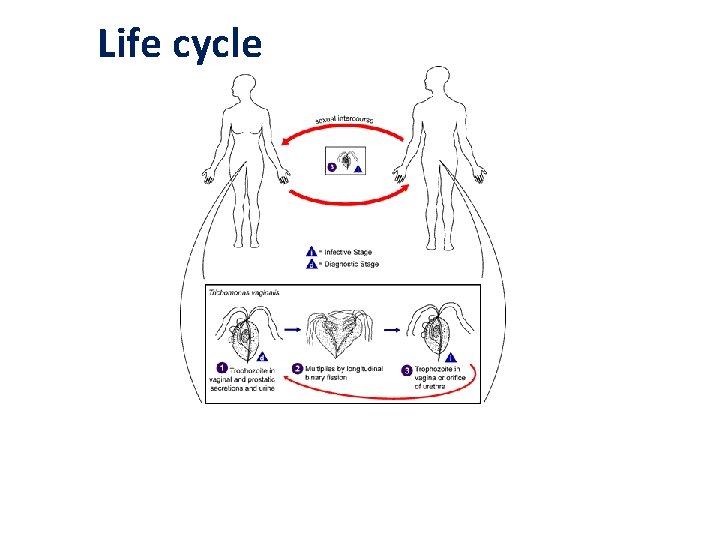
Life cycle

Trichomonas vaginalis Pathogenesis: →→ Trophozoite infect the squamous epith. Cells. →→ It is asymptomatic particularly in male. In females causing severe causing irritation& Inflammation of the vaginal mucosa(vaginitis) or inflammation uterine cervix(cervicitis). →→ ales causing inflammation of urethra and prostate (urithritis and prostatitis). Clinical symptoms : ority of infected males without symptoms and ⅓ of infected females without symptoms. →→ both in male and female genital discharge and pain in urination.

Diagnosis and treatment Diagnosis →→ By GUE or males and females UG swab and smear stain with Giemsa stain. Treatment. dazole(Flagyle) tablets for men and vaginal suppositories for females. 2 -Tinidazole alternative drug. it has a shorter ent course.
- Slides: 13