
Ludwig van Beethoven Symphony No 5 Primary classroom

Ludwig van Beethoven Symphony No 5 Primary classroom lesson plan Written by Rachel Leach
Lesson outcomes After this lesson, pupils will be able to: • listen and reflect on a piece of orchestral music • invent their own musical motifs and structure them into a piece • perform as an ensemble • learn musical language appropriate to the task Copyright : Words - Rachel Leach, Design - BBC 2
Curriculum checklist Learners will: • play and perform in ensemble contexts, using voices and playing musical instruments • improvise and compose music for a range of purposes using the interrelated dimensions of music • listen with attention to detail and recall sounds with increasing aural memory Copyright : Words - Rachel Leach, Design - BBC 3
Glossary of music terms Term Definition Coda another word for ‘ending’ Graphic Score a graphic or diagrammatic representation of music Movement a large section Pitched percussion instruments that can play different pitches – xylophones, glockenspiels, chime bars etc. Sonata An oft-used shape in music made up from three sections Symphony A large piece for orchestra often with four movements, the first of which is often a sonata Tune another word for ‘melody’. A linear line of notes that makes a satisfying musical shape Unpitched percussion instruments that can only make a limited number of sounds – drums, shakers woodblocks, tambourine etc. Copyright : Words - Rachel Leach, Design - BBC 4
Lesson 1 Watching and listening Copyright Rachel Leach & BBC

Background – the composer Ludwig van Beethoven (1770 1827) • German composer and pianist • Transformed music by adding an extra layer of drama and emotion to classical structures • Was deaf from the age of about 26 so didn't actually hear most of his greatest works LESSON 1 Copyright : Words - Rachel Leach, Design - BBC 6

Background – the music Symphony No 5, movement 1 § First performed in 1808 § A symphony is a large work for orchestra usually in 4 sections or movements § Has one of the most famous beginnings in all of orchestra music LESSON 1 Copyright : Words - Rachel Leach, Design - BBC 7
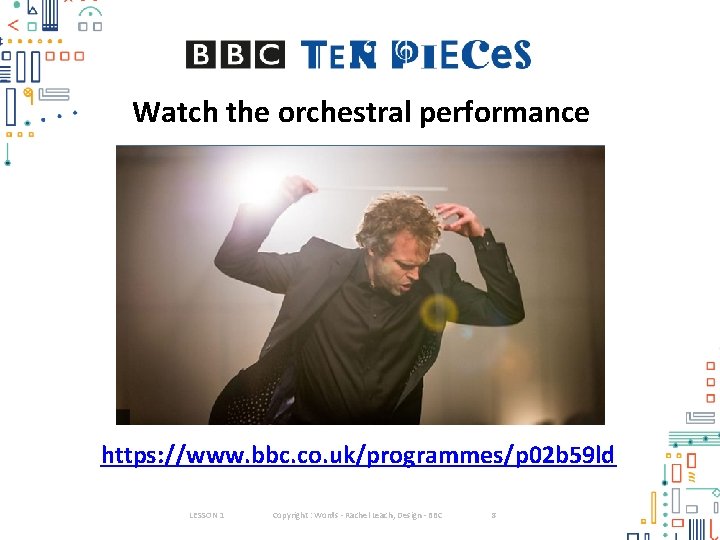
Watch the orchestral performance https: //www. bbc. co. uk/programmes/p 02 b 59 ld LESSON 1 Copyright : Words - Rachel Leach, Design - BBC 8
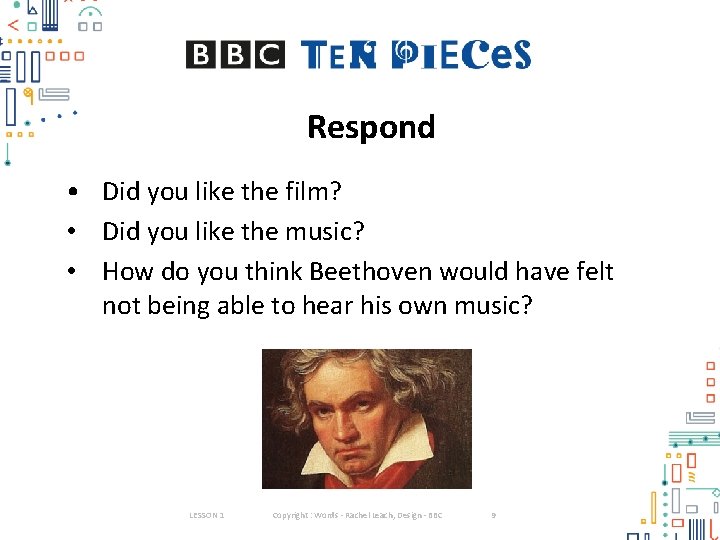
Respond • Did you like the film? • Did you like the music? • How do you think Beethoven would have felt not being able to hear his own music? LESSON 1 Copyright : Words - Rachel Leach, Design - BBC 9
Can you draw what you are hearing? LESSON 1 Copyright : Words - Rachel Leach, Design - BBC 10
Graphic score LESSON 1 Copyright : Words - Rachel Leach, Design - BBC 11
Lesson 2 Da, da, duh! Copyright Rachel Leach & BBC

Copy me! LESSON 2 Copyright : Words - Rachel Leach, Design - BBC 13
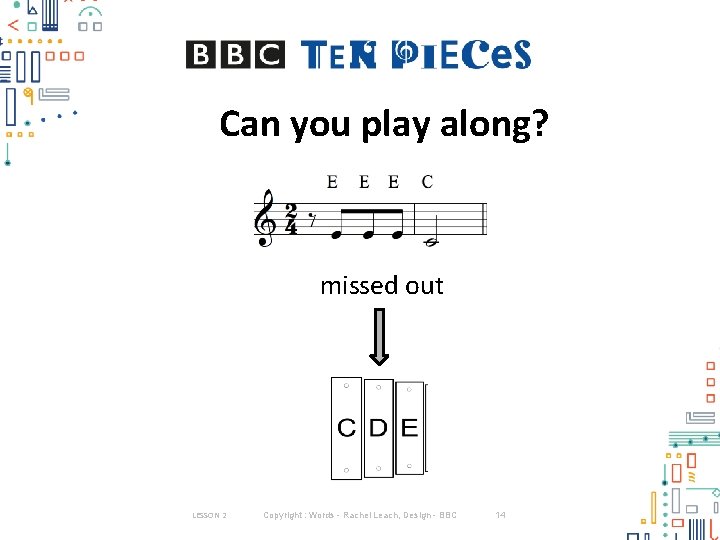
Can you play along? missed out LESSON 2 Copyright : Words - Rachel Leach, Design - BBC 14
Create your own piece LESSON 2 Copyright : Words - Rachel Leach, Design - BBC 15
Lesson 3 The contrasting, twisty tune Copyright Rachel Leach & BBC
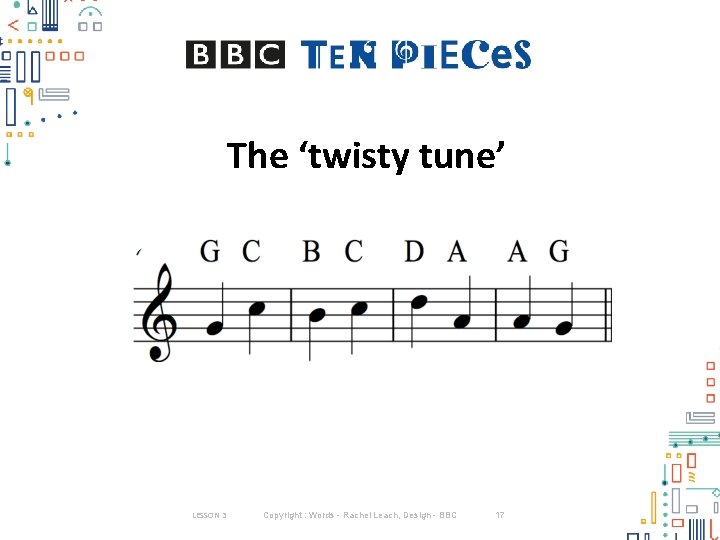
The ‘twisty tune’ LESSON 3 Copyright : Words - Rachel Leach, Design - BBC 17
Create your own piece LESSON 3 Copyright : Words - Rachel Leach, Design - BBC 18
Lesson 4 Combine & develop Copyright Rachel Leach & BBC
Sonata LESSON 4 Copyright : Words - Rachel Leach, Design - BBC 20
Exposition LESSON 4 Copyright : Words - Rachel Leach, Design - BBC 21
Create your own piece LESSON 4 Copyright : Words - Rachel Leach, Design - BBC 22
Development LESSON 4 Copyright : Words - Rachel Leach, Design - BBC 23
Lesson 5 Recap Copyright Rachel Leach & BBC
Recapitulation LESSON 4 Copyright : Words - Rachel Leach, Design - BBC 25
Can you alter the music? LESSON 5 Copyright : Words - Rachel Leach, Design - BBC 26
Practice your sonata! • EXPOSITION (jagged then smooth) • DEVELOPMENT (jagged and smooth combined) • RECAP (new jagged, then new smooth) LESSON 5 Copyright : Words - Rachel Leach, Design - BBC 27
Lesson 6 Coda Copyright Rachel Leach & BBC
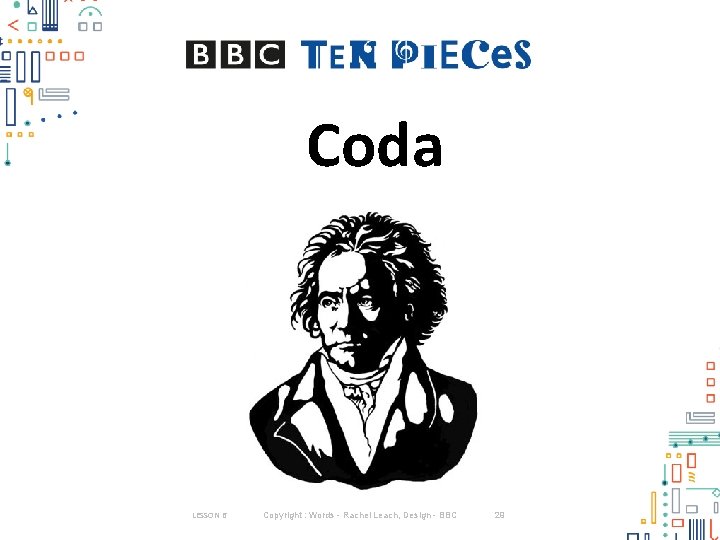
Coda LESSON 6 Copyright : Words - Rachel Leach, Design - BBC 29
The big ending! • One note to play over and over (or two that alternate before getting stuck on one) • One rhythm that is repeated several times • All the big, loud, splashy percussion instruments such as cymbals, gong, triangle, big drums • Clever dynamics (louds and softs). Is it more effective to be loud all the time or to vary the volume? LESSON 6 Copyright : Words - Rachel Leach, Design - BBC 30
Finish your sonata! • • EXPOSITION (jagged then smooth) DEVELOPMENT (jagged and smooth combined) RECAP (new jagged, then new smooth) CODA (big showing ending) LESSON 6 Copyright : Words - Rachel Leach, Design - BBC 31

Let’s perform LESSON 6 Copyright : Words - Rachel Leach, Design - BBC 32
Taking it further – cross-curricular activities LISTENING: Beethoven wrote nine wonderful symphonies. The 6 th (Pastoral) was one of the first symphonies to tell a story - it describes a day in countryside with a celebration and a storm. The 7 th is all about dance rhythms and the 9 th has a very famous tune in its last movement LITERACY: After Beethoven lost his hearing, he could only communicate through letters and a ‘conversation book’. In both he wrote about his life; his letters tend to talk about the big things – his ideas for symphonies, how his work is going – his conversation books are much more everyday – his shopping lists, instructions for his cleaner etc. Write your own versions of Beethoven’s letters or conversation books RESEARCH: Beethoven had an amazing life and was admired by many other composers. He lived at the same time as Mozart and Schubert, he was obsessed with Napoleon and he had several secret girlfriends. Copyright : Words - Rachel Leach, Design - BBC 33
- Slides: 33