
Lubna Sameer 1 Psychosis Delusion definition epidemiology etiology
Lubna Sameer 1
Psychosis Delusion : *definition *epidemiology *etiology *risk factors Types
Psychosis is a general term used to describe a distorted perception of reality. Poor reality testing may be accompanied by delusions, perceptual disturbances (illusions or hallucinations), and/or disorganized thinking/behavior. Psychosis can be a symptom of schizophrenia, mania, depression, delirium, and major neurocognitive disorder (i. e. , dementia), and it can be substance or medication-induced. Psychosis is exemplified by delusions, hallucinations, or severe disorganization of thought/behavior.
Delusions Definition Delusions are fixed, false beliefs that persist despite evidence to the contrary and that do not make sense within the context of an individual’s cultural background. They can be categorized as either bizarre or non bizarre. A non bizarre delusion is a false belief that is plausible but is not true. must be about situations that can occur in real life, such as being followed, infected, loved at a distance, and so on Example: “The neighbors are spying on me by reading my e-mail. ” A bizarre delusion is a false belief that is impossible. Example: “Aliens are spying on me through a Wi-Fi connection in my brain. ”
EPIDEMIOLOGY Prevalence — The lifetime morbid risk of delusional disorder in the general population has been estimated to range from 0. 05 to 0. 1 percent based on data from various sources including case registries, case series, and population based samples Attempts to quantify incidence estimates (0. 7 to 3. 0/100, 000) have been based on hospital admission data of uncertain accuracy Because a significant proportion of people with delusional disorder do not regard it as an illness or receive treatment, and measurement often relies, to some extent, on self-report, studies likely underestimate the prevalence of the disorder ETIOLOGY As with all major psychiatric disorders, the cause of delusional disorder is unknown. Risk factors family history of paranoid personality disorder and sensory impairment Studies have identified numerous sociodemographic and clinical factors that may be risk factors for delusional disorder, but require further research Comorbid conditions Small studies of patients with delusional disorder have found psychiatric comorbidity rates of 35 to 72 percent. . Depression has been the most commonly observed co-occurring condition, but anxiety can also be a significant factor. . As an example Patients with the persecutory subtype were most likely to have a mood disorder
Biological factors May play some role in the development of delusional disorder, as delusions are associated with a wide range of nonpsychiatric medical conditions. Among patients with neurologic disorders (primarily dementia, head injury, and seizures) problems with the basal ganglia and temporal lobe are most commonly associated with delusions. Hyperdopaminergic states have been implicated in the development of delusions. Delusional symptoms are preferentially associated with disorders involving the limbic system and basal ganglia. Head trauma has been associated with development of delusions.
TYPES : The subtypes are categorized by central themes of the delusions observed in patients meeting criteria for delusional disorder. Each subtype can be: primary (an idiopathic disorder that meets diagnostic criteria) or secondary (arising from specific causes, such as general medical illness). The delusional themes and common consequences are described below. In each case, the central belief should be thoroughly reviewed and found to be false 7
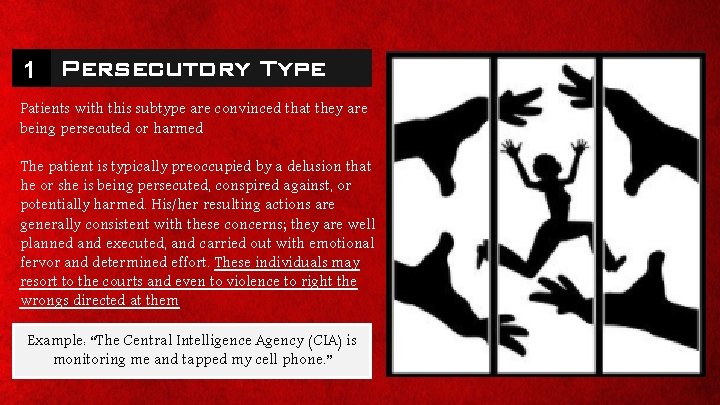
1 Persecutory Type Patients with this subtype are convinced that they are being persecuted or harmed The patient is typically preoccupied by a delusion that he or she is being persecuted, conspired against, or potentially harmed. His/her resulting actions are generally consistent with these concerns; they are well planned and executed, and carried out with emotional fervor and determined effort. These individuals may resort to the courts and even to violence to right the wrongs directed at them Example: “The Central Intelligence Agency (CIA) is monitoring me and tapped my cell phone. ”
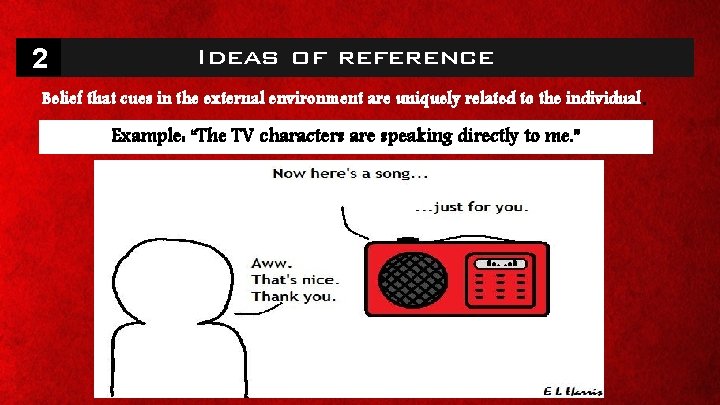
2 Ideas of reference Belief that cues in the external environment are uniquely related to the individual. Example: “The TV characters are speaking directly to me. ”
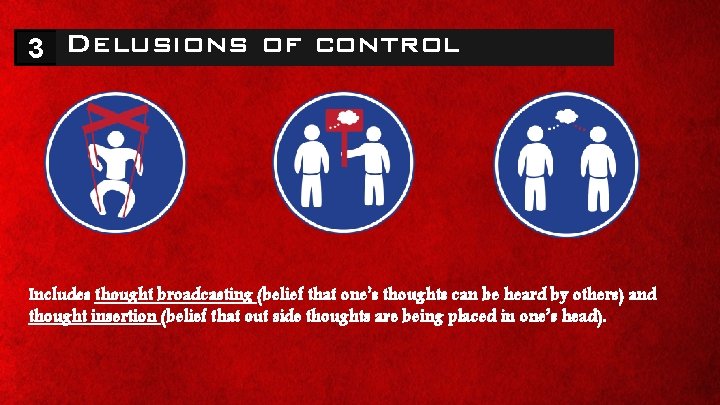
3 Delusions of control Includes thought broadcasting (belief that one’s thoughts can be heard by others) and thought insertion (belief that out side thoughts are being placed in one’s head).

4 Delusions of grandeur Belief that one has special powers beyond those of a normal person. The patient believes he/she has special prominence or talent, unusual fame, or major achievements. Features of the patient’s thinking may suggest the grandiosity associated with mania, but in the delusional disorder, the mood disturbance and behaviors characteristic of mania are not present. Example: “I am the all-powerful son of God and I shall bring down my wrath on you if I don’t get my way. ”

5 Delusions of guilt Belief that one is guilty or responsible for something. Example: “I am responsible for all the world’s wars. ”
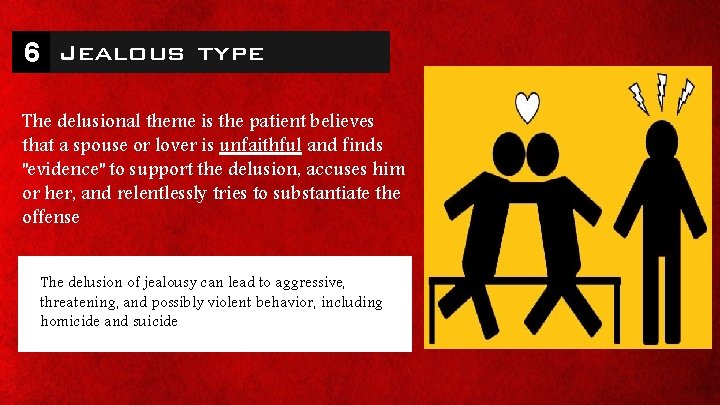
6 Jealous type The delusional theme is the patient believes that a spouse or lover is unfaithful and finds "evidence" to support the delusion, accuses him or her, and relentlessly tries to substantiate the offense. The delusion of jealousy can lead to aggressive, threatening, and possibly violent behavior, including homicide and suicide
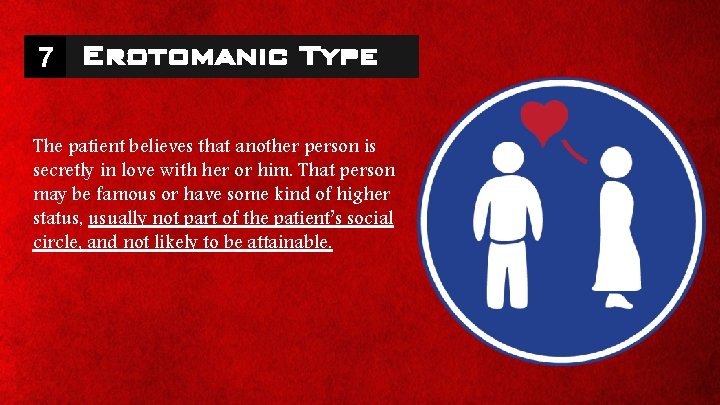
7 Erotomanic Type The patient believes that another person is secretly in love with her or him. That person may be famous or have some kind of higher status, usually not part of the patient’s social circle, and not likely to be attainable.
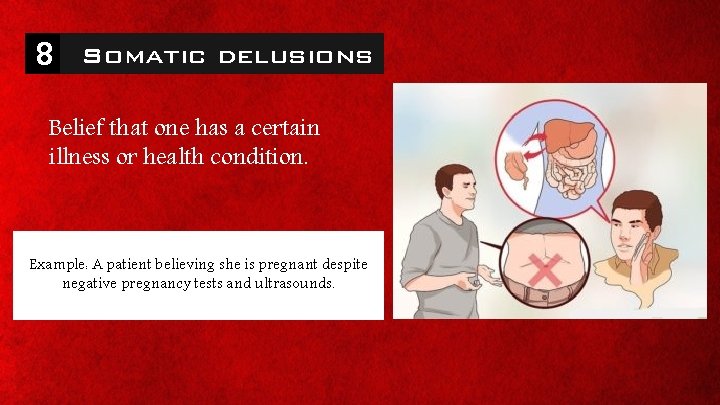
8 Somatic delusions Belief that one has a certain illness or health condition. Example: A patient believing she is pregnant despite negative pregnancy tests and ultrasounds.
9 Mixed type No one delusional theme predominates 10 Unspecified type The dominant delusional belief cannot be clearly determined or is not described by the subtypes above.
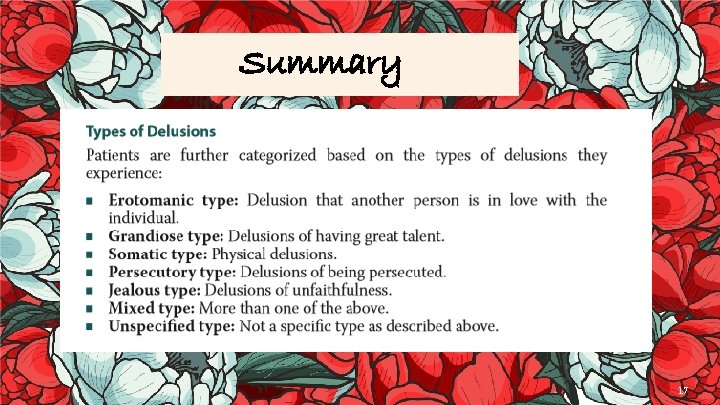
Summary 17

Thank you
- Slides: 18