
Lub and glb Given a poset S and
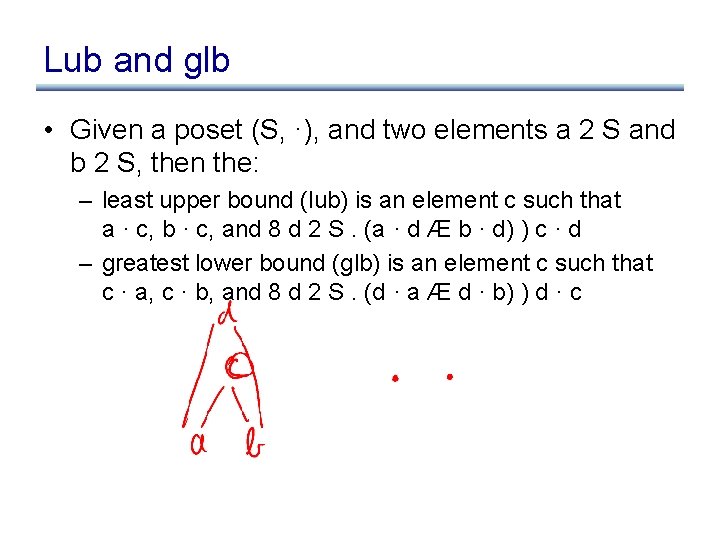
Lub and glb • Given a poset (S, ·), and two elements a 2 S and b 2 S, then the: – least upper bound (lub) is an element c such that a · c, b · c, and 8 d 2 S. (a · d Æ b · d) ) c · d – greatest lower bound (glb) is an element c such that c · a, c · b, and 8 d 2 S. (d · a Æ d · b) ) d · c
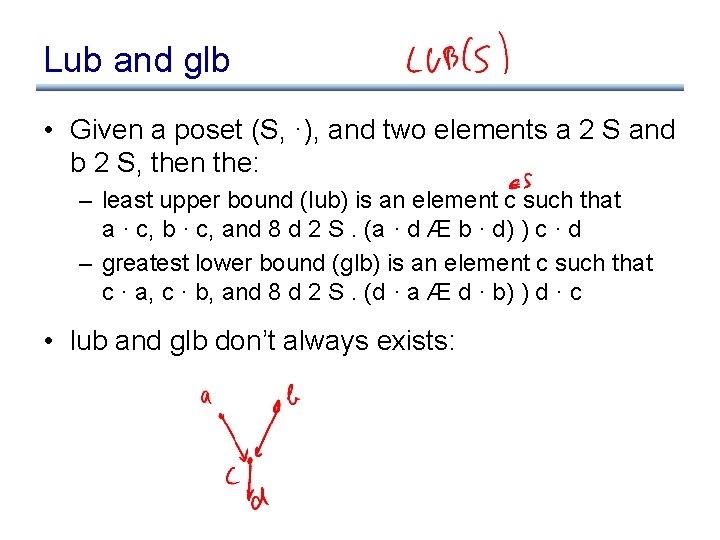
Lub and glb • Given a poset (S, ·), and two elements a 2 S and b 2 S, then the: – least upper bound (lub) is an element c such that a · c, b · c, and 8 d 2 S. (a · d Æ b · d) ) c · d – greatest lower bound (glb) is an element c such that c · a, c · b, and 8 d 2 S. (d · a Æ d · b) ) d · c • lub and glb don’t always exists:
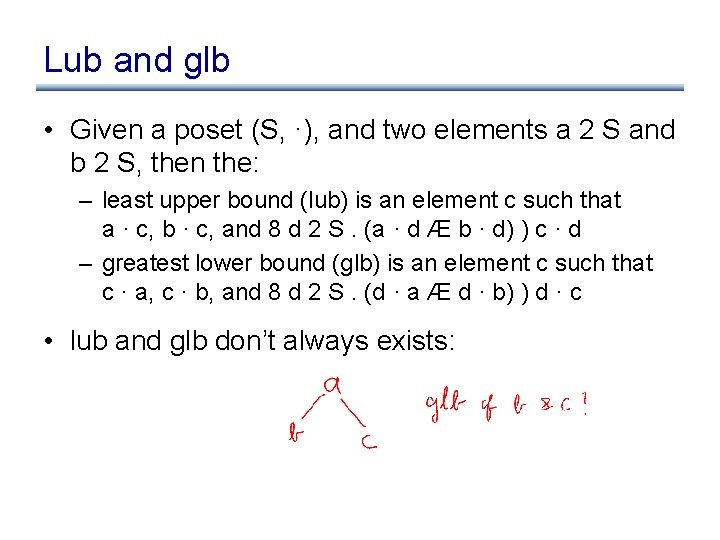
Lub and glb • Given a poset (S, ·), and two elements a 2 S and b 2 S, then the: – least upper bound (lub) is an element c such that a · c, b · c, and 8 d 2 S. (a · d Æ b · d) ) c · d – greatest lower bound (glb) is an element c such that c · a, c · b, and 8 d 2 S. (d · a Æ d · b) ) d · c • lub and glb don’t always exists:
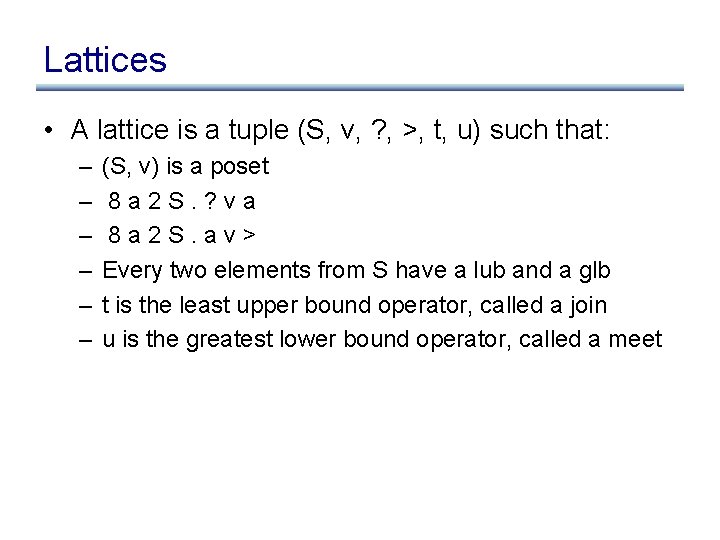
Lattices • A lattice is a tuple (S, v, ? , >, t, u) such that: – – – (S, v) is a poset 8 a 2 S. ? va 8 a 2 S. av> Every two elements from S have a lub and a glb t is the least upper bound operator, called a join u is the greatest lower bound operator, called a meet
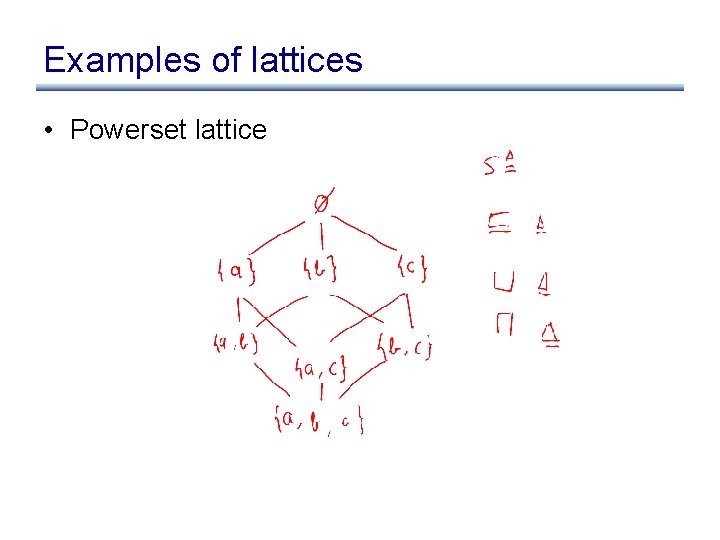
Examples of lattices • Powerset lattice
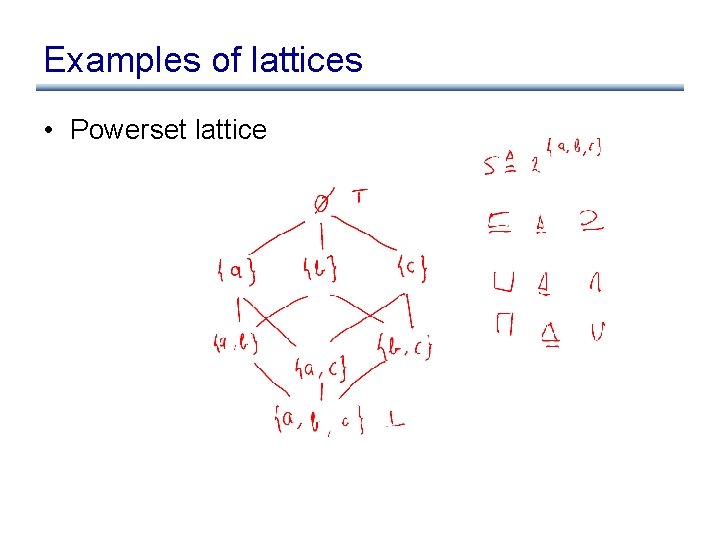
Examples of lattices • Powerset lattice
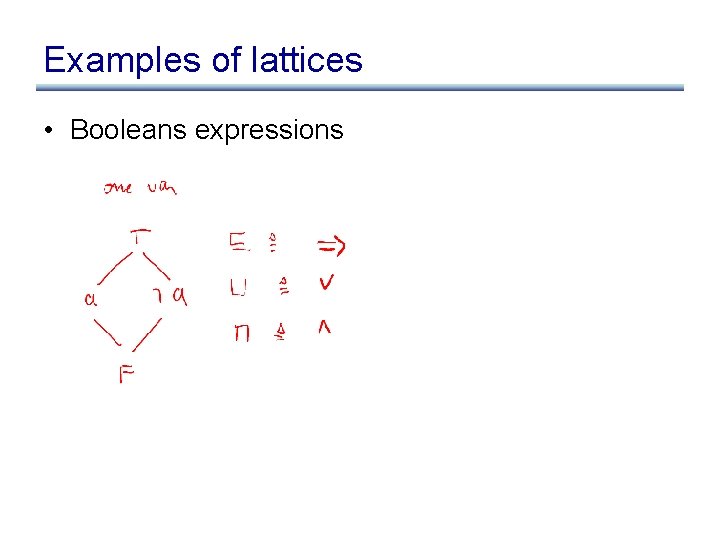
Examples of lattices • Booleans expressions
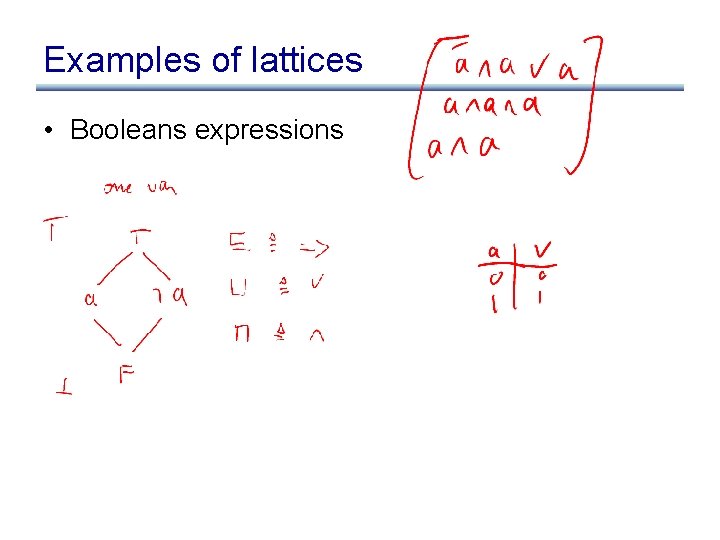
Examples of lattices • Booleans expressions
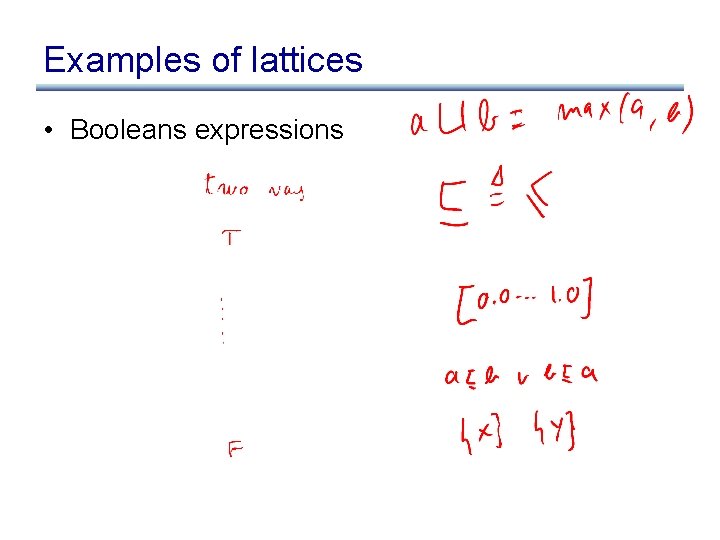
Examples of lattices • Booleans expressions
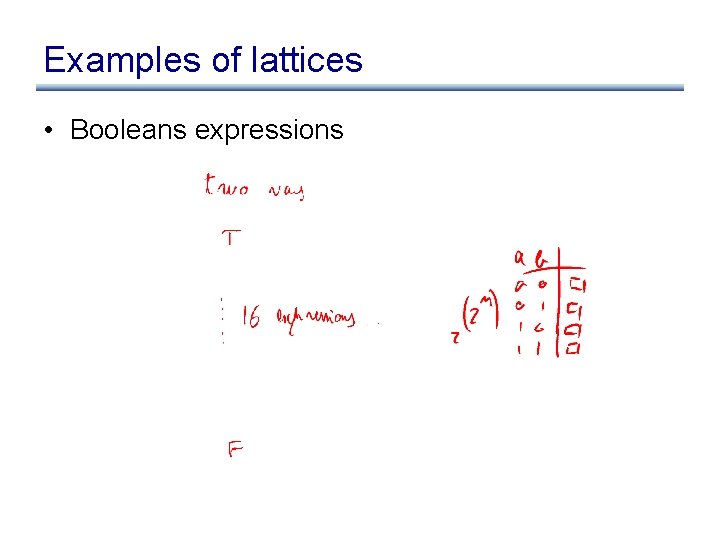
Examples of lattices • Booleans expressions

End of background material
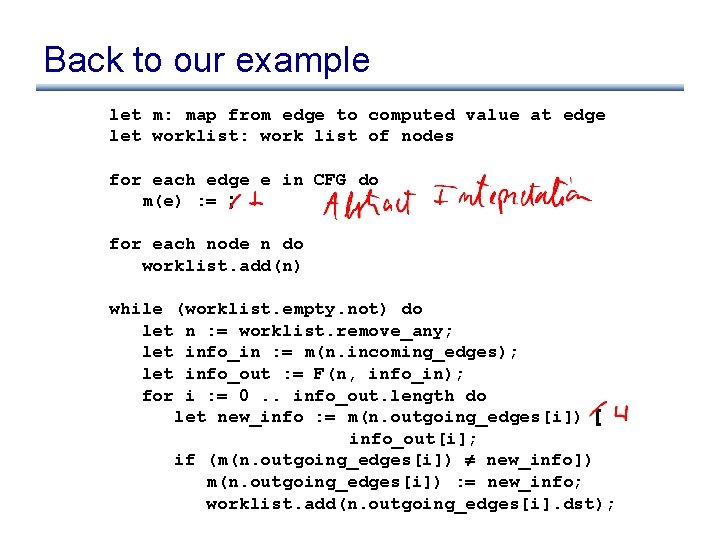
Back to our example let m: map from edge to computed value at edge let worklist: work list of nodes for each edge e in CFG do m(e) : = ; for each node n do worklist. add(n) while (worklist. empty. not) do let n : = worklist. remove_any; let info_in : = m(n. incoming_edges); let info_out : = F(n, info_in); for i : = 0. . info_out. length do let new_info : = m(n. outgoing_edges[i]) [ info_out[i]; if (m(n. outgoing_edges[i]) new_info]) m(n. outgoing_edges[i]) : = new_info; worklist. add(n. outgoing_edges[i]. dst);
Back to our example • We formalize our domain with a powerset lattice • What should be top and what should be bottom?
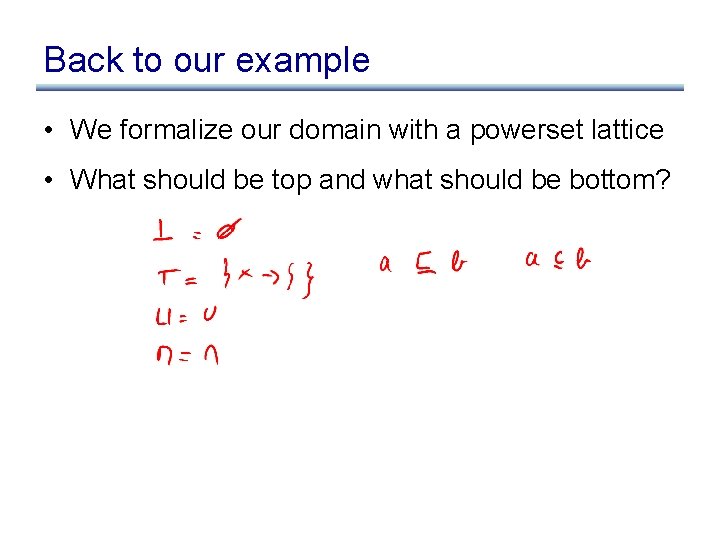
Back to our example • We formalize our domain with a powerset lattice • What should be top and what should be bottom?
Back to our example • We formalize our domain with a powerset lattice • What should be top and what should be bottom? • Does it matter? – It matters because, as we’ve seen, there is a notion of approximation, and this notion shows up in the lattice
Direction of lattice • Unfortunately: – dataflow analysis community has picked one direction – abstract interpretation community has picked the other • We will work with the abstract interpretation direction • Bottom is the most precise (optimistic) answer, Top the most imprecise (conservative)
Direction of lattice • Always safe to go up in the lattice • Can always set the result to > • Hard to go down in the lattice • So. . . Bottom will be the empty set in reaching defs
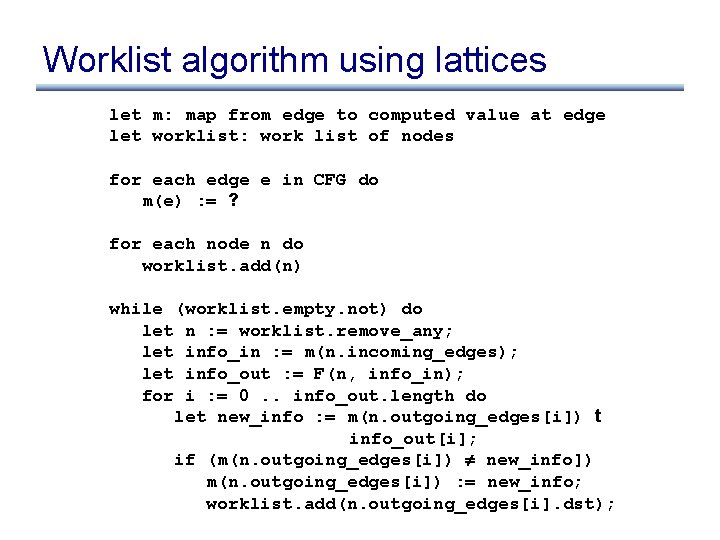
Worklist algorithm using lattices let m: map from edge to computed value at edge let worklist: work list of nodes for each edge e in CFG do m(e) : = ? for each node n do worklist. add(n) while (worklist. empty. not) do let n : = worklist. remove_any; let info_in : = m(n. incoming_edges); let info_out : = F(n, info_in); for i : = 0. . info_out. length do let new_info : = m(n. outgoing_edges[i]) t info_out[i]; if (m(n. outgoing_edges[i]) new_info]) m(n. outgoing_edges[i]) : = new_info; worklist. add(n. outgoing_edges[i]. dst);
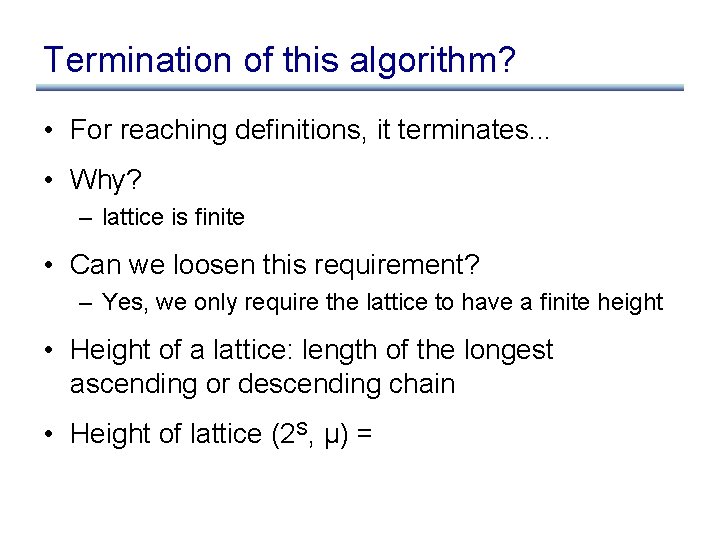
Termination of this algorithm? • For reaching definitions, it terminates. . . • Why? – lattice is finite • Can we loosen this requirement? – Yes, we only require the lattice to have a finite height • Height of a lattice: length of the longest ascending or descending chain • Height of lattice (2 S, µ) =
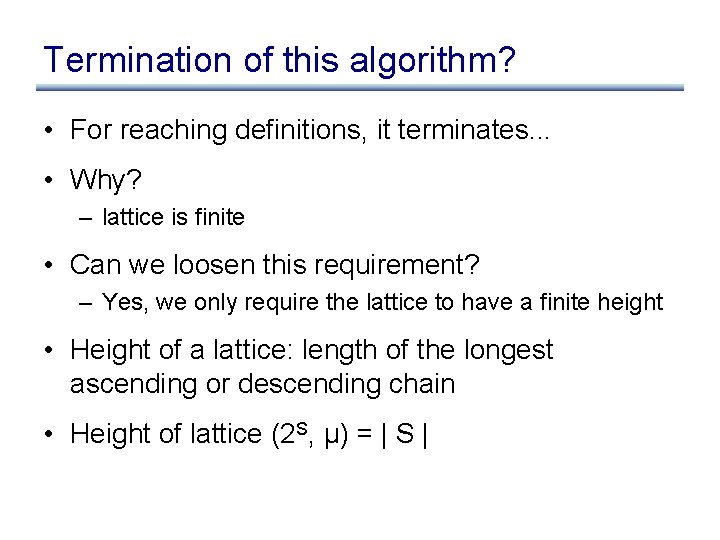
Termination of this algorithm? • For reaching definitions, it terminates. . . • Why? – lattice is finite • Can we loosen this requirement? – Yes, we only require the lattice to have a finite height • Height of a lattice: length of the longest ascending or descending chain • Height of lattice (2 S, µ) = | S |
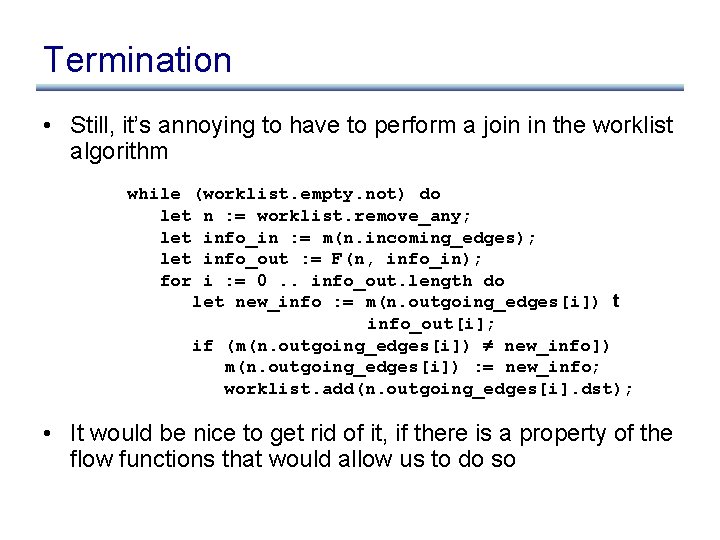
Termination • Still, it’s annoying to have to perform a join in the worklist algorithm while (worklist. empty. not) do let n : = worklist. remove_any; let info_in : = m(n. incoming_edges); let info_out : = F(n, info_in); for i : = 0. . info_out. length do let new_info : = m(n. outgoing_edges[i]) t info_out[i]; if (m(n. outgoing_edges[i]) new_info]) m(n. outgoing_edges[i]) : = new_info; worklist. add(n. outgoing_edges[i]. dst); • It would be nice to get rid of it, if there is a property of the flow functions that would allow us to do so
Even more formal • To reason more formally about termination and precision, we re-express our worklist algorithm mathematically • We will use fixed points to formalize our algorithm
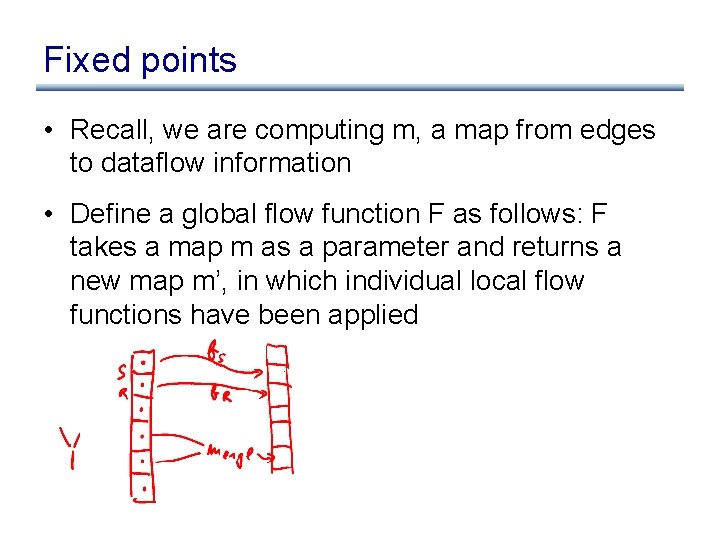
Fixed points • Recall, we are computing m, a map from edges to dataflow information • Define a global flow function F as follows: F takes a map m as a parameter and returns a new map m’, in which individual local flow functions have been applied
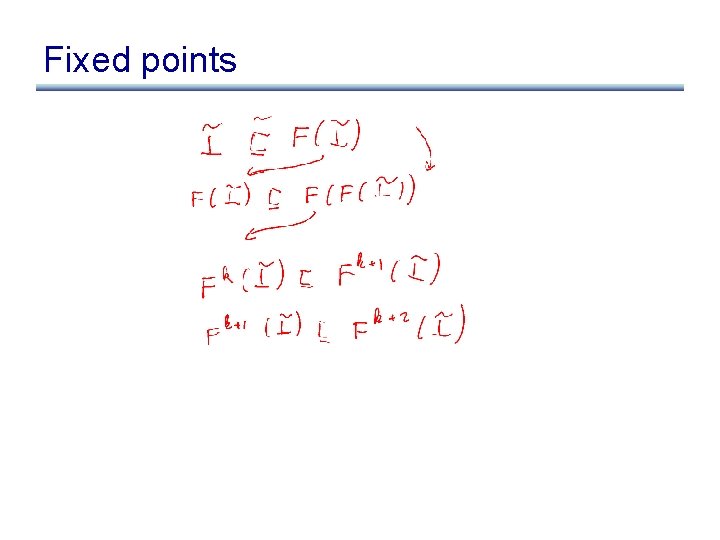
Fixed points • We want to find a fixed point of F, that is to say a map m such that m = F(m) • Approach to doing this? • Define ? , which is ? lifted to be a map: ? = e. ? • Compute F(? ), then F(F(? )), then F(F(F(? ))), . . . until the result doesn’t change anymore
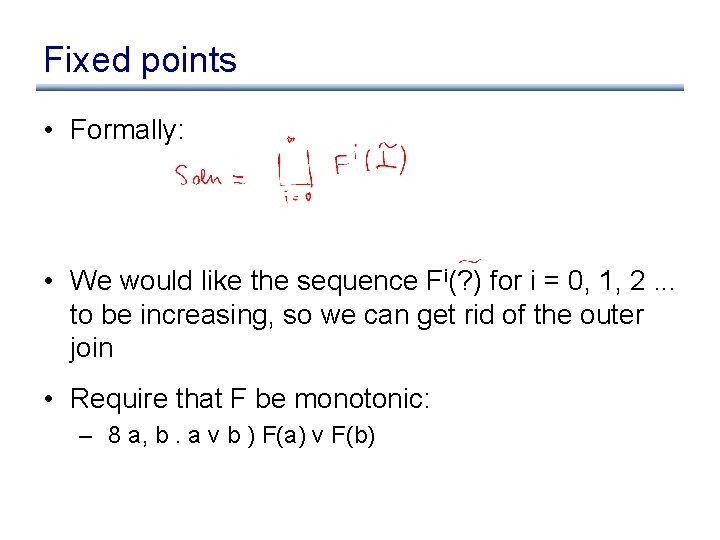
Fixed points • Formally: • We would like the sequence Fi(? ) for i = 0, 1, 2. . . to be increasing, so we can get rid of the outer join • Require that F be monotonic: – 8 a, b. a v b ) F(a) v F(b)
Fixed points
Fixed points
Back to termination • So if F is monotonic, we have what we want: finite height ) termination, without the outer join • Also, if the local flow functions are monotonic, then global flow function F is monotonic
- Slides: 28