
LU Factorization Berlin Chen Department of Computer Science
LU Factorization Berlin Chen Department of Computer Science & Information Engineering National Taiwan Normal University Reference: 1. Applied Numerical Methods with MATLAB for Engineers, Chapter 10 & Teaching material

Chapter Objectives (1/2) • Understanding that LU factorization involves decomposing the coefficient matrix into two triangular matrices that can then be used to efficiently evaluate different right-hand-side vector • Knowing how to express Gauss elimination as an LU factorization • Given an LU factorization, knowing how to evaluate multiple right-hand-side vectors NM – Berlin Chen 2
Chapter Objectives (2/2) • Recognizing that Cholesky’s method provides an efficient way to decompose a symmetric matrix and that the resulting triangular matrix and its transpose can be used to evaluate right-hand-side vectors efficiently • Understanding in general terms what happens when MATLAB’s backslash operator is used to solve linear systems NM – Berlin Chen 3

LU Factorization (1/2) • Recall that the forward-elimination step of Gauss elimination comprises the bulk of the computational effort • LU factorization methods separate the time-consuming elimination of the matrix [A] from the manipulations of the right-hand-side [b] • Once [A] has been factored (or decomposed), multiple right-hand-side vectors can be evaluated in an efficient manner NM – Berlin Chen 4
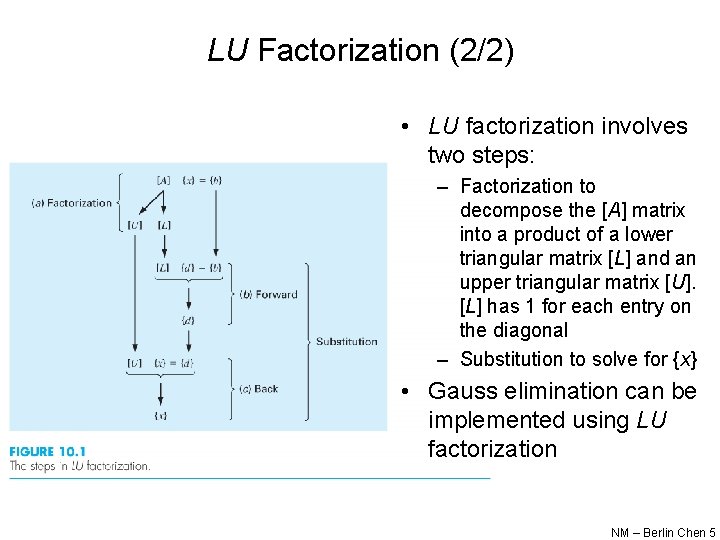
LU Factorization (2/2) • LU factorization involves two steps: – Factorization to decompose the [A] matrix into a product of a lower triangular matrix [L] and an upper triangular matrix [U]. [L] has 1 for each entry on the diagonal – Substitution to solve for {x} • Gauss elimination can be implemented using LU factorization NM – Berlin Chen 5
![Gauss Elimination as LU Factorization (1/5) • [A]{x}={b} can be rewritten as [L][U]{x}={b} using](http://slidetodoc.com/presentation_image_h2/a94f0a375d1bea07144b0a906efbf80c/image-6.jpg "Gauss Elimination as LU Factorization (1/5) • [A]{x}={b} can be rewritten as [L][U]{x}={b} using")
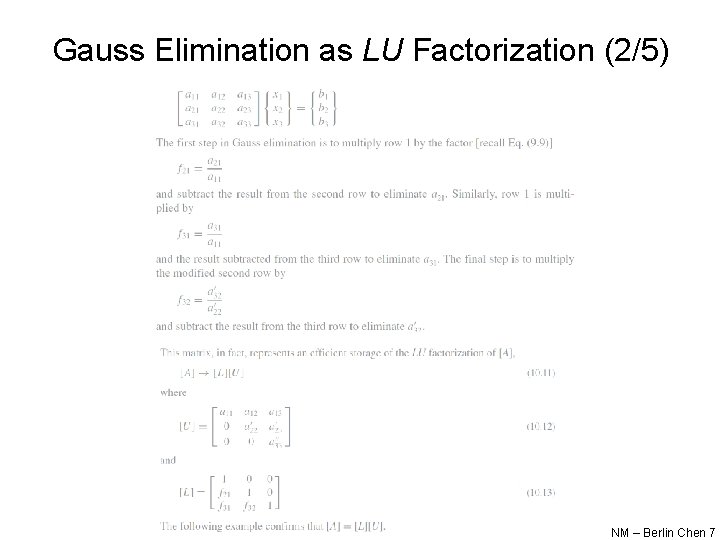
Gauss Elimination as LU Factorization (1/5) • [A]{x}={b} can be rewritten as [L][U]{x}={b} using LU factorization • The LU factorization algorithm requires the same total flops as for Gauss elimination • The main advantage is once [A] is decomposed, the same [L] and [U] can be used for multiple {b} vectors • MATLAB’s lu function can be used to generate the [L] and [U] matrices: [L, U] = lu(A) NM – Berlin Chen 6
Gauss Elimination as LU Factorization (2/5) NM – Berlin Chen 7
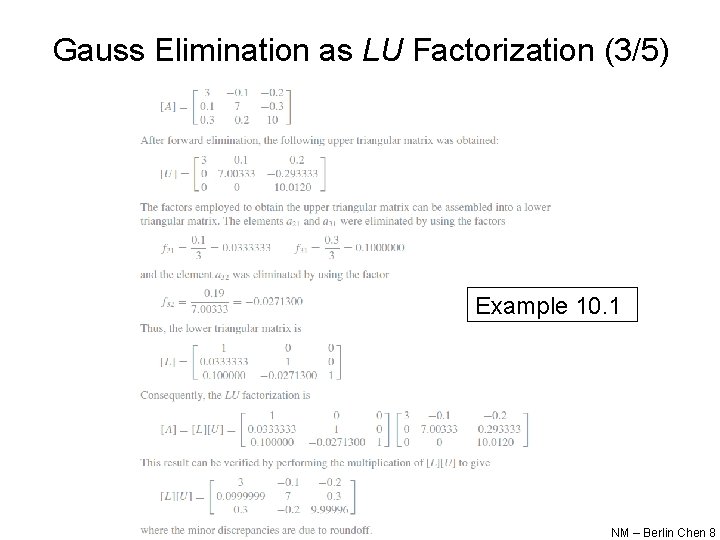
Gauss Elimination as LU Factorization (3/5) Example 10. 1 NM – Berlin Chen 8
![Gauss Elimination as LU Factorization (4/5) • To solve [A]{x}={b}, first decompose [A] to](http://slidetodoc.com/presentation_image_h2/a94f0a375d1bea07144b0a906efbf80c/image-9.jpg "Gauss Elimination as LU Factorization (4/5) • To solve [A]{x}={b}, first decompose [A] to")
Gauss Elimination as LU Factorization (4/5) • To solve [A]{x}={b}, first decompose [A] to get [L][U]{x}={b} • Set up and solve [L]{d}={b}, where {d} can be found using forward substitution • Set up and solve [U]{x}={d}, where {x} can be found using backward substitution • In MATLAB: [L, U] = lu(A) d = Lb x = Ud NM – Berlin Chen 9
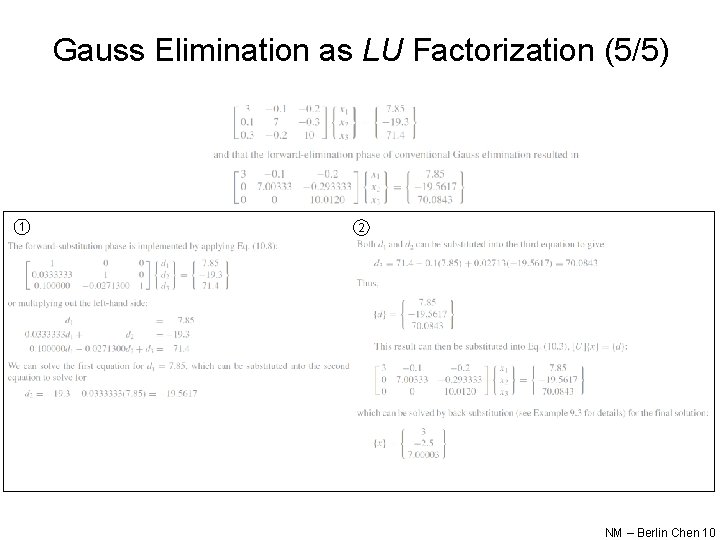
Gauss Elimination as LU Factorization (5/5) 1 2 NM – Berlin Chen 10
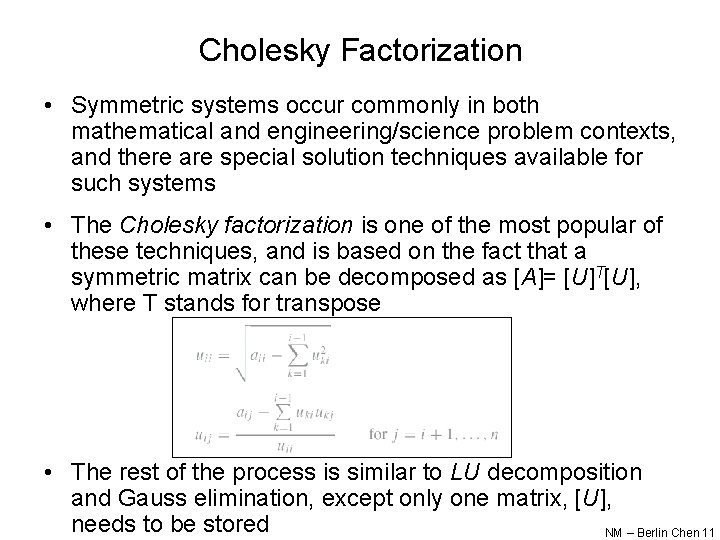
Cholesky Factorization • Symmetric systems occur commonly in both mathematical and engineering/science problem contexts, and there are special solution techniques available for such systems • The Cholesky factorization is one of the most popular of these techniques, and is based on the fact that a symmetric matrix can be decomposed as [A]= [U]T[U], where T stands for transpose • The rest of the process is similar to LU decomposition and Gauss elimination, except only one matrix, [U], needs to be stored NM – Berlin Chen 11
- Slides: 11