
LTL to Bchi Automata 15 820 A LTL
LTL to Büchi Automata 15 -820 A LTL to Büchi Automata Flavio Lerda 1
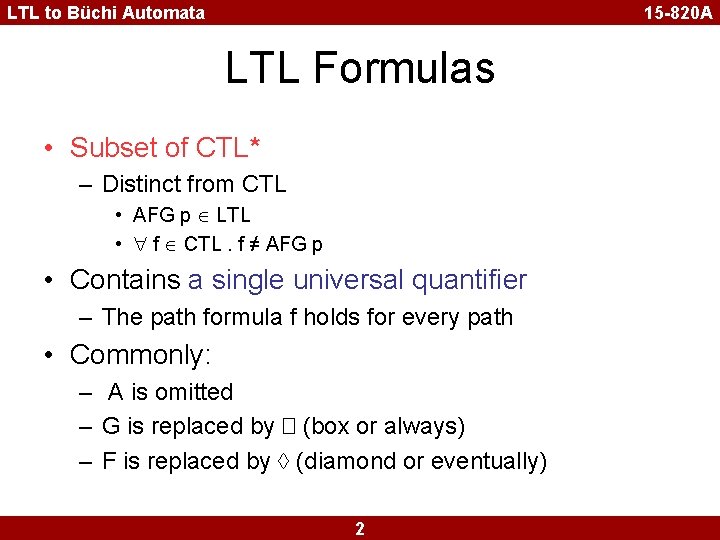
LTL to Büchi Automata 15 -820 A LTL Formulas • Subset of CTL* – Distinct from CTL • AFG p LTL • f CTL. f ≠ AFG p • Contains a single universal quantifier – The path formula f holds for every path • Commonly: – A is omitted – G is replaced by � (box or always) – F is replaced by (diamond or eventually) 2
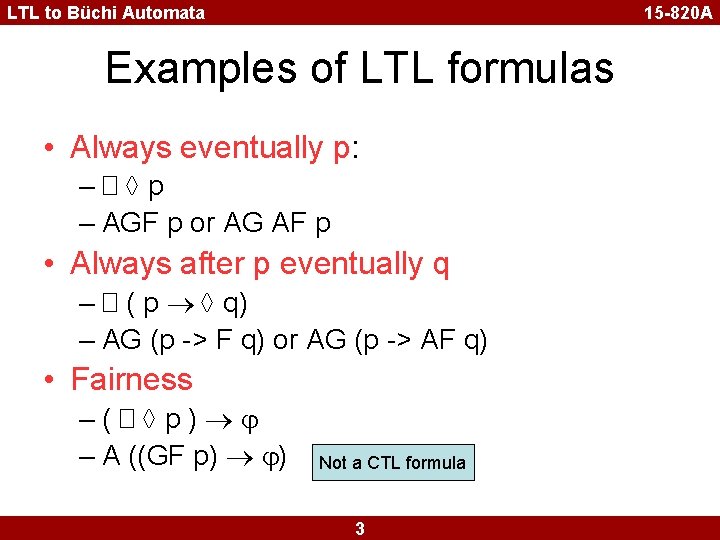
LTL to Büchi Automata 15 -820 A Examples of LTL formulas • Always eventually p: –� p – AGF p or AG AF p • Always after p eventually q – � ( p q) – AG (p -> F q) or AG (p -> AF q) • Fairness –(� p) – A ((GF p) ) Not a CTL formula 3
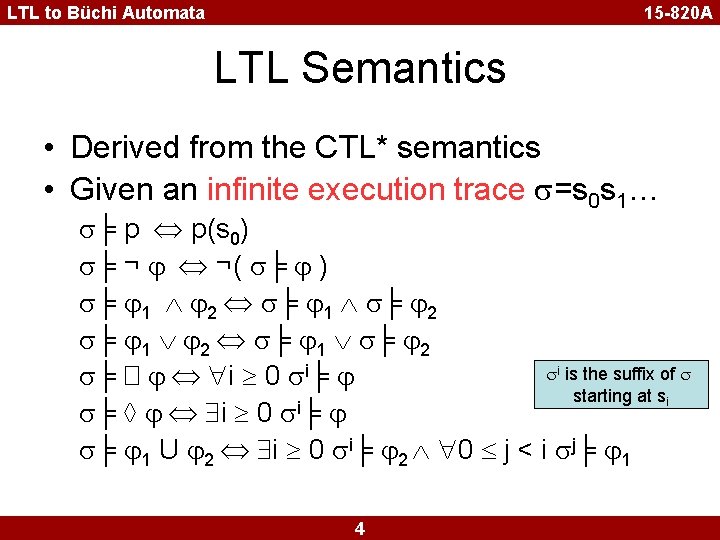
LTL to Büchi Automata 15 -820 A LTL Semantics • Derived from the CTL* semantics • Given an infinite execution trace =s 0 s 1… ╞ p p(s 0) ╞ ¬ ¬( ╞ ) ╞ 1 2 ╞ 1 ╞ 2 ╞ 1 2 ╞ 1 ╞ 2 i is the suffix of ╞ � i 0 i╞ starting at si i ╞ i 0 ╞ ╞ 1 U 2 i 0 i╞ 2 0 j < i j╞ 1 4
LTL to Büchi Automata 15 -820 A Büchi Automata • Automaton which accepts infinite traces • A Büchi automaton is 4 -tuple S, I, , F – S is a finite set of states – I S is a set of initial states – S S is a transition relation – F S is a set of accepting states • An infinite sequence of states is accepted iff it contains accepting states infinitely often 5
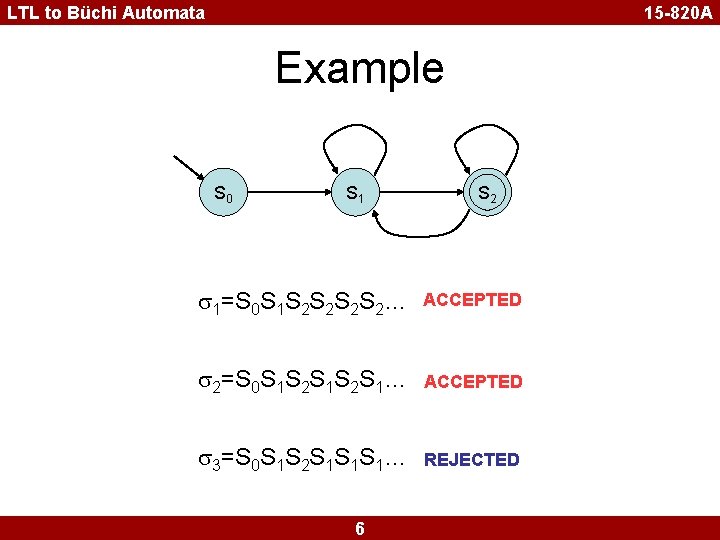
LTL to Büchi Automata 15 -820 A Example S 0 S 1 S 2 1=S 0 S 1 S 2 S 2… ACCEPTED 2=S 0 S 1 S 2 S 1… ACCEPTED 3=S 0 S 1 S 2 S 1 S 1 S 1… REJECTED 6
LTL to Büchi Automata 15 -820 A LTL and Büchi Automata • LTL formula – Represents a set of infinite traces which satisfy such formula • Büchi Automaton – Accepts a set of infinite traces • We can build an automaton which accepts all and only the infinite traces represented by an LTL formula 7
LTL to Büchi Automata 15 -820 A Labeled Büchi Automata • Given a set of atomic proposition P – Define a labeling function : S 2 P – Each state is assigned a set of propositions that must be true • Similar to the labeling for the model M 8
LTL to Büchi Automata 15 -820 A Generating Büchi Automata • We need a procedure to generate a Büchi automaton given an LTL formula – Efficiently • Formulas are usually small • Büchi automaton exponential in the size of the formula • The cost of model checking is proportional to the size of the automaton – Non-deterministic Büchi automata are not equivalent to deterministic Büchi automata • Cannot use automata minimization algorithms – Finding the minimal automata is exponential 9
LTL to Büchi Automata 15 -820 A Approach • Formula rewriting – Rewrite the formula in negated normal form – Apply rewriting rules • Core translation – Turns an LTL formula into a generalized Büchi automaton • Degeneralization – Turns a generalized Büchi automaton into a Büchi automaton 10
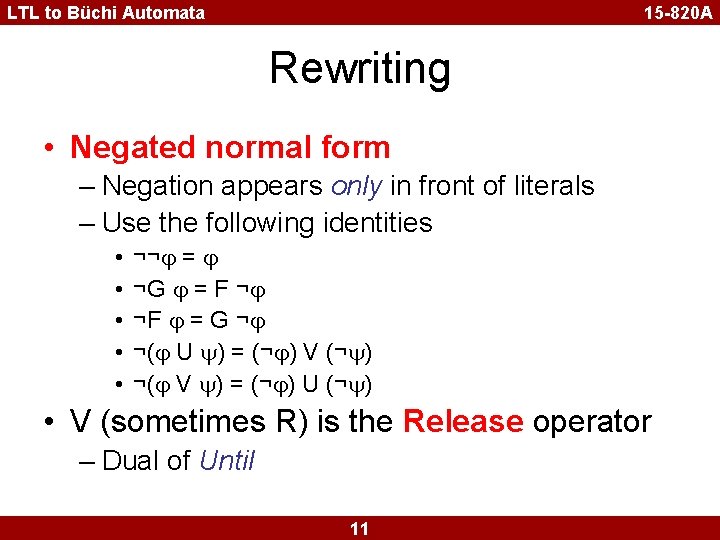
LTL to Büchi Automata 15 -820 A Rewriting • Negated normal form – Negation appears only in front of literals – Use the following identities • • • ¬¬ = ¬G = F ¬ ¬F = G ¬ ¬( U ) = (¬ ) V (¬ ) ¬( V ) = (¬ ) U (¬ ) • V (sometimes R) is the Release operator – Dual of Until 11
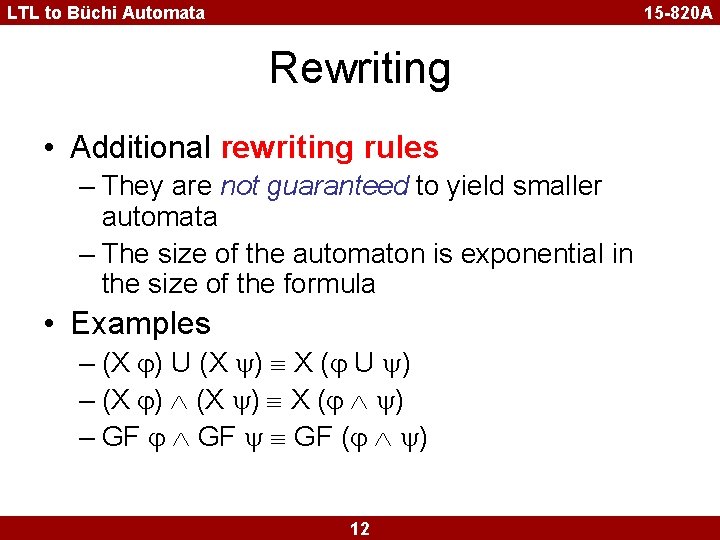
LTL to Büchi Automata 15 -820 A Rewriting • Additional rewriting rules – They are not guaranteed to yield smaller automata – The size of the automaton is exponential in the size of the formula • Examples – (X ) U (X ) X ( U ) – (X ) X ( ) – GF GF GF ( ) 12
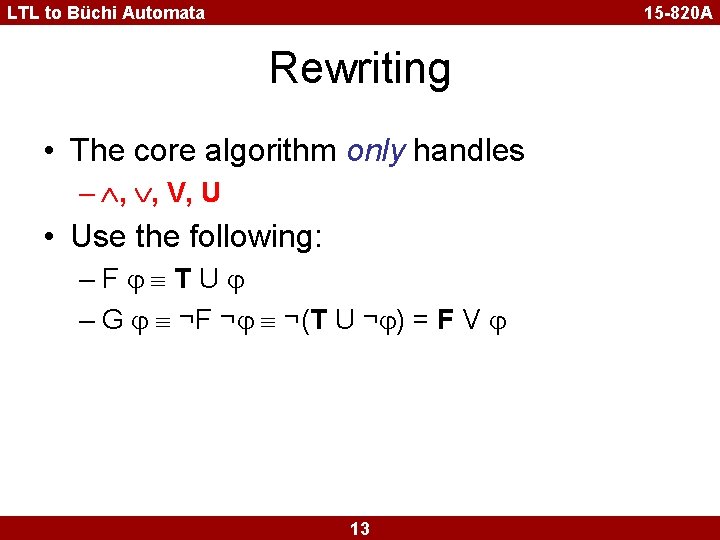
LTL to Büchi Automata 15 -820 A Rewriting • The core algorithm only handles – , , V, U • Use the following: –F TU – G ¬F ¬ ¬(T U ¬ ) = F V 13
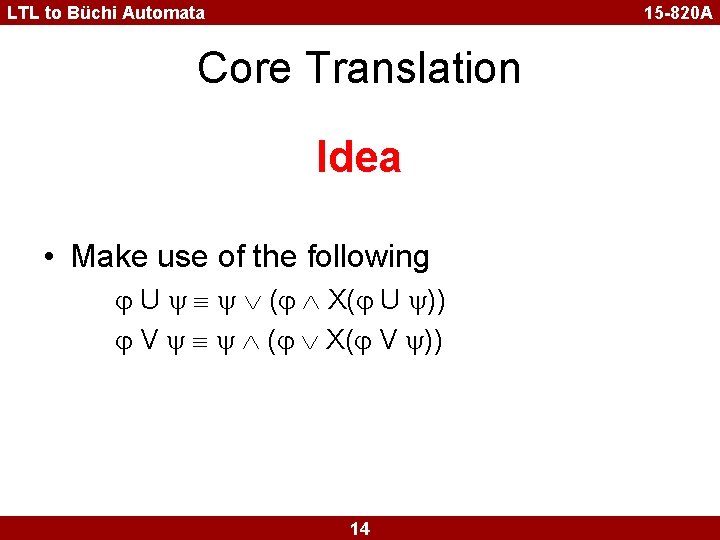
LTL to Büchi Automata 15 -820 A Core Translation Idea • Make use of the following U ( X( U )) V ( X( V )) 14
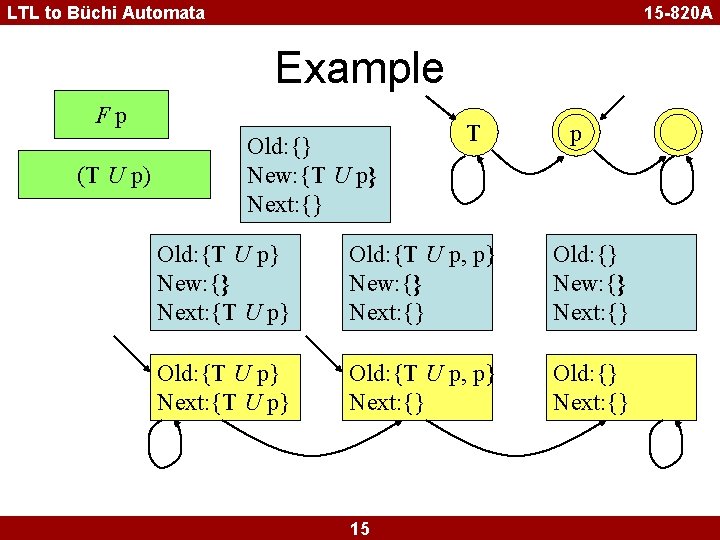
LTL to Büchi Automata 15 -820 A Example Fp (T U p) Old: {} New: {T U p} Next: {} T p Old: {T U p} New: {T} New: {} Next: {T U p} Old: {T U p, p}p} New: {} Next: {} Old: {} New: {} Next: {} Old: {T U p} Next: {T U p} Old: {T U p, p} Next: {} Old: {} Next: {} 15
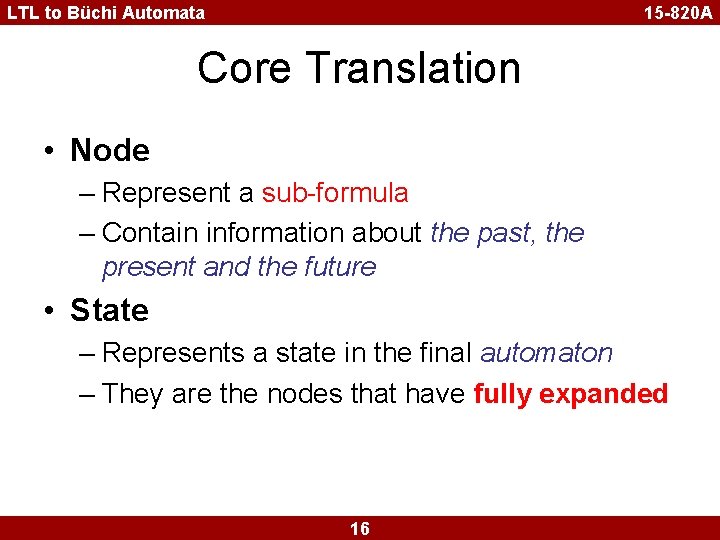
LTL to Büchi Automata 15 -820 A Core Translation • Node – Represent a sub-formula – Contain information about the past, the present and the future • State – Represents a state in the final automaton – They are the nodes that have fully expanded 16
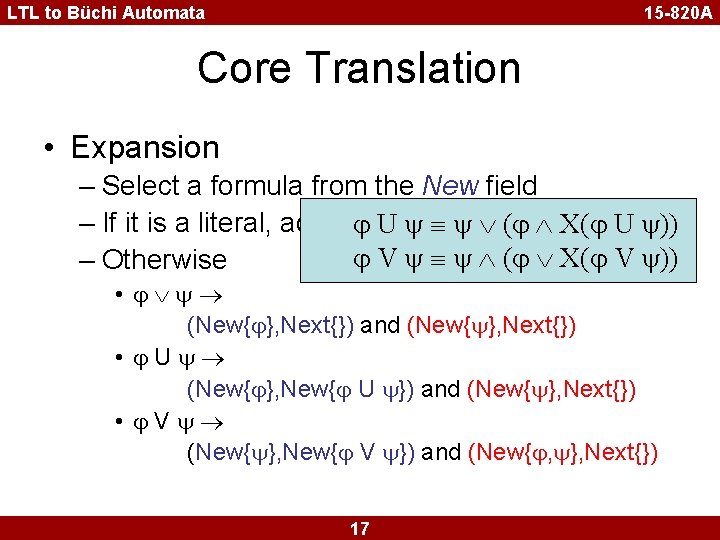
LTL to Büchi Automata 15 -820 A Core Translation • Expansion – Select a formula from the New field – If it is a literal, add it to. Uthe Old field ( X( U )) V ( X( V )) – Otherwise • (New{ }, Next{}) and (New{ }, Next{}) • U (New{ }, New{ U }) and (New{ }, Next{}) • V (New{ }, New{ V }) and (New{ , }, Next{}) 17
LTL to Büchi Automata 15 -820 A Core Translation • Nodes to states – If a node has no New formulas – Create a new node with all the Next formulas – Create an edge between the two nodes – Check if there is any equivalent state • With the same Next field • With the same Old field 18
LTL to Büchi Automata 15 -820 A Core Translation • Accepting states – Generalized Büchi automaton • Multiple accepting sets – One for each Until sub-formula ( U ) – Such that • The Old field doesn’t contain U or • The Old field does contain 19
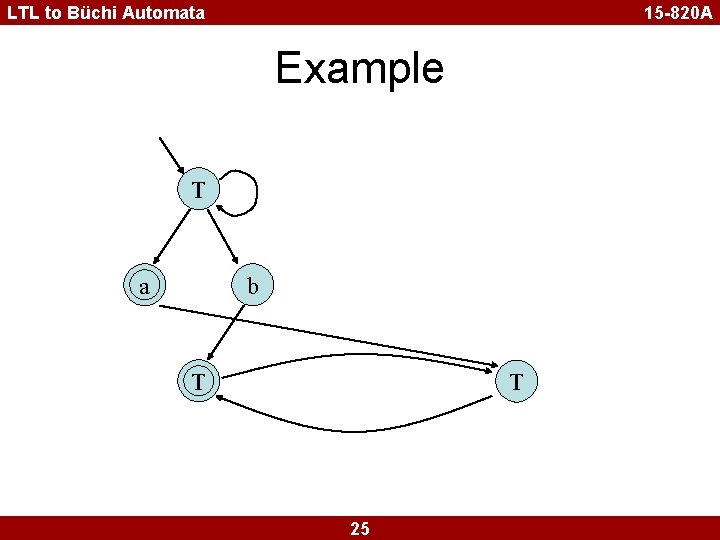
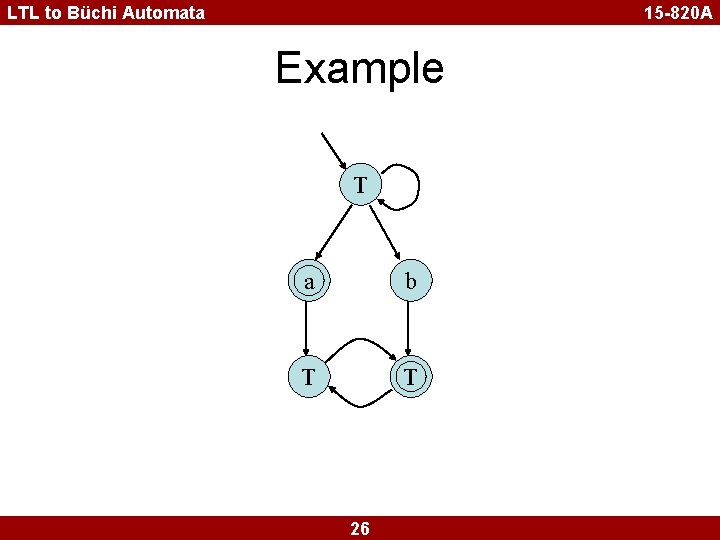
LTL to Büchi Automata 15 -820 A Degeneralization • Turn a generalized Büchi automaton into a Büchi automaton • Consider as many copies of the automaton as the number of accepting sets • Replace incoming edges from accepting states with edges to the next copy • Each cycle must go through every copy • Each cycle must contains accepting states from each accepting set 20
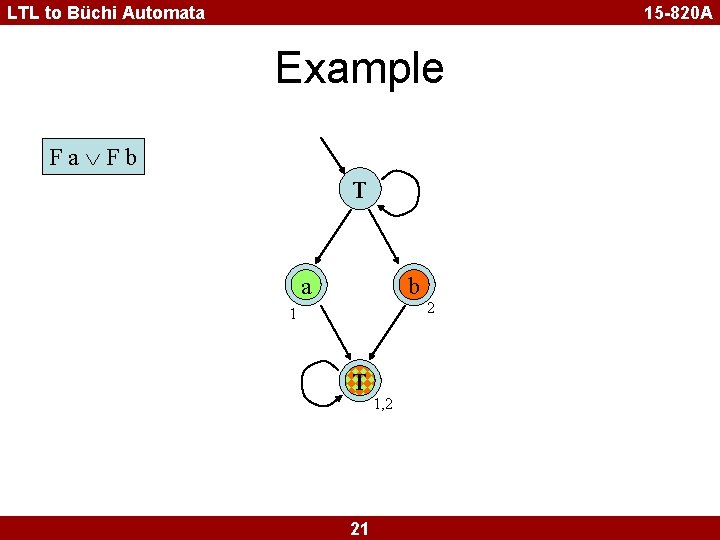
LTL to Büchi Automata 15 -820 A Example Fa Fb T a b 2 1 T 1, 2 21
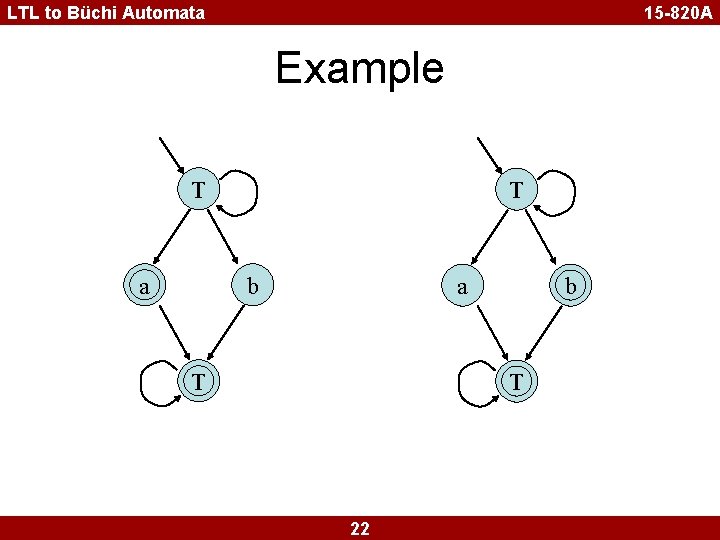
LTL to Büchi Automata 15 -820 A Example T a T b T 22
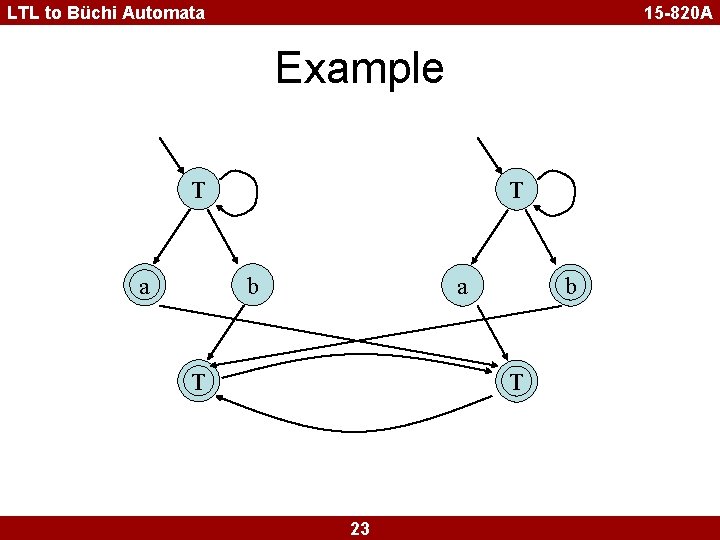
LTL to Büchi Automata 15 -820 A Example T a T b T 23
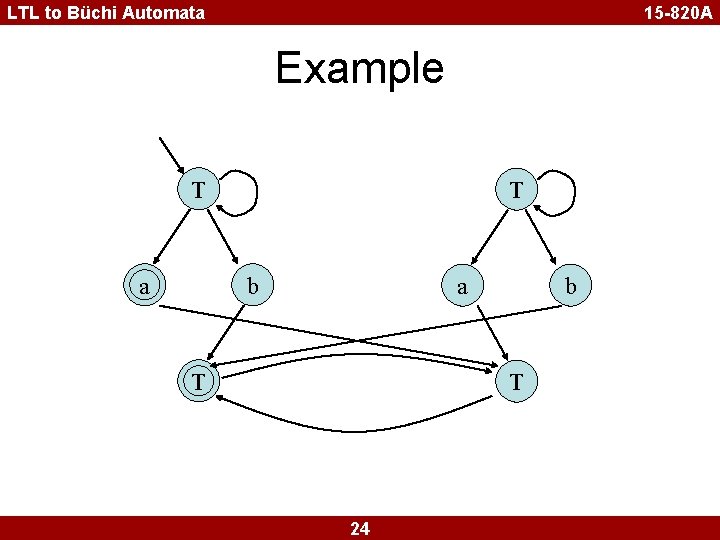
LTL to Büchi Automata 15 -820 A Example T a T b T 24
LTL to Büchi Automata 15 -820 A Example T a b T T 25
LTL to Büchi Automata 15 -820 A Example T a b T T 26
LTL to Büchi Automata 15 -820 A Optimizations • Can be done at each stage • Try to minimize – The number of states and transitions – The number of accepting states • Involve – Strongly connected components – Fair (bi)simulation • Expensive but – The Büchi automaton is usually small – The saving during verification can be very high 27
- Slides: 27