
LTE Handover LTE Handover Mobility Management 2 LTE
課程單元目標 • 了解 LTE系統交遞 (Handover) • 了解 LTE Handover 的條件 • 了解 Mobility Management 2
LTE系統交遞 (Handover) 3
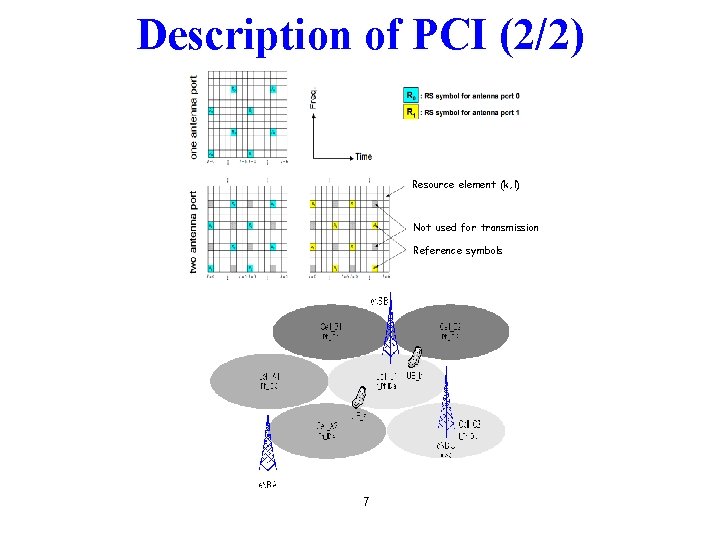
Description of PCI (2/2) Resource element (k, l) Not used for transmission Reference symbols 7
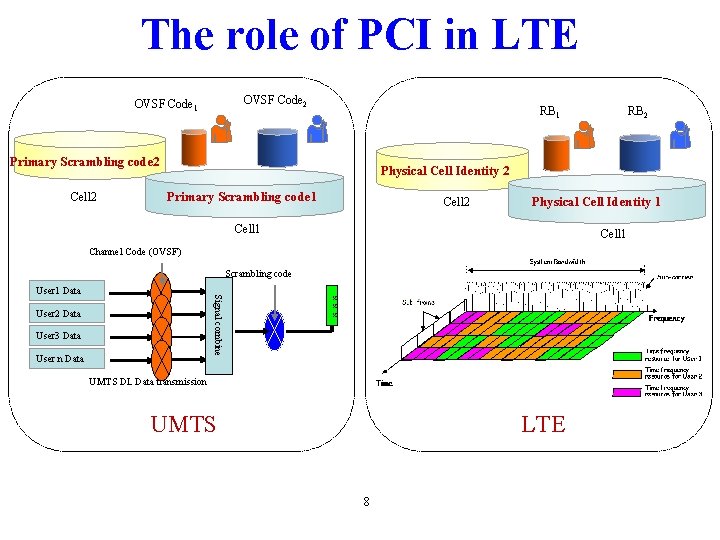
The role of PCI in LTE OVSF Code 2 OVSF Code 1 RB 1 Primary Scrambling code 2 Cell 2 RB 2 Physical Cell Identity 2 Primary Scrambling code 1 Cell 2 Physical Cell Identity 1 Cell 1 Channel Code (OVSF) Scrambling code Signal combine User 1 Data User 2 Data User 3 Data User n Data x x x UMTS DL Data transmission UMTS LTE 8
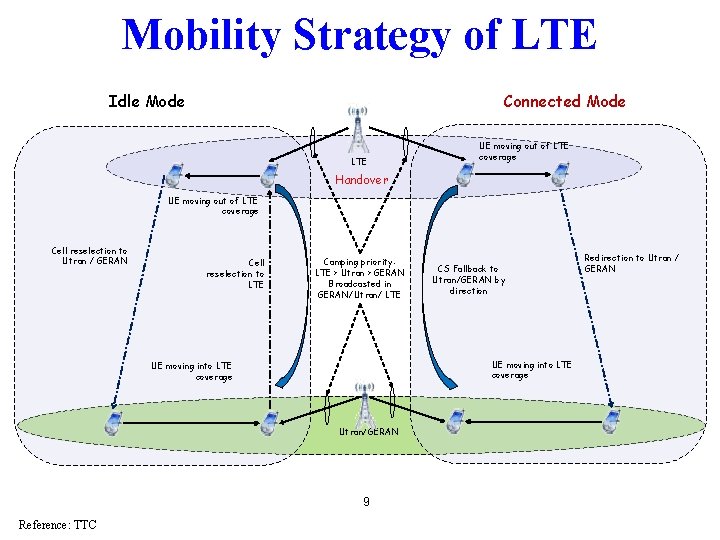
Mobility Strategy of LTE Idle Mode Connected Mode LTE UE moving out of LTE coverage Handover UE moving out of LTE coverage Cell reselection to Utran / GERAN Cell reselection to LTE Camping priority: LTE > Utran > GERAN Broadcasted in GERAN/Utran/ LTE UE moving into LTE coverage Utran/GERAN 9 Reference: TTC CS Fallback to Utran/GERAN by direction Redirection to Utran / GERAN
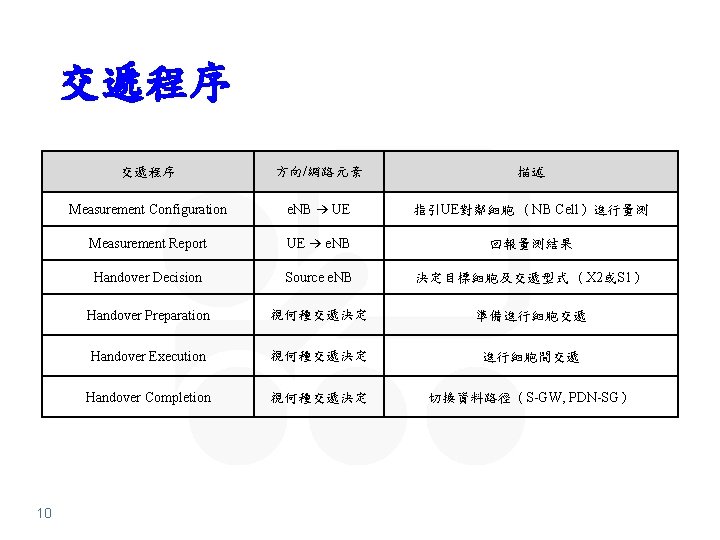
交遞程序 10 交遞程序 方向/網路元素 描述 Measurement Configuration e. NB → UE 指引UE對鄰細胞 (NB Cell)進行量測 Measurement Report UE → e. NB 回報量測結果 Handover Decision Source e. NB 決定目標細胞及交遞型式 (X 2或S 1) Handover Preparation 視何種交遞決定 準備進行細胞交遞 Handover Execution 視何種交遞決定 進行細胞間交遞 Handover Completion 視何種交遞決定 切換資料路徑(S-GW, PDN-SG)
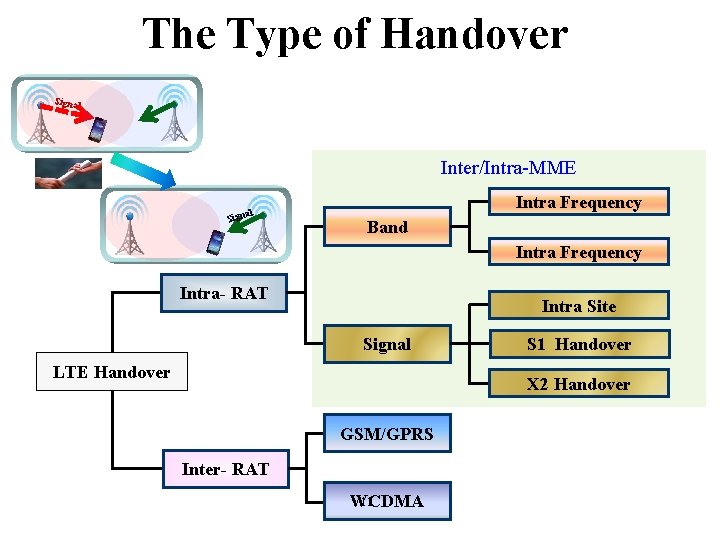
The Type of Handover Signa l Inter/Intra-MME al Sign Intra Frequency Band Intra Frequency Intra- RAT Intra Site Signal LTE Handover S 1 Handover X 2 Handover GSM/GPRS Inter- RAT 11 WCDMA

LTE Handover 的條件 12
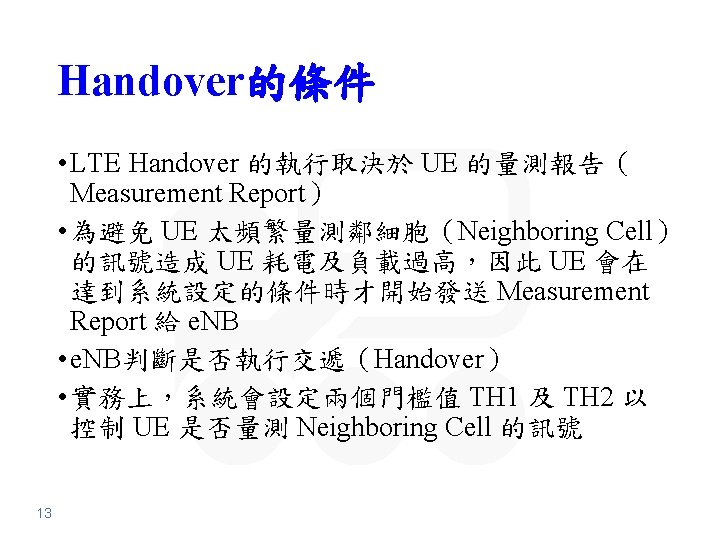
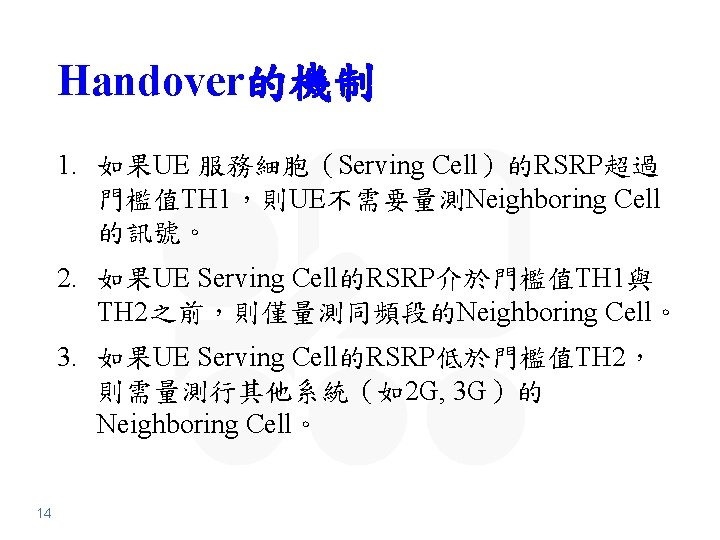
Handover的機制 1. 如果UE 服務細胞(Serving Cell)的RSRP超過 門檻值TH 1,則UE不需要量測Neighboring Cell 的訊號。 2. 如果UE Serving Cell的RSRP介於門檻值TH 1與 TH 2之前,則僅量測同頻段的Neighboring Cell。 3. 如果UE Serving Cell的RSRP低於門檻值TH 2, 則需量測行其他系統(如2 G, 3 G)的 Neighboring Cell。 14
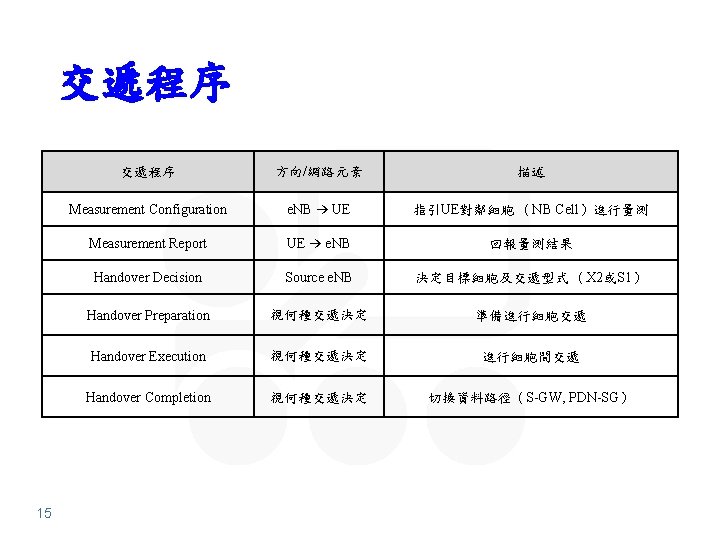
交遞程序 15 交遞程序 方向/網路元素 描述 Measurement Configuration e. NB → UE 指引UE對鄰細胞 (NB Cell)進行量測 Measurement Report UE → e. NB 回報量測結果 Handover Decision Source e. NB 決定目標細胞及交遞型式 (X 2或S 1) Handover Preparation 視何種交遞決定 準備進行細胞交遞 Handover Execution 視何種交遞決定 進行細胞間交遞 Handover Completion 視何種交遞決定 切換資料路徑(S-GW, PDN-SG)
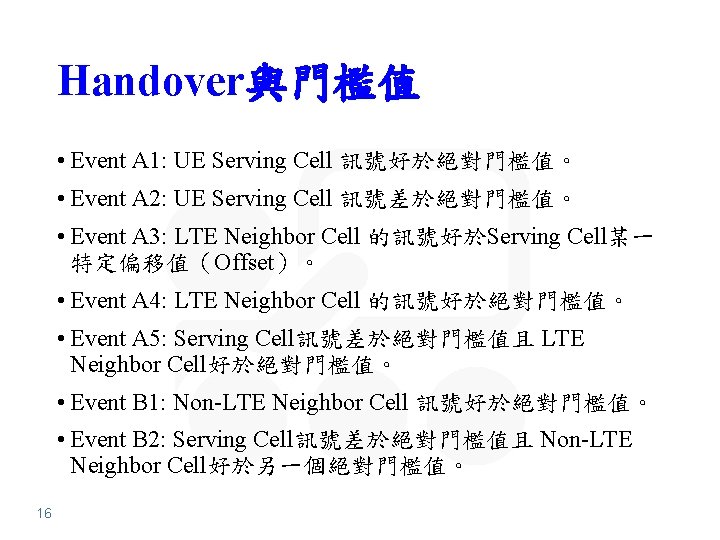
Handover與門檻值 • Event A 1: UE Serving Cell 訊號好於絕對門檻值。 • Event A 2: UE Serving Cell 訊號差於絕對門檻值。 • Event A 3: LTE Neighbor Cell 的訊號好於Serving Cell某一 特定偏移值(Offset)。 • Event A 4: LTE Neighbor Cell 的訊號好於絕對門檻值。 • Event A 5: Serving Cell訊號差於絕對門檻值且 LTE Neighbor Cell好於絕對門檻值。 • Event B 1: Non-LTE Neighbor Cell 訊號好於絕對門檻值。 • Event B 2: Serving Cell訊號差於絕對門檻值且 Non-LTE Neighbor Cell好於另一個絕對門檻值。 16
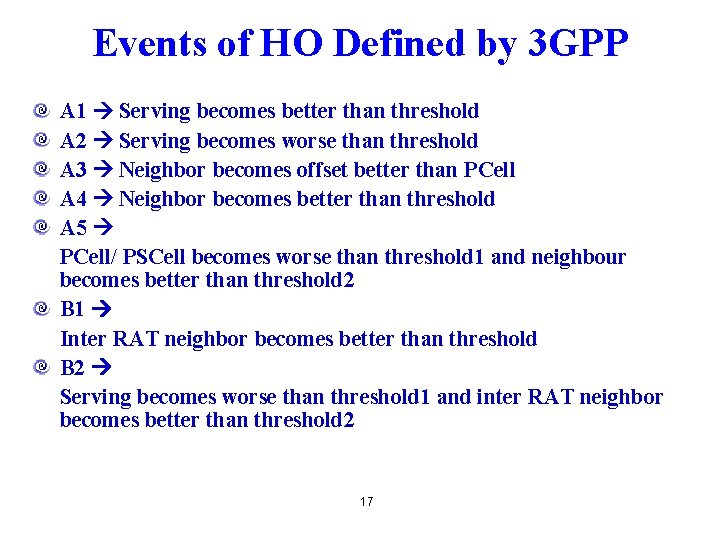
Events of HO Defined by 3 GPP A 1 Serving becomes better than threshold A 2 Serving becomes worse than threshold A 3 Neighbor becomes offset better than PCell A 4 Neighbor becomes better than threshold A 5 PCell/ PSCell becomes worse than threshold 1 and neighbour becomes better than threshold 2 B 1 Inter RAT neighbor becomes better than threshold B 2 Serving becomes worse than threshold 1 and inter RAT neighbor becomes better than threshold 2 17
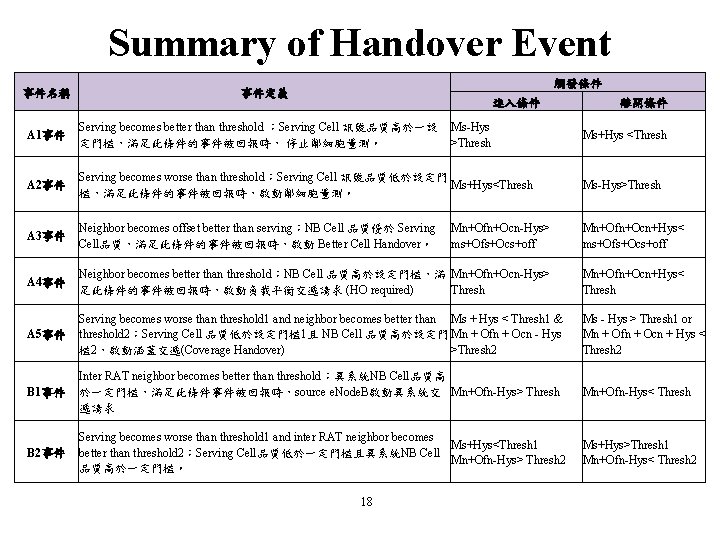
Summary of Handover Event 事件名稱 觸發條件 事件定義 進入條件 離開條件 A 1事件 Serving becomes better than threshold :Serving Cell 訊號品質高於一設 定門檻,滿足此條件的事件被回報時, 停止鄰細胞量測。 A 2事件 Serving becomes worse than threshold:Serving Cell 訊號品質低於設定門 Ms+Hys<Thresh 檻,滿足此條件的事件被回報時,啟動鄰細胞量測。 Ms-Hys>Thresh A 3事件 Neighbor becomes offset better than serving:NB Cell 品質優於 Serving Cell品質,滿足此條件的事件被回報時,啟動 Better Cell Handover。 Mn+Ofn+Ocn-Hys> ms+Ofs+Ocs+off Mn+Ofn+Ocn+Hys< ms+Ofs+Ocs+off A 4事件 Neighbor becomes better than threshold:NB Cell 品質高於設定門檻,滿 Mn+Ofn+Ocn-Hys> 足此條件的事件被回報時,啟動負載平衡交遞請求 (HO required) Thresh Mn+Ofn+Ocn+Hys< Thresh A 5事件 Serving becomes worse than threshold 1 and neighbor becomes better than Ms + Hys < Thresh 1 & threshold 2:Serving Cell 品質低於設定門檻 1且 NB Cell 品質高於設定門 Mn + Ofn + Ocn - Hys 檻 2,啟動涵蓋交遞(Coverage Handover) >Thresh 2 Ms - Hys > Thresh 1 or Mn + Ofn + Ocn + Hys < Thresh 2 B 1事件 Inter RAT neighbor becomes better than threshold:異系統NB Cell品質高 於一定門檻,滿足此條件事件被回報時,source e. Node. B啟動異系統交 Mn+Ofn-Hys> Thresh 遞請求 Mn+Ofn-Hys< Thresh B 2事件 Serving becomes worse than threshold 1 and inter RAT neighbor becomes Ms+Hys<Thresh 1 better than threshold 2:Serving Cell品質低於一定門檻且異系統NB Cell Mn+Ofn-Hys> Thresh 2 品質高於一定門檻。 Ms+Hys>Thresh 1 Mn+Ofn-Hys< Thresh 2 18 Ms-Hys Ms+Hys <Thresh >Thresh
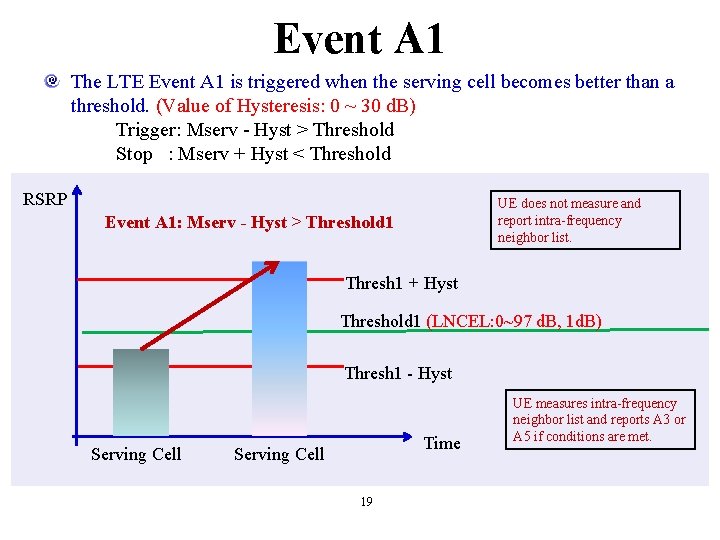
Event A 1 The LTE Event A 1 is triggered when the serving cell becomes better than a threshold. (Value of Hysteresis: 0 ~ 30 d. B) Trigger: Mserv - Hyst > Threshold Stop : Mserv + Hyst < Threshold RSRP UE does not measure and report intra-frequency neighbor list. Event A 1: Mserv - Hyst > Threshold 1 Thresh 1 + Hyst Threshold 1 (LNCEL: 0~97 d. B, 1 d. B) Thresh 1 - Hyst Serving Cell Time Serving Cell 19 UE measures intra-frequency neighbor list and reports A 3 or A 5 if conditions are met.
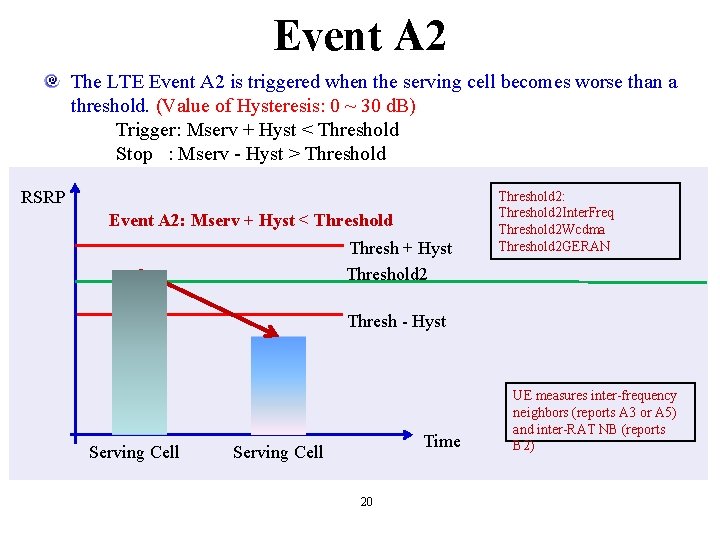
Event A 2 The LTE Event A 2 is triggered when the serving cell becomes worse than a threshold. (Value of Hysteresis: 0 ~ 30 d. B) Trigger: Mserv + Hyst < Threshold Stop : Mserv - Hyst > Threshold RSRP Event A 2: Mserv + Hyst < Threshold Thresh + Hyst Threshold 2: Threshold 2 Inter. Freq Threshold 2 Wcdma Threshold 2 GERAN Thresh - Hyst Serving Cell Time Serving Cell 20 UE measures inter-frequency neighbors (reports A 3 or A 5) and inter-RAT NB (reports B 2)
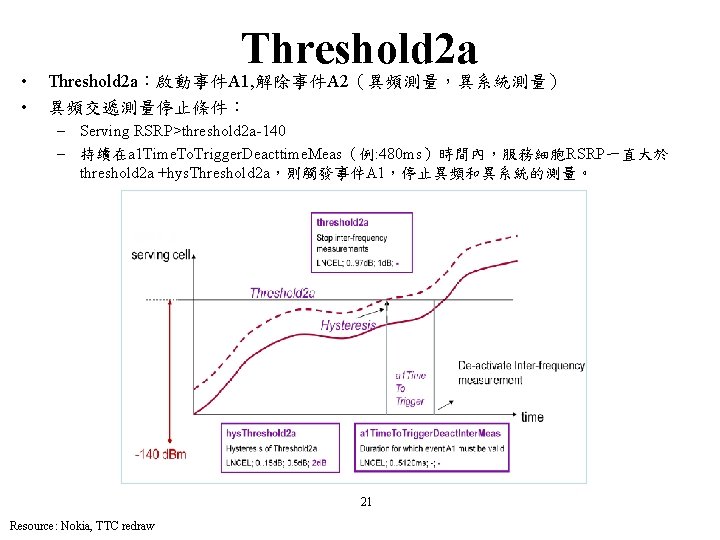
• • Threshold 2 a:啟動事件A 1, 解除事件A 2(異頻測量,異系統測量) 異頻交遞測量停止條件: – Serving RSRP>threshold 2 a-140 – 持續在a 1 Time. To. Trigger. Deacttime. Meas(例: 480 ms)時間內,服務細胞RSRP一直大於 threshold 2 a +hys. Threshold 2 a,則觸發事件A 1,停止異頻和異系統的測量。 21 Resource: Nokia, TTC redraw
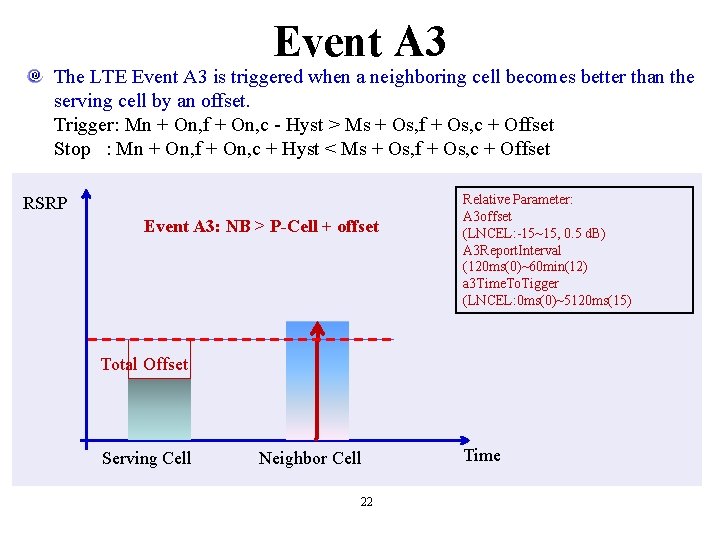
Event A 3 The LTE Event A 3 is triggered when a neighboring cell becomes better than the serving cell by an offset. Trigger: Mn + On, f + On, c - Hyst > Ms + Os, f + Os, c + Offset Stop : Mn + On, f + On, c + Hyst < Ms + Os, f + Os, c + Offset RSRP Event A 3: NB > P-Cell + offset Relative Parameter: A 3 offset (LNCEL: -15~15, 0. 5 d. B) A 3 Report. Interval (120 ms(0)~60 min(12) a 3 Time. To. Tigger (LNCEL: 0 ms(0)~5120 ms(15) Total Offset Serving Cell Neighbor Cell 22 Time
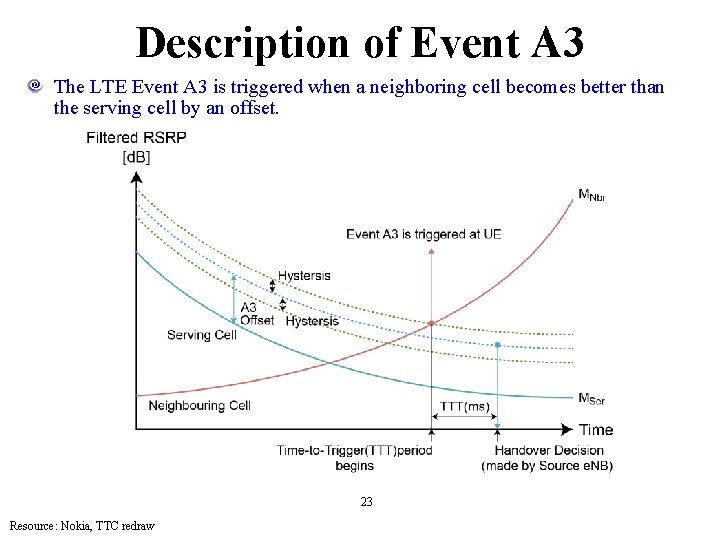
Description of Event A 3 The LTE Event A 3 is triggered when a neighboring cell becomes better than the serving cell by an offset. 23 Resource: Nokia, TTC redraw
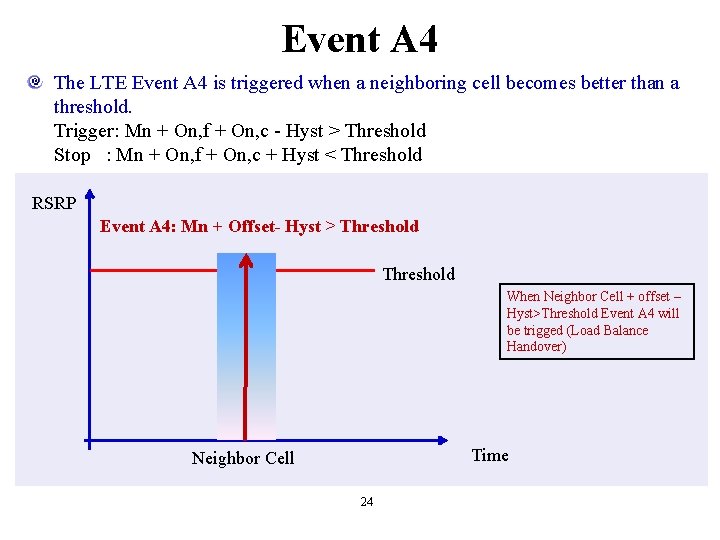
Event A 4 The LTE Event A 4 is triggered when a neighboring cell becomes better than a threshold. Trigger: Mn + On, f + On, c - Hyst > Threshold Stop : Mn + On, f + On, c + Hyst < Threshold RSRP Event A 4: Mn + Offset- Hyst > Threshold When Neighbor Cell + offset – Hyst>Threshold Event A 4 will be trigged (Load Balance Handover) Time Neighbor Cell 24
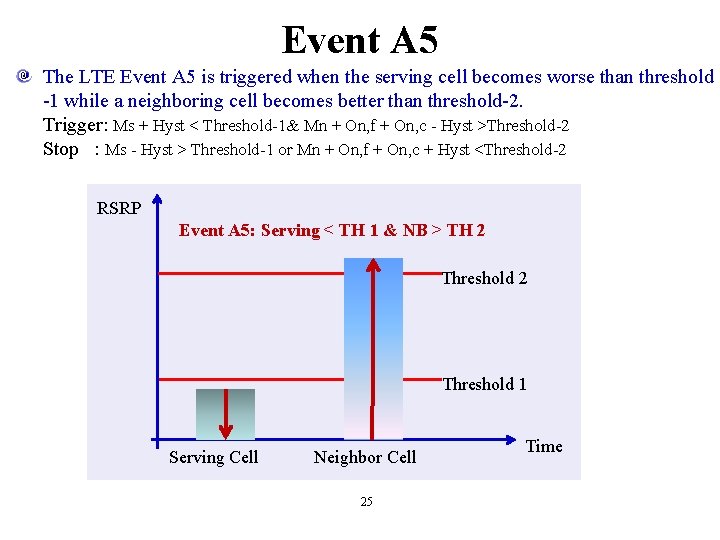
Event A 5 The LTE Event A 5 is triggered when the serving cell becomes worse than threshold -1 while a neighboring cell becomes better than threshold-2. Trigger: Ms + Hyst < Threshold-1& Mn + On, f + On, c - Hyst >Threshold-2 Stop : Ms - Hyst > Threshold-1 or Mn + On, f + On, c + Hyst <Threshold-2 RSRP Event A 5: Serving < TH 1 & NB > TH 2 Threshold 1 Serving Cell Neighbor Cell 25 Time
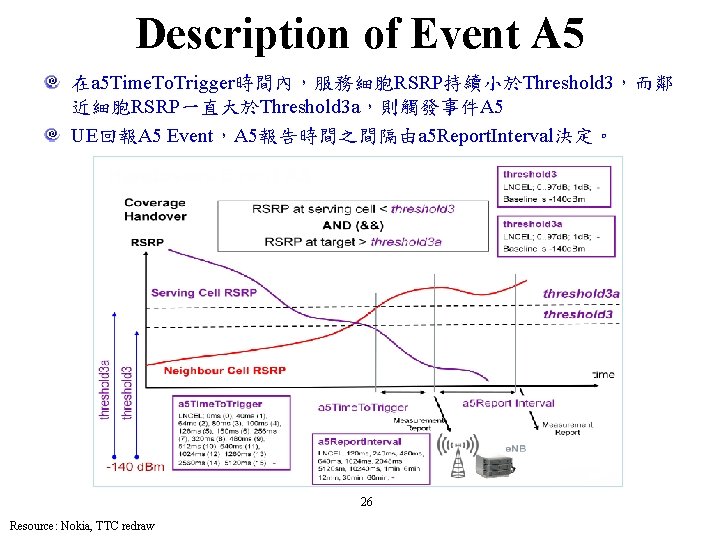
Description of Event A 5 在a 5 Time. To. Trigger時間內,服務細胞RSRP持續小於Threshold 3,而鄰 近細胞RSRP一直大於Threshold 3 a,則觸發事件A 5 UE回報A 5 Event,A 5報告時間之間隔由a 5 Report. Interval決定。 26 Resource: Nokia, TTC redraw
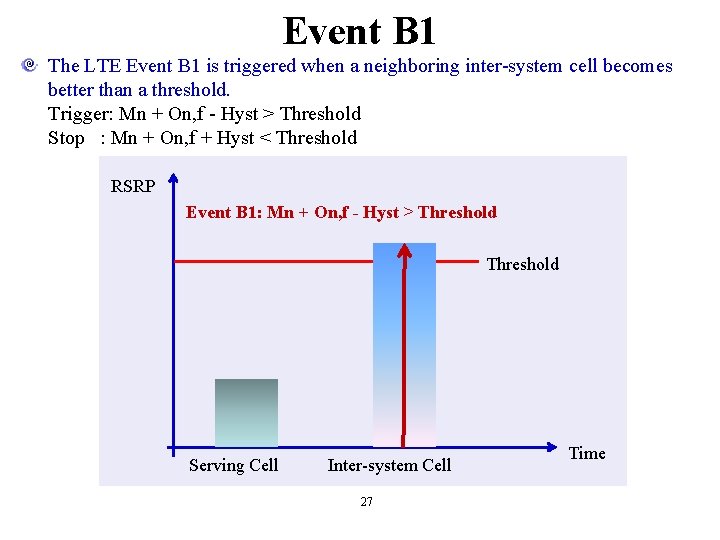
Event B 1 The LTE Event B 1 is triggered when a neighboring inter-system cell becomes better than a threshold. Trigger: Mn + On, f - Hyst > Threshold Stop : Mn + On, f + Hyst < Threshold RSRP Event B 1: Mn + On, f - Hyst > Threshold Serving Cell Inter-system Cell 27 Time
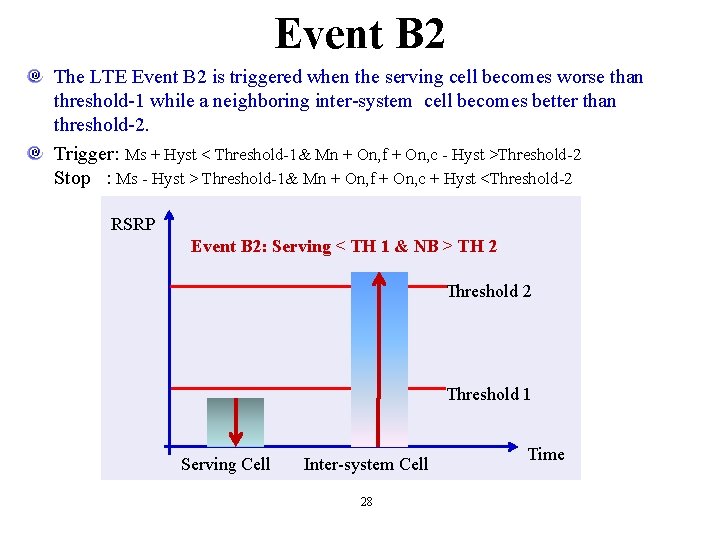
Event B 2 The LTE Event B 2 is triggered when the serving cell becomes worse than threshold-1 while a neighboring inter-system cell becomes better than threshold-2. Trigger: Ms + Hyst < Threshold-1& Mn + On, f + On, c - Hyst >Threshold-2 Stop : Ms - Hyst > Threshold-1& Mn + On, f + On, c + Hyst <Threshold-2 RSRP Event B 2: Serving < TH 1 & NB > TH 2 Threshold 1 Serving Cell Inter-system Cell 28 Time
Mobility Management 29
Mobility Principles • EPS • complete realization of multi-access convergence: • a packet core network that supports full mobility management • access network discovery • and selection for any type of access network. • The functionality of mobility management • the network can “reach” the user • a user can initiate communication towards other users or services • ongoing sessions can be maintained as the user moves EPC 30
Mobility within 3 GPP Family of Accesses • Cellular Idle-Mode Mobility Management • Not be practical to keep track of a UE in idle mode every time it moves between different cells. • Not practical to search for the UE in the whole network for every terminating event (incoming call) • Cells are grouped together into “registration areas” EPC 31
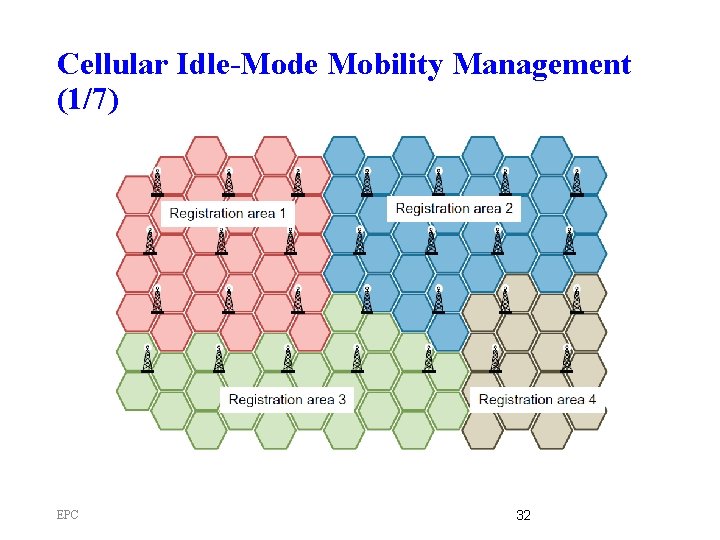
Cellular Idle-Mode Mobility Management (1/7) EPC 32
Cellular Idle-Mode Mobility Management (2/7) • Base stations broadcast registration area information. • UE compares the broadcasted registration area information with its own information EPC 33
Cellular Idle-Mode Mobility Management (3/7) • In EPS the registration areas are called Tracking Areas (TAs). • As long as the UE moves within its list of allocated TAs, it does not have to perform a tracking area update. • Periodic updates are used to clear resources in the network for UEs that are out of coverage or have been turned off. EPC 34
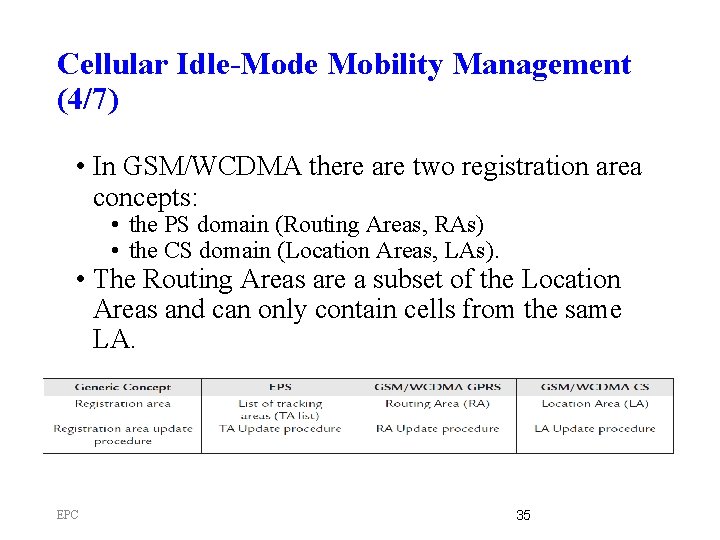
Cellular Idle-Mode Mobility Management (4/7) • In GSM/WCDMA there are two registration area concepts: • the PS domain (Routing Areas, RAs) • the CS domain (Location Areas, LAs). • The Routing Areas are a subset of the Location Areas and can only contain cells from the same LA. EPC 35
Cellular Idle-Mode Mobility Management (5/7) • A summary of the idle mobility procedure in EPS: • A TA consists of a set of cells • The registration area in EPS is a list of one or more TAs • The UE performs TA Update when moving outside its TA list • The UE also performs TA Update when the periodic TA Update timer expires. • An outline of the Tracking Area Update procedure is shown in the figure of next slide. EPC 36
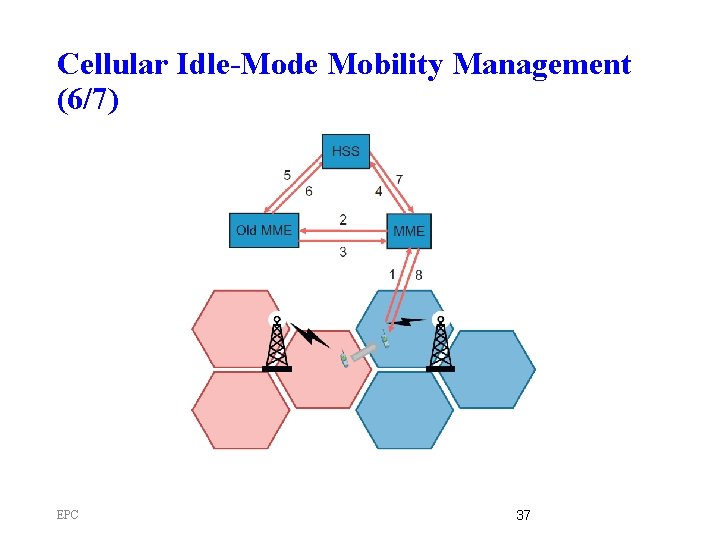
Cellular Idle-Mode Mobility Management (6/7) EPC 37
Cellular Idle-Mode Mobility Management (7/7) • Paging is used to search for Idle UEs and establish a signaling connection. EPC 38
References 1. 電信技術中心 TTC Notes. 2. M. Olsson, Shabnam Sultana, Stefan Rommer, Lars Frid, and C. Mulligan, “EPC and 4 G Packet Networks, ” Second Edition: Driving the Mobile Broadband Revolution, Elsevier, 2013 EPC 39
- Slides: 39