
LTE Agenda LTE Basic LTE Road Map LTE
LTE - Agenda LTE Basic LTE Road Map LTE Architecture LTE Access LTE Channel Network
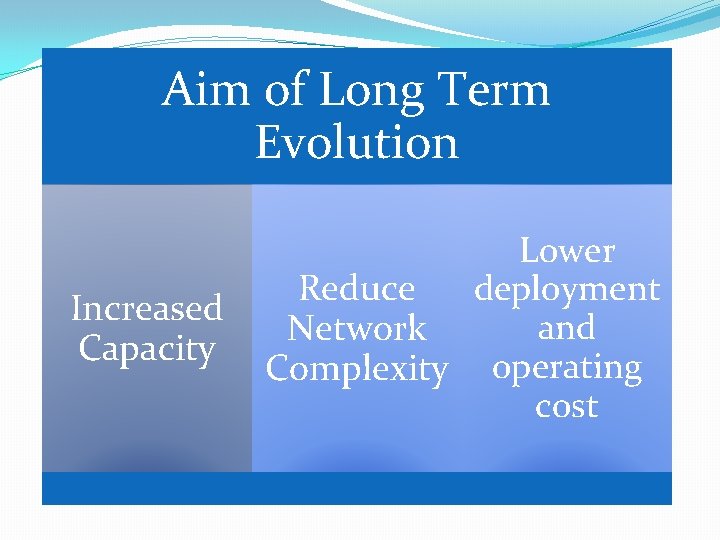
Aim of Long Term Evolution Increased Capacity Lower Reduce deployment and Network Complexity operating cost
LTE – Basics
What is LTE ? � 3 GPP Long Term Evolution, referred to as LTE and marketed as 4 G LTE, is a standard for wireless communication of high-speed data for mobile phones and data terminals. It is based on the GSM/EDGE and UMTS/HSPA network technologies, increasing the capacity and speed using new modulation techniques. In Nov. 2004, 3 GPP began a project to define the long-term evolution (LTE) of Universal Mobile Telecommunications System (UMTS) cellular technology �Higher performance �Backwards compatible �Wide application 5
LTE – Key factors �LTE � High Data Rates � � � > 100 Mbps – Downlink > 50 Mbps – Uplink Channel Setup < 100 ms �Why ? � Mobile Broadband Tendency � Customers need for more Spectral Efficience platform for Mobile data communicattion. ( Cost of Bits / Hz) � Efficient – Reducing OPEX & CAPEX � Easy to deploy (self configuring/optimizing) � TDD / FDD & Spectrum Flexibility � New Services (IPTV & Games in Real Time) � High Performance for Broadcast Services � Wide Range of Terminals � Increase Service Provisioning
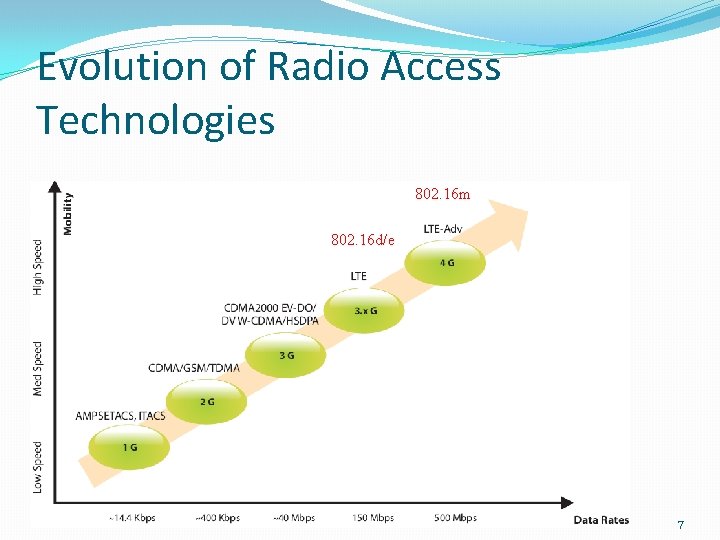
Evolution of Radio Access Technologies 802. 16 m 802. 16 d/e LTE (3. 9 G) : 3 GPP release 8~9 LTE-Advanced : 3 GPP release 10+ 7
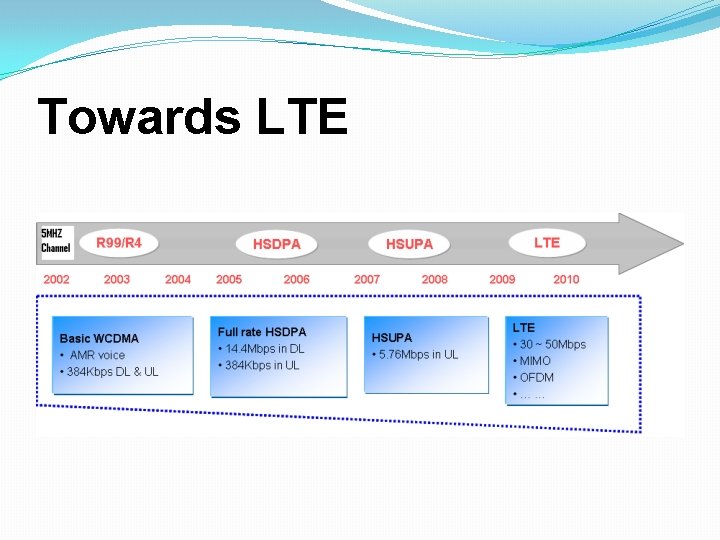
Towards LTE
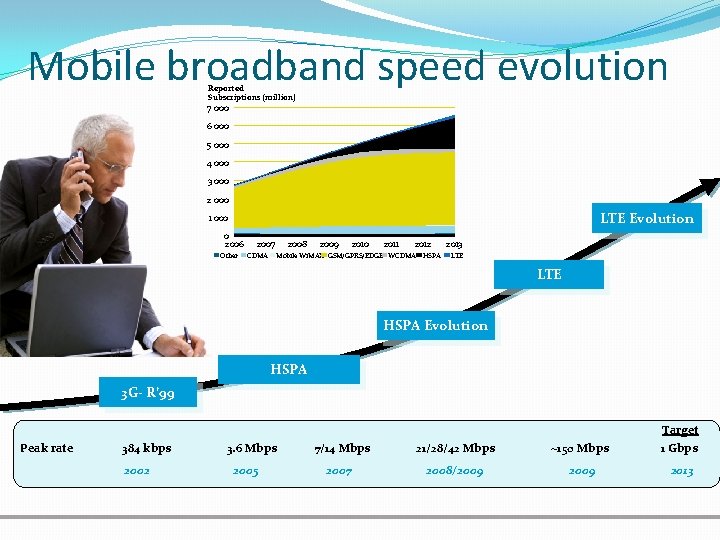
Mobile broadband speed evolution Reported Subscriptions (million) 7 000 6 000 5 000 4 000 3 000 2 000 LTE Evolution 1 000 0 2006 Other 2007 CDMA 2008 2009 2010 2011 2012 Mobile Wi. MAX GSM/GPRS/EDGE WCDMA HSPA 2013 LTE HSPA Evolution HSPA 3 G- R’ 99 Peak rate 384 kbps 2002 3. 6 Mbps 2005 7/14 Mbps 2007 21/28/42 Mbps ~150 Mbps Target 1 Gbps 2008/2009 2013
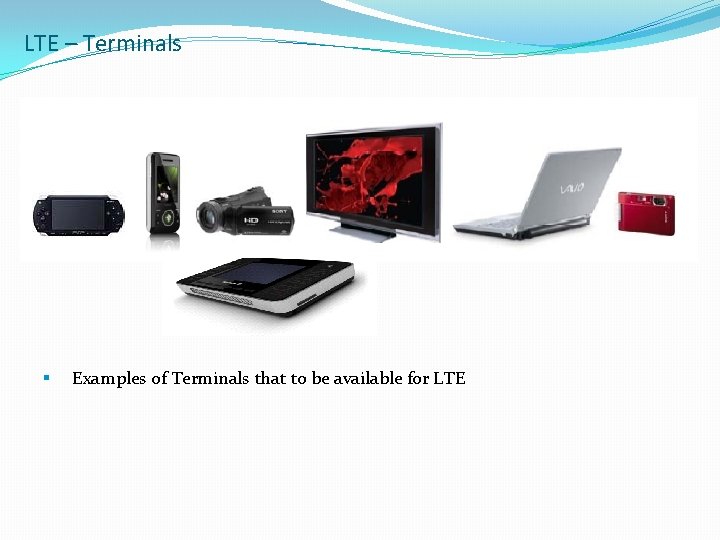
LTE – Terminals § Examples of Terminals that to be available for LTE
LTE – Roadmap
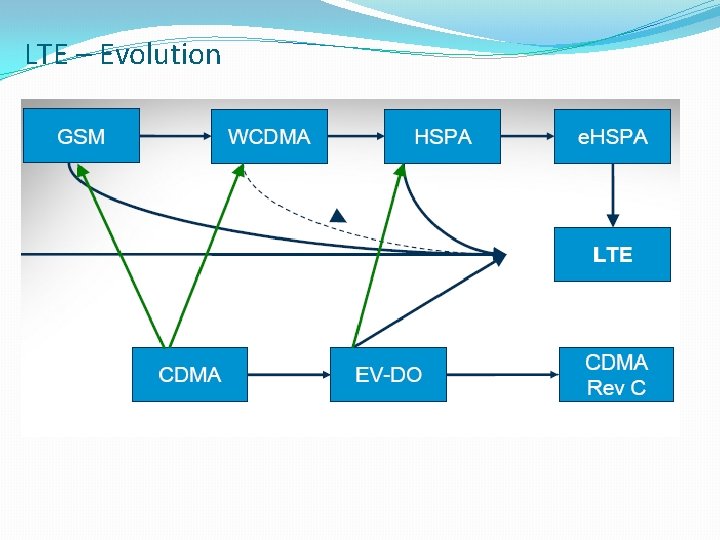
LTE – Evolution
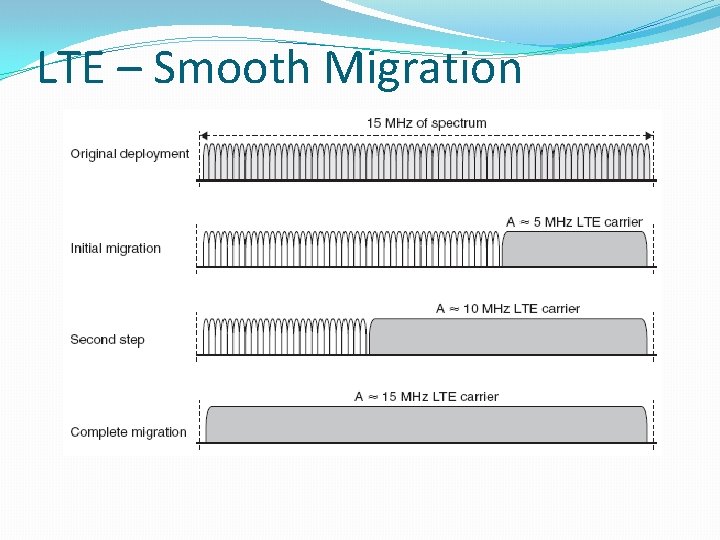
LTE – Smooth Migration
LTE – Long Term Evolution Architeture
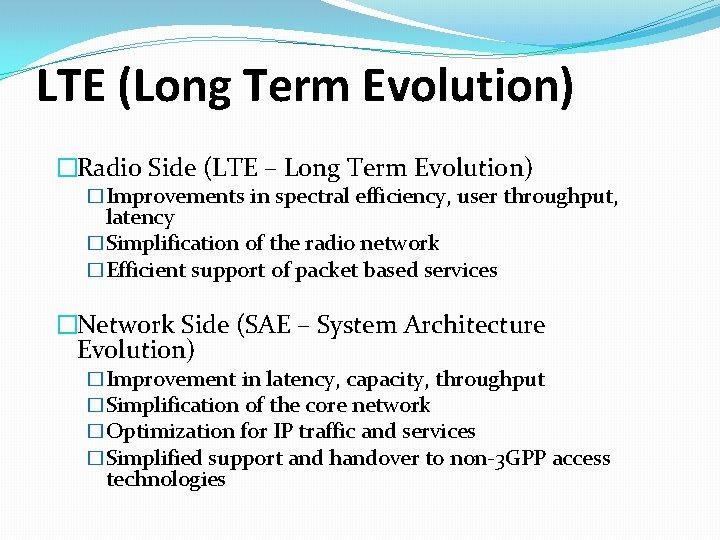
LTE (Long Term Evolution) �Radio Side (LTE – Long Term Evolution) �Improvements in spectral efficiency, user throughput, latency �Simplification of the radio network �Efficient support of packet based services �Network Side (SAE – System Architecture Evolution) �Improvement in latency, capacity, throughput �Simplification of the core network �Optimization for IP traffic and services �Simplified support and handover to non-3 GPP access technologies
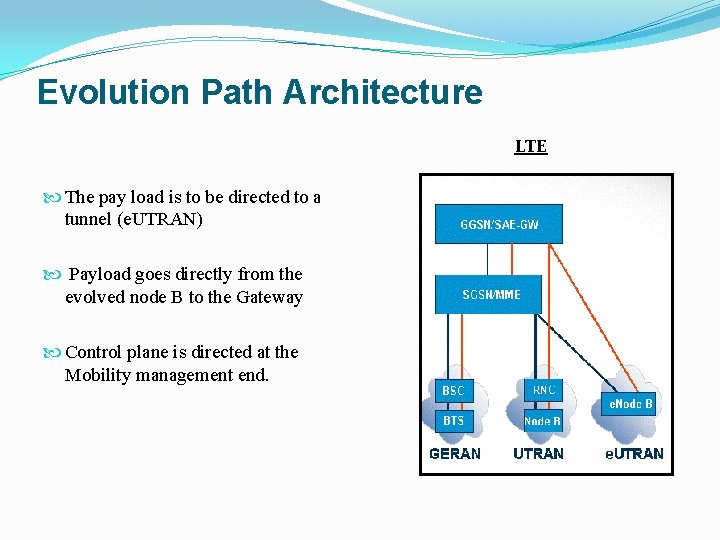
Evolution Path Architecture LTE The pay load is to be directed to a tunnel (e. UTRAN) Payload goes directly from the evolved node B to the Gateway Control plane is directed at the Mobility management end.
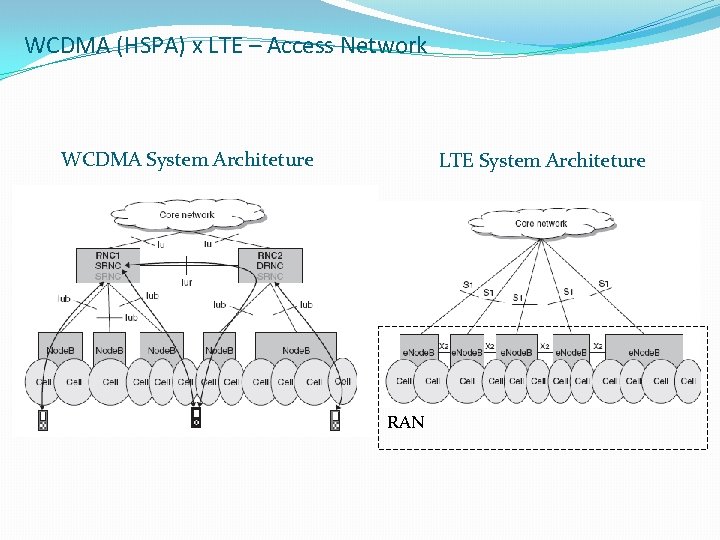
WCDMA (HSPA) x LTE – Access Network WCDMA System Architeture LTE System Architeture RAN
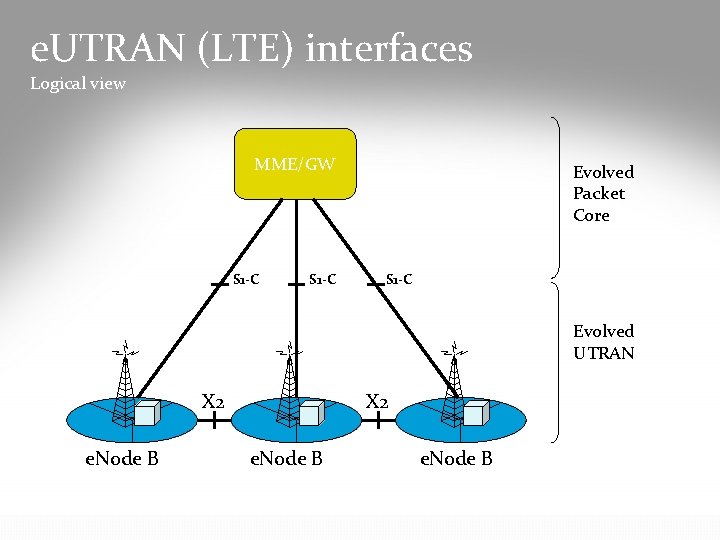
e. UTRAN (LTE) interfaces Logical view MME/GW S 1 -C Evolved Packet Core S 1 -C Evolved UTRAN X 2 e. Node B

LTE – e. Node. B �LTE e. Node. B �Coding, Interleaving, modulation & typical layer functions. �ARQ, Header Compression & layer functions �Security Functions (Ciphering / Integrity Protection ) �e. Node. B take decisions about Handover & scheduling for uplink and downlink. �Radio Resources Control functions �Connected to the Core Network with S 1 Interface (similar as Iu) �X 2 is similar to Iur Interface, mainly used to support the Active Mode Mobility.
LTE – Long Term Evolution Core Network
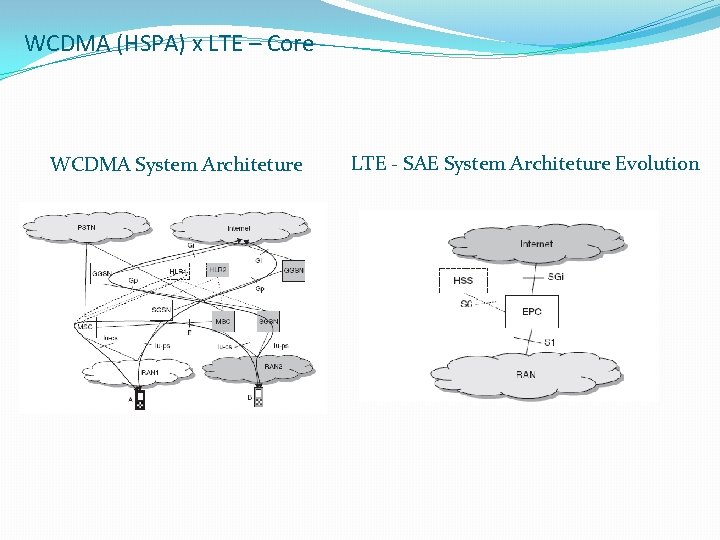
WCDMA (HSPA) x LTE – Core WCDMA System Architeture LTE - SAE System Architeture Evolution
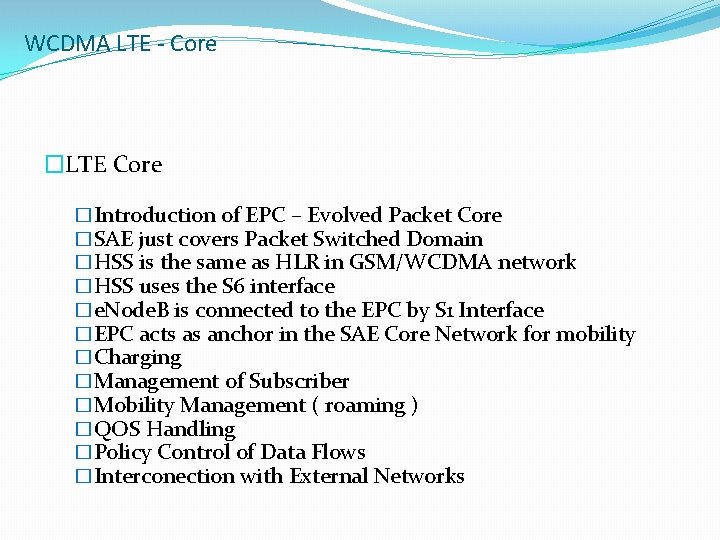
WCDMA LTE - Core �LTE Core �Introduction of EPC – Evolved Packet Core �SAE just covers Packet Switched Domain �HSS is the same as HLR in GSM/WCDMA network �HSS uses the S 6 interface �e. Node. B is connected to the EPC by S 1 Interface �EPC acts as anchor in the SAE Core Network for mobility �Charging �Management of Subscriber �Mobility Management ( roaming ) �QOS Handling �Policy Control of Data Flows �Interconection with External Networks
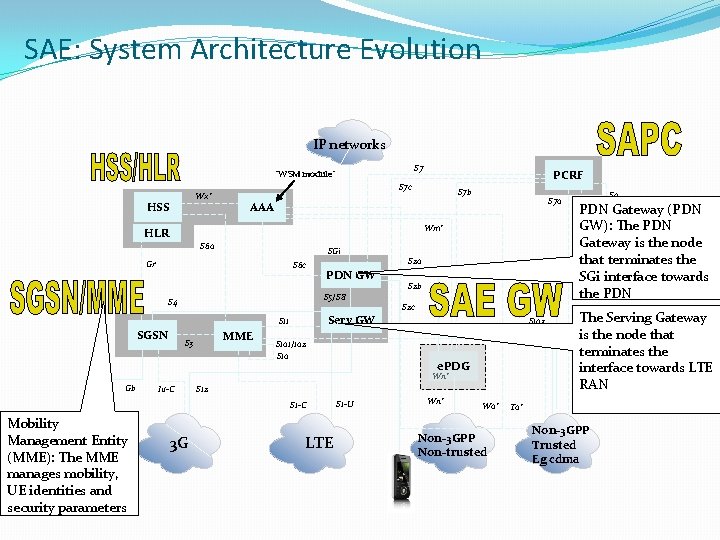
SAE: System Architecture Evolution IP networks S 7 ”WSM module” Wx* HSS PCRF S 7 c S 7 b S 7 a AAA Wm* HLR S 6 a SGi Gr S 6 c S 5/S 8 S 4 Serv GW S 11 SGSN PDN GW MME S 3 S 101/102 S 10 S 2 a S 2 b S 2 c S 103 e. PDG Wn* Gb Iu-C S 12 S 1 -C Mobility Management 2 G Entity (MME): The MME manages mobility, UE identities and security parameters 3 G LTE S 1 -U Wn* Wa* Non-3 GPP Non-trusted S 9 PDN Gateway (PDN GW): The PDN Gateway is the node that terminates the SGi interface towards the PDN The Serving Gateway is the node that terminates the interface towards LTE RAN Ta* Non-3 GPP Trusted Eg cdma
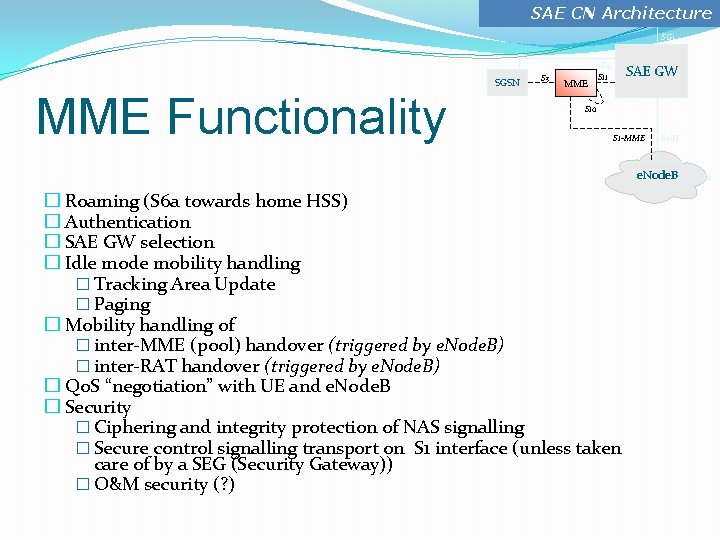
SAE CN Architecture SGi SGSN MME Functionality S 3 MME S 4 S 11 SAE GW S 10 S 1 -MME S 1 -U e. Node. B � Roaming (S 6 a towards home HSS) � Authentication � SAE GW selection � Idle mode mobility handling � Tracking Area Update � Paging � Mobility handling of � inter-MME (pool) handover (triggered by e. Node. B) � inter-RAT handover (triggered by e. Node. B) � Qo. S “negotiation” with UE and e. Node. B � Security � Ciphering and integrity protection of NAS signalling � Secure control signalling transport on S 1 interface (unless taken care of by a SEG (Security Gateway)) � O&M security (? ) X 2
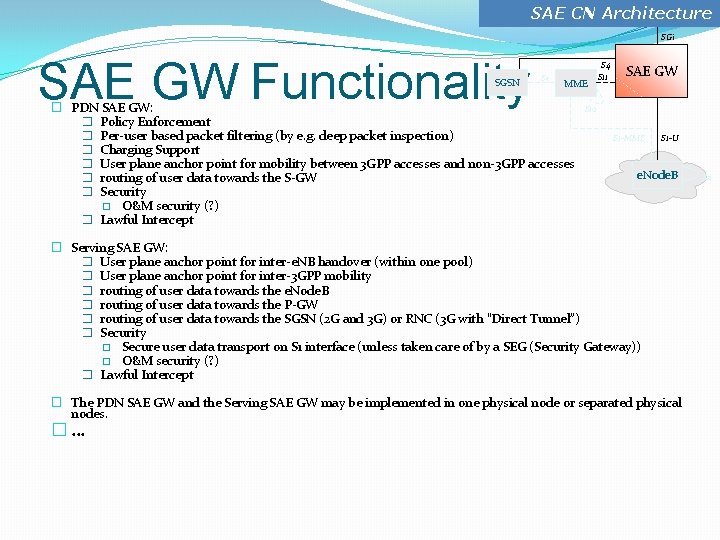
SAE CN Architecture SGi SAE GW Functionality SGSN S 3 MME � PDN SAE GW: � Policy Enforcement � Per-user based packet filtering (by e. g. deep packet inspection) � Charging Support � User plane anchor point for mobility between 3 GPP accesses and non-3 GPP accesses � routing of user data towards the S-GW � Security � O&M security (? ) � Lawful Intercept S 4 S 11 SAE GW S 10 S 1 -MME S 1 -U e. Node. B � Serving SAE GW: � User plane anchor point for inter-e. NB handover (within one pool) � User plane anchor point for inter-3 GPP mobility � routing of user data towards the e. Node. B � routing of user data towards the P-GW � routing of user data towards the SGSN (2 G and 3 G) or RNC (3 G with “Direct Tunnel”) � Security � Secure user data transport on S 1 interface (unless taken care of by a SEG (Security Gateway)) � O&M security (? ) � Lawful Intercept � The PDN SAE GW and the Serving SAE GW may be implemented in one physical node or separated physical nodes. �… X 2
LTE – Long Term Evolution Access Network
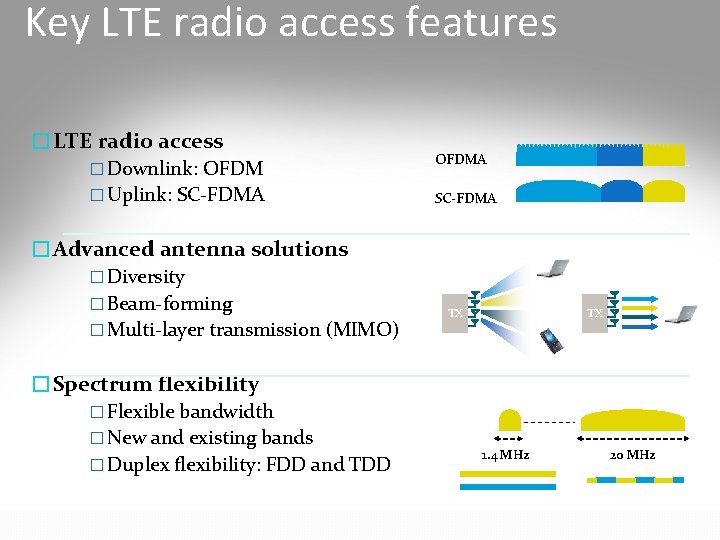
Key LTE radio access features �LTE radio access � Downlink: OFDM � Uplink: SC-FDMA OFDMA SC-FDMA �Advanced antenna solutions � Diversity � Beam-forming � Multi-layer transmission (MIMO) TX TX �Spectrum flexibility � Flexible bandwidth � New and existing bands � Duplex flexibility: FDD and TDD 1. 4 MHz 20 MHz
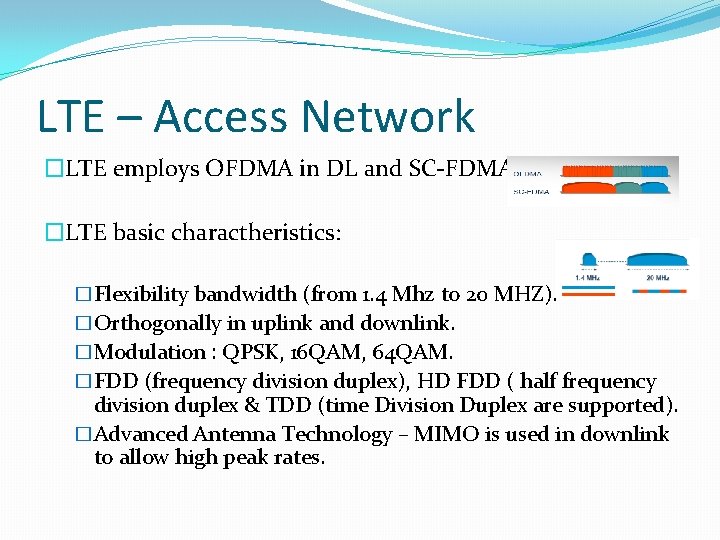
LTE – Access Network �LTE employs OFDMA in DL and SC-FDMA in UL �LTE basic charactheristics: �Flexibility bandwidth (from 1. 4 Mhz to 20 MHZ). �Orthogonally in uplink and downlink. �Modulation : QPSK, 16 QAM, 64 QAM. �FDD (frequency division duplex), HD FDD ( half frequency division duplex & TDD (time Division Duplex are supported). �Advanced Antenna Technology – MIMO is used in downlink to allow high peak rates.
LTE – Long Term Evolution Channels
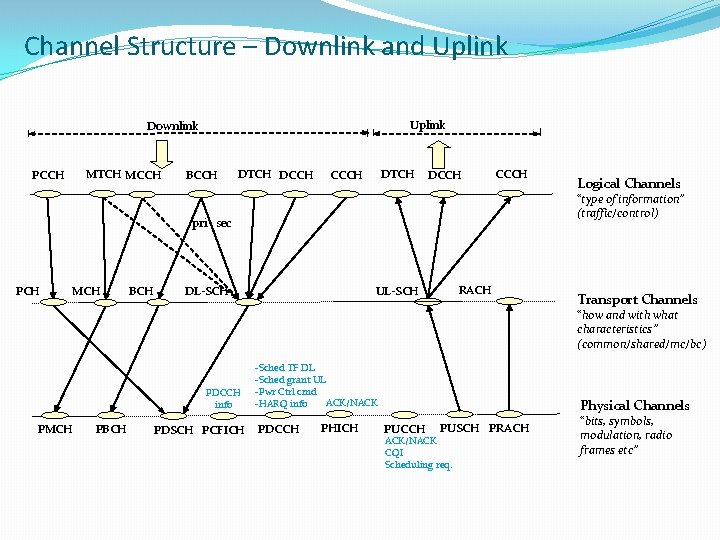
Channel Structure – Downlink and Uplink Downlink MTCH MCCH PCCH BCCH DTCH DCCH DTCH CCCH DCCH CCCH “type of information” (traffic/control) pri sec PCH MCH BCH Logical Channels RACH UL-SCH DL-SCH Transport Channels “how and with what characteristics” (common/shared/mc/bc) PDCCH info PMCH PBCH PDSCH PCFICH -Sched TF DL -Sched grant UL -Pwr Ctrl cmd ACK/NACK -HARQ info PDCCH PHICH Physical Channels PUCCH PUSCH PRACH ACK/NACK CQI Scheduling req. “bits, symbols, modulation, radio frames etc”
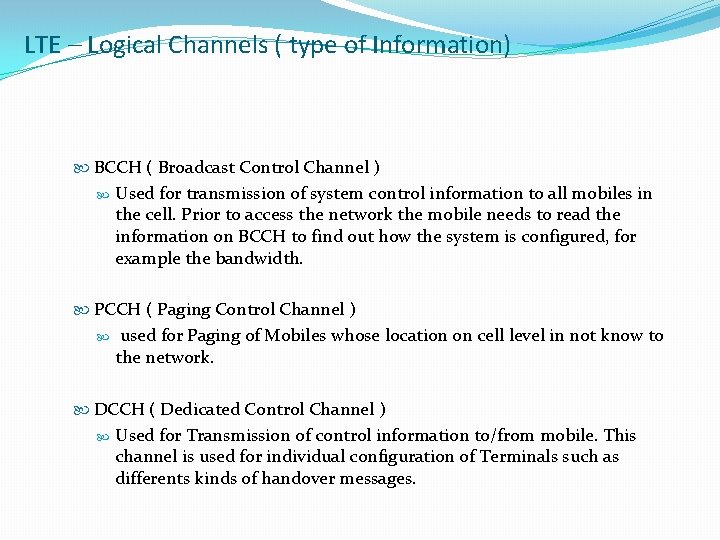
LTE – Logical Channels ( type of Information) BCCH ( Broadcast Control Channel ) Used for transmission of system control information to all mobiles in the cell. Prior to access the network the mobile needs to read the information on BCCH to find out how the system is configured, for example the bandwidth. PCCH ( Paging Control Channel ) used for Paging of Mobiles whose location on cell level in not know to the network. DCCH ( Dedicated Control Channel ) Used for Transmission of control information to/from mobile. This channel is used for individual configuration of Terminals such as differents kinds of handover messages.
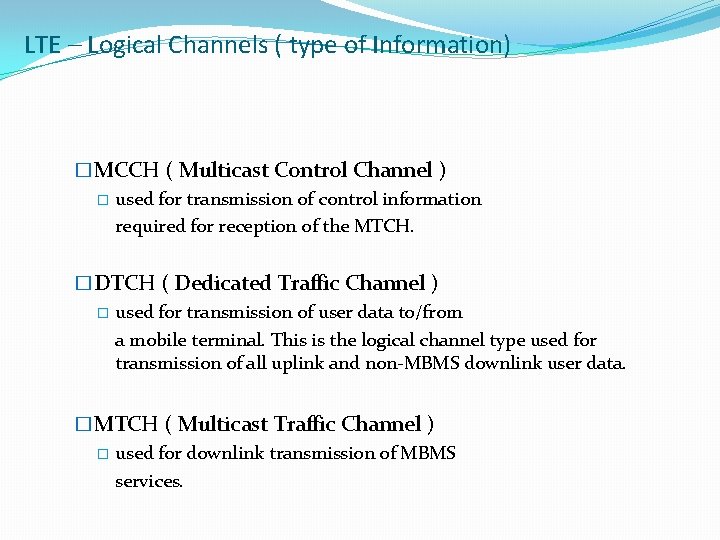
LTE – Logical Channels ( type of Information) �MCCH ( Multicast Control Channel ) � used for transmission of control information required for reception of the MTCH. �DTCH ( Dedicated Traffic Channel ) � used for transmission of user data to/from a mobile terminal. This is the logical channel type used for transmission of all uplink and non-MBMS downlink user data. �MTCH ( Multicast Traffic Channel ) � used for downlink transmission of MBMS services.
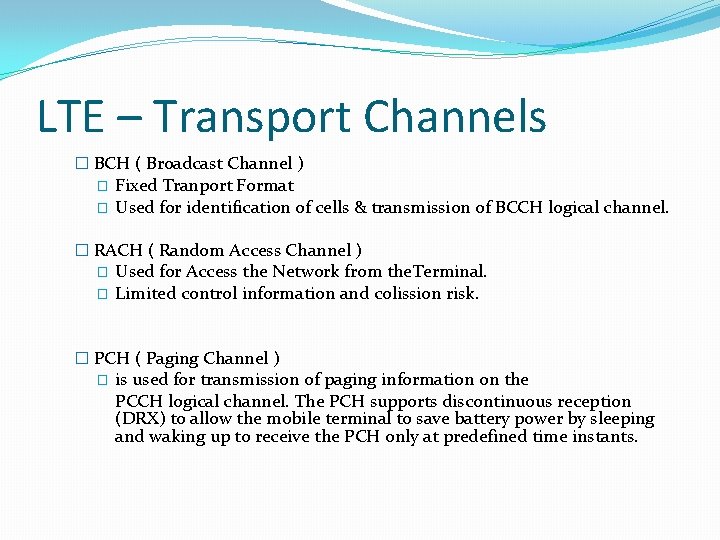
LTE – Transport Channels � BCH ( Broadcast Channel ) � � Fixed Tranport Format Used for identification of cells & transmission of BCCH logical channel. � RACH ( Random Access Channel ) � � Used for Access the Network from the. Terminal. Limited control information and colission risk. � PCH ( Paging Channel ) � is used for transmission of paging information on the PCCH logical channel. The PCH supports discontinuous reception (DRX) to allow the mobile terminal to save battery power by sleeping and waking up to receive the PCH only at predefined time instants.
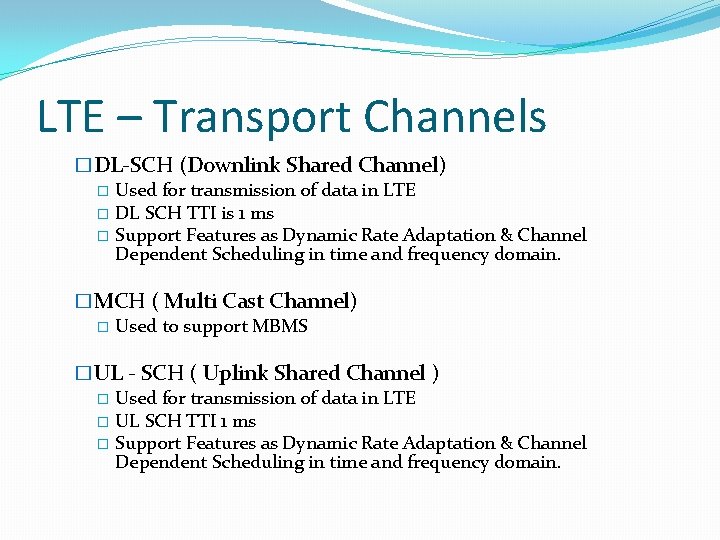
LTE – Transport Channels �DL-SCH (Downlink Shared Channel) � Used for transmission of data in LTE � DL SCH TTI is 1 ms � Support Features as Dynamic Rate Adaptation & Channel Dependent Scheduling in time and frequency domain. �MCH ( Multi Cast Channel) � Used to support MBMS �UL - SCH ( Uplink Shared Channel ) � Used for transmission of data in LTE � UL SCH TTI 1 ms � Support Features as Dynamic Rate Adaptation & Channel Dependent Scheduling in time and frequency domain.
Commercial Views
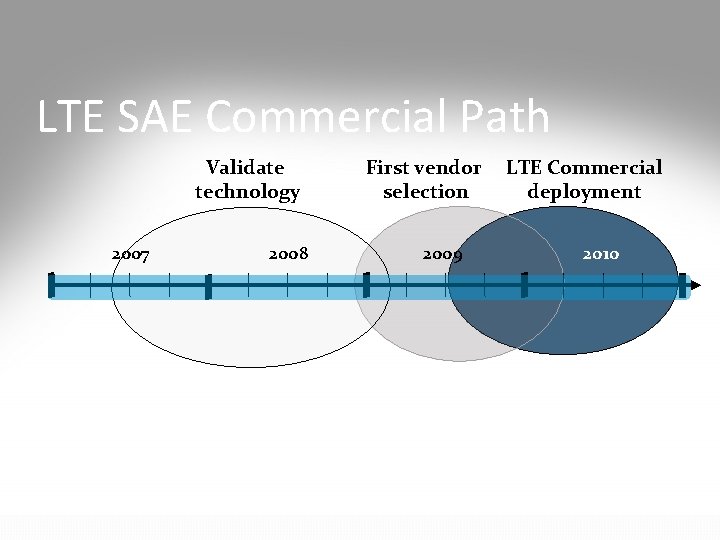
LTE SAE Commercial Path Validate technology 2007 2008 First vendor selection 2009 LTE Commercial deployment 2010
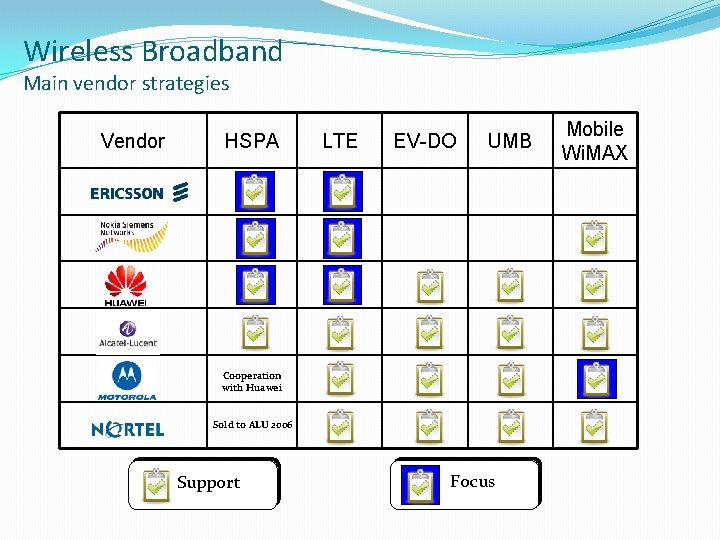
Wireless Broadband Main vendor strategies Vendor HSPA LTE EV-DO UMB Cooperation with Huawei Sold to ALU 2006 Support Focus Mobile Wi. MAX

- Slides: 38