
LSST Telescope and Site Observatory Control System Interface
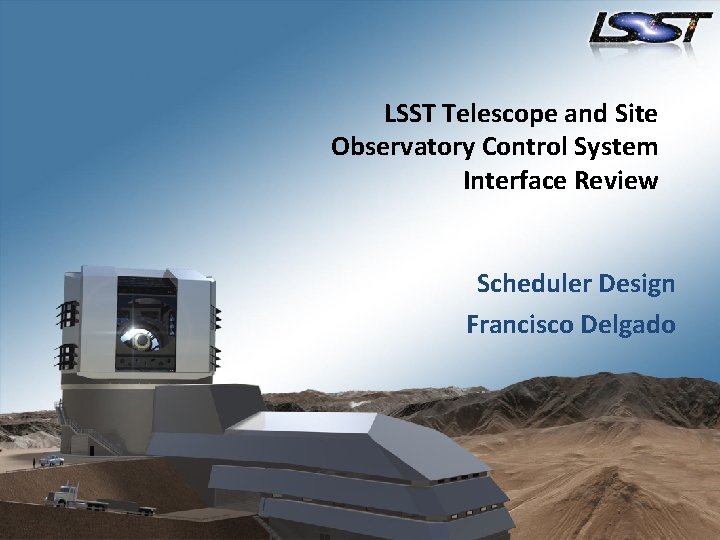
LSST Telescope and Site Observatory Control System Interface Review Scheduler Design Francisco Delgado
Addressing the Charge 2. Is the OCS design mature enough to support (i) the analysis of compliance with the requirements and (ii) the definition of interfaces? 9. Are the plans for implementing the OCS are adequate and realistic, including budget, schedule, and organization/management structure? Are the deliverables for the Scheduler and the Operations Simulator well defined and the corresponding resources properly aligned between the OCS and Systems Engineering teams? Are the deliverables for communication middleware well defined and the assigned resources adequate? Scheduler Design OCS Interface Review • Tucson, Arizona • September 10 -11, 2014 2

Scheduling the LSST Survey • LSST as a robotic observatory • Survey is automatic • Multiple science goals • Combine area distribution with temporal sampling • Dynamic adaptation to weather • Flexibility for survey adjustments during operations • Flexibility for changes in science programs Scheduler Design OCS Interface Review • Tucson, Arizona • September 10 -11, 2014 3

Requirements Flow down Science Requirements Document LPM-17 Science Collaborations Science Book LSST System Requirements LSE-29 Metrics Requirements DOC-15319 Observatory System Specifications LSE-30 Op. Sim Requirements LSE-189 Observatory Control System Requirements LSE-62 Scheduler Requirements LSE-190 Scheduler Design OCS Interface Review • Tucson, Arizona • September 10 -11, 2014 4
Scheduler Requirements Traceability Scheduler Design OCS Interface Review • Tucson, Arizona • September 10 -11, 2014 5
Scheduler concepts • Sky field map, tiling regions, a target is a field/filter combination. • Fully configurable set of concurrent competing science programs. • Sky brightness dynamically modeled for each sky field with lookahead window. • Comprehensive observatory kinematic model for slew time optimizations. • Target score balances science value and time cost Scheduler Design OCS Interface Review • Tucson, Arizona • September 10 -11, 2014 6
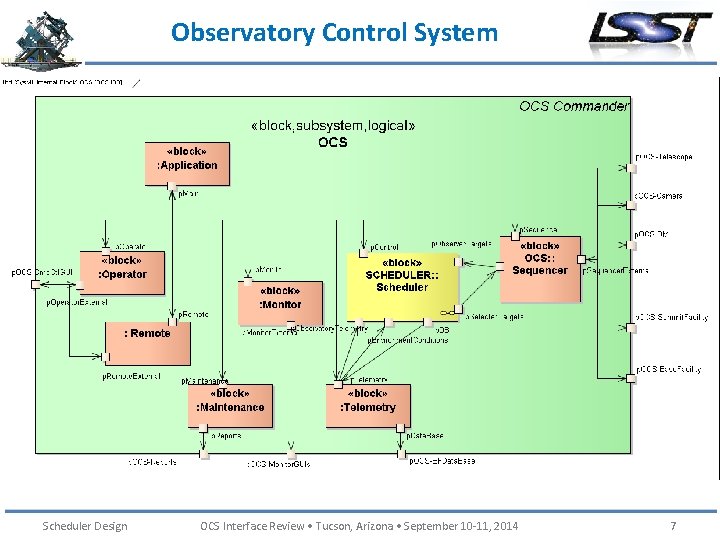
Observatory Control System Scheduler Design OCS Interface Review • Tucson, Arizona • September 10 -11, 2014 7
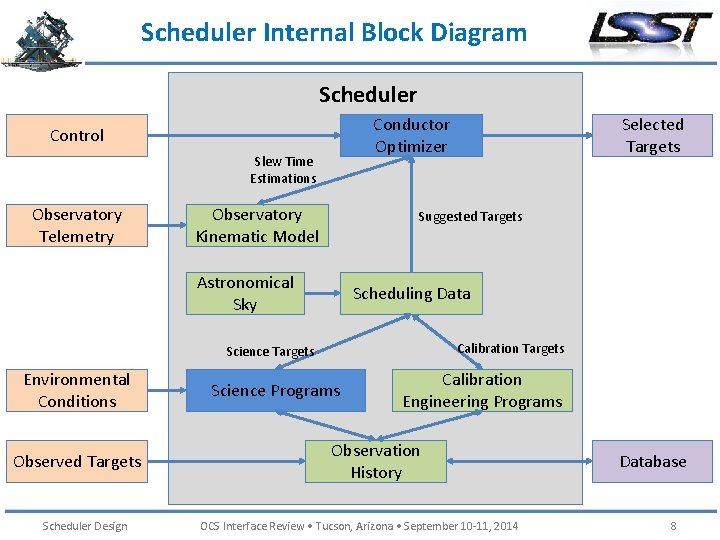
Scheduler Internal Block Diagram Scheduler Conductor Optimizer Control Slew Time Estimations Observatory Telemetry Observatory Kinematic Model Suggested Targets Astronomical Sky Scheduling Data Calibration Targets Science Targets Environmental Conditions Observed Targets Scheduler Design Selected Targets Science Programs Calibration Engineering Programs Observation History OCS Interface Review • Tucson, Arizona • September 10 -11, 2014 Database 8
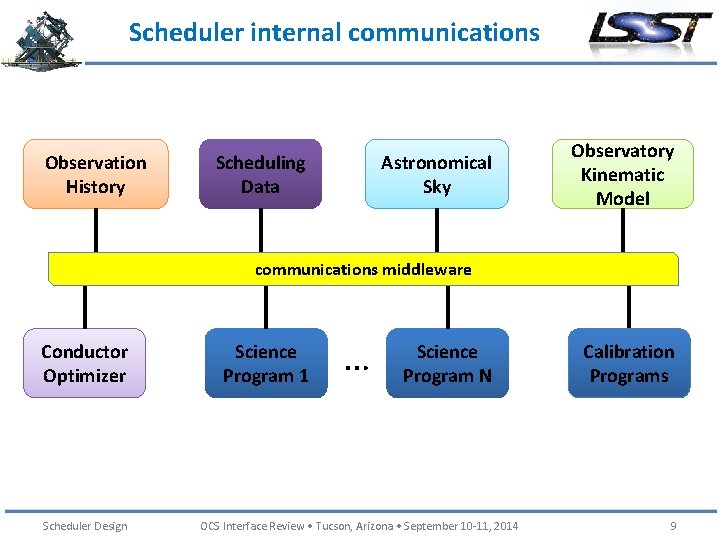
Scheduler internal communications Observation History Scheduling Data Astronomical Sky Observatory Kinematic Model communications middleware Conductor Optimizer Scheduler Design Science Program 1 … Science Program N OCS Interface Review • Tucson, Arizona • September 10 -11, 2014 Calibration Programs 9
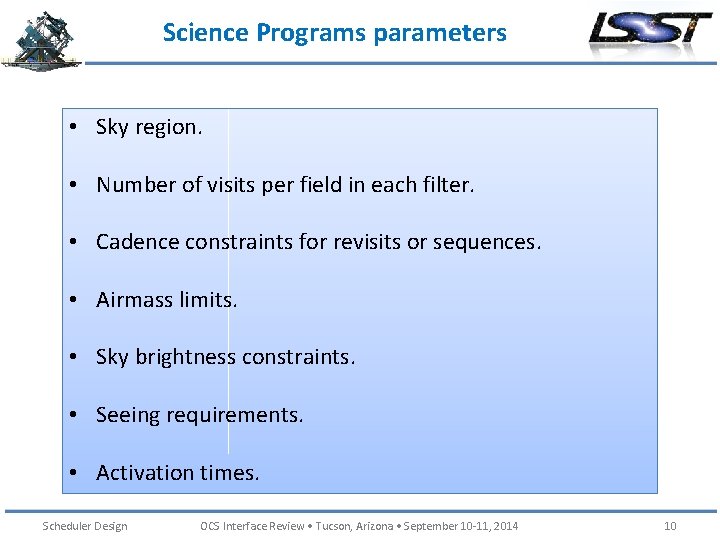
Science Programs parameters • Sky region. • Number of visits per field in each filter. • Cadence constraints for revisits or sequences. • Airmass limits. • Sky brightness constraints. • Seeing requirements. • Activation times. Scheduler Design OCS Interface Review • Tucson, Arizona • September 10 -11, 2014 10
Science Programs classes Ø Area distribution programs Ø Designed to obtain uniform distribution Ø Basic parameter: goal visits per filter Ø Look-ahead info: future available time for the targets Ø Time distribution programs Ø Designed to obtain specified intervals in sequences Ø Basic parameter: time window for visits interval Ø Look-ahead info: visibility for next intervals Scheduler Design OCS Interface Review • Tucson, Arizona • September 10 -11, 2014 11
Selecting the next visit q Dynamic and adaptive process for each visit: q Each science program: q analyzes its assigned sky region and selects the candidate targets that comply with its requirements. q computes the science merit for each selected target according to its own distribution and cadence constraints. q The conductor optimizer combines the targets and their science merit from all the science programs. q The observatory model computes the slew time cost for each target from the current position. q The target with the highest overall rank is selected. Scheduler Design OCS Interface Review • Tucson, Arizona • September 10 -11, 2014 12
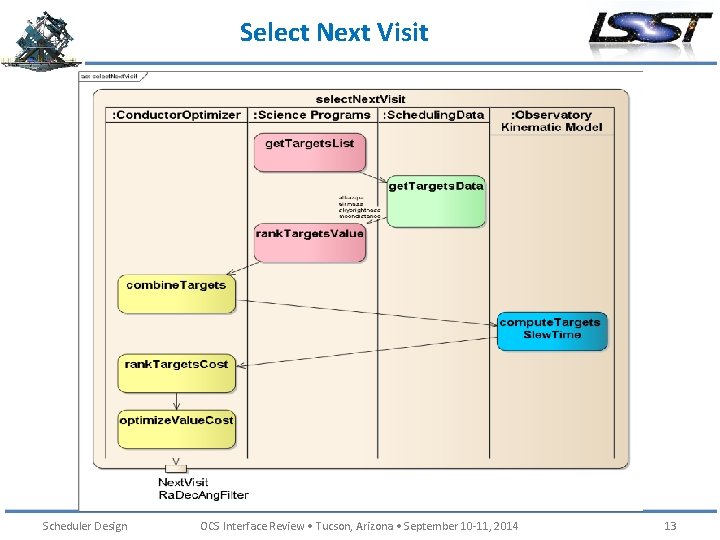
Select Next Visit Scheduler Design OCS Interface Review • Tucson, Arizona • September 10 -11, 2014 13
Look-ahead q A time window is defined for a number of nights to the future. q For each target from the candidates list: q Airmass and sky-brightness are pre-calculated. q Visibility is determined from each science program constraints. q Science programs have this look-ahead information for improving time distribution and efficiency in sequences. Scheduler Design OCS Interface Review • Tucson, Arizona • September 10 -11, 2014 14
Operations Simulator • System simulation and prototype for the Scheduler • Validate observatory design • Design science programs to achieve SRD • Develop an efficient LSST scheduling strategy • Systems engineering trade off studies • Support Commissioning and Operations Scheduler Design OCS Interface Review • Tucson, Arizona • September 10 -11, 2014 15
Op. Sim requirements • Simulate Operations visit by visit for 10 years • Simulate Observatory (Telescope & Camera kinematics, slew & track) • Simulate Environment (clouds, seeing, sky brightness) • Prototype Scheduler (targets generation and scheduling algorithms) • Set of proposals, SRD defined universal plus auxiliary projects • Flexibility for algorithm experimentation Scheduler Design OCS Interface Review • Tucson, Arizona • September 10 -11, 2014 16
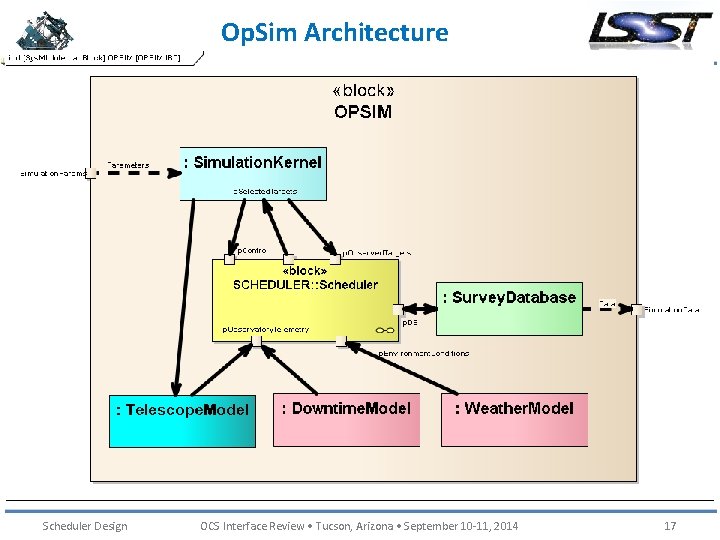
Op. Sim Architecture Scheduler Design OCS Interface Review • Tucson, Arizona • September 10 -11, 2014 17
Environment Models • slalib for sun & moon • Sophisticated sky brightness model using the Krisciunas and Schaeffer model with twilight. • Actual seeing historic measurements from the site. • Actual clouds historic record from the site. Scheduler Design OCS Interface Review • Tucson, Arizona • September 10 -11, 2014 18
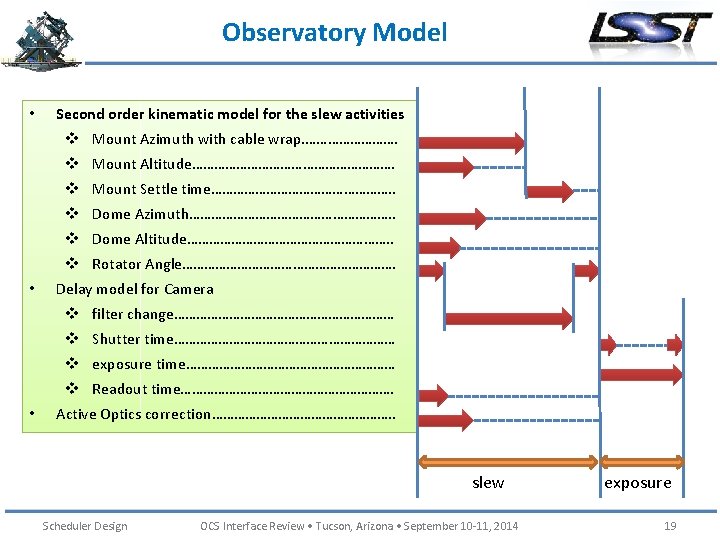
Observatory Model • Second order kinematic model for the slew activities v Mount Azimuth with cable wrap. …………. v Mount Altitude………………………. v Mount Settle time……………………. . v Dome Azimuth………………………. . v Dome Altitude………………………. . v Rotator Angle…………………………. • Delay model for Camera v filter change………………………… v Shutter time………………………… v exposure time………………………… v Readout time…………………………. • Active Optics correction……………………. . slew Scheduler Design OCS Interface Review • Tucson, Arizona • September 10 -11, 2014 exposure 19
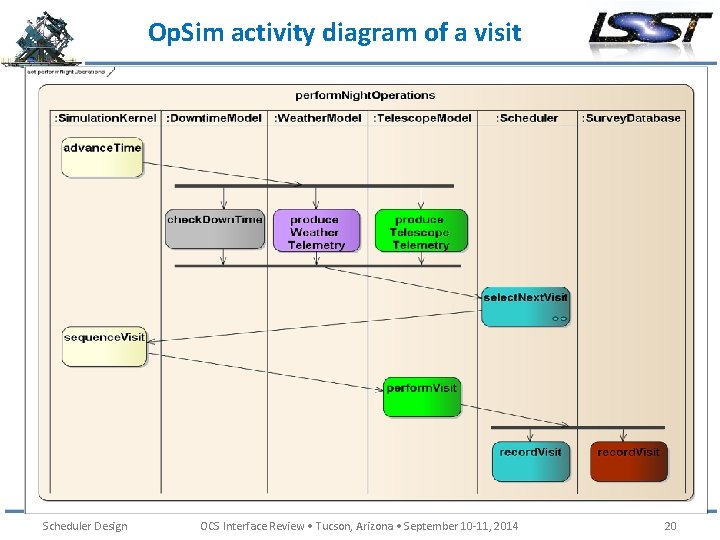
Op. Sim activity diagram of a visit Scheduler Design OCS Interface Review • Tucson, Arizona • September 10 -11, 2014 20
Op. Sim implementation • Python language for the logic and data handling C++ for libraries, such as slalib 20 k lines of code approx. • Typical 10 year run takes 50 hours in personal computers • My. SQL database with 22 tables for the history of visits, slews and sequences, sky conditions, etc. Scheduler Design OCS Interface Review • Tucson, Arizona • September 10 -11, 2014 21
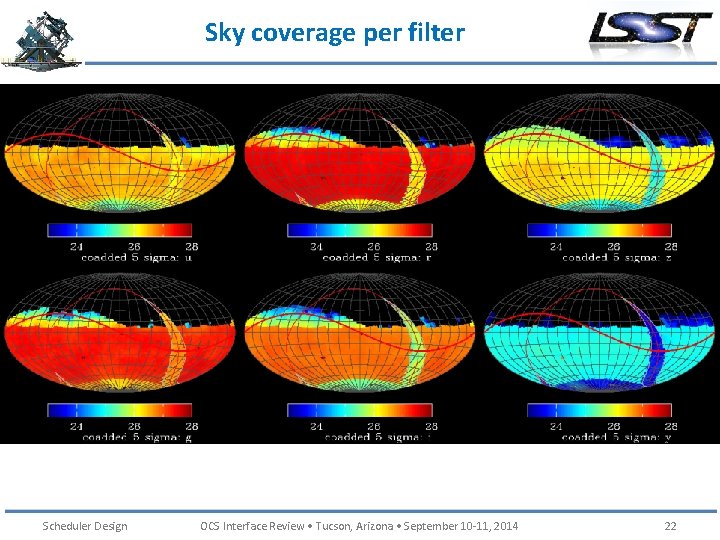
Sky coverage per filter Scheduler Design OCS Interface Review • Tucson, Arizona • September 10 -11, 2014 22
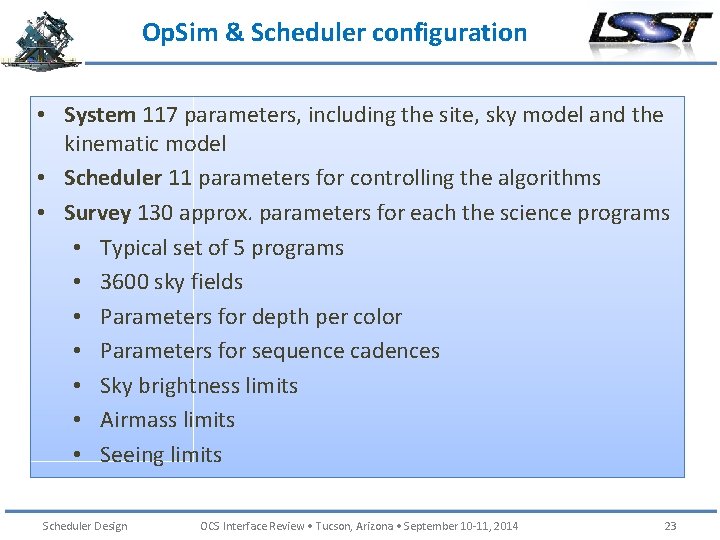
Op. Sim & Scheduler configuration • System 117 parameters, including the site, sky model and the kinematic model • Scheduler 11 parameters for controlling the algorithms • Survey 130 approx. parameters for each the science programs • Typical set of 5 programs • 3600 sky fields • Parameters for depth per color • Parameters for sequence cadences • Sky brightness limits • Airmass limits • Seeing limits Scheduler Design OCS Interface Review • Tucson, Arizona • September 10 -11, 2014 23
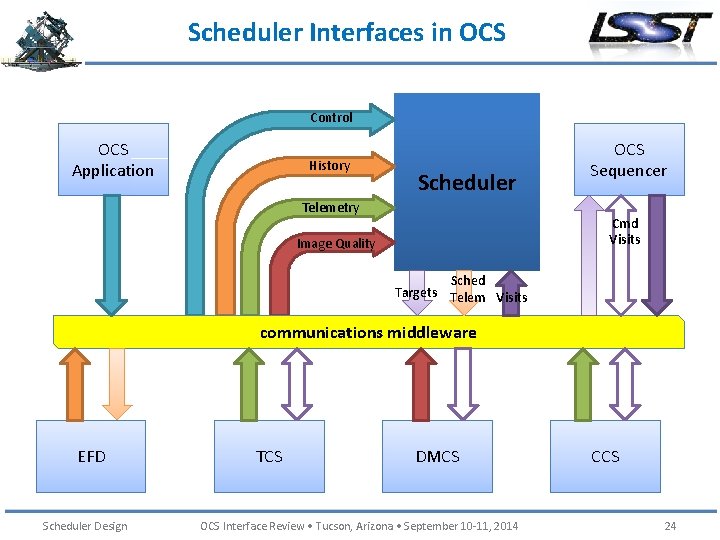
Scheduler Interfaces in OCS Control OCS Application History Scheduler Telemetry OCS Sequencer Cmd Visits Image Quality Sched Targets Telem Visits communications middleware EFD Scheduler Design TCS DMCS OCS Interface Review • Tucson, Arizona • September 10 -11, 2014 CCS 24
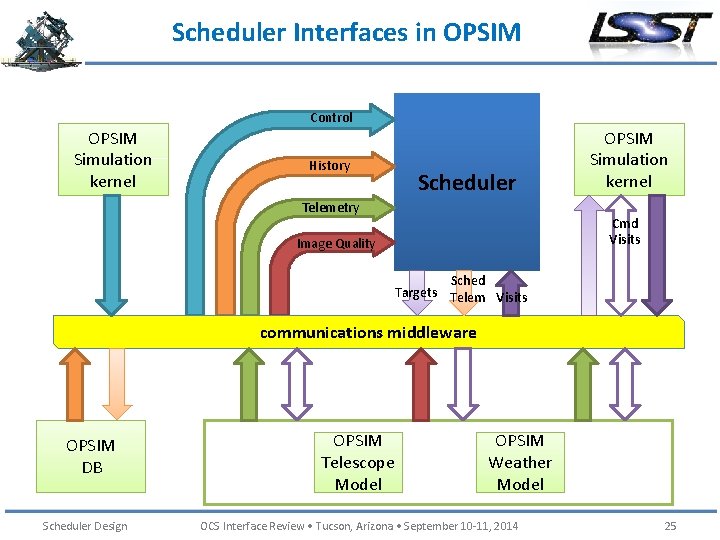
Scheduler Interfaces in OPSIM Control OPSIM Simulation kernel History Scheduler Telemetry OPSIM Simulation kernel Cmd Visits Image Quality Sched Targets Telem Visits communications middleware OPSIM DB Scheduler Design OPSIM Telescope Model OPSIM Weather Model OCS Interface Review • Tucson, Arizona • September 10 -11, 2014 25
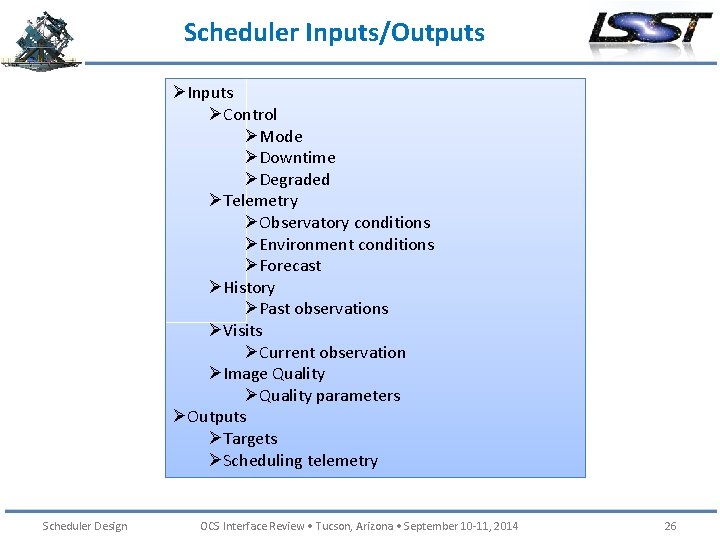
Scheduler Inputs/Outputs ØInputs ØControl ØMode ØDowntime ØDegraded ØTelemetry ØObservatory conditions ØEnvironment conditions ØForecast ØHistory ØPast observations ØVisits ØCurrent observation ØImage Quality ØQuality parameters ØOutputs ØTargets ØScheduling telemetry Scheduler Design OCS Interface Review • Tucson, Arizona • September 10 -11, 2014 26
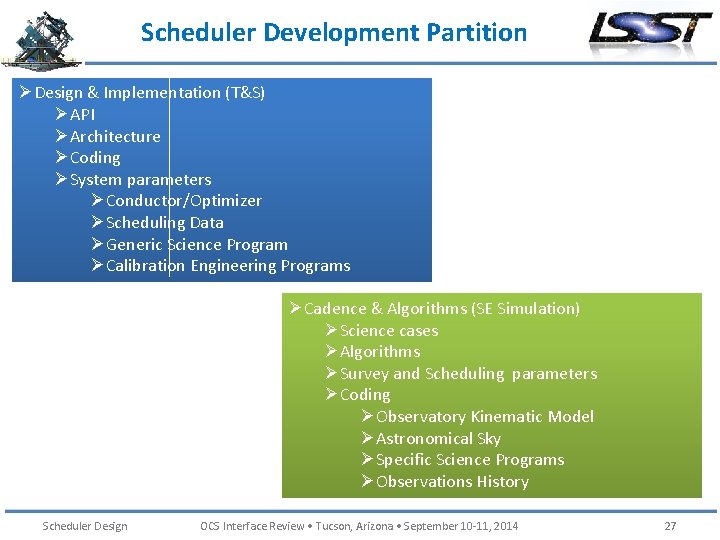
Scheduler Development Partition ØDesign & Implementation (T&S) ØAPI ØArchitecture ØCoding ØSystem parameters ØConductor/Optimizer ØScheduling Data ØGeneric Science Program ØCalibration Engineering Programs ØCadence & Algorithms (SE Simulation) ØScience cases ØAlgorithms ØSurvey and Scheduling parameters ØCoding ØObservatory Kinematic Model ØAstronomical Sky ØSpecific Science Programs ØObservations History Scheduler Design OCS Interface Review • Tucson, Arizona • September 10 -11, 2014 27
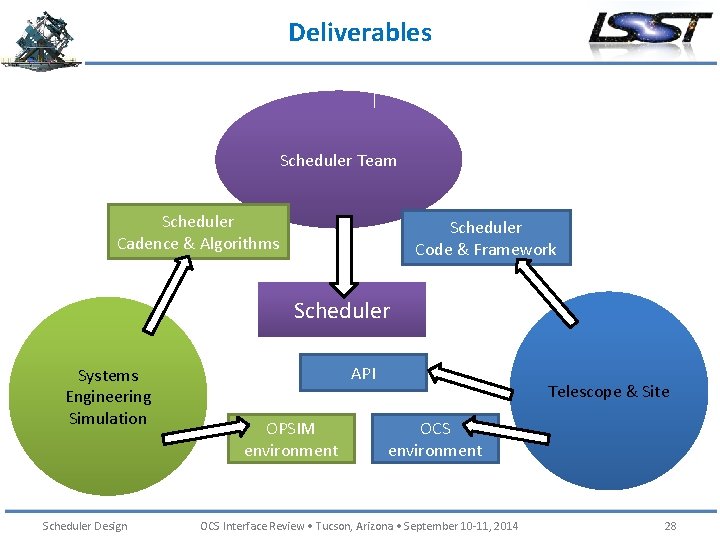
Deliverables Scheduler Team Scheduler Cadence & Algorithms Scheduler Code & Framework Scheduler Systems Engineering Simulation Scheduler Design API OPSIM environment Telescope & Site OCS environment OCS Interface Review • Tucson, Arizona • September 10 -11, 2014 28
Summary ØScheduler design integrated with OCS architecture. ØOCS telemetry architecture enables the use of any variable for scheduling purposes. ØPartition and architecture makes for a flexible implementation. ØDesigned to allow a distributed deployment. ØScheduling strategies have been extensively tested in Op. Sim. ØSimple scheduling algorithms applied to thousands of competing targets produce emerging behavior to solve a complex problem. Scheduler Design OCS Interface Review • Tucson, Arizona • September 10 -11, 2014 29
End of Presentation
Backup slides Scheduler Design OCS Interface Review • Tucson, Arizona • September 10 -11, 2014 31
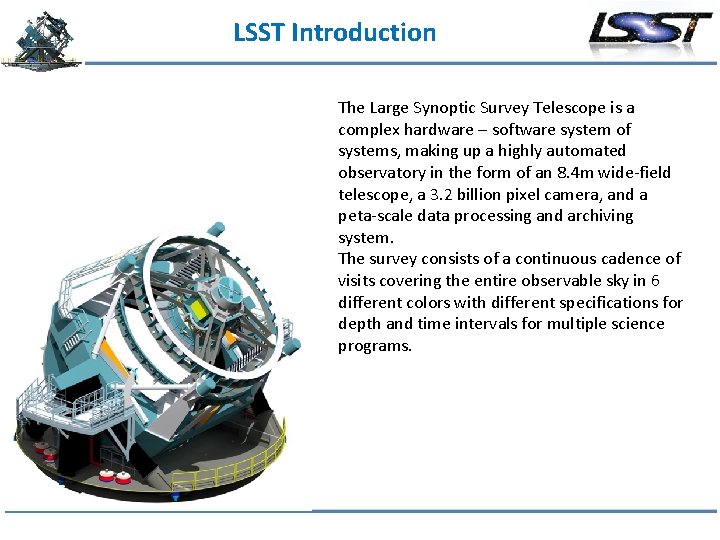
LSST Introduction The Large Synoptic Survey Telescope is a complex hardware – software system of systems, making up a highly automated observatory in the form of an 8. 4 m wide-field telescope, a 3. 2 billion pixel camera, and a peta-scale data processing and archiving system. The survey consists of a continuous cadence of visits covering the entire observable sky in 6 different colors with different specifications for depth and time intervals for multiple science programs.
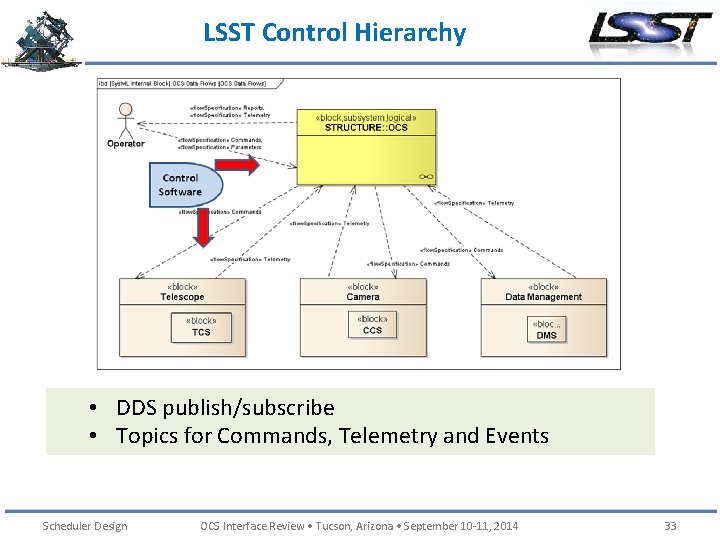
LSST Control Hierarchy • DDS publish/subscribe • Topics for Commands, Telemetry and Events Scheduler Design OCS Interface Review • Tucson, Arizona • September 10 -11, 2014 33
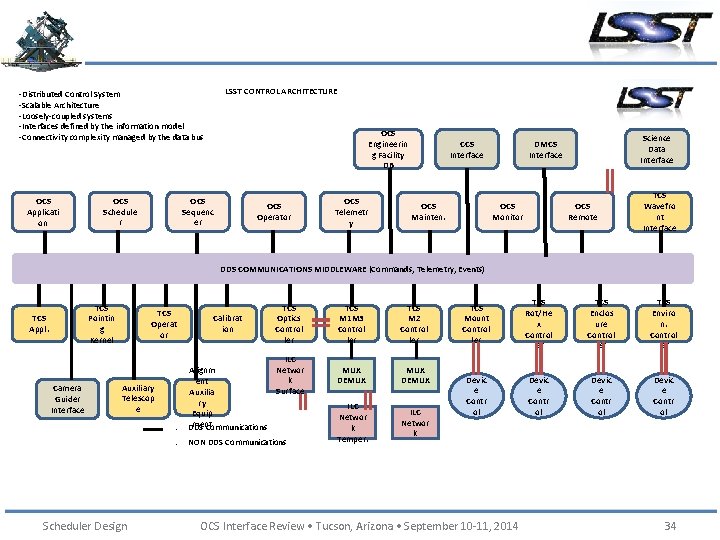
LSST CONTROL ARCHITECTURE -Distributed Control System -Scalable Architecture -Loosely-coupled systems -Interfaces defined by the information model -Connectivity complexity managed by the data bus OCS Applicati on OCS Schedule r OCS Engineerin g Facility DB OCS Sequenc er OCS Operator OCS Telemetr y CCS Interface OCS Monitor OCS Mainten. Science Data Interface DMCS Interface OCS Remote TCS Wavefro nt Interface DDS COMMUNICATIONS MIDDLEWARE (Commands, Telemetry, Events) TCS Pointin g Kernel TCS Appl. Camera Guider Interface TCS Operat or TCS M 1 M 3 Control ler TCS M 2 Control ler ILC Networ k Surface MUX DEMUX ILC Networ k Temper. ILC Networ k : Alignm ent Auxilia ry Equip ment DDS Communications : NON DDS Communications Auxiliary Telescop e Scheduler Design Calibrat ion TCS Optics Control ler TCS Mount Control ler TCS Rot/He x Control ler TCS Enclos ure Control ler TCS Enviro n. Control ler Devic e Contr ol OCS Interface Review • Tucson, Arizona • September 10 -11, 2014 34
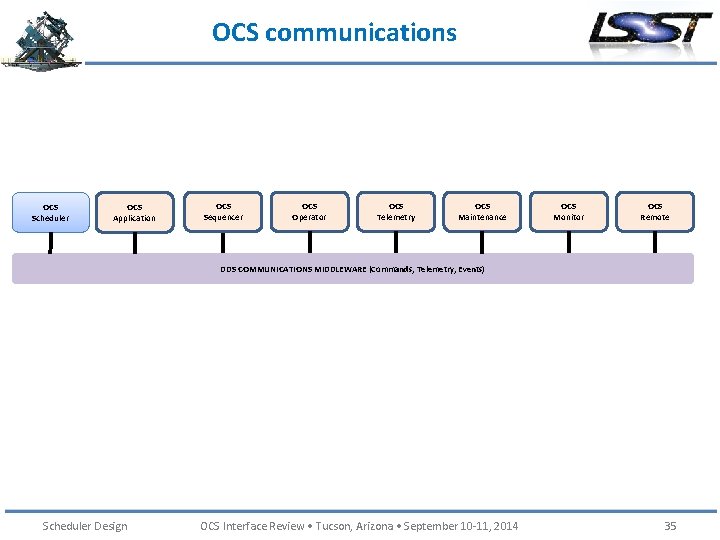
OCS communications OCS Scheduler OCS Application OCS Sequencer OCS Operator OCS Telemetry OCS Maintenance OCS Monitor OCS Remote DDS COMMUNICATIONS MIDDLEWARE (Commands, Telemetry, Events) Scheduler Design OCS Interface Review • Tucson, Arizona • September 10 -11, 2014 35
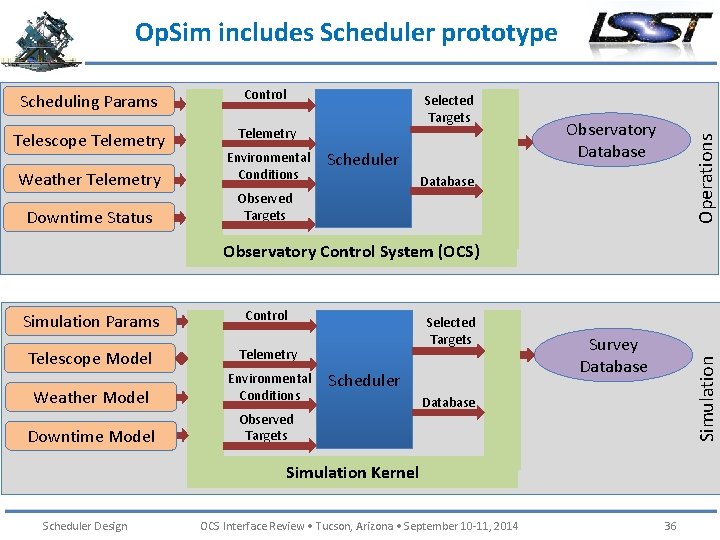
Op. Sim includes Scheduler prototype Control Telescope Telemetry Weather Telemetry Downtime Status Environmental Conditions Selected Targets Scheduler Observatory Database Operations Scheduling Params Database Observed Targets Observatory Control System (OCS) Control Telescope Model Telemetry Weather Model Environmental Conditions Downtime Model Observed Targets Selected Targets Scheduler Survey Database Simulation Params Database Simulation Kernel Scheduler Design OCS Interface Review • Tucson, Arizona • September 10 -11, 2014 36
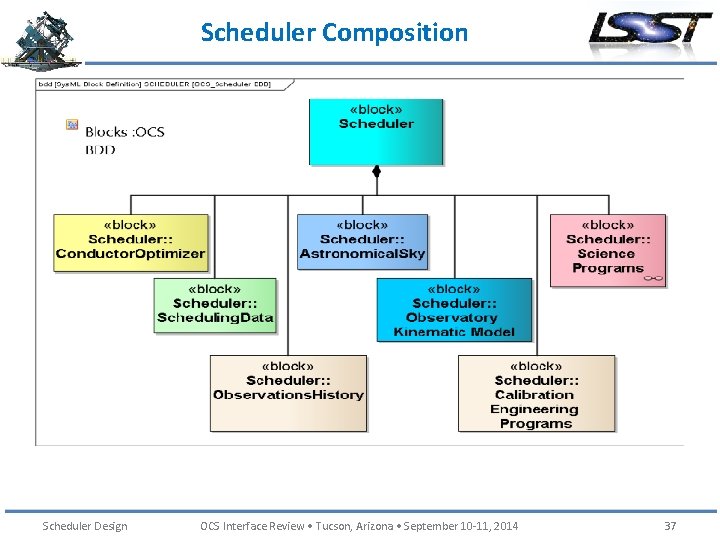
Scheduler Composition Scheduler Design OCS Interface Review • Tucson, Arizona • September 10 -11, 2014 37
Model Based Systems Engineering (MBSE) • The LSST uses MBSE to capture the high level system development • The language is Sys. ML • The tool is Enterprise Architect • The model captures and relates: – – – Requirements Interfaces Overall System Architecture Components Structure System Behavior Operational Definitions • Document 9336 “Using Sys. ML for MBSE Analysis of the LSST System
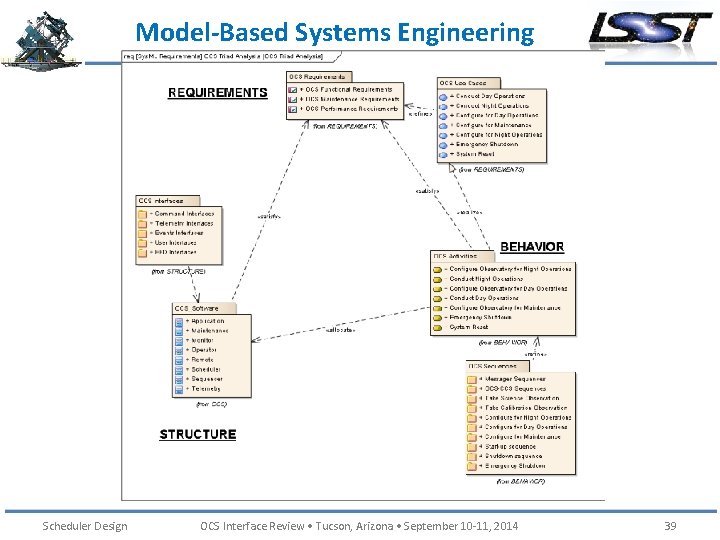
Model-Based Systems Engineering Scheduler Design OCS Interface Review • Tucson, Arizona • September 10 -11, 2014 39
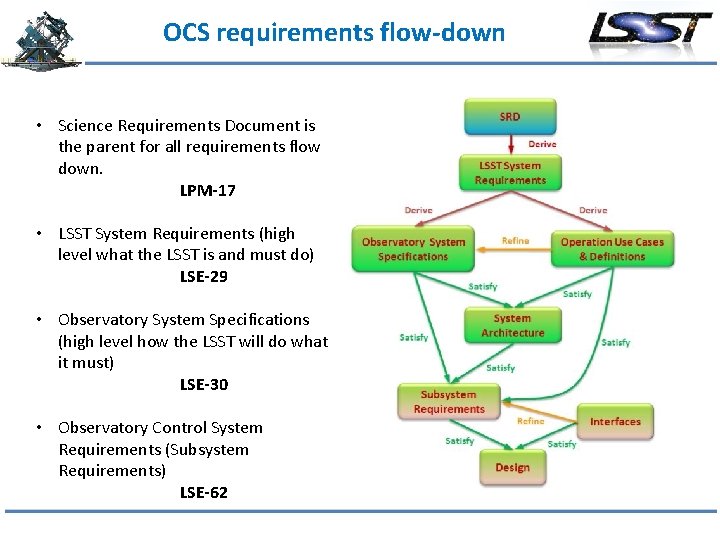
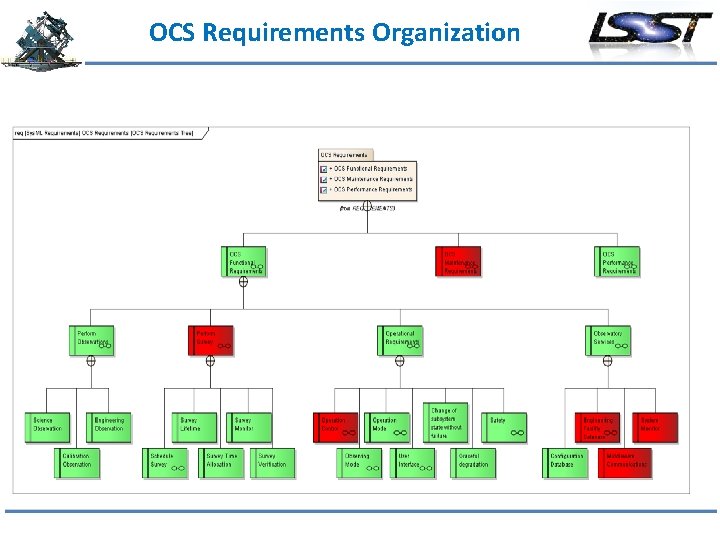
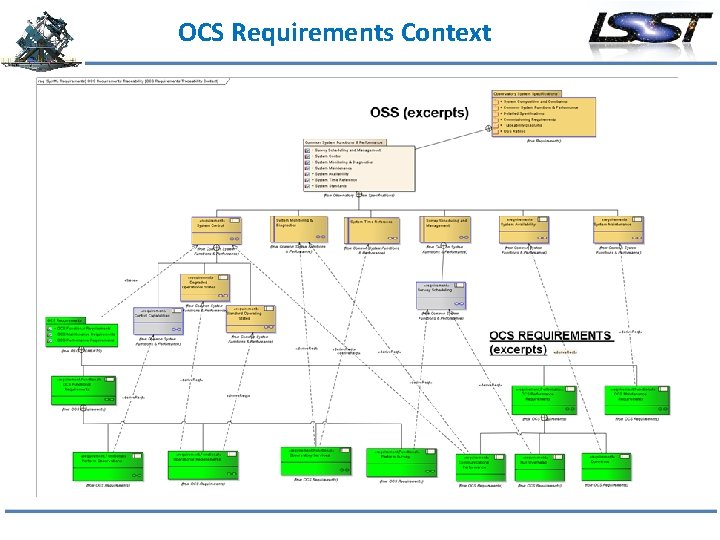
OCS requirements flow-down • Science Requirements Document is the parent for all requirements flow down. LPM-17 • LSST System Requirements (high level what the LSST is and must do) LSE-29 • Observatory System Specifications (high level how the LSST will do what it must) LSE-30 • Observatory Control System Requirements (Subsystem Requirements) LSE-62
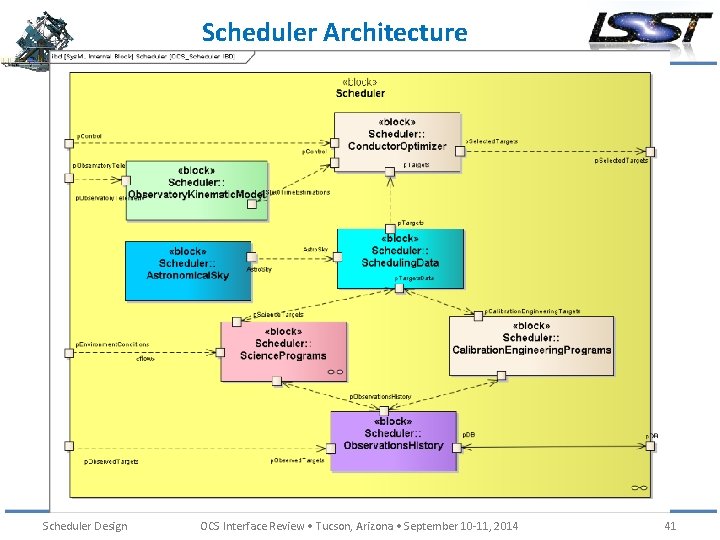
Scheduler Architecture Scheduler Design OCS Interface Review • Tucson, Arizona • September 10 -11, 2014 41
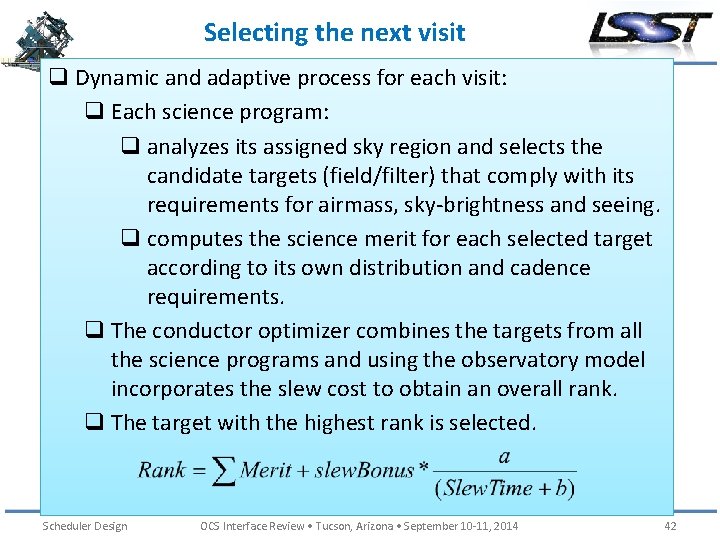
Selecting the next visit q Dynamic and adaptive process for each visit: q Each science program: q analyzes its assigned sky region and selects the candidate targets (field/filter) that comply with its requirements for airmass, sky-brightness and seeing. q computes the science merit for each selected target according to its own distribution and cadence requirements. q The conductor optimizer combines the targets from all the science programs and using the observatory model incorporates the slew cost to obtain an overall rank. q The target with the highest rank is selected. Scheduler Design OCS Interface Review • Tucson, Arizona • September 10 -11, 2014 42
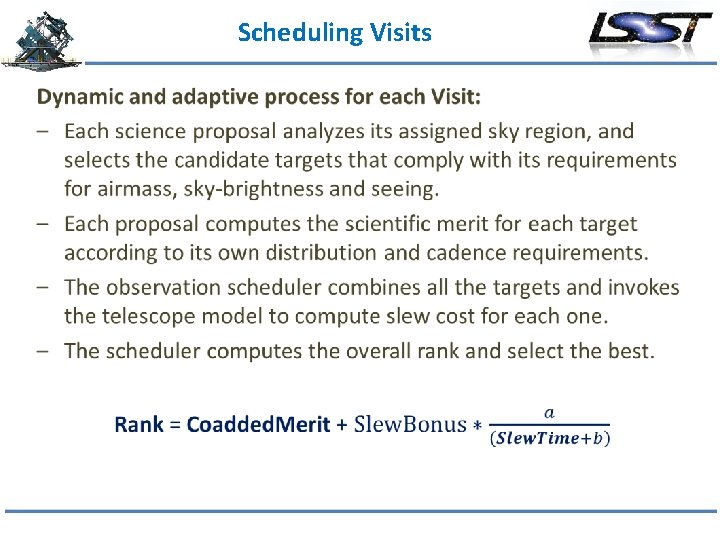
Scheduling Visits
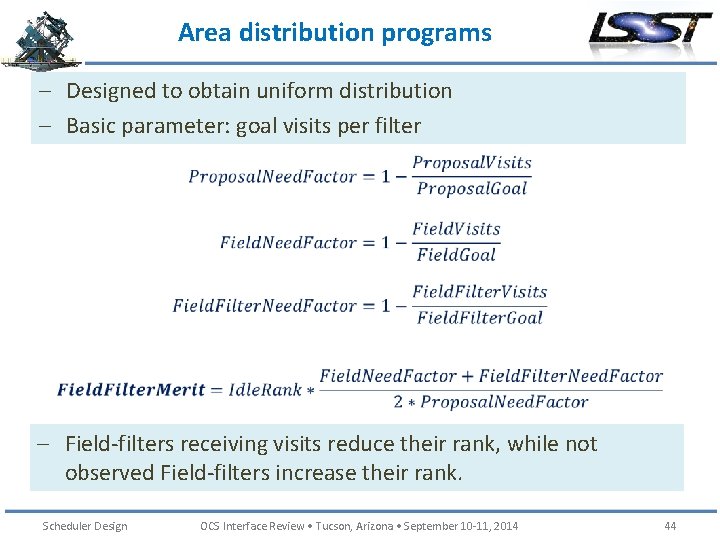
Area distribution programs – Designed to obtain uniform distribution – Basic parameter: goal visits per filter – Field-filters receiving visits reduce their rank, while not observed Field-filters increase their rank. Scheduler Design OCS Interface Review • Tucson, Arizona • September 10 -11, 2014 44
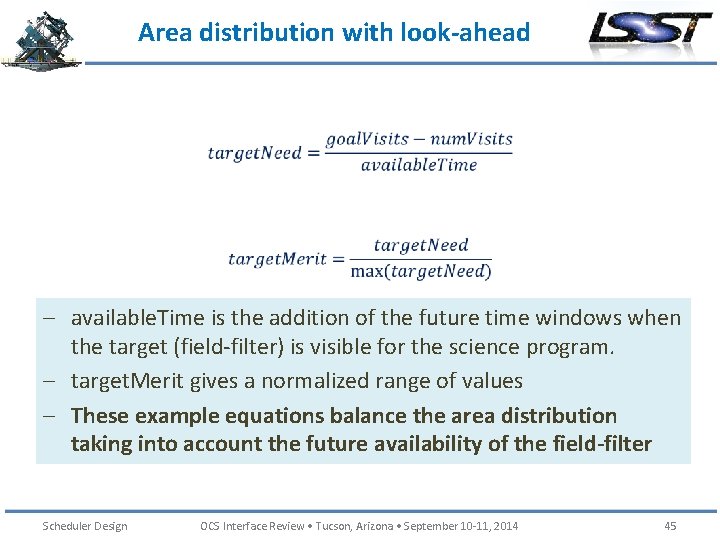
Area distribution with look-ahead – available. Time is the addition of the future time windows when the target (field-filter) is visible for the science program. – target. Merit gives a normalized range of values – These example equations balance the area distribution taking into account the future availability of the field-filter Scheduler Design OCS Interface Review • Tucson, Arizona • September 10 -11, 2014 45
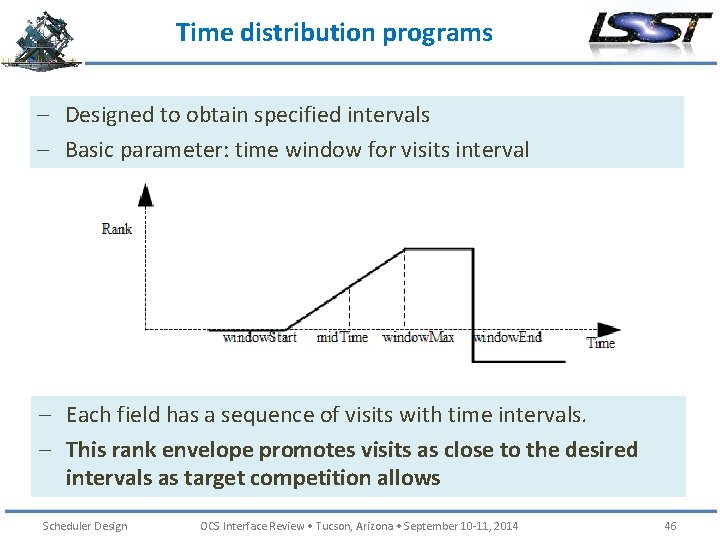
Time distribution programs – Designed to obtain specified intervals – Basic parameter: time window for visits interval – Each field has a sequence of visits with time intervals. – This rank envelope promotes visits as close to the desired intervals as target competition allows Scheduler Design OCS Interface Review • Tucson, Arizona • September 10 -11, 2014 46
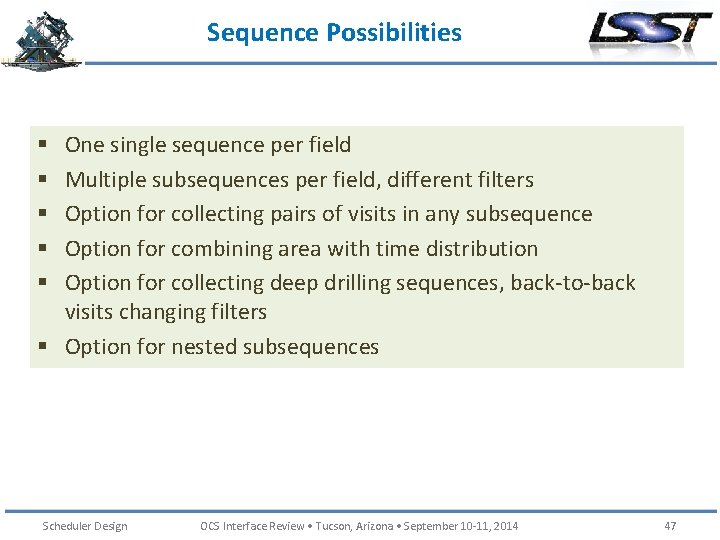
Sequence Possibilities One single sequence per field Multiple subsequences per field, different filters Option for collecting pairs of visits in any subsequence Option for combining area with time distribution Option for collecting deep drilling sequences, back-to-back visits changing filters § Option for nested subsequences § § § Scheduler Design OCS Interface Review • Tucson, Arizona • September 10 -11, 2014 47
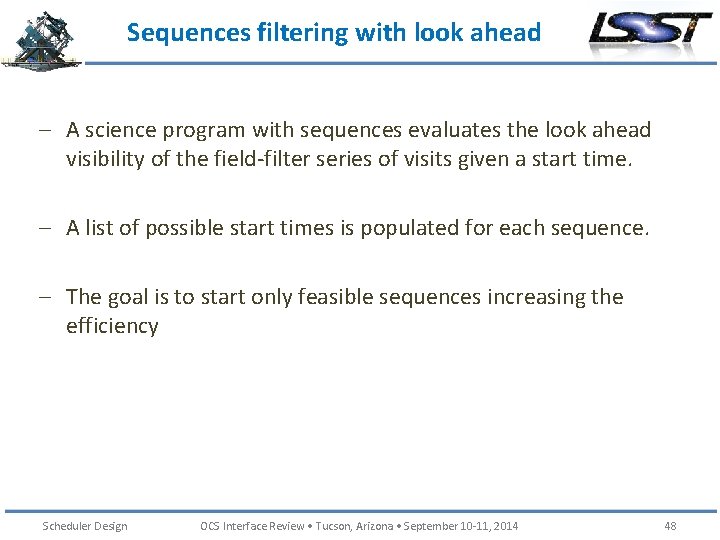
Sequences filtering with look ahead – A science program with sequences evaluates the look ahead visibility of the field-filter series of visits given a start time. – A list of possible start times is populated for each sequence. – The goal is to start only feasible sequences increasing the efficiency Scheduler Design OCS Interface Review • Tucson, Arizona • September 10 -11, 2014 48
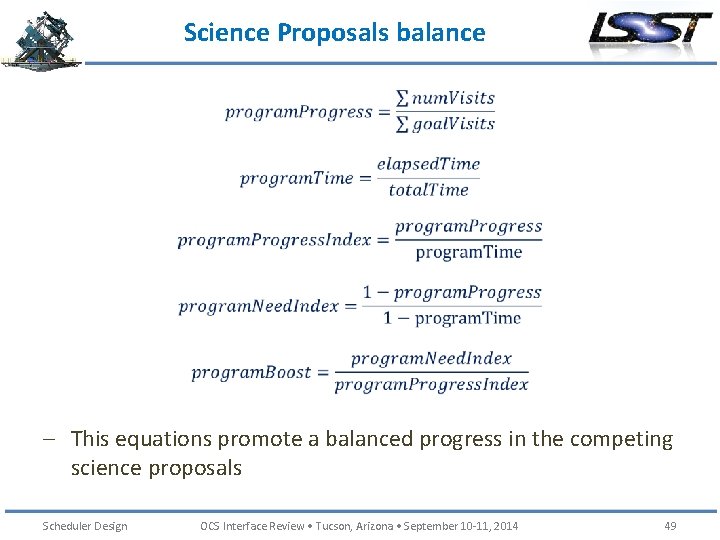
Science Proposals balance – This equations promote a balanced progress in the competing science proposals Scheduler Design OCS Interface Review • Tucson, Arizona • September 10 -11, 2014 49
Summary ØPowerful tool for designing the survey and systems engineering ØOp. Sim was key on site-selection, validation of telescope-camera specifications, and demonstrated that the science requirements could be met. ØOp. Sim-Scheduler as a prototype for OCS-Scheduler. ØOp. Sim as a simulation environment for the Scheduler prototype. ØOp. Sim will be evolved into an operational tool for survey assessment and planning. ØNew look-ahead capabilities and scheduling algorithms in development. Scheduler Design OCS Interface Review • Tucson, Arizona • September 10 -11, 2014 50
Operations Simulator • Verify the specifications of LSST hardware and survey against SRD • Experiment with sets of science programs • Experiment scheduling algorithms and strategies • Systems engineering trade off studies • Refine requirements for OCS Scheduler
Operations Simulator Software package for simulating the 10 years survey in a visit by visit, slew by slew detail. Detailed kinematic model of the telescope+camera+dome Sophisticated sky model, calculating sky brightness using the Krisciunas and Schaeffer model. It tracks the sun and moon using SLALIB routines. Actual seeing and clouds historic tables from the site. Multiple science programs that implement a cadence that satisfies the science requirements.
Operations Simulator Requirements • Simulate Operations • Simulate Observatory (Telescope & Camera kinematics, slew & track) • Simulate Environment (clouds, seeing, sky brightness) • Prototype Scheduler (targets generation and scheduling algorithms) • Set of proposals, SRD defined universal plus key projects • Flexibility for algorithm experimentation
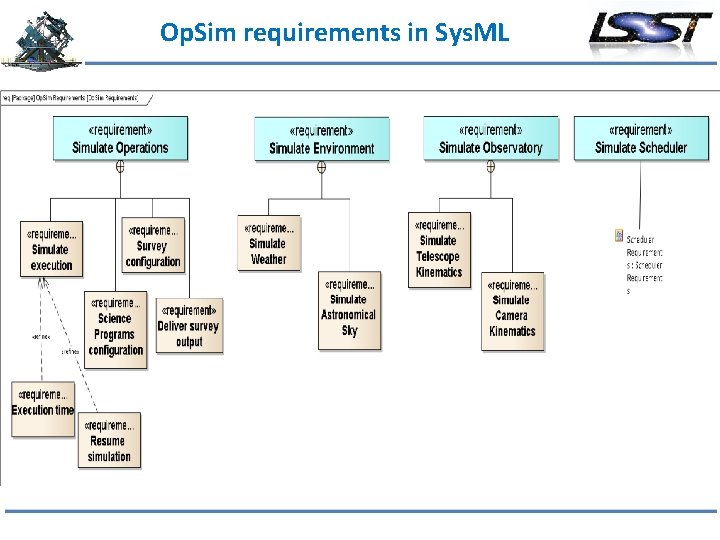
Op. Sim requirements in Sys. ML
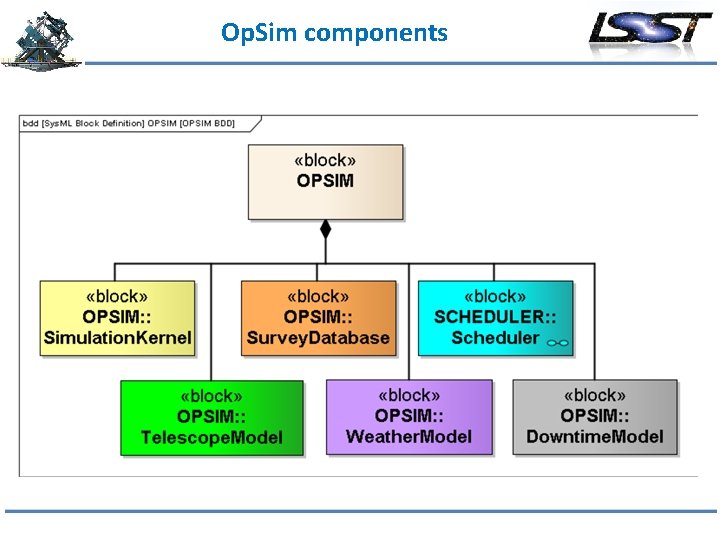
Op. Sim components
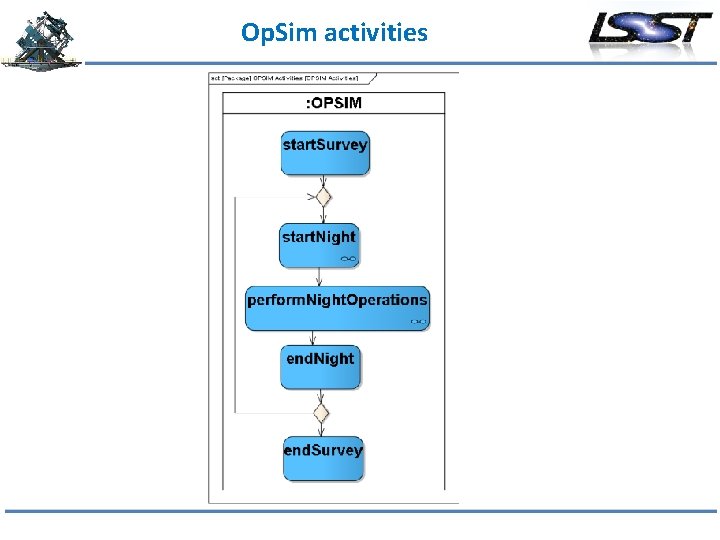
Op. Sim activities
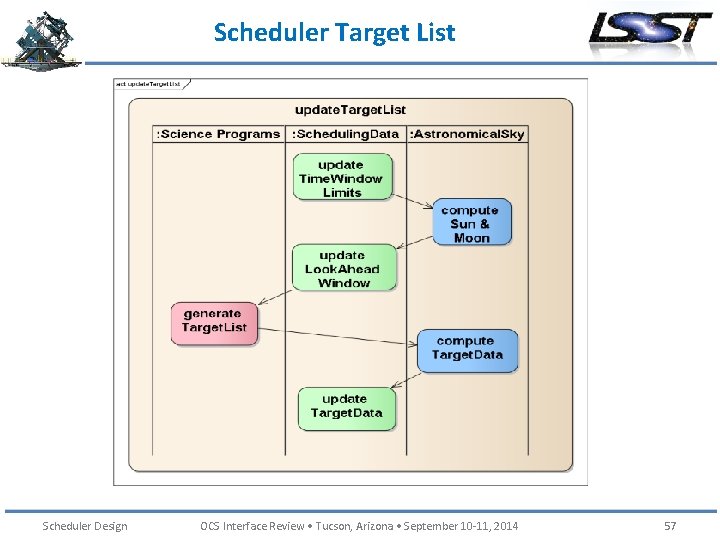
Scheduler Target List Scheduler Design OCS Interface Review • Tucson, Arizona • September 10 -11, 2014 57
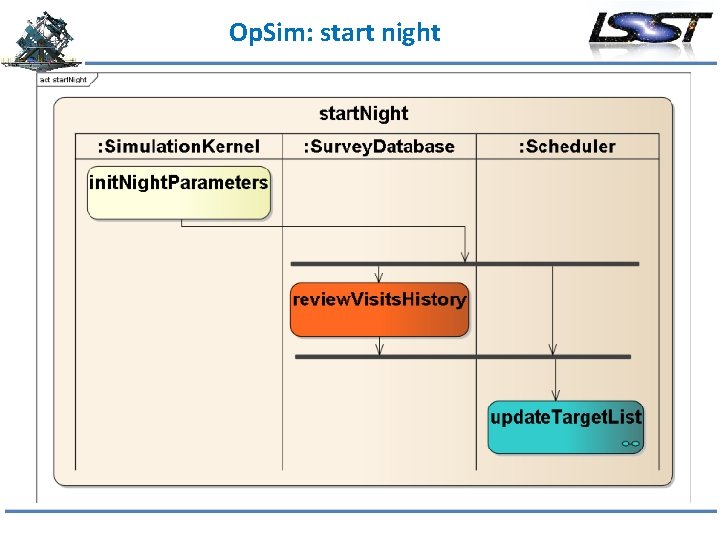
Op. Sim: start night
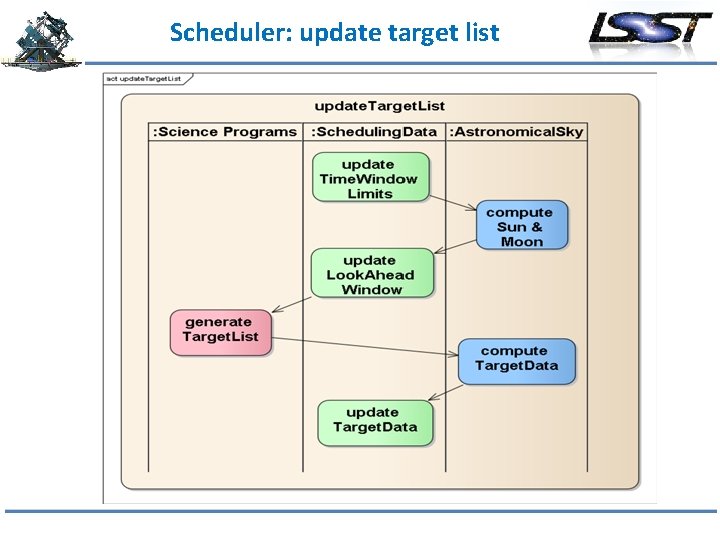
Scheduler: update target list
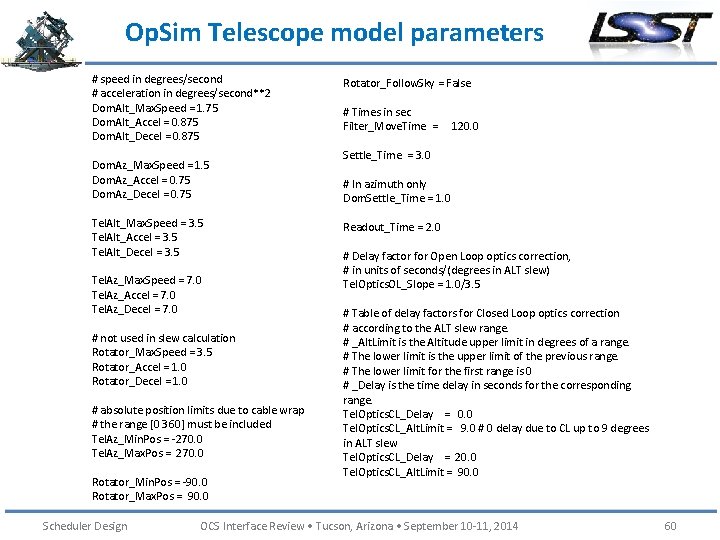
Op. Sim Telescope model parameters # speed in degrees/second # acceleration in degrees/second**2 Dom. Alt_Max. Speed = 1. 75 Dom. Alt_Accel = 0. 875 Dom. Alt_Decel = 0. 875 Dom. Az_Max. Speed = 1. 5 Dom. Az_Accel = 0. 75 Dom. Az_Decel = 0. 75 Tel. Alt_Max. Speed = 3. 5 Tel. Alt_Accel = 3. 5 Tel. Alt_Decel = 3. 5 Tel. Az_Max. Speed = 7. 0 Tel. Az_Accel = 7. 0 Tel. Az_Decel = 7. 0 # not used in slew calculation Rotator_Max. Speed = 3. 5 Rotator_Accel = 1. 0 Rotator_Decel = 1. 0 # absolute position limits due to cable wrap # the range [0 360] must be included Tel. Az_Min. Pos = -270. 0 Tel. Az_Max. Pos = 270. 0 Rotator_Min. Pos = -90. 0 Rotator_Max. Pos = 90. 0 Scheduler Design Rotator_Follow. Sky = False # Times in sec Filter_Move. Time = 120. 0 Settle_Time = 3. 0 # In azimuth only Dom. Settle_Time = 1. 0 Readout_Time = 2. 0 # Delay factor for Open Loop optics correction, # in units of seconds/(degrees in ALT slew) Tel. Optics. OL_Slope = 1. 0/3. 5 # Table of delay factors for Closed Loop optics correction # according to the ALT slew range. # _Alt. Limit is the Altitude upper limit in degrees of a range. # The lower limit is the upper limit of the previous range. # The lower limit for the first range is 0 # _Delay is the time delay in seconds for the corresponding range. Tel. Optics. CL_Delay = 0. 0 Tel. Optics. CL_Alt. Limit = 9. 0 # 0 delay due to CL up to 9 degrees in ALT slew Tel. Optics. CL_Delay = 20. 0 Tel. Optics. CL_Alt. Limit = 90. 0 OCS Interface Review • Tucson, Arizona • September 10 -11, 2014 60
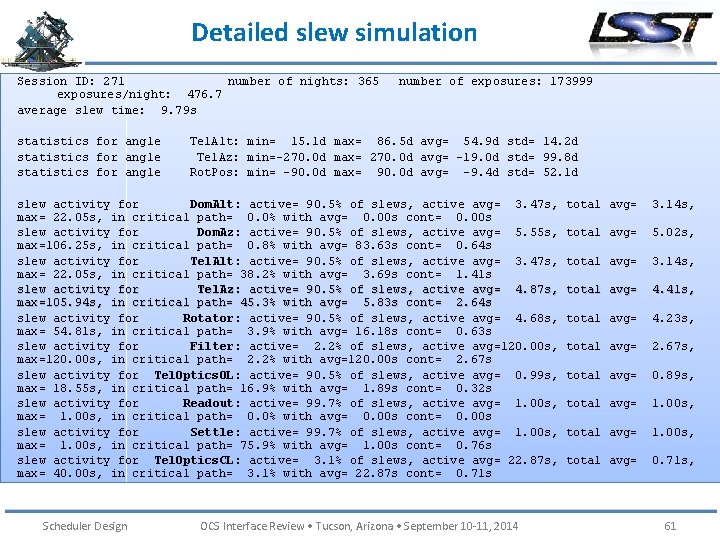
Detailed slew simulation Session ID: 271 number of nights: 365 exposures/night: 476. 7 average slew time: 9. 79 s statistics for angle number of exposures: 173999 Tel. Alt: min= 15. 1 d max= 86. 5 d avg= 54. 9 d std= 14. 2 d Tel. Az: min=-270. 0 d max= 270. 0 d avg= -19. 0 d std= 99. 8 d Rot. Pos: min= -90. 0 d max= 90. 0 d avg= -9. 4 d std= 52. 1 d slew activity for Dom. Alt: active= 90. 5% of slews, active avg= 3. 47 s, max= 22. 05 s, in critical path= 0. 0% with avg= 0. 00 s cont= 0. 00 s slew activity for Dom. Az: active= 90. 5% of slews, active avg= 5. 55 s, max=106. 25 s, in critical path= 0. 8% with avg= 83. 63 s cont= 0. 64 s slew activity for Tel. Alt: active= 90. 5% of slews, active avg= 3. 47 s, max= 22. 05 s, in critical path= 38. 2% with avg= 3. 69 s cont= 1. 41 s slew activity for Tel. Az: active= 90. 5% of slews, active avg= 4. 87 s, max=105. 94 s, in critical path= 45. 3% with avg= 5. 83 s cont= 2. 64 s slew activity for Rotator: active= 90. 5% of slews, active avg= 4. 68 s, max= 54. 81 s, in critical path= 3. 9% with avg= 16. 18 s cont= 0. 63 s slew activity for Filter: active= 2. 2% of slews, active avg=120. 00 s, max=120. 00 s, in critical path= 2. 2% with avg=120. 00 s cont= 2. 67 s slew activity for Tel. Optics. OL: active= 90. 5% of slews, active avg= 0. 99 s, max= 18. 55 s, in critical path= 16. 9% with avg= 1. 89 s cont= 0. 32 s slew activity for Readout: active= 99. 7% of slews, active avg= 1. 00 s, max= 1. 00 s, in critical path= 0. 0% with avg= 0. 00 s cont= 0. 00 s slew activity for Settle: active= 99. 7% of slews, active avg= 1. 00 s, max= 1. 00 s, in critical path= 75. 9% with avg= 1. 00 s cont= 0. 76 s slew activity for Tel. Optics. CL: active= 3. 1% of slews, active avg= 22. 87 s, max= 40. 00 s, in critical path= 3. 1% with avg= 22. 87 s cont= 0. 71 s Scheduler Design OCS Interface Review • Tucson, Arizona • September 10 -11, 2014 total avg= 3. 14 s, total avg= 5. 02 s, total avg= 3. 14 s, total avg= 4. 41 s, total avg= 4. 23 s, total avg= 2. 67 s, total avg= 0. 89 s, total avg= 1. 00 s, total avg= 0. 71 s, 61
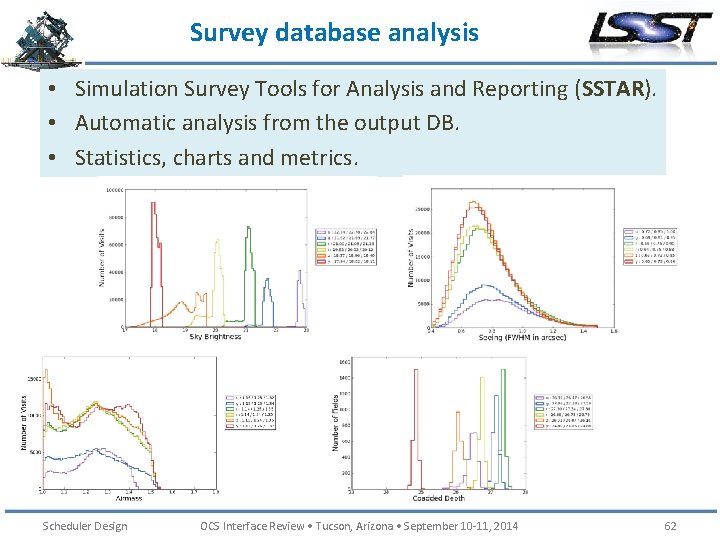
Survey database analysis • Simulation Survey Tools for Analysis and Reporting (SSTAR). • Automatic analysis from the output DB. • Statistics, charts and metrics. Scheduler Design OCS Interface Review • Tucson, Arizona • September 10 -11, 2014 62
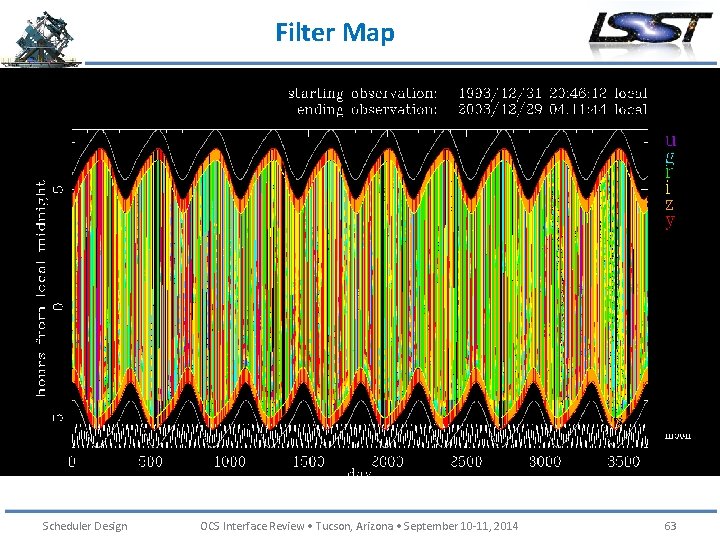
Filter Map Scheduler Design OCS Interface Review • Tucson, Arizona • September 10 -11, 2014 63
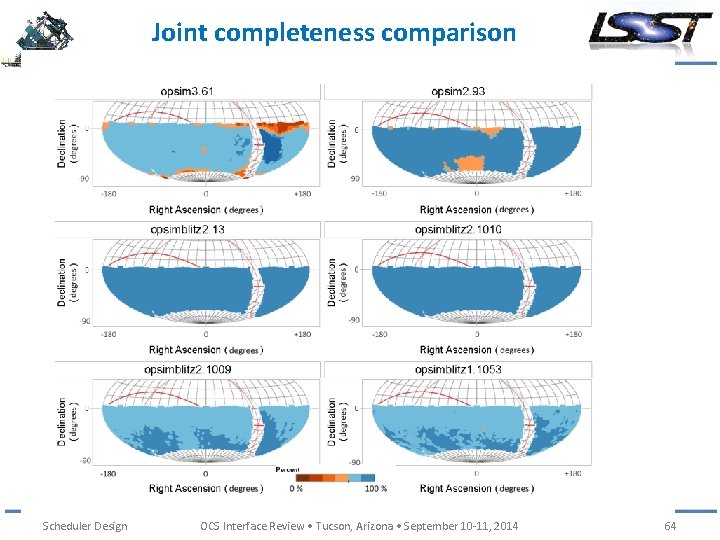
Joint completeness comparison Scheduler Design OCS Interface Review • Tucson, Arizona • September 10 -11, 2014 64
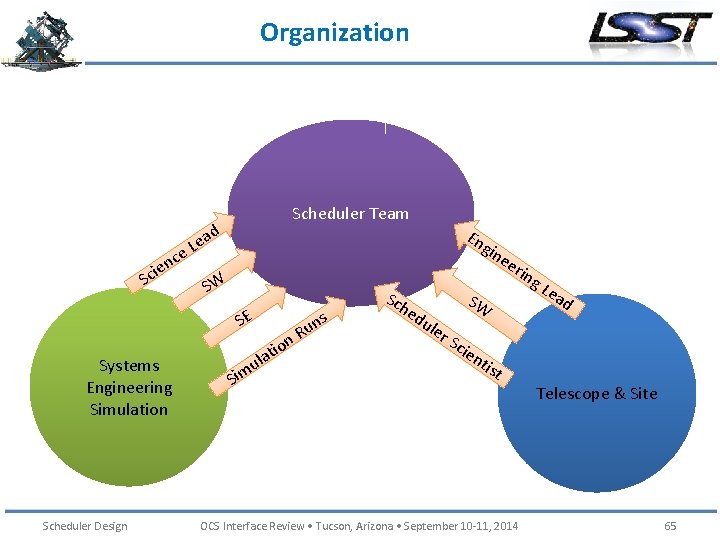
Organization Scheduler Team d ea L ce en i c S SW SE Systems Engineering Simulation Scheduler Design la u Sim s n tio n Ru Sc he du le En gin e eri SW ng Le ad r S cie nti st OCS Interface Review • Tucson, Arizona • September 10 -11, 2014 Telescope & Site 65
Design Validation using MBSE The following slides show an example of the triad validation methodology for the OCS design. From LSST Observatory all the way to the OCS Scheduler Kinematic model structure component, flowing top down through the corresponding requirements and behavior.
Scheduler structure traceability to requirements
OCS Requirements Organization
OCS Requirements Context
OCS Scheduler Requirements
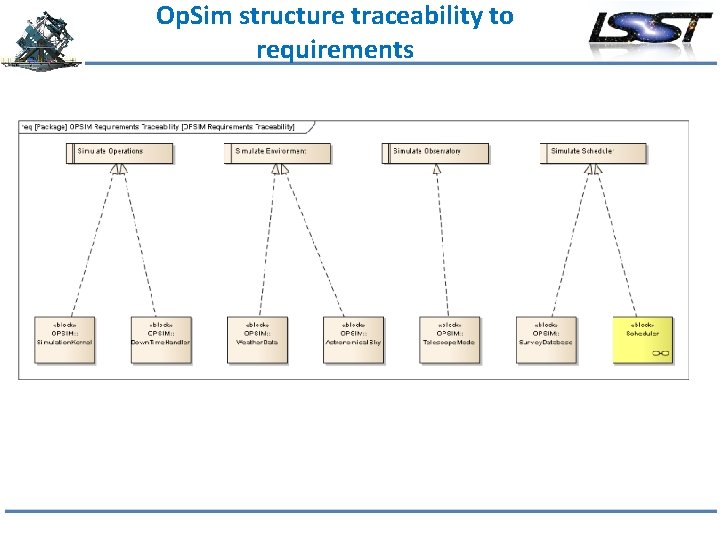
Op. Sim structure traceability to requirements
Perform Survey Activity
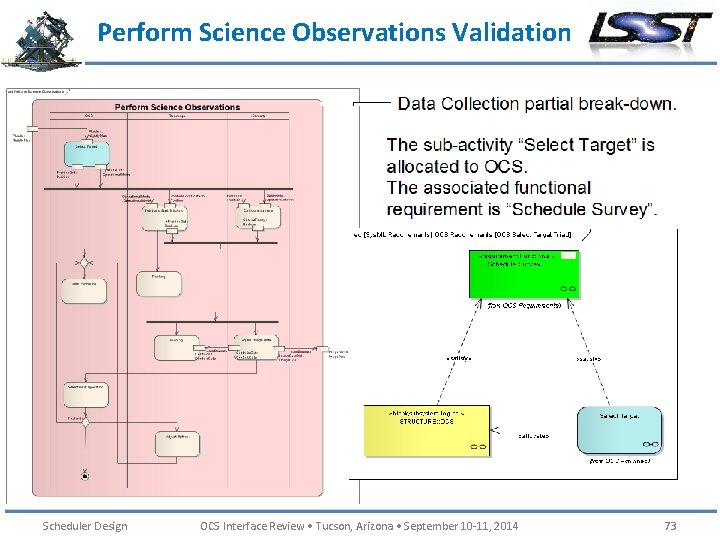
Perform Science Observations Validation Scheduler Design OCS Interface Review • Tucson, Arizona • September 10 -11, 2014 73
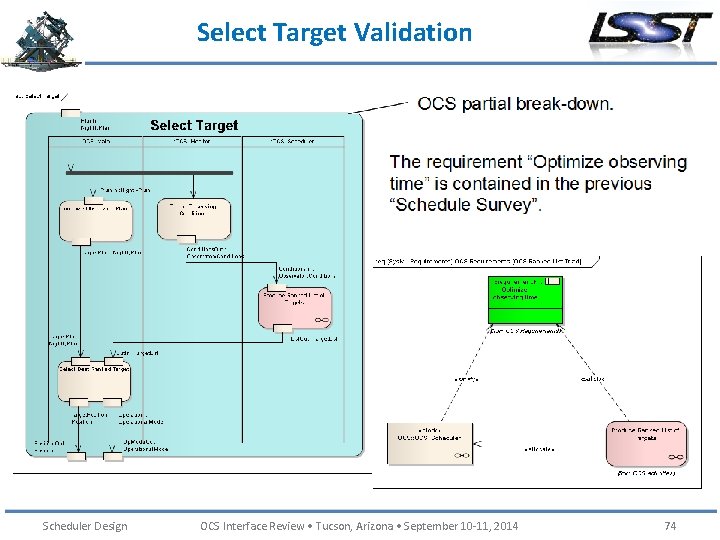
Select Target Validation Scheduler Design OCS Interface Review • Tucson, Arizona • September 10 -11, 2014 74
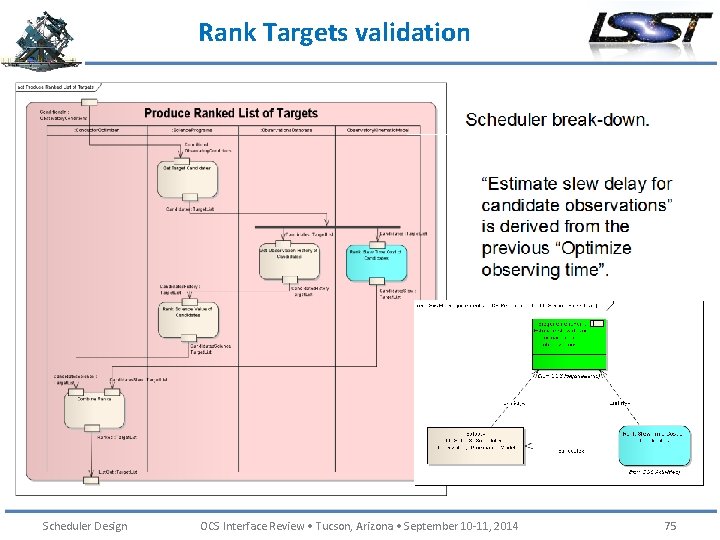
Rank Targets validation Scheduler Design OCS Interface Review • Tucson, Arizona • September 10 -11, 2014 75
Summary Powerful tool for survey designing and systems engineering Op. Sim was key on site-selection, telescope-camera specifications validation, and finding a survey that fulfilled the science requirements. Op. Sim-Scheduler as a prototype for OCS-Scheduler, reducing the risk on a critical component. Op. Sim can be evolved into an operational tool for survey assessment and planning. Op. Sim as a simulation environment for the Scheduler prototype Scheduler arquitecture designed for flexibility and multiple goals Scheduler Design OCS Interface Review • Tucson, Arizona • September 10 -11, 2014 76
- Slides: 76