
LSP TEACHERS NEEDS SEEN THROUGH QUALITATIVE DATA Languages




- Slides: 41
LSP TEACHERS‘ NEEDS SEEN THROUGH QUALITATIVE DATA Languages for Specific Purposes in Higher Education 2019 London, 12 – 13 September, 2019 Saša Podgoršek, Faculty of Arts (University of Ljubljana) Violeta Jurkovič, Faculty of Maritime Studies and Transport (University of Ljubljana)
INTRODUCTION Quality teaching in the European Higher Education Area (EHEA) is an issue of importance … … yet, learning to teach remains too often neglected. This is of particular concern for teachers and learners of LSP in HEI … … because most LSP teachers teach LSP courses without any initial training. (Basturkmen, 2010) General language teacher courses only … … rarely address the specific domain of LSP teaching.
INTRODUCTION The core dimensions of the professional language competence of LGP teachers (Trappes-Lomax, 2002; Richards, 2010) are: - target language competence, - language awareness, - knowledge of the language as a system, and - pedagogical skills set. Yet, … … LSP teachers might have different core and secondary training needs.
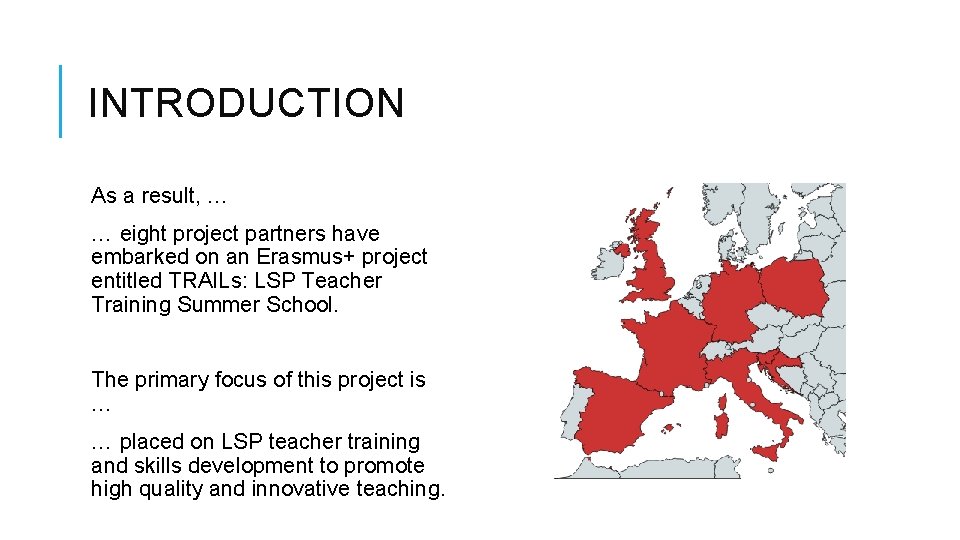
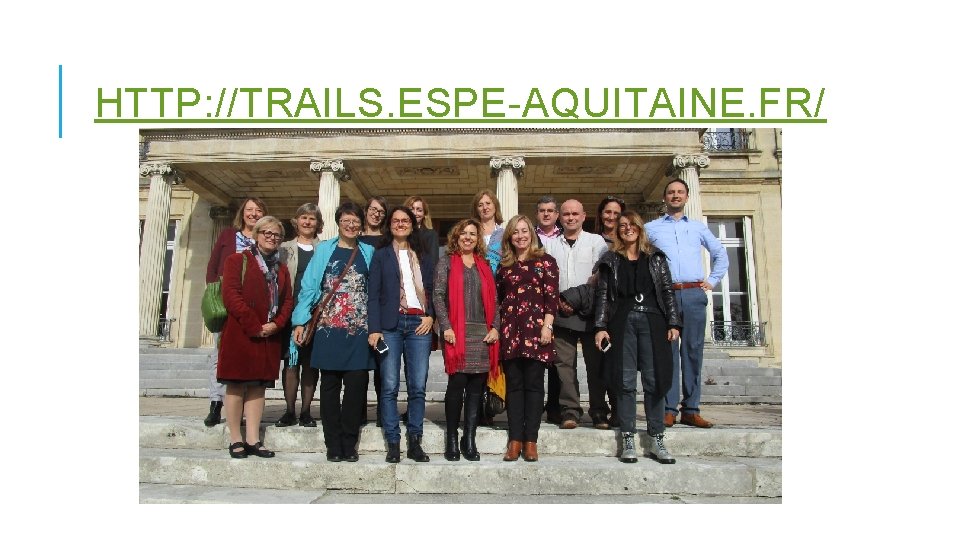
INTRODUCTION As a result, … … eight project partners have embarked on an Erasmus+ project entitled TRAILs: LSP Teacher Training Summer School. The primary focus of this project is … … placed on LSP teacher training and skills development to promote high quality and innovative teaching.
ROADMAP 1. Introduction 2. LSP teachers needs – literature overview 3. TRAILs project 4. Research questions 5. Methodology 6. Results 7. Conclusion
LITERATURE OVERVIEW There has been little literature on LSP teachers. (Belcher, 2013; Basturkmen, 2014; Basturkmen and Bocanegra-Valle, 2014) ESP professionals know least about their own community. (Belcher, 2013) In the literature on ELT, teacher education has not received adequate attention, most probably because of the reform of communicative language teaching and focus on learner needs. (Savignon, 2005)
LITERATURE OVERVIEW LSP teacher training is far from being standardised in the EHEA, instead it is offered in a huge variety of different formats. (John et al. , 2019) Several models of LSP teacher education have been proposed but none relies on the results of a comprehensive needs analysis. (Ewer, 1983; Howard and Brown, 1997; Hall, 2013; Basturkmen, 2017)
LITERATURE OVERVIEW (Bocanegra-Valle and Basturkmen, 2019) - Identify the needs of ESP teachers as teaching professionals - Interviews with 19 experienced ESP teachers from 2 Spanish universities
LITERATURE OVERVIEW (Bocanegra-Valle and Basturkmen, 2019) - Course development needs (needs assessment, teaching skills, …) - Knowledge of the target discipline/profession/industry - Knowledge of language use in the target discipline/profession/industry (genres and text types, …) - Peer collaboration (collaboration with peers and content teachers) - Professional development opportunities
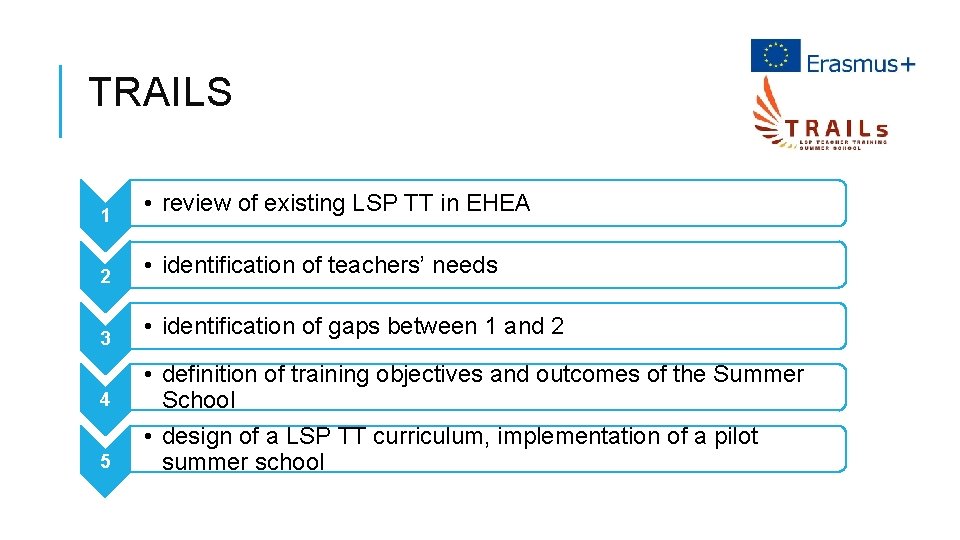
TRAILS 1 2 3 4 5 • review of existing LSP TT in EHEA • identification of teachers’ needs • identification of gaps between 1 and 2 • definition of training objectives and outcomes of the Summer School • design of a LSP TT curriculum, implementation of a pilot summer school
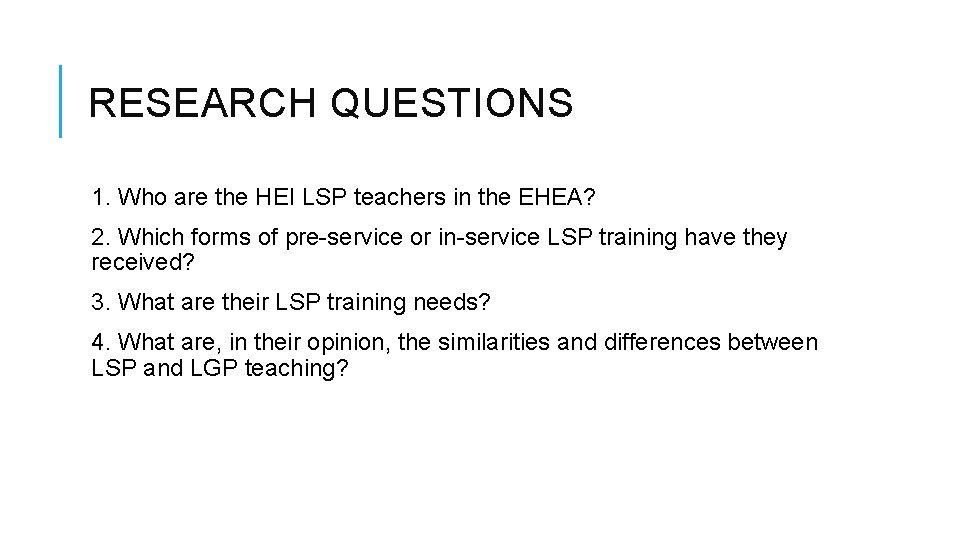
RESEARCH QUESTIONS 1. Who are the HEI LSP teachers in the EHEA? 2. Which forms of pre-service or in-service LSP training have they received? 3. What are their LSP training needs? 4. What are, in their opinion, the similarities and differences between LSP and LGP teaching?
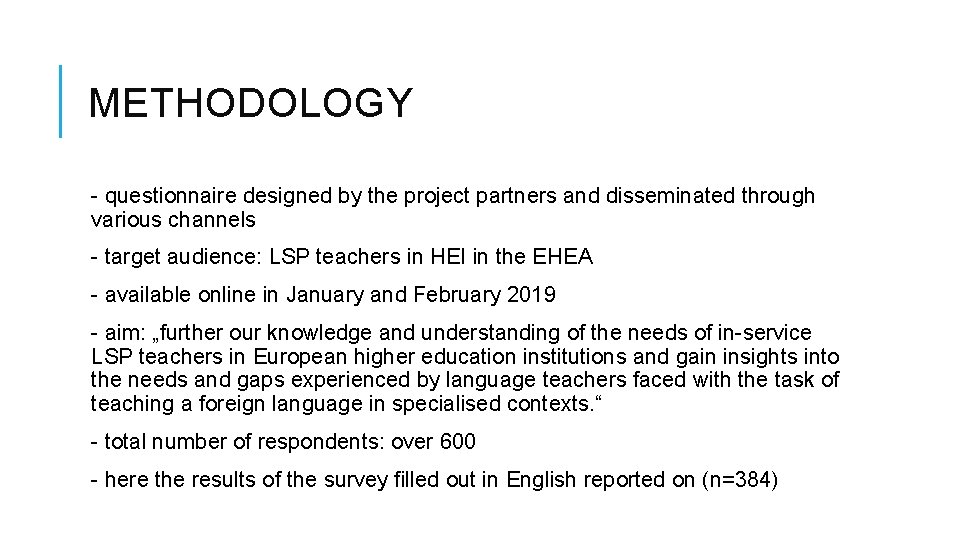
METHODOLOGY - questionnaire designed by the project partners and disseminated through various channels - target audience: LSP teachers in HEI in the EHEA - available online in January and February 2019 - aim: „further our knowledge and understanding of the needs of in-service LSP teachers in European higher education institutions and gain insights into the needs and gaps experienced by language teachers faced with the task of teaching a foreign language in specialised contexts. “ - total number of respondents: over 600 - here the results of the survey filled out in English reported on (n=384)
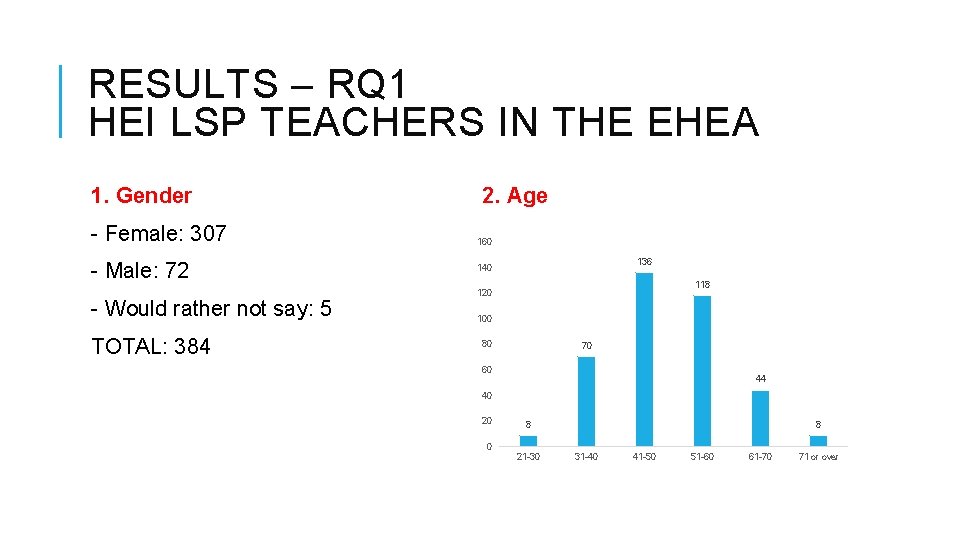
RESULTS – RQ 1 HEI LSP TEACHERS IN THE EHEA 1. Gender - Female: 307 - Male: 72 - Would rather not say: 5 TOTAL: 384 2. Age 160 136 140 118 120 100 80 70 60 44 40 20 8 8 0 21 -30 31 -40 41 -50 51 -60 61 -70 71 or over
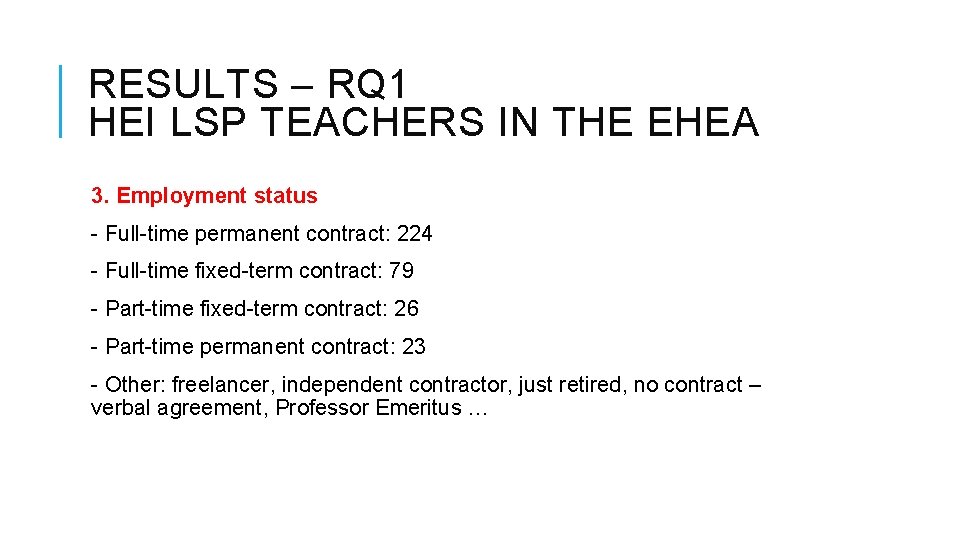
RESULTS – RQ 1 HEI LSP TEACHERS IN THE EHEA 3. Employment status - Full-time permanent contract: 224 - Full-time fixed-term contract: 79 - Part-time fixed-term contract: 26 - Part-time permanent contract: 23 - Other: freelancer, independent contractor, just retired, no contract – verbal agreement, Professor Emeritus …
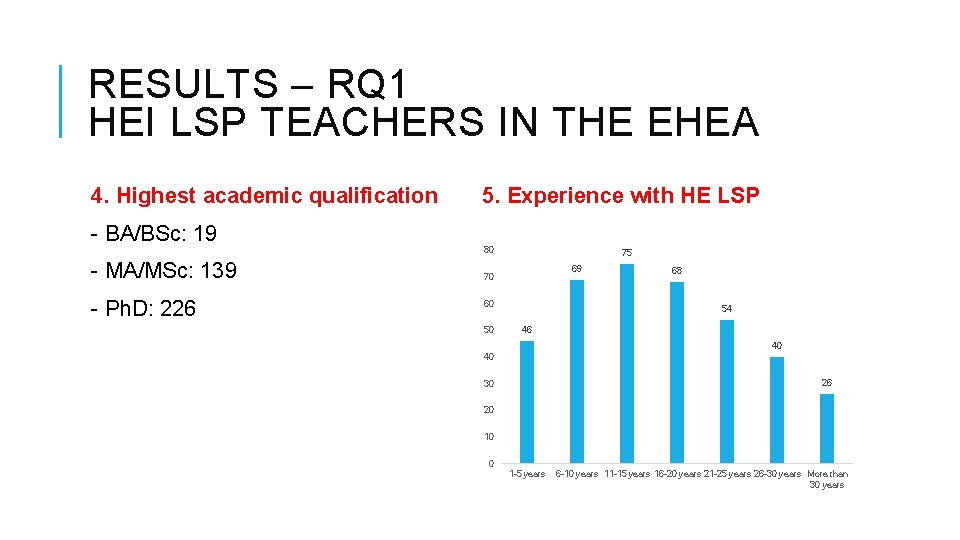
RESULTS – RQ 1 HEI LSP TEACHERS IN THE EHEA 4. Highest academic qualification - BA/BSc: 19 - MA/MSc: 139 - Ph. D: 226 5. Experience with HE LSP 80 75 69 70 60 50 68 54 46 40 40 26 30 20 10 0 1 -5 years 6 -10 years 11 -15 years 16 -20 years 21 -25 years 26 -30 years More than 30 years
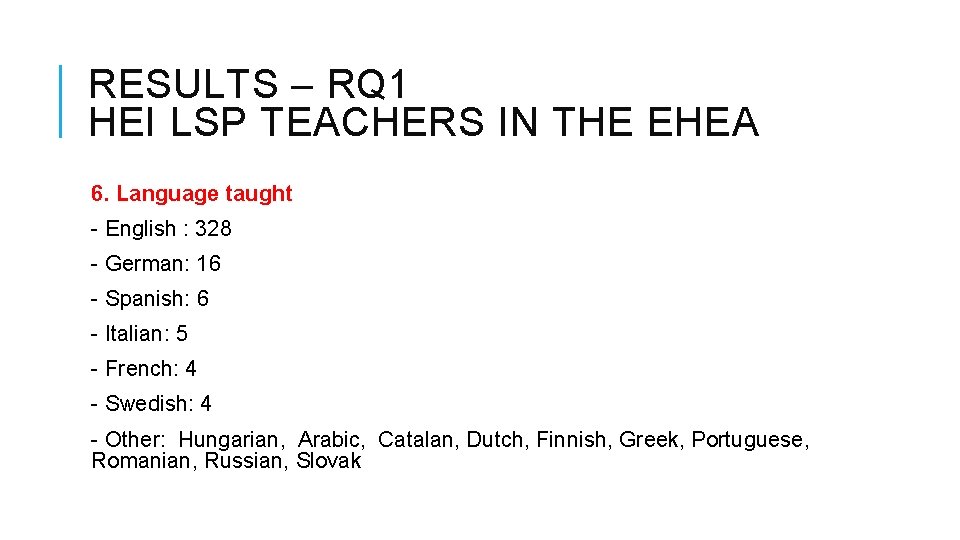
RESULTS – RQ 1 HEI LSP TEACHERS IN THE EHEA 6. Language taught - English : 328 - German: 16 - Spanish: 6 - Italian: 5 - French: 4 - Swedish: 4 - Other: Hungarian, Arabic, Catalan, Dutch, Finnish, Greek, Portuguese, Romanian, Russian, Slovak
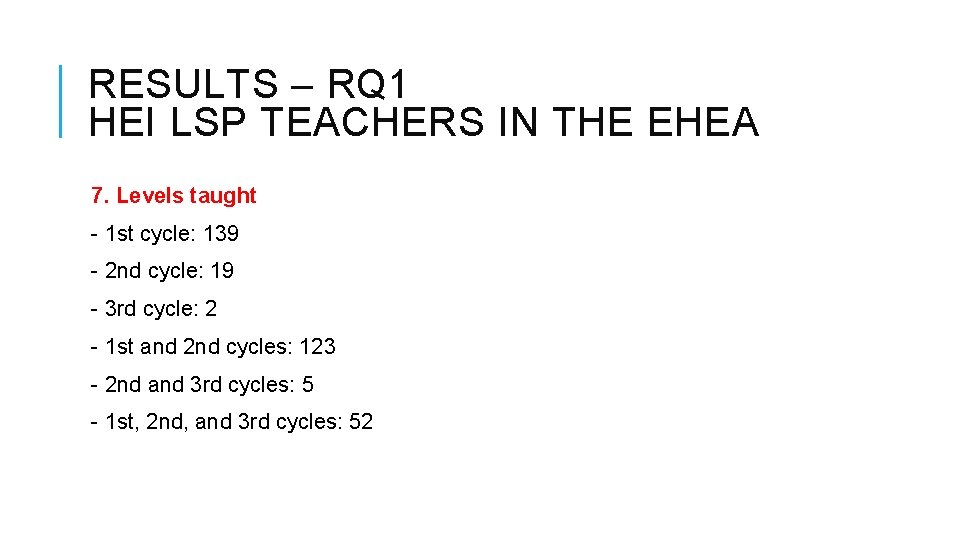
RESULTS – RQ 1 HEI LSP TEACHERS IN THE EHEA 7. Levels taught - 1 st cycle: 139 - 2 nd cycle: 19 - 3 rd cycle: 2 - 1 st and 2 nd cycles: 123 - 2 nd and 3 rd cycles: 5 - 1 st, 2 nd, and 3 rd cycles: 52
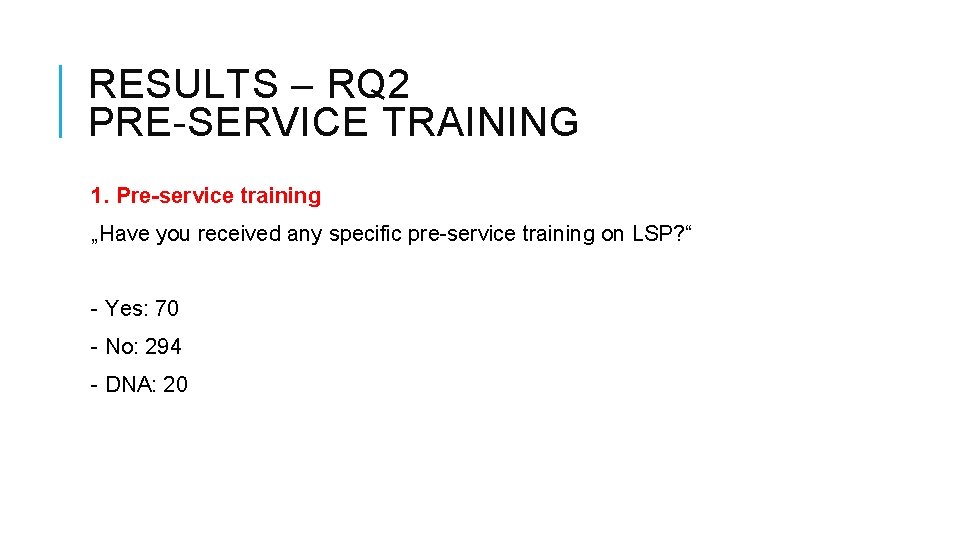
RESULTS – RQ 2 PRE-SERVICE TRAINING 1. Pre-service training „Have you received any specific pre-service training on LSP? “ - Yes: 70 - No: 294 - DNA: 20
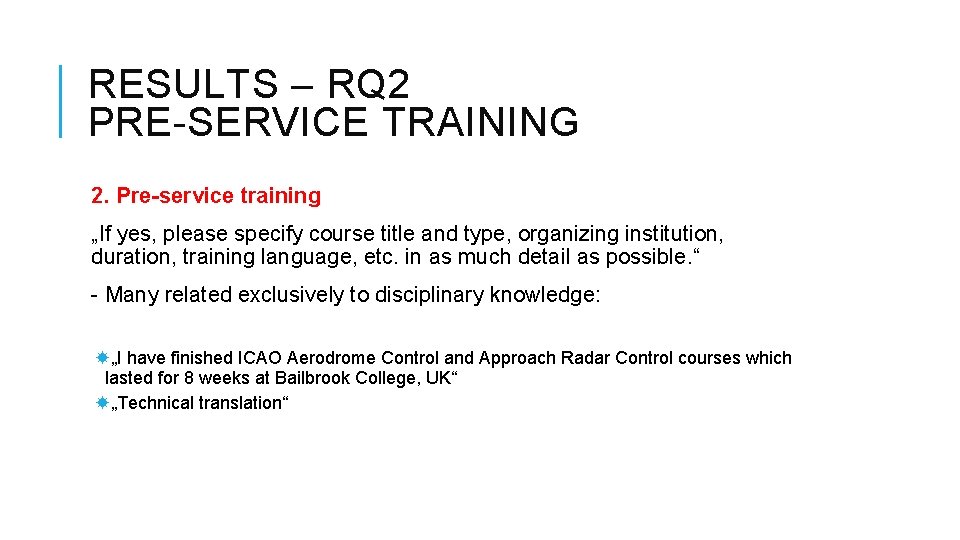
RESULTS – RQ 2 PRE-SERVICE TRAINING 2. Pre-service training „If yes, please specify course title and type, organizing institution, duration, training language, etc. in as much detail as possible. “ - Many related exclusively to disciplinary knowledge: „I have finished ICAO Aerodrome Control and Approach Radar Control courses which lasted for 8 weeks at Bailbrook College, UK“ „Technical translation“
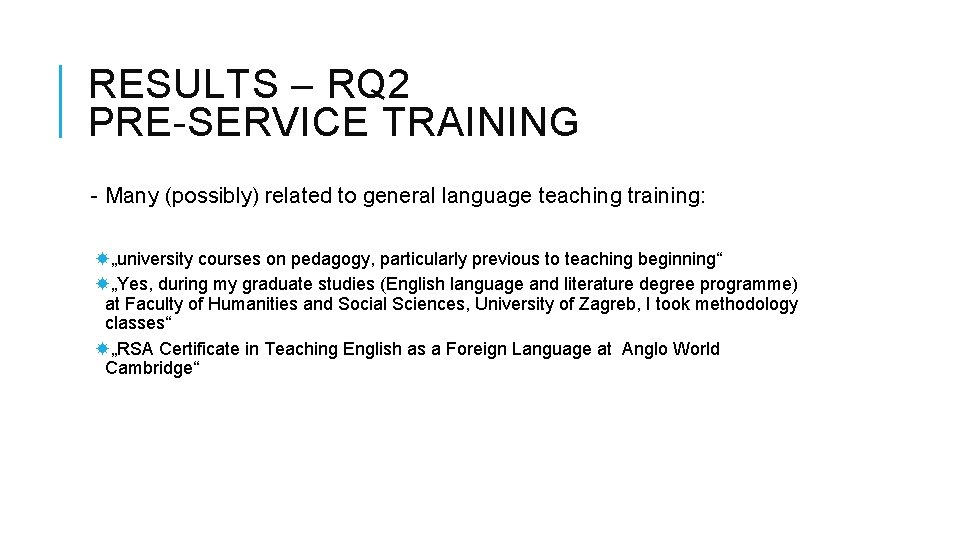
RESULTS – RQ 2 PRE-SERVICE TRAINING - Many (possibly) related to general language teaching training: „university courses on pedagogy, particularly previous to teaching beginning“ „Yes, during my graduate studies (English language and literature degree programme) at Faculty of Humanities and Social Sciences, University of Zagreb, I took methodology classes“ „RSA Certificate in Teaching English as a Foreign Language at Anglo World Cambridge“
RESULTS – RQ 2 PRE-SERVICE TRAINING - Informal training: conferences and self-training „constant self-training“ „International and national conferences dedicated to LSP“
RESULTS – RQ 2 PRE-SERVICE TRAINING - 22 (of 384 participants) clear references to pre-service LSP teacher training: „I courses in teaching LSP during my Masters in Paris University and one in the University of Lorraine in Nancy where I was working /…/. Each course was 20 h long (I think). In one of them, we mainly concentrated on finding and analyzing published FSP material. In the second one, we learned how to conduct a needs analysis and create a curriculum and materials of our own based on the needs analysis. “
RESULTS – RQ 2 IN-SERVICE TRAINING 1. In-service training „Have you received any specific in-service training on LSP? “ - Yes: 74 - No: 290 - DNA: 19
RESULTS – RQ 2 IN-SERVICE TRAINING 2. In-service training „If yes, please specify course title and type, organizing institution, duration, training language, etc. in as much detail as possible. “ - Many related exclusively to disciplinary knowledge: „ 4 years of attending lectures and workshops held by legal professionals within the EU funded international project "Foreign Languages in the Field of Law"“
RESULTS – RQ 2 IN-SERVICE TRAINING - Conferences, in-house training: „My colleagues mentored me. “ - Many (possibly) related to general language teaching training: § „TEFL/TESOL certification; Cambridge English Language Assessment training/continuing education seminars for Intermediate and Advanced levels. “
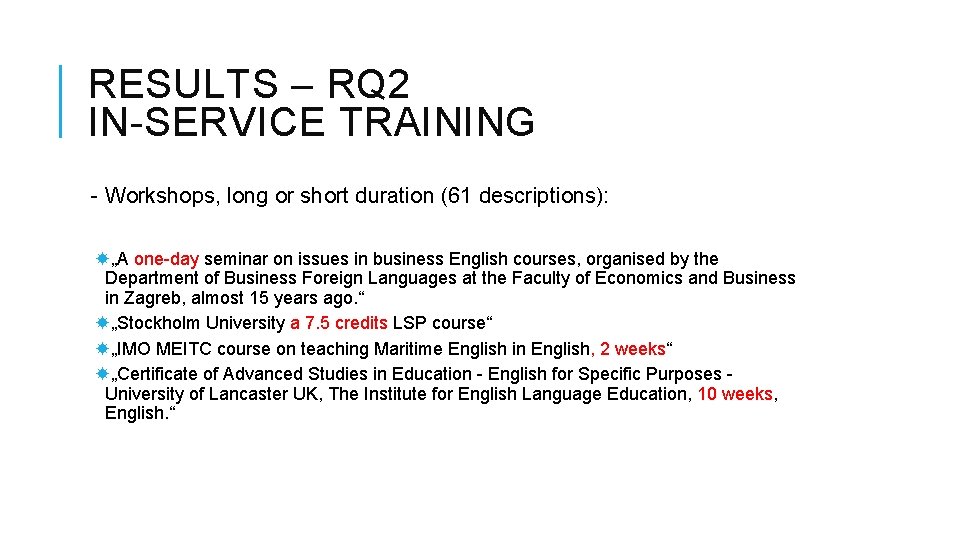
RESULTS – RQ 2 IN-SERVICE TRAINING - Workshops, long or short duration (61 descriptions): „A one-day seminar on issues in business English courses, organised by the Department of Business Foreign Languages at the Faculty of Economics and Business in Zagreb, almost 15 years ago. “ „Stockholm University a 7. 5 credits LSP course“ „IMO MEITC course on teaching Maritime English in English, 2 weeks“ „Certificate of Advanced Studies in Education - English for Specific Purposes - University of Lancaster UK, The Institute for English Language Education, 10 weeks, English. “
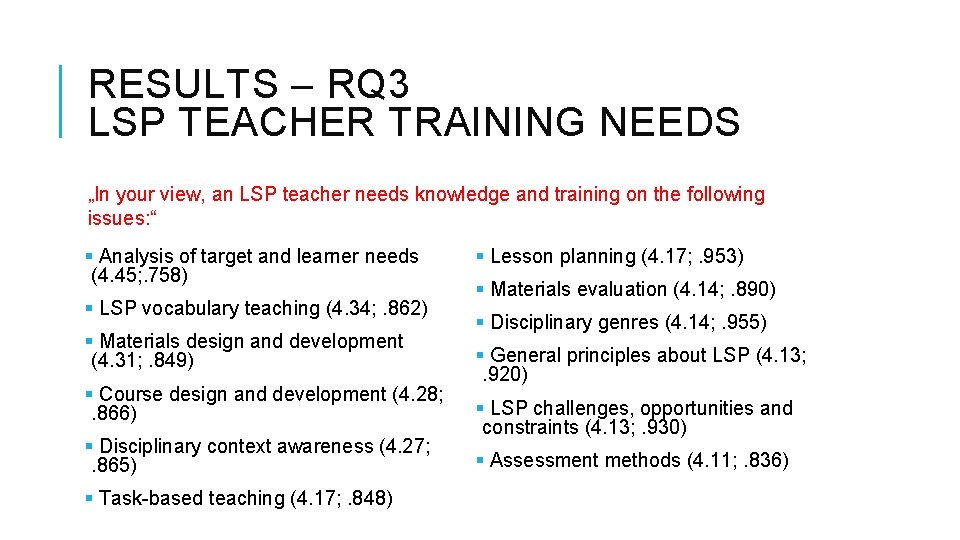
RESULTS – RQ 3 LSP TEACHER TRAINING NEEDS „In your view, an LSP teacher needs knowledge and training on the following issues: “ § Analysis of target and learner needs (4. 45; . 758) § LSP vocabulary teaching (4. 34; . 862) § Materials design and development (4. 31; . 849) § Course design and development (4. 28; . 866) § Disciplinary context awareness (4. 27; . 865) § Task-based teaching (4. 17; . 848) § Lesson planning (4. 17; . 953) § Materials evaluation (4. 14; . 890) § Disciplinary genres (4. 14; . 955) § General principles about LSP (4. 13; . 920) § LSP challenges, opportunities and constraints (4. 13; . 930) § Assessment methods (4. 11; . 836)
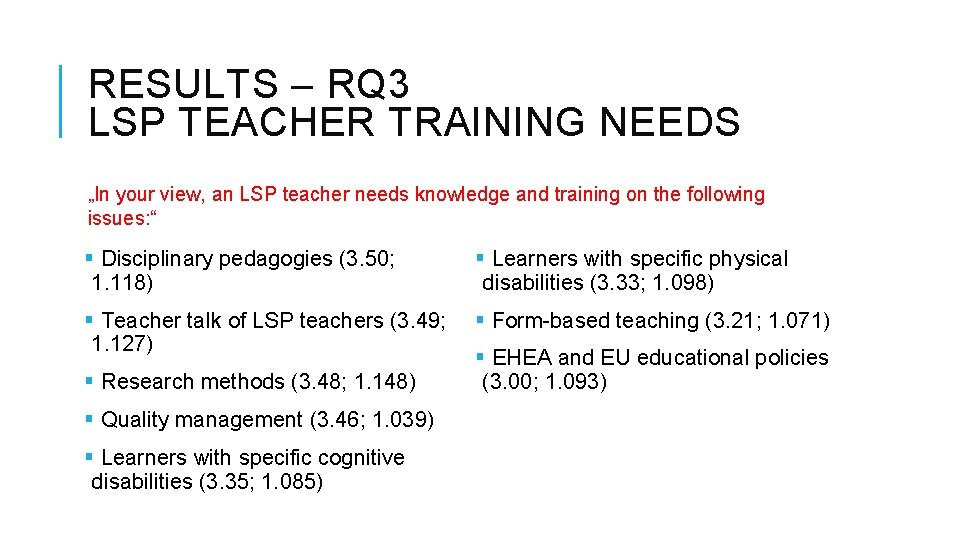
RESULTS – RQ 3 LSP TEACHER TRAINING NEEDS „In your view, an LSP teacher needs knowledge and training on the following issues: “ § Disciplinary pedagogies (3. 50; 1. 118) § Learners with specific physical disabilities (3. 33; 1. 098) § Teacher talk of LSP teachers (3. 49; 1. 127) § Form-based teaching (3. 21; 1. 071) § Research methods (3. 48; 1. 148) § Quality management (3. 46; 1. 039) § Learners with specific cognitive disabilities (3. 35; 1. 085) § EHEA and EU educational policies (3. 00; 1. 093)
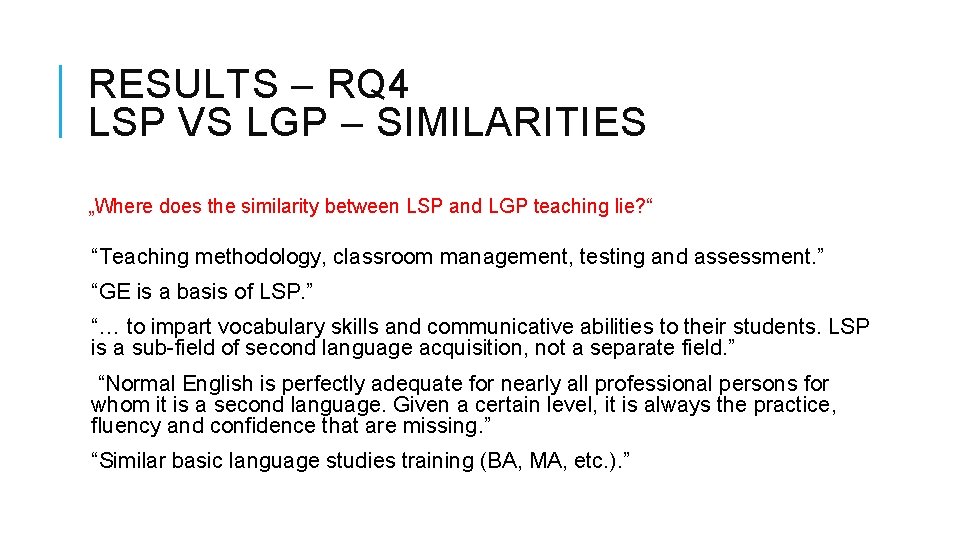
RESULTS – RQ 4 LSP VS LGP – SIMILARITIES „Where does the similarity between LSP and LGP teaching lie? “ “Teaching methodology, classroom management, testing and assessment. ” “GE is a basis of LSP. ” “… to impart vocabulary skills and communicative abilities to their students. LSP is a sub-field of second language acquisition, not a separate field. ” “Normal English is perfectly adequate for nearly all professional persons for whom it is a second language. Given a certain level, it is always the practice, fluency and confidence that are missing. ” “Similar basic language studies training (BA, MA, etc. ). ”
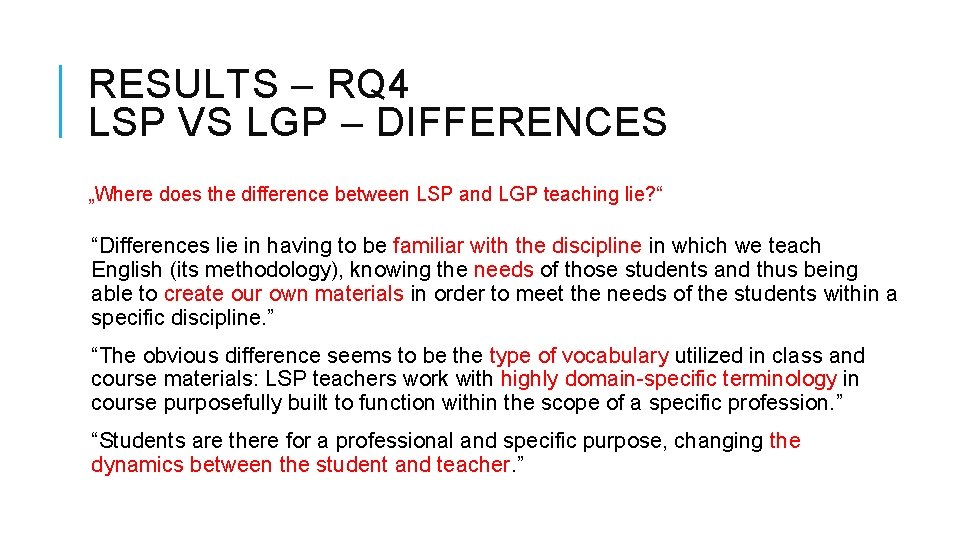
RESULTS – RQ 4 LSP VS LGP – DIFFERENCES „Where does the difference between LSP and LGP teaching lie? “ “Differences lie in having to be familiar with the discipline in which we teach English (its methodology), knowing the needs of those students and thus being able to create our own materials in order to meet the needs of the students within a specific discipline. ” “The obvious difference seems to be the type of vocabulary utilized in class and course materials: LSP teachers work with highly domain-specific terminology in course purposefully built to function within the scope of a specific profession. ” “Students are there for a professional and specific purpose, changing the dynamics between the student and teacher. ”
RESULTS – RQ 4 LSP VS LGP – DIFFERENCES „Where does the difference between LSP and LGP teaching lie? “ “LSP teachers need more insight and training regarding the subject matter, also interdisciplinary research and cooperation with subject specialists is needed, but not always available. ” “LSP teachers often need to create their own syllabus and teaching material and familiarize themselves with students' subject area to certain extent. ” “The need to research the specific context, the need for tools to analyse discourse, an awareness of different facets of genre knowledge …”
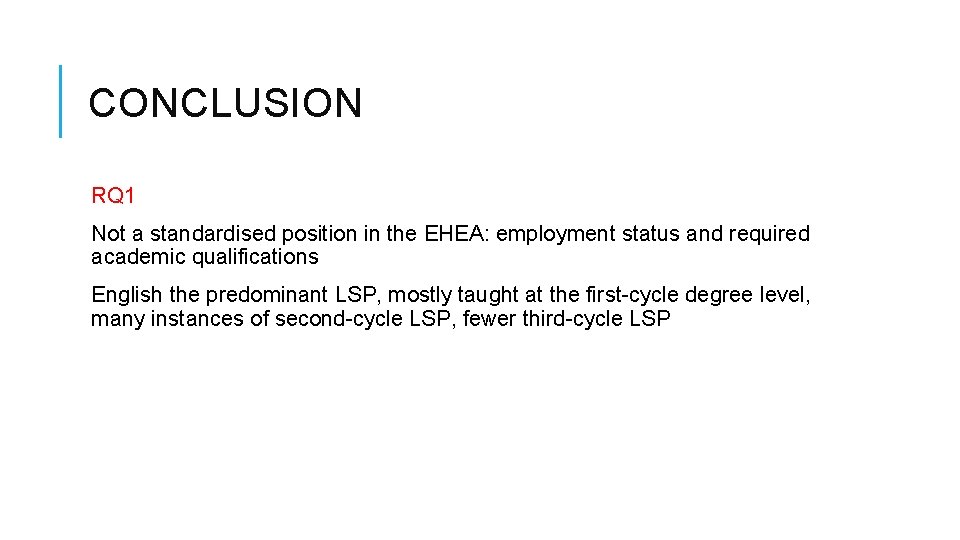
CONCLUSION RQ 1 Not a standardised position in the EHEA: employment status and required academic qualifications English the predominant LSP, mostly taught at the first-cycle degree level, many instances of second-cycle LSP, fewer third-cycle LSP
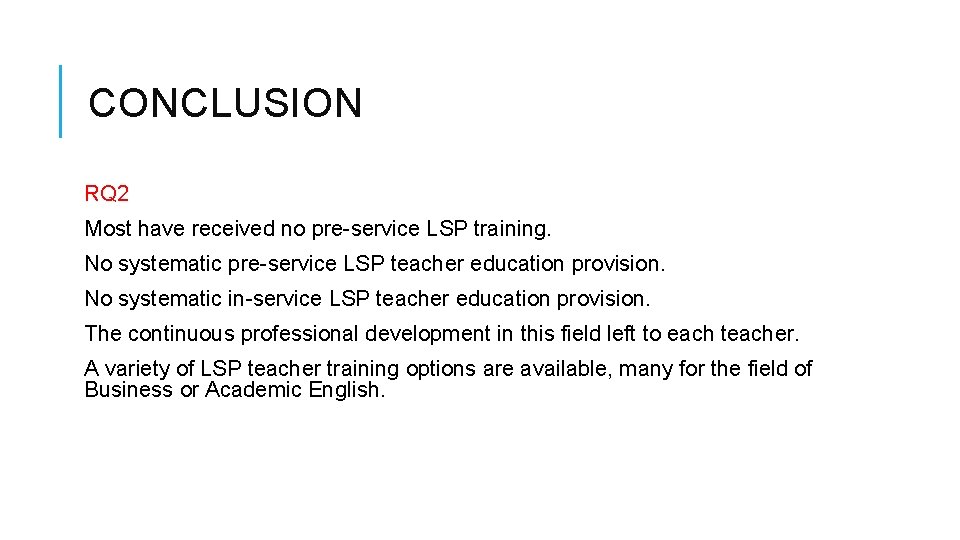
CONCLUSION RQ 2 Most have received no pre-service LSP training. No systematic pre-service LSP teacher education provision. No systematic in-service LSP teacher education provision. The continuous professional development in this field left to each teacher. A variety of LSP teacher training options are available, many for the field of Business or Academic English.
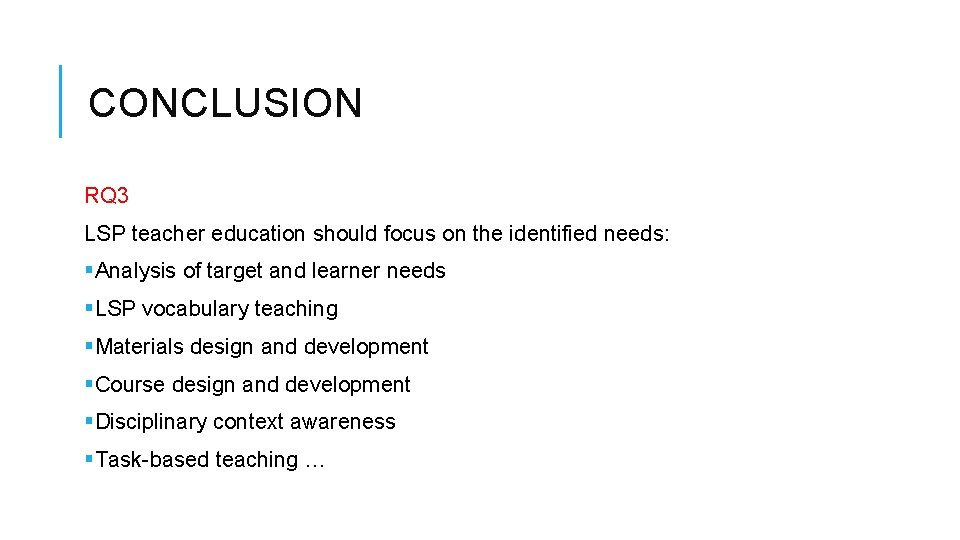
CONCLUSION RQ 3 LSP teacher education should focus on the identified needs: §Analysis of target and learner needs §LSP vocabulary teaching §Materials design and development §Course design and development §Disciplinary context awareness §Task-based teaching …
CONCLUSION RQ 3 Some among these needs are clearly different from the needs of LGP teachers.
CONCLUSION RQ 4 The identified differences between LSP and LGP teaching largely overlap with the identified training needs of the participants.
CONCLUSION „Please, provide us with any additional comments you find relevant and would like to add to this questionnaire. “ “LSP teachers’ knowledge, competences and efforts are not appreciated enough at our institutions of higher (and secondary) education. Our colleagues know almost nothing about LSP. For them you "just teach English/Italian/German. . "” “I think the teaching of languages can easily be turned into a 'science' which it is not. /…/ They are supported in their belief of the correctness of their approach by the language teaching industry. ” “LSP is seen as a non-existent, minor sub-genre of language teaching (if that) whereas in reality all language teaching is a form of LSP needs to have its profile raised. ”
REFERENCES Basturkmen, Helen. (2010). Developing Courses in English for Specific Purposes. Basingstoke: Palgrave Macmillan. Basturkmen, Helen. (2014). LSP teacher education: Review of literature and suggestions for the research agenda. Iberica, 28, 17 -34. Basturkmen, Helen. (2017). ESP teacher education needs. Language Teaching, 1 -13. Basturkmen, Helen and Bocanegra-Valle, Ana. (2014). Materials design processes, beliefs and practices of experienced ESP teachers in university setting in Spain. In: Kirkgöz, K. Dikilitas (Eds. ), Key Issues in English for Specific Purposes in Higher Education, 13 -27. Belcher, Diane. (2013). The future of ESP research: resources for access and choice. In: Brian Paltridge and Sue Starfield (Eds. ), The Handbook of English for Specific Purposes, 535 -551. Hoboken: Wiley-Blackwell. Bocanegra-Valle, Ana and Basturkmen, Helen. (2019). Investigating the teacher education needs of experienced ESP teachers in Spanish universities. Iberica, 38. Ewer, Jack R. (1983). Teacher training for EST: problems and methods. The ESP Journal, 2, 9 -31.
REFERENCES Hall, David R. (2013). Teacher education for languages for specific purposes. In: Carol A. Chapelle (Ed. ), The Encyclopaedia of Applied Linguistics. Hoboken: Blackwell Publishing. Howard, Ron and Brown, Gillian. (1997). Introduction. In: Ron Howard and Gillian Brown (eds. ), Teacher Education for Languages for Specific Purposes, pp. 1 -10. Clevedon: Multilingual Matters. John, Peter, Greenwood, Russell, Jurkovič, Violeta, and Kereković, Snježana. (2019). Identification and analysis of LSP teacher training programmes in Europe. Pre-print. Richards, J. (2010). Competence and performance in language teaching. RELC Journal, 41(2), 101 -122. Savignon, Sandra J. (2005). Communicative language teaching: strategies and goals. In: Hinkel, Eli (Ed. ), Handbook of Research in Second Language Teaching and Learning, pp. 635 -651. Mahwah and London: Lawrence Erlbaum Associates. Trappes-Lomax, H. (2002). Language in language teacher education - a discourse perspective. In H. Trappes-Lomax & G. Ferguson (Eds. ), Language in language teacher education (pp. 1 -23). Amsterdam: John Benjamins.
HTTP: //TRAILS. ESPE-AQUITAINE. FR/