
LSolved Fingerprint Analysis Developing Prints 3 20 LName


















- Slides: 158
LSolved: Fingerprint Analysis - Developing Prints 3: 20 LName 3 ways that fingerprints can be developed. Chapter 4 Kendall/Hunt Publishing Company 1
Painting Time
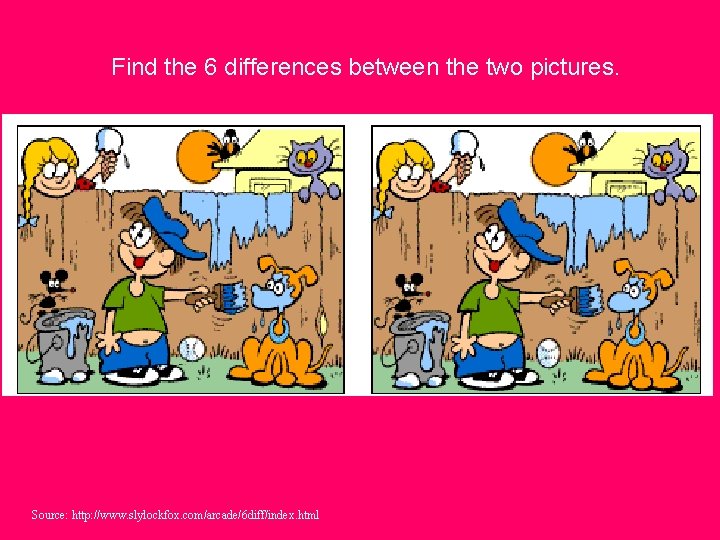
Find the 6 differences between the two pictures. Source: http: //www. slylockfox. com/arcade/6 diff/index. html
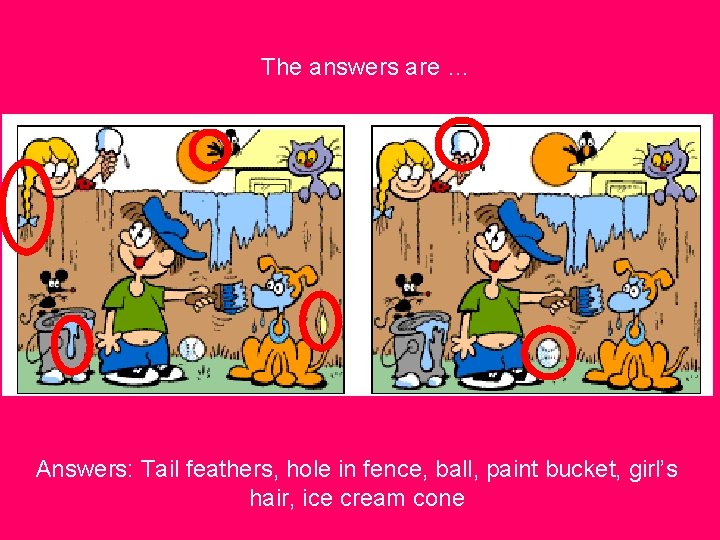
The answers are … Answers: Tail feathers, hole in fence, ball, paint bucket, girl’s hair, ice cream cone
T. Trimpe 2006 http: //sciencespot. net/
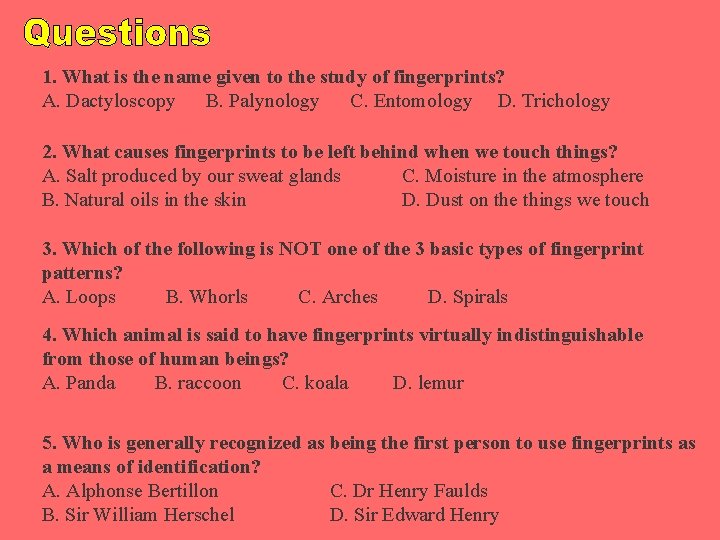
1. What is the name given to the study of fingerprints? A. Dactyloscopy B. Palynology C. Entomology D. Trichology 2. What causes fingerprints to be left behind when we touch things? A. Salt produced by our sweat glands C. Moisture in the atmosphere B. Natural oils in the skin D. Dust on the things we touch 3. Which of the following is NOT one of the 3 basic types of fingerprint patterns? A. Loops B. Whorls C. Arches D. Spirals 4. Which animal is said to have fingerprints virtually indistinguishable from those of human beings? A. Panda B. raccoon C. koala D. lemur 5. Who is generally recognized as being the first person to use fingerprints as a means of identification? A. Alphonse Bertillon C. Dr Henry Faulds B. Sir William Herschel D. Sir Edward Henry
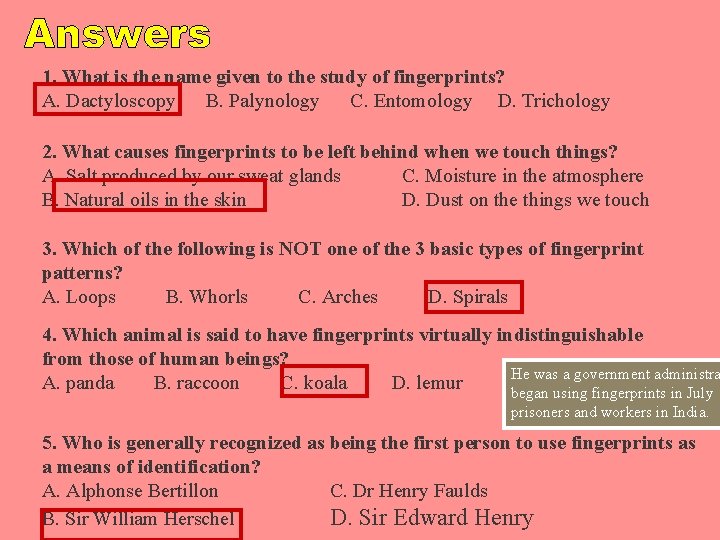
1. What is the name given to the study of fingerprints? A. Dactyloscopy B. Palynology C. Entomology D. Trichology 2. What causes fingerprints to be left behind when we touch things? A. Salt produced by our sweat glands C. Moisture in the atmosphere B. Natural oils in the skin D. Dust on the things we touch 3. Which of the following is NOT one of the 3 basic types of fingerprint patterns? A. Loops B. Whorls C. Arches D. Spirals 4. Which animal is said to have fingerprints virtually indistinguishable from those of human beings? He was a government administra A. panda B. raccoon C. koala D. lemur began using fingerprints in July 1 prisoners and workers in India. 5. Who is generally recognized as being the first person to use fingerprints as a means of identification? A. Alphonse Bertillon C. Dr Henry Faulds B. Sir William Herschel D. Sir Edward Henry
Fingerprints T. Trimpe 2006 http: //sciencespot. net/
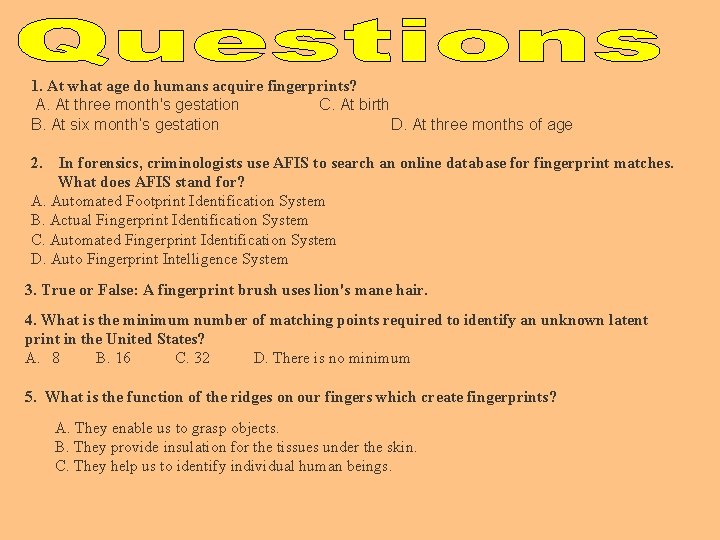
1. At what age do humans acquire fingerprints? A. At three month's gestation C. At birth B. At six month’s gestation D. At three months of age 2. In forensics, criminologists use AFIS to search an online database for fingerprint matches. What does AFIS stand for? A. Automated Footprint Identification System B. Actual Fingerprint Identification System C. Automated Fingerprint Identification System D. Auto Fingerprint Intelligence System 3. True or False: A fingerprint brush uses lion's mane hair. 4. What is the minimum number of matching points required to identify an unknown latent print in the United States? A. 8 B. 16 C. 32 D. There is no minimum 5. What is the function of the ridges on our fingers which create fingerprints? A. They enable us to grasp objects. B. They provide insulation for the tissues under the skin. C. They help us to identify individual human beings.
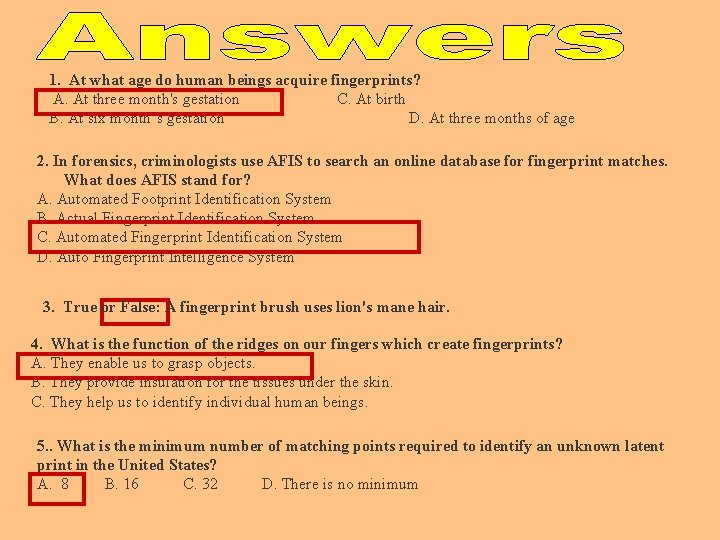
1. At what age do human beings acquire fingerprints? A. At three month's gestation C. At birth B. At six month’s gestation D. At three months of age 2. In forensics, criminologists use AFIS to search an online database for fingerprint matches. What does AFIS stand for? A. Automated Footprint Identification System B. Actual Fingerprint Identification System C. Automated Fingerprint Identification System D. Auto Fingerprint Intelligence System 3. True or False: A fingerprint brush uses lion's mane hair. 4. What is the function of the ridges on our fingers which create fingerprints? A. They enable us to grasp objects. B. They provide insulation for the tissues under the skin. C. They help us to identify individual human beings. 5. . What is the minimum number of matching points required to identify an unknown latent print in the United States? A. 8 B. 16 C. 32 D. There is no minimum
Challenge
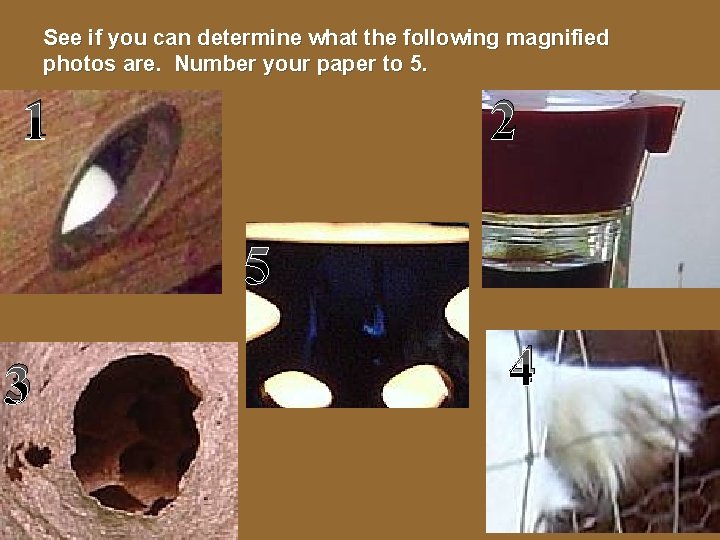
See if you can determine what the following magnified photos are. Number your paper to 5. 1 2 5 3 4
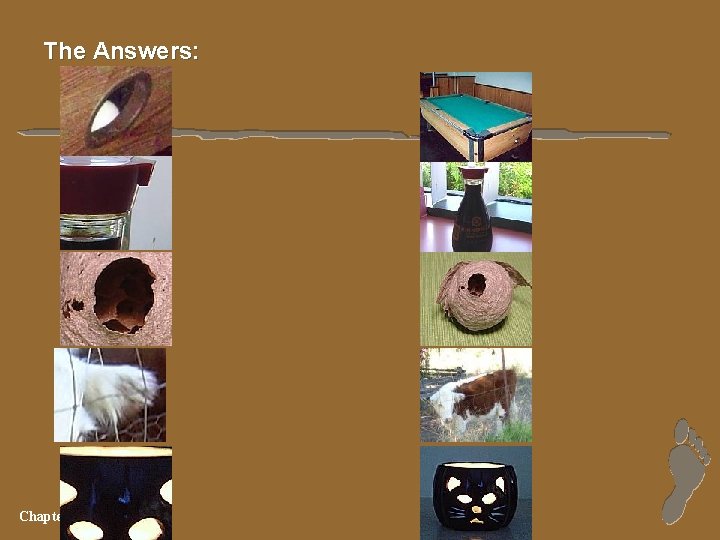
The Answers: Chapter 4
Types of Fingerprints Challenge
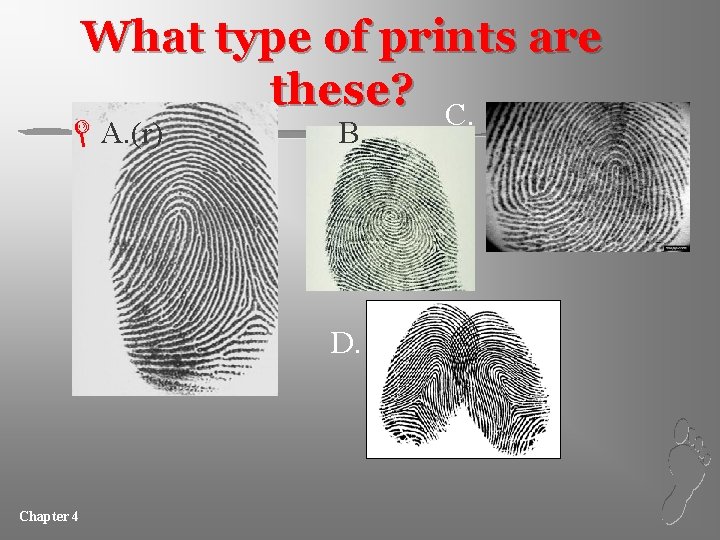
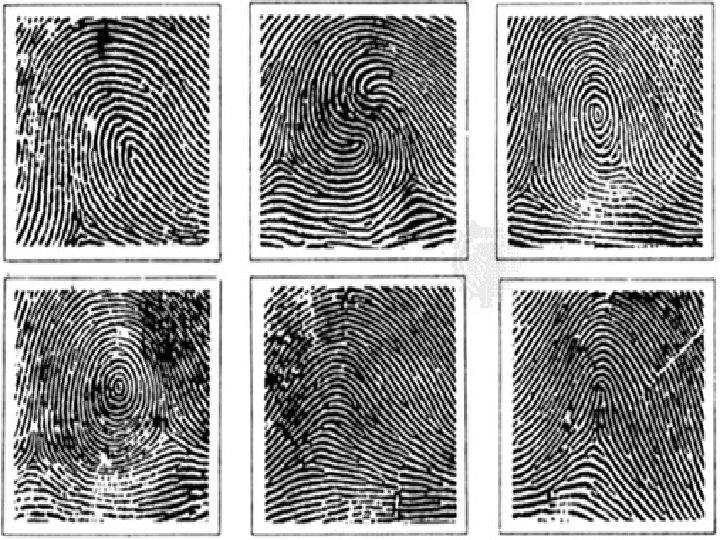
What type of prints are these? C. LA. (r) B. D. Chapter 4
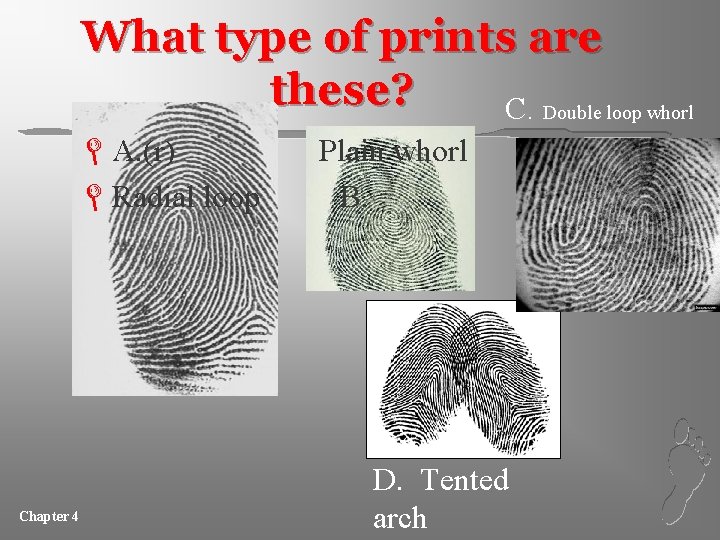
What type of prints are these? C. Double loop whorl LA. (r) LRadial loop Chapter 4 Plain whorl B. D. Tented arch
Crime 360 - Finding Fingerprints with Superglue? 1. 00 Carefully listen to the video clip and be prepared to answer 5 questions at/ the end Chapter 4
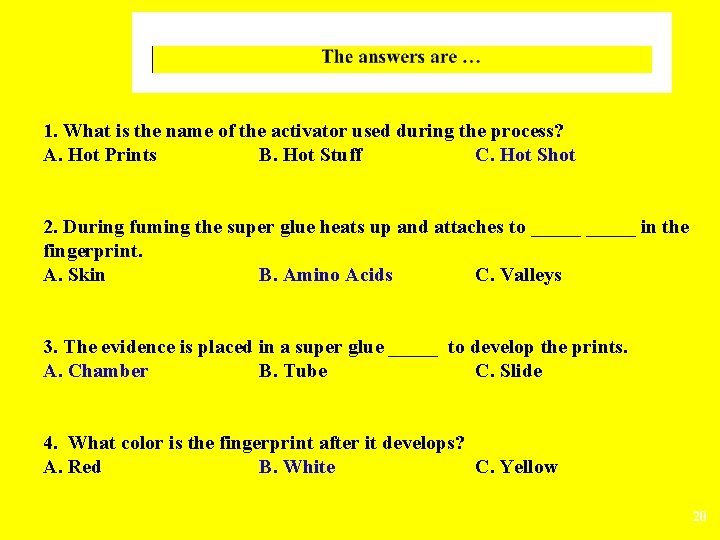
Watch the video and answer the questions at the end. 1. What is the name of the activator used during the process? A. Hot Prints B. Hot Stuff C. Hot Shot 2. During fuming the super glue heats up and attaches to _____ in the fingerprint. A. Skin B. Amino Acids C. Valleys 3. The evidence is placed in a super glue _____ to develop the prints. A. Chamber B. Tube C. Slide 4. What color is the fingerprint after it develops? A. Red B. White C. Yellow Chapter 4 19
1. What is the name of the activator used during the process? A. Hot Prints B. Hot Stuff C. Hot Shot 2. During fuming the super glue heats up and attaches to _____ in the fingerprint. A. Skin B. Amino Acids C. Valleys 3. The evidence is placed in a super glue _____ to develop the prints. A. Chamber B. Tube C. Slide 4. What color is the fingerprint after it develops? A. Red B. White C. Yellow 20
Fingerprint Processing Challenge
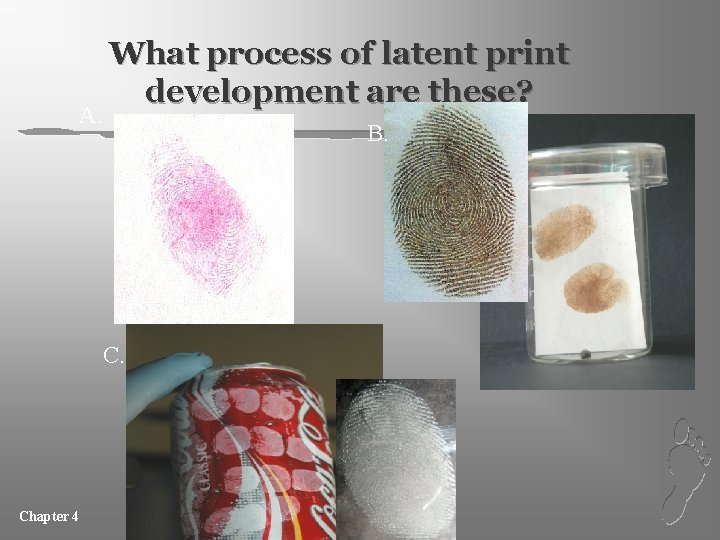
A. What process of latent print development are these? B. Chapter 4
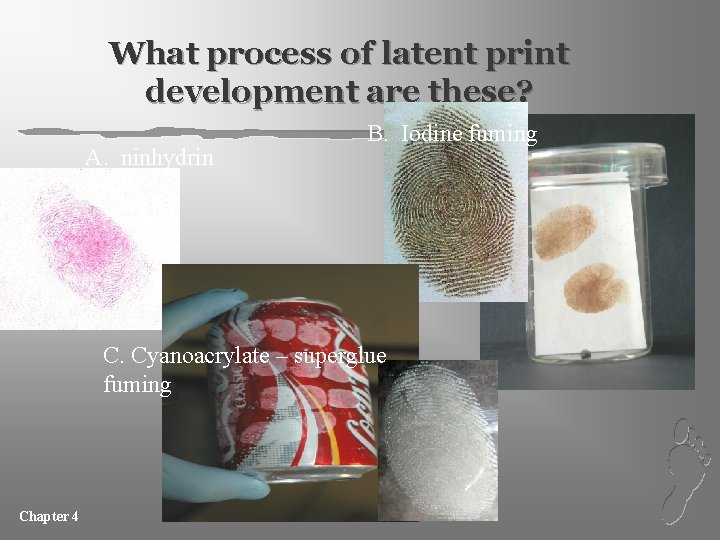
What process of latent print development are these? A. ninhydrin B. Iodine fuming C. Cyanoacrylate – superglue fuming Chapter 4
Chapter 4: Fingerprints “Fingerprints can not lie, but liars can make fingerprints. ” —Unknown
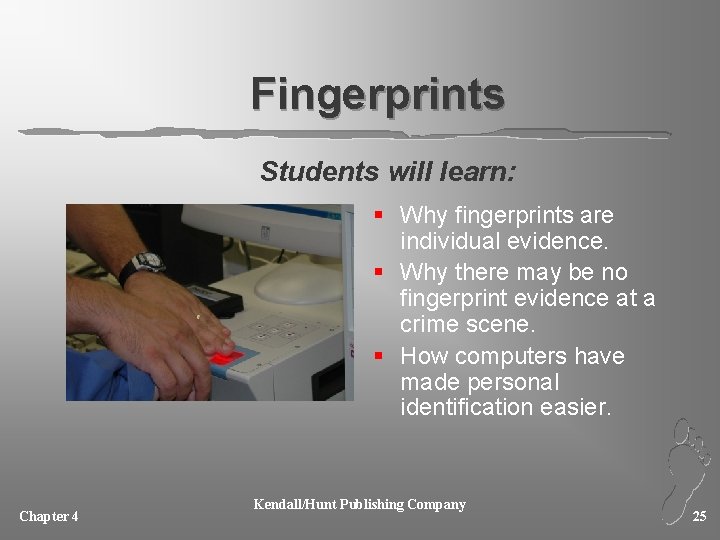
Fingerprints Students will learn: § Why fingerprints are individual evidence. § Why there may be no fingerprint evidence at a crime scene. § How computers have made personal identification easier. Chapter 4 Kendall/Hunt Publishing Company 25
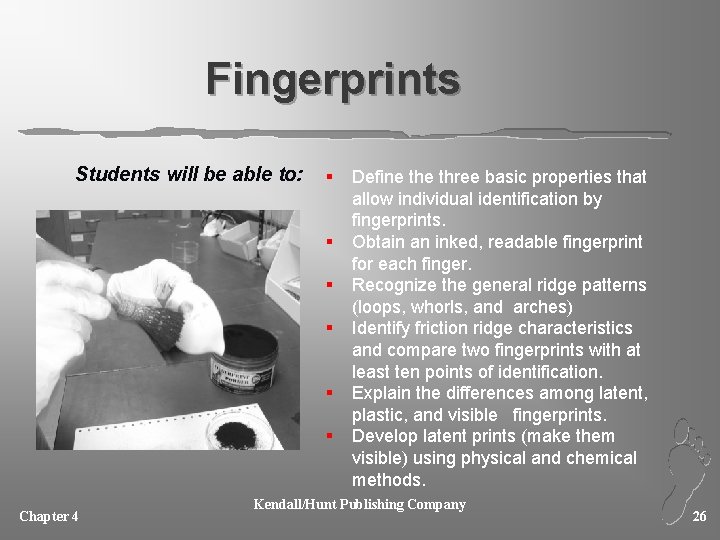
Fingerprints Students will be able to: § § § Chapter 4 Define three basic properties that allow individual identification by fingerprints. Obtain an inked, readable fingerprint for each finger. Recognize the general ridge patterns (loops, whorls, and arches) Identify friction ridge characteristics and compare two fingerprints with at least ten points of identification. Explain the differences among latent, plastic, and visible fingerprints. Develop latent prints (make them visible) using physical and chemical methods. Kendall/Hunt Publishing Company 26
The History of Fingerprinting
The Chinese LIn the eighth century during China’s T’ang dynasty, Chinese used thumbprints to seal important documents and on business contracts. LThere is no record of whether they were actually used for identification, and there was no systematic classification. Chapter 4 Kendall/Hunt Publishing Company 28
Quntilian, the Roman Lawyer LMade use of a bloody handprint in a murder case in 1000 AD Chapter 4 Kendall/Hunt Publishing Company 29
A number of people throughout history noted fingerprints and even commented on the different ridge patterns. However, the science of dactyloscopy, the study of fingerprints, (comes from the Greek word daktulos, meaning finger) really started in the 19 th century in India with William Herschel.
William Herschel LHighly placed civil servant who decided to require Indians to add their fingerprint to contracts. LLater (1877) he introduced the use of fingerprints as a means of identifying prisoners. Chapter 4 Kendall/Hunt Publishing Company 31
Henry Faulds LIn Japan, molded fingerprints in old pottery piqued the interest of Henry, a health missionary in Tokyo. LHe published a scientific paper in 1880 about the possibility of using fingerprints to identify criminals. LThought that fingerprints were unique. LCould be used for classification LSaid fingerprints did not change over a lifetime. LFirst to use fingerprints to solve a crime. Chapter 4 Kendall/Hunt Publishing Company 32
Prisoners LIdentification has always been a problem for the criminal justice system. LPrisoners were often branded or tattooed or even had hands or fingers chopped off so they would be recognized as criminals. LThis practice was generally abolished in the Western world in the early 1800’s. Chapter 4 Kendall/Hunt Publishing Company 33
Photography LThe advent of photography helped, but without a means of classification, the police records were soon overwhelmed with too many photographs to be useful. LThey often employed men with “photographic” memories. Chapter 4 Kendall/Hunt Publishing Company 34
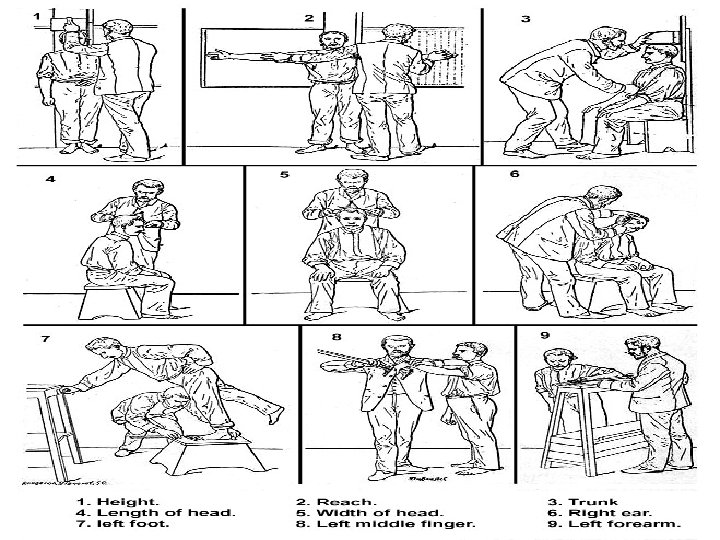
Alphonse Bertillon L 1881 LEmployed as a ledger clerk at the police headquarters in Paris, suggested using 11 body measurements to identify habitual offenders. LWas accepted almost everywhere. LThe science of human measurements was called anthropometry. LThis was initially the system that most police departments used for personal identification. Chapter 4 Kendall/Hunt Publishing Company 35
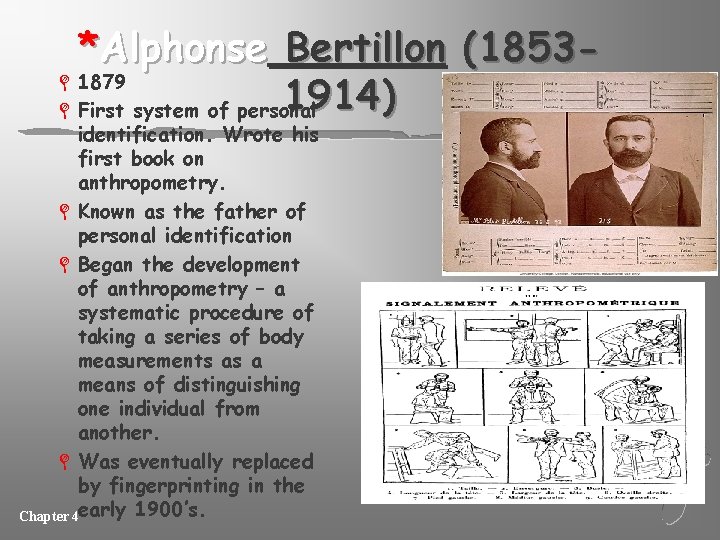
*Alphonse Bertillon (1853 L 1879 1914) L First system of personal identification. Wrote his first book on anthropometry. L Known as the father of personal identification L Began the development of anthropometry – a systematic procedure of taking a series of body measurements as a means of distinguishing one individual from another. L Was eventually replaced by fingerprinting in the Chapter 4 early 1900’s.
Chapter 4
Francis Galton L 1891 A British anthroplogist - Published two books in which he showed how to classify fingerprints using loops, whorls, and arches. LHe showed that: L 1. a person’s fingerprints stay the same from birth until death. L 2. no two fingerprints are identical L 3. prints cannot be altered LAnd said it is possible to classify a very large number of prints. Chapter 4 Kendall/Hunt Publishing Company 38
Sir Edward Richard Henry L 1897 – Inspector general of police in Bengal, India. LSimplified Galton’s classification system in India LEstablished the Henry System of Classification which replaced Bertillon’s system. LEngland’s (FBI) Scotland Yard, adopted the Henry System LHenry System is used in most English speaking countries. Chapter 4 Kendall/Hunt Publishing Company 39
Juan Vucetich L 1901 – Argentinean police official LSet up a workable fingerprint classification system based on Galton’s method LUsed in most Spanish speaking countries. Chapter 4 Kendall/Hunt Publishing Company 40
Juan Vucetich L 1902 – a year later, Vucetich first officially identified a criminal using fingerprints. LIn a small town in the province of Buenos Aires, Argentina, a woman named Francesca Rojas had murdered her two sons and blamed the attack on a neighbor. LUsing Vucetich’s methods, police identified bloody fingerprints on a door post as Rojas’s, which led to her confession. Chapter 4 Kendall/Hunt Publishing Company 41
Civil Service Test L 1902 – The New York Civil Service began the practice of fingerprinting everyone who took a civil service exam. Chapter 4 Kendall/Hunt Publishing Company 42
Leavenworth Prison L 1903 - The death of Bertillon’s anthropomorphic classification. . Mainly because. . . L A man named Will West arrived there to serve time. L When convicted, he received an extra severe sentence because he was a repeat offender. L He protested the sentence, stating that he had never been convicted before. L As was done with all prisoners on admission, his Bertillon measurements were taken and compared to existing files. Chapter 4 Kendall/Hunt Publishing Company 43
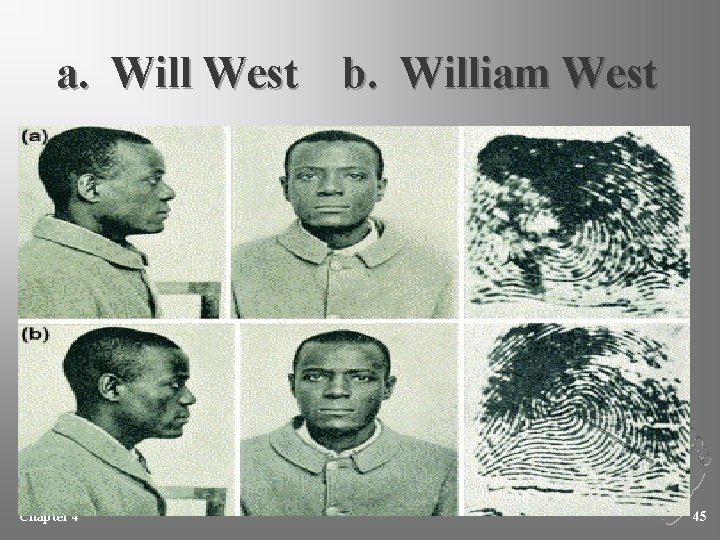
Will and William West LPrison officials were astonished to find that another man who was serving a life term for murder had almost identical measurements, and even more amazing, his name was William West. . . And he looked almost the same as the new prisoner! LThe two men’s fingerprints were taken and, of course, were quite different! Chapter 4 Kendall/Hunt Publishing Company 44
a. Will West b. William West Chapter 4 Kendall/Hunt Publishing Company 45
L 1903 – The New York State prison system started fingerprinting all the inmates. L 1904 – because of the William West case, Leavenworth Penitentiary also switched to fingerprinting as its primary means of personal identification. L 1905 – the U. S. Army began using fingerprints , and the U. S. Department of Justice set up the Bureau of Criminal Identification in Washington D. C. to centralize and standardize the use of fingerprinting. Chapter 4 Kendall/Hunt Publishing Company 46
L 1907 – The Navy began using fingerprints, and the Bureau of Criminal Identification was moved to Leavenworth Penitentiary. L 1918 Edmond Locard recommended that 12 points of comparison be required to prove the identity of an individual. L 1924 – the U. S. Congress established the FBI as the central repository for all fingerprint information. LBy 1946 it held 100 million fingerprint cards. Chapter 4 Kendall/Hunt Publishing Company 47
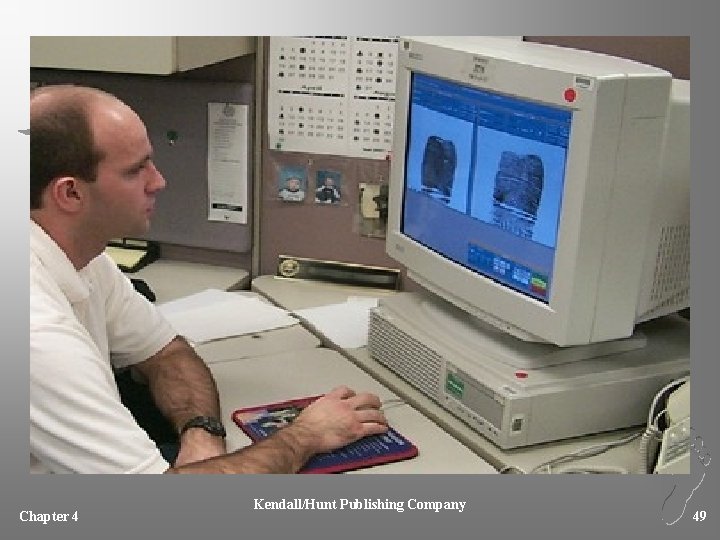
IAFIS L 2004 – The FBI crime lab identification section began using the Integrated Automated Fingerprint Identification System (IAFIS). L It can search 47 million records in 5 minutes! L Assuming good quality, IAFIS requires only one print for a match! L The final identification however, is always done by hand by a forensic expert. L The more than 250 million fingerprint cards already collected are still kept on file. L If piled on top of each other, these records would make 133 stacks as high as the Empire State Building! Chapter 4 Kendall/Hunt Publishing Company 48
Chapter 4 Kendall/Hunt Publishing Company 49
Chapter 4 Kendall/Hunt Publishing Company 50
IAFIS Lhttp: //www. youtube. com/wat ch? v=ZKi 1 CKTRCQM&feature=related 6: 37 Lhttp: //www. youtube. com/watch? v=ZKi 1 CK TRCQM&feature=related Chapter 4
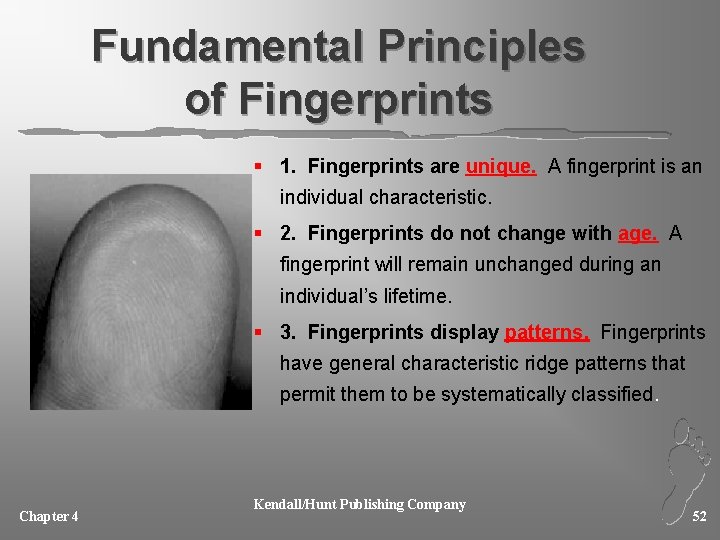
Fundamental Principles of Fingerprints § 1. Fingerprints are unique. A fingerprint is an individual characteristic. § 2. Fingerprints do not change with age. A fingerprint will remain unchanged during an individual’s lifetime. § 3. Fingerprints display patterns. Fingerprints have general characteristic ridge patterns that permit them to be systematically classified. Chapter 4 Kendall/Hunt Publishing Company 52
The Anatomy of a Fingerprint
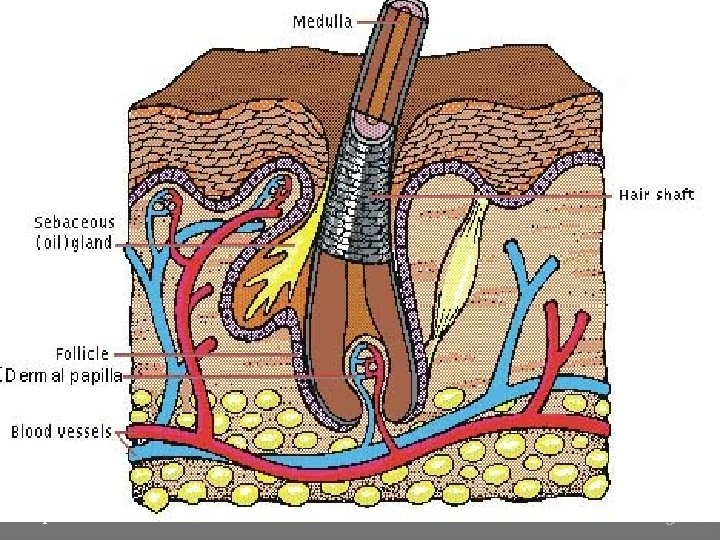
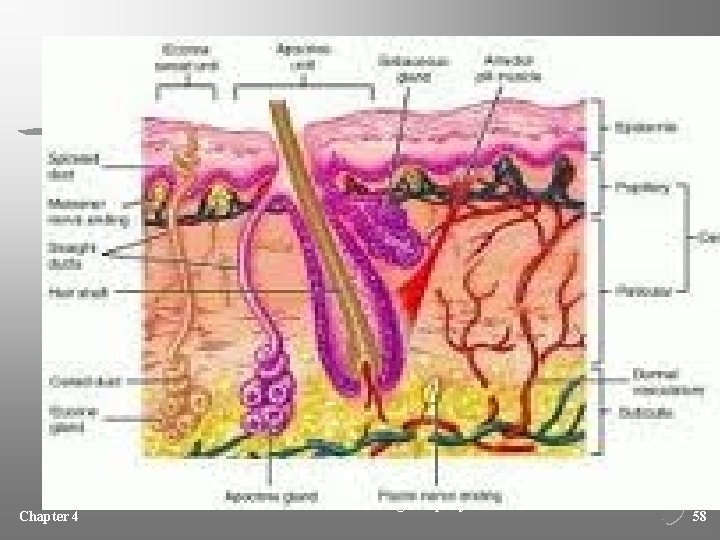
Human Skin LHuman skin is the body’s first line of defense against invasion and infection. LThe hills and valleys (ridges and grooves) you saw when examining your fingers with a magnifying glass make up the skin pattern that is yours alone. Chapter 4 Kendall/Hunt Publishing Company 54
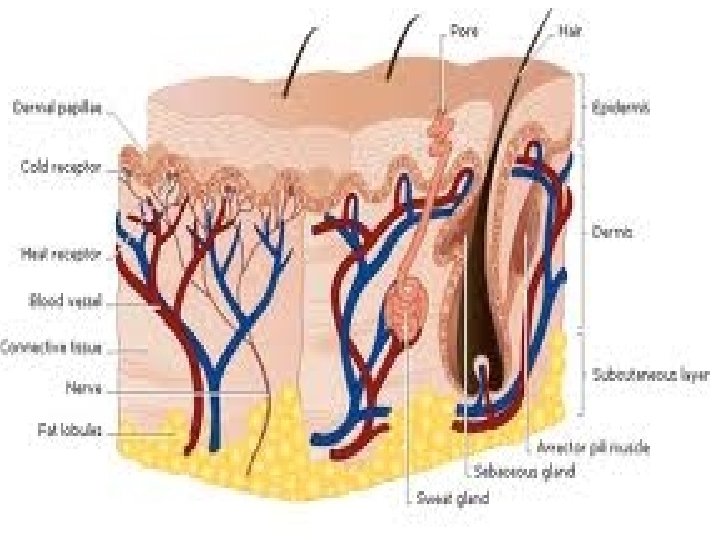
Skin and Papillae LIs made up an outer epidermal layer separated from the inner dermal part by the papillae. LThe papillae form a boundary that determines the friction ridge structure of the epidermis. LThe friction ridge pattern of a fingerprint is established by the dermal papillae. Chapter 4 Kendall/Hunt Publishing Company 55
Chapter 4 Kendall/Hunt Publishing Company 56
Chapter 4 Kendall/Hunt Publishing Company 57
Chapter 4 Kendall/Hunt Publishing Company 58
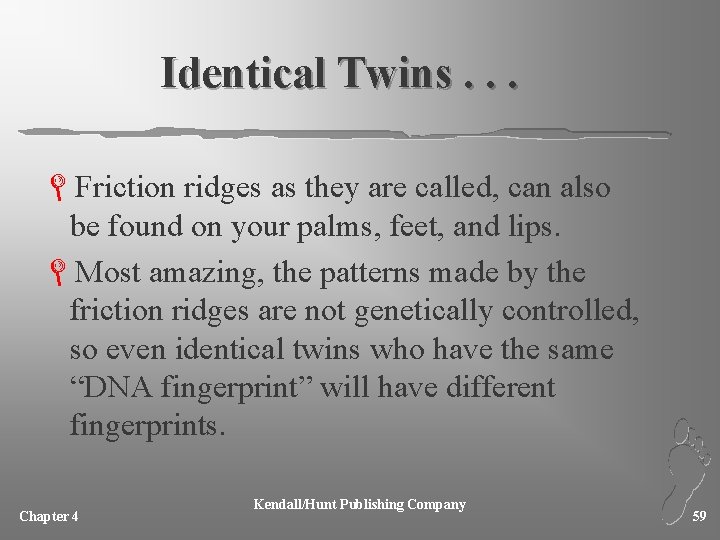
Identical Twins. . . LFriction ridges as they are called, can also be found on your palms, feet, and lips. LMost amazing, the patterns made by the friction ridges are not genetically controlled, so even identical twins who have the same “DNA fingerprint” will have different fingerprints. Chapter 4 Kendall/Hunt Publishing Company 59
Lunitedstreaming. com - Search Results: fingerprinting Chapter 4 Kendall/Hunt Publishing Company 60
LChemically or physically erasing the epidermal structure, as John Dillinger tried to do, causes only pain because the original print will soon grow back. Chapter 4 Kendall/Hunt Publishing Company 61
Chapter 4 Kendall/Hunt Publishing Company 62
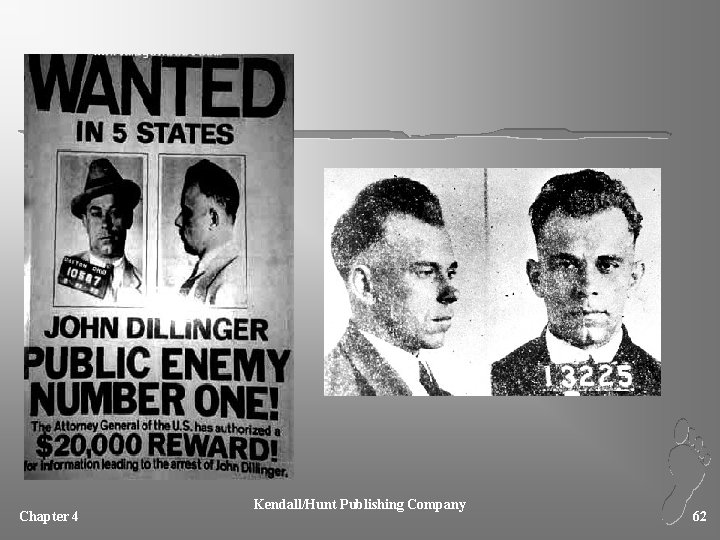
John Dillinger L. . . Was as a notorious bank robber who tried to remove his fingerprints by using a corrosive acid. LPublic Enemy Number One in the early 1930’s paid a doctor $5, 000, plus $25 per day for room and board to “dissolve” his fingerprints and perform some minor surgery on his face. Chapter 4 Kendall/Hunt Publishing Company 63
John Dillinger LHe had the outer layers of the skin (the epidermis) removed by acid and had plastic surgery performed on his face to conceal his identity. LThe operation created lots of scar tissue that obscured the ridges in the centers of his fingers, but there were still plenty of minutiae for identification. LHe was shot and killed on July 22, 1934, during the famous “lady in red” incident outside the Biograph Theater. Chapter 4 Kendall/Hunt Publishing Company 64
“Lady in Red” LThe term lady in red derives from the incident in which the FBI was looking for Dillinger, and an informant, Ana Cumpanas (Sage) , stepped forward and said she would be going to theater with him in the near future. LShe wanted the cash reward offered for the capture of Dillinger and to be allowed to stay in the United States (she was scheduled for deportation back to Romania as an undesirable alien). Chapter 4 Kendall/Hunt Publishing Company 65
LShe was told to wear a bright red dress so that the agents waiting outside theater could easily spot both her and her date, John Dillinger. LWhen she exited theater, the agents attempted to arrest the man she was with, but he fled. LThe agents shot and killed the man, but there was some question whether he was truly John Dillinger. Chapter 4 Kendall/Hunt Publishing Company 66
LThe fingerprints of the dead man were taken, and in spite of the presence of a tremendous amount of scar tissue, the FBI was able to match them to those of John Dillinger from fingerprint records taken earlier in his career. Chapter 4 Kendall/Hunt Publishing Company 67
LJohn Dillinger musical 5: 45 LJohn Dillinger and "Baby Face" Nelson Hunted by FBI 2: 28 LJohn Dillinger Died Here 1: 59 Chapter 4 Kendall/Hunt Publishing Company 68
L http: //www. youtube. com/watch? v=no. Iz_N vot. Mw&feature=fvst John Dillinger 5: 45 musical Lhttp: //www. youtube. com/watch? v=bx_m. Qc tz 944 John Dillinger and “Baby Face” Nelson Hunted by FBI 2: 28 Lhttp: //www. youtube. com/watch? v=i. Orlc. PT xw. Vk John Dillinger Died Here 1: 59 Chapter 4 Kendall/Hunt Publishing Company 69
Changes in Fingerprints? ? LCertain professions can affect a fingerprint. LFor example: LThe ridges of a concrete worker and plasterer can become rather indistinct over time because of the alkalinity of cement and gypsum can dissolve proteins. Chapter 4 Kendall/Hunt Publishing Company 70
Classification of Fingerprints
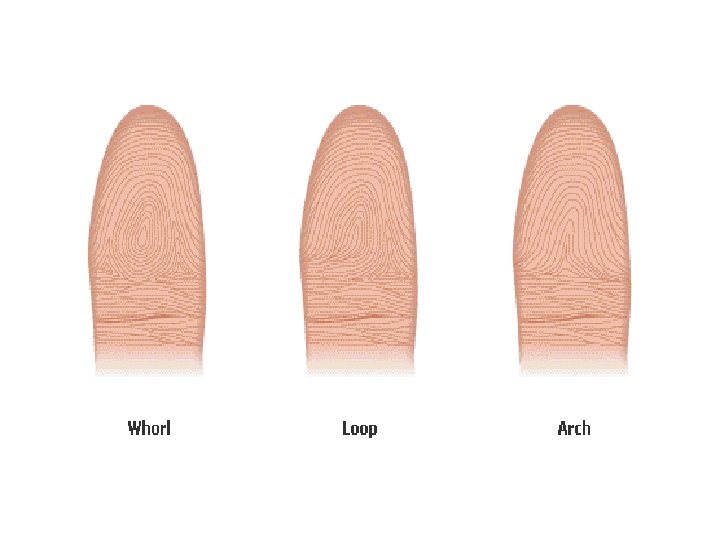
Patterns LAll fingerprints can be classified into three basic patterns: LLoops LWhorls LArches Chapter 4 Kendall/Hunt Publishing Company 72
Chapter 4 Kendall/Hunt Publishing Company 73
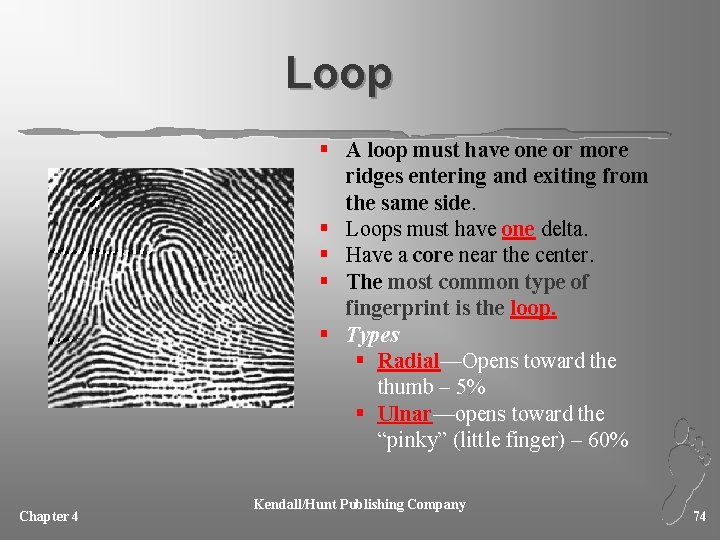
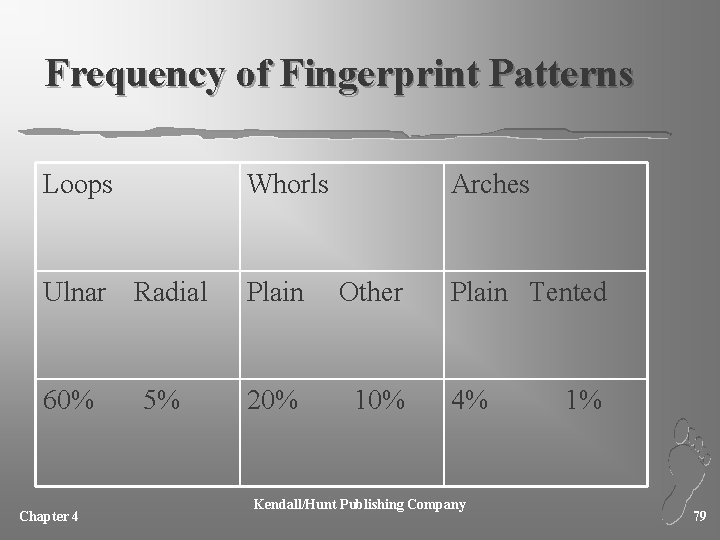
Loop § A loop must have one or more ridges entering and exiting from the same side. § Loops must have one delta. § Have a core near the center. § The most common type of fingerprint is the loop. § Types § Radial—Opens toward the thumb – 5% § Ulnar—opens toward the “pinky” (little finger) – 60% Chapter 4 Kendall/Hunt Publishing Company 74
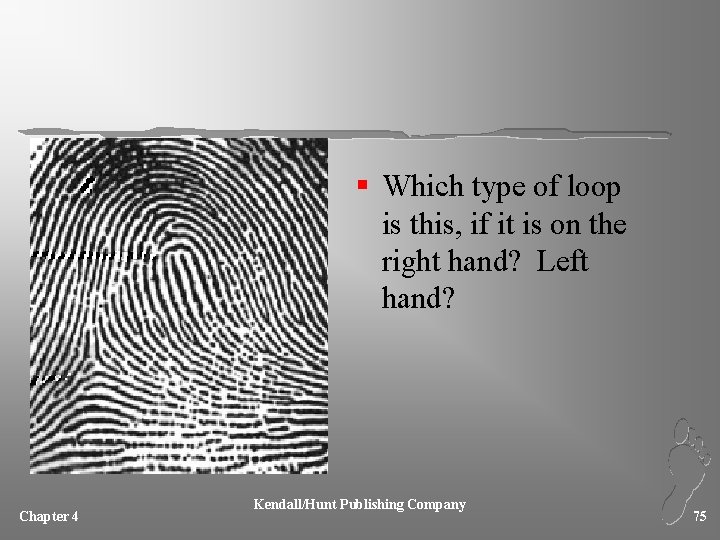
§ Which type of loop is this, if it is on the right hand? Left hand? Chapter 4 Kendall/Hunt Publishing Company 75
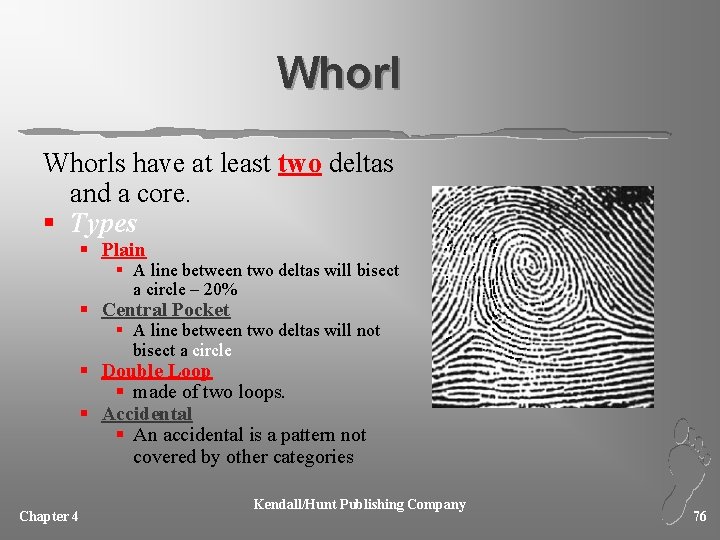
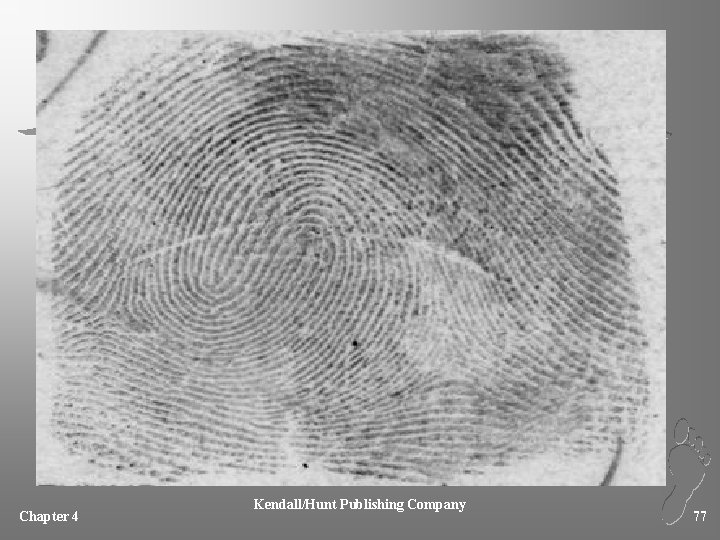
Whorls have at least two deltas and a core. § Types § Plain § A line between two deltas will bisect a circle – 20% § Central Pocket § A line between two deltas will not bisect a circle § Double Loop § made of two loops. § Accidental § An accidental is a pattern not covered by other categories Chapter 4 Kendall/Hunt Publishing Company 76
Chapter 4 Kendall/Hunt Publishing Company 77
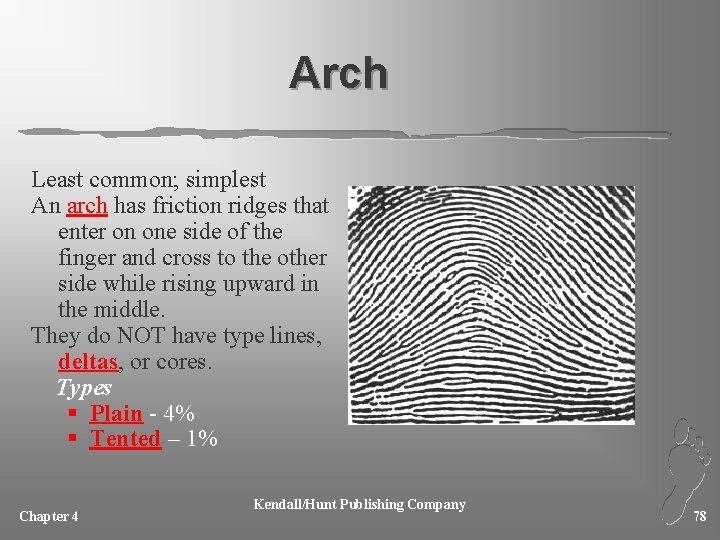
Arch Least common; simplest An arch has friction ridges that enter on one side of the finger and cross to the other side while rising upward in the middle. They do NOT have type lines, deltas, or cores. Types § Plain - 4% § Tented – 1% Chapter 4 Kendall/Hunt Publishing Company 78
Frequency of Fingerprint Patterns Loops Ulnar 60% Chapter 4 Whorls Radial 5% Arches Plain Other 20% 10% Plain Tented 4% Kendall/Hunt Publishing Company 1% 79
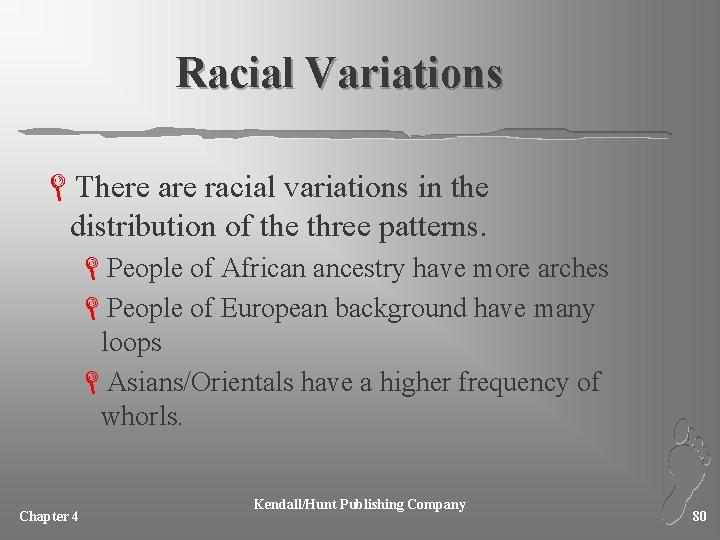
Racial Variations LThere are racial variations in the distribution of the three patterns. LPeople of African ancestry have more arches LPeople of European background have many loops LAsians/Orientals have a higher frequency of whorls. Chapter 4 Kendall/Hunt Publishing Company 80
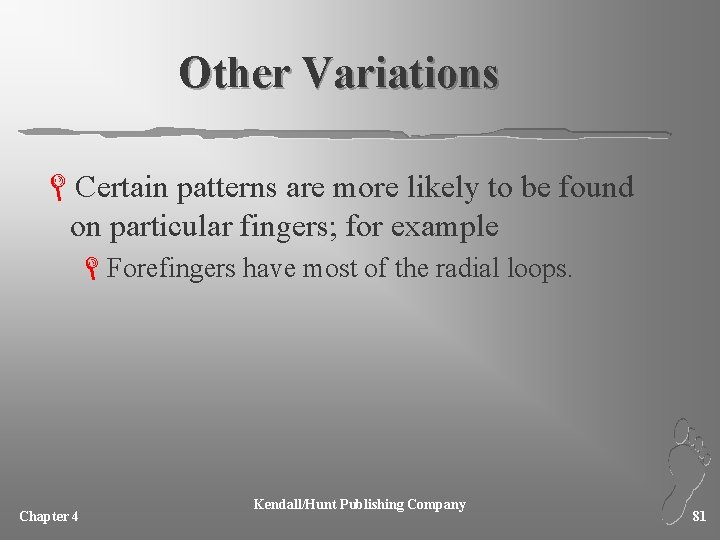
Other Variations LCertain patterns are more likely to be found on particular fingers; for example LForefingers have most of the radial loops. Chapter 4 Kendall/Hunt Publishing Company 81
Chapter 4 Kendall/Hunt Publishing Company 82
How to Roll Fingerprints Lhttp: //www. youtube. com/watch? v=d 7 N 4 UNAzsw 4: 31 How to roll fingerprints Lhttp: //www. youtube. com/watch? v=d 7 N 4 UNAzsw Chapter 4
Chapter 4 Kendall/Hunt Publishing Company 84
Chapter 4 Kendall/Hunt Publishing Company 85
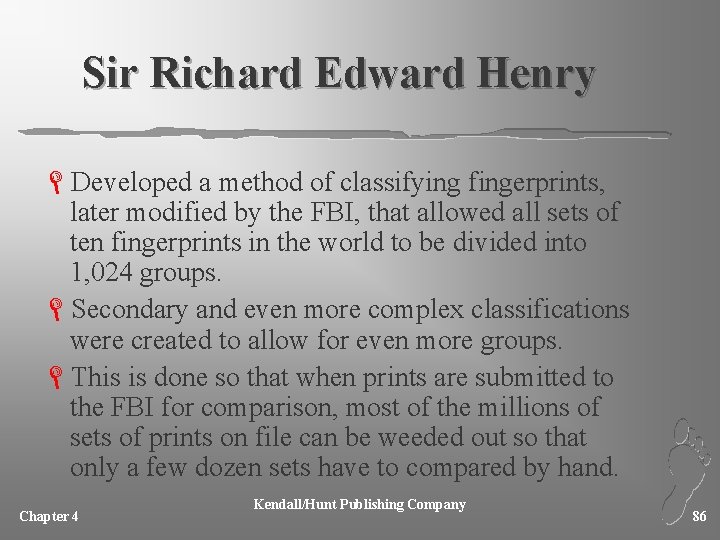
Sir Richard Edward Henry LDeveloped a method of classifying fingerprints, later modified by the FBI, that allowed all sets of ten fingerprints in the world to be divided into 1, 024 groups. LSecondary and even more complex classifications were created to allow for even more groups. LThis is done so that when prints are submitted to the FBI for comparison, most of the millions of sets of prints on file can be weeded out so that only a few dozen sets have to compared by hand. Chapter 4 Kendall/Hunt Publishing Company 86
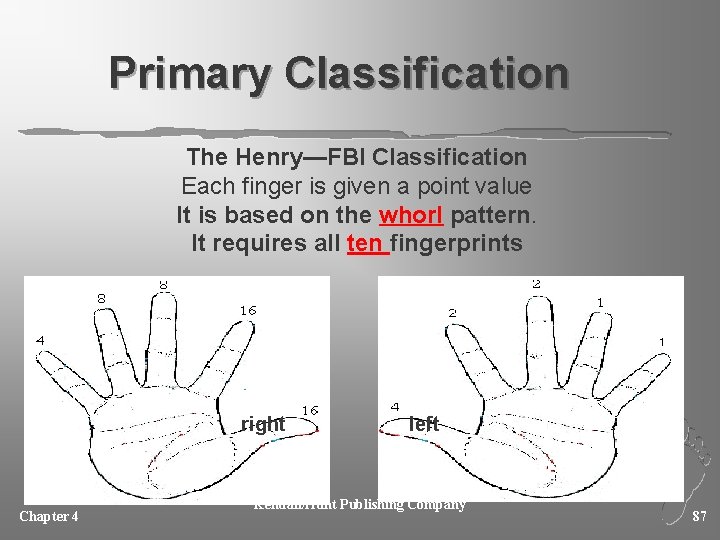
Primary Classification The Henry—FBI Classification Each finger is given a point value It is based on the whorl pattern. It requires all ten fingerprints right Chapter 4 left Kendall/Hunt Publishing Company 87
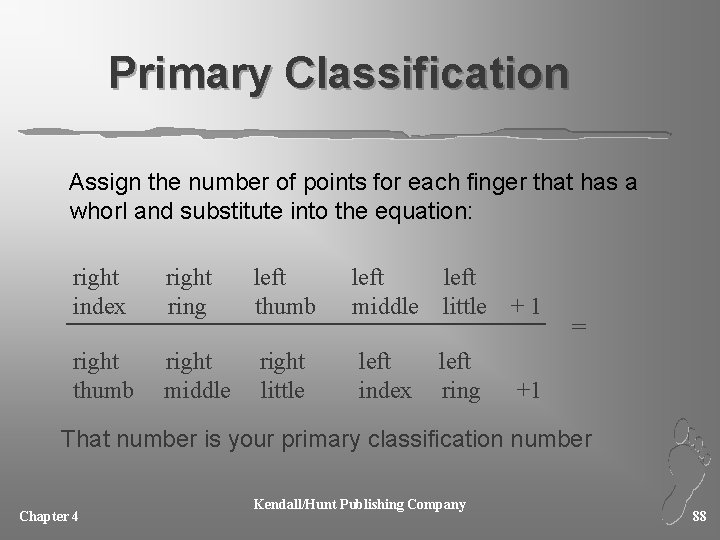
Primary Classification Assign the number of points for each finger that has a whorl and substitute into the equation: right index right ring left thumb left middle left little +1 right thumb right middle right little left index left ring +1 = That number is your primary classification number Chapter 4 Kendall/Hunt Publishing Company 88
Complete Your Henry System Classification
Fingerprint Games L Digital fingerprint puzzle L – sciencespot and tru tv - Forensic Files: Fingerprint Game on tru. TV. com L Match the fingerprints investigation discovery – sciencespot - Fingerprint Memory Games : Detective Games : Investigation Discovery L Match the fingerprints investigation discovery – sciencepost - Fingerprint Memory Games : Detective Games : Investigation Discovery Chapter 4 90
Individualization Ridge Classification
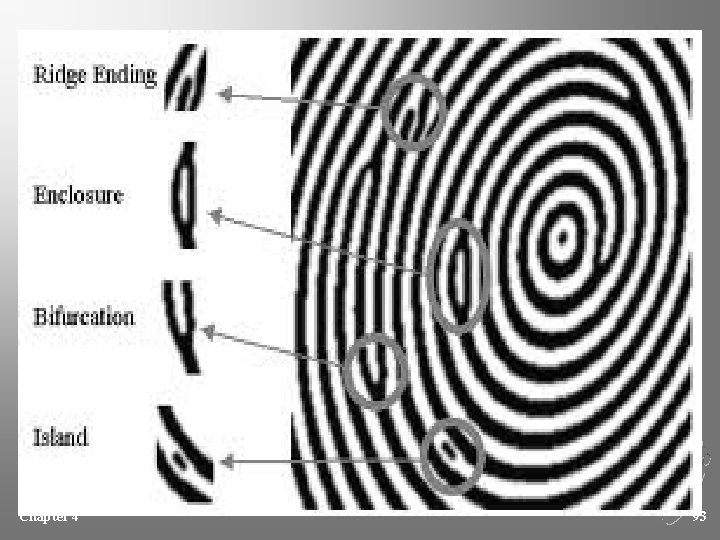
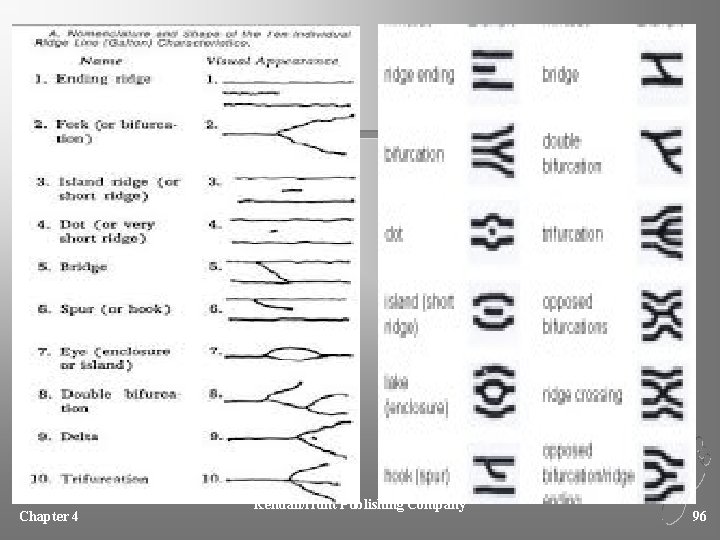
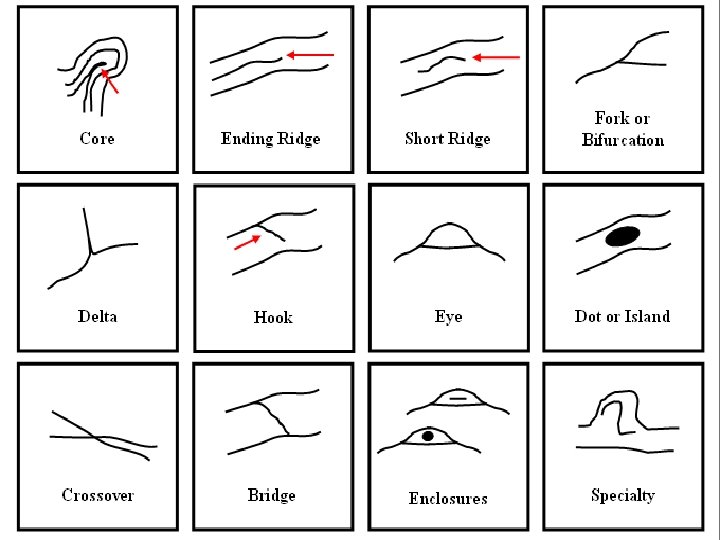
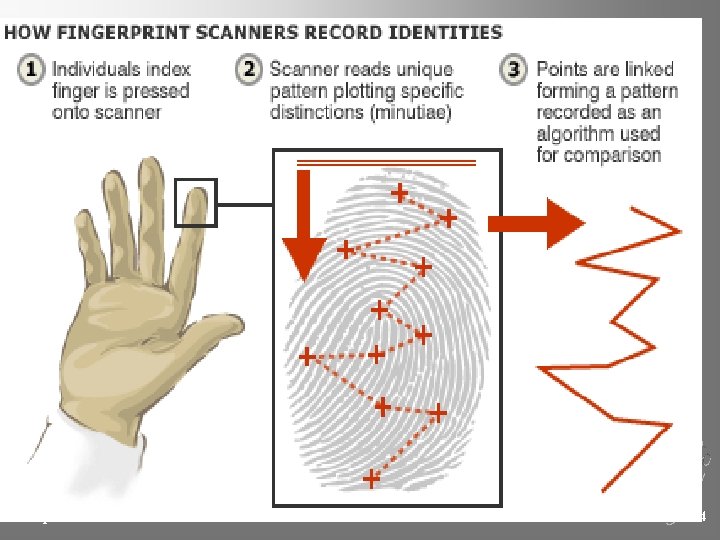
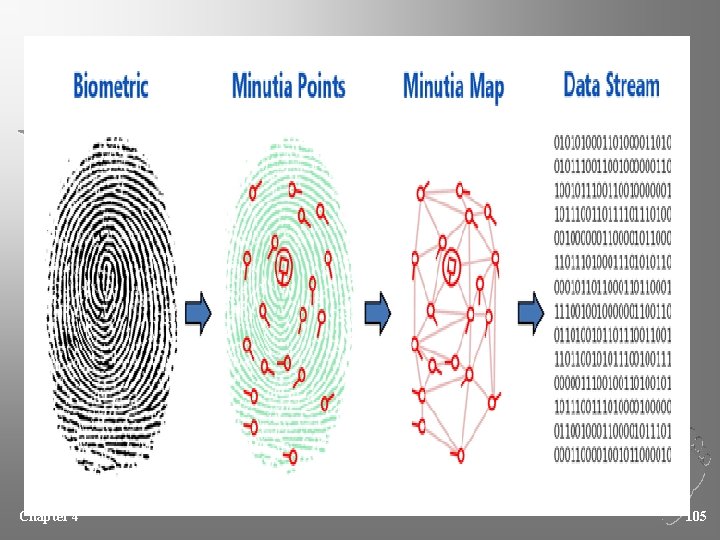
Individualization of Fingerprints You have now classified fingerprints according to general patterns or groups, but to individualize them, you must use the fine structure of ridge characteristics or minutiae. Chapter 4 Kendall/Hunt Publishing Company 92
Chapter 4 Kendall/Hunt Publishing Company 93
Chapter 4 Kendall/Hunt Publishing Company 94
Chapter 4 Kendall/Hunt Publishing Company 95
Chapter 4 Kendall/Hunt Publishing Company 96
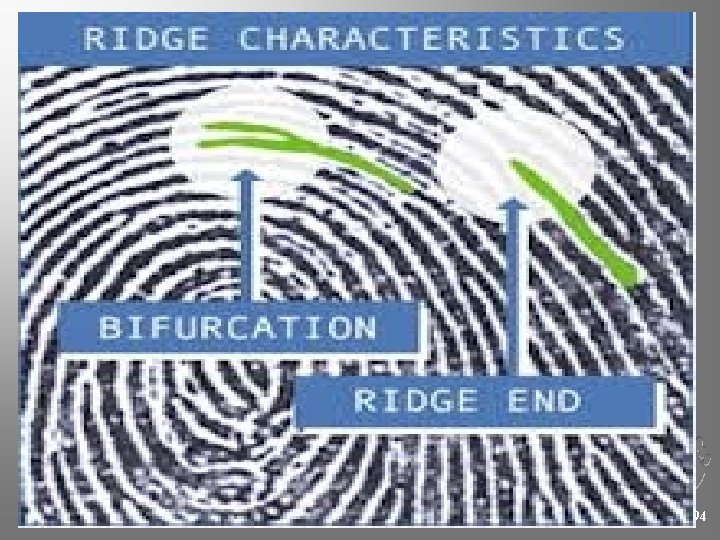
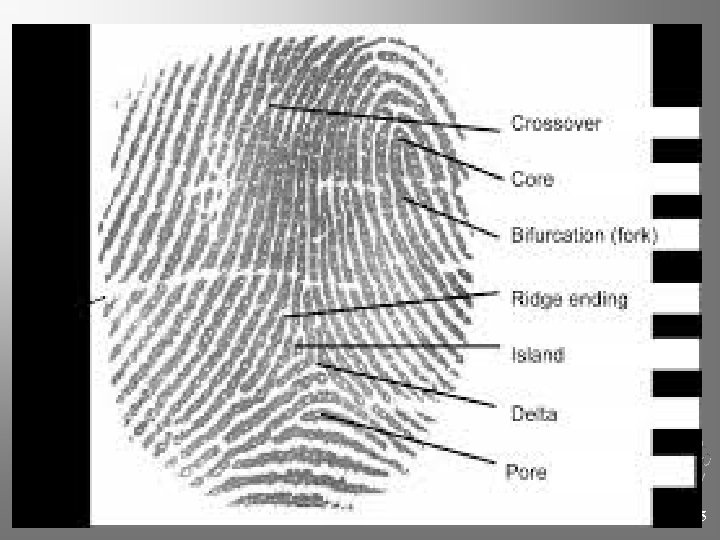
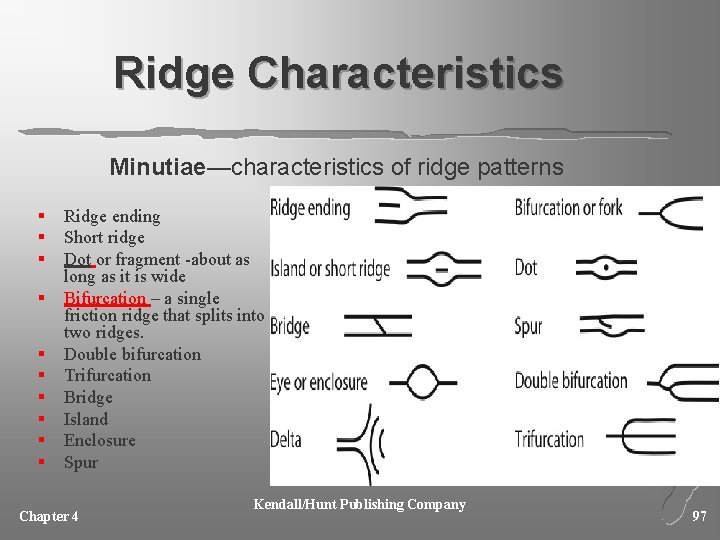
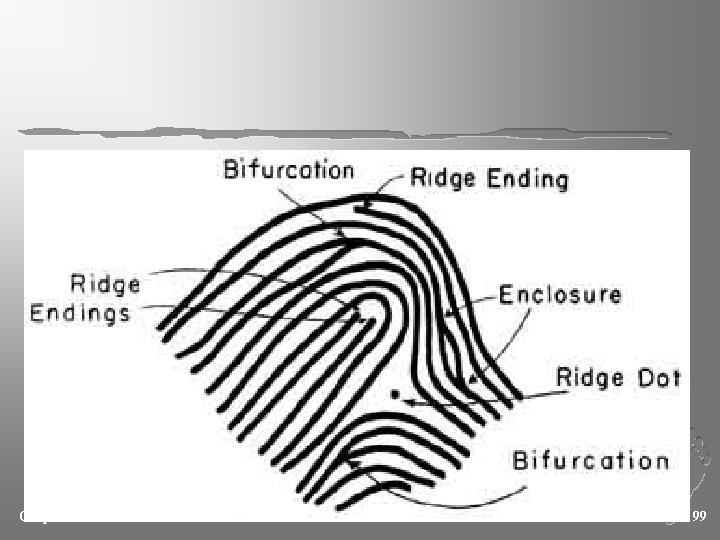
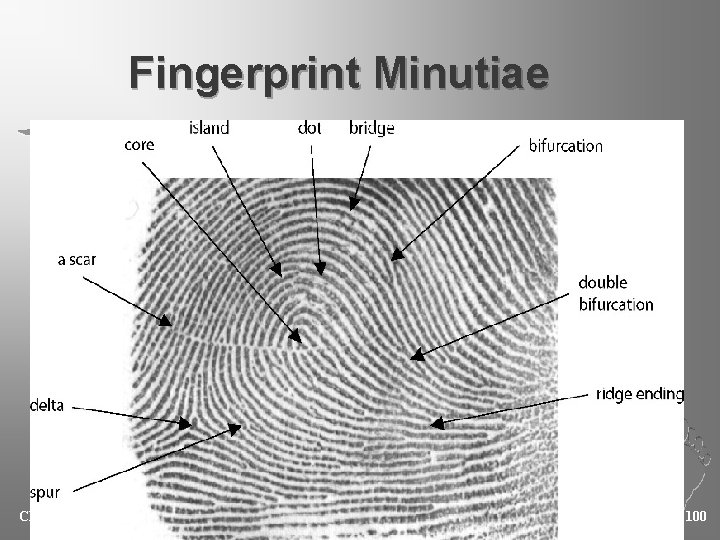
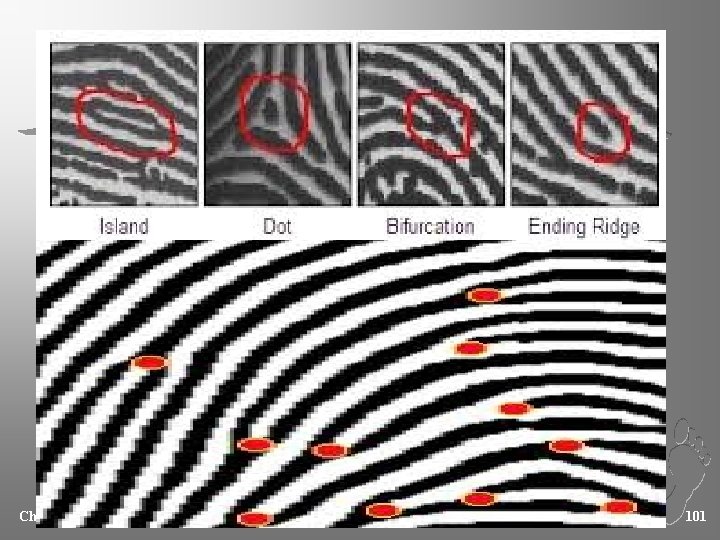
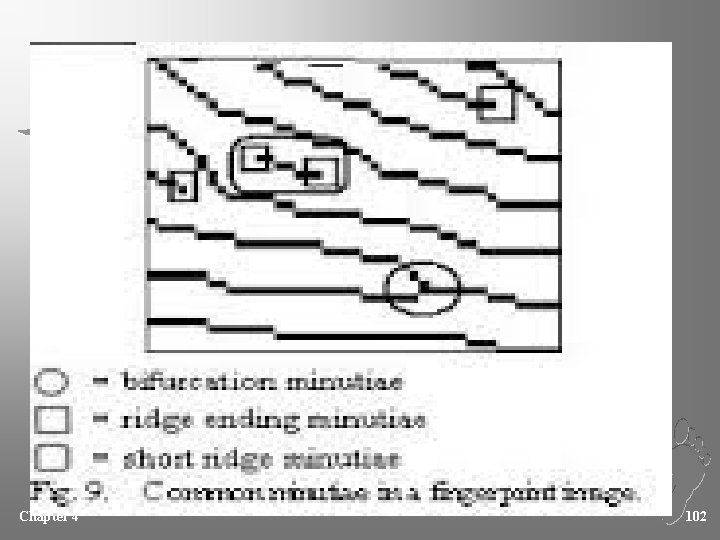
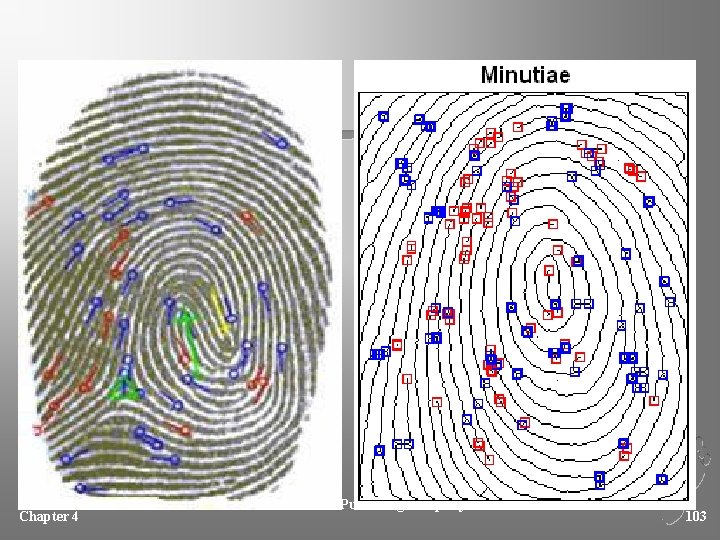
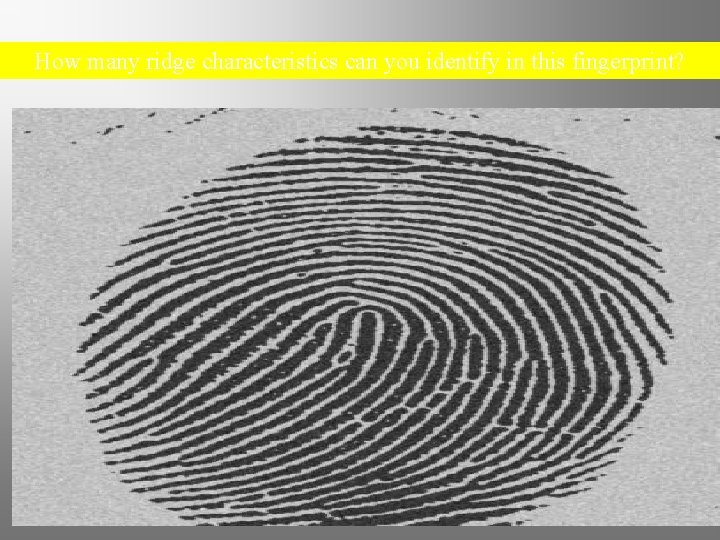
Ridge Characteristics Minutiae—characteristics of ridge patterns § § § § § Ridge ending Short ridge Dot or fragment -about as long as it is wide Bifurcation – a single friction ridge that splits into two ridges. Double bifurcation Trifurcation Bridge Island Enclosure Spur Chapter 4 Kendall/Hunt Publishing Company 97
Chapter 4 Kendall/Hunt Publishing Company 98
Chapter 4 Kendall/Hunt Publishing Company 99
Fingerprint Minutiae Chapter 4 Kendall/Hunt Publishing Company 100
Chapter 4 Kendall/Hunt Publishing Company 101
Chapter 4 Kendall/Hunt Publishing Company 102
Chapter 4 Kendall/Hunt Publishing Company 103
Chapter 4 Kendall/Hunt Publishing Company 104
Chapter 4 Kendall/Hunt Publishing Company 105
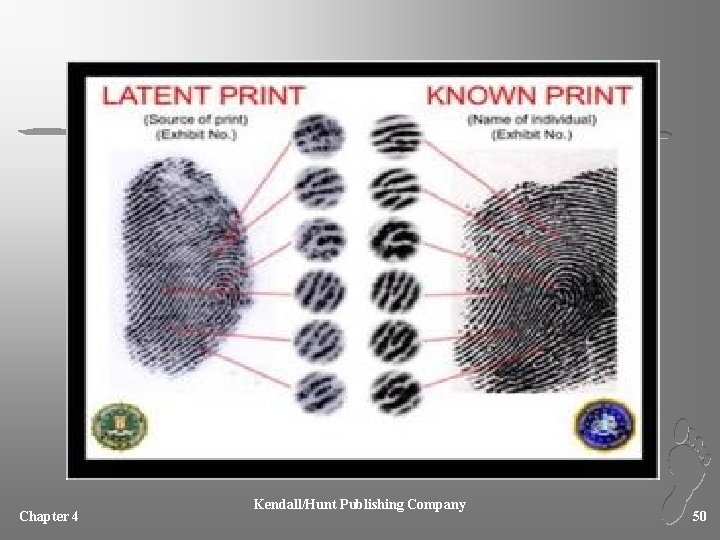
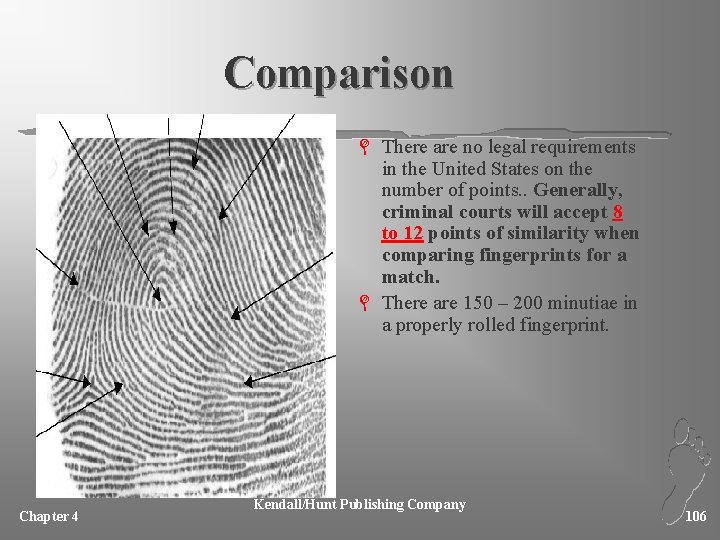
Comparison L There are no legal requirements in the United States on the number of points. . Generally, criminal courts will accept 8 to 12 points of similarity when comparing fingerprints for a match. L There are 150 – 200 minutiae in a properly rolled fingerprint. Chapter 4 Kendall/Hunt Publishing Company 106
How many ridge characteristics can you identify in this fingerprint? Chapter 4 Kendall/Hunt Publishing Company 107
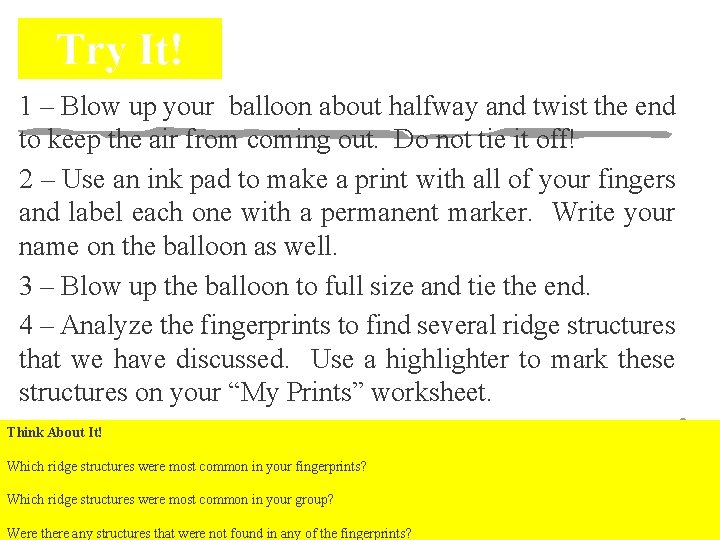
Try It! 1 – Blow up your balloon about halfway and twist the end to keep the air from coming out. Do not tie it off! 2 – Use an ink pad to make a print with all of your fingers and label each one with a permanent marker. Write your name on the balloon as well. 1 3 – Blow up the balloon to full size and tie the end. 4 – Analyze the fingerprints to find several ridge structures that we have discussed. Use a highlighter to mark these structures on your “My Prints” worksheet. Think About It! Which ridge structures were most common in your fingerprints? Which ridge structures were most common in your group? Chapter 4 Were there any structures that were not found in any of the fingerprints? 108
How to Compare Fingerprints: the basics Lhttp: //www. youtube. com/watch? v=Irp. Tq. Kk gyg. A&feature=related 5: 44 Lhttp: //www. youtube. com/watch? v=Irp. Tq. Kk gyg. A&feature=related Chapter 4
Digital Storytelling – Fingerprints 7: 58 Lhttp: //www. youtube. com/watch? v=Ry 8920 R 7 bxs&feature=related Lfbi. gov fingerprint memory game Chapter 4
Types of Prints Plastic Visible Latent
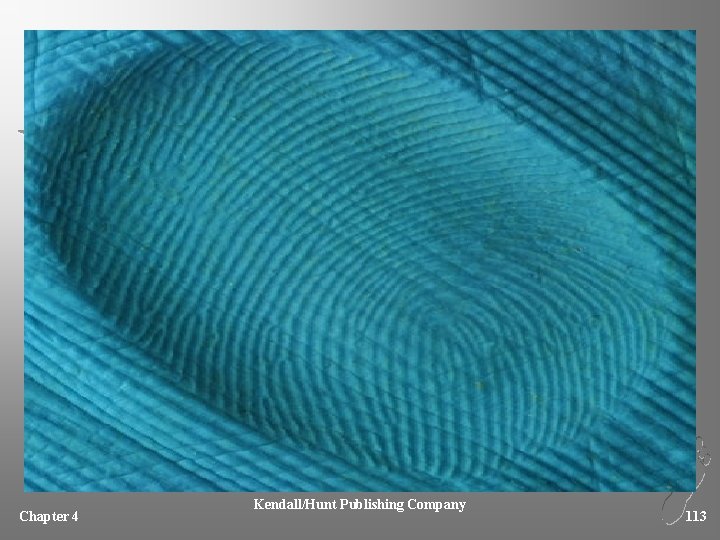
1. Plastic Prints - (etched) LPrints that are indented or molded LAre made by pressing a finger against a plastic-like material to form a negative impression of a fingerprint. LPaint, putty, soap, candle wax, gum on envelopes or stamps, a candy bar that has softened in ones hand. Chapter 4 Kendall/Hunt Publishing Company 112
Chapter 4 Kendall/Hunt Publishing Company 113
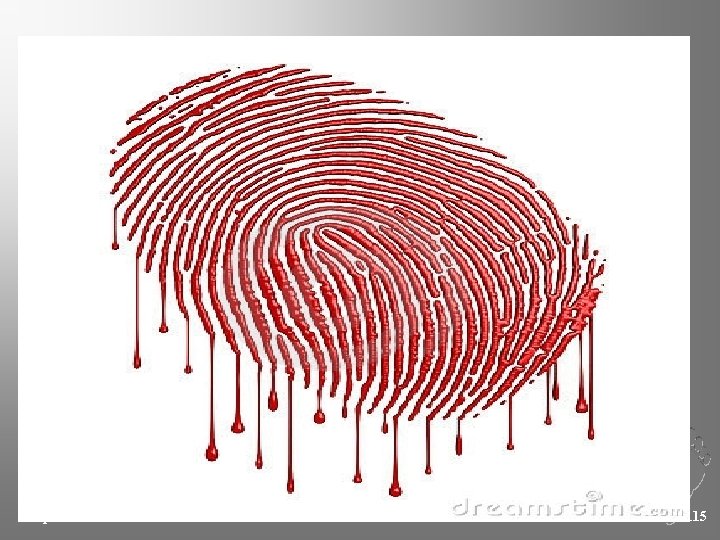
2. Visible Prints LPrints that are easily seen. LLeft by a finger that has touched colored material such as blood, paint, ink, grease, chalk, mud, or sometimes dust. Chapter 4 Kendall/Hunt Publishing Company 114
Chapter 4 Kendall/Hunt Publishing Company 115
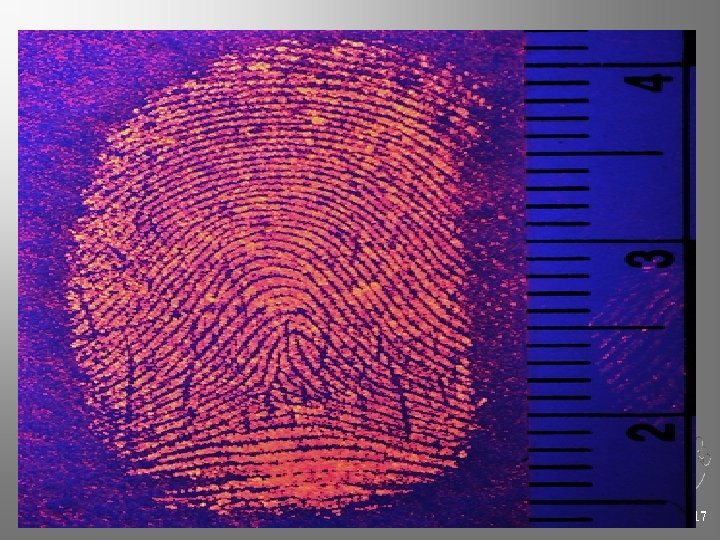
3. Latent Prints LSo called “invisible” prints that must be developed by chemical or physical means. LThey result from deposits of perspiration and body oils. LA fingerprint on the skin could be an example of a latent print. Chapter 4 Kendall/Hunt Publishing Company 116
Chapter 4 Kendall/Hunt Publishing Company 117
Visualizing Latent Prints
LSweat pores along the ridges release perspiration, which is 98 – 99 % water. LSo, a fingerprint is composed mostly of water. LIt is estimated that a fingerprint initially may weight 0. 1 milligram, so after evaporation of the water, we have left about 1 microgram of residue. LThis residue is made up of half salt and half complex organic compounds such as amino acids, lipids, vitamins, and additional body oils picked up on the finger by touching oily or hairy parts of the body. Chapter 4 Kendall/Hunt Publishing Company 119
This doesn’t leave much for the investigator to work with!
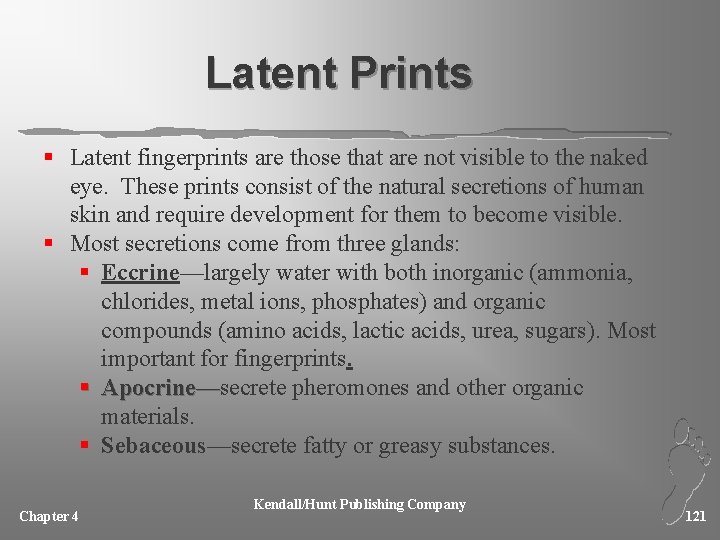
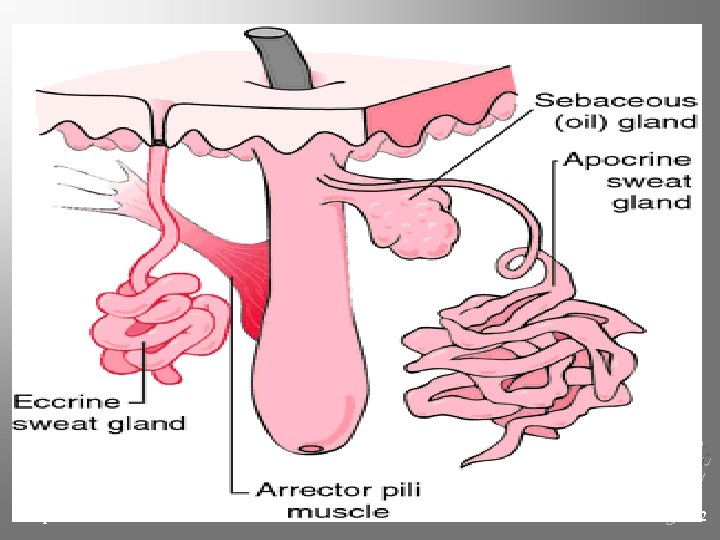
Latent Prints § Latent fingerprints are those that are not visible to the naked eye. These prints consist of the natural secretions of human skin and require development for them to become visible. § Most secretions come from three glands: § Eccrine—largely water with both inorganic (ammonia, chlorides, metal ions, phosphates) and organic compounds (amino acids, lactic acids, urea, sugars). Most important for fingerprints. § Apocrine—secrete pheromones and other organic materials. § Sebaceous—secrete fatty or greasy substances. Chapter 4 Kendall/Hunt Publishing Company 121
Chapter 4 Kendall/Hunt Publishing Company 122
Developing Latent Prints § Developing a print requires substances that interact with secretions that cause the print to stand out against its background. § It may be necessary to attempt more than one technique, done in a particular order so as not to destroy the print. Chapter 4 Kendall/Hunt Publishing Company 123
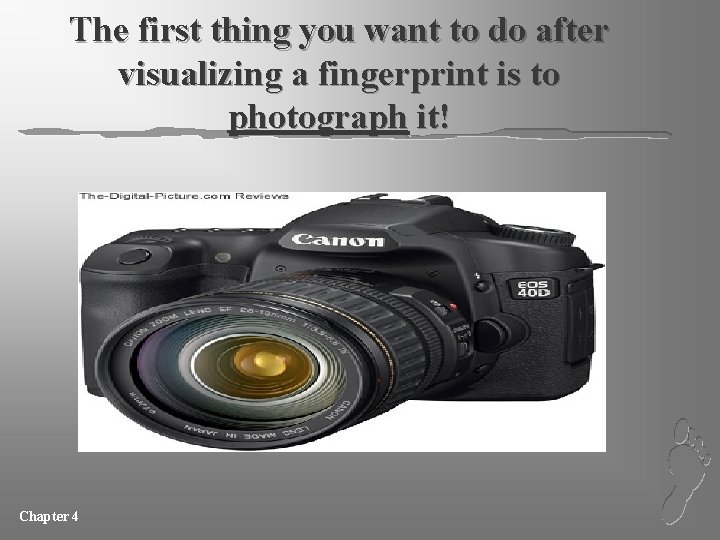
The first thing you want to do after visualizing a fingerprint is to photograph it! Chapter 4
Developing Latent Prints Physical Methods
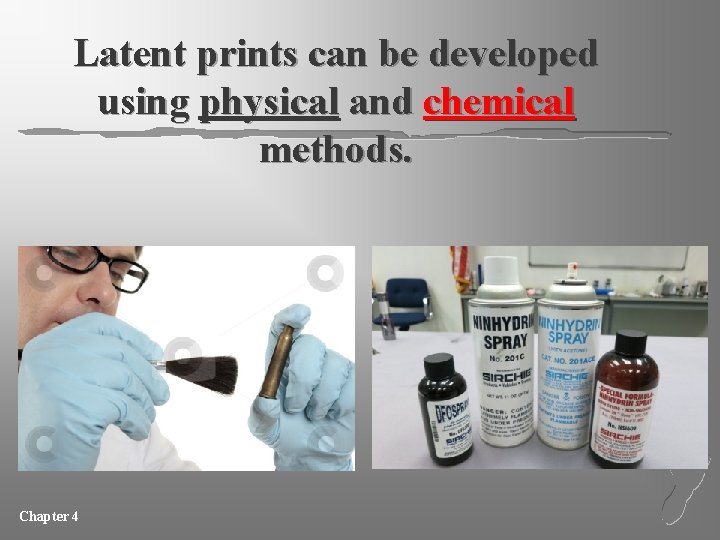
Latent prints can be developed using physical and chemical methods. Chapter 4
Dusting is a physical method of developing latent prints LDust with a fine powder. LMost effective on hard, nonabsorbent surfaces. LAdhere to both water and fatty deposits. LColor is chosen to stand out against the surface. LThe developed print can then be “lifted” by means of clear sticky tape and collected for analysis. Chapter 4 Kendall/Hunt Publishing Company 127
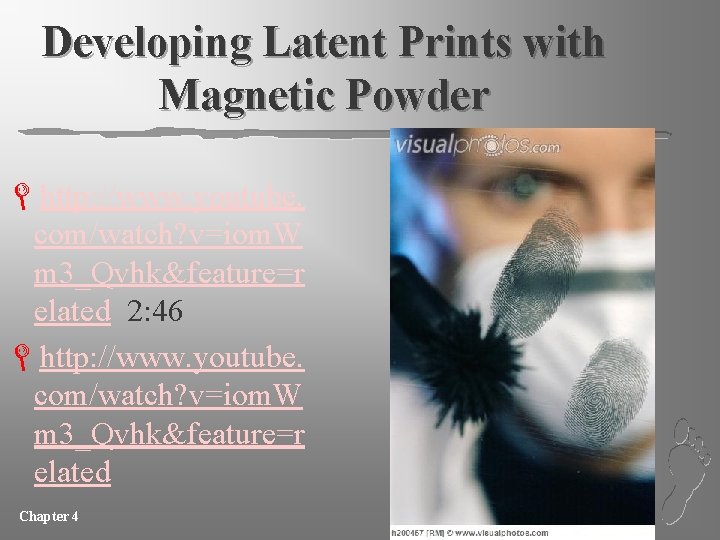
Developing Latent Prints with Magnetic Powder Lhttp: //www. youtube. com/watch? v=iom. W m 3_Qvhk&feature=r elated 2: 46 Lhttp: //www. youtube. com/watch? v=iom. W m 3_Qvhk&feature=r elated Chapter 4
Developing Latent Prints Chemical Methods Generally more effective for soft, porous surfaces such as paper, Styrofoam cups, leather, metal, etc.
Chemical Methods of Developing Latent Prints LIodine fuming LNinhydrin LCyanoacrylate – also called “superglue fuming” LSilver nitrate – physical developer. Should always be done last. Chapter 4 Kendall/Hunt Publishing Company 130
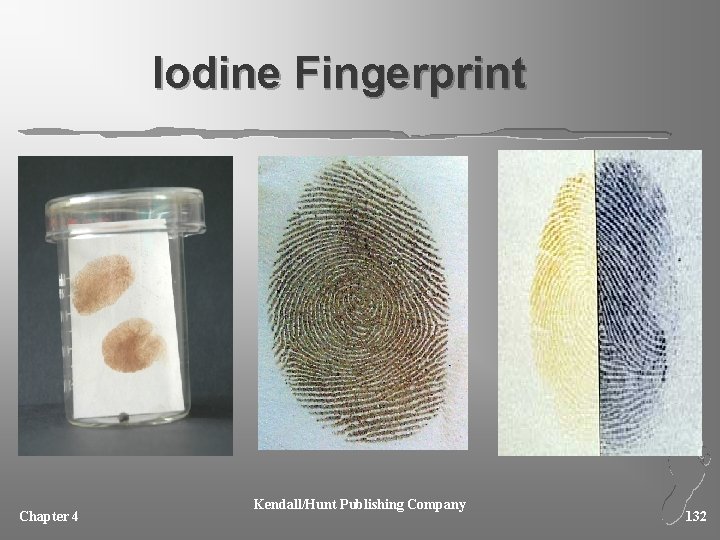
Iodine Fuming § Works best for prints on porous paper. § Iodine—fumes react with oils and fats to produce a temporary yellow brown reaction. § Iodine reacts with the fatty oils from the finger to form a visible but short lasting print. Chapter 4 Kendall/Hunt Publishing Company 131
Iodine Fingerprint Chapter 4 Kendall/Hunt Publishing Company 132
Iodine Fuming Processing LIodine Fuming 5: 04 Chapter 4 Kendall/Hunt Publishing Company 133
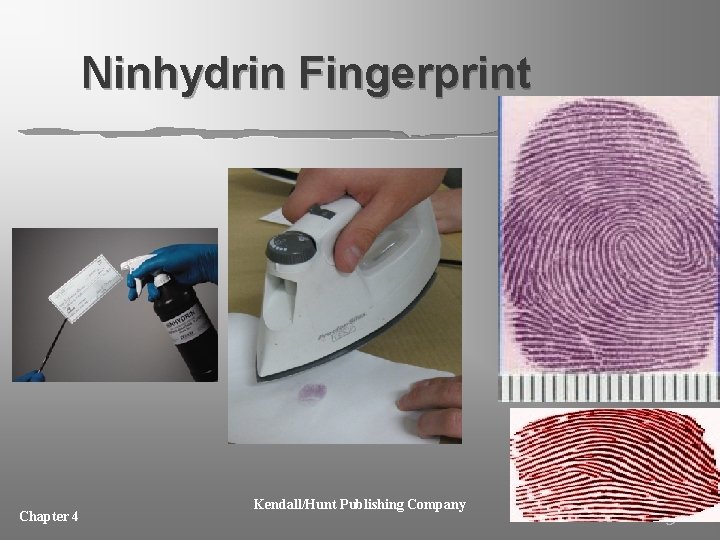
Ninhydrin LIs most commonly used with paper and porous surfaces. LIt reacts with amino acids left by the finger to make an orange to purple image. LEx – matchbook Chapter 4 Kendall/Hunt Publishing Company 134
Ninhydrin Fingerprint Chapter 4 Kendall/Hunt Publishing Company 135
Ninhydrin Fingerprint Processing LNinhyrdin processing 8: 02 Chapter 4 Kendall/Hunt Publishing Company 136
Cyanoacrylate § An interesting method of chemically developing fingerprints was discovered by accident in Japan in the late 1970’s. § Is now widely used for developing latent prints on nonporous surfaces such as metals, glass, adhesive tapes, and plastic articles § Crime 360: Superglue to find fingerprints? Chapter 4 Kendall/Hunt Publishing Company 137
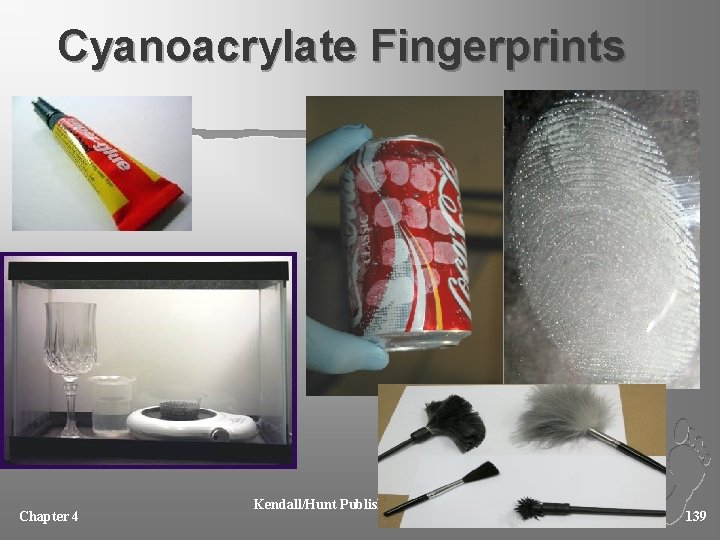
Cyanoacrylate Finding Fingerprints LIt involves evaporating superglue in an enclosed container. LThe glue, a cyanoacrylate ester, reacts with print residues to make a white, permanent impression that can then be treated with powders or fluorescent dyes to make a sharper contrast and allow easier photography or lifting. L“super glue” fumes react with amino acids, fatty acids, proteins, water and other fingerprint constituents to form a hard, whitish deposit. Chapter 4 Kendall/Hunt Publishing Company 138
Cyanoacrylate Fingerprints Chapter 4 Kendall/Hunt Publishing Company 139
Developing Prints with Superglue Lhttp: //www. youtube. com/watch? v=R 0 e 8 W Xk. FA 64&feature=related 5: 25 Lhttp: //www. youtube. com/watch? v=R 0 e 8 W Xk. FA 64&feature=related LCrime 360: Superglue to find fingerprints? 1: 00 Chapter 4
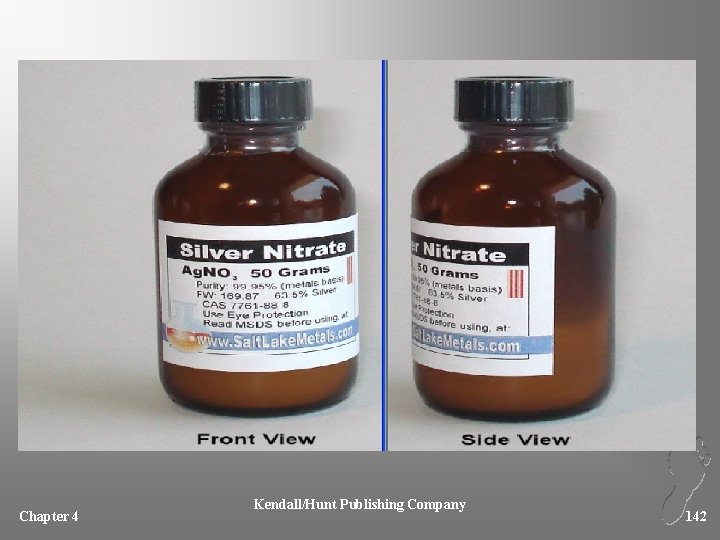
Silver Nitrate § Also called physical developer. § Reacts with salt left from perspiration in a dried print to form silver chloride, a material which turns gray when exposed to light. § It is then converted to dark silver oxide. § This is the same process used in developing photographs. § This must be a last resort because it can wash away traces of fatty oils and proteins. Chapter 4 Kendall/Hunt Publishing Company 141
Chapter 4 Kendall/Hunt Publishing Company 142
Often, the order of the steps in developing prints is important! LWhen you have just one piece of evidence, first use tests that won’t harm that evidence. LYou want to get as much information as possible, so you may have to perform several tests. Chapter 4 Kendall/Hunt Publishing Company 143
For example: LTo get the best image of latent fingerprints, you might first use iodine fuming; then you might try ninhydrin. LYou would save the silver nitrate method until last because this procedure will wash away traces of fatty oils and proteins. Chapter 4 Kendall/Hunt Publishing Company 144
A fingerprint left at the scene of a crime may last for years. . .
Lasers and Alterative Light Sources In modern labs and criminal investigations, lasers and alternative light sources are used to view latent fingerprints. These were first used by the FBI in 1978. Since lasers can damage the retina of the eye, special precautions must be taken. Chapter 4 Kendall/Hunt Publishing Company 146
Other Prints § Ridge characteristics can be also found on footprints and palm prints. § Modern labs also utilize other evidences: § A. Ears—shape, length and width § B. Voice—electronic pulses measured on a spectrograph § C. Foot—size of foot and toes; friction ridges on the foot § D. Shoes—can be compared and identified by type of shoe, brand, size, year of purchase, and wear pattern. Chapter 4 Kendall/Hunt Publishing Company 147
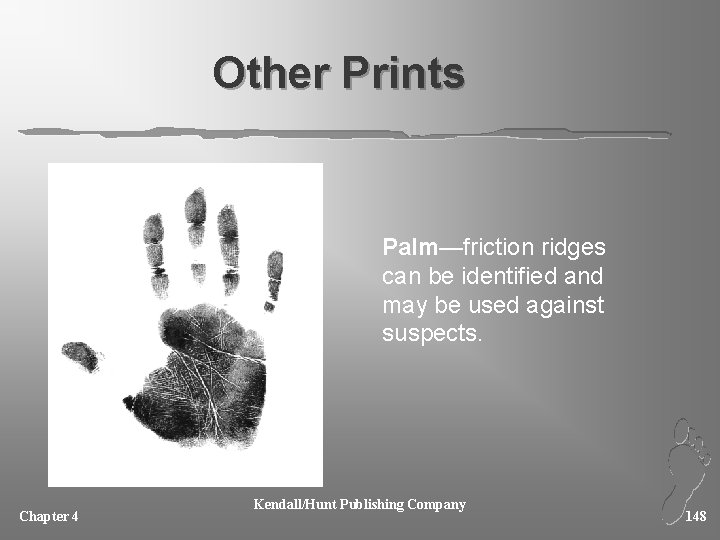
Other Prints Palm—friction ridges can be identified and may be used against suspects. Chapter 4 Kendall/Hunt Publishing Company 148
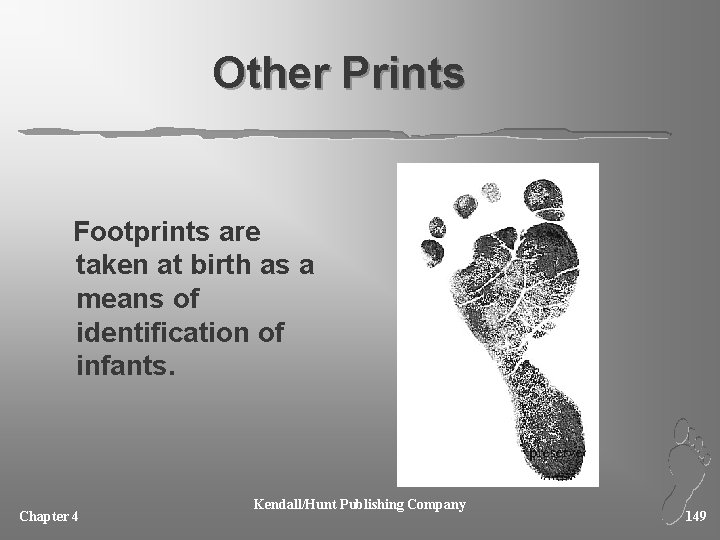
Other Prints Footprints are taken at birth as a means of identification of infants. Chapter 4 Kendall/Hunt Publishing Company 149
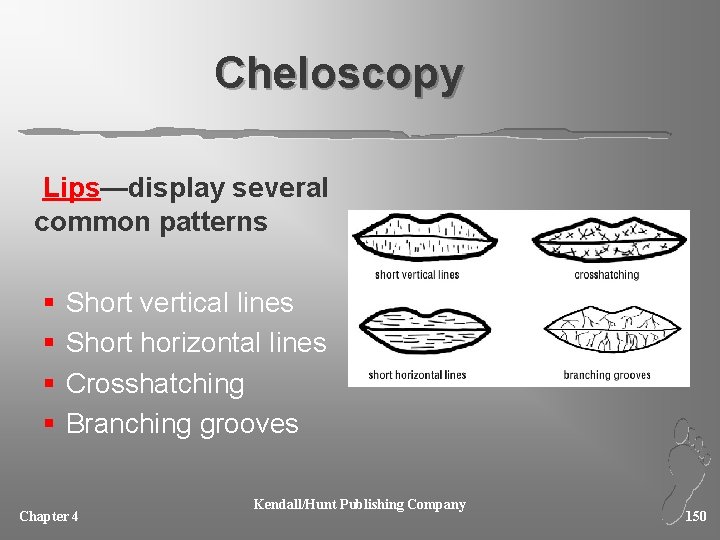
Cheloscopy Lips—display several common patterns § § Short vertical lines Short horizontal lines Crosshatching Branching grooves Chapter 4 Kendall/Hunt Publishing Company 150
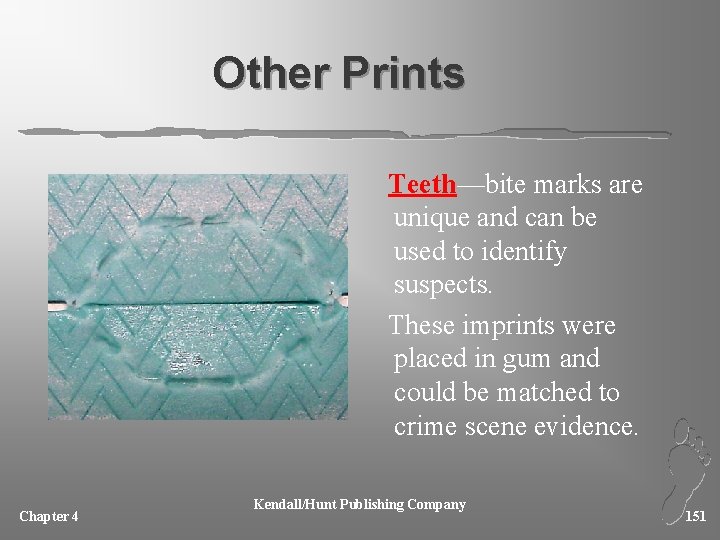
Other Prints Teeth—bite marks are unique and can be used to identify suspects. These imprints were placed in gum and could be matched to crime scene evidence. Chapter 4 Kendall/Hunt Publishing Company 151
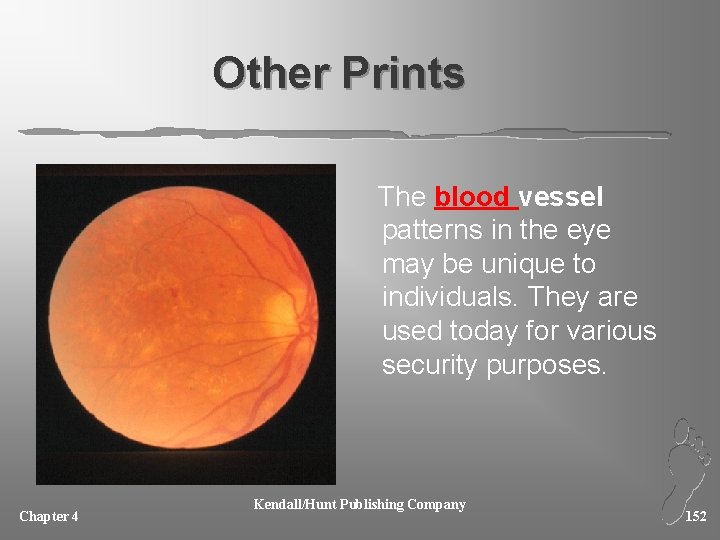
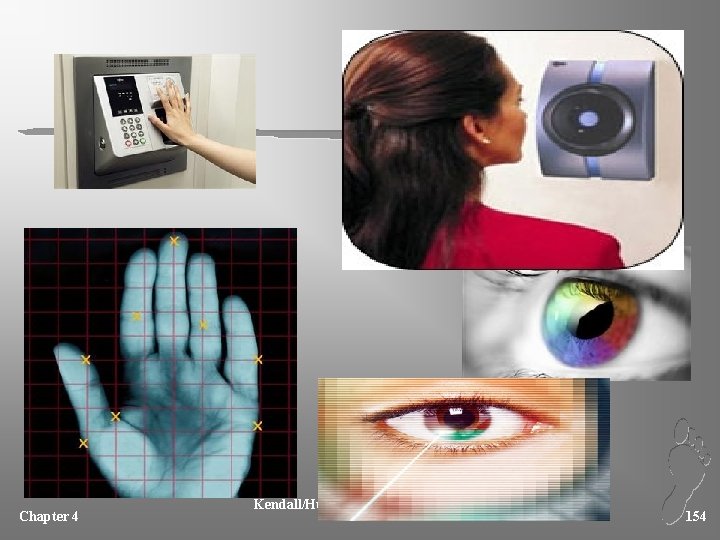
Other Prints The blood vessel patterns in the eye may be unique to individuals. They are used today for various security purposes. Chapter 4 Kendall/Hunt Publishing Company 152
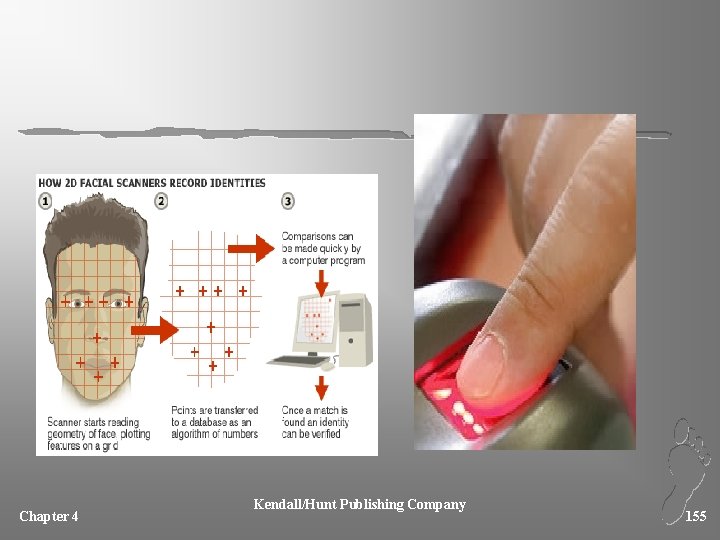
Biometrics § Used today in conjunction with AFIS § Use of some type of body metrics for the purpose of identification. (The Bertillon system may actually have been the first biometry system. ) § Examples include retinal or iris patterns, voice recognition, hand geometry § Other functions for biometrics—can be used to control entry or access to computers or other structures; can identify a person for security purposes; can help prevent identity theft or control social services fraud. Chapter 4 Kendall/Hunt Publishing Company 153
Chapter 4 Kendall/Hunt Publishing Company 154
Chapter 4 Kendall/Hunt Publishing Company 155
Practice Makes Perfect LFingerprints at the Crime Scene LLatent Print Concept Map Lfingerprints and identical twins Lfingerprint scanner Lreplicating fingerprints Chapter 4 Kendall/Hunt Publishing Company 156
More about Prints For additional information about prints and crime, check out Court TV’s Crime Library www. crimelibrary. com/criminal_mind/forensics/fing erprints/1. html Chapter 4 Kendall/Hunt Publishing Company 157