
LSDYNA Performance Benchmark and Profiling October 2017 Note
LS-DYNA Performance Benchmark and Profiling October 2017
Note • The following research was performed under the HPC Advisory Council activities – Participating vendors: LSTC, Huawei, Mellanox – Compute resource - HPC Advisory Council Cluster Center • The following was done to provide best practices – LS-DYNA performance overview – Understanding LS-DYNA communication patterns – Ways to increase LS-DYNA productivity – MPI libraries comparisons • For more info please refer to – http: //www. lstc. com – http: //www. huawei. com – http: //www. mellanox. com 2

LS-DYNA • LS-DYNA – A general purpose structural and fluid analysis simulation software package capable of simulating complex real world problems – Developed by the Livermore Software Technology Corporation (LSTC) • LS-DYNA used by – Automobile – Aerospace – Construction – Military – Manufacturing – Bioengineering 3
Objectives • The presented research was done to provide best practices – LS-DYNA performance benchmarking • MPI Library performance comparison • Interconnect performance comparison • Compilers comparison • Optimization tuning • The presented results will demonstrate – The scalability of the compute environment/application – Considerations for higher productivity and efficiency 4
Test Cluster Configuration • Huawei Fusion. Server E 9000 with Fusion. Server CH 121 V 5 16 -node (640 -core) “Skylake” cluster – Dual-Socket 20 -Core Intel Xeon Gold 6138 @ 2. 00 GHz CPUs – Memory: 192 GB memory, DDR 4 2666 MHz RDIMMs per node – OS: RHEL 7. 2, MLNX_OFED_LINUX-4. 1 -1. 0. 2. 0 Infini. Band SW stack • Mellanox Connect. X-5 EDR 100 Gb/s Infini. Band Adapters • Mellanox Switch-IB SB 7800 36 -port EDR 100 Gb/s Infini. Band Switch • Compilers: Intel Parallel Studio XE 2018 • MPI: Intel MPI 2018, Mellanox HPC-X MPI Toolkit v 1. 9. 7, Platform MPI 9. 1. 4. 3 • Application: MPP LS-DYNA R 9. 1. 0, build 113698, single precision • MPI Profiler: IPM (from Mellanox HPC-X) • Benchmarks: Top. Crunch benchmarks – Neon Refined Revised (neon_refined_revised), Three Vehicle Collision (3 cars), NCAC Minivan Model (Caravan 2 m-ver 10), odb 10 m (NCAC Taurus model) 5
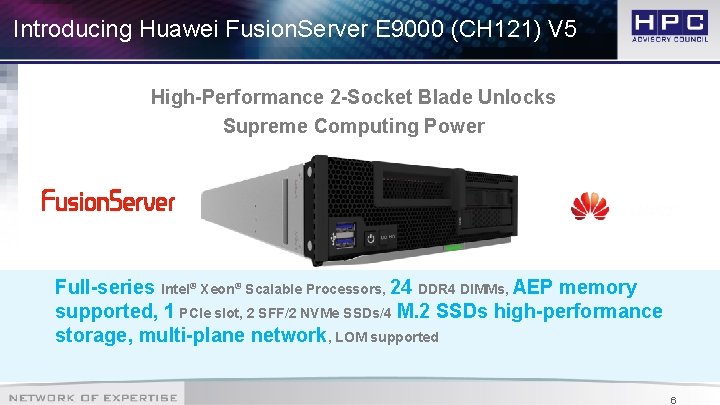
Introducing Huawei Fusion. Server E 9000 (CH 121) V 5 High-Performance 2 -Socket Blade Unlocks Supreme Computing Power Full-series Intel® Xeon® Scalable Processors, 24 DDR 4 DIMMs, AEP memory supported, 1 PCIe slot, 2 SFF/2 NVMe SSDs/4 M. 2 SSDs high-performance storage, multi-plane network, LOM supported 6
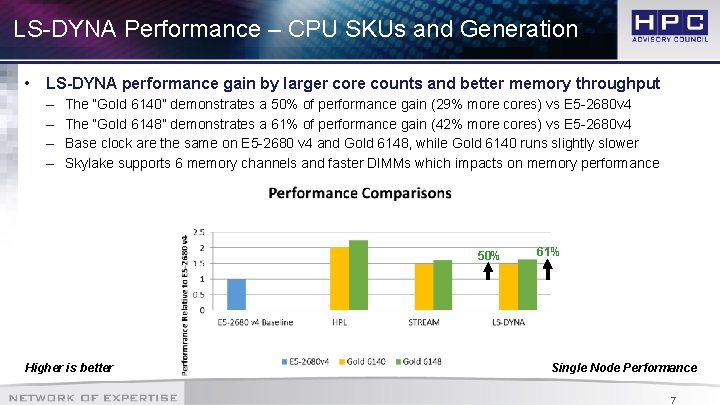
LS-DYNA Performance – CPU SKUs and Generation • LS-DYNA performance gain by larger core counts and better memory throughput – – The “Gold 6140” demonstrates a 50% of performance gain (29% more cores) vs E 5 -2680 v 4 The “Gold 6148” demonstrates a 61% of performance gain (42% more cores) vs E 5 -2680 v 4 Base clock are the same on E 5 -2680 v 4 and Gold 6148, while Gold 6140 runs slightly slower Skylake supports 6 memory channels and faster DIMMs which impacts on memory performance 50% Higher is better 61% Single Node Performance 7
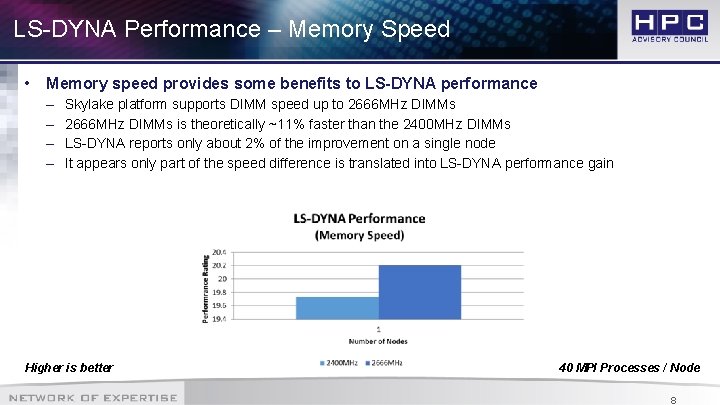
LS-DYNA Performance – Memory Speed • Memory speed provides some benefits to LS-DYNA performance – – Skylake platform supports DIMM speed up to 2666 MHz DIMMs is theoretically ~11% faster than the 2400 MHz DIMMs LS-DYNA reports only about 2% of the improvement on a single node It appears only part of the speed difference is translated into LS-DYNA performance gain Higher is better 40 MPI Processes / Node 8
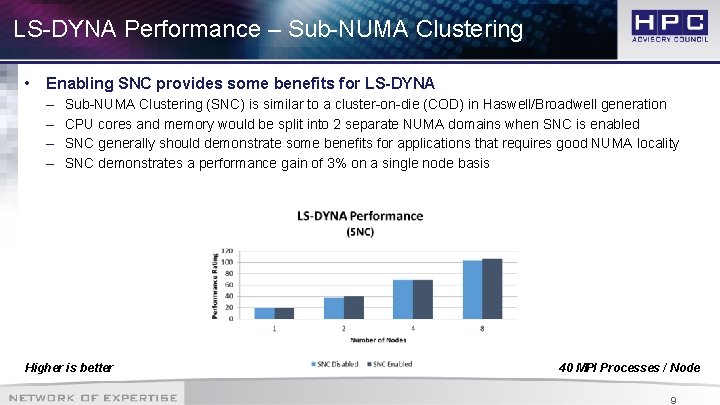
LS-DYNA Performance – Sub-NUMA Clustering • Enabling SNC provides some benefits for LS-DYNA – – Sub-NUMA Clustering (SNC) is similar to a cluster-on-die (COD) in Haswell/Broadwell generation CPU cores and memory would be split into 2 separate NUMA domains when SNC is enabled SNC generally should demonstrate some benefits for applications that requires good NUMA locality SNC demonstrates a performance gain of 3% on a single node basis Higher is better 40 MPI Processes / Node 9
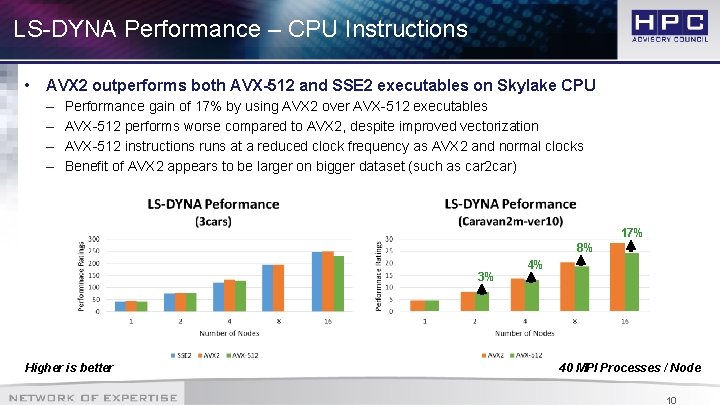
LS-DYNA Performance – CPU Instructions • AVX 2 outperforms both AVX-512 and SSE 2 executables on Skylake CPU – – Performance gain of 17% by using AVX 2 over AVX-512 executables AVX-512 performs worse compared to AVX 2, despite improved vectorization AVX-512 instructions runs at a reduced clock frequency as AVX 2 and normal clocks Benefit of AVX 2 appears to be larger on bigger dataset (such as car 2 car) 17% 8% 3% Higher is better 4% 40 MPI Processes / Node 10
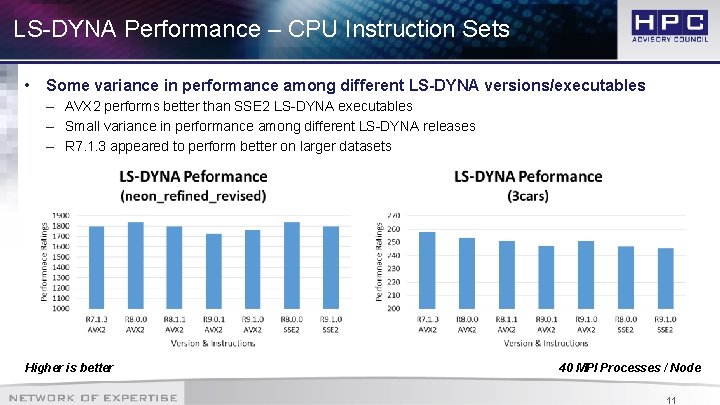
LS-DYNA Performance – CPU Instruction Sets • Some variance in performance among different LS-DYNA versions/executables – AVX 2 performs better than SSE 2 LS-DYNA executables – Small variance in performance among different LS-DYNA releases – R 7. 1. 3 appeared to perform better on larger datasets 20% Higher is better 40 MPI Processes / Node 11
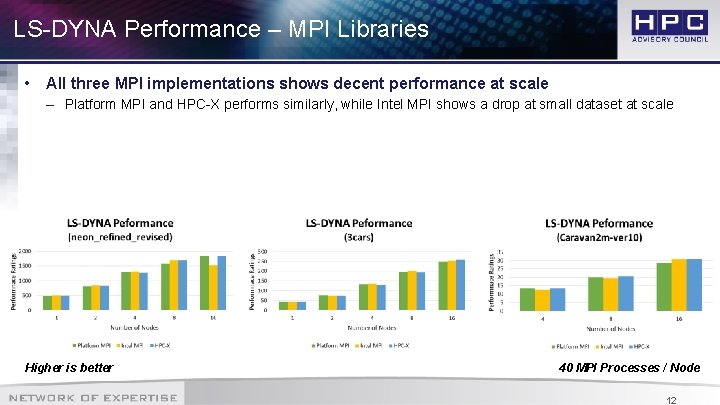
LS-DYNA Performance – MPI Libraries • All three MPI implementations shows decent performance at scale – Platform MPI and HPC-X performs similarly, while Intel MPI shows a drop at small dataset at scale Higher is better 40 MPI Processes / Node 12
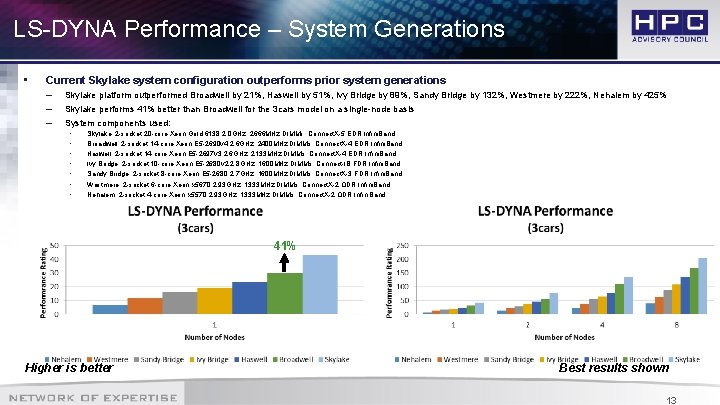
LS-DYNA Performance – System Generations • Current Skylake system configuration outperforms prior system generations – – – Skylake platform outperformed Broadwell by 21%, Haswell by 51%, Ivy Bridge by 89%, Sandy Bridge by 132%, Westmere by 222%, Nehalem by 425% Skylake performs 41% better than Broadwell for the 3 cars model on a single-node basis System components used: • • Skylake: 2 -socket 20 -core Xeon Gold 6138 2. 0 GHz, 2666 MHz DIMMs, Connect. X-5 EDR Infini. Band Broadwell: 2 -socket 14 -core Xeon E 5 -2690 v 4 2. 6 GHz, 2400 MHz DIMMs, Connect. X-4 EDR Infini. Band Haswell: 2 -socket 14 -core Xeon E 5 -2697 v 3 2. 6 GHz, 2133 MHz DIMMs, Connect. X-4 EDR Infini. Band Ivy Bridge: 2 -socket 10 -core Xeon E 5 -2680 v 2 2. 8 GHz, 1600 MHz DIMMs, Connect-IB FDR Infini. Band Sandy Bridge: 2 -socket 8 -core Xeon E 5 -2680 2. 7 GHz, 1600 MHz DIMMs, Connect. X-3 FDR Infini. Band Westmere: 2 -socket 6 -core Xeon x 5670 2. 93 GHz, 1333 MHz DIMMs, Connect. X-2 QDR Infini. Band Nehalem: 2 -socket 4 -core Xeon x 5570 2. 93 GHz, 1333 MHz DIMMs, Connect. X-2 QDR Infini. Band 41% Higher is better Best results shown 13
LS-DYNA Summary • LS-DYNA is multi-purpose explicit and implicit finite element program – Utilizes both compute and network communications • MPI library performance – Platform MPI and HPC-X performs similarly, while Intel MPI shows a drop at small dataset • Effect on CPU instructions – AVX-512 performs worse compared to AVX 2, despite improved vectorization – AVX-512 instructions runs at a reduced clock frequency as AVX 2 and normal clocks • Effect on CPU cores per node – Almost no difference when limiting the number of CPUs per node from 40 to 36 or 32 • Effect on LS-DYNA versions – Small variance in performance among different LS-DYNA releases 14
Thank You HPC Advisory Council All trademarks are property of their respective owners. All information is provided “As-Is” without any kind of warranty. The HPC Advisory Council makes no representation to the accuracy and completeness of the information contained herein. HPC Advisory Council undertakes no duty and assumes no obligation to update or correct any information presented herein 15 15
- Slides: 15