
LRUK PAGE REPLACEMENT ALGORITHM E 0 261 Jayant

- Slides: 26
LRU-K PAGE REPLACEMENT ALGORITHM E 0 261 Jayant Haritsa Computer Science and Automation Indian Institute of Science JAN 2020 LRU-K Slide 1
ABOUT PAPER • Authors: – Elizabeth J. O’Neil – Patrick E. O’Neill – Gerhard Weikum • Facts: – Presented at ACM SIGMOD Conference May 1993, Washington D. C. and published in its Proceedings, May 1993. – Paper has 1235 Citations till date. – Implementation in C available on author’s website. JAN 2020 LRU-K Slide 2
LRU • Concept: – When a new buffer page is needed, the buffer pool manager drops the page from buffer that has not been accessed for the longest time. • Why LRU? – Most logical and intuitive – Easy to implement – Good chance of a question in GATE exam => Increased chances of getting into IISc! JAN 2020 LRU-K Slide 3
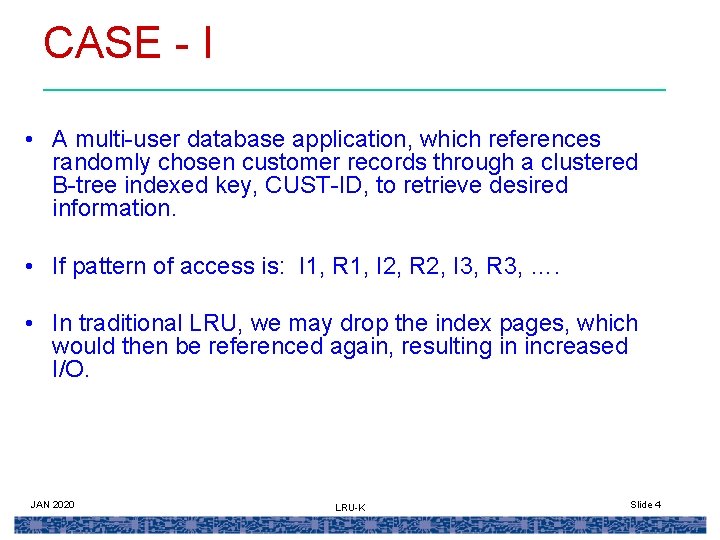
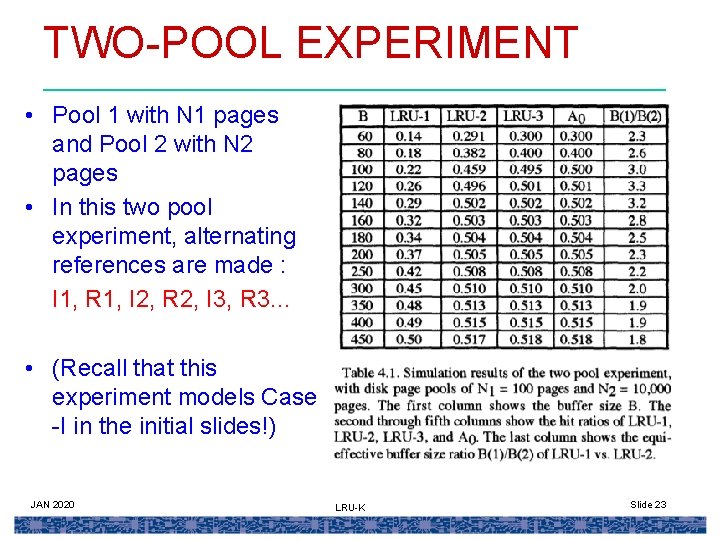
CASE - I • A multi-user database application, which references randomly chosen customer records through a clustered B-tree indexed key, CUST-ID, to retrieve desired information. • If pattern of access is: I 1, R 1, I 2, R 2, I 3, R 3, …. • In traditional LRU, we may drop the index pages, which would then be referenced again, resulting in increased I/O. JAN 2020 LRU-K Slide 4
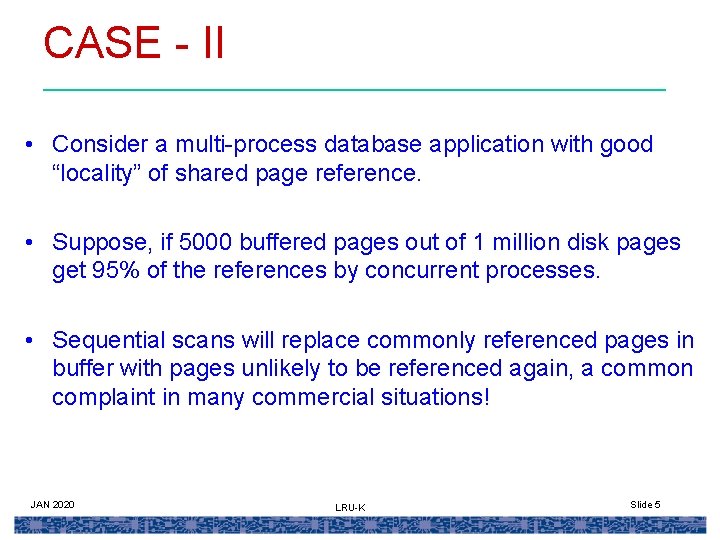
CASE - II • Consider a multi-process database application with good “locality” of shared page reference. • Suppose, if 5000 buffered pages out of 1 million disk pages get 95% of the references by concurrent processes. • Sequential scans will replace commonly referenced pages in buffer with pages unlikely to be referenced again, a common complaint in many commercial situations! JAN 2020 LRU-K Slide 5
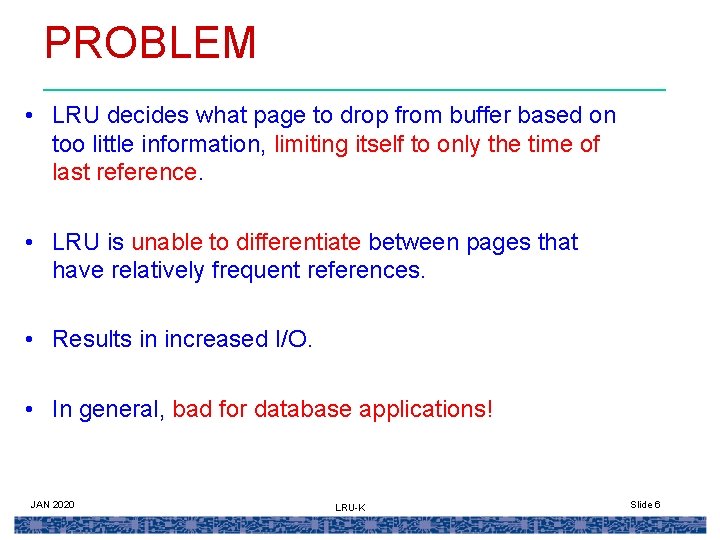
PROBLEM • LRU decides what page to drop from buffer based on too little information, limiting itself to only the time of last reference. • LRU is unable to differentiate between pages that have relatively frequent references. • Results in increased I/O. • In general, bad for database applications! JAN 2020 LRU-K Slide 6
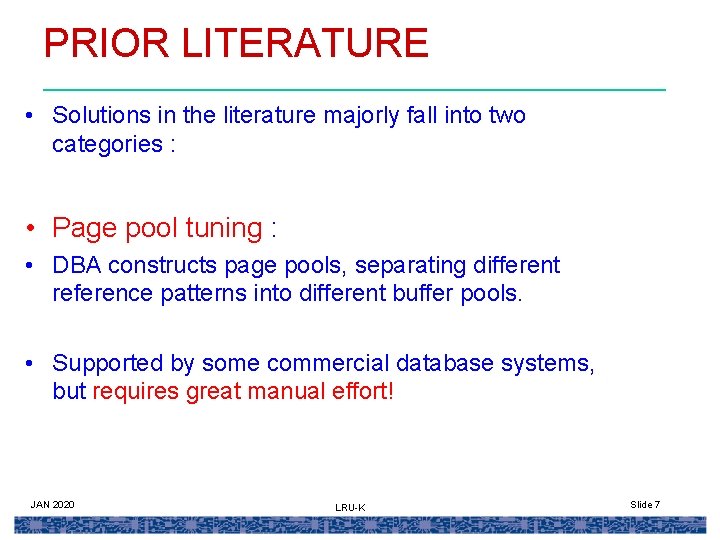
PRIOR LITERATURE • Solutions in the literature majorly fall into two categories : • Page pool tuning : • DBA constructs page pools, separating different reference patterns into different buffer pools. • Supported by some commercial database systems, but requires great manual effort! JAN 2020 LRU-K Slide 7
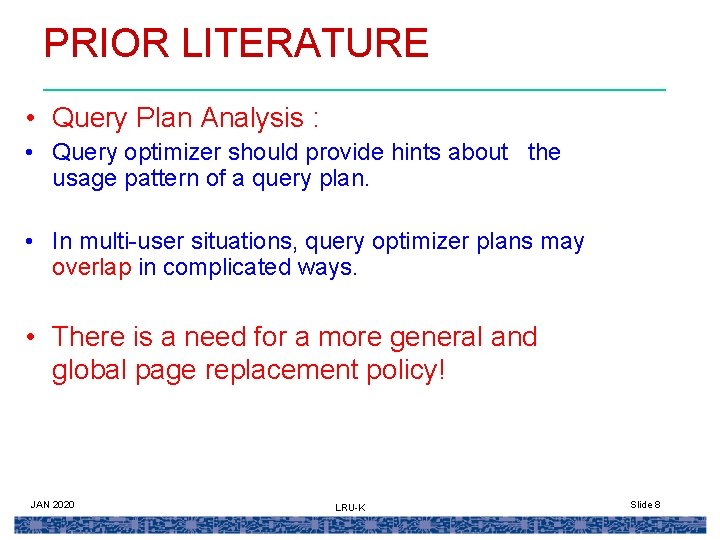
PRIOR LITERATURE • Query Plan Analysis : • Query optimizer should provide hints about the usage pattern of a query plan. • In multi-user situations, query optimizer plans may overlap in complicated ways. • There is a need for a more general and global page replacement policy! JAN 2020 LRU-K Slide 8
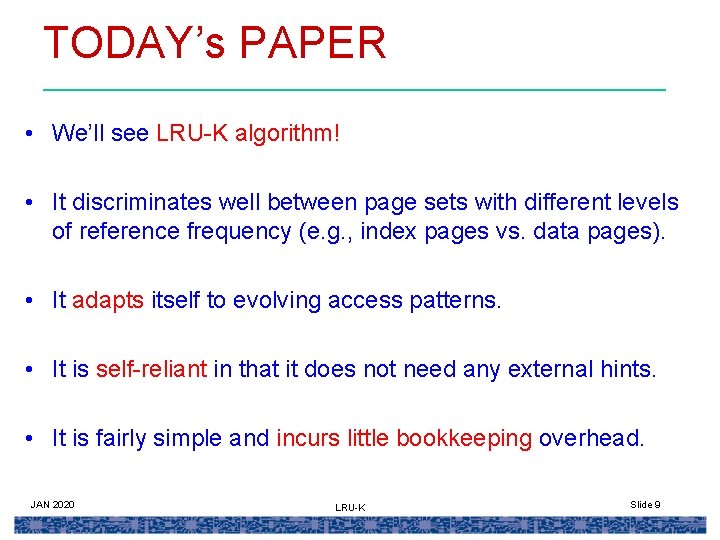
TODAY’s PAPER • We’ll see LRU-K algorithm! • It discriminates well between page sets with different levels of reference frequency (e. g. , index pages vs. data pages). • It adapts itself to evolving access patterns. • It is self-reliant in that it does not need any external hints. • It is fairly simple and incurs little bookkeeping overhead. JAN 2020 LRU-K Slide 9
INDEPENDENT REFERENCE MODEL • The Independent Reference Model is a conceptual model used in the analysis of storage system like disk drives, caches, etc. • Under this model the references to stored objects are independent random variables. JAN 2020 LRU-K Slide 10
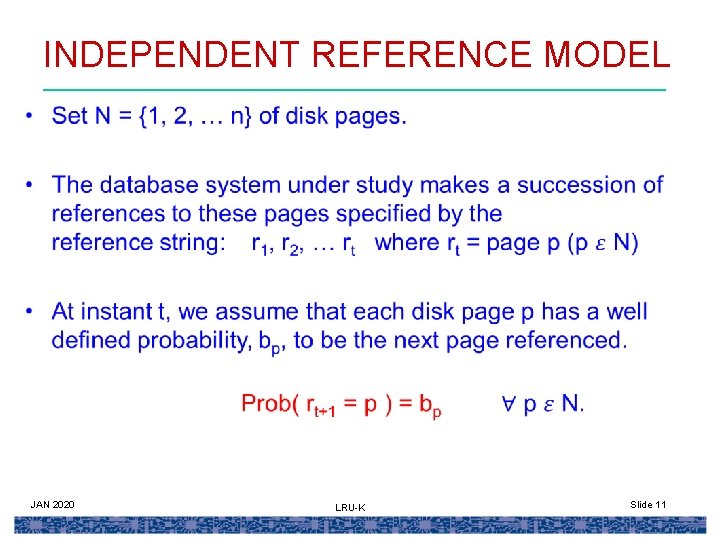
INDEPENDENT REFERENCE MODEL JAN 2020 LRU-K Slide 11
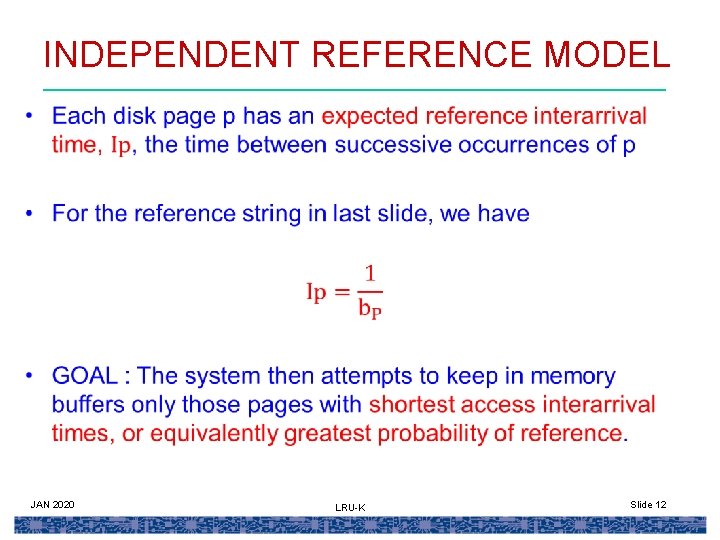
INDEPENDENT REFERENCE MODEL JAN 2020 LRU-K Slide 12
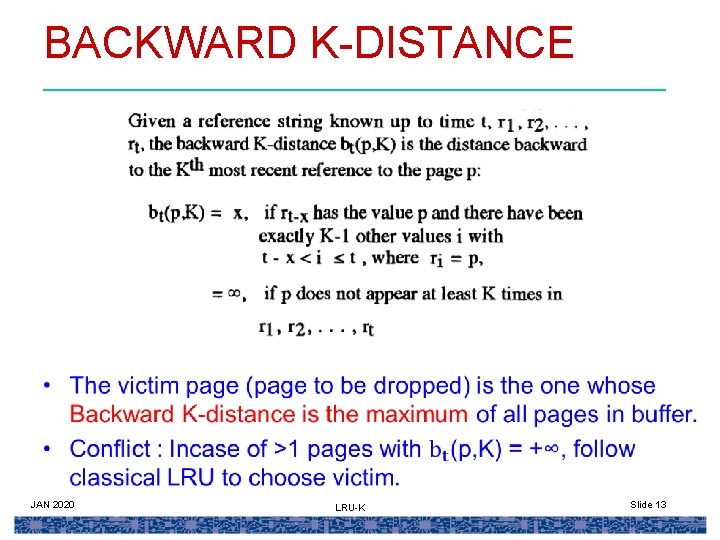
BACKWARD K-DISTANCE JAN 2020 LRU-K Slide 13
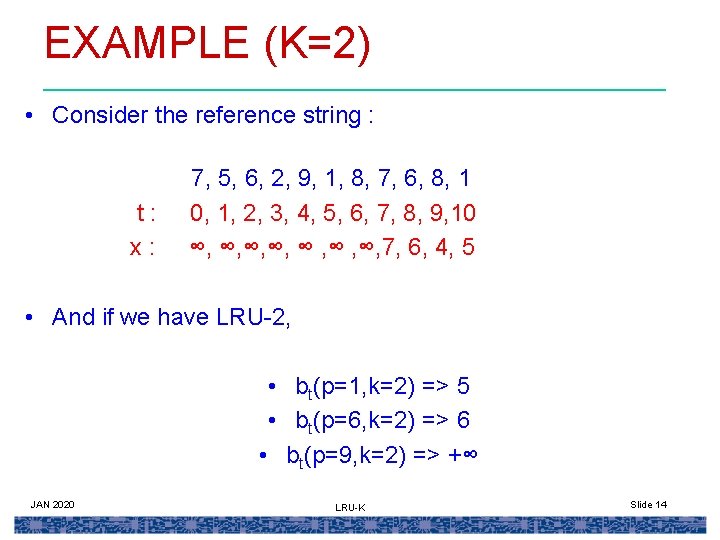
EXAMPLE (K=2) • Consider the reference string : t: x: 7, 5, 6, 2, 9, 1, 8, 7, 6, 8, 1 0, 1, 2, 3, 4, 5, 6, 7, 8, 9, 10 ∞, ∞, ∞ , ∞, 7, 6, 4, 5 • And if we have LRU-2, • bt(p=1, k=2) => 5 • bt(p=6, k=2) => 6 • bt(p=9, k=2) => +∞ JAN 2020 LRU-K Slide 14
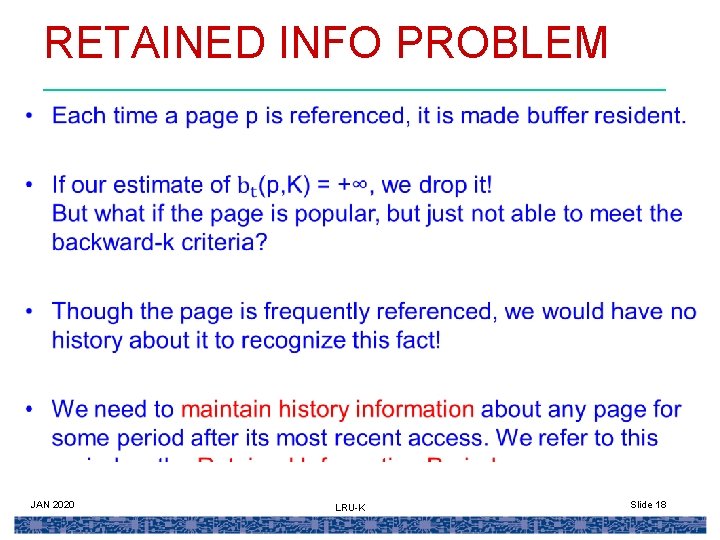
BACKWARD K-DISTANCE • Ability to make decisions by measurement of an actual interarrival between references, rather than estimating simply by a lower bound of the time back to the most recent reference! But, we still have problems : • Early page replacement • Retained information problem JAN 2020 LRU-K Slide 15
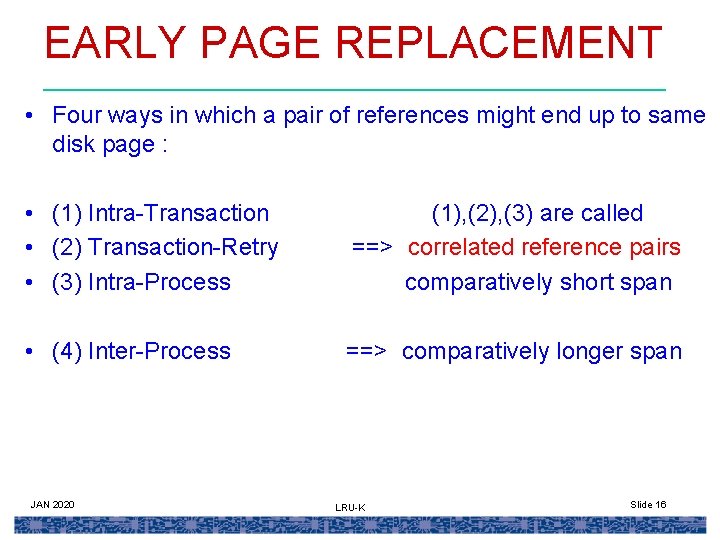
EARLY PAGE REPLACEMENT • Four ways in which a pair of references might end up to same disk page : • (1) Intra-Transaction • (2) Transaction-Retry • (3) Intra-Process (1), (2), (3) are called ==> correlated reference pairs comparatively short span • (4) Inter-Process ==> comparatively longer span JAN 2020 LRU-K Slide 16
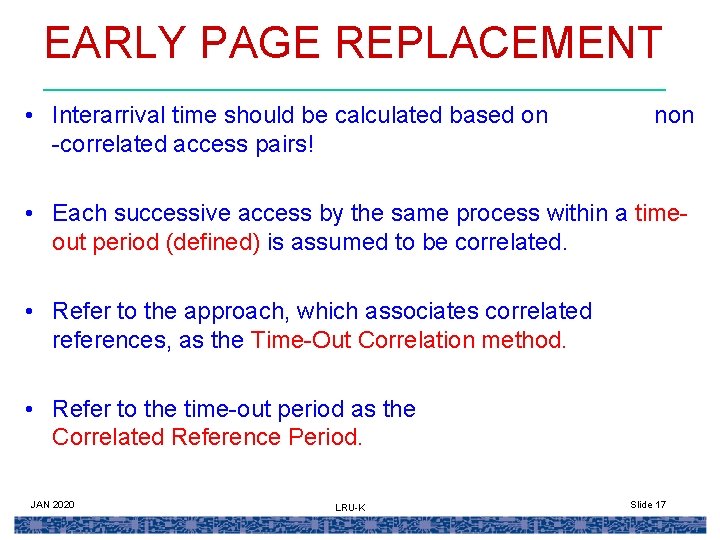
EARLY PAGE REPLACEMENT • Interarrival time should be calculated based on -correlated access pairs! non • Each successive access by the same process within a timeout period (defined) is assumed to be correlated. • Refer to the approach, which associates correlated references, as the Time-Out Correlation method. • Refer to the time-out period as the Correlated Reference Period. JAN 2020 LRU-K Slide 17
RETAINED INFO PROBLEM JAN 2020 LRU-K Slide 18
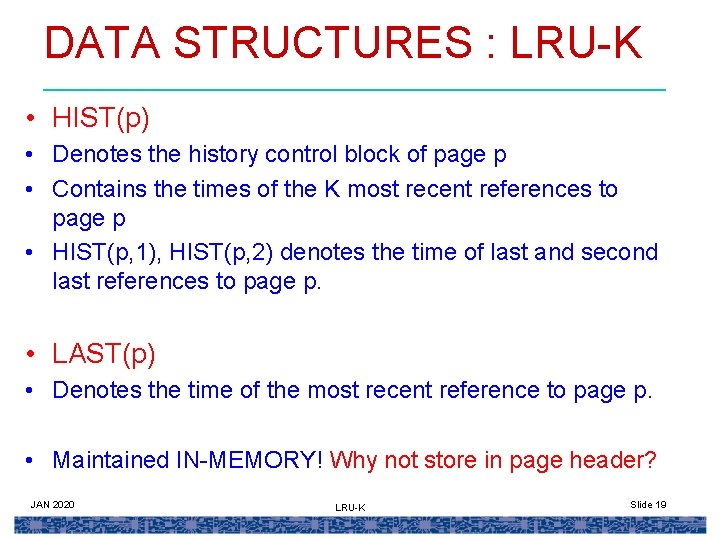
DATA STRUCTURES : LRU-K • HIST(p) • Denotes the history control block of page p • Contains the times of the K most recent references to page p • HIST(p, 1), HIST(p, 2) denotes the time of last and second last references to page p. • LAST(p) • Denotes the time of the most recent reference to page p. • Maintained IN-MEMORY! Why not store in page header? JAN 2020 LRU-K Slide 19
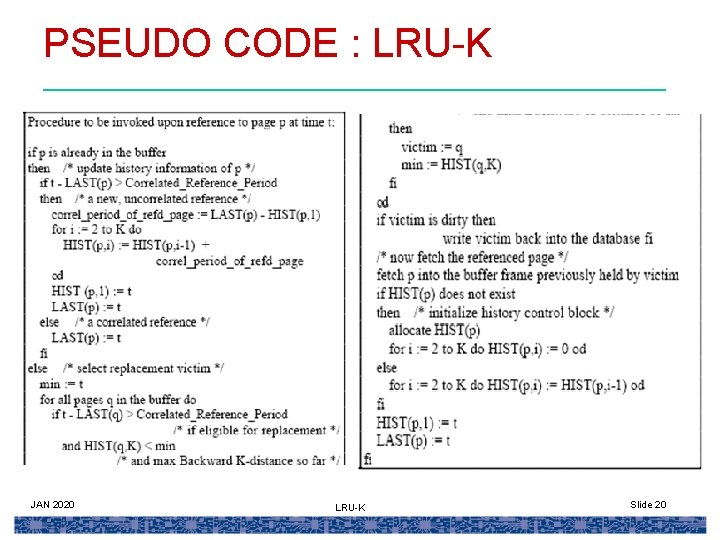
PSEUDO CODE : LRU-K JAN 2020 LRU-K Slide 20
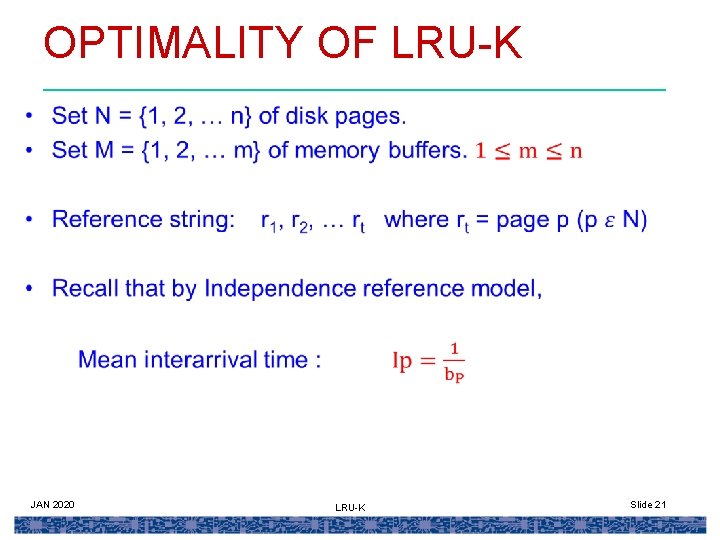
OPTIMALITY OF LRU-K JAN 2020 LRU-K Slide 21
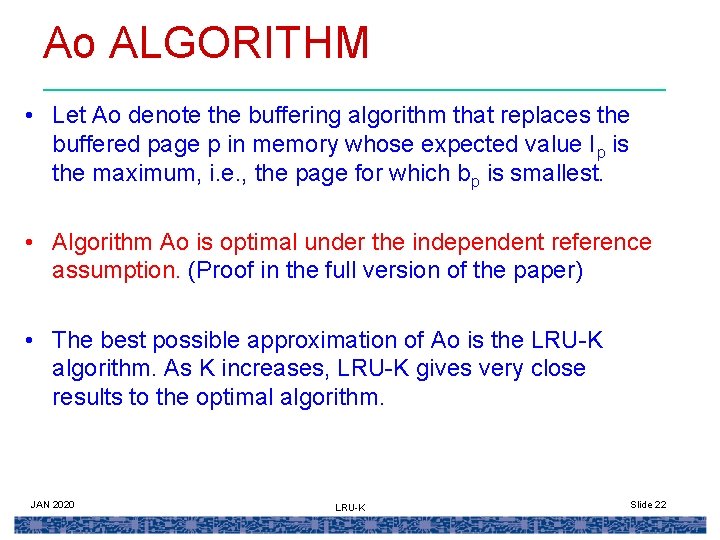
Ao ALGORITHM • Let Ao denote the buffering algorithm that replaces the buffered page p in memory whose expected value Ip is the maximum, i. e. , the page for which bp is smallest. • Algorithm Ao is optimal under the independent reference assumption. (Proof in the full version of the paper) • The best possible approximation of Ao is the LRU-K algorithm. As K increases, LRU-K gives very close results to the optimal algorithm. JAN 2020 LRU-K Slide 22
TWO-POOL EXPERIMENT • Pool 1 with N 1 pages and Pool 2 with N 2 pages • In this two pool experiment, alternating references are made : I 1, R 1, I 2, R 2, I 3, R 3. . . • (Recall that this experiment models Case -I in the initial slides!) JAN 2020 LRU-K Slide 23
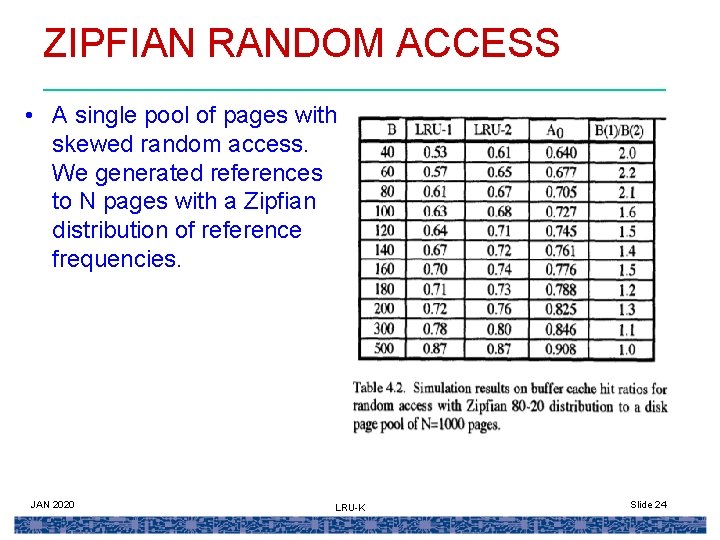
ZIPFIAN RANDOM ACCESS • A single pool of pages with skewed random access. We generated references to N pages with a Zipfian distribution of reference frequencies. JAN 2020 LRU-K Slide 24
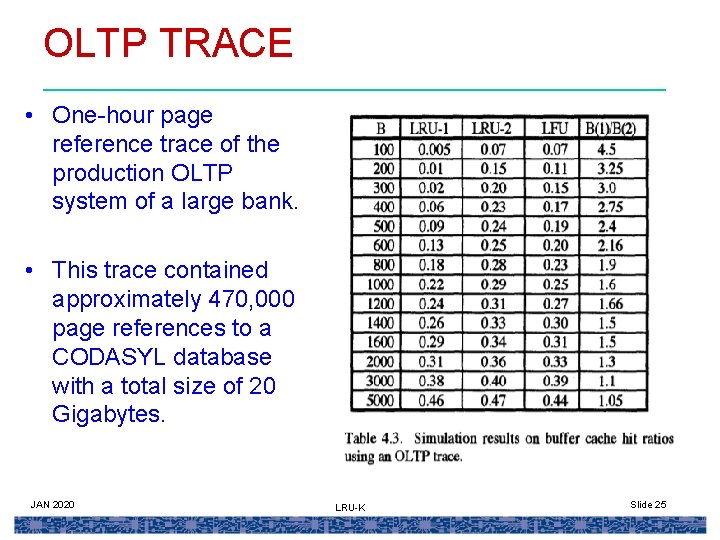
OLTP TRACE • One-hour page reference trace of the production OLTP system of a large bank. • This trace contained approximately 470, 000 page references to a CODASYL database with a total size of 20 Gigabytes. JAN 2020 LRU-K Slide 25
END LRU-K E 0 261 JAN 2020 LRU-K Slide 26