
LR Structures algebraic constructions and large vertexstabilizers with
LR Structures: algebraic constructions and large vertex-stabilizers (with Primoz Potocnik) SYGN July, 2014, Rogla
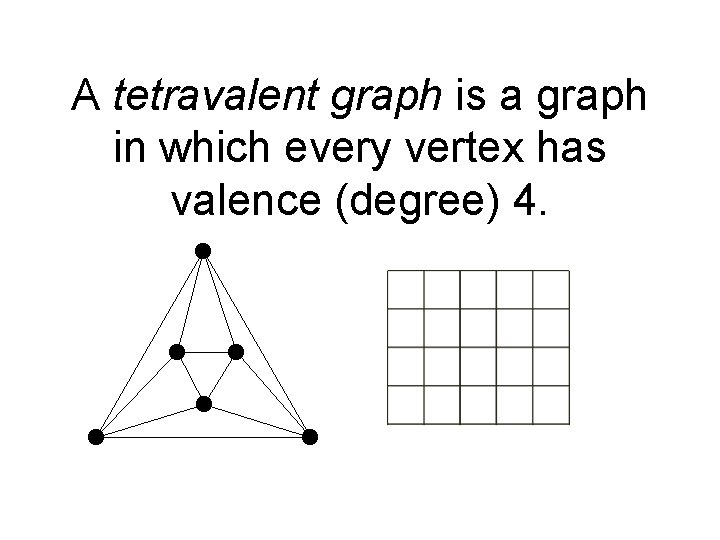
A tetravalent graph is a graph in which every vertex has valence (degree) 4.
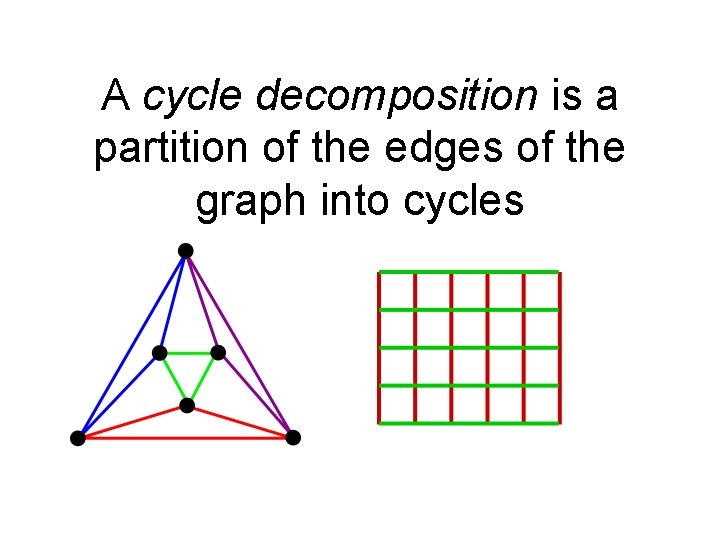
A cycle decomposition is a partition of the edges of the graph into cycles
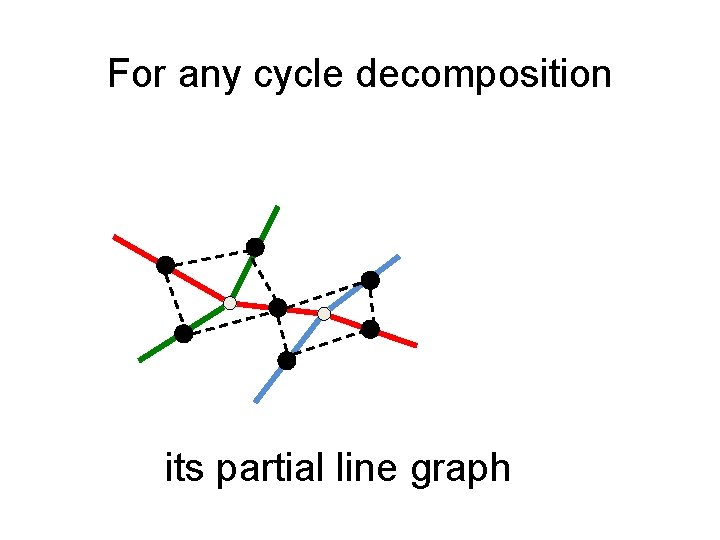
For any cycle decomposition its partial line graph
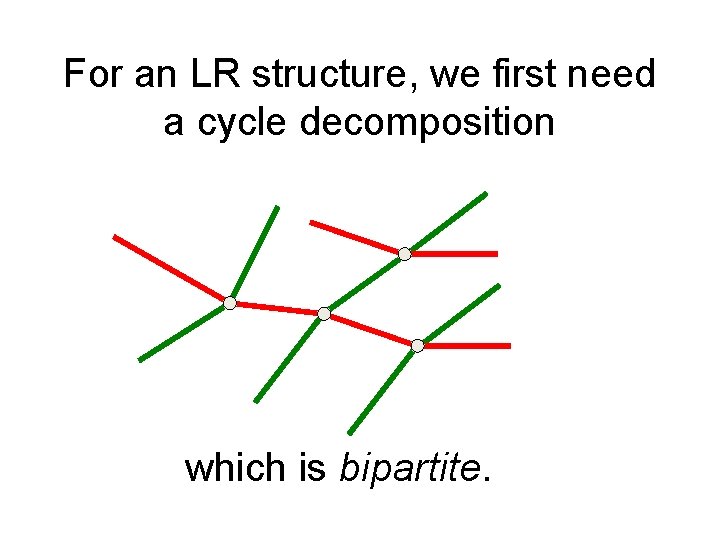
For an LR structure, we first need a cycle decomposition which is bipartite.
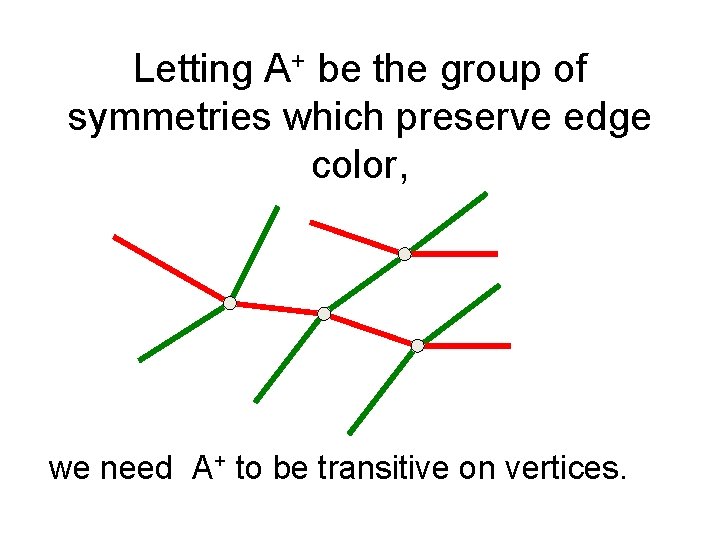
Letting A+ be the group of symmetries which preserve edge color, we need A+ to be transitive on vertices.
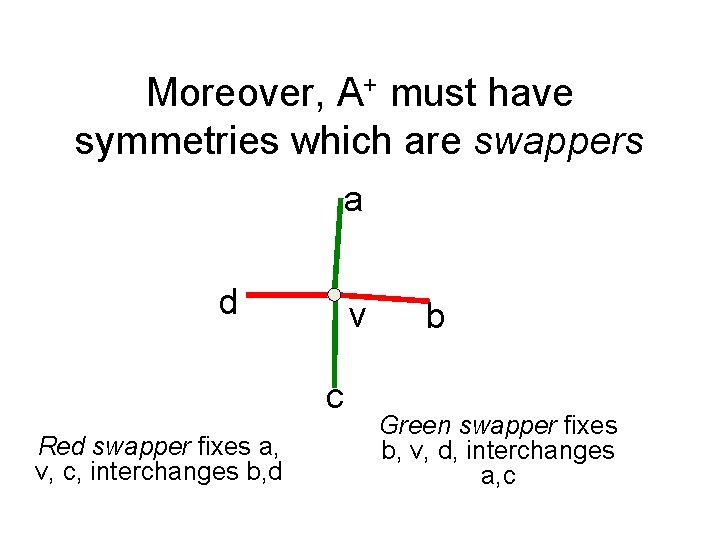
Moreover, A+ must have symmetries which are swappers a d v c Red swapper fixes a, v, c, interchanges b, d b Green swapper fixes b, v, d, interchanges a, c
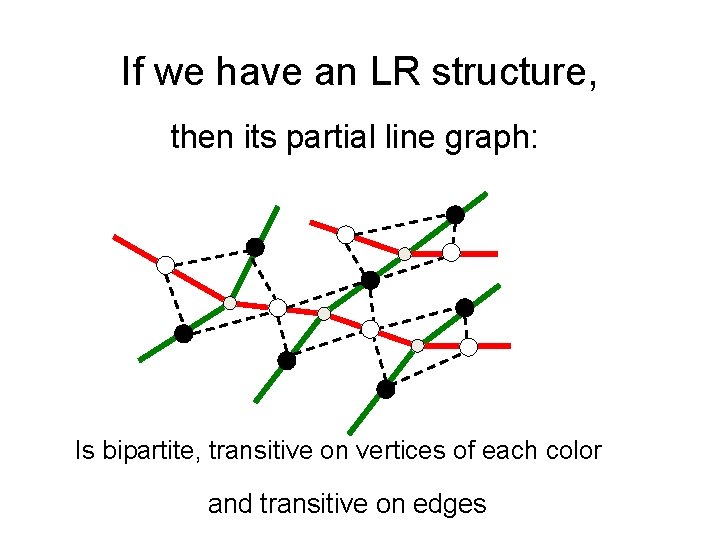
If we have an LR structure, then its partial line graph: Is bipartite, transitive on vertices of each color and transitive on edges
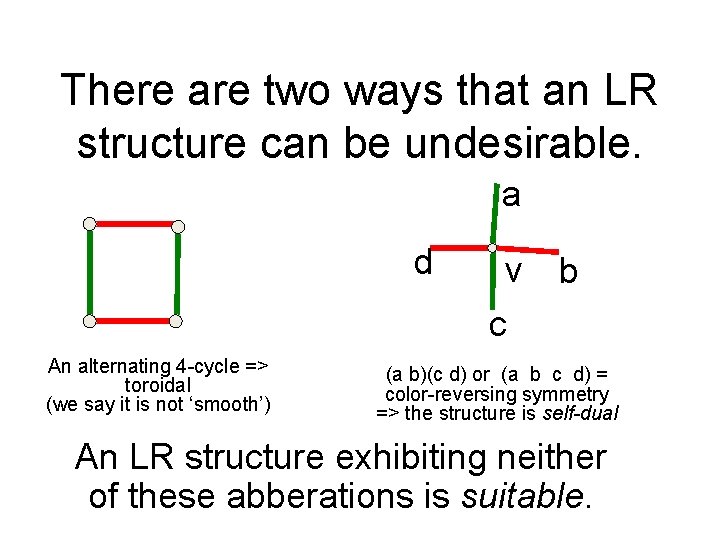
There are two ways that an LR structure can be undesirable. a d An alternating 4 -cycle => toroidal (we say it is not ‘smooth’) v b c (a b)(c d) or (a b c d) = color-reversing symmetry => the structure is self-dual An LR structure exhibiting neither of these abberations is suitable.
If an LR structure is suitable, then its partial line graph is semisymmetric. And every tetravalent semisymmetric graph of girth 4 is the partial line graph of some suitable LR structure.
Algebraic Constructions Let A be a group generated by some a, b, c, d, and suppose that b = a-1 or a and b each have order 2, and similarly for c, d.
Then define the structure to have one vertex for each g in A. Red edges connect g – ag and g – bg; greens are g – cg and g – dg. This just a coloring of Cay(A, {a, b, c, d}
To make it an LR structure, we need f, g in Aut(A) such that f fixes a and b while interchanging c and d, and vice versa for g. Then f and g act as colorpreserving symmetries of the structure, and as swappers at Id. A. We call them Cayley swappers.
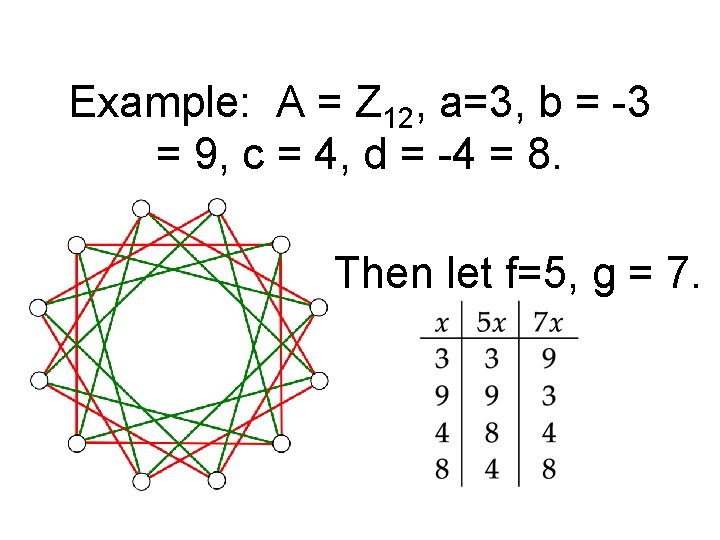
Example: A = Z 12, a=3, b = -3 = 9, c = 4, d = -4 = 8. Then let f=5, g = 7.
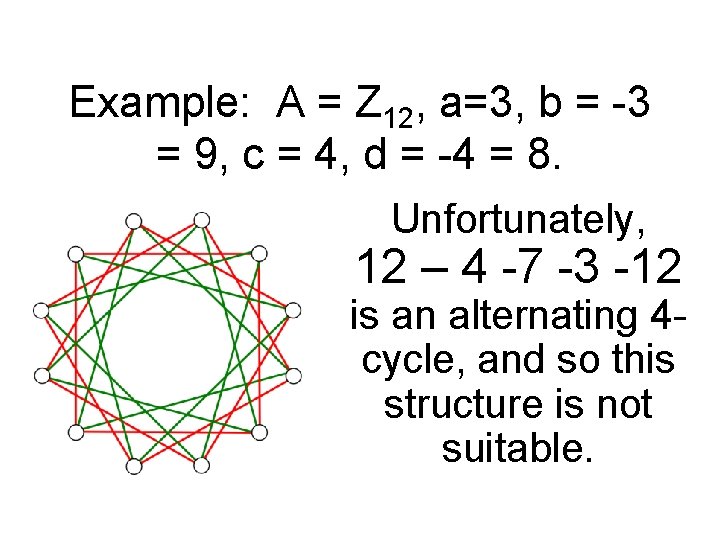
Example: A = Z 12, a=3, b = -3 = 9, c = 4, d = -4 = 8. Unfortunately, 12 – 4 -7 -3 -12 is an alternating 4 cycle, and so this structure is not suitable.
If A is any abelian group, the 4 cycle 0 – a+c – 0 is alternating and so the structure cannot be suitable.
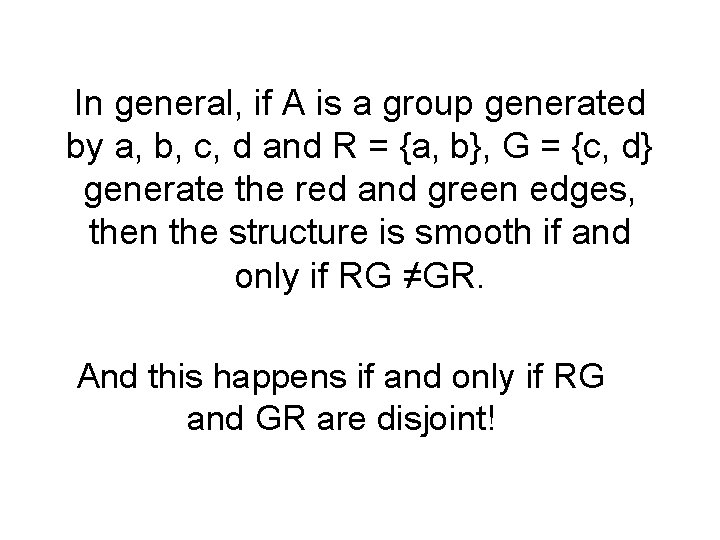
In general, if A is a group generated by a, b, c, d and R = {a, b}, G = {c, d} generate the red and green edges, then the structure is smooth if and only if RG ≠GR. And this happens if and only if RG and GR are disjoint!
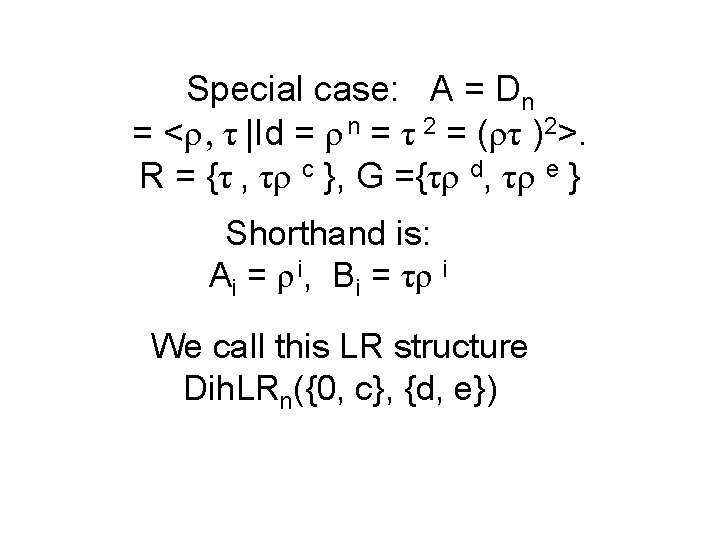
Special case: A = Dn = <ρ , τ |Id = ρ n = τ 2 = (ρτ )2>. R = {τ , τρ c }, G ={τρ d, τρ e } Shorthand is: Ai = ρ i, Bi = τρ i We call this LR structure Dih. LRn({0, c}, {d, e})
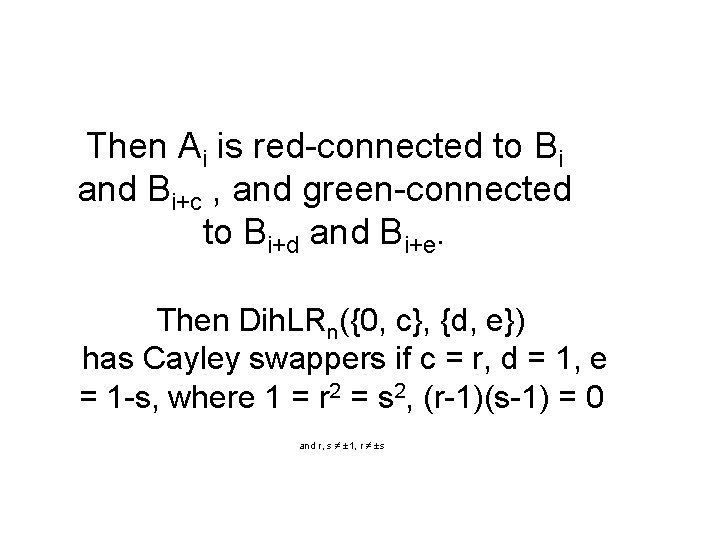
Then Ai is red-connected to Bi and Bi+c , and green-connected to Bi+d and Bi+e. Then Dih. LRn({0, c}, {d, e}) has Cayley swappers if c = r, d = 1, e = 1 -s, where 1 = r 2 = s 2, (r-1)(s-1) = 0 and r, s ≠ ± 1, r ≠ ±s
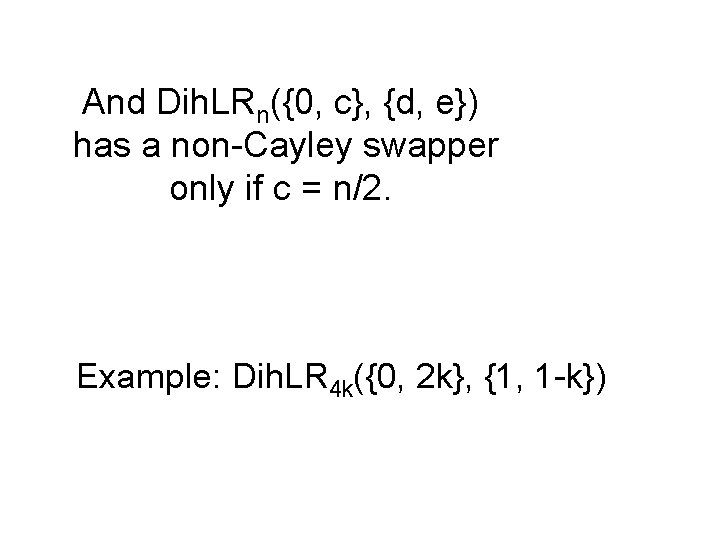
And Dih. LRn({0, c}, {d, e}) has a non-Cayley swapper only if c = n/2. Example: Dih. LR 4 k({0, 2 k}, {1, 1 -k})
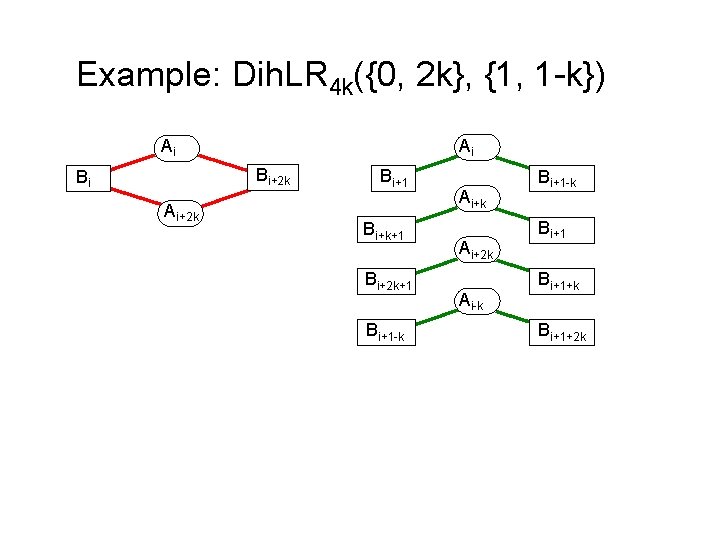
Example: Dih. LR 4 k({0, 2 k}, {1, 1 -k}) Ai Ai Bi+2 k Bi Ai+2 k Bi+1 Bi+k+1 Bi+2 k+1 Bi+1 -k Ai+2 k Ai-k Bi+1+k Bi+1+2 k
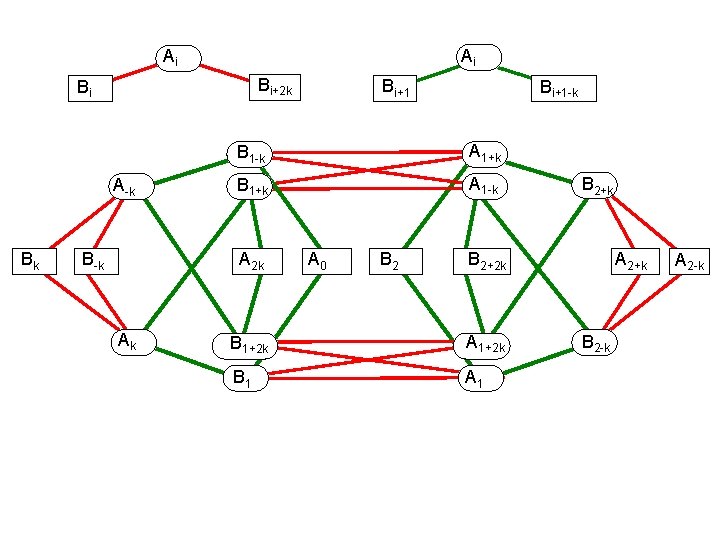
Ai Ai Bi+2 k Bi A-k Bk B-k Bi+1 -k B 1 -k A 1+k B 1+k A 1 -k A 2 k Ak Bi+1 A 0 B 2+k B 2+2 k B 1+2 k A 1+2 k B 1 A 2+k B 2 -k A 2 -k
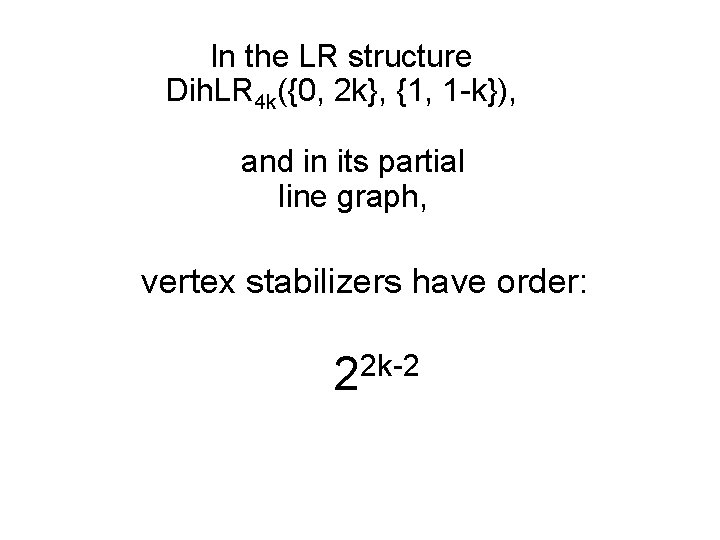
In the LR structure Dih. LR 4 k({0, 2 k}, {1, 1 -k}), and in its partial line graph, vertex stabilizers have order: 2 k-2 2

Poignant moment from research life
- Slides: 24