
LQ mechanical performances Status and lessons learned Collaboration

LQ mechanical performances Status and lessons learned Collaboration Meeting 18 May 7 th to 9 th 2012, FNAL Helene Felice
Overview • Magnet overview • LQ assemblies summary: from LQS 01 a to LQS 03 • Lessons learned 05/09/2012 CM 18 - H. Felice 2
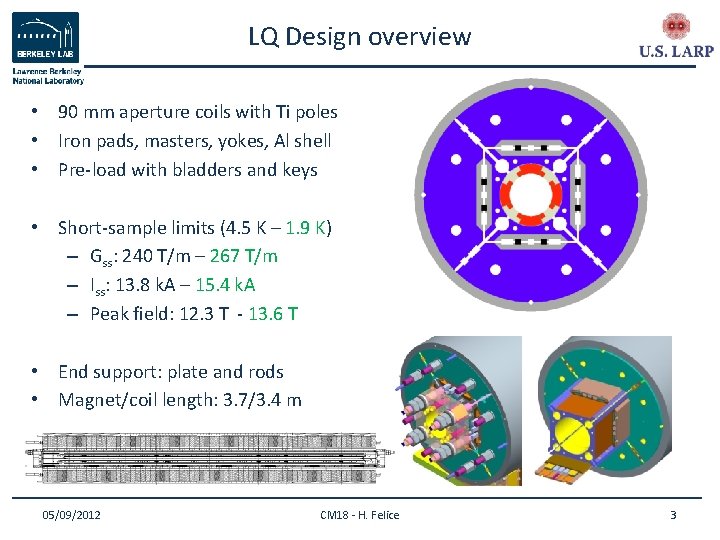
LQ Design overview • 90 mm aperture coils with Ti poles • Iron pads, masters, yokes, Al shell • Pre-load with bladders and keys • Short-sample limits (4. 5 K – 1. 9 K) – Gss: 240 T/m – 267 T/m – Iss: 13. 8 k. A – 15. 4 k. A – Peak field: 12. 3 T - 13. 6 T • End support: plate and rods • Magnet/coil length: 3. 7/3. 4 m 05/09/2012 CM 18 - H. Felice 3
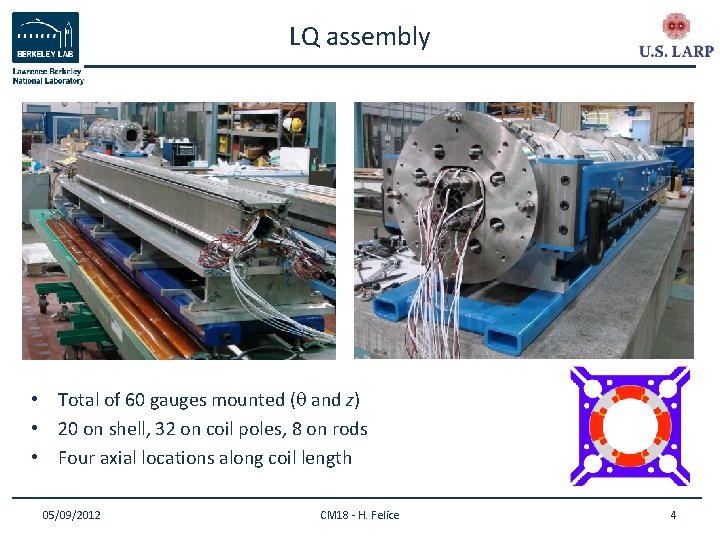
LQ assembly • Total of 60 gauges mounted (q and z) • 20 on shell, 32 on coil poles, 8 on rods • Four axial locations along coil length 05/09/2012 CM 18 - H. Felice 4
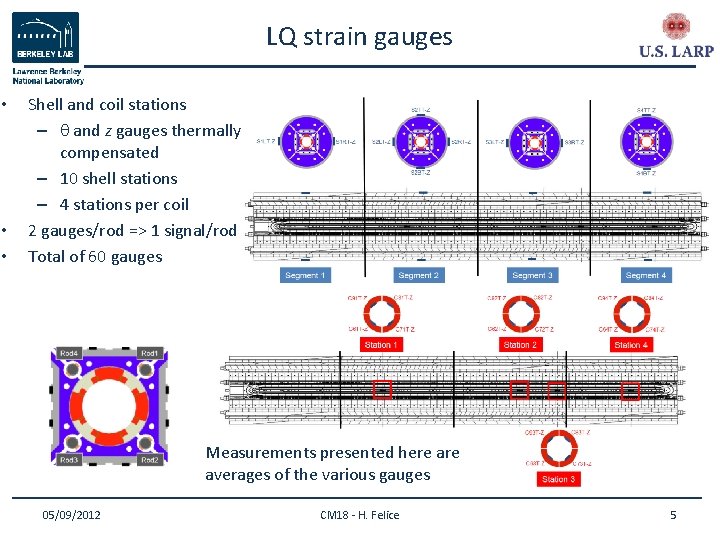
LQ strain gauges • • • Shell and coil stations – q and z gauges thermally compensated – 10 shell stations – 4 stations per coil 2 gauges/rod => 1 signal/rod Total of 60 gauges Measurements presented here averages of the various gauges 05/09/2012 CM 18 - H. Felice 5
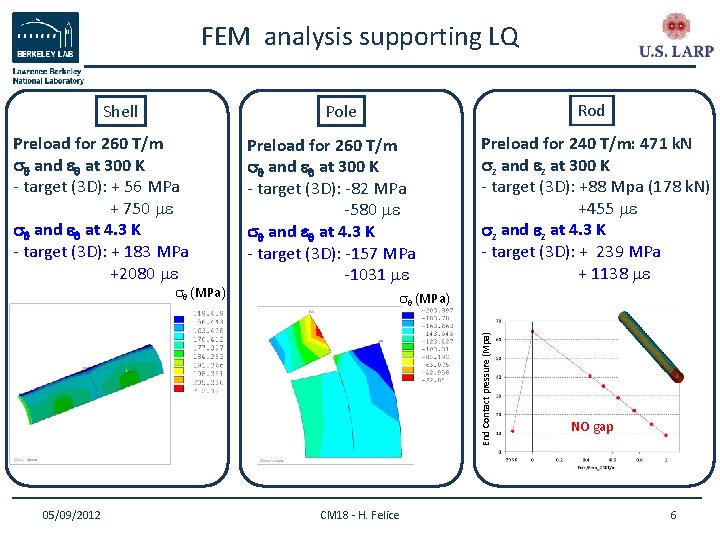
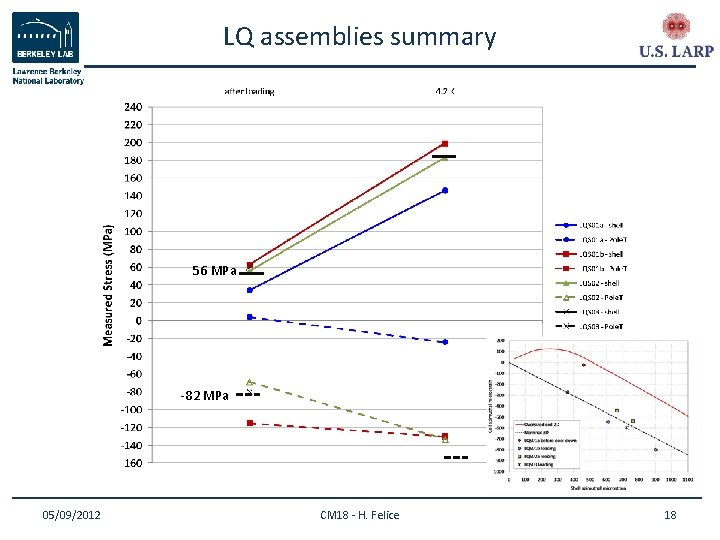
FEM analysis supporting LQ Shell Rod Pole Preload for 260 T/m sq and eq at 300 K - target (3 D): + 56 MPa + 750 me sq and eq at 4. 3 K - target (3 D): + 183 MPa +2080 me Preload for 240 T/m: 471 k. N sz and ez at 300 K - target (3 D): +88 Mpa (178 k. N) +455 me sz and ez at 4. 3 K - target (3 D): + 239 MPa + 1138 me sq (MPa) End Contact pressure (Mpa) sq (MPa) Preload for 260 T/m sq and eq at 300 K - target (3 D): -82 MPa -580 me sq and eq at 4. 3 K - target (3 D): -157 MPa -1031 me 05/09/2012 CM 18 - H. Felice NO gap 6
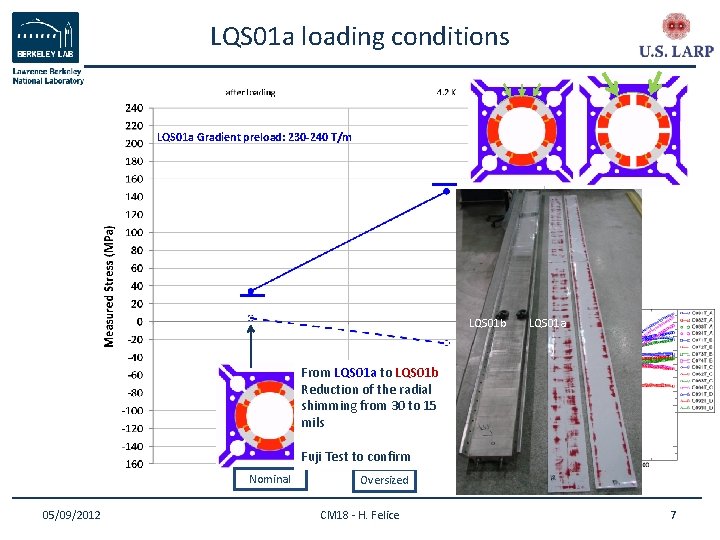
LQS 01 a loading conditions LQS 01 a Gradient preload: 230 -240 T/m LQS 01 b LQS 01 a From LQS 01 a to LQS 01 b Reduction of the radial shimming from 30 to 15 Some unloading of the mils pole suggested lack of preload Fuji Test to confirm Nominal 05/09/2012 Oversized CM 18 - H. Felice 7
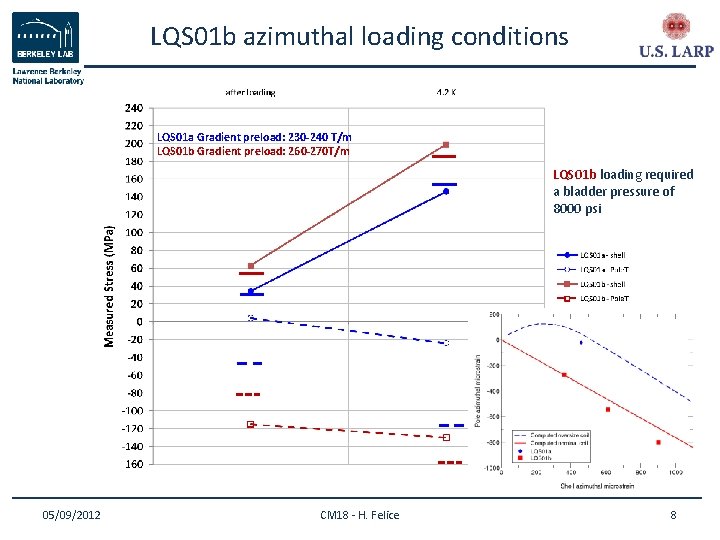
LQS 01 b azimuthal loading conditions LQS 01 a Gradient preload: 230 -240 T/m LQS 01 b Gradient preload: 260 -270 T/m LQS 01 b loading required a bladder pressure of 8000 psi 05/09/2012 CM 18 - H. Felice 8
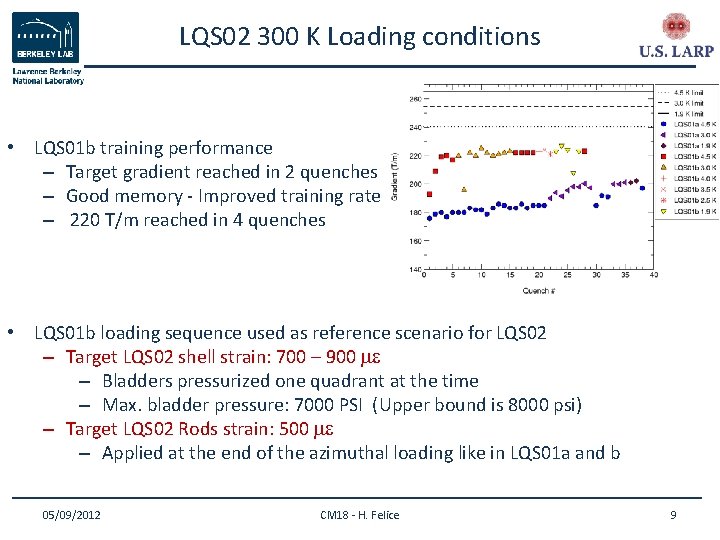
LQS 02 300 K Loading conditions • LQS 01 b training performance – Target gradient reached in 2 quenches – Good memory - Improved training rate – 220 T/m reached in 4 quenches • LQS 01 b loading sequence used as reference scenario for LQS 02 – Target LQS 02 shell strain: 700 – 900 me – Bladders pressurized one quadrant at the time – Max. bladder pressure: 7000 PSI (Upper bound is 8000 psi) – Target LQS 02 Rods strain: 500 me – Applied at the end of the azimuthal loading like in LQS 01 a and b 05/09/2012 CM 18 - H. Felice 9
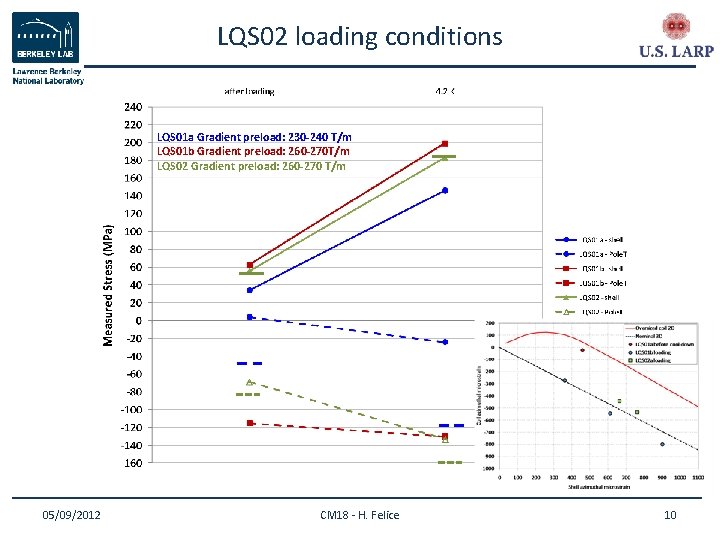
LQS 02 loading conditions LQS 01 a Gradient preload: 230 -240 T/m LQS 01 b Gradient preload: 260 -270 T/m LQS 02 Gradient preload: 260 -270 T/m 05/09/2012 CM 18 - H. Felice 10
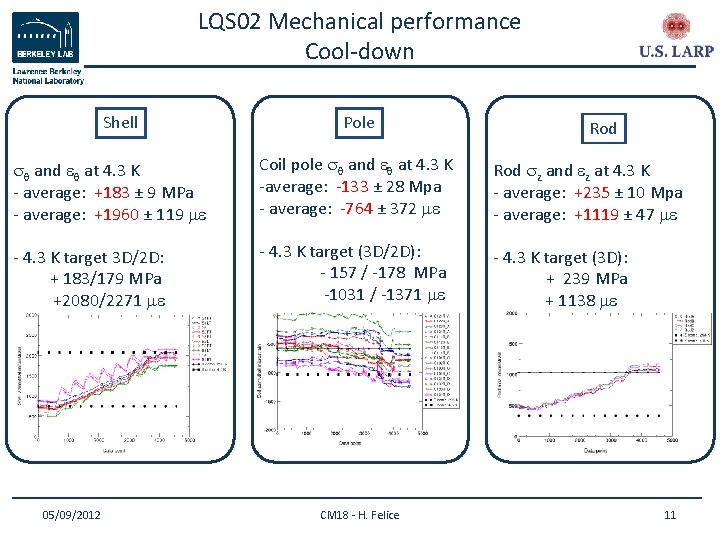
LQS 02 Mechanical performance Cool-down Shell Pole Rod sq and eq at 4. 3 K - average: +183 ± 9 MPa - average: +1960 ± 119 me Coil pole sq and eq at 4. 3 K -average: -133 ± 28 Mpa - average: -764 ± 372 me Rod sz and ez at 4. 3 K - average: +235 ± 10 Mpa - average: +1119 ± 47 me - 4. 3 K target 3 D/2 D: + 183/179 MPa +2080/2271 me - 4. 3 K target (3 D/2 D): - 157 / -178 MPa -1031 / -1371 me - 4. 3 K target (3 D): + 239 MPa + 1138 me 05/09/2012 CM 18 - H. Felice 11
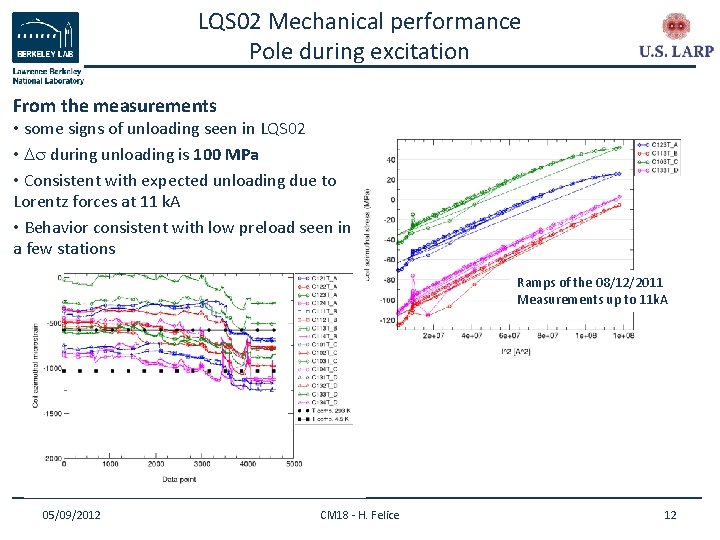
LQS 02 Mechanical performance Pole during excitation From the measurements • some signs of unloading seen in LQS 02 • Ds during unloading is 100 MPa • Consistent with expected unloading due to Lorentz forces at 11 k. A • Behavior consistent with low preload seen in a few stations Ramps of the 08/12/2011 Measurements up to 11 k. A 05/09/2012 CM 18 - H. Felice 12
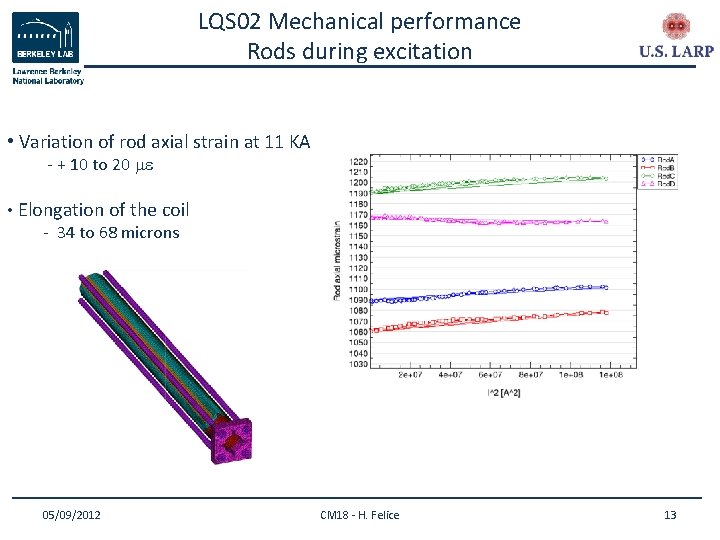
LQS 02 Mechanical performance Rods during excitation • Variation of rod axial strain at 11 KA - + 10 to 20 me • Elongation of the coil - 34 to 68 microns 05/09/2012 CM 18 - H. Felice 13
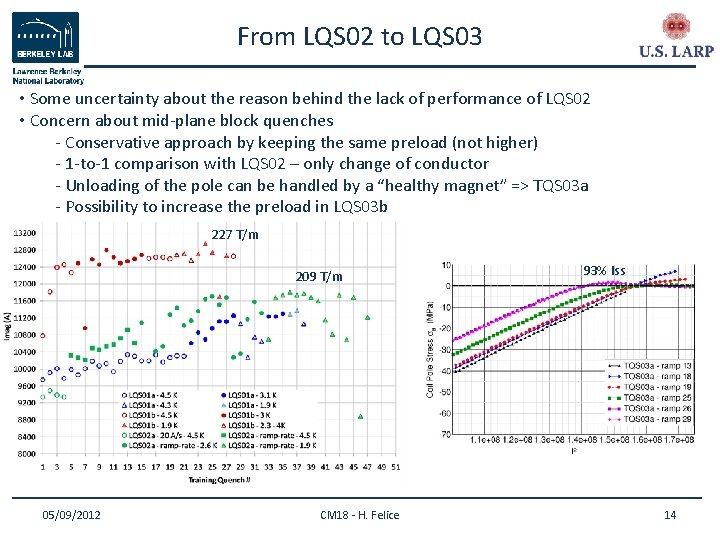
From LQS 02 to LQS 03 • Some uncertainty about the reason behind the lack of performance of LQS 02 • Concern about mid-plane block quenches - Conservative approach by keeping the same preload (not higher) - 1 -to-1 comparison with LQS 02 – only change of conductor - Unloading of the pole can be handled by a “healthy magnet” => TQS 03 a - Possibility to increase the preload in LQS 03 b 227 T/m 209 T/m 05/09/2012 CM 18 - H. Felice 93% Iss 14
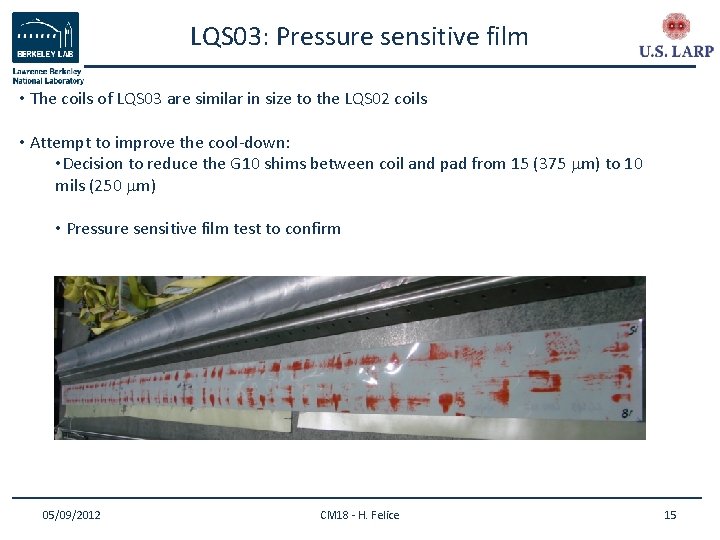
LQS 03: Pressure sensitive film • The coils of LQS 03 are similar in size to the LQS 02 coils • Attempt to improve the cool-down: • Decision to reduce the G 10 shims between coil and pad from 15 (375 mm) to 10 mils (250 mm) • Pressure sensitive film test to confirm 05/09/2012 CM 18 - H. Felice 15
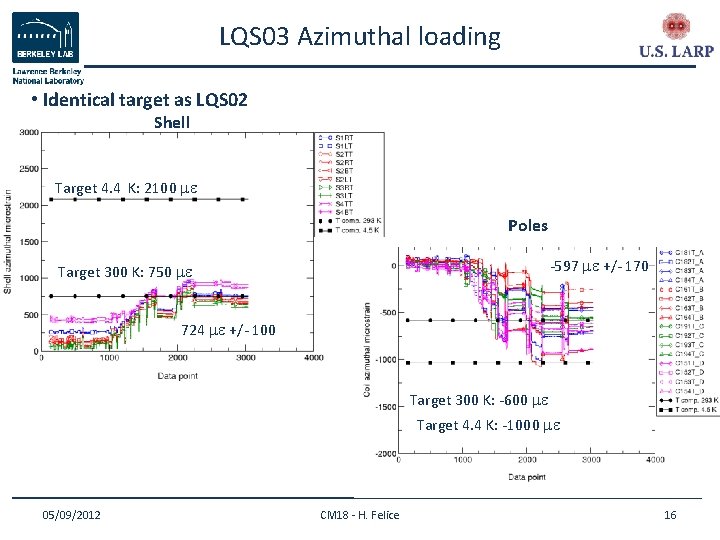
LQS 03 Azimuthal loading • Identical target as LQS 02 Shell Target 4. 4 K: 2100 me Poles -597 me +/- 170 Target 300 K: 750 me 724 me +/- 100 Target 300 K: -600 me Target 4. 4 K: -1000 me 05/09/2012 CM 18 - H. Felice 16
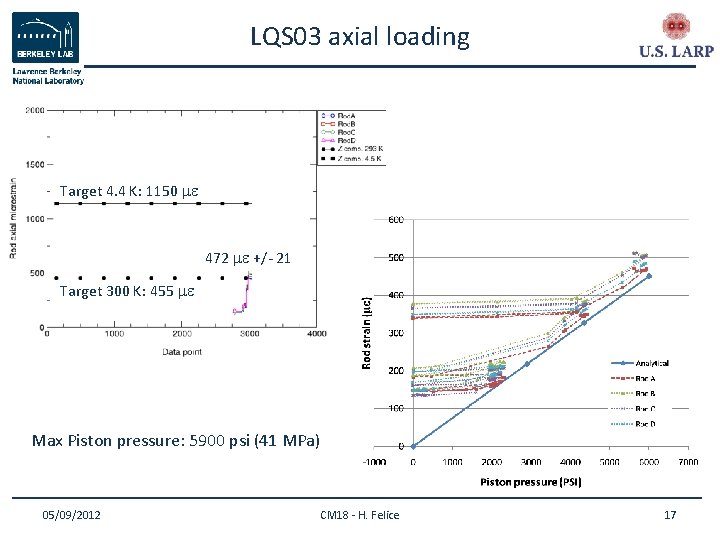
LQS 03 axial loading Target 4. 4 K: 1150 me 472 me +/- 21 Target 300 K: 455 me Max Piston pressure: 5900 psi (41 MPa) 05/09/2012 CM 18 - H. Felice 17
LQ assemblies summary 56 MPa -82 MPa 05/09/2012 CM 18 - H. Felice 18
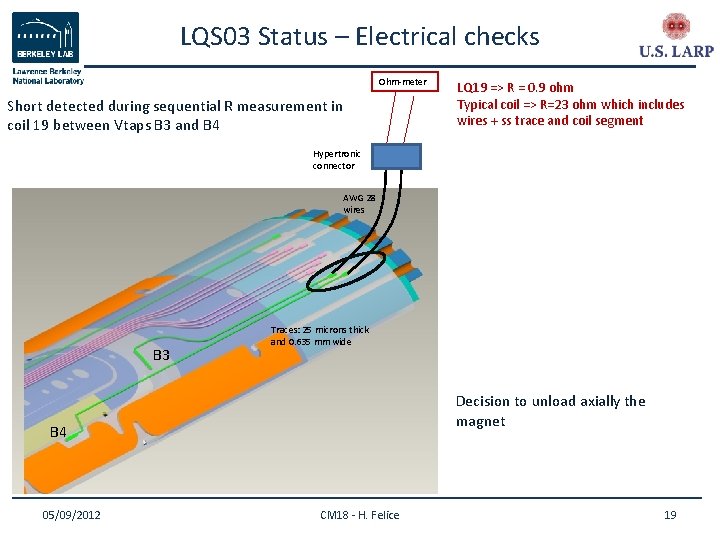
LQS 03 Status – Electrical checks Ohm-meter Short detected during sequential R measurement in coil 19 between Vtaps B 3 and B 4 LQ 19 => R = 0. 9 ohm Typical coil => R=23 ohm which includes wires + ss trace and coil segment Hypertronic connector AWG 28 wires B 3 Traces: 25 microns thick and 0. 635 mm wide Decision to unload axially the magnet B 4 05/09/2012 CM 18 - H. Felice 19
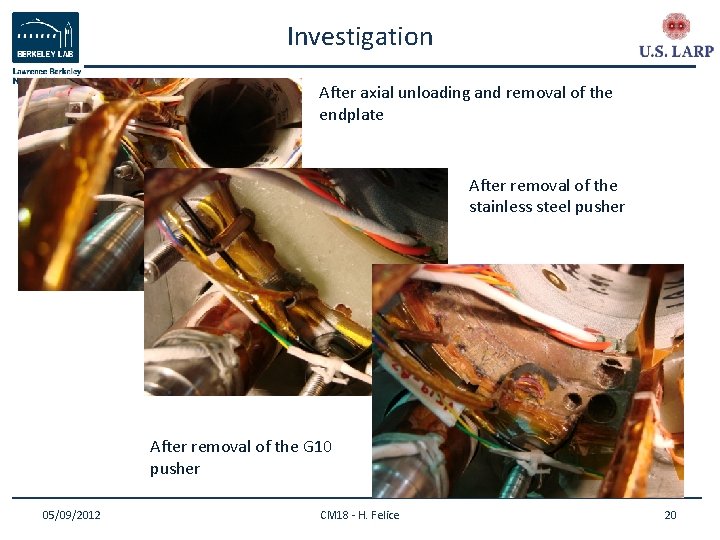
Investigation After axial unloading and removal of the endplate After removal of the stainless steel pusher After removal of the G 10 pusher 05/09/2012 CM 18 - H. Felice 20
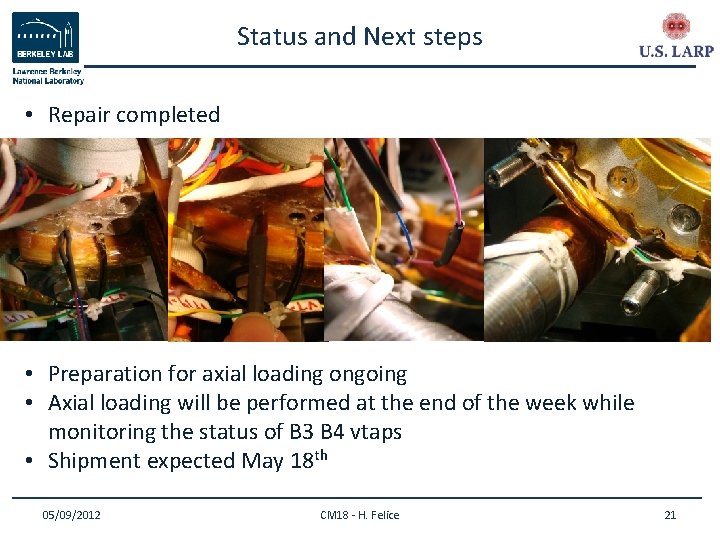
Status and Next steps • Repair completed • Preparation for axial loading ongoing • Axial loading will be performed at the end of the week while monitoring the status of B 3 B 4 vtaps • Shipment expected May 18 th 05/09/2012 CM 18 - H. Felice 21
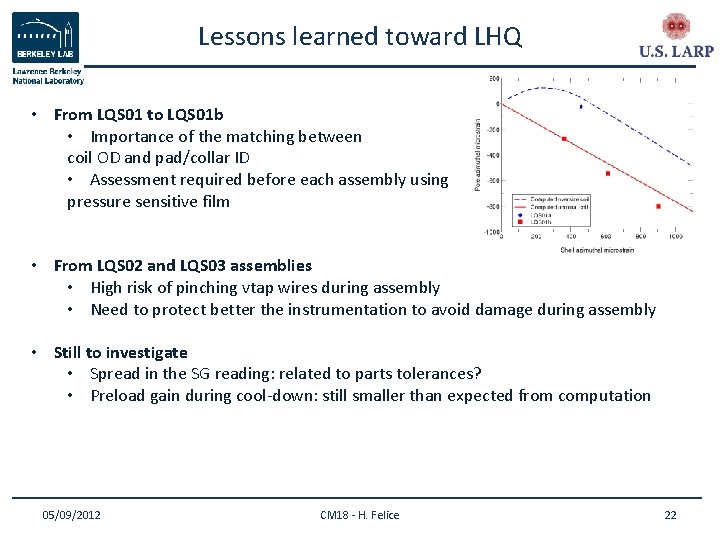
Lessons learned toward LHQ • From LQS 01 to LQS 01 b • Importance of the matching between coil OD and pad/collar ID • Assessment required before each assembly using pressure sensitive film • From LQS 02 and LQS 03 assemblies • High risk of pinching vtap wires during assembly • Need to protect better the instrumentation to avoid damage during assembly • Still to investigate • Spread in the SG reading: related to parts tolerances? • Preload gain during cool-down: still smaller than expected from computation 05/09/2012 CM 18 - H. Felice 22

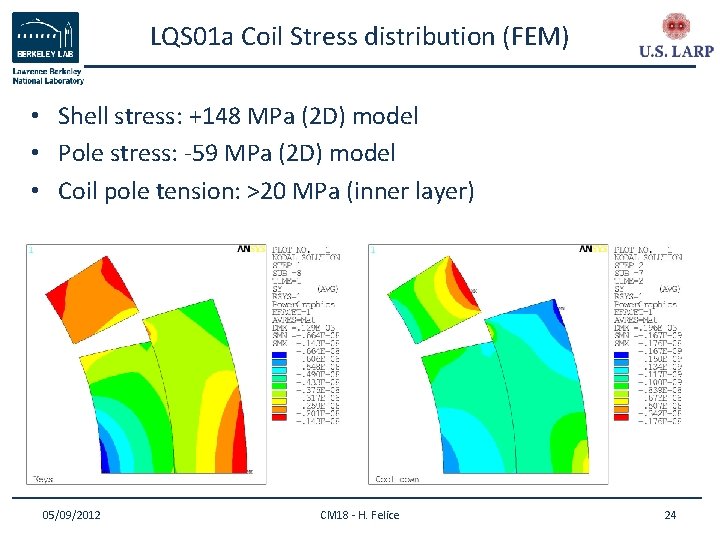
LQS 01 a Coil Stress distribution (FEM) • Shell stress: +148 MPa (2 D) model • Pole stress: -59 MPa (2 D) model • Coil pole tension: >20 MPa (inner layer) 05/09/2012 CM 18 - H. Felice 24
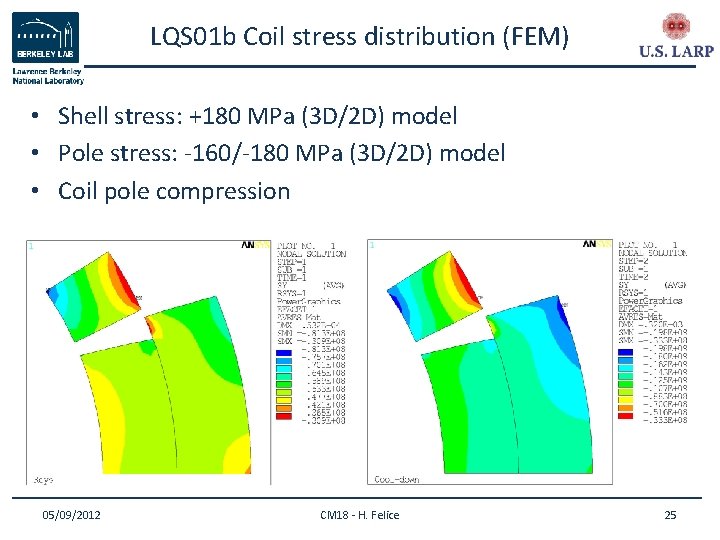
LQS 01 b Coil stress distribution (FEM) • Shell stress: +180 MPa (3 D/2 D) model • Pole stress: -160/-180 MPa (3 D/2 D) model • Coil pole compression 05/09/2012 CM 18 - H. Felice 25
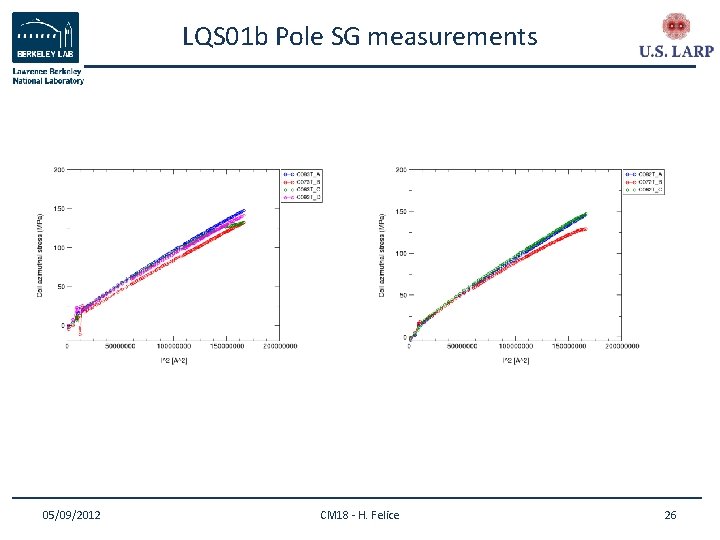
LQS 01 b Pole SG measurements 05/09/2012 CM 18 - H. Felice 26
- Slides: 26