
LPT Unit1 Milk and Milk Products Technology By
LPT Unit-1 Milk and Milk Products Technology By. Dr. SUSHMA KUMARI HOD, DEPT. OF LPT , BVC, PATNA
Retrospect and prospects of milk industry in India • The performance of Indian dairy sector during the 1950 s and 1960 s was not remarkable. However, with the successful implementation of Operation Flood Programme (OFP) during the 1970 s, the dairy sector achieved fourfold growth rate by touching the mark compound growth rate. During the past three decades, the total milk production increased. • India has emerged as the world’s largest milk producing country. Milk production increased by about 4 percent a year and it increased from 22 million tons in 1970 -71 to 104. 8 million tons in 2007 -08, the per capita per day milk availability increased from 107 grams to 245 grams during this period. • India’s first automated dairy plant has been established at Gandhinagar near Ahmedabad in Western India along with several domestic cooperatives.
• OFP for the first time recognized the need of rural milk producers and paid attention towards their thorough development. It plays the key role in bringing about the transformation of dairy development in the country. • The OFP established milk producer’s co-operatives in villages and made modern technology available to them. • At present India is not able to compete with European Countries and United States in export trade of dairy products because milk in these countries is highly subsidized. It is to be noted that the GATT Negotiations were for removal of these subsidies. If India intends to capture a major chunk of this market, it will have to make concerted efforts to ensure quality of milk and milk products
Operation Flood • Operation Flood, launched on 13 January 1970, was the world's largest dairy development program and a landmark project of India's National Dairy Development Board (NDDB). • It transformed India from a milk-deficient nation into the world's largest milk producer, surpassing the United States of America in 1998 with about 17 percent of global output in 2010– 11. • Within 30 years, it doubled the milk available person in India and made dairy farming India's largest self-sustainable rural employment generator.

• The Anand Pattern Experiment at Amul, a dairy co-operative, was the engine behind the success of the program. • Verghese Kurien, the chairman and founder of Amul, was named the Chairman of NDDB and he thrust the program towards success and has since been recognized as its architect. • Operation Flood is the program that led to "The White Revolution. " It created a national milk grid linking producers throughout India to consumers in over 700 towns and cities and reducing seasonal and regional price variations while ensuring that producers get a major share of the profit by eliminating the middlemen.
Operation Flood's objectives included: • Increased milk production ("a flood of creepers") • Augmented rural incomes • Fair prices for consumers. • Increased income of, and reduced poverty among participating farmers while ensuring a steady supply of milk in return.
Operation Flood was implemented in Three phases: • Phase I- (1970 -1980) • It was financed by the sale of skimmed milk powder and butter oil donated by the European Economic Community (EEC) through the World Food Program (WFP). • NDDB planned the program. During this phase Operation Flood linked 18 of India's premier milk sheds with consumers in India's major metropolitan cities: Delhi, Mumbai, Kolkata, and Chennai, establishing mother dairies in the four metros. • Operation Flood-I was originally meant to be completed in 1975, but it eventually lasted until the end of 1979, at a total cost of Rs. 116 crores. At the start of Operation Flood-I, in 1970, certain aims were kept in view for the implementation of the programs: • Improving the organized dairy sector in metropolitan cities Mumbai (then Bombay), Kolkata (then Calcutta), Chennai (then Madras), and Delhi through marketing, • An increase of producers' share in the milk market, • The speeding up of the development of dairy animals in rural areas to increase both production and procurement.
OF (Phase II) • Operation Flood (OF) Phase II (1981– 1985) • In this phase, increased the number of milk-sheds from 18 to 136; urban markets also expanded the outlets for milk to 290. • By the end of 1985, a self-sustaining system of 43, 000 village cooperatives with 4, 250, 000 milk producers was covered. • Domestic milk powder production increased from 22, 000 tons in the pre -project year to 140, 000 tons by 1989, with all of this increase coming from dairies set up under Operation Flood. • In this way, EEC gifts and a World Bank loan helped in promoting selfreliance. Direct marketing of milk by producers' co-operatives also increased by several million liters a day.
Phase III • Phase III (1985– 1996) – • It enabled dairy co-operatives to expand strengthen the infrastructure required to procure and market increasing volumes of milk. • Veterinary first-aid health care services, feed, and artificial insemination services for cooperative members were extended, along with intensified member education. • Operation Flood's Phase III consolidated India's dairy co-operative movement, adding 30, 000 new dairy co-operatives to the 43, 000 existing co-operatives organized during Phase II. • The number of milk-sheds peaked at 173 in 1988 -89, with the numbers of female members and female Dairy Co-operative Societies increasing significantly. • Phase III also increased emphasis on research and development in animal health and nutrition. Innovations such as a vaccine for Theileriosis, bypassing protein feed and urea -molasses mineral blocks, contributed to the enhanced productivity of milk-producing animals.
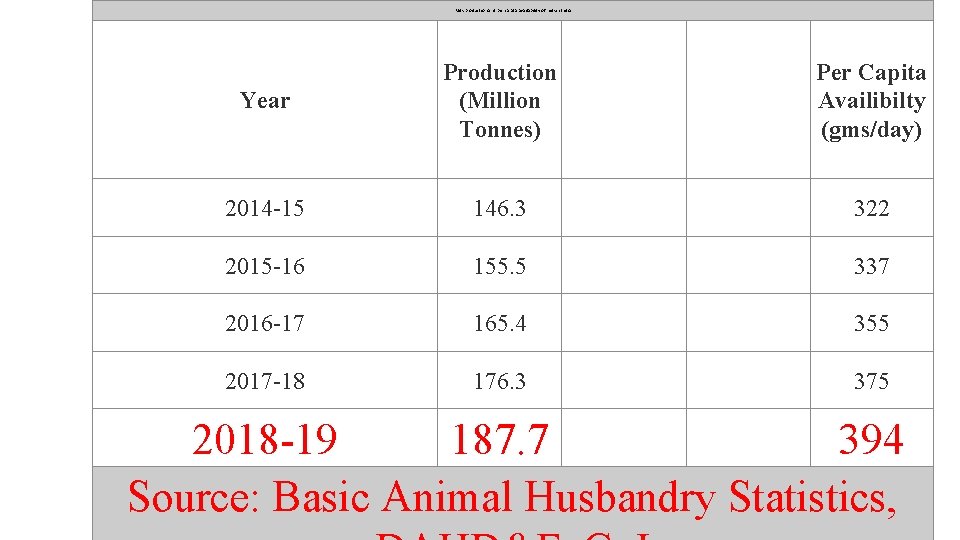
Milk production and per capita availability of milk in India Year Production (Million Tonnes) Per Capita Availibilty (gms/day) 2014 -15 146. 3 322 2015 -16 155. 5 337 2016 -17 165. 4 355 2017 -18 176. 3 375 2018 -19 187. 7 394 Source: Basic Animal Husbandry Statistics,
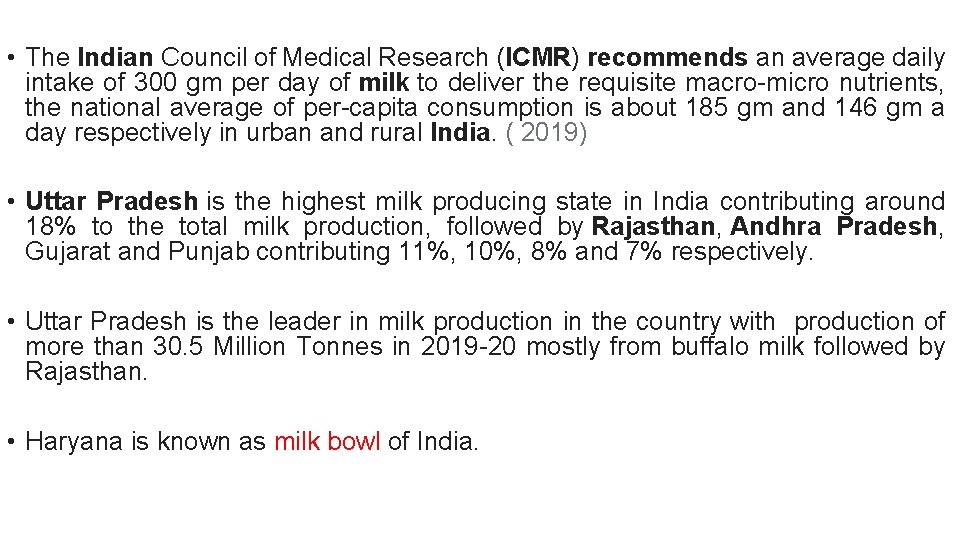
• The Indian Council of Medical Research (ICMR) recommends an average daily intake of 300 gm per day of milk to deliver the requisite macro-micro nutrients, the national average of per-capita consumption is about 185 gm and 146 gm a day respectively in urban and rural India. ( 2019) • Uttar Pradesh is the highest milk producing state in India contributing around 18% to the total milk production, followed by Rajasthan, Andhra Pradesh, Gujarat and Punjab contributing 11%, 10%, 8% and 7% respectively. • Uttar Pradesh is the leader in milk production in the country with production of more than 30. 5 Million Tonnes in 2019 -20 mostly from buffalo milk followed by Rajasthan. • Haryana is known as milk bowl of India.

• • THANKS
- Slides: 12