
LPC 10 2 4 kbps federal standard in
LPC 10 2. 4 kbps federal standard in speech coding ECE 8873 Data Compression & Modeling 03/17/2004 Soo Hyun Bae School of Electrical & Computer Engineering Georgia Institute of Technology <soohyun@ece. gatech. edu>
Agenda 1. 2. 3. 4. 5. 6. 7. Taxonomy of Speech Coders LPC 10 Properties Voicing Classification Levinson-Durbin Recursion Pitch Detection Synthesize Speech Coder Comparision

Linear Prediction Speech Coder Standard FS 1015 -LPC 10 LP Coefficient 10 FS 1016 -CELP MELP Code Excitation LP Mixed Excitation LP IS-54 VCELP Vector Sum Excited LP IS-96 QCELP Qual. Comm Code Excited LP LD-CELP G. 728 Low-Delay Code-Excited LP G. 729 CS-ACELP Conjugate-structure Algebraic. Code-Excited LP
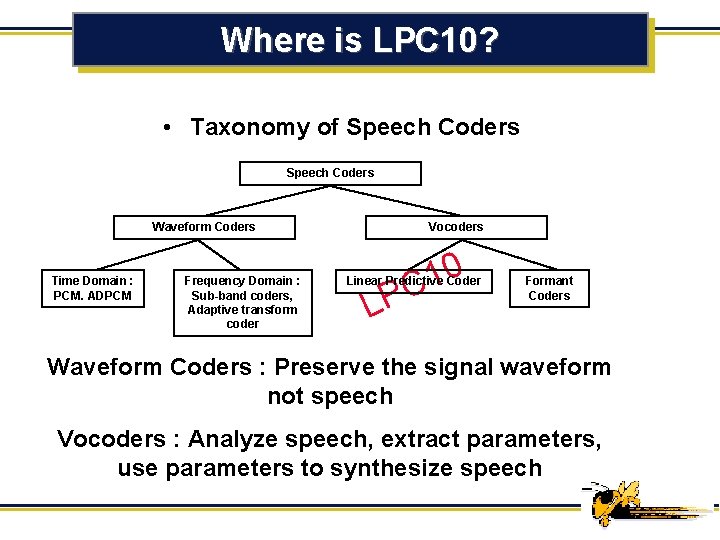
Where is LPC 10? • Taxonomy of Speech Coders Waveform Coders Time Domain : PCM. ADPCM Frequency Domain : Sub-band coders, Adaptive transform coder Vocoders 0 1 C Linear Predictive Coder LP Formant Coders Waveform Coders : Preserve the signal waveform not speech Vocoders : Analyze speech, extract parameters, use parameters to synthesize speech
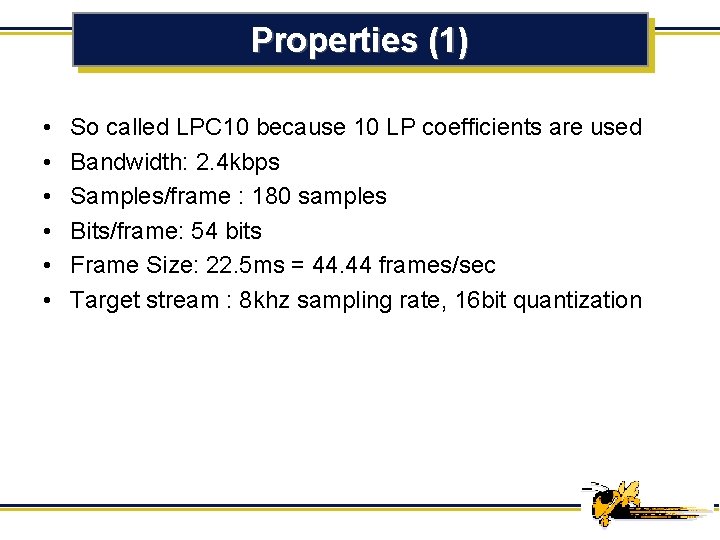
Properties (1) • • • So called LPC 10 because 10 LP coefficients are used Bandwidth: 2. 4 kbps Samples/frame : 180 samples Bits/frame: 54 bits Frame Size: 22. 5 ms = 44. 44 frames/sec Target stream : 8 khz sampling rate, 16 bit quantization
Properties (2) • “Buzzy” since noise through parameter updates • Regularly voiced excitation is unnatural, makes some jitter • Voicing error produce significant distortions • Only models speech, doesn’t work if backgound noise. Not suitable to mobile phone application
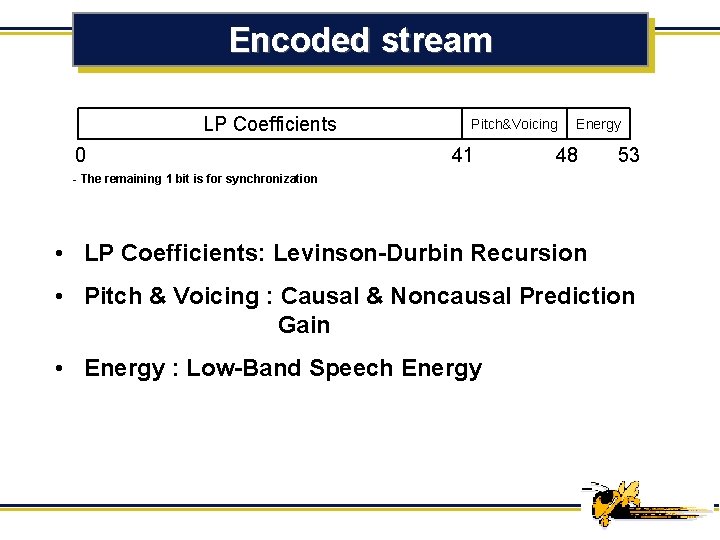
Encoded stream LP Coefficients 0 Pitch&Voicing 41 Energy 48 53 - The remaining 1 bit is for synchronization • LP Coefficients: Levinson-Durbin Recursion • Pitch & Voicing : Causal & Noncausal Prediction Gain • Energy : Low-Band Speech Energy
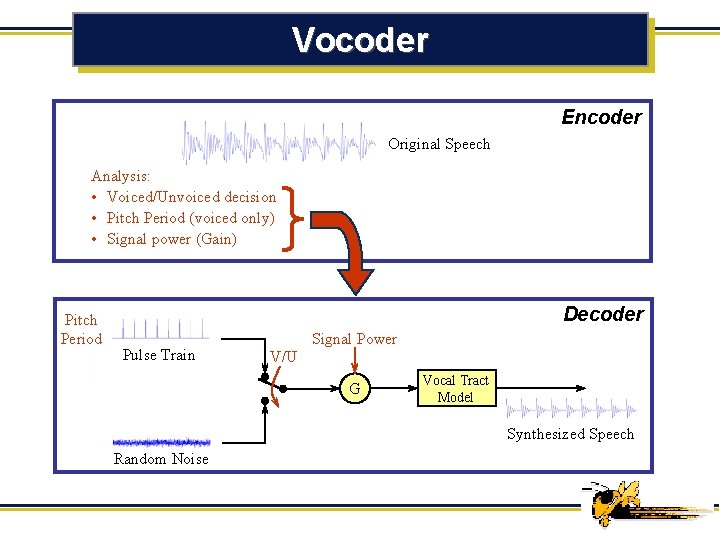
Vocoder Encoder Original Speech Analysis: • Voiced/Unvoiced decision • Pitch Period (voiced only) • Signal power (Gain) Pitch Period Decoder Pulse Train Signal Power V/U G Vocal Tract Model Synthesized Speech Random Noise
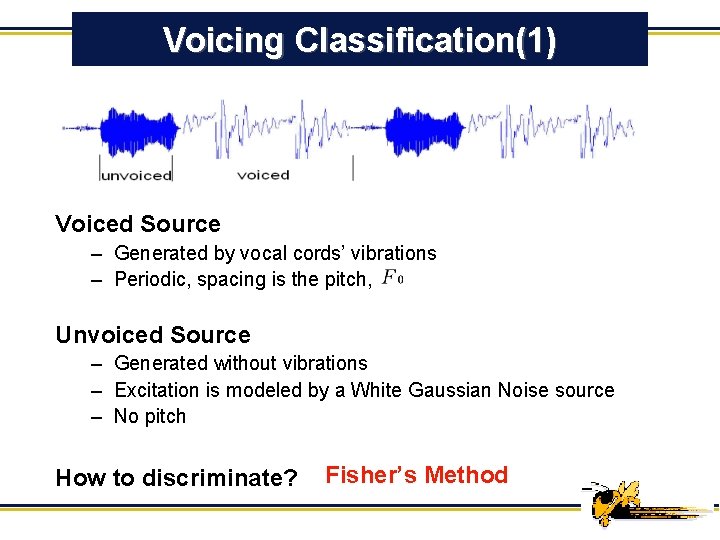
Voicing Classification(1) Voiced Source – Generated by vocal cords’ vibrations – Periodic, spacing is the pitch, Unvoiced Source – Generated without vibrations – Excitation is modeled by a White Gaussian Noise source – No pitch How to discriminate? Fisher’s Method
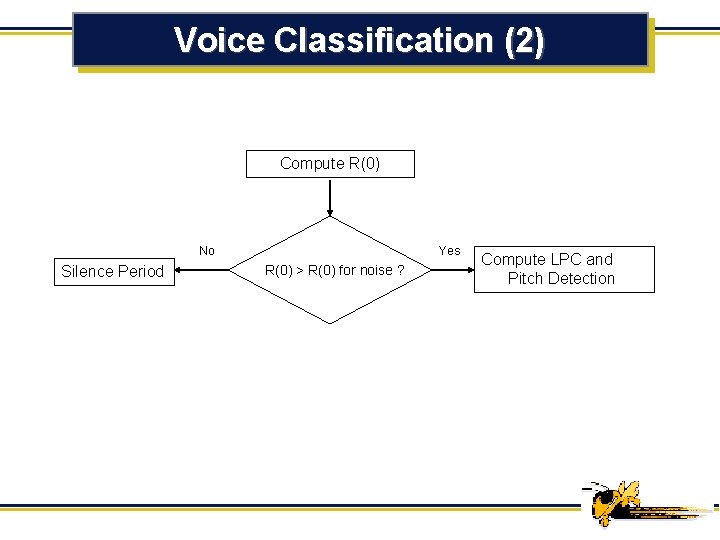
Voice Classification (2) Compute R(0) No Silence Period Yes R(0) > R(0) for noise ? Compute LPC and Pitch Detection
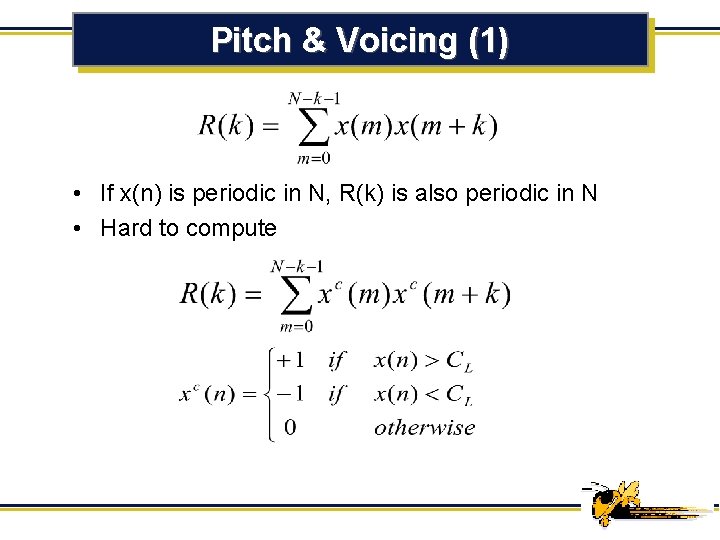
Pitch & Voicing (1) • If x(n) is periodic in N, R(k) is also periodic in N • Hard to compute
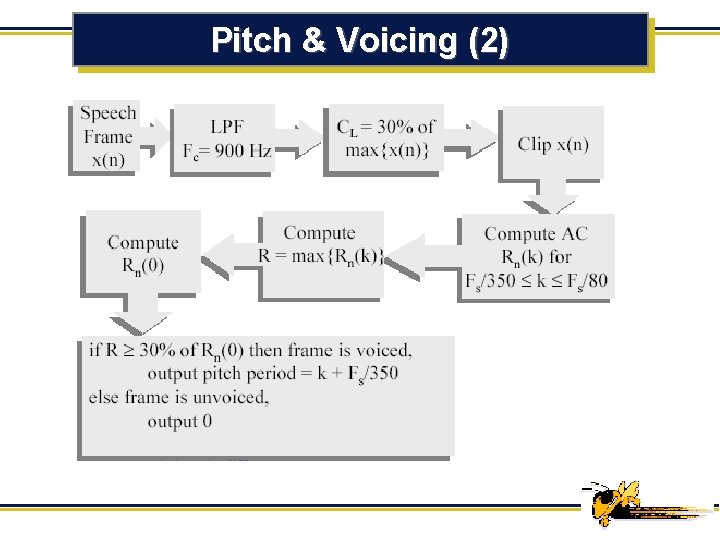
Pitch & Voicing (2)
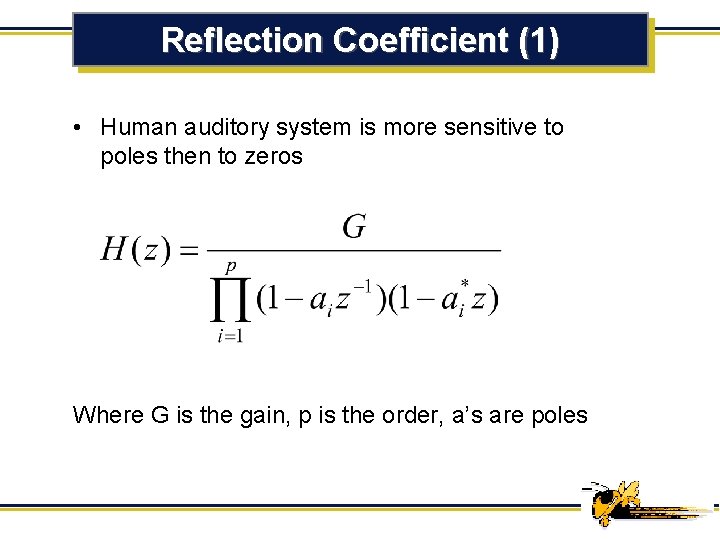
Reflection Coefficient (1) • Human auditory system is more sensitive to poles then to zeros Where G is the gain, p is the order, a’s are poles
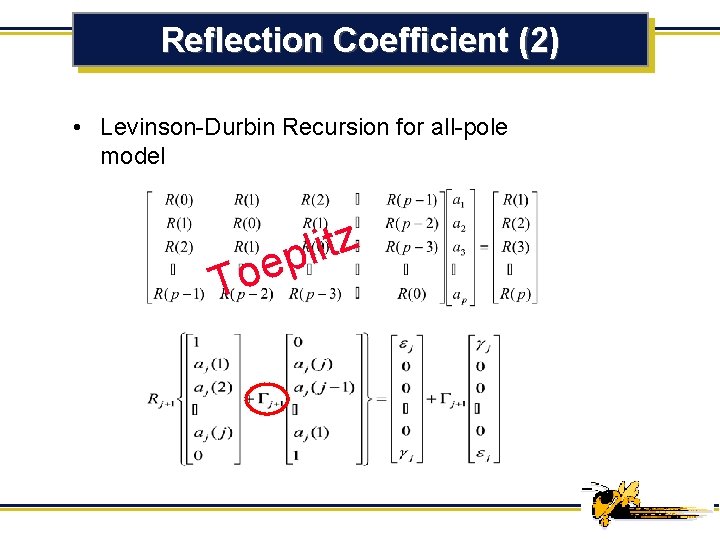
Reflection Coefficient (2) • Levinson-Durbin Recursion for all-pole model z t i l p e To
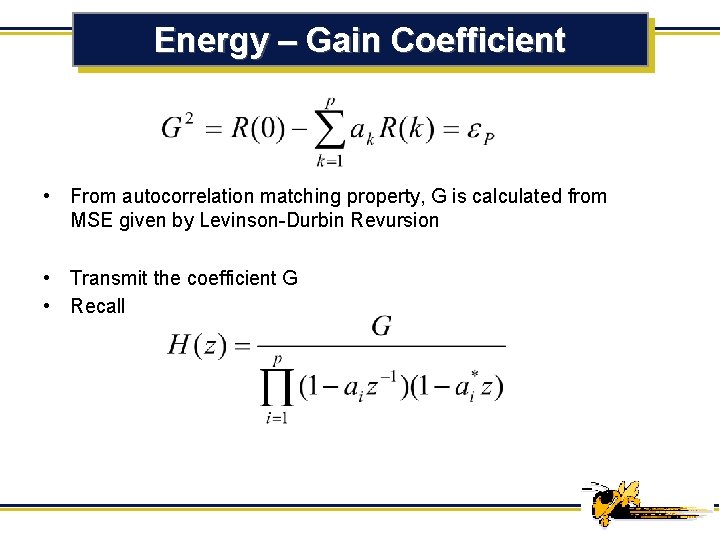
Energy – Gain Coefficient • From autocorrelation matching property, G is calculated from MSE given by Levinson-Durbin Revursion • Transmit the coefficient G • Recall
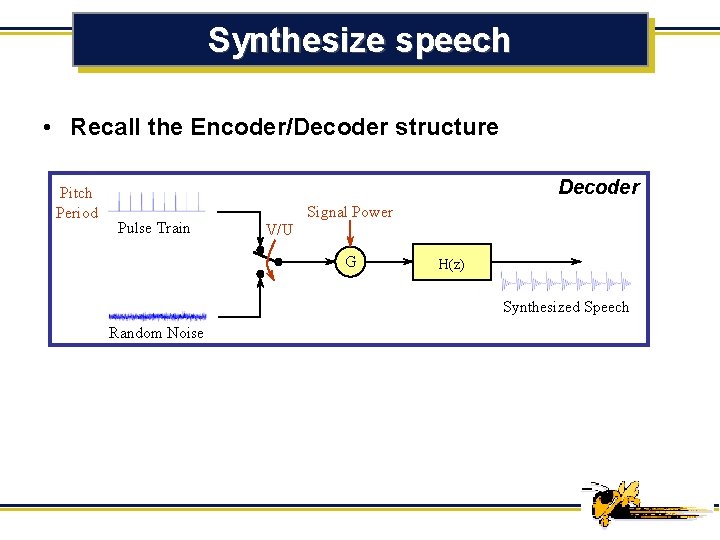
Synthesize speech • Recall the Encoder/Decoder structure Pitch Period Decoder Pulse Train Signal Power V/U G H(z) Synthesized Speech Random Noise
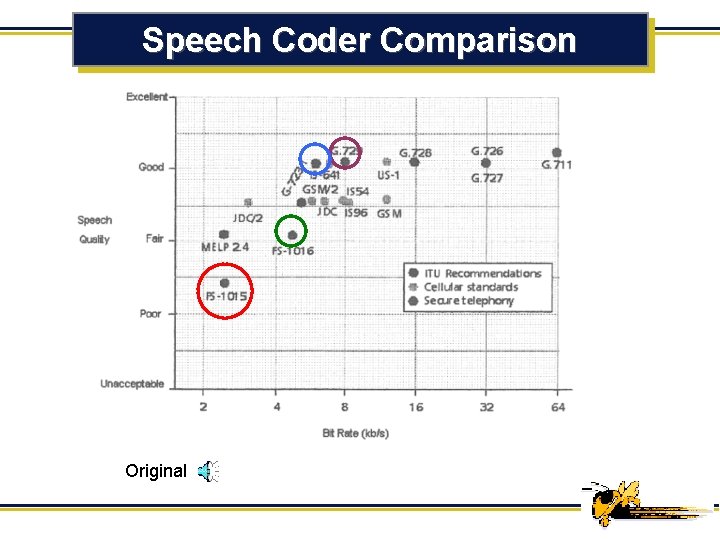
Speech Coder Comparison Original
References • • • Welch V. C. , Tremain T. E. , Campbell J. P. Jr. , “A comparison of US Government standard voice coders”, MILCOM’ 89, Vol. 1, pp 269 -273, 1989. Cox R. V. , “Three New Speech Coders from the ITU Cover a Range of Applications”, Comm. Magazine of IEEE, Vol. 35, pp 40 -47, 1997 Campbell J. P. Jr. , Tremain T. E. , “Voiced/Unvoiced Classification of Speech with Applications to the U. S. Government LPC-10 E Algorithm”, ICASSP 86, Vol. 11, pp 473476, 1986 http: //www. ee. ucla. edu/~ingrid/ee 213 a/speech. html http: //mia. ece. uic. edu/~papers/WWW/Multimedia. Standards/ http: //www. ecse. rpi. edu/Homepages/shivkuma/ http: //www. eee. strath. ac. uk/r. w. stewart/index 2. htm http: //web. syr. edu/~gsriniva/tech/docs/ http: //www. speech. cs. cmu. edu/comp. speech/Section 3/Software/celp 3. 2 a. html http: //www. arl. wustl. edu/~jaf/lpc/ http: //www. ecsl. cs. sunysb. edu/cse 660/speech. html
- Slides: 18