
LP 1 Knowledge Organiser Science Year 8 Key
- Slides: 1
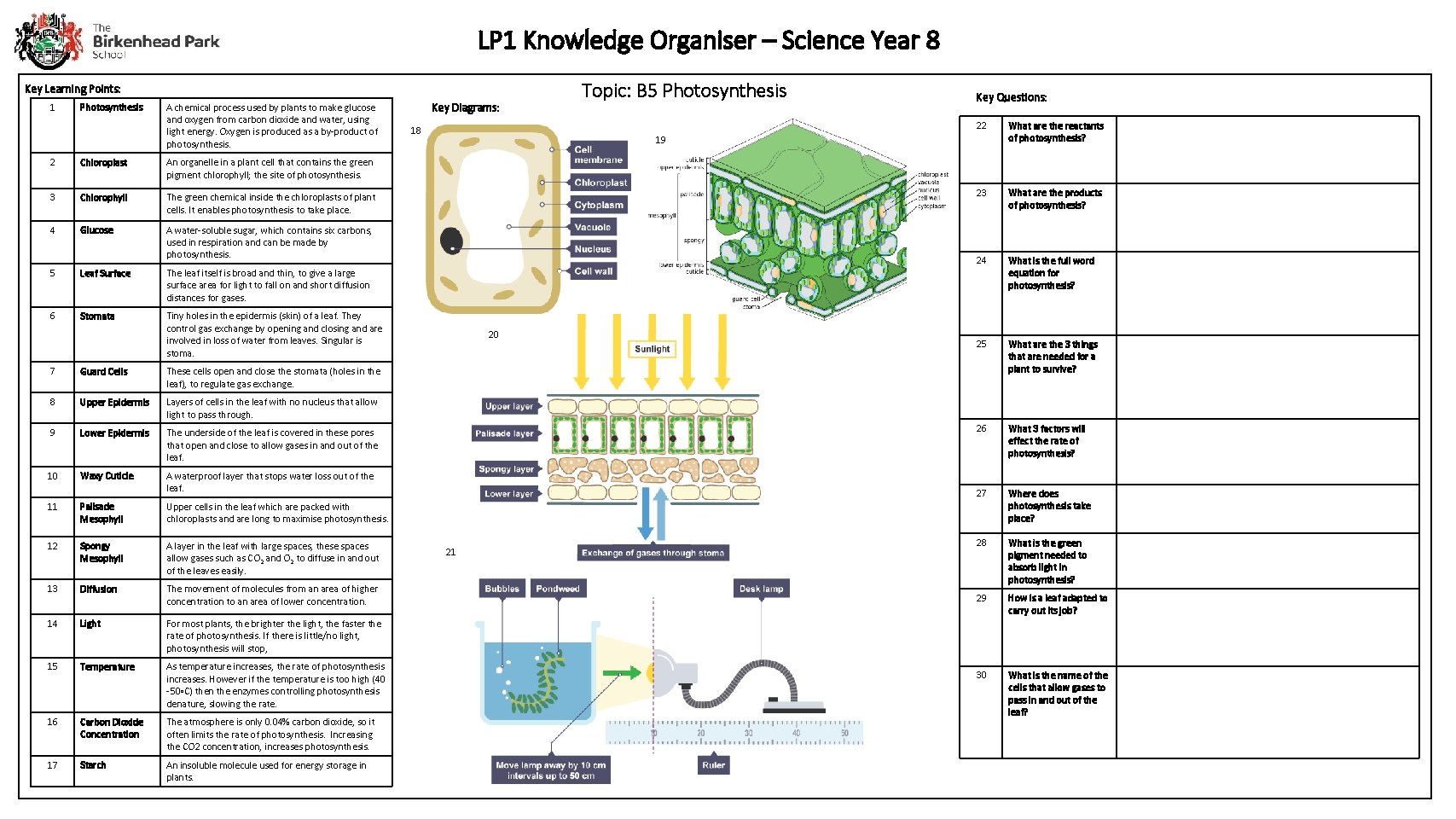
LP 1 Knowledge Organiser – Science Year 8 Key Learning Points: 1 Photosynthesis A chemical process used by plants to make glucose and oxygen from carbon dioxide and water, using light energy. Oxygen is produced as a by-product of photosynthesis. 2 Chloroplast An organelle in a plant cell that contains the green pigment chlorophyll; the site of photosynthesis. 3 Chlorophyll The green chemical inside the chloroplasts of plant cells. It enables photosynthesis to take place. 4 Glucose A water-soluble sugar, which contains six carbons, used in respiration and can be made by photosynthesis. 5 Leaf Surface The leaf itself is broad and thin, to give a large surface area for light to fall on and short diffusion distances for gases. 6 Stomata Tiny holes in the epidermis (skin) of a leaf. They control gas exchange by opening and closing and are involved in loss of water from leaves. Singular is stoma. 7 Guard Cells These cells open and close the stomata (holes in the leaf), to regulate gas exchange. 8 Upper Epidermis Layers of cells in the leaf with no nucleus that allow light to pass through. 9 Lower Epidermis The underside of the leaf is covered in these pores that open and close to allow gases in and out of the leaf. 10 Waxy Cuticle A waterproof layer that stops water loss out of the leaf. 11 Palisade Mesophyll Upper cells in the leaf which are packed with chloroplasts and are long to maximise photosynthesis. 12 Spongy Mesophyll A layer in the leaf with large spaces, these spaces allow gases such as CO 2 and O 2 to diffuse in and out of the leaves easily. 13 Diffusion The movement of molecules from an area of higher concentration to an area of lower concentration. 14 Light For most plants, the brighter the light, the faster the rate of photosynthesis. If there is little/no light, photosynthesis will stop, 15 Temperature As temperature increases, the rate of photosynthesis increases. However if the temperature is too high (40 -50◦C) then the enzymes controlling photosynthesis denature, slowing the rate. 16 Carbon Dioxide Concentration The atmosphere is only 0. 04% carbon dioxide, so it often limits the rate of photosynthesis. Increasing the CO 2 concentration, increases photosynthesis. 17 Starch An insoluble molecule used for energy storage in plants. Key Diagrams: 18 Topic: B 5 Photosynthesis Key Questions: 22 What are the reactants of photosynthesis? 23 What are the products of photosynthesis? 24 What is the full word equation for photosynthesis? 25 What are the 3 things that are needed for a plant to survive? 26 What 3 factors will effect the rate of photosynthesis? 27 Where does photosynthesis take place? 28 What is the green pigment needed to absorb light in photosynthesis? 29 How is a leaf adapted to carry out its job? 30 What is the name of the cells that allow gases to pass in and out of the leaf? 19 20 21