
LowTemperature Plasma Surface Interactions Nanoscale Graphitic Film Formation

- Slides: 51
Low-Temperature Plasma Surface Interactions: Nanoscale Graphitic Film Formation, Atomic Layer Etching And Atmospheric Pressure Plasma Jet Modification Of Biomolecules* Gottlieb S. Oehrlein Materials Science and Engineering Institute for Research in Electronics and Applied Physics University of Maryland, College Park, MD 20742� 2115
Acknowledgements Nanoscale graphitic film § D. Metzler, F. Weilnboeck, N. Fox-Lyon, Prof. L. Salamanca-Riba (UMD) § R. Bruce, S. Engelmann (IBM Research) Atomic Layer Etching § D. Metzler, C. Li (UMD) § S. Engelmann, R. Bruce, E. Joseph (IBM Research) Deactivation of harmful biomolecules using atmospheric pressure plasma § E. Bartis, A. Knoll, P. Luan, C. Hart, N. Fox-Lyon, Prof. J. Seog (UMD) § T. -Y. Chung, H. -W. Chang, Prof. D. B. Graves (UC Berkeley) § Profs. I. V. Adamovich and W. R. Lempert (OSU), E. Raitses (PPPL) Funding § Semiconductor Research Corporation, NSF (DMR-0705953) § National Science Foundation (CBET-1134273; PHY-1004256) § US Department of Energy Office of Fusion Energy Sciences (DESC 0005105; DE-SC 0001939)
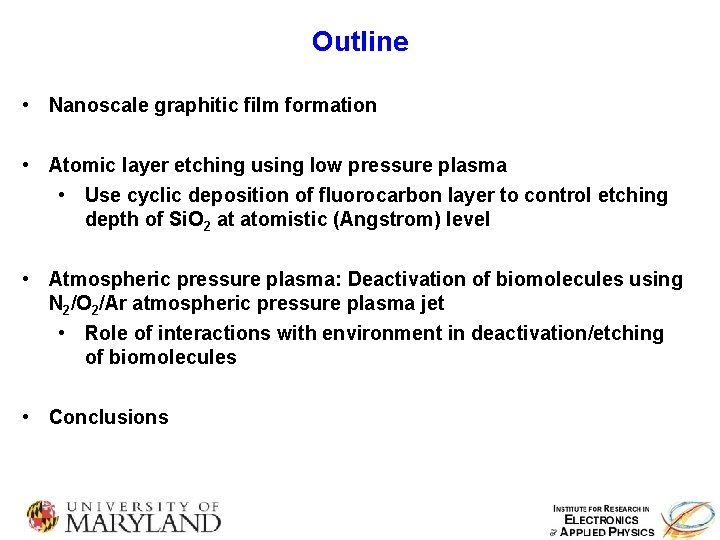
Outline • Nanoscale graphitic film formation • Atomic layer etching using low pressure plasma • Use cyclic deposition of fluorocarbon layer to control etching depth of Si. O 2 at atomistic (Angstrom) level • Atmospheric pressure plasma: Deactivation of biomolecules using N 2/O 2/Ar atmospheric pressure plasma jet • Role of interactions with environment in deactivation/etching of biomolecules • Conclusions
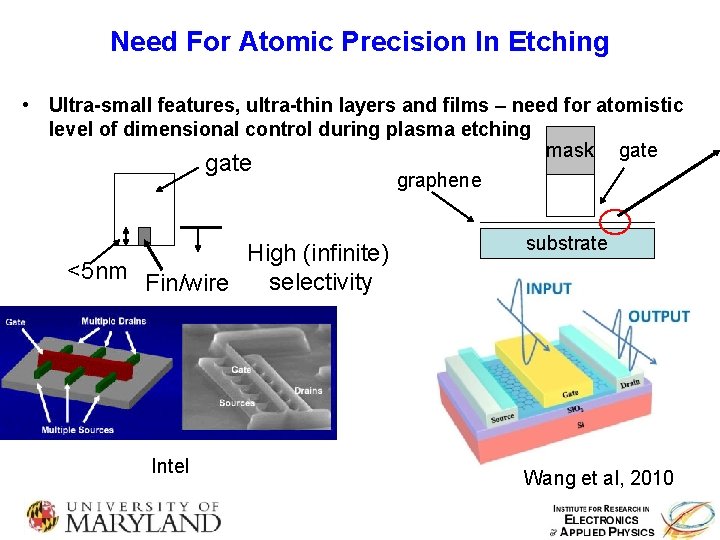
Need For Atomic Precision In Etching • Ultra-small features, ultra-thin layers and films – need for atomistic level of dimensional control during plasma etching mask gate graphene High (infinite) <5 nm Fin/wire selectivity Intel substrate Wang et al, 2010
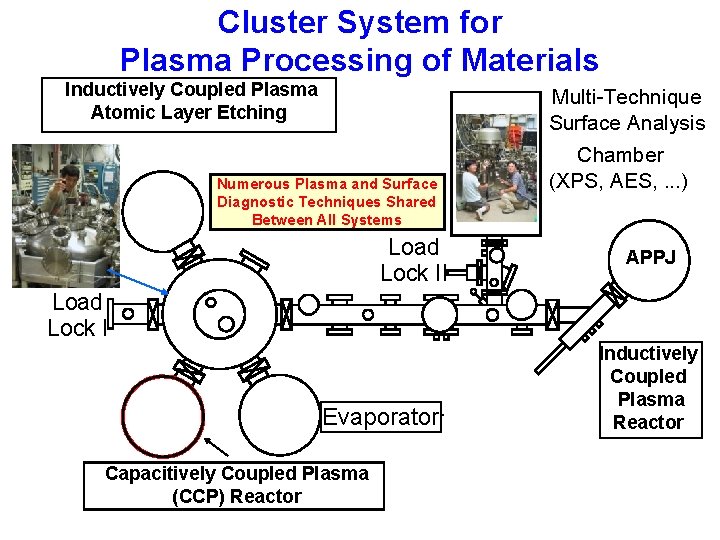
Cluster System for Plasma Processing of Materials Inductively Coupled Plasma Atomic Layer Etching Multi-Technique Surface Analysis Numerous Plasma and Surface Diagnostic Techniques Shared Between All Systems Load Lock II Chamber (XPS, AES, . . . ) APPJ Load Lock I Evaporator Capacitively Coupled Plasma (CCP) Reactor Inductively Coupled Plasma Reactor
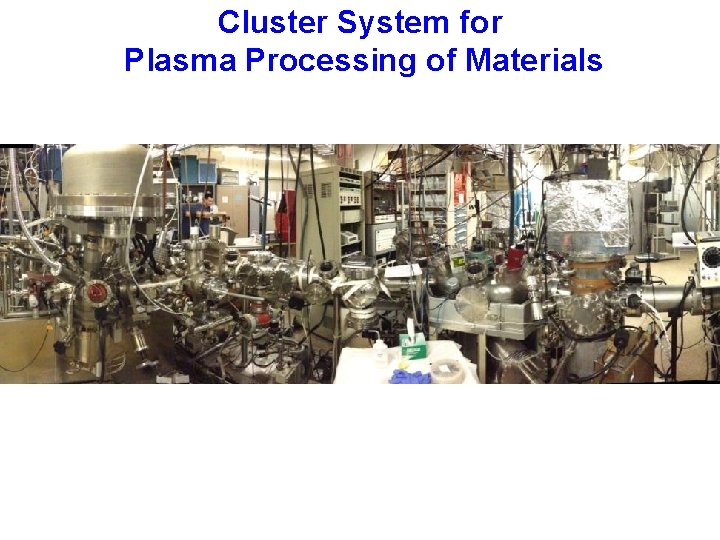
Cluster System for Plasma Processing of Materials
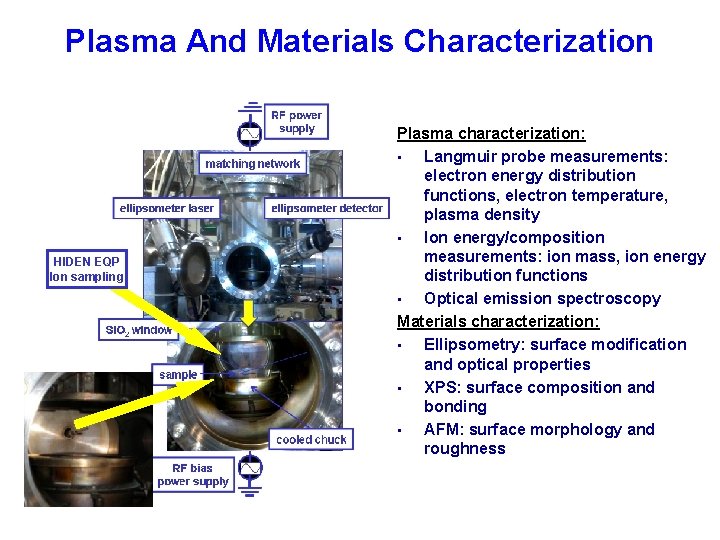
Plasma And Materials Characterization HIDEN EQP Ion sampling Plasma characterization: • Langmuir probe measurements: electron energy distribution functions, electron temperature, plasma density • Ion energy/composition measurements: ion mass, ion energy distribution functions • Optical emission spectroscopy Materials characterization: • Ellipsometry: surface modification and optical properties • XPS: surface composition and bonding • AFM: surface morphology and roughness
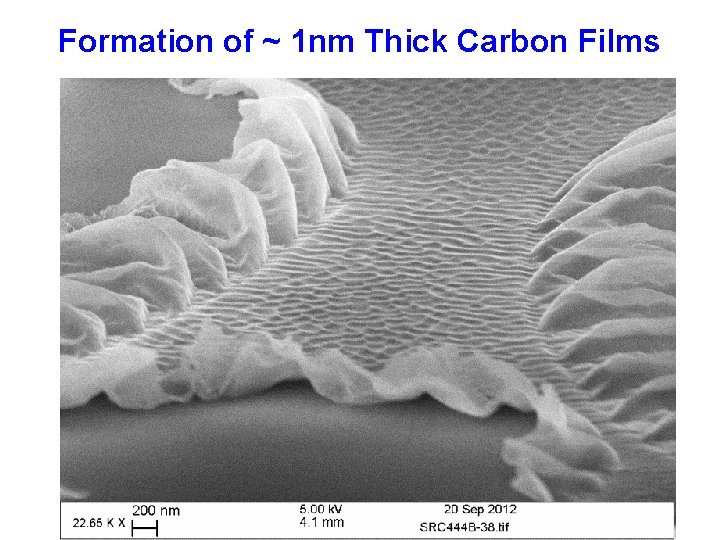
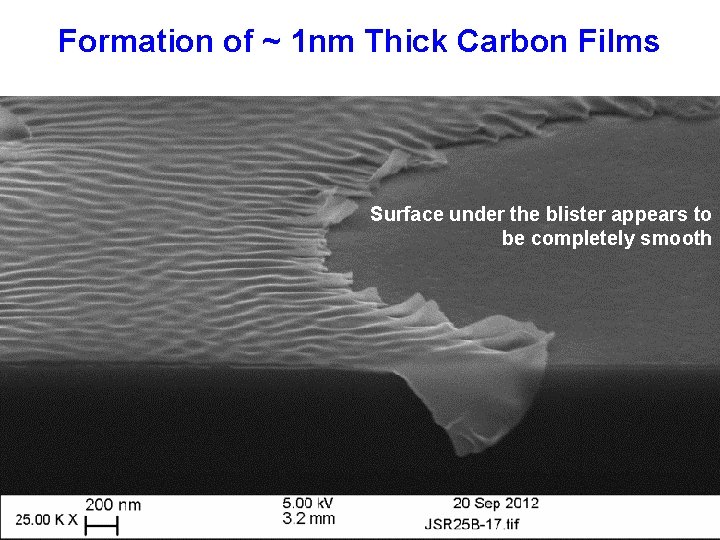
Formation of ~ 1 nm Thick Carbon Films
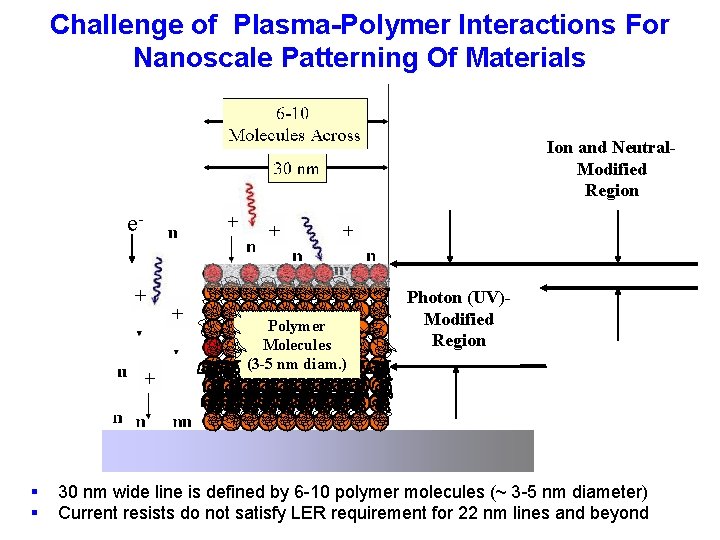
Challenge of Plasma-Polymer Interactions For Nanoscale Patterning Of Materials Ion and Neutral. Modified Region e- Polymer Molecules (3 -5 nm diam. ) § § Photon (UV)Modified Region 30 nm wide line is defined by 6 -10 polymer molecules (~ 3 -5 nm diameter) Current resists do not satisfy LER requirement for 22 nm lines and beyond
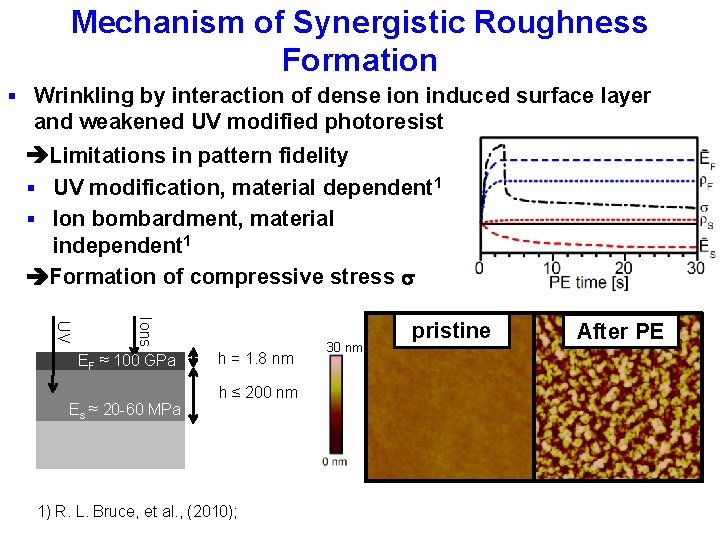
Mechanism of Synergistic Roughness Formation § Wrinkling by interaction of dense ion induced surface layer and weakened UV modified photoresist Limitations in pattern fidelity § UV modification, material dependent 1 § Ion bombardment, material independent 1 Formation of compressive stress Ions UV EF ≈ 100 GPa Es ≈ 20 -60 MPa h = 1. 8 nm h ≤ 200 nm 1) R. L. Bruce, et al. , (2010); 30 nm pristine After PE
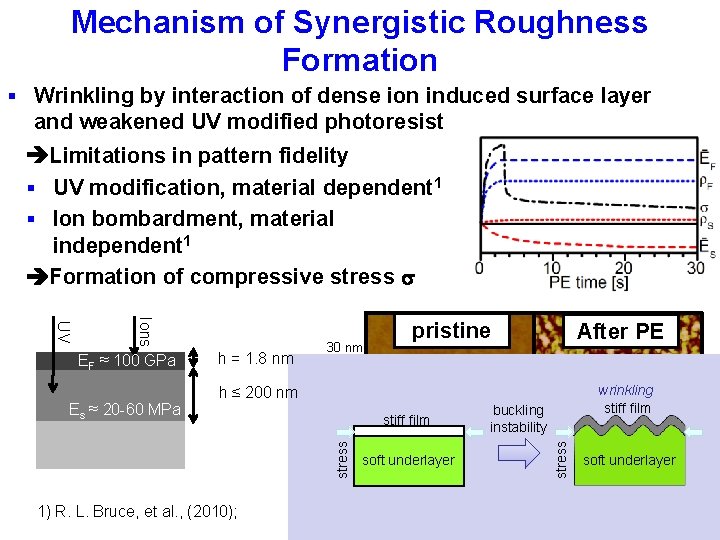
Mechanism of Synergistic Roughness Formation § Wrinkling by interaction of dense ion induced surface layer and weakened UV modified photoresist Limitations in pattern fidelity § UV modification, material dependent 1 § Ion bombardment, material independent 1 Formation of compressive stress Ions 30 nm wrinkling stiff film h ≤ 200 nm stiff film stress Es ≈ 20 -60 MPa h = 1. 8 nm After PE 1) R. L. Bruce, et al. , (2010); 250 nm soft underlayer buckling instability stress UV EF ≈ 100 GPa pristine soft underlayer
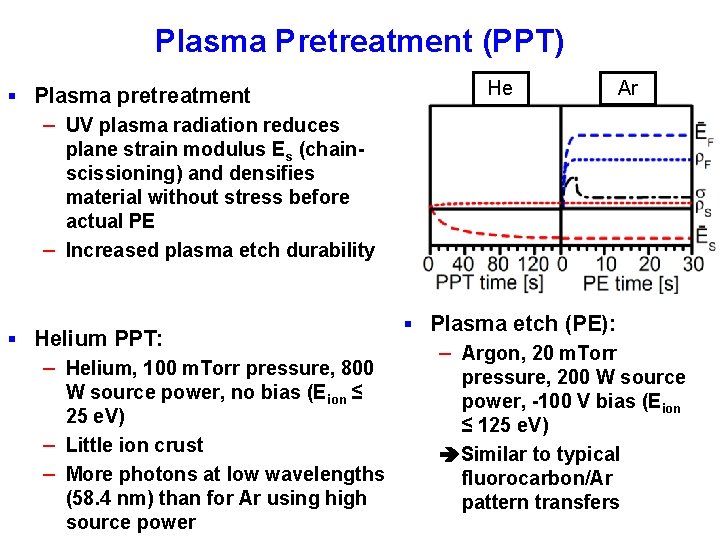
Plasma Pretreatment (PPT) § Plasma pretreatment – UV plasma radiation reduces plane strain modulus Es (chainscissioning) and densifies material without stress before actual PE – Increased plasma etch durability He Ar § Plasma etch (PE): § Helium PPT: – Argon, 20 m. Torr – Helium, 100 m. Torr pressure, 800 pressure, 200 W source power, no bias (Eion ≤ power, -100 V bias (Eion 25 e. V) ≤ 125 e. V) – Little ion crust Similar to typical – More photons at low wavelengths fluorocarbon/Ar (58. 4 nm) than for Ar using high pattern transfers source power
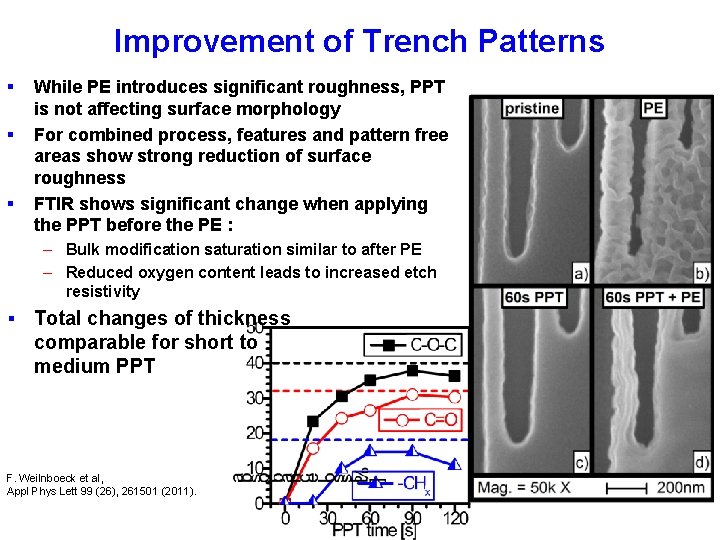
Improvement of Trench Patterns § § § While PE introduces significant roughness, PPT is not affecting surface morphology For combined process, features and pattern free areas show strong reduction of surface roughness FTIR shows significant change when applying the PPT before the PE : – Bulk modification saturation similar to after PE – Reduced oxygen content leads to increased etch resistivity § Total changes of thickness comparable for short to medium PPT F. Weilnboeck et al, Appl Phys Lett 99 (26), 261501 (2011).
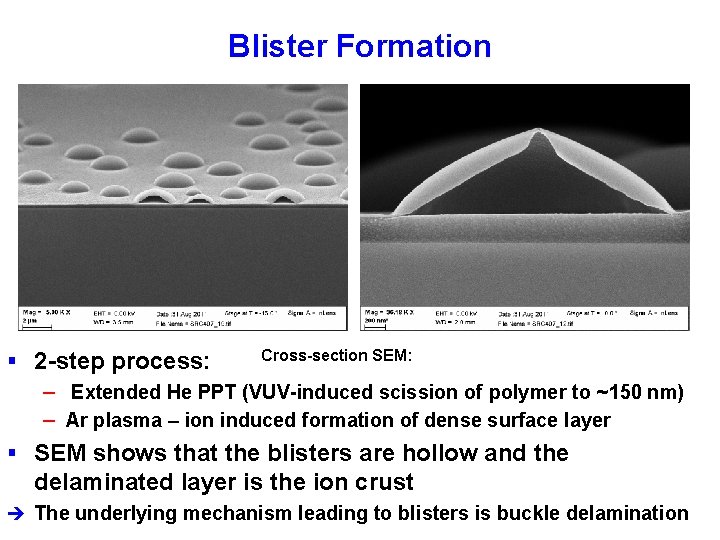
Blister Formation Cross-section SEM: § 2 -step process: – Extended He PPT (VUV-induced scission of polymer to ~150 nm) – Ar plasma – ion induced formation of dense surface layer § SEM shows that the blisters are hollow and the delaminated layer is the ion crust The underlying mechanism leading to blisters is buckle delamination
Formation of ~ 1 nm Thick Carbon Films Surface under the blister appears to be completely smooth
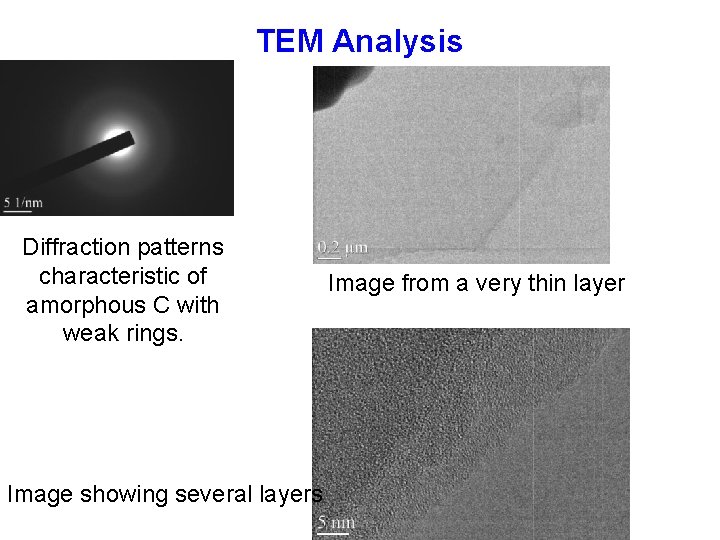
TEM Analysis Diffraction patterns characteristic of amorphous C with weak rings. Image showing several layers Image from a very thin layer
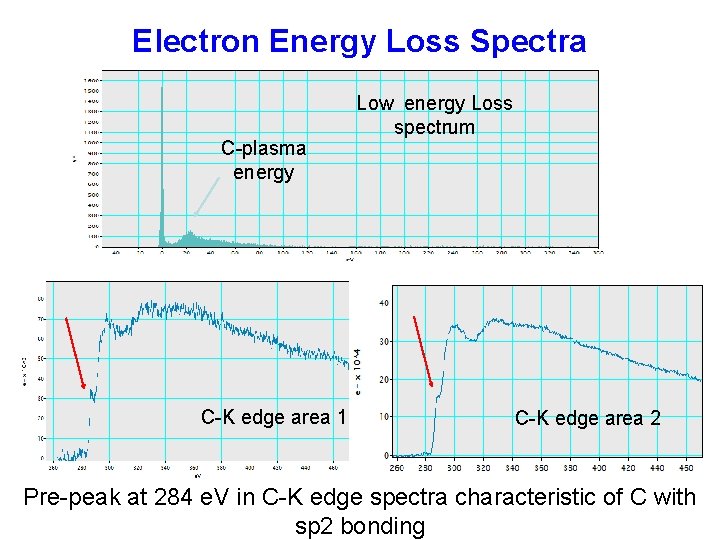
Electron Energy Loss Spectra C-plasma energy C-K edge area 1 Low energy Loss spectrum C-K edge area 2 Pre-peak at 284 e. V in C-K edge spectra characteristic of C with sp 2 bonding
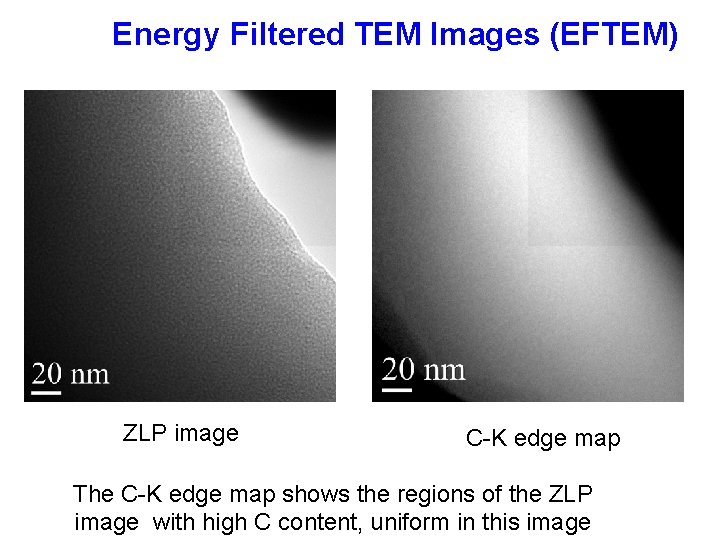
Energy Filtered TEM Images (EFTEM) ZLP image C-K edge map The C-K edge map shows the regions of the ZLP image with high C content, uniform in this image
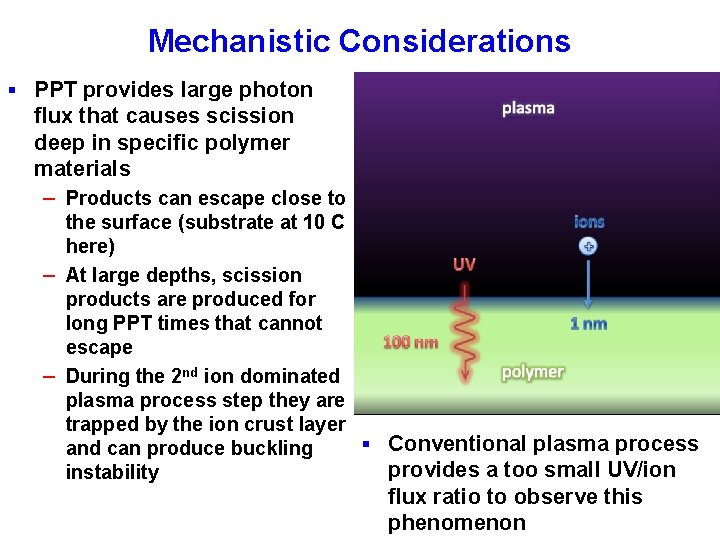
Mechanistic Considerations § PPT provides large photon flux that causes scission deep in specific polymer materials – Products can escape close to the surface (substrate at 10 C here) – At large depths, scission products are produced for long PPT times that cannot escape – During the 2 nd ion dominated plasma process step they are trapped by the ion crust layer § Conventional plasma process and can produce buckling provides a too small UV/ion instability flux ratio to observe this phenomenon
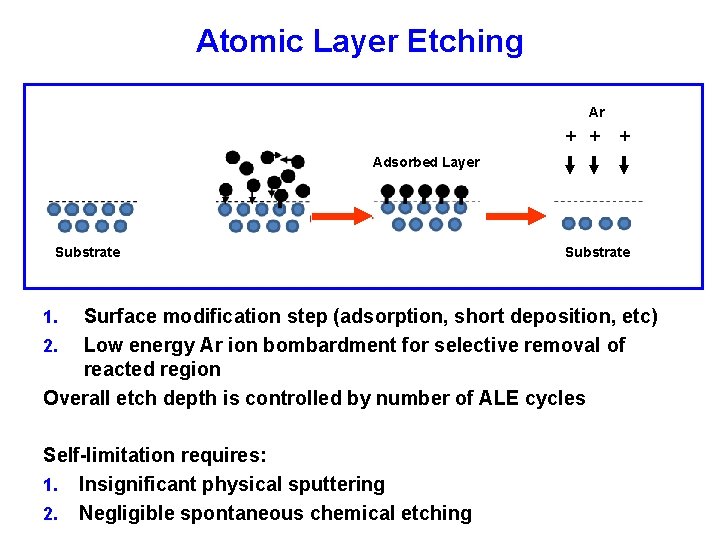
Atomic Layer Etching Ar + + + Adsorbed Layer Substrate Surface modification step (adsorption, short deposition, etc) 2. Low energy Ar ion bombardment for selective removal of reacted region Overall etch depth is controlled by number of ALE cycles 1. Self-limitation requires: 1. Insignificant physical sputtering 2. Negligible spontaneous chemical etching
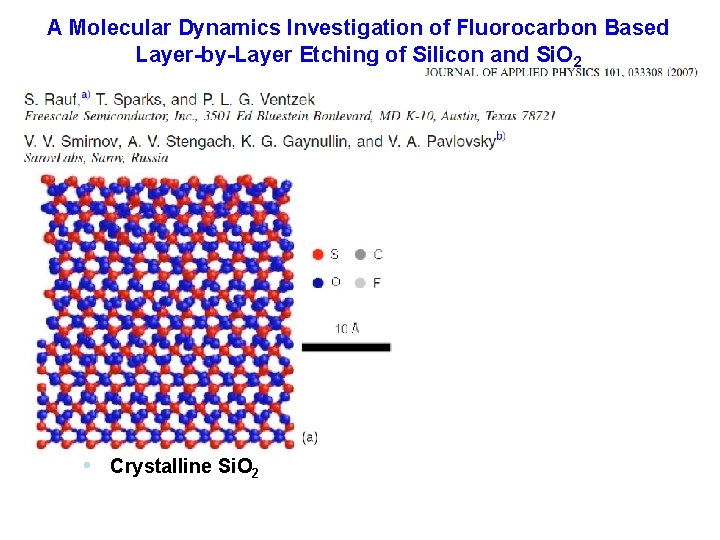
A Molecular Dynamics Investigation of Fluorocarbon Based Layer-by-Layer Etching of Silicon and Si. O 2 • Crystalline Si. O 2
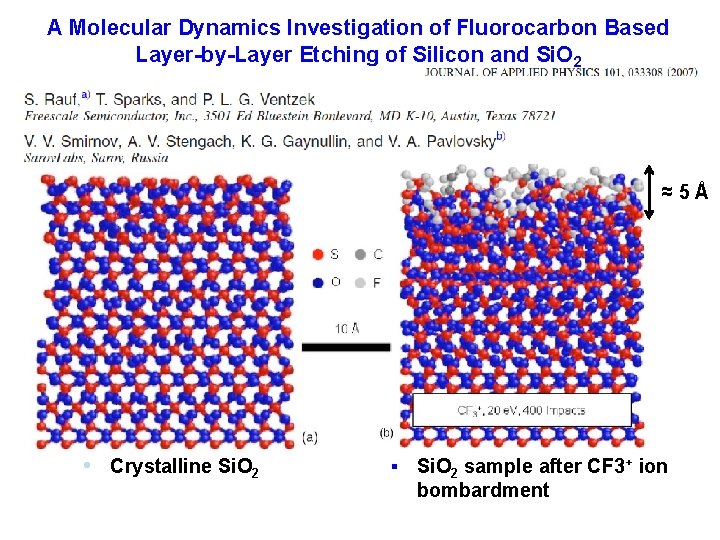
A Molecular Dynamics Investigation of Fluorocarbon Based Layer-by-Layer Etching of Silicon and Si. O 2 ≈5Å • Crystalline Si. O 2 § Si. O 2 sample after CF 3+ ion bombardment
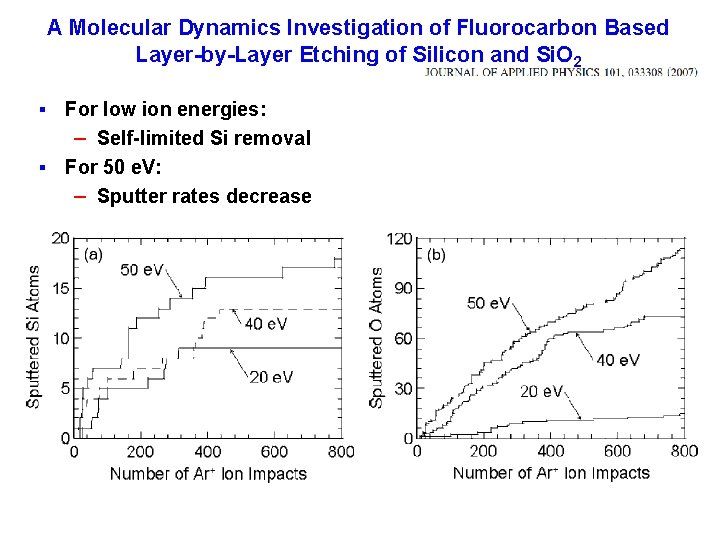
A Molecular Dynamics Investigation of Fluorocarbon Based Layer-by-Layer Etching of Silicon and Si. O 2 For low ion energies: – Self-limited Si removal § For 50 e. V: – Sputter rates decrease §
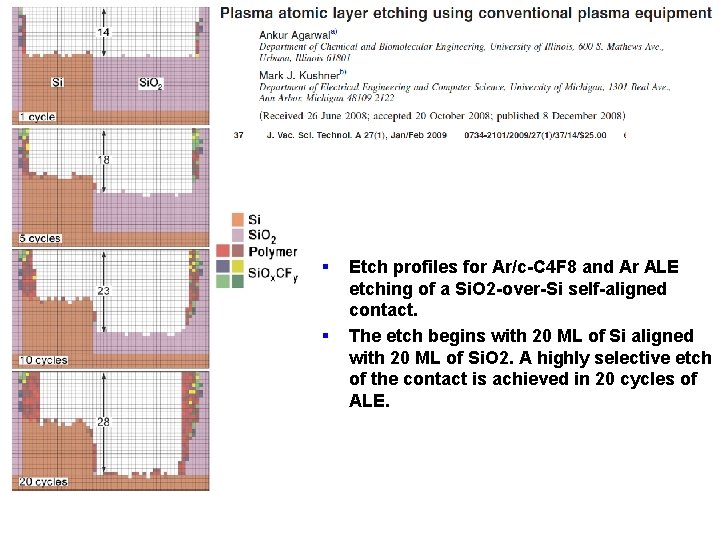
§ § Etch profiles for Ar/c-C 4 F 8 and Ar ALE etching of a Si. O 2 -over-Si self-aligned contact. The etch begins with 20 ML of Si aligned with 20 ML of Si. O 2. A highly selective etch of the contact is achieved in 20 cycles of ALE.
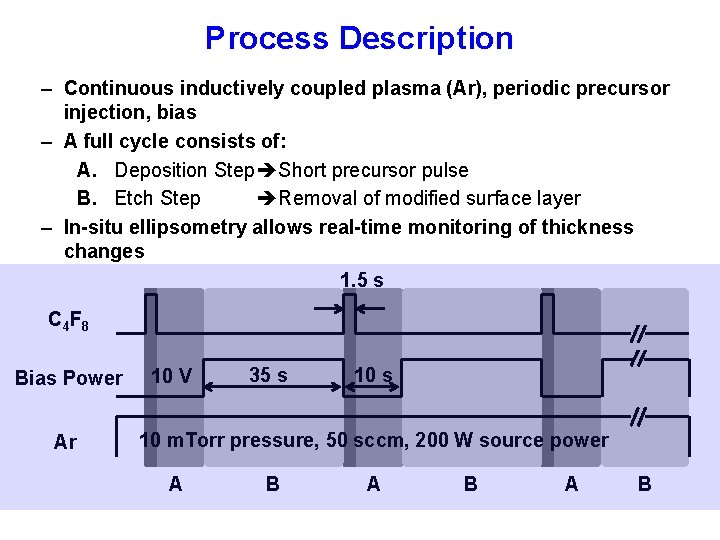
Process Description – Continuous inductively coupled plasma (Ar), periodic precursor injection, bias – A full cycle consists of: A. Deposition Step Short precursor pulse B. Etch Step Removal of modified surface layer – In-situ ellipsometry allows real-time monitoring of thickness changes 1. 5 s C 4 F 8 Bias Power Ar 10 V 35 s 10 m. Torr pressure, 50 sccm, 200 W source power A B A B
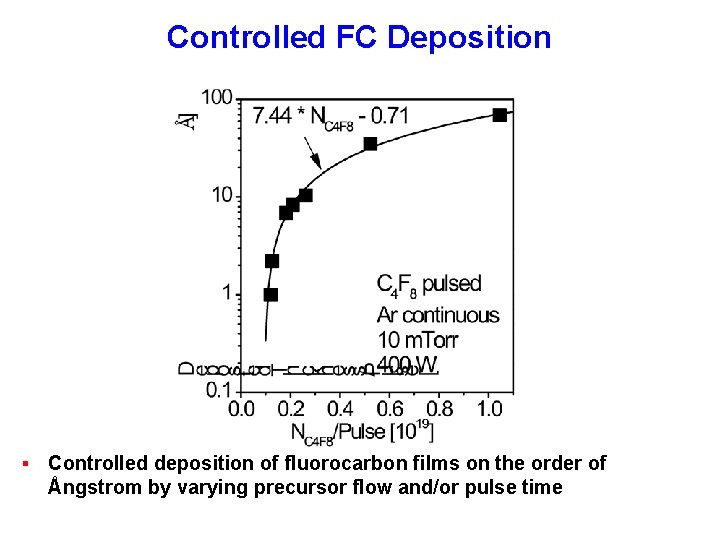
Controlled FC Deposition § Controlled deposition of fluorocarbon films on the order of Ångstrom by varying precursor flow and/or pulse time
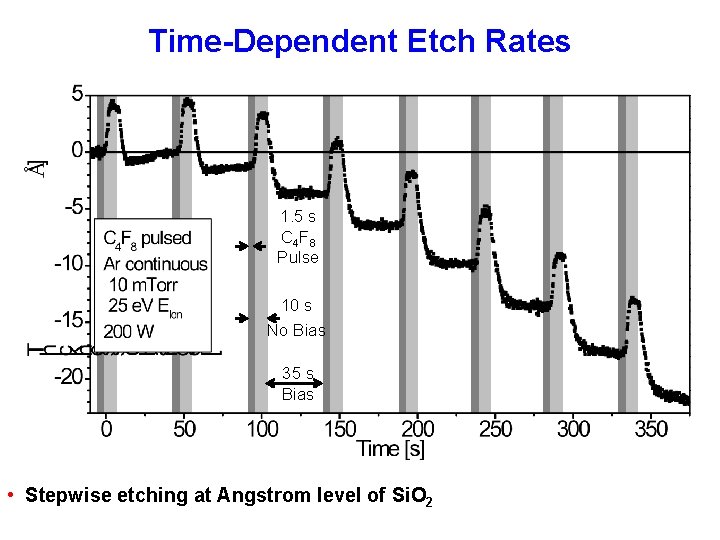
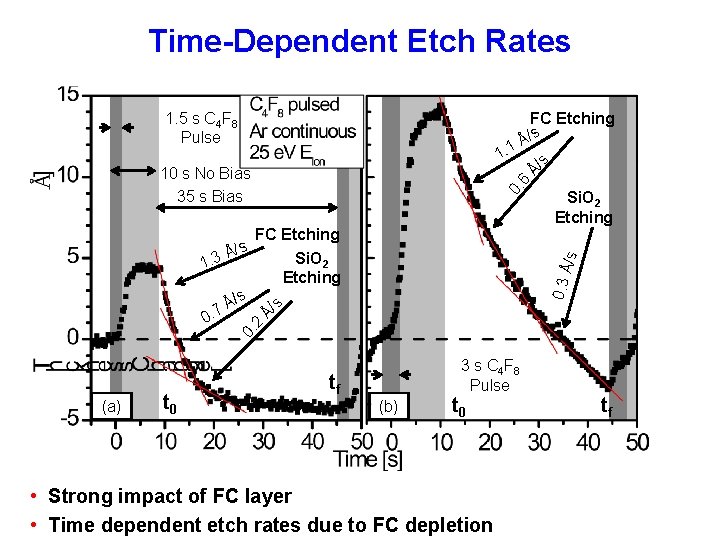
Time-Dependent Etch Rates 1. 5 s C 4 F 8 Pulse 10 s No Bias 35 s Bias • Stepwise etching at Angstrom level of Si. O 2
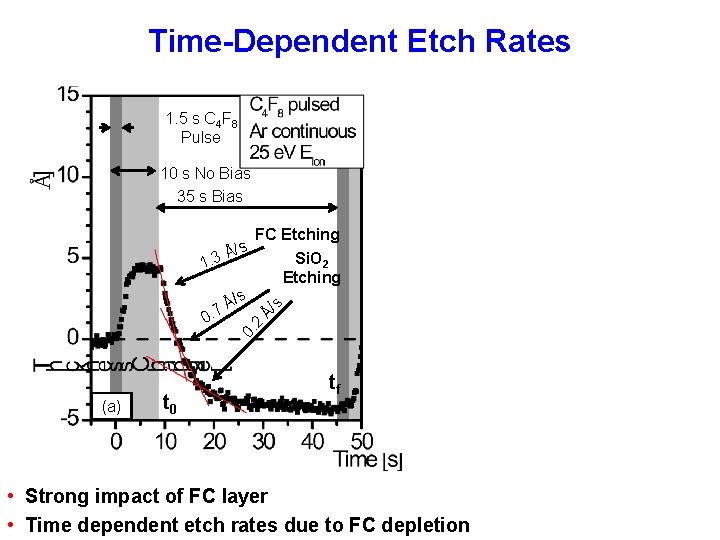
Time-Dependent Etch Rates FC Etching /s Å 1 1. 5 s C 4 F 8 Pulse 0. 6 Å/ 10 s No Bias 35 s Bias s 1. 0. 2 Å /s 0. 3 Å /s FC Etching Å/s Si. O 2 3. 1 Etching /s Å 0. 7 (a) t 0 Si. O 2 Etching 3 s C 4 F 8 Pulse tf (b) • Strong impact of FC layer • Time dependent etch rates due to FC depletion
Time-Dependent Etch Rates FC Etching /s Å 1 1. 5 s C 4 F 8 Pulse 0. 6 Å/ 10 s No Bias 35 s Bias s 1. 0. 2 Å /s 0. 3 Å /s FC Etching Å/s Si. O 2 3. 1 Etching /s Å 0. 7 Si. O 2 Etching (a) t 0 3 s C 4 F 8 Pulse tf (b) t 0 • Strong impact of FC layer • Time dependent etch rates due to FC depletion tf
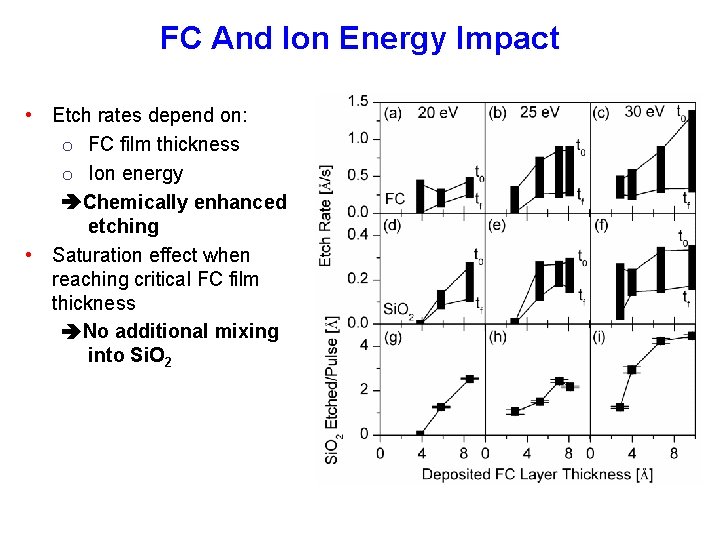
FC And Ion Energy Impact • Etch rates depend on: o FC film thickness o Ion energy Chemically enhanced etching • Saturation effect when reaching critical FC film thickness No additional mixing into Si. O 2
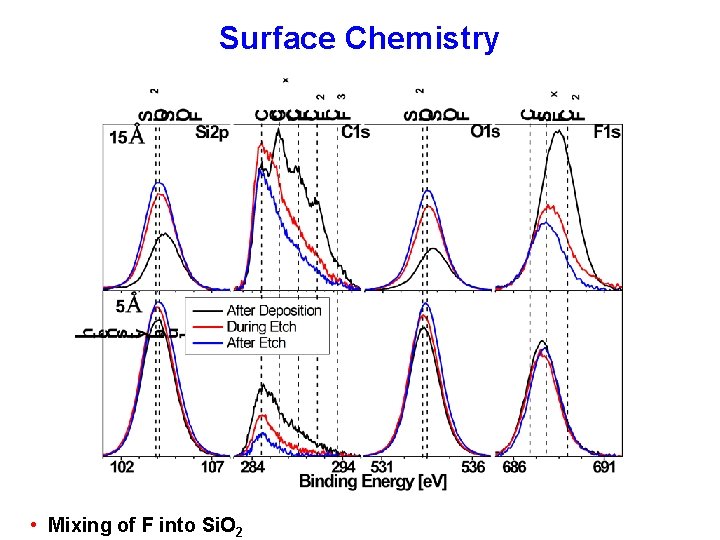
Surface Chemistry • Mixing of F into Si. O 2
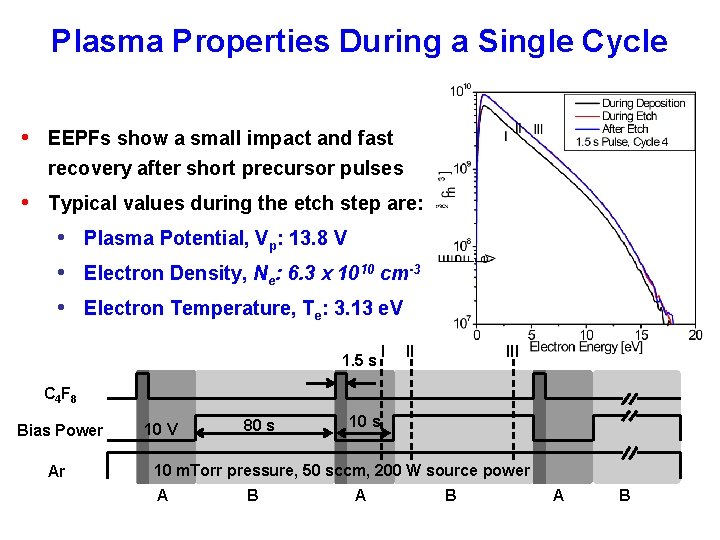
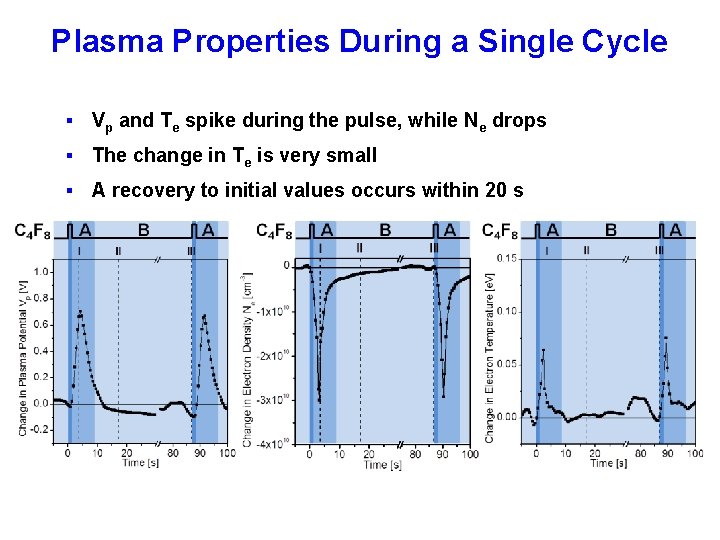
Plasma Properties During a Single Cycle • EEPFs show a small impact and fast recovery after short precursor pulses • Typical values during the etch step are: • Plasma Potential, Vp: 13. 8 V • Electron Density, Ne: 6. 3 x 1010 cm-3 • Electron Temperature, Te: 3. 13 e. V 1. 5 s I II III C 4 F 8 Bias Power Ar 10 V 80 s 10 m. Torr pressure, 50 sccm, 200 W source power A B A B
Plasma Properties During a Single Cycle § Vp and Te spike during the pulse, while Ne drops § The change in Te is very small § A recovery to initial values occurs within 20 s
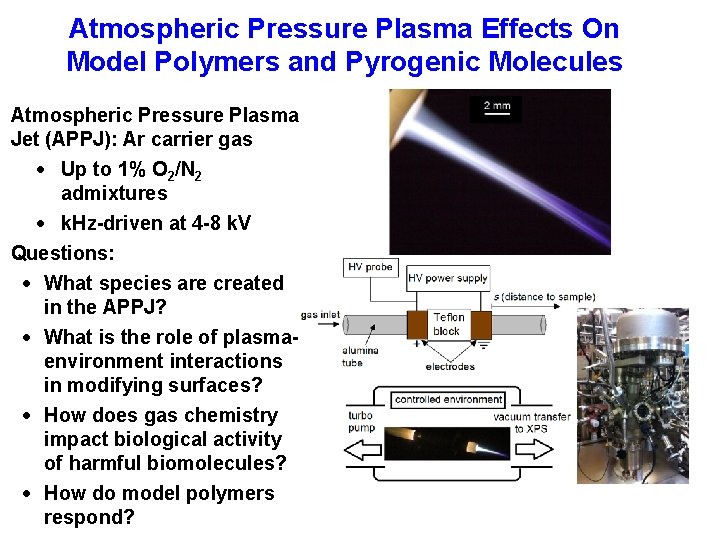
Atmospheric Pressure Plasma Effects On Model Polymers and Pyrogenic Molecules Atmospheric Pressure Plasma Jet (APPJ): Ar carrier gas Up to 1% O 2/N 2 admixtures k. Hz-driven at 4 -8 k. V Questions: What species are created in the APPJ? What is the role of plasmaenvironment interactions in modifying surfaces? How does gas chemistry impact biological activity of harmful biomolecules? How do model polymers respond?
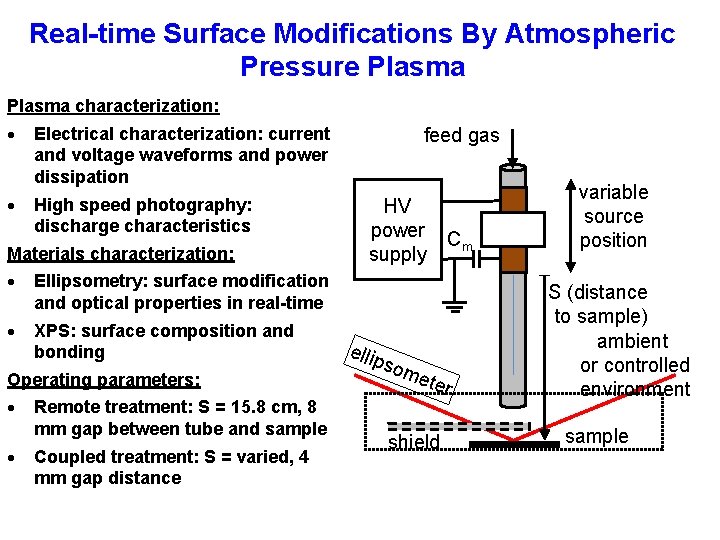
Real-time Surface Modifications By Atmospheric Pressure Plasma characterization: Electrical characterization: current and voltage waveforms and power dissipation High speed photography: discharge characteristics Materials characterization: Ellipsometry: surface modification and optical properties in real-time XPS: surface composition and bonding Operating parameters: Remote treatment: S = 15. 8 cm, 8 mm gap between tube and sample Coupled treatment: S = varied, 4 mm gap distance feed gas HV power C m supply ellip s om ete shield r variable source position S (distance to sample) ambient or controlled environment sample
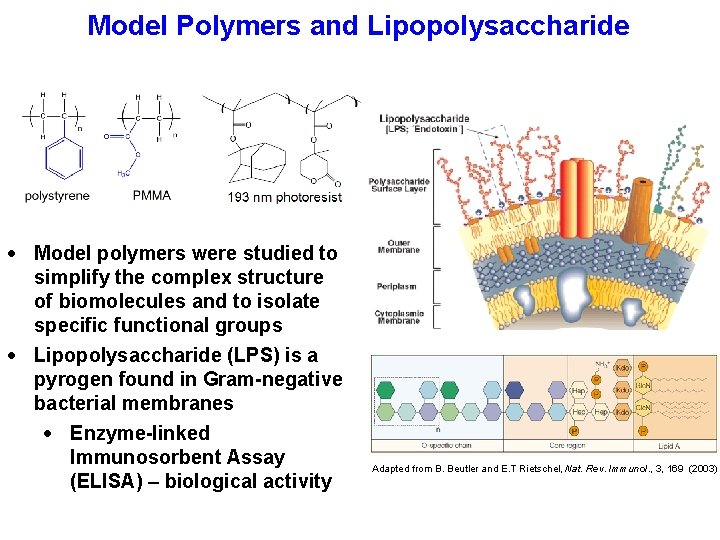
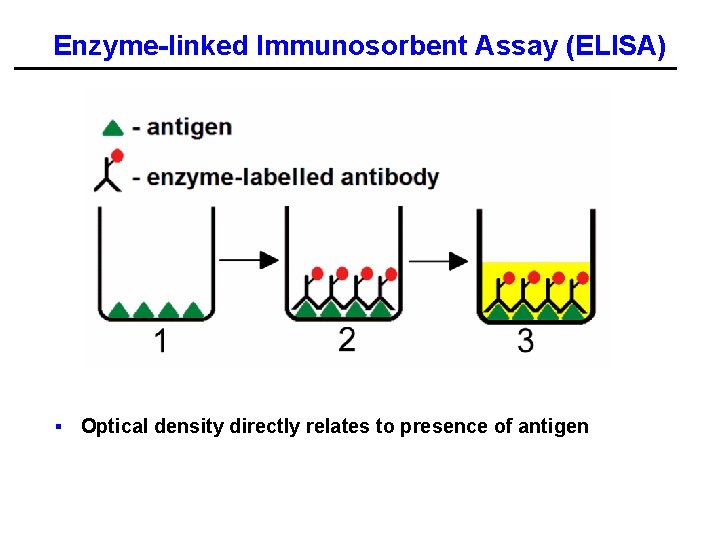
Model Polymers and Lipopolysaccharide Model polymers were studied to simplify the complex structure of biomolecules and to isolate specific functional groups Lipopolysaccharide (LPS) is a pyrogen found in Gram-negative bacterial membranes Enzyme-linked Immunosorbent Assay (ELISA) – biological activity Adapted from B. Beutler and E. T Rietschel, Nat. Rev. Immunol. , 3, 169 (2003)
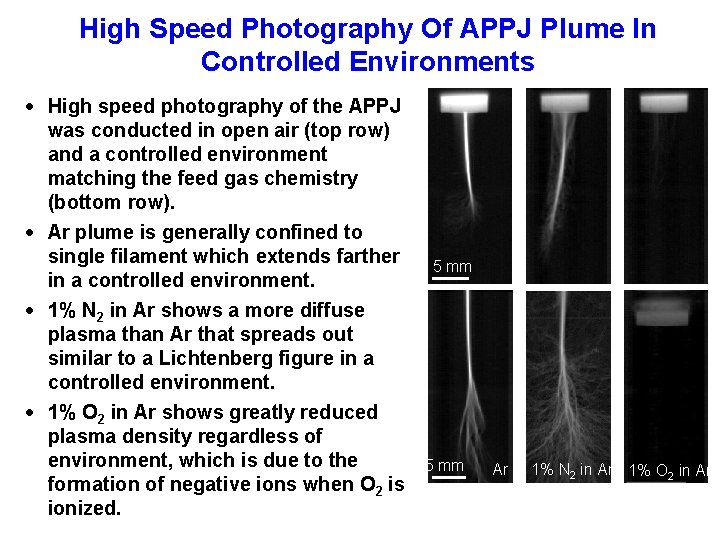
High Speed Photography Of APPJ Plume In Controlled Environments High speed photography of the APPJ was conducted in open air (top row) and a controlled environment matching the feed gas chemistry (bottom row). Ar plume is generally confined to single filament which extends farther in a controlled environment. 1% N 2 in Ar shows a more diffuse plasma than Ar that spreads out similar to a Lichtenberg figure in a controlled environment. 1% O 2 in Ar shows greatly reduced plasma density regardless of environment, which is due to the formation of negative ions when O 2 is ionized. 5 mm Ar 1% N 2 in Ar 1% O 2 in Ar
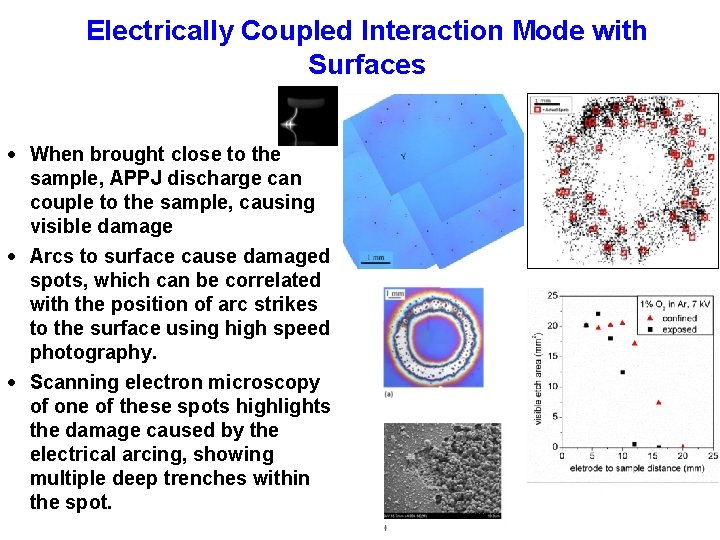
Electrically Coupled Interaction Mode with Surfaces When brought close to the sample, APPJ discharge can couple to the sample, causing visible damage Arcs to surface cause damaged spots, which can be correlated with the position of arc strikes to the surface using high speed photography. Scanning electron microscopy of one of these spots highlights the damage caused by the electrical arcing, showing multiple deep trenches within the spot.
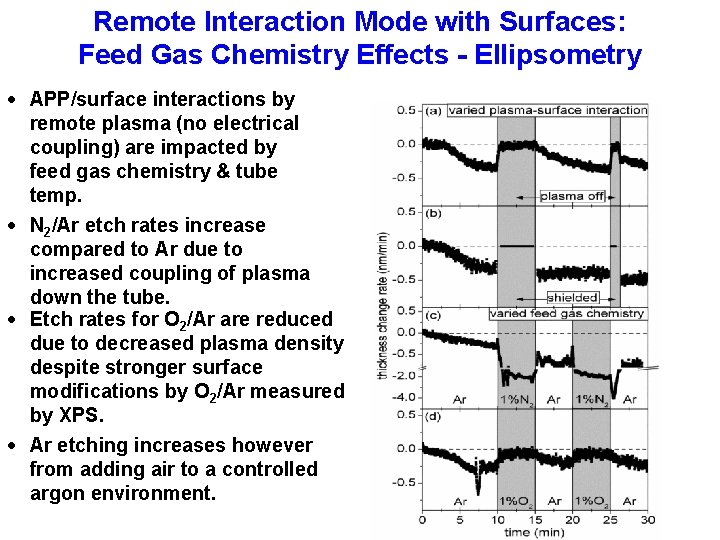
Remote Interaction Mode with Surfaces: Feed Gas Chemistry Effects - Ellipsometry APP/surface interactions by remote plasma (no electrical coupling) are impacted by feed gas chemistry & tube temp. N 2/Ar etch rates increase compared to Ar due to increased coupling of plasma down the tube. Etch rates for O 2/Ar are reduced due to decreased plasma density despite stronger surface modifications by O 2/Ar measured by XPS. Ar etching increases however from adding air to a controlled argon environment.
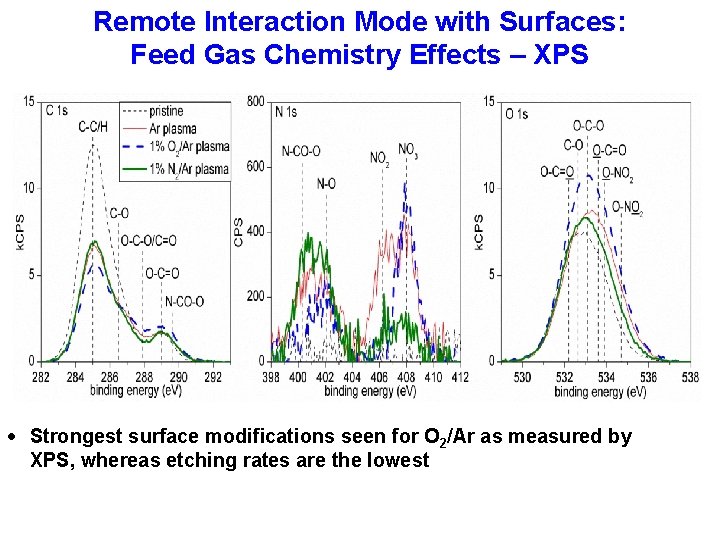
Remote Interaction Mode with Surfaces: Feed Gas Chemistry Effects – XPS Strongest surface modifications seen for O 2/Ar as measured by XPS, whereas etching rates are the lowest
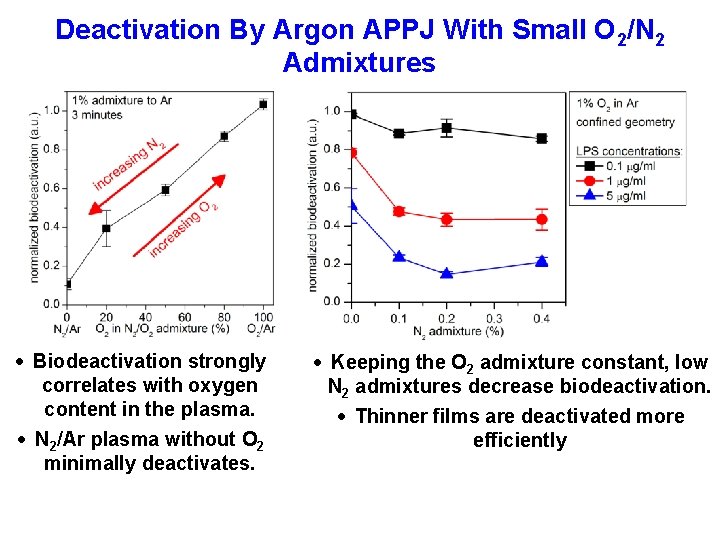
Deactivation By Argon APPJ With Small O 2/N 2 Admixtures Biodeactivation strongly correlates with oxygen content in the plasma. N 2/Ar plasma without O 2 minimally deactivates. Keeping the O 2 admixture constant, low N 2 admixtures decrease biodeactivation. Thinner films are deactivated more efficiently
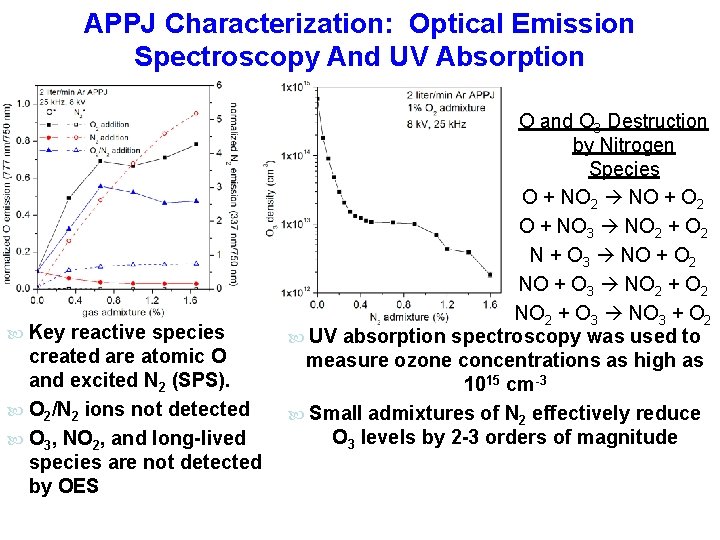
APPJ Characterization: Optical Emission Spectroscopy And UV Absorption Key reactive species created are atomic O and excited N 2 (SPS). O 2/N 2 ions not detected O 3, NO 2, and long-lived species are not detected by OES O and O 3 Destruction by Nitrogen Species O + NO 2 NO + O 2 O + NO 3 NO 2 + O 2 N + O 3 NO + O 2 NO + O 3 NO 2 + O 2 NO 2 + O 3 NO 3 + O 2 UV absorption spectroscopy was used to measure ozone concentrations as high as 1015 cm-3 Small admixtures of N 2 effectively reduce O 3 levels by 2 -3 orders of magnitude
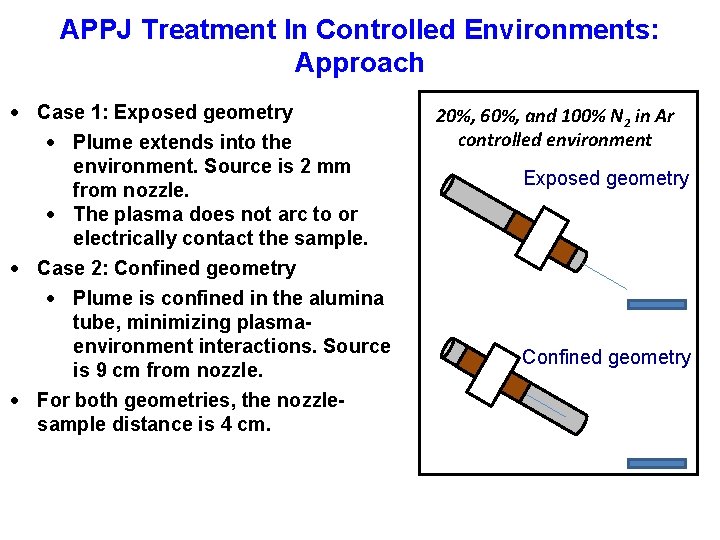
APPJ Treatment In Controlled Environments: Approach Case 1: Exposed geometry Plume extends into the environment. Source is 2 mm from nozzle. The plasma does not arc to or electrically contact the sample. Case 2: Confined geometry Plume is confined in the alumina tube, minimizing plasmaenvironment interactions. Source is 9 cm from nozzle. For both geometries, the nozzlesample distance is 4 cm. 20%, 60%, and 100% N 2 in Ar controlled environment Exposed geometry Confined geometry
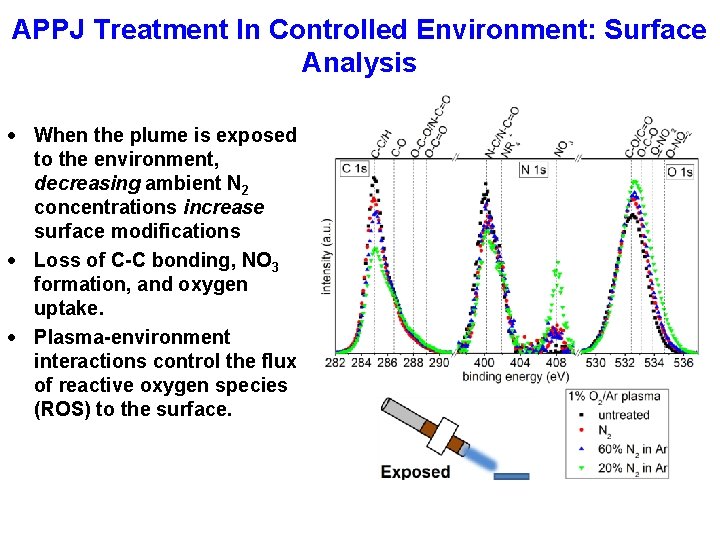
APPJ Treatment In Controlled Environment: Surface Analysis When the plume is exposed to the environment, decreasing ambient N 2 concentrations increase surface modifications Loss of C-C bonding, NO 3 formation, and oxygen uptake. Plasma-environment interactions control the flux of reactive oxygen species (ROS) to the surface.
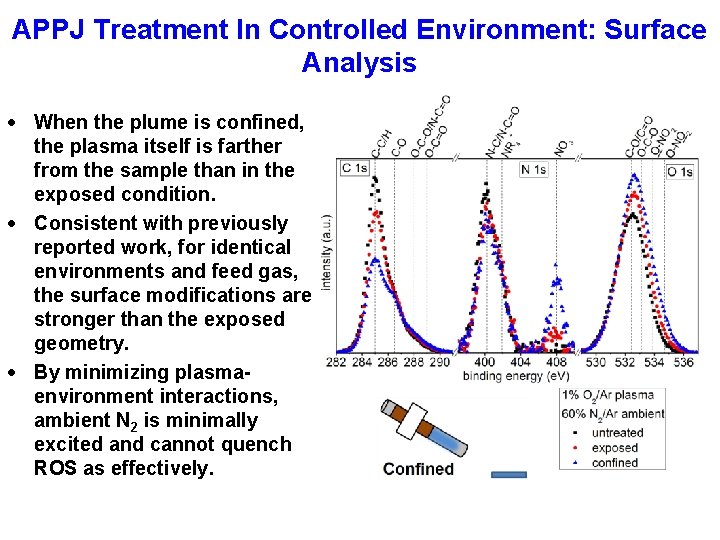
APPJ Treatment In Controlled Environment: Surface Analysis When the plume is confined, the plasma itself is farther from the sample than in the exposed condition. Consistent with previously reported work, for identical environments and feed gas, the surface modifications are stronger than the exposed geometry. By minimizing plasmaenvironment interactions, ambient N 2 is minimally excited and cannot quench ROS as effectively.
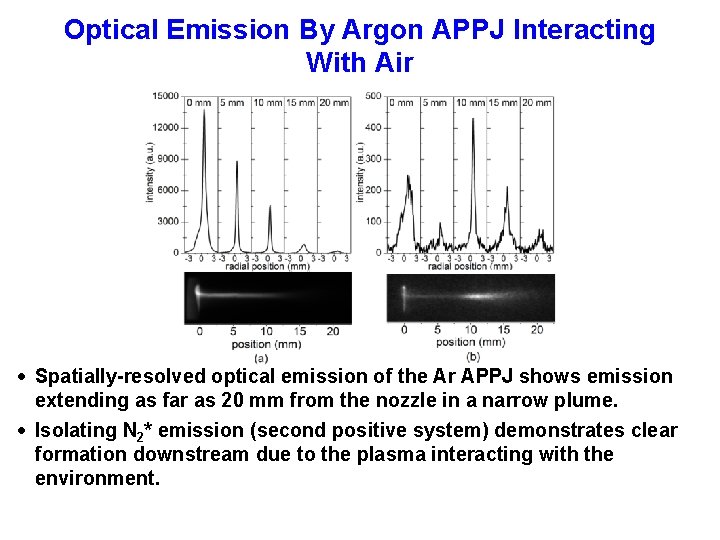
Optical Emission By Argon APPJ Interacting With Air Spatially-resolved optical emission of the Ar APPJ shows emission extending as far as 20 mm from the nozzle in a narrow plume. Isolating N 2* emission (second positive system) demonstrates clear formation downstream due to the plasma interacting with the environment.
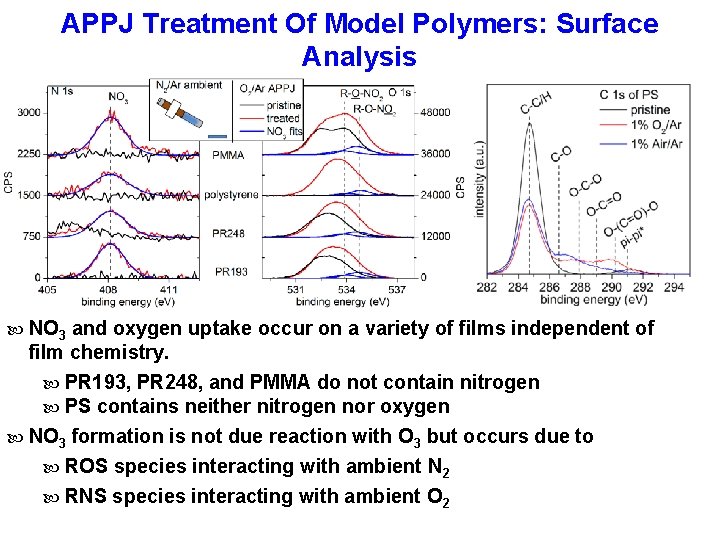
APPJ Treatment Of Model Polymers: Surface Analysis NO 3 and oxygen uptake occur on a variety of films independent of film chemistry. PR 193, PR 248, and PMMA do not contain nitrogen PS contains neither nitrogen nor oxygen NO 3 formation is not due reaction with O 3 but occurs due to ROS species interacting with ambient N 2 RNS species interacting with ambient O 2
Conclusions • Low pressure: • Understanding/controlling inherent synergies in plasma-surface interactions leads to unexpected phenomena, including novel paths of forming new 2 -D materials • Designed pulsed plasma process sequences can enable atomic level etching/surface modifications of materials, e. g. Si. O 2 • Atmospheric pressure: • Plasma plume interactions with the environment can play a key role in plasma-surface interactions at atmospheric pressure and their control is a prerequisite for management of surface chemical modifications of materials
Enzyme-linked Immunosorbent Assay (ELISA) § Optical density directly relates to presence of antigen
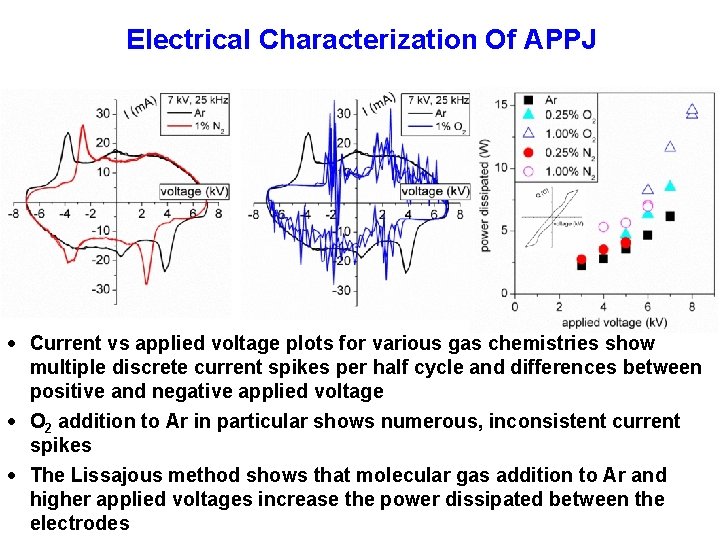
Electrical Characterization Of APPJ Current vs applied voltage plots for various gas chemistries show multiple discrete current spikes per half cycle and differences between positive and negative applied voltage O 2 addition to Ar in particular shows numerous, inconsistent current spikes The Lissajous method shows that molecular gas addition to Ar and higher applied voltages increase the power dissipated between the electrodes