
Lower limb muscle strength balance mobility and function
Lower limb muscle strength, balance, mobility and function in older women with urge and mixed urinary incontinence: an observational pilot study Mélanie Le Berre, 1, 2 Mélanie Morin, 3, 4 Hélène Corriveau, 3, 4 Mathieu Hamel, 3, 4 Sylvie Nadeau, 1, 5 Johanne Filiatrault, 1, 2 Chantale Dumoulin 1, 2 1 Institut Universitaire de Gériatrie de Montréal, Université de Montréal, Montreal, Canada of Rehabilitation, Université de Montréal, Montreal, Canada Centre on Aging, Université de Sherbrooke, Canada 4 School of Rehabilitation, Université de Sherbrooke, Canada 5 Pathokinesiology Laboratory, Centre for Interdisciplinary Research in Rehabilitation of Greater Montreal, Canada 2 School 3 Research
Background • After the age of 65, up to 1/2 women may experience symptoms of urinary incontinence (UI). 1 • A positive correlation between falls and urgency UI (UUI) or mixed UI (MUI) has been identified. 2, 3 Deficits in physical function and motor skills were mentioned as a possible explanation. 3, 4 • This hypothesis could be of particular relevance for physiotherapy. 2 However, lower-extremity impairments in older women with UUI/MUI have not been thoroughly investigated. Objectives 1) Compare the specific characteristics of lower limb muscle strength, balance, mobility and function in older women with and without UUI or MUI; 2) Explore the association between the severity of the UI symptoms and these characteristics. 1. Milsom et al, 2013; 2. Chiarelli et al, 2019; 3. Foley et al, 2012; 4. Fritel et al, 2013
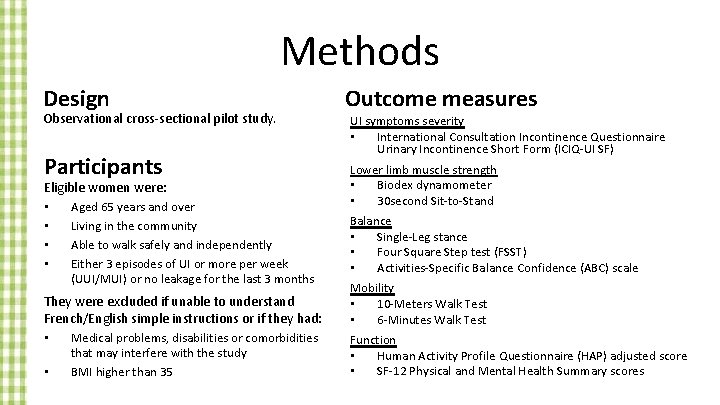
Methods Design Observational cross-sectional pilot study. Participants Eligible women were: • Aged 65 years and over • Living in the community • Able to walk safely and independently • Either 3 episodes of UI or more per week (UUI/MUI) or no leakage for the last 3 months They were excluded if unable to understand French/English simple instructions or if they had: • Medical problems, disabilities or comorbidities • that may interfere with the study BMI higher than 35 Outcome measures UI symptoms severity • International Consultation Incontinence Questionnaire Urinary Incontinence Short Form (ICIQ-UI SF) Lower limb muscle strength • Biodex dynamometer • 30 second Sit-to-Stand Balance • Single-Leg stance • Four Square Step test (FSST) • Activities-Specific Balance Confidence (ABC) scale Mobility • 10 -Meters Walk Test • 6 -Minutes Walk Test Function • Human Activity Profile Questionnaire (HAP) adjusted score • SF-12 Physical and Mental Health Summary scores

Results Lower limb muscle strength 30° F l e x E x t Balance With urge/mixed UI No UI Statistical tests 3. 93 (0. 8529. 10) 23. 99 (2. 6560. 00) p < 0. 001 17. 97 (1. 9060. 00) p < 0. 005 median (min-max) 5. 74 (1. 1260. 00) Four Square Step Test (score) 8. 52 (1. 96) 7. 86 (1. 54) p = 0. 22 76. 03 (19. 05) 88. 48 (9. 26) p = 0. 01 60° Single-leg stance dominant side (sec) median (min-max) Single-leg stance - nondominant side (sec) mean (sd) Activities-Specific Balance Confidence scale mean (sd)

Results Mobility Function 10 -Meters Walk Test (m/sec) median (min-max) 6 -Minutes Walk Test (metres) mean (sd) With urge/mixed UI No UI 1. 61 (1. 062. 11) 1. 81 (1. 163. 22) 449. 06 (58. 29) 463. 84 (46. 36) Statistical tests p = 0. 01 Human Activity Profile Questionnaire (adjusted score) With urge/mixed UI No UI Statistical tests 67 (43 -81) 74 (3 -82) p = 0. 34 48. 5 (29. 059. 0) 57. 0 (44. 061. 0) p = 0. 01 median (min-max) p = 0. 46 SF-12 Physical Health Summary (score) median (min-max) Conclusion • • The results from this pilot study suggest balance and mobility impairments in high-functioning older women with UUI/MUI. More studies are needed to confirm these results.
- Slides: 5