
Lower Limb disorders By Dr Mohammad Hamdan Hip
Lower Limb disorders By : Dr. Mohammad Hamdan
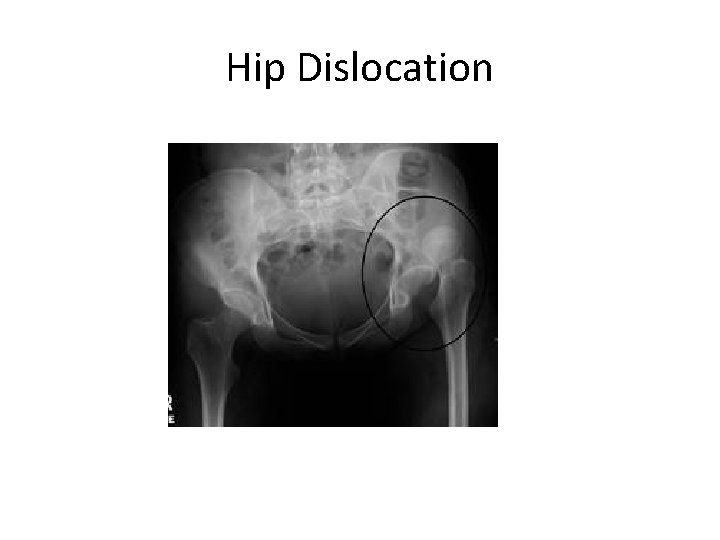
Hip Dislocation
Introduction • Requires significant trauma. • Posterior dislocation (90%) more common than anterior dislocation (10%) • Mechanism of posterior dislocation • posteriorly directed force on internally rotated, flexed, adducted hip (dashboard injury) • Orthopedic emergency • needs reduction ASAP
Presentation • lower extemity immobility. • hip deformity and pain. • groin pain • pain referred to knee (especially in children) • Physical exam (posterior dislocation) • shortened limb • limb held in slight flexion, adduction and internal rotation • neurovascular status • exclude sciatic nerve palsy • usually neuropraxia • footdrop (weak ankle dorsiflexion) and sensory loss
Evaluation • X-rays • CT to look for • associated fractures (femoral head and acetabulum) • loose bodies in the joint

Treatment • Reduction • closed reduction (under sedation) within 6 hours • if unsuccessful, open reduction is necessary • Light traction or abduction pillow bracing for five days is recommended. • No weight bearing for 3 weeks followed by 34 weeks of light weight bearing. • Follow up imaging studies required from 6 mos to 2 years.
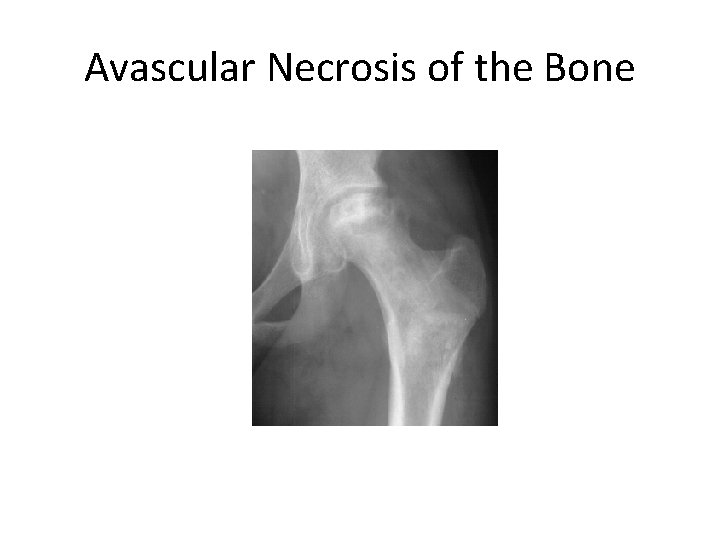
Avascular Necrosis of the Bone
Introduction • Infarction of bone due to a disruption in blood supply • aseptic • Result of • • • corticosteroid use alcohol use idiopathic sickle cell anemia Gaucher's disease • Most commonly involves • • • femoral head humeral head scaphoid digits talus
Presentation • Symptoms • non-specific • bone pain • limitation of movement
Evaluation • Imaging. MR • most sensitive test • Xray • insensitive in early phases • may show collapsed bone in late phases • Bone scan • no uptake in early stages • increased uptake in later stages
Treatment • Pharmacologic • Bisphonates • Surgical
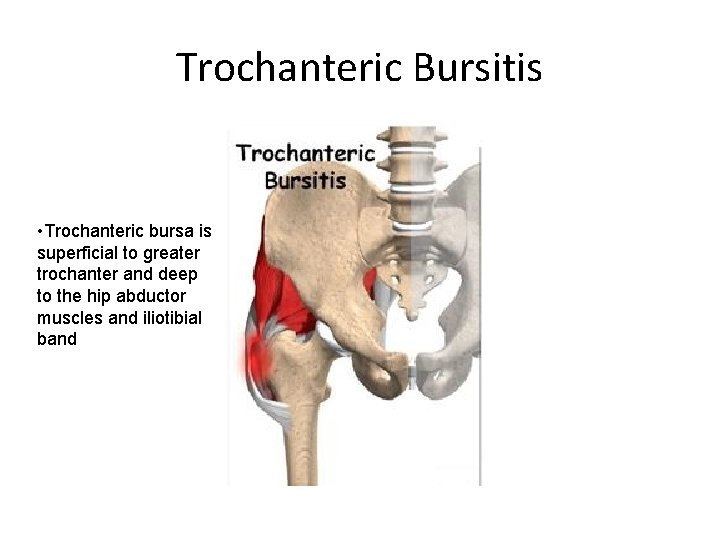
Trochanteric Bursitis • Trochanteric bursa is superficial to greater trochanter and deep to the hip abductor muscles and iliotibial band

Introduction • Pain over the lateral aspect of the greater trochanter • Associated with • female runners • running on banked surfaces • Mechanism • repetitive trauma caused by iliotibial band tracking over trochanteric bursa • irritates the bursa, causing inflammation
Presentation • Symptoms • lateral sided hip pain • true hip disease has referred pain to the groin • Physical exam • tenderness to palpation over greater trochante
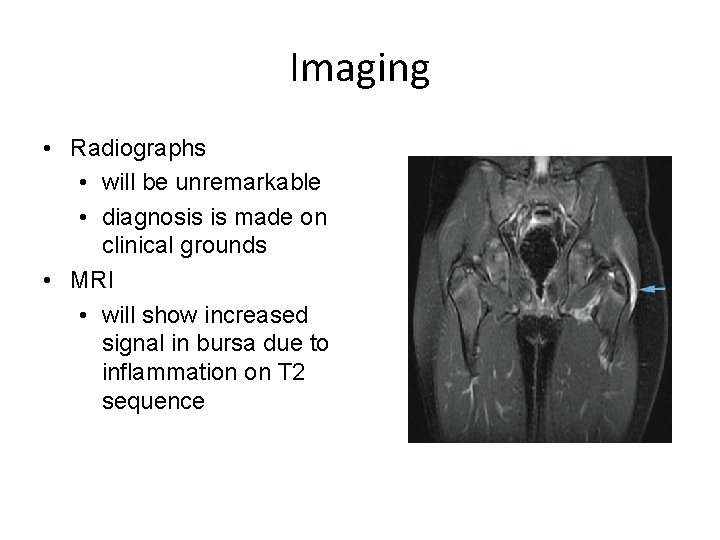
Imaging • Radiographs • will be unremarkable • diagnosis is made on clinical grounds • MRI • will show increased signal in bursa due to inflammation on T 2 sequence
Treatment • NSAIDS, stretching, PT, corticosteroid injections
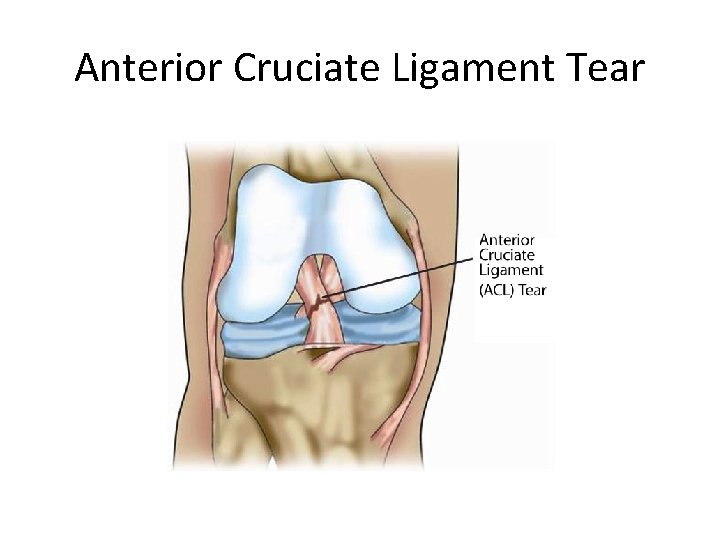
Anterior Cruciate Ligament Tear
Introduction • Most common knee ligament injury • Possible mechanisms • noncontact twisting - planted foot with force applied to front or back of knee • forced hyperextension • impact to extended knee • Often presents as a component of the Terrible Triad injury: • meniscus tear • original triad was defined with a medial meniscus tear • later research discovered that a lateral meniscus tear is more common • ACL tear • MCL tear •
Presentation • • "pop" in knee followed by immediate swelling knee buckling or locking knee pain and swelling. knee instability and "giving way" • Physical exam • anterior tibial translation. • positive Lachman test • performed with knee at 30 degrees of flexion • positive anterior drawer test • performed with knee at 90 degrees of flexion • Lachman test is a better test based on sensitivity and specificity
Evaluation • Conventional radiographs are not usually useful in evaluating this injury • MRI more commonly used for evaluation • confirm injury and determine the extent of injury • can be used to exclude other injuries (meniscus, MCL)
Treatment • Conservative treatment • indicated for older patients, nonathletes, minor injury • rest, ice, NSAIDS • Arthroscopic ligament reconstruction • for young patients, athletes, severe injury
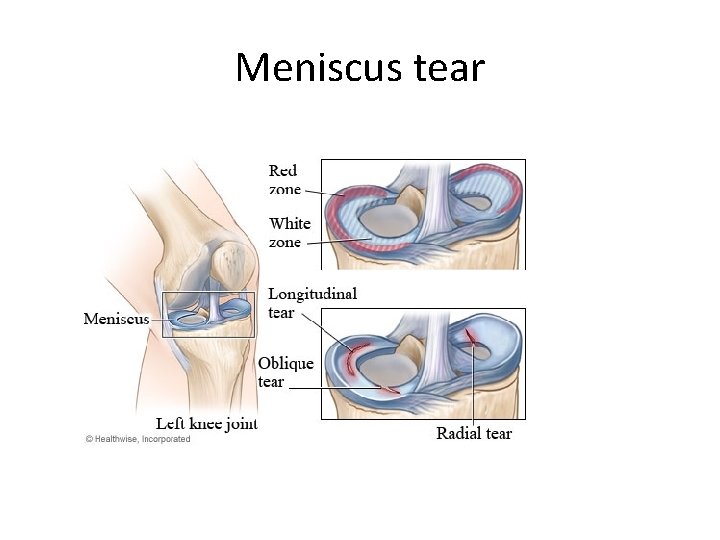
Meniscus tear
Introduction • Mechanism • acute or chronic trauma • degenerative injury with age • usually medial meniscus • young patients present with vertical longitudinal tears • older patients present with horizontal tears
Presentation • Symptoms • intermittent pain, worse on walking uphill or up stairs • delayed or intermittent knee swelling • locking or clicking while walking • sensation of joint giving way • Physical exam • joint line tenderness • knee effusion • positive Mc. Murray test
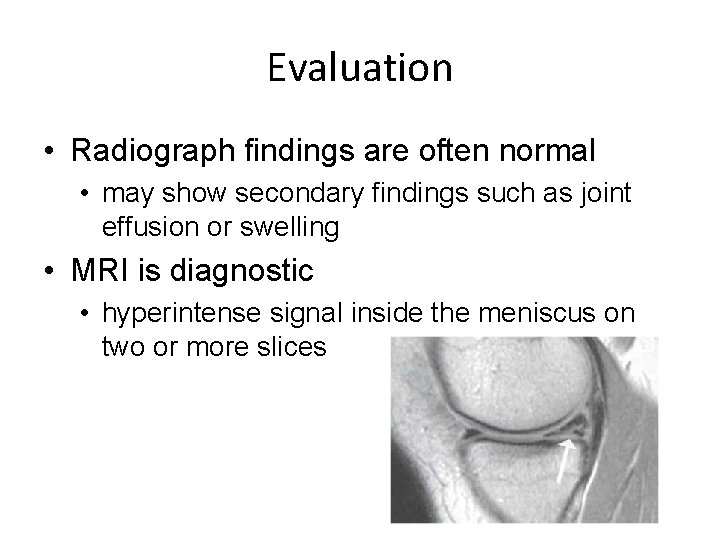
Evaluation • Radiograph findings are often normal • may show secondary findings such as joint effusion or swelling • MRI is diagnostic • hyperintense signal inside the meniscus on two or more slices
Treatment • Conservative treatment • rest, ice, NSAIDS • Arthroscopic surgery • partial meniscectomy or meniscal repair
Achilles Tendonitis
Insertional Achilles tendonitis • Occur in middle ages and elderly patients with a tight heel cord • mechanism is repetitive trauma (leads to inflammation followed by cartilagenous then bony metaplasia) • Treatment • nonoperative • rest • gastroc-soleus stretching • night splints • operative
Achilles tendonitis • Consist of two different conditions • achilles tendinosis • pathoanatomy of tendon along without acute or chronic inflammatory cells • thought to be caused by anaerobic degeneration in portion of tendon with poor blood supply • achilles peritendonits • involves inflammation of tendon sheath
• Presentation • physical exam • tendon thickening and tenderness • Imaging • MRI can distinguish between peritondonitis and tendonosis based on involvement of the sheath • Treatment • rest • physical therapy • emphasize eccentric training in later phases
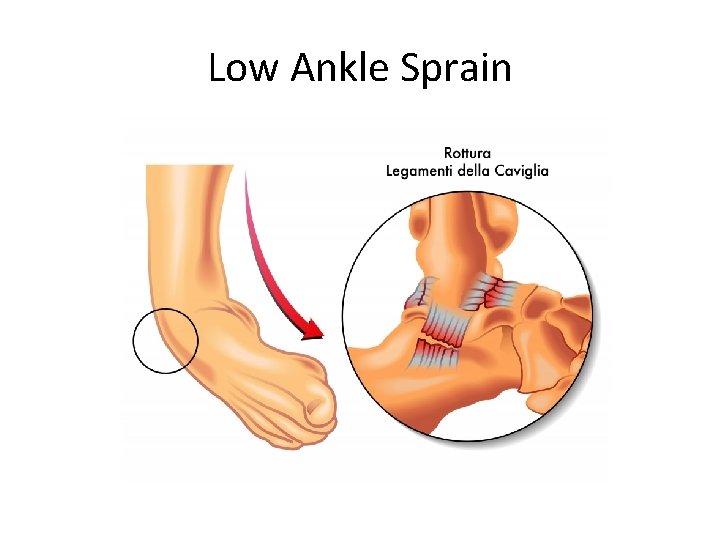
Low Ankle Sprain

Introduction • Low ankle sprains are injuries to the anterior talofibular ligament (ATFL). • more severe ankle sprains also involve the calcaneofibular ligament (CFL). • Mechanism • ATFL injuries occur with ankle plantar flexion and inversion (90% of sprains) • CFL injuries occur with ankle dorsiflexion and inversion (10% of sprains) • medial sprains are rare because medial deltoid ligament is stronger
Presentation • Symptoms • pain with weight bearing • recurrent instability • catching or popping sensation may occur following recurrent sprains • Physical exam • focal tenderness and swelling over involved ligament(s) • anterior drawer test
Imaging • Radiographs • radiographic views • standard ankle series of weight bearing AP, lateral and mortise • MRI • indicated if pain persists for 8 weeks following sprain
Treatment • RICE (rest, ice, compression with ACE bandage wrap, elevation above level of heart) followed by therapy • indications • first line of treatment • technique • severe sprains may benefit from casting • therapy (after pain and swelling have subsided) • neuromuscular training with a focus on peroneal muscle strengthening and propioception • Surgery • indications • for continued pain and instability despite nonoperative management
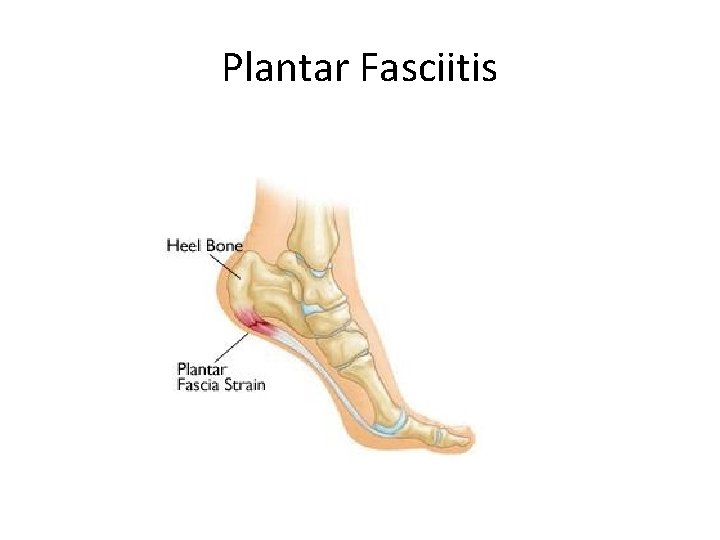
Plantar Fasciitis
Introduction • Inflamation at origin of plantar fascia on the medial calcaneal tuberosity. • Anatomy • made up of medial, central and lateral bands • central band is most likely involved • Epidemiology • common in runners • 40 -60 year old women
Presentation • Symptoms • sharp heel pain • first getting out of bed • at the end of the day after prolonged standing • relieved by ambulation, warming up • Examination • tender to palpation at medial tuberosity of calcaneus • tight Achilles tendon (limited ankle dorsiflexion)
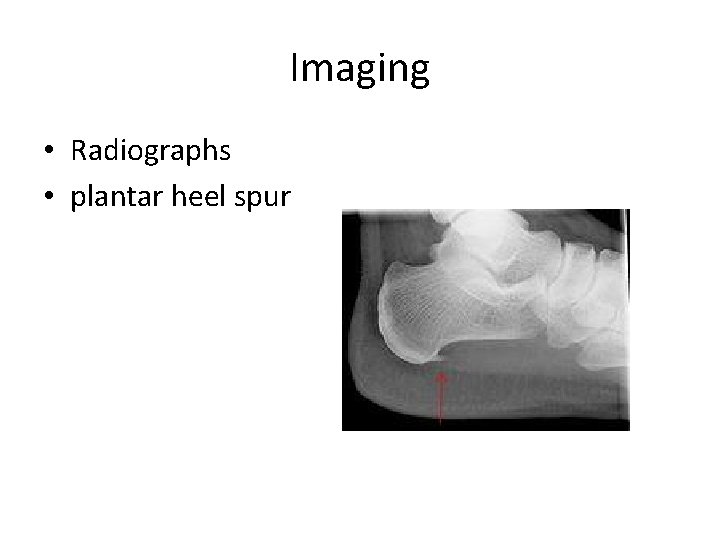
Imaging • Radiographs • plantar heel spur
Treatment • First line (majority of cases) • night splinting • heel cord stretching • Second line • shock wave treatment • Third line • surgical release with plantar fasciotomy • can be done open or arthroscopically • complications common and recovery can be protracted

Thank you
- Slides: 41