
Lower Extremity Venous Anatomy SON 1311 CrossSectional Anatomy

- Slides: 61
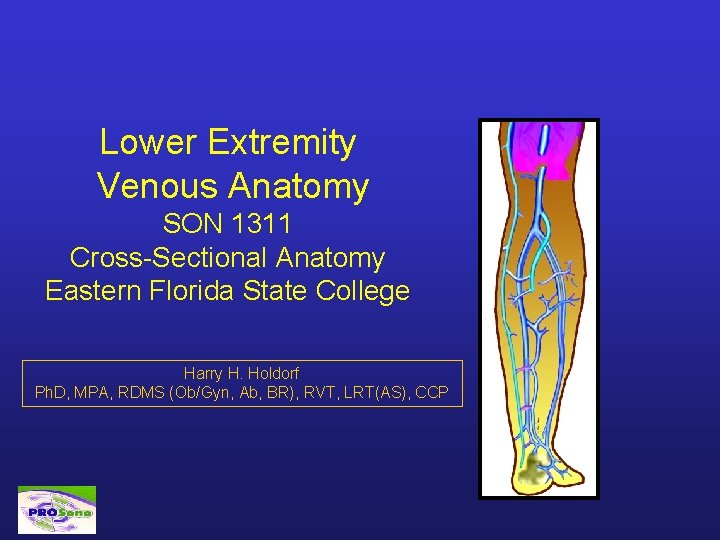
Lower Extremity Venous Anatomy SON 1311 Cross-Sectional Anatomy Eastern Florida State College Harry H. Holdorf Ph. D, MPA, RDMS (Ob/Gyn, Ab, BR), RVT, LRT(AS), CCP
Cross-Sectional Anatomy • Venous Legs – LE Venous system Q: Why are we covering the LE venous system so early in our education? A: The LE venous system is more often than not, a straight line. If the beginning sonographer can master the LE venous system, all the other studies may be easier to grasp.
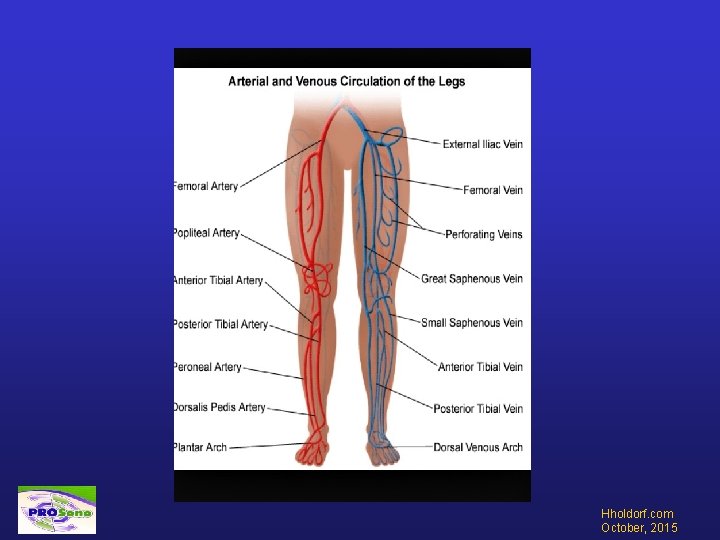
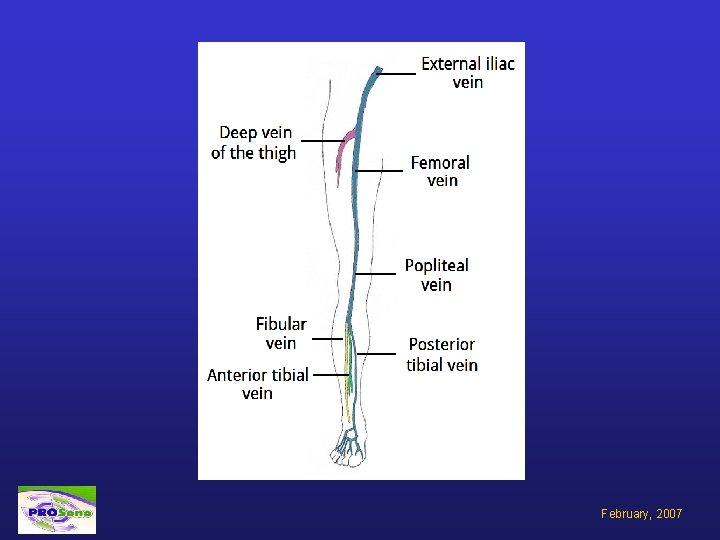
Venous Gross Anatomy • Lower Extremity Veins – Note: The anatomical relationship of the veins to the heart is the same as for the arteries. Veins located at the ankle are considered distal: while veins located closer to the heart (e. g. , Femoral) are considered more proximal – Note: Be sure to know the orientation of vessels from medial to lateral and from lateral to medial
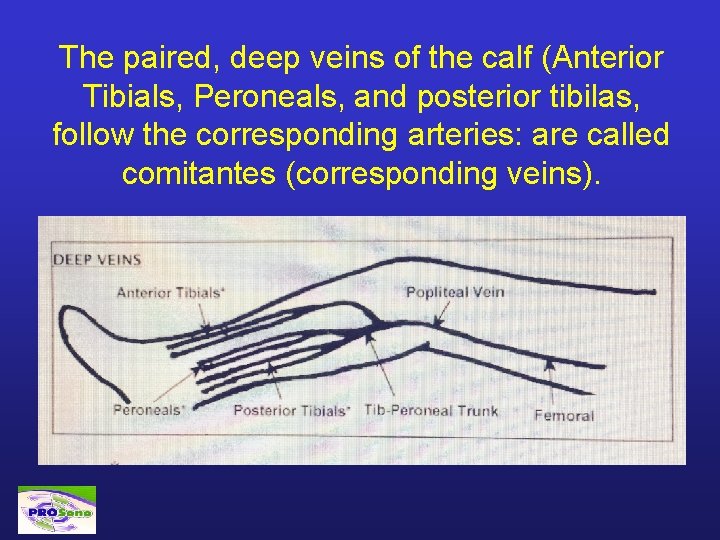
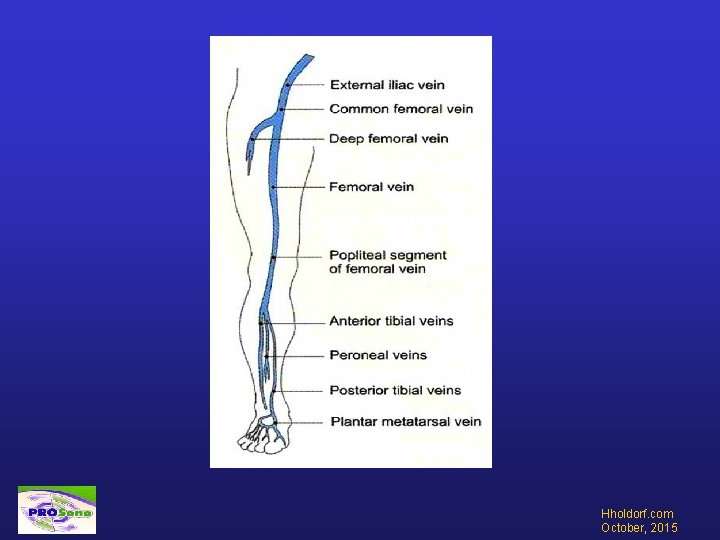
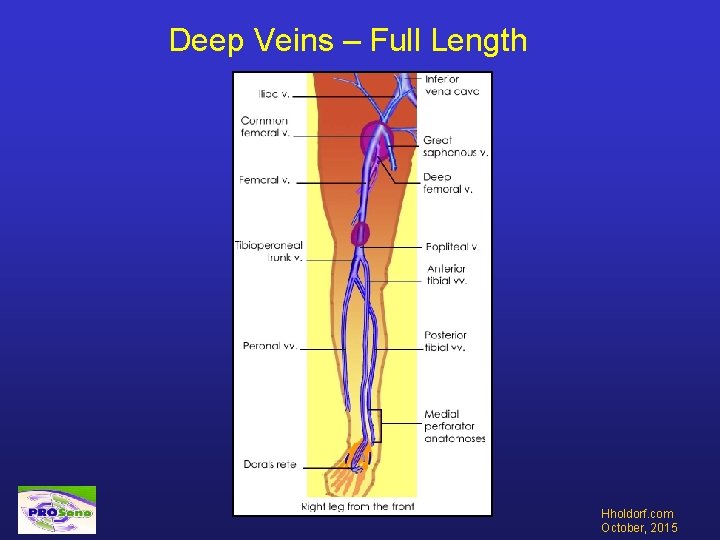
The paired, deep veins of the calf (Anterior Tibials, Peroneals, and posterior tibilas, follow the corresponding arteries: are called comitantes (corresponding veins).
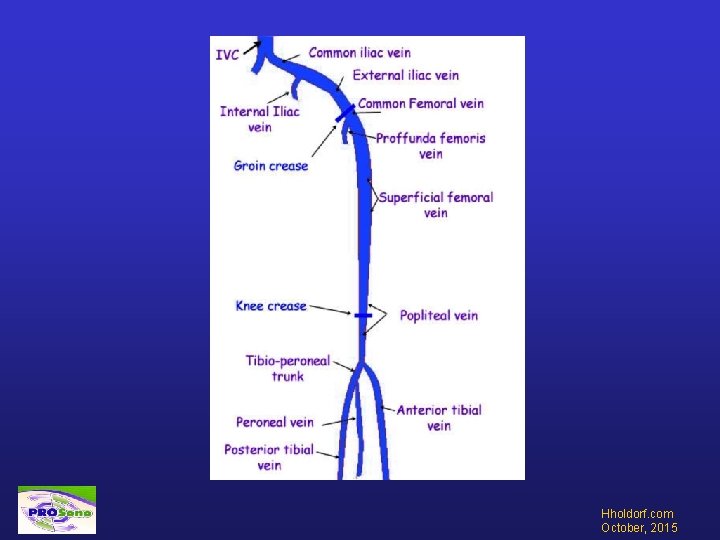
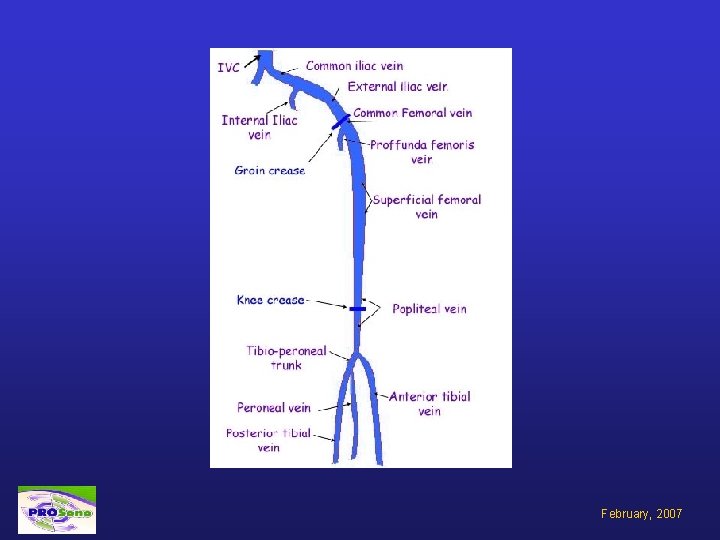
• Paired peroneal veins (Per. V) – Formed by confluence of venules – Empties the lateral leg – Paired veins may form common trunk and carry blood cephalad into tibial-peroneal trunk • Paired posterior tibial veins (PTV) – Formed by confluence of venules – Empties back of leg – Paired veins may form common trunk and carry blood cephalad into tibial-peroneal trunk
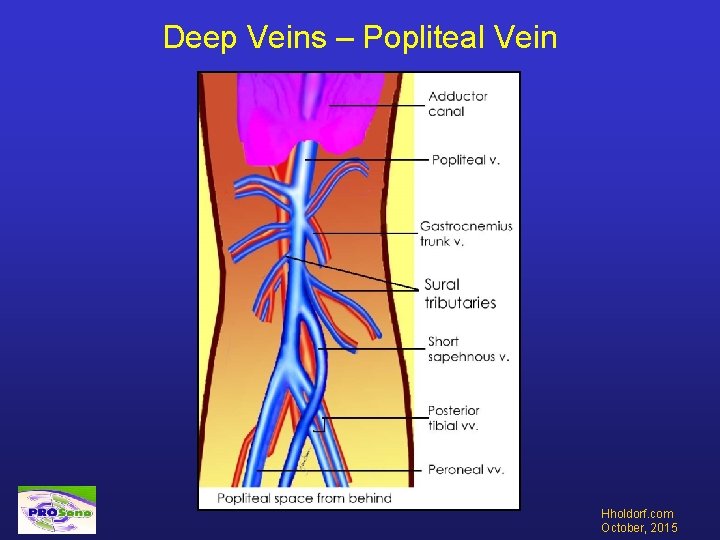
• Paired anterior tibial veins (ATV) – Formed by confluence of venules – Empties front of leg • Popliteal vein (Pop. V) – Formed by union of ATV and Tib-Peroneal Trunk – Usually just below the knee – Becomes femoral vein (previously called superficial femoral vein) when passes through adductor hiatus in lower thigh
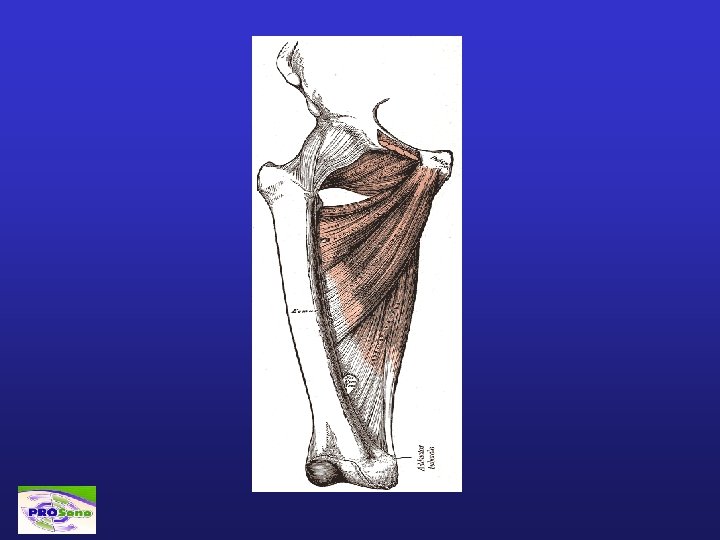
Adductor hiatus The adductor hiatus is a hiatus (gap) between the adductor magnus muscle and the femur that allows the passage of the femoral vessels from the anterior thigh to the posterior thigh and then the popliteal fossa.
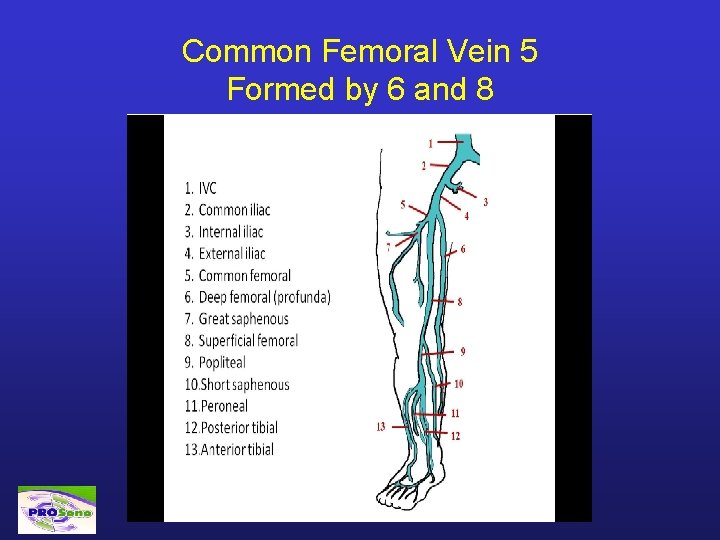
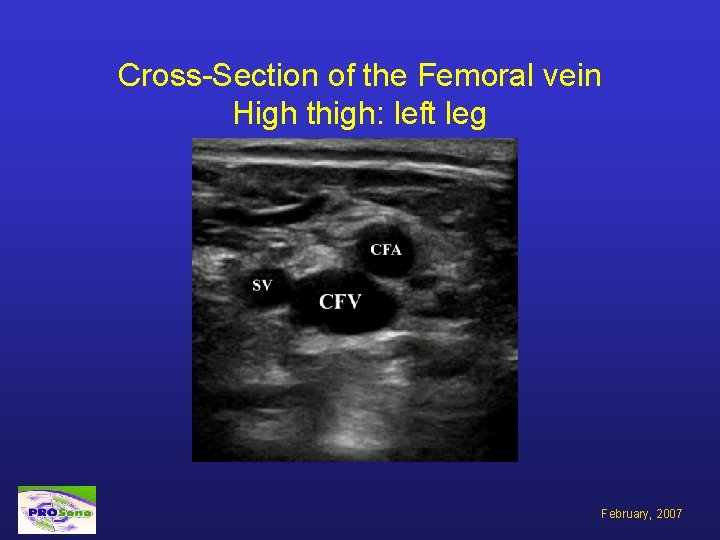
• Femoral Vein (FV) – Popliteal vein becomes FV when vein passed through adductor hiatus • Common Femoral Vein (CFV) – Formed by joining of FV & Deep femoral vein
Common Femoral Vein 5 Formed by 6 and 8
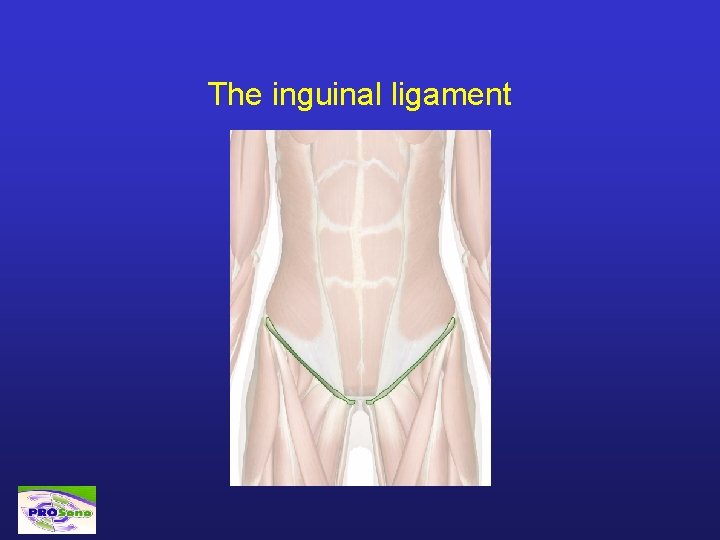
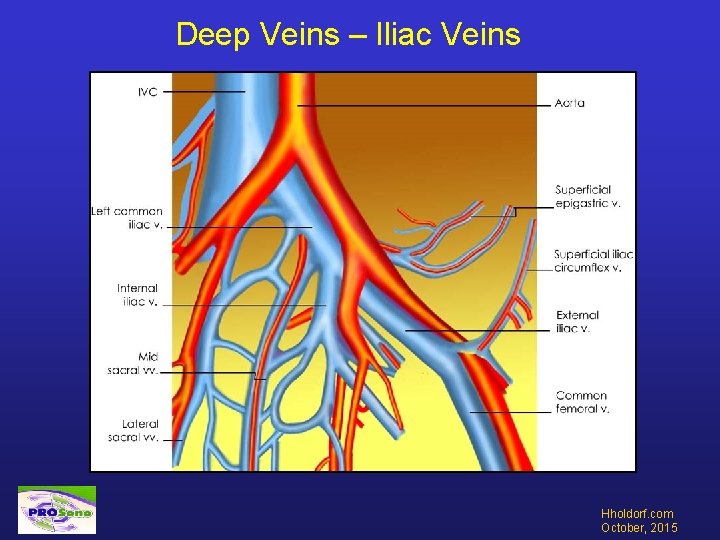
• External iliac Vein (EIV) – Common femoral vein becomes EIV when passes through inguinal ligament • Common Iliac Vein (CIV) – Formed by confluence of external and internal iliac veins
The inguinal ligament
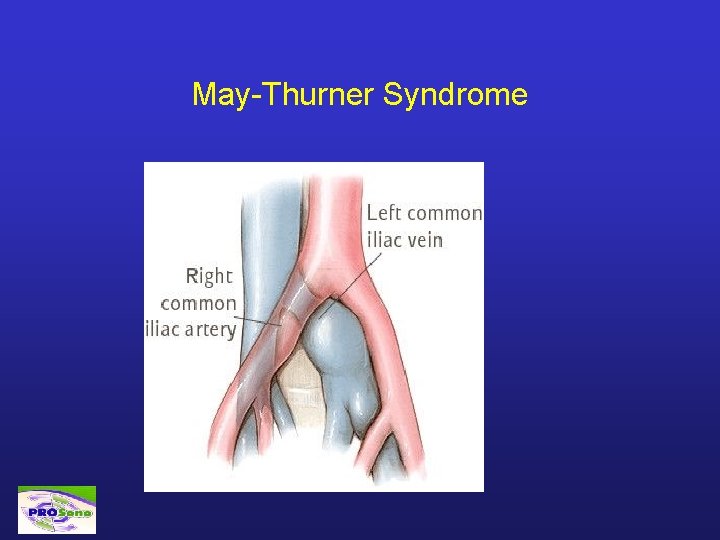
• Because the left common iliac vein passes under the right common iliac artery, extrinsic compression may be evident. • This pressure point may account for left sided DVT; also known as May-Thurner Syndrome
May-Thurner Syndrome
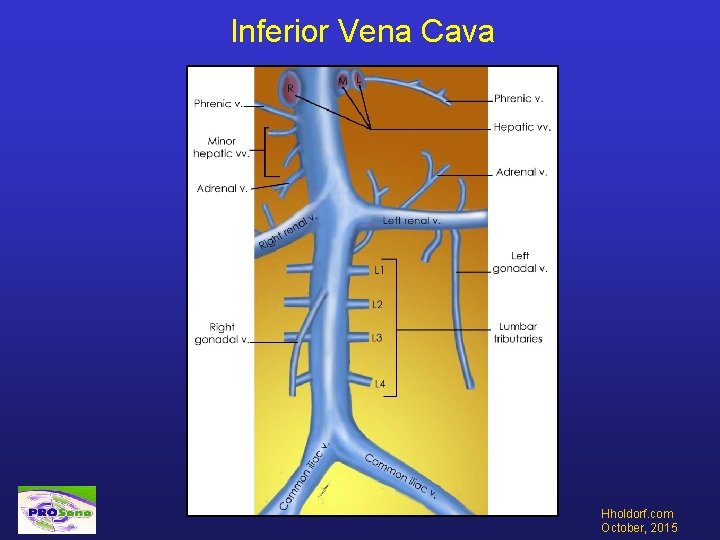
• Inferior Vena Cava (IVC) – Formed by confluence of common iliac veins – Commonly at level of 5 th lumbar vertebra – Carries blood into right atrium of heart
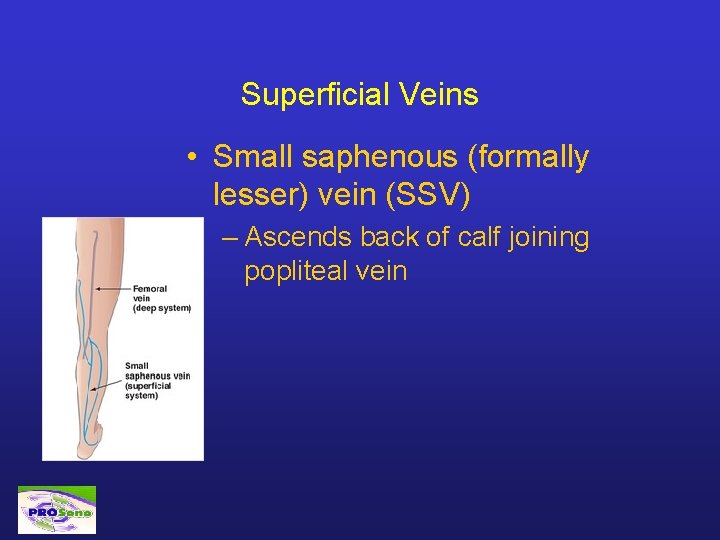
Superficial Veins • Small saphenous (formally lesser) vein (SSV) – Ascends back of calf joining popliteal vein
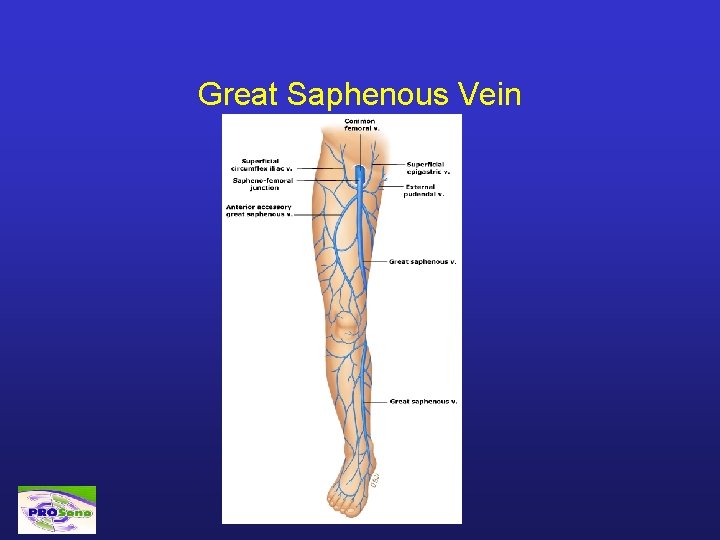
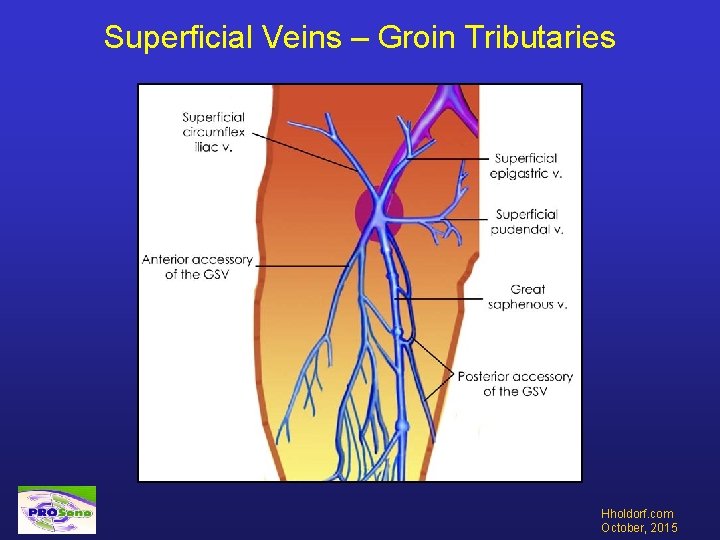
Superficial Veins • Great (formerly Greater) Saphenous Vein (GSV) – Longest vein in the body, originating on dorsum of foot, traveling medially to saphenofemoral junction in the groin (about level of CFA bifurcation)
Great Saphenous Vein
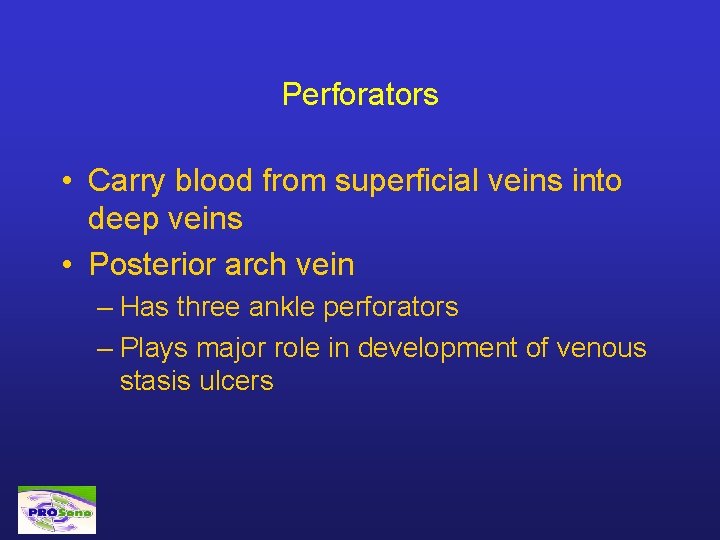
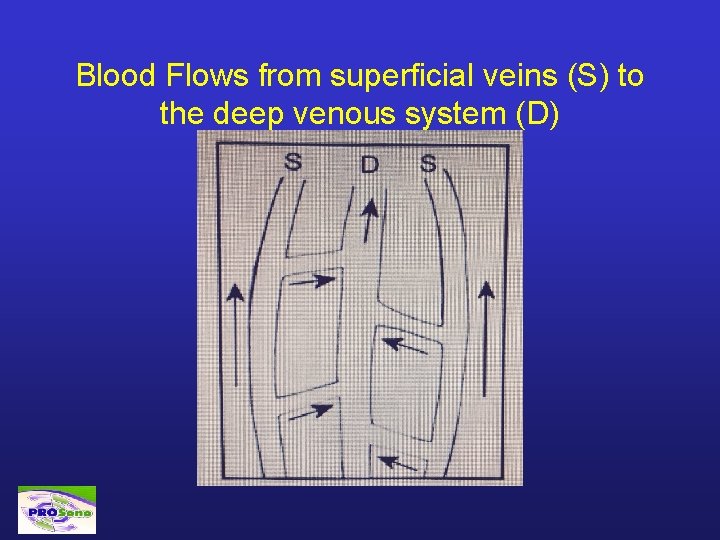
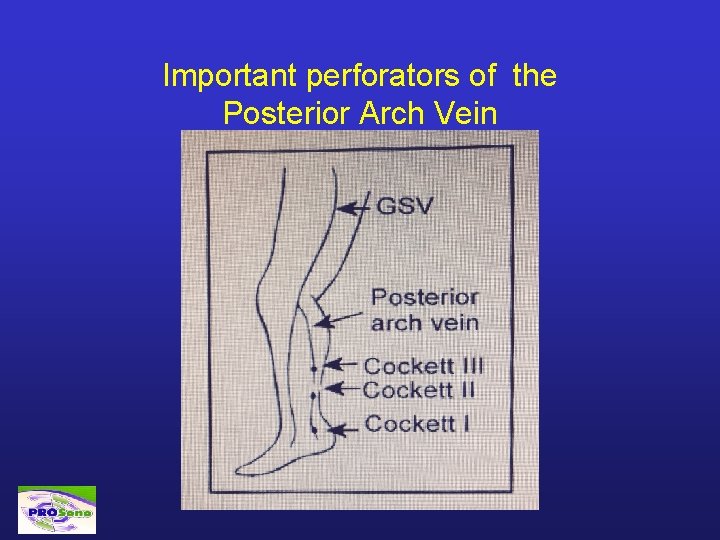
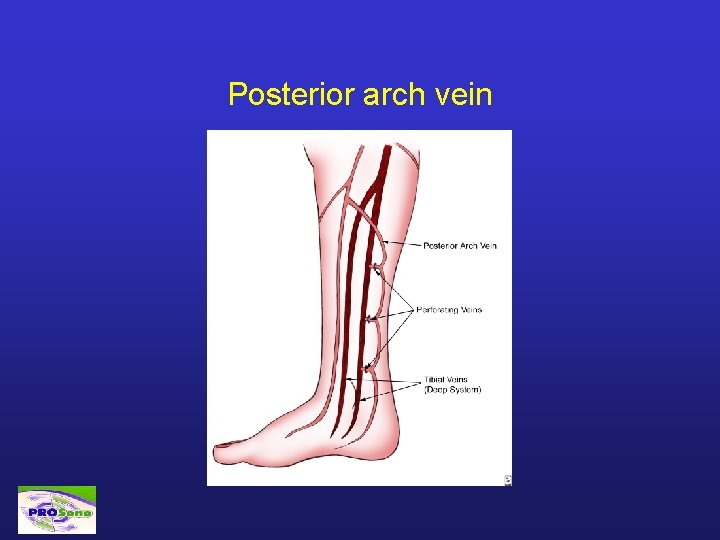
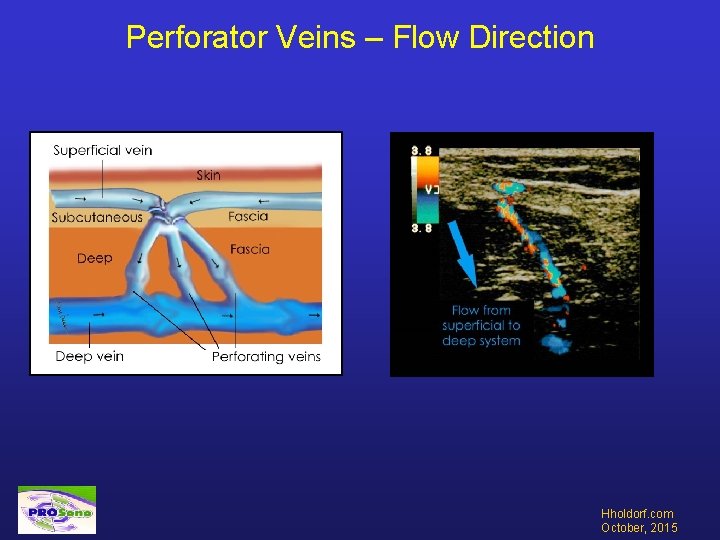
Perforators • Carry blood from superficial veins into deep veins • Posterior arch vein – Has three ankle perforators – Plays major role in development of venous stasis ulcers
Blood Flows from superficial veins (S) to the deep venous system (D)
Important perforators of the Posterior Arch Vein
Posterior arch vein
Hholdorf. com October, 2015
Hholdorf. com October, 2015
Hholdorf. com October, 2015
Hholdorf. com October, 2015
Factors Affecting Venous Flow • Venous-Skeletal muscle pump ‘Venous heart’ • The GREAT MUSCLE PUMP = Calf muscle • Muscle contraction squeezes vein propelling blood upward-forward Hholdorf. com October, 2015
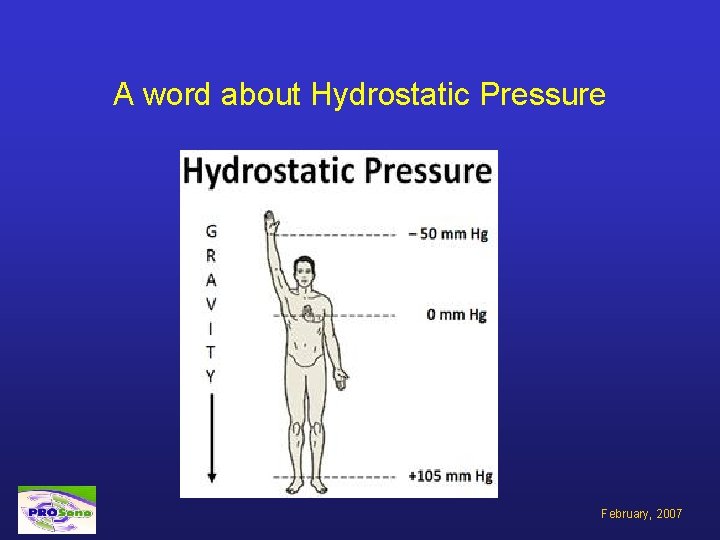
A word about Hydrostatic Pressure February, 2007
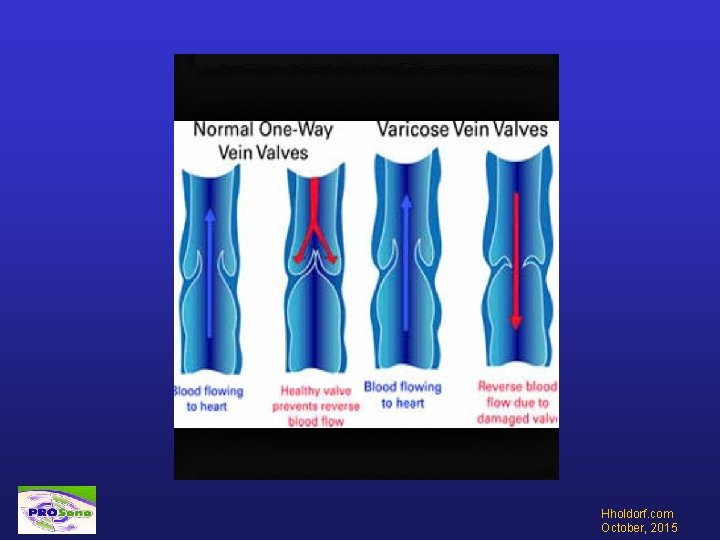
Effective Calf Muscle Pump • Blood moves from superficial system (s) to deep system (D) • Competent valves prevent reflux • Venous volume and pressure decreases • Venous return to heart increases Hholdorf. com October, 2015
Ineffective Calf Muscle Pump • Incompetent valves cause reflux • Venous volume and pressure increases • Results in venous pooling and ambulatory venous hypertension. Hholdorf. com October, 2015
Respiration Inspiration (Phasic) • Decrease in intra-thoracic pressure • Increases blood flow from upper extremities • Increase in intra-abdominal pressure • Decreases blood flow from lower extremities Hholdorf. com October, 2015
Respiration Exhalation • Increase in intra-thoracic pressure • Decreases blood flow from upper extremities • Decrease in intra-abdominal pressure • Increases blood from lower extremities Hholdorf. com October, 2015
Valsalva Maneuver Patient takes in deep breath & holds it, then bears down (as if having a bowel movement) Intra-thoracic and intra-abdominal pressure increases significantly All venous return halted Veins will enlarge Hholdorf. com October, 2015
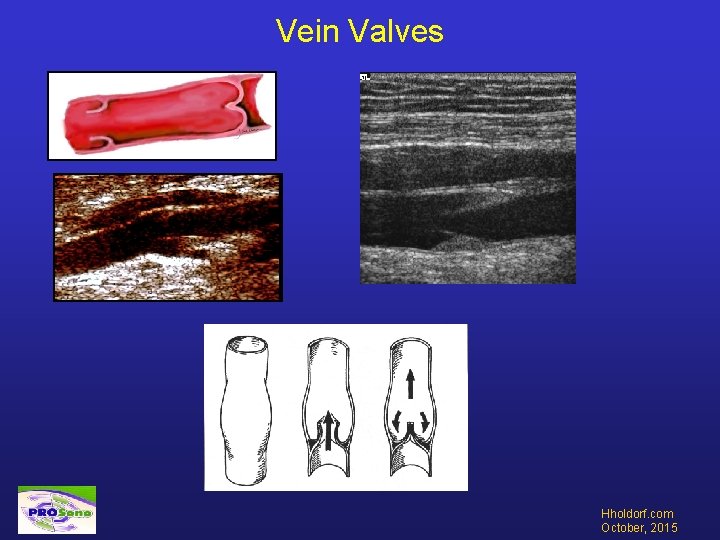
Vein Valves Hholdorf. com October, 2015
Importance of the Greater Saphenous Vein • The great saphenous vein (GSV), previously also called the long saphenous vein, is a large, subcutaneous, superficial vein of the leg. It is the longest vein in the body running along the medial length of the leg. Clinical significance • Pathology of the great saphenous vein is relatively common, but in isolation typically not life-threatening. • Varicose veins: The great saphenous vein, like other superficial veins, can become varicose; swollen, twisted and lengthened, and generally considered to be unsightly. • Thrombophlebitis The GSV can thrombose. This type of phlebitis of the GSV is usually not life-threatening in isolation; however, if the blood clot is located near the sapheno-femoral junction or near a perforator vein, a clot fragment can migrate to the deep venous system and to the pulmonary circulation. Also it can be associated with, or progress to a deep vein thrombosis which must be treated. The vein is often removed by cardiac surgeons and used for auto transplantation in coronary artery bypass operations, when arterial grafts are not available or many grafts are required, such as in a triple bypass or quadruple bypass. February, 2007
Vein Mapping for Coronary Artery bypass graft surgery • • • A tourniquet is placed around the upper thigh or the patient is placed in reverse Trendelenberg to aid in venous filling. The LSV is carefully traced onto the exterior of the leg using a surgical marker. Beginning distally at the medial malleolus, a generous amount of ultrasound gel is applied to the donor leg. The focus is set to a depth of 2. 8 cm to the scan area below the knee and may be adjusted to greater depths as the thigh is reached. The vein is identified and confirmed on the ultrasound screen as a tubular, compressible structure. The LSV is accurately followed up the medial aspect of the leg and marked for the entire length of its course. The caliber of the vein is assessed and measured at multiple sites and adjustment is made for distension. February, 2007
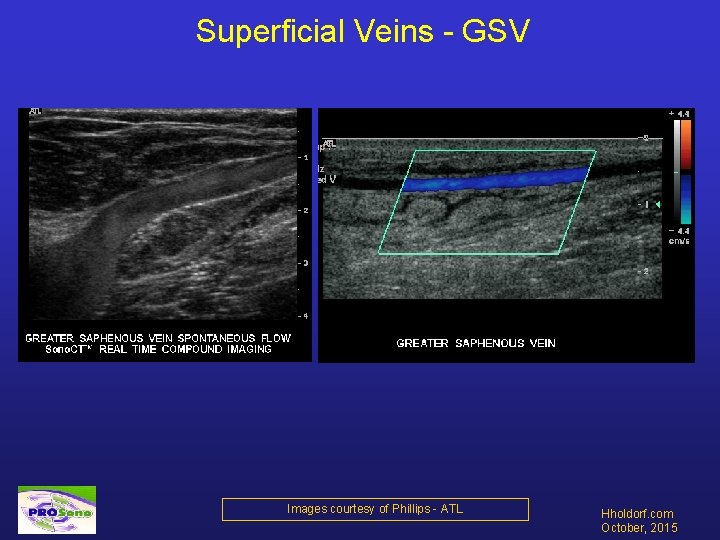
Superficial Veins - GSV Images courtesy of Phillips - ATL Hholdorf. com October, 2015
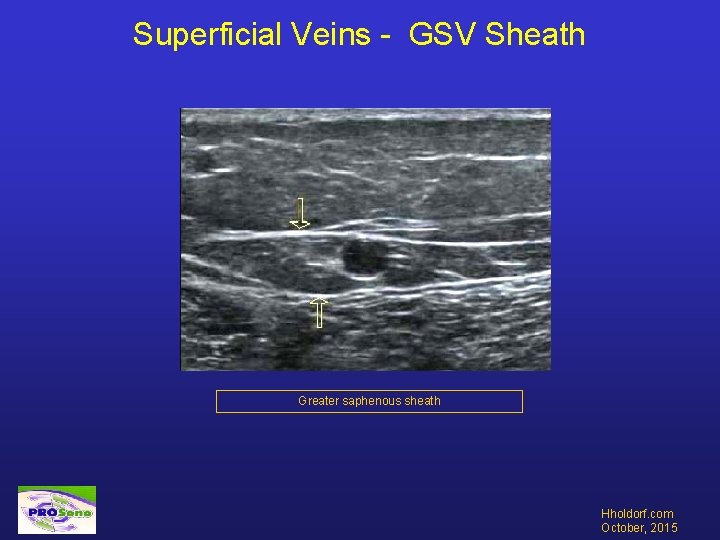
Superficial Veins - GSV Sheath Greater saphenous sheath Hholdorf. com October, 2015
Superficial Veins – Groin Tributaries Hholdorf. com October, 2015
Deep Veins – Full Length Hholdorf. com October, 2015
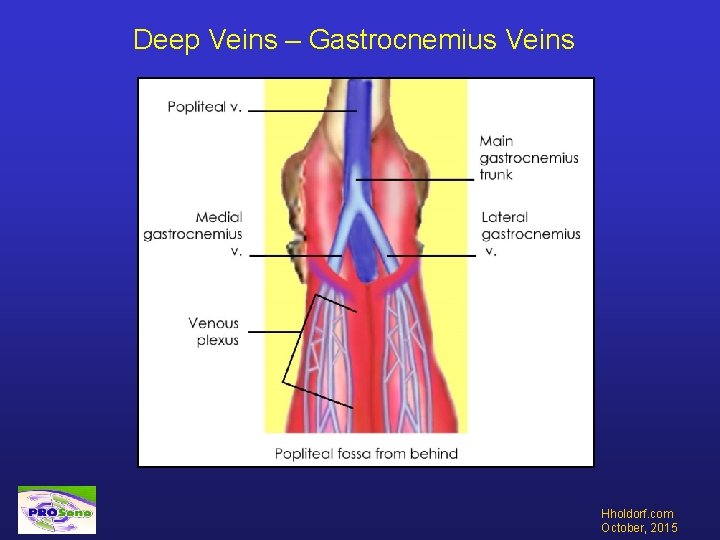
Deep Veins – Gastrocnemius Veins Hholdorf. com October, 2015
Deep Veins – Popliteal Vein Hholdorf. com October, 2015
Deep Veins – Iliac Veins Hholdorf. com October, 2015
Inferior Vena Cava Hholdorf. com October, 2015
Perforator Veins – Flow Direction Hholdorf. com October, 2015
Duplex-Color Flow Imaging • Identify venous thrombosis – help differentiate acute from chronic • Evaluate non-occluding/partial thrombus • Detect calf lesions • Distinguish between extrinsic compression and intrinsic obstruction • Evaluate soft tissue masses • Detect venous incompetence • Document re-canalized channels or collateralization Hholdorf. com October, 2015
Limitations of Duplex Imaging • Sources of false-Positive studies include: – Extrinsic compression: e. g. , tumors such as SVC syndrome, ascites, pregnancy – Peripheral arterial disease (PAD): decreased venous filling – Chronic obstructive pulmonary disease COPD: Elevated central venous Pressure – Improper Doppler angle or probe pressure Hholdorf. com October, 2015
Patient Positioning • Peripheral veins: Lower Extremities – Facilitate venous filling: i. e. , reverse Trendelenburg – Diminish extrinsic compression: e. g. , extreme Left lateral decubitus position February, 2007
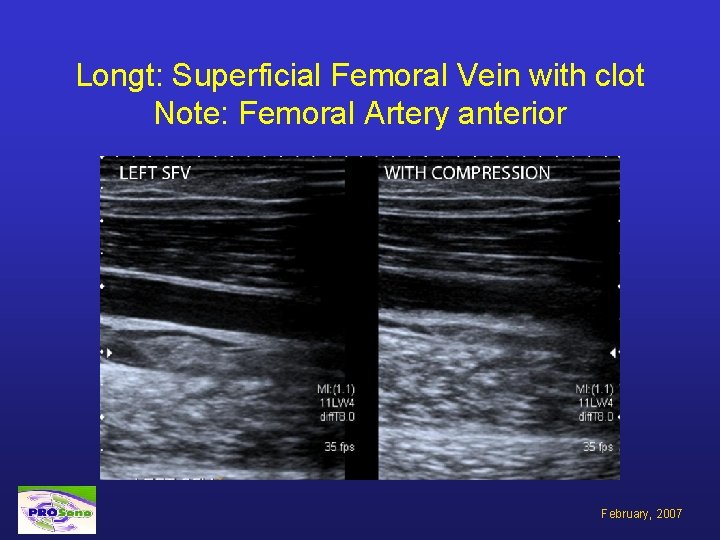
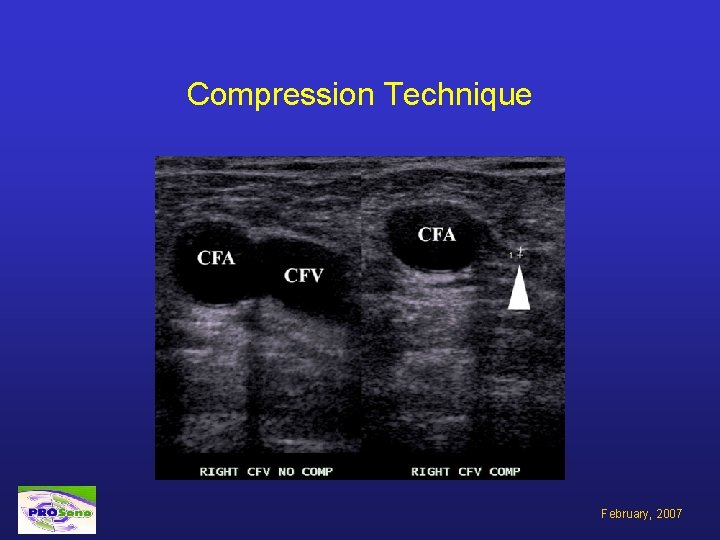
Technique • Coaptation: From the Latin word meaning “To fit together” is another word for compressibility February, 2007
Venous Flow Patterns • Evaluate venous Doppler signals in sagittal view: Spontaneous Phasic (with respiration) Augment with distal compression Augment with proximal release February, 2007
Cross-Section of the Femoral vein High thigh: left leg February, 2007
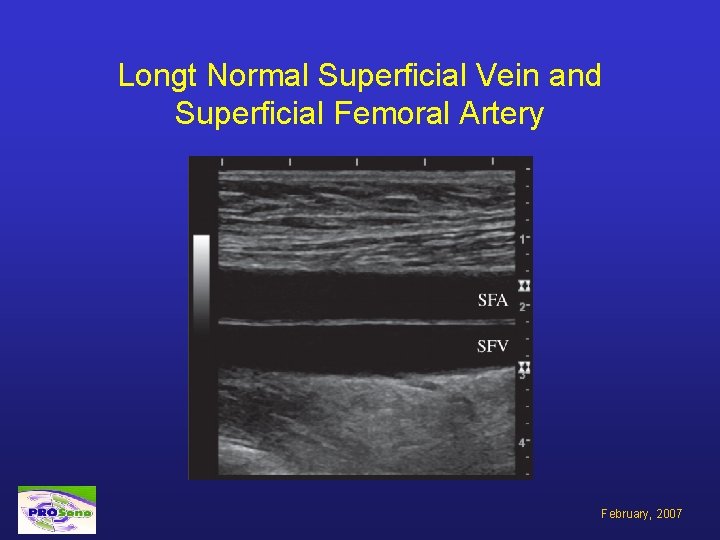
Longt Normal Superficial Vein and Superficial Femoral Artery February, 2007
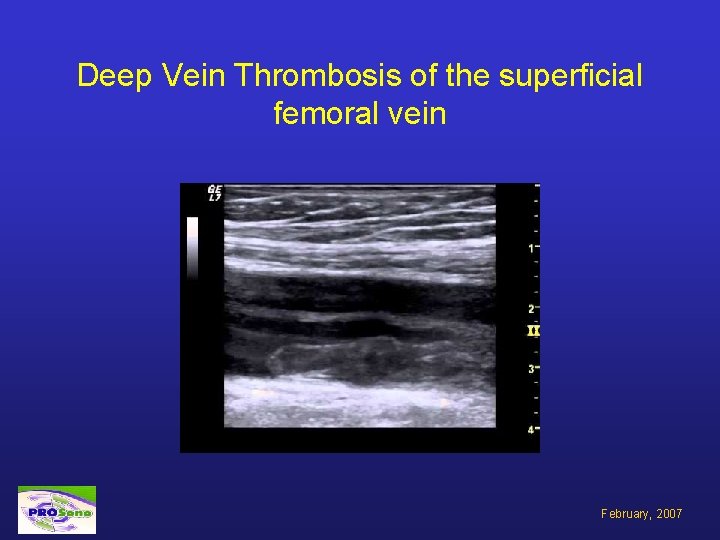
Longt: Superficial Femoral Vein with clot Note: Femoral Artery anterior February, 2007
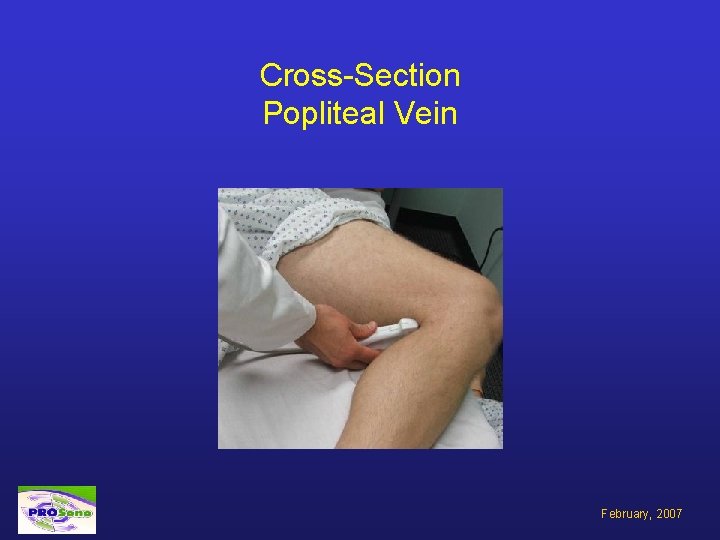
Cross-Section Popliteal Vein February, 2007
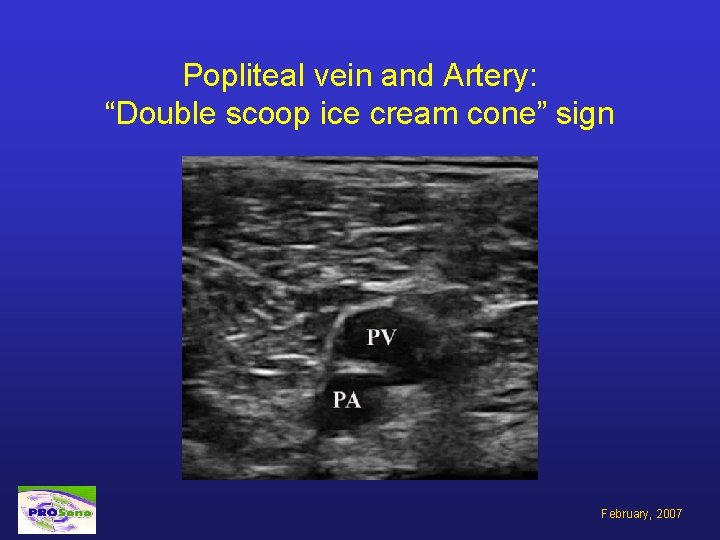
Popliteal vein and Artery: “Double scoop ice cream cone” sign February, 2007
Distal Augmentation • With distal augmentation of the calf area, flow in the femoral vein initially goes cephalad. • With the release of the calf area, flow should not reflux back down the leg. • This maneuver demonstrates competent venous valves. February, 2007
Compression Technique February, 2007
Deep Vein Thrombosis of the superficial femoral vein February, 2007
February, 2007
February, 2007
Homework Show images of the following • Augmentation with Distal Compression • Augmentation with Proximal Release • The mickey mouse sign (of the lower venous legs) • Coaptation of the popliteal vein – To include compression and non compression images • Coaptation of the femoral vein – Same images required as above February, 2007 Holdorf