
Lower Extremity HP Knee Exam WEEK 1 ORTHO
- Slides: 11
Lower Extremity H&P: Knee Exam WEEK 1 ORTHO CURRICULUM
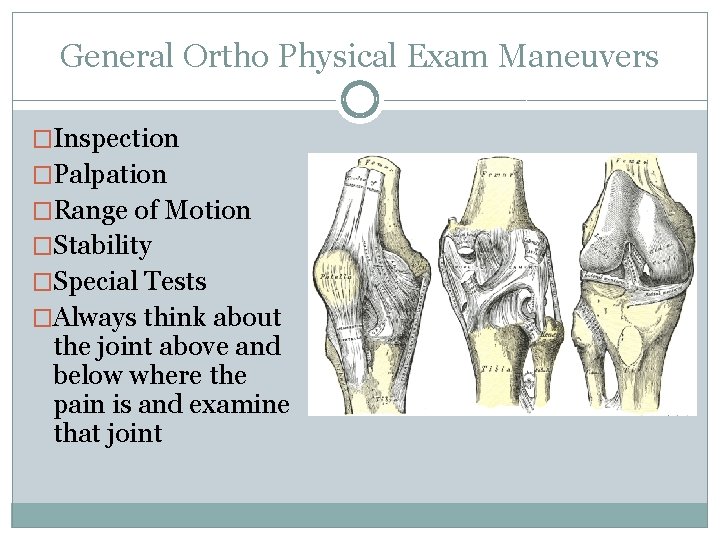
General Ortho Physical Exam Maneuvers �Inspection �Palpation �Range of Motion �Stability �Special Tests �Always think about the joint above and below where the pain is and examine that joint
INSPECTION �Look for redness, swelling, warmth -> think septic arthritis �Look for effusion – occurs in acute injury Is the effusion mild, moderate, or severe? �Look for displacement of the patella �Baker’s cyst – swelling over posterior aspect of the knee �Don’t forget to watch the patient walk Is the patient able to bear weight? Does the patient have an antalgic gait? (limping gait) Indicates pain with weight bearing
PALPATION �Grasp the lower extremity just distal to the knee and push upward, attempting to “milk” any effusion that may be present If there is a significant effusion, you will see it fill the crevices on the medial and lateral sides of the patella �Palpate the patella – should be mobile �Palpate the entire knee, looking for any point tenderness Evaluate joint line tenderness with the thumb
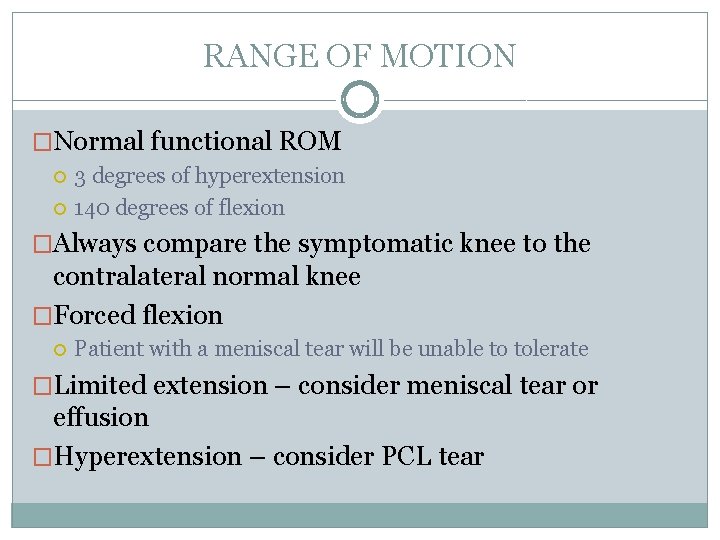
RANGE OF MOTION �Normal functional ROM 3 degrees of hyperextension 140 degrees of flexion �Always compare the symptomatic knee to the contralateral normal knee �Forced flexion Patient with a meniscal tear will be unable to tolerate �Limited extension – consider meniscal tear or effusion �Hyperextension – consider PCL tear
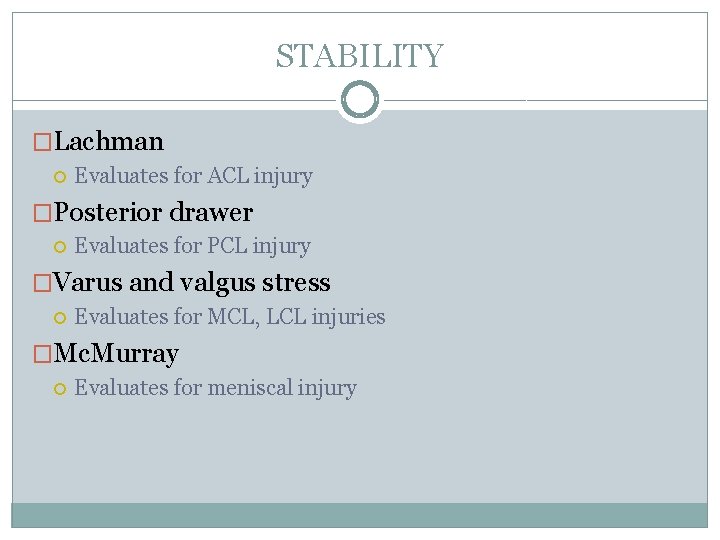
STABILITY �Lachman Evaluates for ACL injury �Posterior drawer Evaluates for PCL injury �Varus and valgus stress Evaluates for MCL, LCL injuries �Mc. Murray Evaluates for meniscal injury
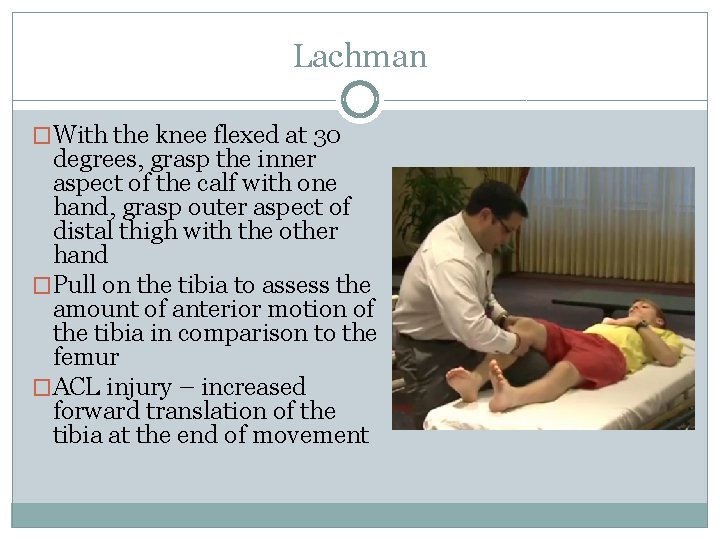
Lachman �With the knee flexed at 30 degrees, grasp the inner aspect of the calf with one hand, grasp outer aspect of distal thigh with the other hand �Pull on the tibia to assess the amount of anterior motion of the tibia in comparison to the femur �ACL injury – increased forward translation of the tibia at the end of movement
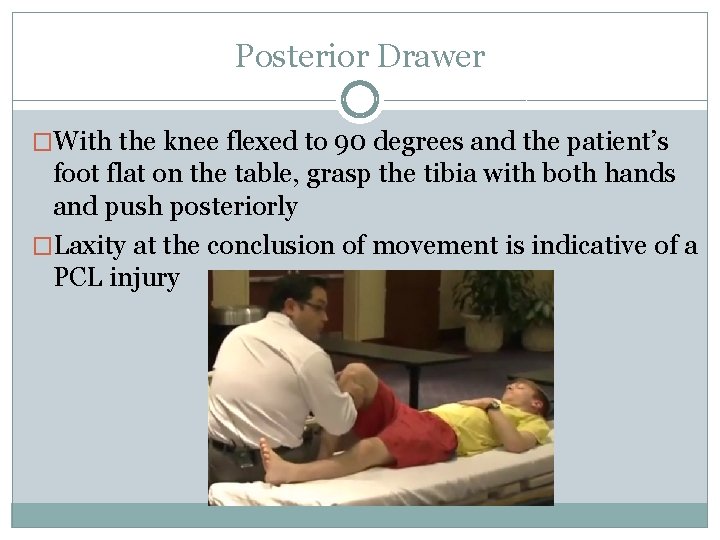
Posterior Drawer �With the knee flexed to 90 degrees and the patient’s foot flat on the table, grasp the tibia with both hands and push posteriorly �Laxity at the conclusion of movement is indicative of a PCL injury
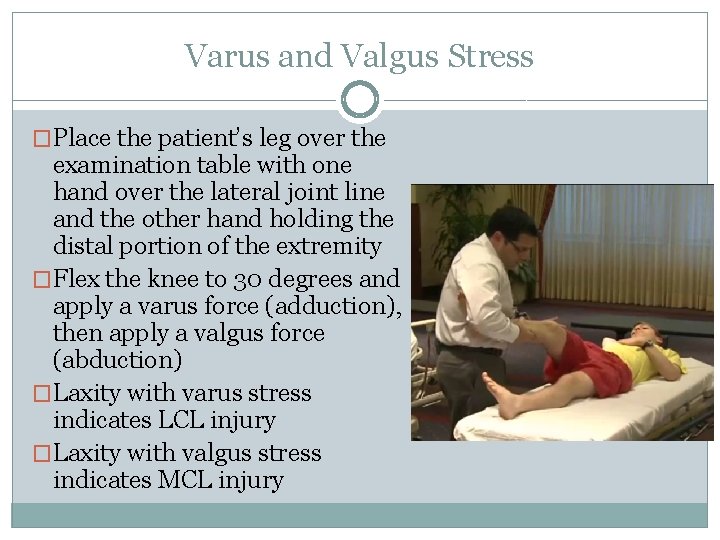
Varus and Valgus Stress �Place the patient’s leg over the examination table with one hand over the lateral joint line and the other hand holding the distal portion of the extremity �Flex the knee to 30 degrees and apply a varus force (adduction), then apply a valgus force (abduction) �Laxity with varus stress indicates LCL injury �Laxity with valgus stress indicates MCL injury
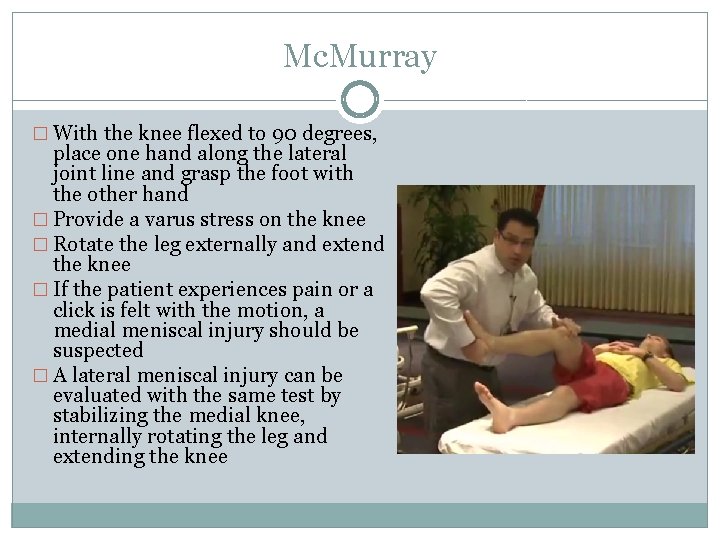
Mc. Murray � With the knee flexed to 90 degrees, place one hand along the lateral joint line and grasp the foot with the other hand � Provide a varus stress on the knee � Rotate the leg externally and extend the knee � If the patient experiences pain or a click is felt with the motion, a medial meniscal injury should be suspected � A lateral meniscal injury can be evaluated with the same test by stabilizing the medial knee, internally rotating the leg and extending the knee
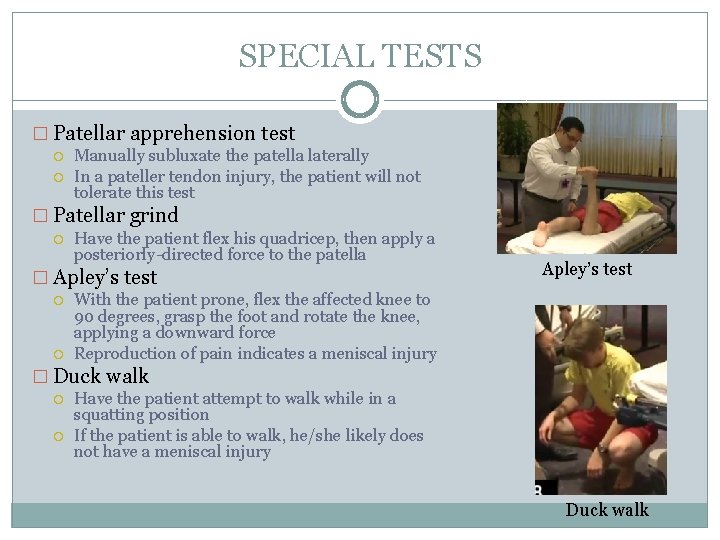
SPECIAL TESTS � Patellar apprehension test Manually subluxate the patella laterally In a pateller tendon injury, the patient will not tolerate this test � Patellar grind Have the patient flex his quadricep, then apply a posteriorly-directed force to the patella � Apley’s test With the patient prone, flex the affected knee to 90 degrees, grasp the foot and rotate the knee, applying a downward force Reproduction of pain indicates a meniscal injury � Duck walk Have the patient attempt to walk while in a squatting position If the patient is able to walk, he/she likely does not have a meniscal injury Duck walk