
Lower Course of a River Water Cycle Key
- Slides: 2
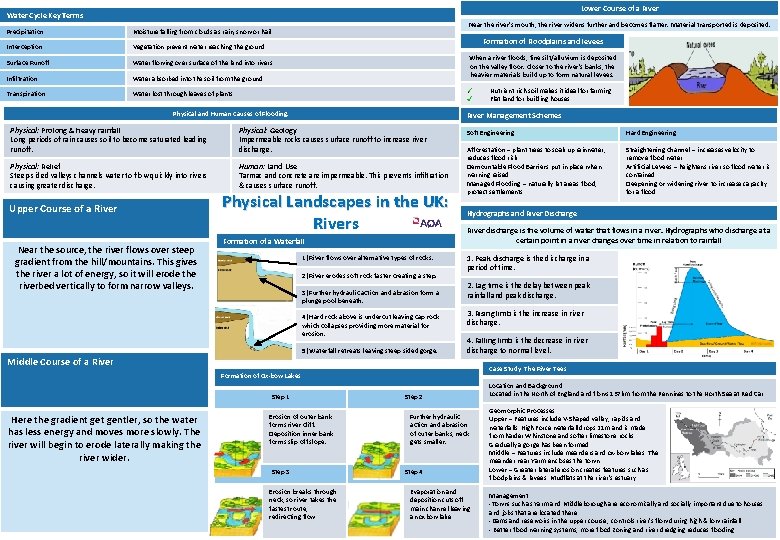
Lower Course of a River Water Cycle Key Terms Precipitation Moisture falling from clouds as rain, snow or hail. Interception Vegetation prevent water reaching the ground. Surface Runoff Water flowing over surface of the land into rivers Infiltration Water absorbed into the soil from the ground. Transpiration Water lost through leaves of plants. Near the river’s mouth, the river widens further and becomes flatter. Material transported is deposited. Formation of Floodplains and levees When a river floods, fine silt/alluvium is deposited on the valley floor. Closer to the river’s banks, the heavier materials build up to form natural levees. Nutrient rich soil makes it ideal for farming. Flat land for building houses. Physical and Human Causes of Flooding. River Management Schemes Physical: Prolong & heavy rainfall Long periods of rain causes soil to become saturated leading runoff. Physical: Geology Impermeable rocks causes surface runoff to increase river discharge. Physical: Relief Steep-sided valleys channels water to flow quickly into rivers causing greater discharge. Human: Land Use Tarmac and concrete are impermeable. This prevents infiltration & causes surface runoff. Upper Course of a River Near the source, the river flows over steep gradient from the hill/mountains. This gives the river a lot of energy, so it will erode the riverbed vertically to form narrow valleys. Physical Landscapes in the UK: Rivers Formation of a Waterfall 1) River flows over alternative types of rocks. 2) River erodes soft rock faster creating a step. 3) Further hydraulic action and abrasion form a plunge pool beneath. 4) Hard rock above is undercut leaving cap rock which collapses providing more material for erosion. 5) Waterfall retreats leaving steep sided gorge. Soft Engineering Hard Engineering Afforestation – plant trees to soak up rainwater, reduces flood risk. Demountable Flood Barriers put in place when warning raised. Managed Flooding – naturally let areas flood, protect settlements. Straightening Channel – increases velocity to remove flood water. Artificial Levees – heightens river so flood water is contained. Deepening or widening river to increase capacity for a flood. Hydrographs and River Discharge River discharge is the volume of water that flows in a river. Hydrographs who discharge at a certain point in a river changes over time in relation to rainfall 1. Peak discharge is the discharge in a period of time. 2. Lag time is the delay between peak rainfall and peak discharge. 3. Rising limb is the increase in river discharge. 4. Falling limb is the decrease in river discharge to normal level. Middle Course of a River Case Study: The River Tees Formation of Ox-bow Lakes Step 1 Here the gradient gentler, so the water has less energy and moves more slowly. The river will begin to erode laterally making the river wider. Erosion of outer bank forms river cliff. Deposition inner bank forms slip off slope. Step 3 Erosion breaks through neck, so river takes the fastest route, redirecting flow Step 2 Further hydraulic action and abrasion of outer banks, neck gets smaller. Step 4 Evaporation and deposition cuts off main channel leaving an oxbow lake. Location and Background Located in the North of England flows 137 km from the Pennines to the North Sea at Red Car. Geomorphic Processes Upper – Features include V-Shaped valley, rapids and waterfalls. High Force waterfall drops 21 m and is made from harder Whinstone and softer limestone rocks. Gradually a gorge has been formed. Middle – Features include meanders and ox-bow lakes. The meander near Yarm encloses the town. Lower – Greater lateral erosion creates features such as floodplains & levees. Mudflats at the river’s estuary. Management -Towns such as Yarm and Middleborough are economically and socially important due to houses and jobs that are located there. -Dams and reservoirs in the upper course, controls river’s flow during high & low rainfall. - Better flood warning systems, more flood zoning and river dredging reduces flooding.
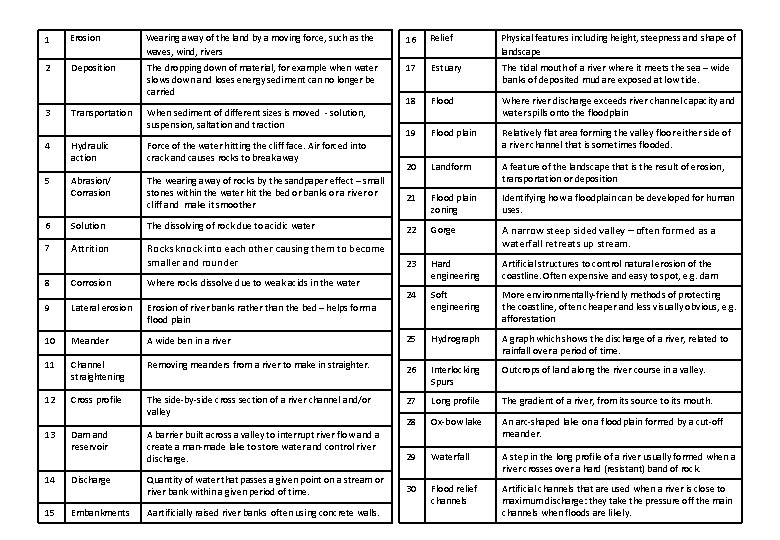
1 Erosion Wearing away of the land by a moving force, such as the waves, wind, rivers 16 Relief Physical features including height, steepness and shape of landscape 2 Deposition The dropping down of material, for example when water slows down and loses energy sediment can no longer be carried 17 Estuary The tidal mouth of a river where it meets the sea – wide banks of deposited mud are exposed at low tide. 3 Transportation When sediment of different sizes is moved - solution, suspension, saltation and traction 18 Flood Where river discharge exceeds river channel capacity and water spills onto the floodplain 19 Flood plain Relatively flat area forming the valley floor either side of a river channel that is sometimes flooded. 20 Landform A feature of the landscape that is the result of erosion, transportation or deposition 4 Hydraulic action Force of the water hitting the cliff face. Air forced into crack and causes rocks to break away Abrasion/ Corrasion The wearing away of rocks by the sandpaper effect – small stones within the water hit the bed or banks or a river or cliff and make it smoother 21 Flood plain zoning Identifying how a floodplain can be developed for human uses. 6 Solution The dissolving of rock due to acidic water 22 Gorge 7 Attrition Rocks knock into each other causing them to become smaller and rounder A narrow steep sided valley – often formed as a waterfall retreats up stream. 23 Hard engineering Artificial structures to control natural erosion of the coastline. Often expensive and easy to spot, e. g. dam 24 Soft engineering More environmentally-friendly methods of protecting the coastline, often cheaper and less visually obvious, e. g. afforestation 25 Hydrograph A graph which shows the discharge of a river, related to rainfall over a period of time. 26 Interlocking Spurs Outcrops of land along the river course in a valley. 27 Long profile The gradient of a river, from its source to its mouth. 5 8 Corrosion Where rocks dissolve due to weak acids in the water 9 Lateral erosion Erosion of river banks rather than the bed – helps form a flood plain 10 Meander A wide ben in a river 11 Channel straightening Removing meanders from a river to make in straighter. 12 Cross profile The side-by-side cross section of a river channel and/or valley 28 Ox-bow lake 13 Dam and reservoir A barrier built across a valley to interrupt river flow and a create a man-made lake to store water and control river discharge. An arc-shaped lake on a floodplain formed by a cut-off meander. 29 Waterfall 14 Discharge Quantity of water that passes a given point on a stream or river bank within a given period of time. A step in the long profile of a river usually formed when a river crosses over a hard (resistant) band of rock. 30 15 Embankments Aartificially raised river banks often using concrete walls. Flood relief channels Artificial channels that are used when a river is close to maximum discharge: they take the pressure off the main channels when floods are likely.