
LowEnergy Polarized Positrons for Physics e MESA Eric
- Slides: 20
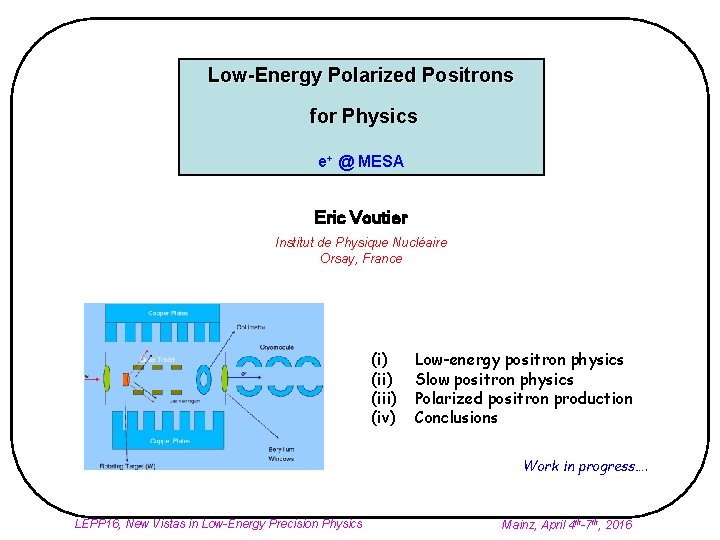
Low-Energy Polarized Positrons for Physics e+ @ MESA Eric Voutier Institut de Physique Nucléaire Orsay, France (i) (iii) (iv) Low-energy positron physics Slow positron physics Polarized positron production Conclusions Work in progress…. LEPP 16, New Vistas in Low-Energy Precision Physics Mainz, April 4 th-7 th, 2016
Low-Energy Positron Physics (E > 10 Me. V) • Two-photon physics (U, P) • Standard Model test (U, P) Mainz, April 4 th-7 th, 2016
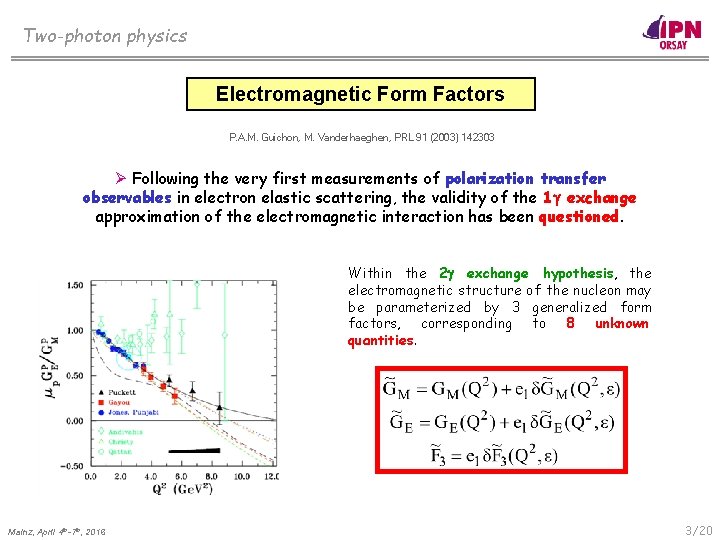
Two-photon physics Electromagnetic Form Factors P. A. M. Guichon, M. Vanderhaeghen, PRL 91 (2003) 142303 Ø Following the very first measurements of polarization transfer observables in electron elastic scattering, the validity of the 1 g exchange approximation of the electromagnetic interaction has been questioned. Within the 2 g exchange hypothesis, the electromagnetic structure of the nucleon may be parameterized by 3 generalized form factors, corresponding to 8 unknown quantities. Mainz, April 4 th-7 th, 2016 3/20
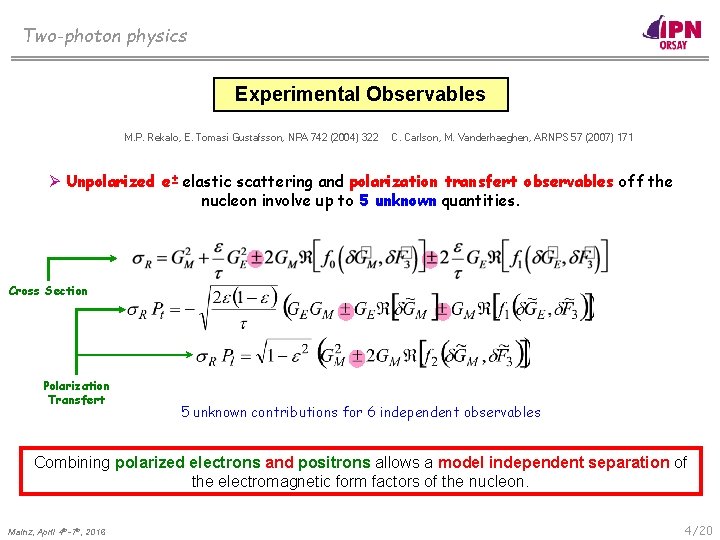
Two-photon physics Experimental Observables M. P. Rekalo, E. Tomasi Gustafsson, NPA 742 (2004) 322 C. Carlson, M. Vanderhaeghen, ARNPS 57 (2007) 171 Ø Unpolarized e± elastic scattering and polarization transfert observables off the nucleon involve up to 5 unknown quantities. Cross Section Polarization Transfert 5 unknown contributions for 6 independent observables Combining polarized electrons and positrons allows a model independent separation of the electromagnetic form factors of the nucleon. Mainz, April 4 th-7 th, 2016 4/20
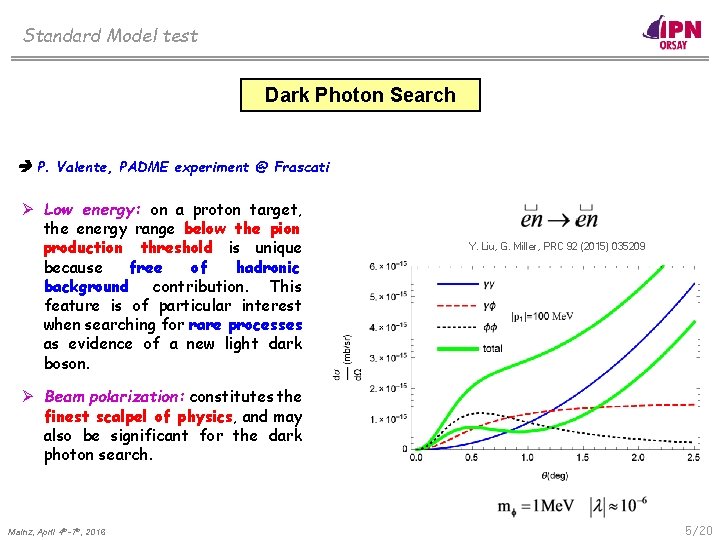
Standard Model test Dark Photon Search P. Valente, PADME experiment @ Frascati Ø Low energy: on a proton target, the energy range below the pion production threshold is unique because free of hadronic background contribution. This feature is of particular interest when searching for rare processes as evidence of a new light dark boson. Y. Liu, G. Miller, PRC 92 (2015) 035209 Ø Beam polarization: constitutes the finest scalpel of physics, and may also be significant for the dark photon search. Mainz, April 4 th-7 th, 2016 5/20
Slow Positron Physics (E < 1 Me. V) • Positron annihilation spectroscopy • Slow positron production Mainz, April 4 th-7 th, 2016
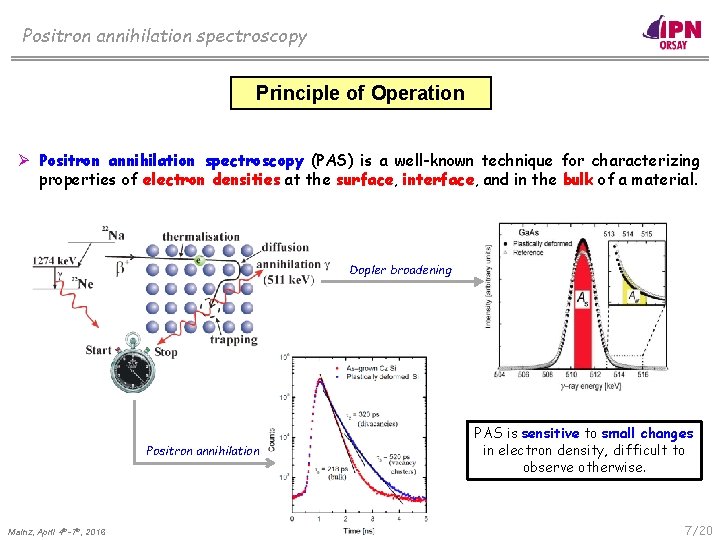
Positron annihilation spectroscopy Principle of Operation Ø Positron annihilation spectroscopy (PAS) is a well-known technique for characterizing properties of electron densities at the surface, interface, and in the bulk of a material. Dopler broadening Positron annihilation Mainz, April 4 th-7 th, 2016 PAS is sensitive to small changes in electron density, difficult to observe otherwise. 7/20
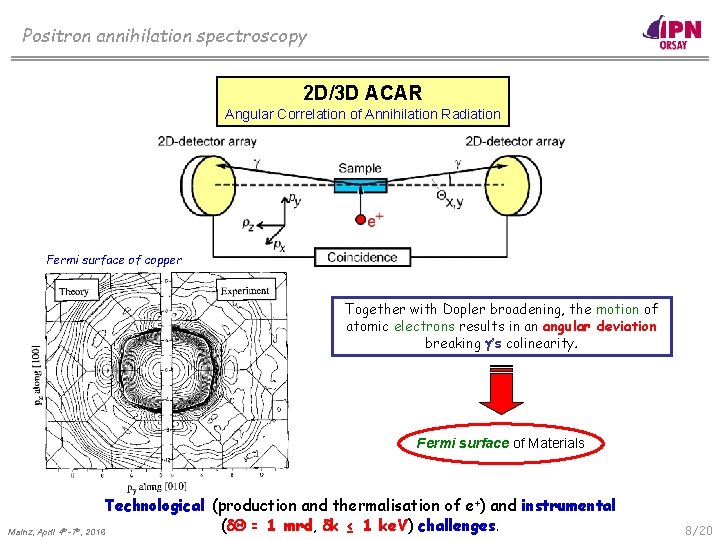
Positron annihilation spectroscopy 2 D/3 D ACAR Angular Correlation of Annihilation Radiation Fermi surface of copper Together with Dopler broadening, the motion of atomic electrons results in an angular deviation breaking g’s colinearity. Fermi surface of Materials Technological (production and thermalisation of e+) and instrumental (d. Q = 1 mrd, dk ≤ 1 ke. V) challenges. , 2016 Mainz, April 4 th-7 th 8/20
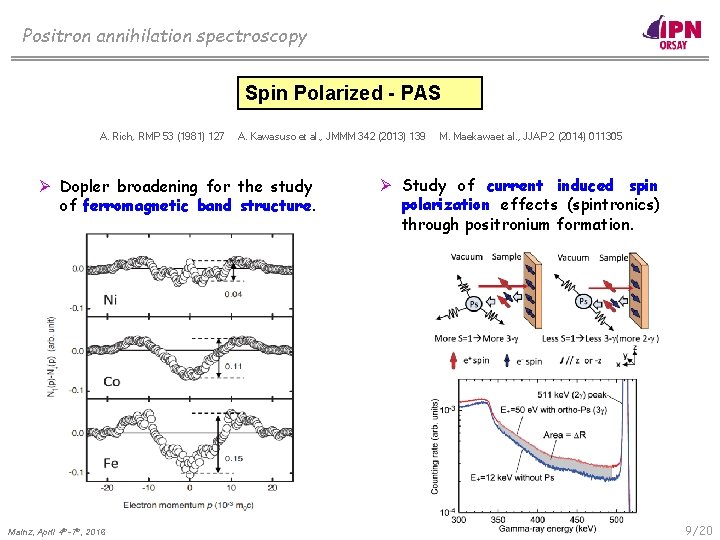
Positron annihilation spectroscopy Spin Polarized - PAS A. Rich, RMP 53 (1981) 127 A. Kawasuso et al. , JMMM 342 (2013) 139 Ø Dopler broadening for the study of ferromagnetic band structure. Mainz, April 4 th-7 th, 2016 M. Maekawa et al. , JJAP 2 (2014) 011305 Ø Study of current induced spin polarization effects (spintronics) through positronium formation. 9/20
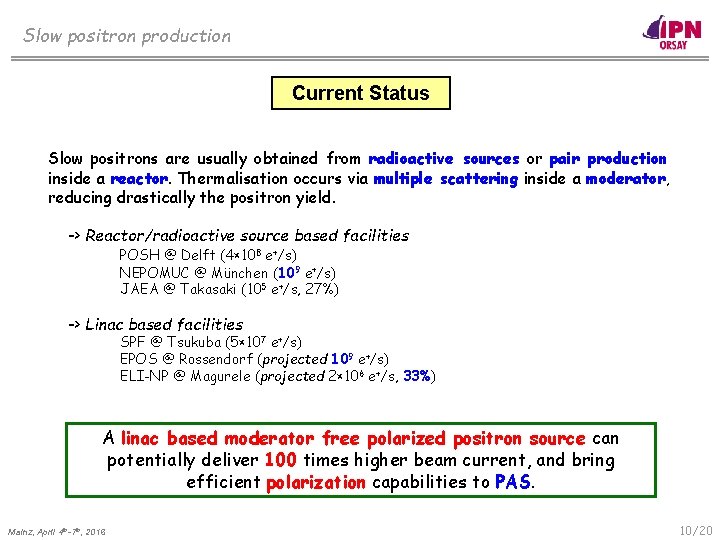
Slow positron production Current Status Slow positrons are usually obtained from radioactive sources or pair production inside a reactor. Thermalisation occurs via multiple scattering inside a moderator, reducing drastically the positron yield. -> Reactor/radioactive source based facilities POSH @ Delft (4× 10⁸ e+/s) NEPOMUC @ München (109 e+/s) JAEA @ Takasaki (105 e+/s, 27%) -> Linac based facilities SPF @ Tsukuba (5× 10⁷ e+/s) EPOS @ Rossendorf (projected 109 e+/s) ELI-NP @ Magurele (projected 2× 10⁶ e+/s, 33%) A linac based moderator free polarized positron source can potentially deliver 100 times higher beam current, and bring efficient polarization capabilities to PAS. Mainz, April 4 th-7 th, 2016 10/20
Polarized Positron Production • Polarization transfer physics • PEPPo experiment • Optimized positron production Mainz, April 4 th-7 th, 2016
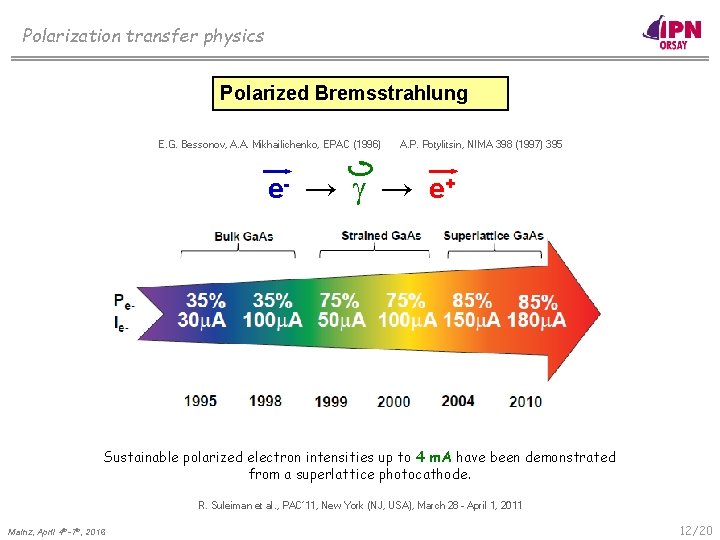
Polarization transfer physics Polarized Bremsstrahlung E. G. Bessonov, A. A. Mikhailichenko, EPAC (1996) A. P. Potylitsin, NIM A 398 (1997) 395 e- → g → e+ Sustainable polarized electron intensities up to 4 m. A have been demonstrated from a superlattice photocathode. R. Suleiman et al. , PAC’ 11, New York (NJ, USA), March 28 – April 1, 2011 Mainz, April 4 th-7 th, 2016 12/20
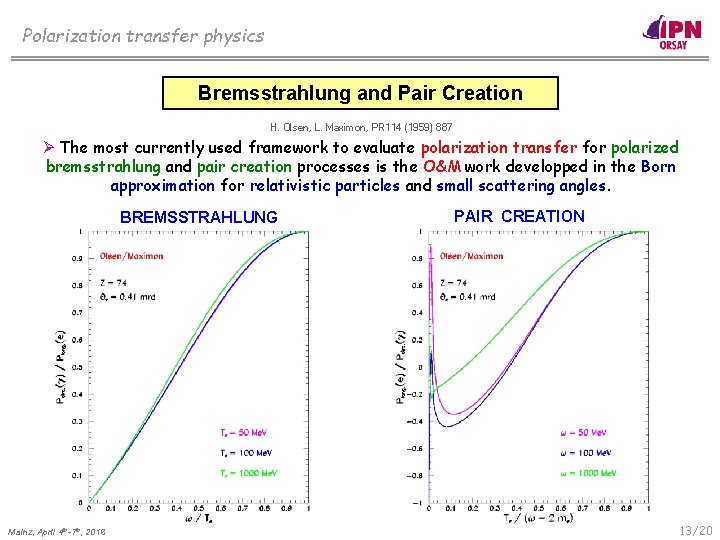
Polarization transfer physics Bremsstrahlung and Pair Creation H. Olsen, L. Maximon, PR 114 (1959) 887 Ø The most currently used framework to evaluate polarization transfer for polarized bremsstrahlung and pair creation processes is the O&M work developped in the Born approximation for relativistic particles and small scattering angles. BREMSSTRAHLUNG Mainz, April 4 th-7 th, 2016 PAIR CREATION 13/20
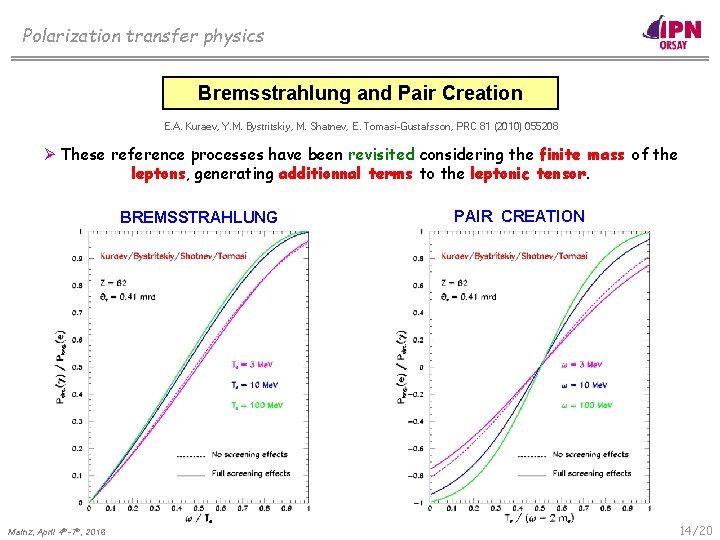
Polarization transfer physics Bremsstrahlung and Pair Creation E. A. Kuraev, Y. M. Bystritskiy, M. Shatnev, E. Tomasi-Gustafsson, PRC 81 (2010) 055208 Ø These reference processes have been revisited considering the finite mass of the leptons, generating additionnal terms to the leptonic tensor. BREMSSTRAHLUNG Mainz, April 4 th-7 th, 2016 PAIR CREATION 14/20
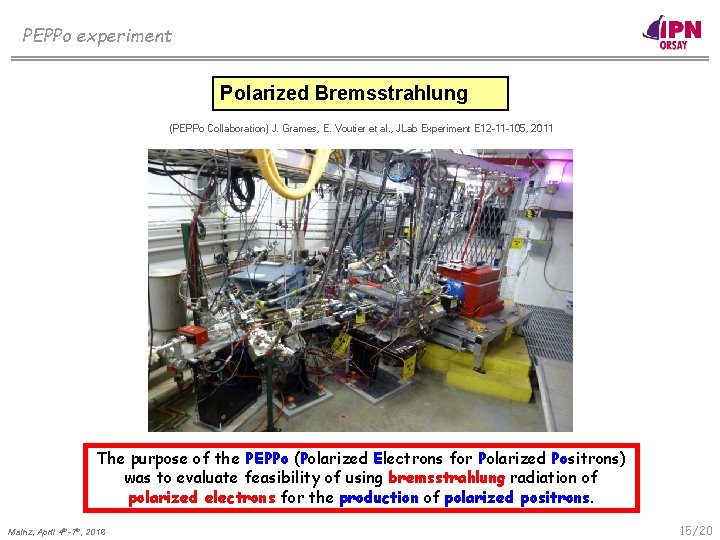
PEPPo experiment Polarized Bremsstrahlung (PEPPo Collaboration) J. Grames, E. Voutier et al. , JLab Experiment E 12 -11 -105, 2011 The purpose of the PEPPo (Polarized Electrons for Polarized Positrons) was to evaluate feasibility of using bremsstrahlung radiation of polarized electrons for the production of polarized positrons. Mainz, April 4 th-7 th, 2016 15/20
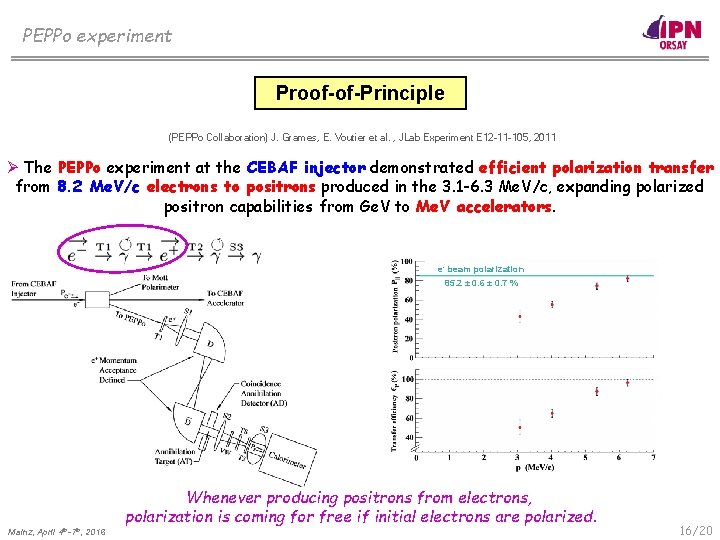
PEPPo experiment Proof-of-Principle (PEPPo Collaboration) J. Grames, E. Voutier et al. , JLab Experiment E 12 -11 -105, 2011 Ø The PEPPo experiment at the CEBAF injector demonstrated efficient polarization transfer from 8. 2 Me. V/c electrons to positrons produced in the 3. 1 -6. 3 Me. V/c, expanding polarized positron capabilities from Ge. V to Me. V accelerators. e- beam polarization 85. 2 ± 0. 6 ± 0. 7 % Mainz, April 4 th-7 th, 2016 Whenever producing positrons from electrons, polarization is coming for free if initial electrons are polarized. 16/20
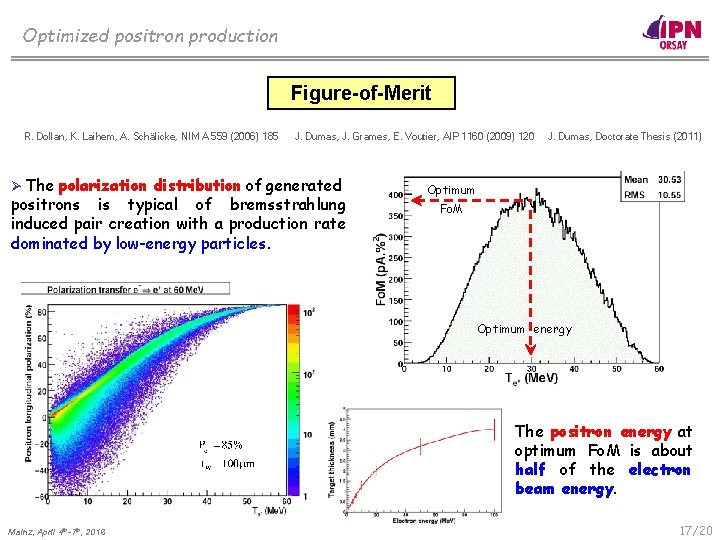
Optimized positron production Figure-of-Merit R. Dollan, K. Laihem, A. Schälicke, NIM A 559 (2006) 185 J. Dumas, J. Grames, E. Voutier, AIP 1160 (2009) 120 Ø The polarization distribution of generated positrons is typical of bremsstrahlung induced pair creation with a production rate dominated by low-energy particles. J. Dumas, Doctorate Thesis (2011) Optimum Fo. M Optimum energy The positron energy at optimum Fo. M is about half of the electron beam energy. Mainz, April 4 th-7 th, 2016 17/20
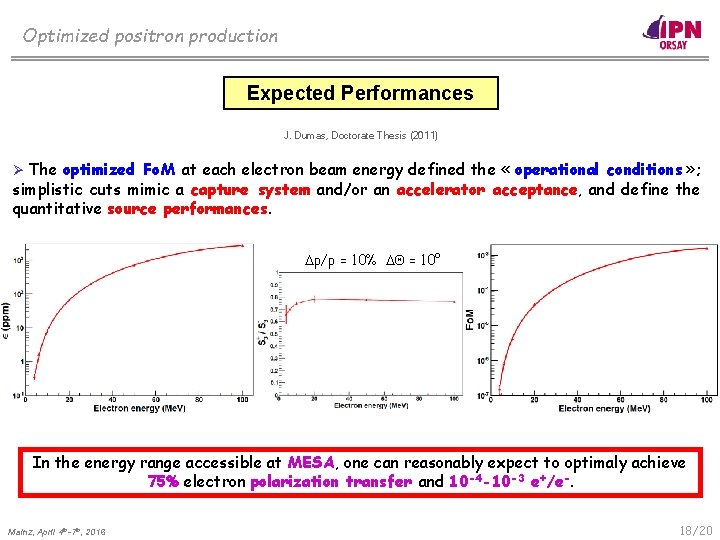
Optimized positron production Expected Performances J. Dumas, Doctorate Thesis (2011) Ø The optimized Fo. M at each electron beam energy defined the « operational conditions » ; simplistic cuts mimic a capture system and/or an accelerator acceptance, and define the quantitative source performances. Dp/p = 10% DQ = 10° In the energy range accessible at MESA, one can reasonably expect to optimaly achieve 75% electron polarization transfer and 10 -4 -10 -3 e+/e-. Mainz, April 4 th-7 th, 2016 18/20
Conclusions Summary Polarized positrons could be an important addition to MESA capabilities, either they would be directly used after production, or injected into MAMI, or decelerated to very low energies. Dark matter search, 2 g physics, Material Science @ very low energy… PEPPo demonstrated that polarized positrons can be efficiently obtained from the bremsstrahlung radiation of a polarized electron beam. Available e+ beam current remains to be optimized for each possible use. Mainz, April 4 th-7 th, 2016 19/20
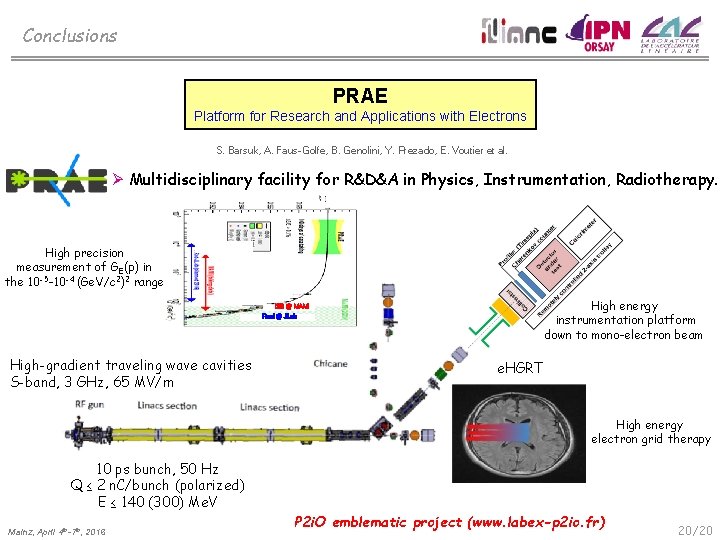
Conclusions PRAE Platform for Research and Applications with Electrons S. Barsuk, A. Faus-Golfe, B. Genolini, Y. Prezado, E. Voutier et al. Ø Multidisciplinary facility for R&D&A in Physics, Instrumentation, Radiotherapy. High precision measurement of GE(p) in the 10 -5 -10 -4 (Ge. V/c 2)2 range v v High energy instrumentation platform down to mono-electron beam ISR @ MAMI Prad @ JLab v High-gradient traveling wave cavities S-band, 3 GHz, 65 MV/m e. HGRT High energy electron grid therapy 10 ps bunch, 50 Hz Q ≤ 2 n. C/bunch (polarized) E ≤ 140 (300) Me. V Mainz, April 4 th-7 th, 2016 P 2 i. O emblematic project (www. labex-p 2 io. fr) 20/20