
LOWCOST SEISMIC DATA ACQUISITION SYSTEM BASED ON OPEN

LOW-COST SEISMIC DATA ACQUISITION SYSTEM BASED ON OPEN SOURCE HARDWARE AND SOFTWARE TOOLS Arvid Ramdeane, Lloyd Lynch Arvid Ramdeane: U. W. I. Seismic Research Centre/Department of Electrical and Computer Engineering Lloyd Lynch: U. W. I. Seismic Research Centre
OVERVIEW • Introduction • Motivation and Objectives behind the project. • Methodology. • Data Acquisition Subsystem • Data Processing Subsystem • Timing • Data Storage and telemetry • Conclusion and Future Work. ICon. ETech-2020, Faculty of Engineering, The UWI, St. Augustine, Trinidad and Tobago 2

INTRODUCTION • UWI SRC network - 56 stations. • Outfitted with: 1. Analog sensors - weak motion, short period and broadband seismometers. 2. Strong motion - Feedback Accelerometer, MEMS accelerometer. 3. PC Based 16 -bit DAS. 4. Embedded 24 -bit DAS 24 -bit. 5. Communication equipment (VSAT, internet, RF). ICon. ETech-2020, Faculty of Engineering, The UWI, St. Augustine, Trinidad and Tobago 3

INTRODUCTION • Path to upgrade to a fully digital network since 2006. • To realize the upgrade, the Centre is in the process of designing and developing a Low-Cost Seismic Data Acquisition System based on Open Source Hardware and Software Tools (SDAS). • Using easily available and low cost components (sensors, microcontrollers, microcomputers, etc. ). ICon. ETech-2020, Faculty of Engineering, The UWI, St. Augustine, Trinidad and Tobago 4
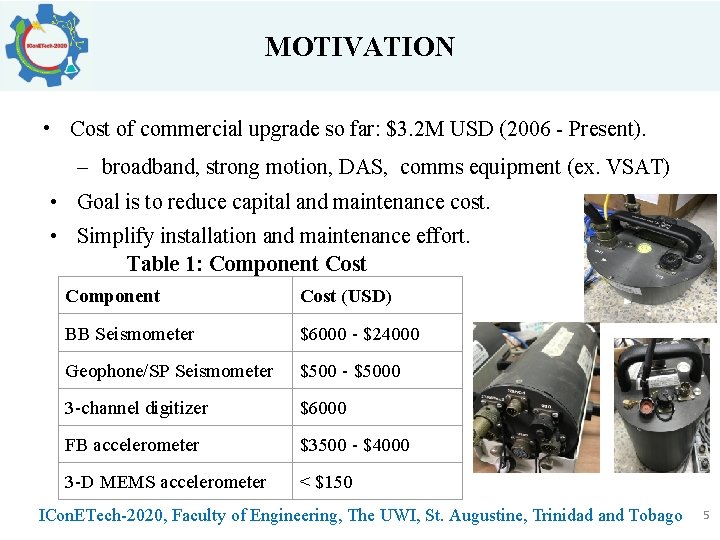
MOTIVATION • Cost of commercial upgrade so far: $3. 2 M USD (2006 - Present). – broadband, strong motion, DAS, comms equipment (ex. VSAT) • Goal is to reduce capital and maintenance cost. • Simplify installation and maintenance effort. Table 1: Component Cost (USD) BB Seismometer $6000 - $24000 Geophone/SP Seismometer $500 - $5000 3 -channel digitizer $6000 FB accelerometer $3500 - $4000 3 -D MEMS accelerometer < $150 ICon. ETech-2020, Faculty of Engineering, The UWI, St. Augustine, Trinidad and Tobago 5
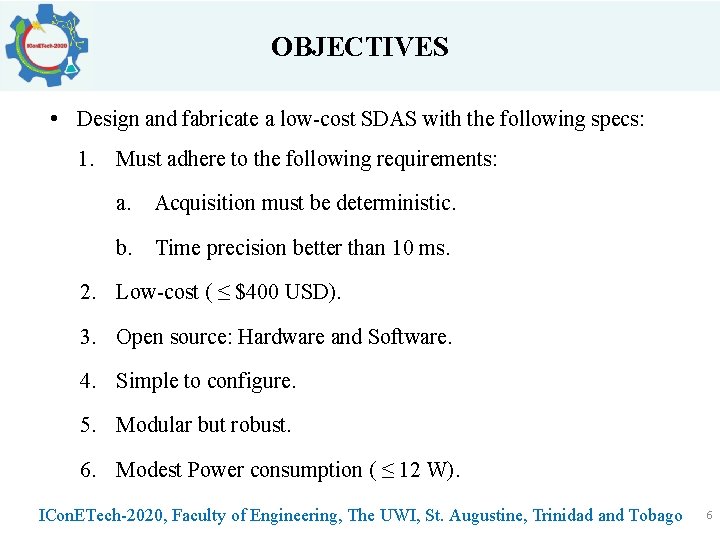
OBJECTIVES • Design and fabricate a low-cost SDAS with the following specs: 1. Must adhere to the following requirements: a. Acquisition must be deterministic. b. Time precision better than 10 ms. 2. Low-cost ( ≤ $400 USD). 3. Open source: Hardware and Software. 4. Simple to configure. 5. Modular but robust. 6. Modest Power consumption ( ≤ 12 W). ICon. ETech-2020, Faculty of Engineering, The UWI, St. Augustine, Trinidad and Tobago 6
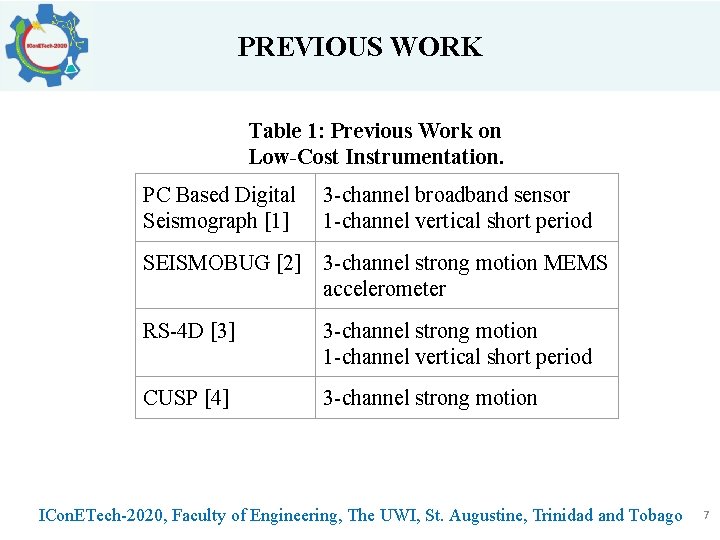
PREVIOUS WORK Table 1: Previous Work on Low-Cost Instrumentation. PC Based Digital 3 -channel broadband sensor Seismograph [1] 1 -channel vertical short period SEISMOBUG [2] 3 -channel strong motion MEMS accelerometer RS-4 D [3] 3 -channel strong motion 1 -channel vertical short period CUSP [4] 3 -channel strong motion ICon. ETech-2020, Faculty of Engineering, The UWI, St. Augustine, Trinidad and Tobago 7
METHODOLOGY • General purpose OS on a popular single board architecture. – Ubuntu on ARM architecture. – Priority of acquisition process to highest level. • Use low-cost microcontroller to supervise acquisition. • Transfer data over to microcomputer using a process and data structure that facilitates buffering, and accurate timing of the sampled data. • GPS module to convert microcomputer to a stratum-1 timeserver. • Data on microcomputer is formatted in MSEED packets, placed into a ringbuffer and stored on a flash drive. ICon. ETech-2020, Faculty of Engineering, The UWI, St. Augustine, Trinidad and Tobago 8

METHODOLOGY DATA ACQUISITION SUBSYSTEM • Collects and digitizes data from the sensor at 100 SPS. • The digitized data is formatted and sent to the data processing subsystem over the USB serial interface. • Data is formatted as follows: x*y*z/r/n. Software (Open Source) Hardware Comm Interfaces 1. Arduino Library (SPI) 1. ADXL 335 1. Serial Peripheral Interface 2. Protocentral (ADS 1220) 2. ADS 1220 2. USB Serial 3. Acquisition code 3. Arduino Mega 3. 3 -Ch single ended bus (ADXL 335 -ADS 1220 ICon. ETech-2020, Faculty of Engineering, The UWI, St. Augustine, Trinidad and Tobago 9
METHODOLOGY DATA PROCESSING SUBSYSTEM • Collects and buffers the sampled raw data from the data acquisition subsystem over the USB serial interface. • Processes the buffered data into 512 -byte MSEED packets. • Inserts MSEED packets into ringbuffer. • Creates MSEED files to be stored on flash. • Facilitates seedlink clients to connect and stream data packets out. ICon. ETech-2020, Faculty of Engineering, The UWI, St. Augustine, Trinidad and Tobago 10
METHODOLOGY Software (Open Source) Hardware (Open Source) 1. Ubuntu Mate 1. Raspberry Pi 3 B+ 2. NTP/PPS kernel support 2. Parallax GPS module 3. ringserver (IRIS) 3. 32 Gb external flash drive (storage) 4. libmseed (IRIS) 4. 5 V 3 A switching power supply 5. Processing code Communication Interfaces 1. UART (GPS) 2. USB Serial (Arduino - RPi) 3. TCP/IP (seedlink, config, http) 4. HDMI (external display) ICon. ETech-2020, Faculty of Engineering, The UWI, St. Augustine, Trinidad and Tobago 11

PUTTING IT TOGETHER Figure 1: SDAS Block Diagram ICon. ETech-2020, Faculty of Engineering, The UWI, St. Augustine, Trinidad and Tobago 12
TIMING – NTP STRATUM 1 SERVER • RFC 1589 - UNIX kernel implementation model for high- precision time-keeping. • It provides an interface to the high-accuracy, one pulse-per-second (PPS) output. • Used in conjunction with the Network Time Protocol (NTP, RFC 1305). • PPS and NTP support are added to the Linux available for the Raspberry Pi (gpsd, pps-gpio, ntpd, ppstest). ICon. ETech-2020, Faculty of Engineering, The UWI, St. Augustine, Trinidad and Tobago 13
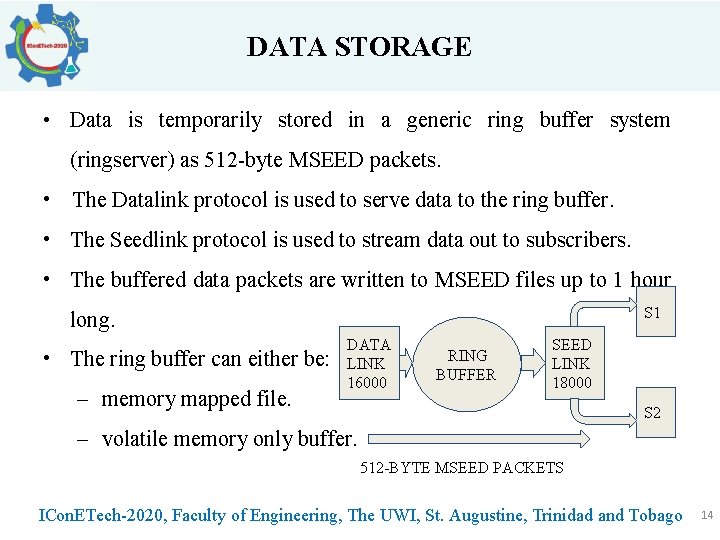
DATA STORAGE • Data is temporarily stored in a generic ring buffer system (ringserver) as 512 -byte MSEED packets. • The Datalink protocol is used to serve data to the ring buffer. • The Seedlink protocol is used to stream data out to subscribers. • The buffered data packets are written to MSEED files up to 1 hour S 1 long. • The ring buffer can either be: – memory mapped file. DATA LINK 16000 RING BUFFER SEED LINK 18000 S 2 – volatile memory only buffer. 512 -BYTE MSEED PACKETS ICon. ETech-2020, Faculty of Engineering, The UWI, St. Augustine, Trinidad and Tobago 14
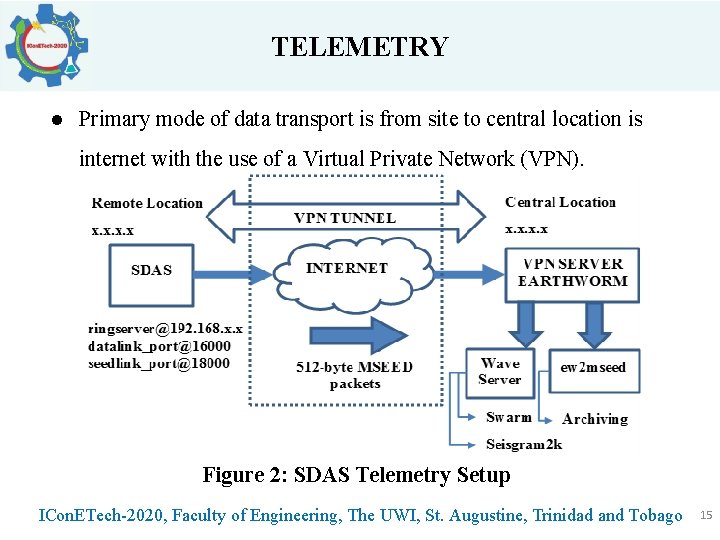
TELEMETRY ● Primary mode of data transport is from site to central location is internet with the use of a Virtual Private Network (VPN). Figure 2: SDAS Telemetry Setup ICon. ETech-2020, Faculty of Engineering, The UWI, St. Augustine, Trinidad and Tobago 15
CONCLUSION AND FUTURE WORK • Low-cost instrumentation has been proven through literature to be a viable option for seismic monitoring. • The SDAS can be used for upgrading SRC seismic network providing cost savings, and easy installation and maintenance effort. • Cost of first prototype: $300 USD. • Main objectives met with the use of open source hardware and software tools. • The SDAS can stream seedlink subscriptions in real-time. • Unit testing completed. ICon. ETech-2020, Faculty of Engineering, The UWI, St. Augustine, Trinidad and Tobago 16
CONCLUSION AND FUTURE WORK • With unit testing completed, system level testing will commence. – In lab Testing – Field testing • PCB design and fabrication, instrumentation response, web interface, durable housing, 6 -channel integration. • Build multiple units for field testing with the TTMP network. ICon. ETech-2020, Faculty of Engineering, The UWI, St. Augustine, Trinidad and Tobago 17
![REFERENCES • [1] B. A. Bolt, J. E. Friday, R. A. Uhrhammer. A PC-based](http://slidetodoc.com/presentation_image_h/1a2cbf702705d350cde7d9e95515b61a/image-18.jpg "REFERENCES • [1] B. A. Bolt, J. E. Friday, R. A. Uhrhammer. A PC-based")
REFERENCES • [1] B. A. Bolt, J. E. Friday, R. A. Uhrhammer. A PC-based broadband digital seismograph network. Geophysical Journal International, 93, no. 3, (1988) 565– 573. • [2] C. Z. Karakostas, V. K. Papanikolaou. 2014. A low-cost instrumentation approach for seismic hazard assessment in urban areas. WIT Transactions on Information and Communication Technologies, 47, pp. 97 -107. • [3] R. E. Anthony, A. T. Ringler, D. C. Wilson, E. Wolin. 2019. Do Low‐Cost Seismographs Perform Well Enough for Your Network? An Overview of Laboratory Tests and Field Observations of the OSOP Raspberry Shake 4 D. Seismological Research Letters, 90, no. 1, pp. 219– 228. • [6] H. R. Avery, J. B. Berrill, M. B. Dewe. 2004. Design and development of a low-cost, high-performance, strong-motion accelerograph. In Proc. Of the 2004 NZSEE Conference, pp. 44 -50. ICon. ETech-2020, Faculty of Engineering, The UWI, St. Augustine, Trinidad and Tobago 18

THANK YOU! ICon. ETech-2020, Faculty of Engineering, The UWI, St. Augustine, Trinidad and Tobago 19
- Slides: 19