
LOWCOST MULTITOUCH SENSING THROUGH FRUSTRATED TOTAL INTERNAL REFLECTION

- Slides: 14
LOW-COST MULTI-TOUCH SENSING THROUGH FRUSTRATED TOTAL INTERNAL REFLECTION Daniel A. Taylor Pitt- Bradford University
Introduction � Touch sensitivity is fairly common in electronics today… � …but only for a single point of contact at any given time. � Touch-sensitive devices that allow for multiple points of contact have thus far been expensive or difficult to produce.
Why multi-touch? � Allows a user to interact with a system with more than one finger at once �Touch Keyboards �Operations using both hands � Also allows multiple users to interact on the same touch-sensitive platform �Interactive walls �Interactive tabletops
Prior approaches to the problem � Matrix of smaller sensors �Requires many connections, which severely limits resolution �Visually translucent - no touch-screen � Video cameras �Measuring of brightness �Identifying tracking markers in gel
A new approach… F rustrated T otal I nternal R eflection
Total Internal Reflection � When light encounters a medium with a lower index of refraction (e. g. , going from glass to air), its refraction depends on the angle at which it hits the border. � Beyond a certain critical angle, light is not refracted, but instead reflects entirely within the material. �This is the basis for fiber optics and other optical wave guides.
Frustrated Total Internal Reflection � If another material touches that within which the light is reflecting, the reflection is frustrated, causing the light to escape. � This has been used in the past: �fingerprint imaging �early touch sensors (1970 s!) �tactile sensors for robotic grips
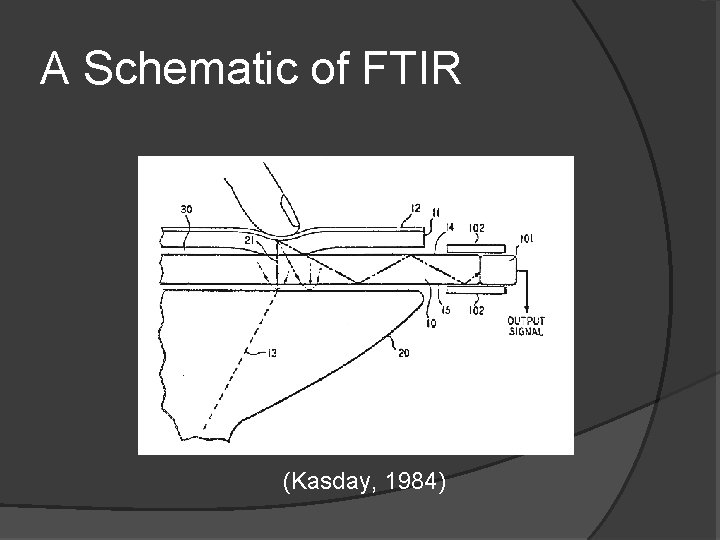
A Schematic of FTIR (Kasday, 1984)
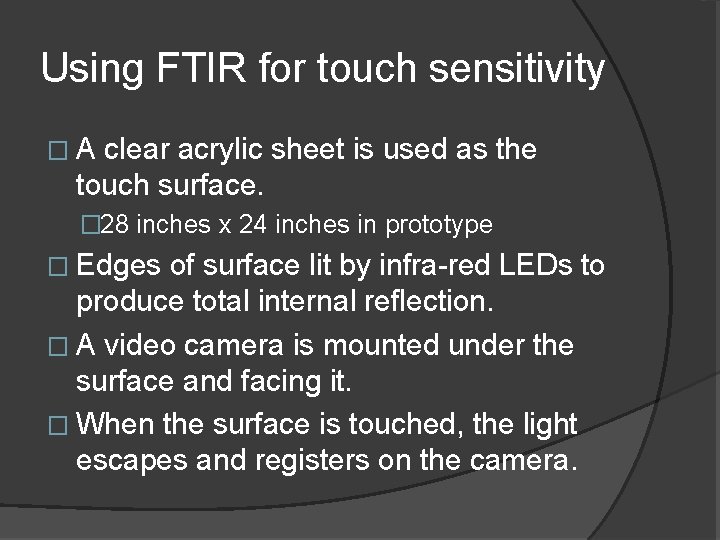
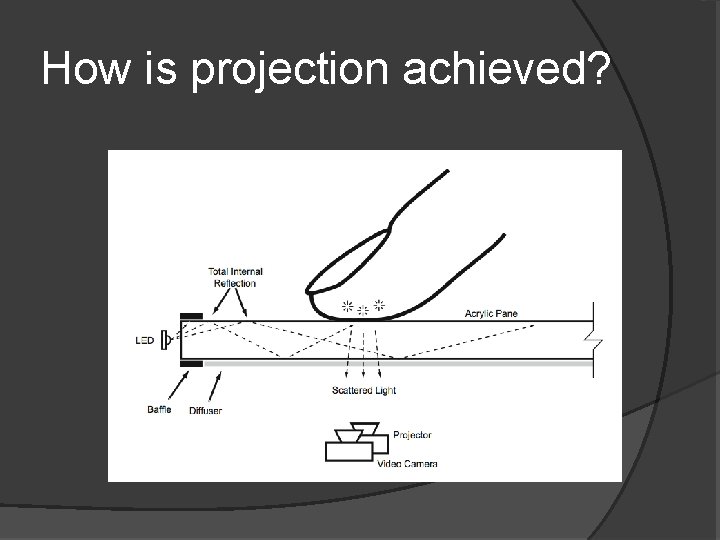
Using FTIR for touch sensitivity �A clear acrylic sheet is used as the touch surface. � 28 inches x 24 inches in prototype � Edges of surface lit by infra-red LEDs to produce total internal reflection. � A video camera is mounted under the surface and facing it. � When the surface is touched, the light escapes and registers on the camera.
Using FTIR for touch sensitivity � Basic image-processing techniques are performed on the camera output to identify the points of contact. � Computer-vision techniques are used to interpret the motion of contact points as discrete touches or strokes. � Processing easily handled in real-time by a 2 GHz Pentium IV processor
Advantages to this approach � High capture rate and resolution � 30 frames per second � 640 x 480 � True zero-force touch sensitivity � Inexpensive to construct � Scalable to much larger (even wall- sized!) surfaces � Transparent: can be combined with rearprojection display
How is projection achieved?
Disadvantages � Requires significant space behind touch surface for camera � Gloves, certain types of styluses, and even dry skin may not register �a function of refractive index � Residues on surface (e. g. , sweat) also produce FTIR effect that may build up
Any Questions?