
LowComplexity Detection of Mary PSK FasterthanNyquist Signaling Ebrahim
Low-Complexity Detection of M-ary PSK Faster-than-Nyquist Signaling Ebrahim Bedeer*, Halim Yanikomeroglu**, Mohamed Hossam Ahmed*** *Ulster University, Belfast, UK **Carleton University, Ottawa, ON, Canada ***Memorial University, St. John’s, NL, Canada April 15, 2019
Agenda q. Introduction q. FTN Signaling System Model q. Our FTN Signaling Contributions Ø Quasi-Optimal Detection (High SE) Ø Symbol-by-Symbol Detection (Low SE) Ø M-ary QAM Detection Ø M-ary PSK Detection q. Conclusions 2
Introduction �Orthogonality is an advantage and a constraint. �Nyquist limit is more of a guideline than a rule. �Nyquist limit simplifies receive design by avoiding ISI. �Faster-than-Nyquist (FTN signaling) intentionally introduce ISI to improve SE. �Detection: Increased complexity 3
![Introduction �FTN signaling concept exists at least since 1968 [Saltzberg-68]. �FTN signaling term coined](http://slidetodoc.com/presentation_image_h2/85ed43b5adff9e1c5ee2a72b5d9354e1/image-4.jpg "Introduction �FTN signaling concept exists at least since 1968 [Saltzberg-68]. �FTN signaling term coined")
Introduction �FTN signaling concept exists at least since 1968 [Saltzberg-68]. �FTN signaling term coined by Mazo in 1975 [Mazo-75]. �Mazo Limit: FTN does not affect minimum distance of uncoded sinc binary transmission up to a certain range. �Mazo Limit: 1/0. 802 25% faster than Nyquist 25% in spectral efficiency. �Much faster Mazo limit: Possible, but with some SNR penalty. Saltzberg B. Intersymbol interference error bounds with application to ideal bandlimited signaling. IEEE Transactions on Information Theory. July 1968; 14(4): 563 -8. Mazo JE. Faster-than-Nyquist signaling. The Bell System Technical Journal. Oct. 1975; 54(8): 1451 -62. 4
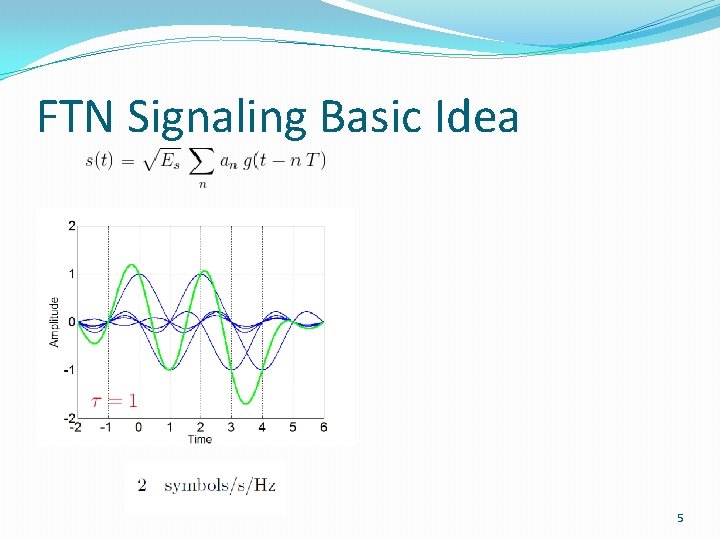
FTN Signaling Basic Idea 5
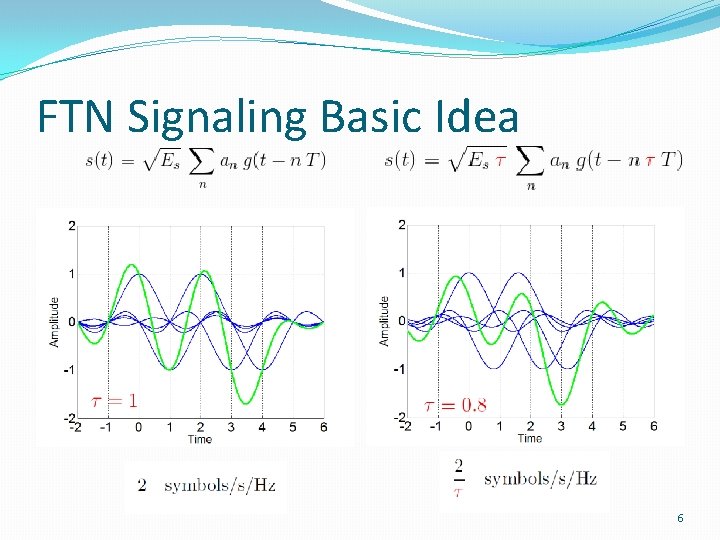
FTN Signaling Basic Idea 6
Extension of Mazo Limit �Other pulse shapes (root-raised cosine, Gaussian, …) �Non-binary transmission �Frequency domain 7
Our FTN Publications Ebrahim Bedeer, Halim Yanikomeroglu, and Mohamed H. Ahmed, “Quasi-optimal sequence estimation of binary faster-than-Nyquist signaling”, IEEE ICC 2017, Paris, France. Ebrahim Bedeer, Mohamed H. Ahmed, and Halim Yanikomeroglu, “A very low complexity successive symbol-by-symbol sequence estimator for binary fasterthan-Nyquist signaling”, IEEE Access, March 2017. Ebrahim Bedeer, Mohamed H. Ahmed, and Halim Yanikomeroglu, “Lowcomplexity detection of high-order QAM faster-than-Nyquist signaling”, IEEE Access, July 2017. Ebrahim Bedeer, Halim Yanikomeroglu, and Mohamed H. Ahmed, “Low. Complexity Detection of M-ary PSK Faster-than-Nyquist Signaling”, IEEE WCNC 2019 Workshops, Marrakech, Morocco. 8
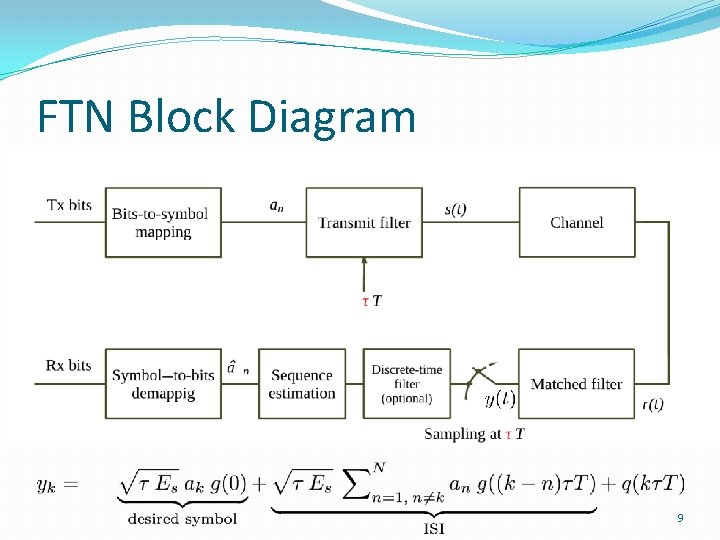
FTN Block Diagram 9
Our FTN Signaling Contributions Quasi-Optimal Detection (High SE) Ebrahim Bedeer, Halim Yanikomeroglu, and Mohamed H. Ahmed, “Quasi-optimal sequence estimation of binary faster-than-Nyquist signaling”, IEEE ICC 2017, Paris, France. 10
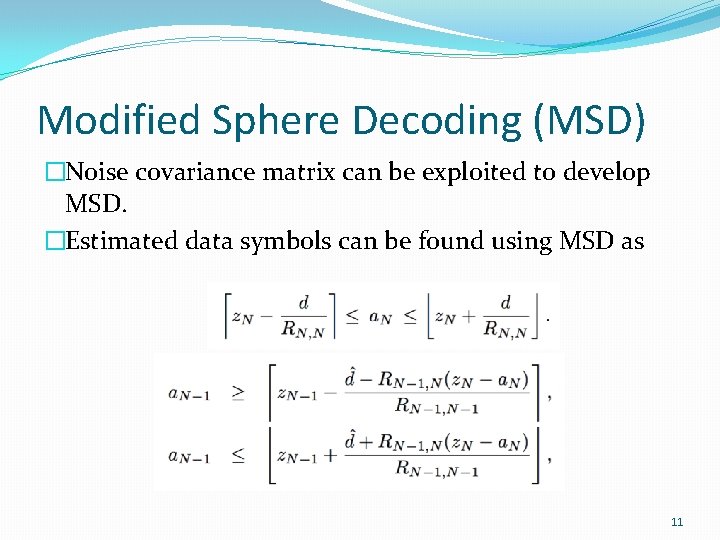
Modified Sphere Decoding (MSD) �Noise covariance matrix can be exploited to develop MSD. �Estimated data symbols can be found using MSD as 11
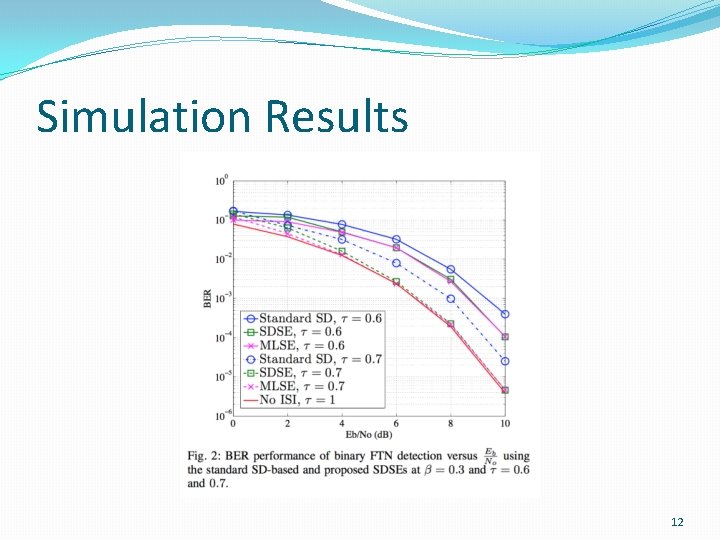
Simulation Results 12
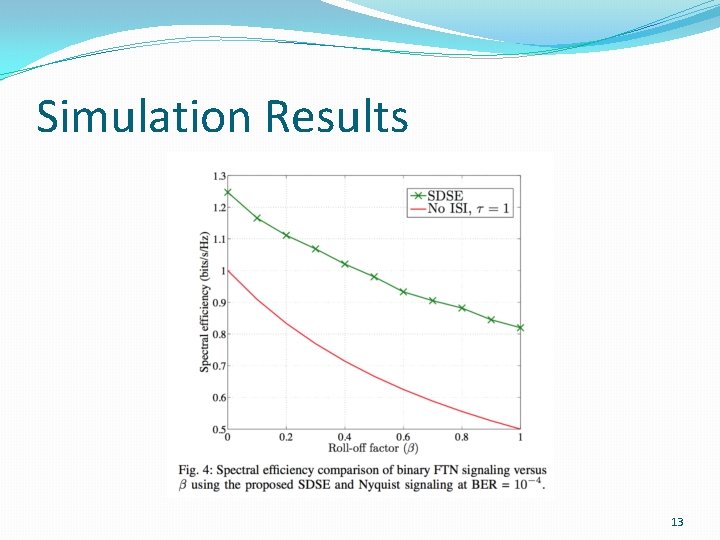
Simulation Results 13
![Simulation Results Spectral Efficiency SE= log 2(M) x [1/(1+b)] x (1/t) bits/s/Hz 14](http://slidetodoc.com/presentation_image_h2/85ed43b5adff9e1c5ee2a72b5d9354e1/image-14.jpg "Simulation Results Spectral Efficiency SE= log 2(M) x [1/(1+b)] x (1/t) bits/s/Hz 14")
Simulation Results Spectral Efficiency SE= log 2(M) x [1/(1+b)] x (1/t) bits/s/Hz 14
Our FTN Signaling Contributions Symbol-by-Symbol Detection (Low SE) Ebrahim Bedeer, Mohamed H. Ahmed, and Halim Yanikomeroglu, “A very low complexity successive symbol-by-symbol sequence estimator for binary fasterthan-Nyquist signaling”, IEEE Access, March 2017. 15
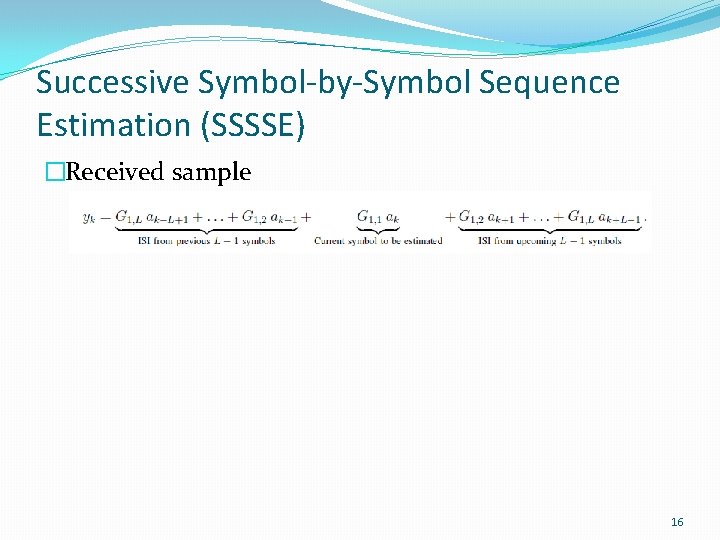
Successive Symbol-by-Symbol Sequence Estimation (SSSSE) �Received sample 16
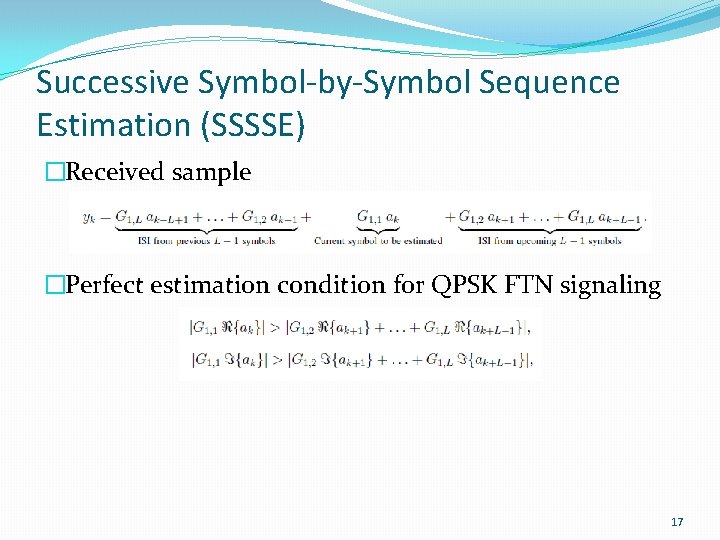
Successive Symbol-by-Symbol Sequence Estimation (SSSSE) �Received sample �Perfect estimation condition for QPSK FTN signaling 17
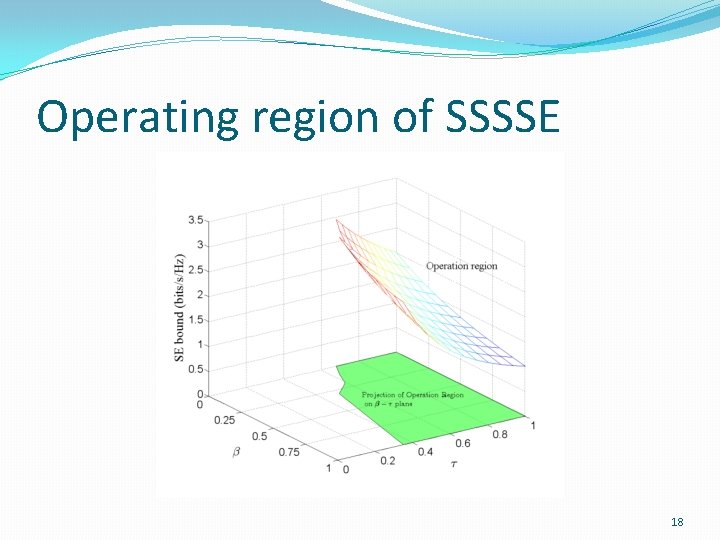
Operating region of SSSSE 18
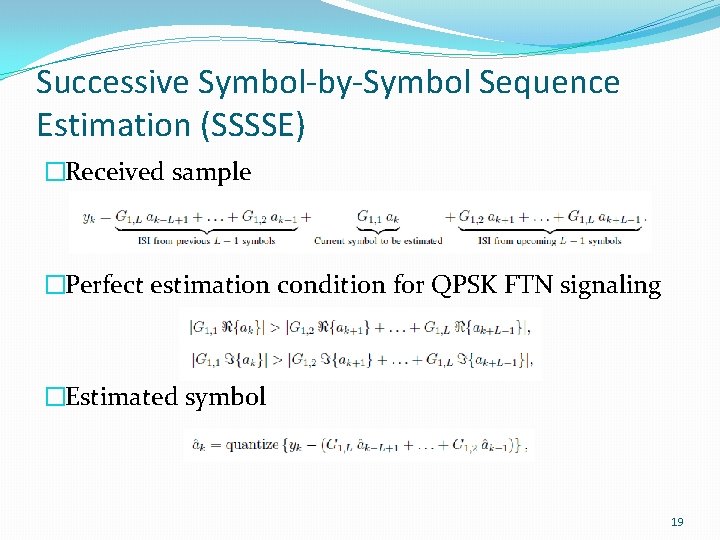
Successive Symbol-by-Symbol Sequence Estimation (SSSSE) �Received sample �Perfect estimation condition for QPSK FTN signaling �Estimated symbol 19
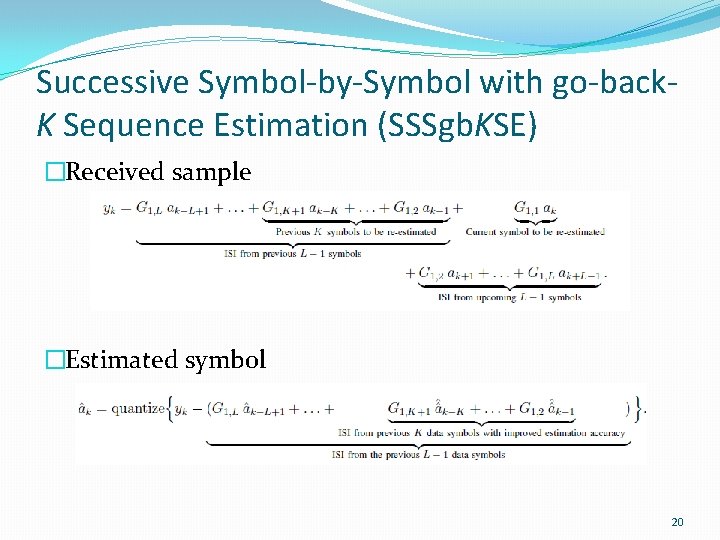
Successive Symbol-by-Symbol with go-back. K Sequence Estimation (SSSgb. KSE) �Received sample �Estimated symbol 20
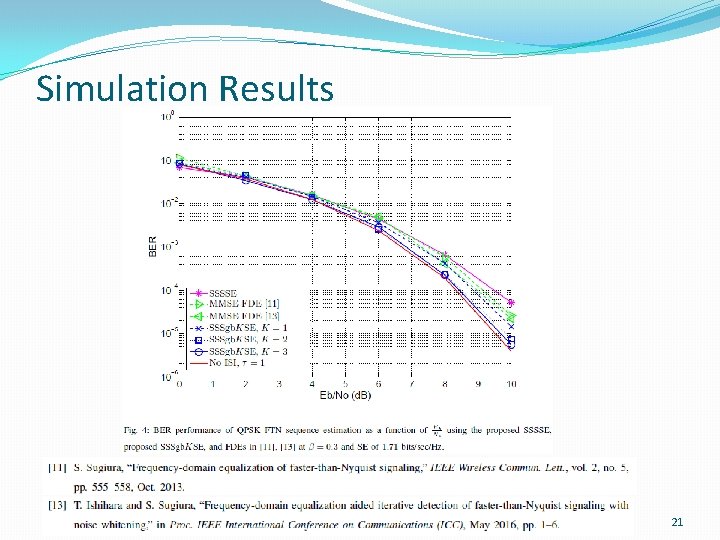
Simulation Results 21
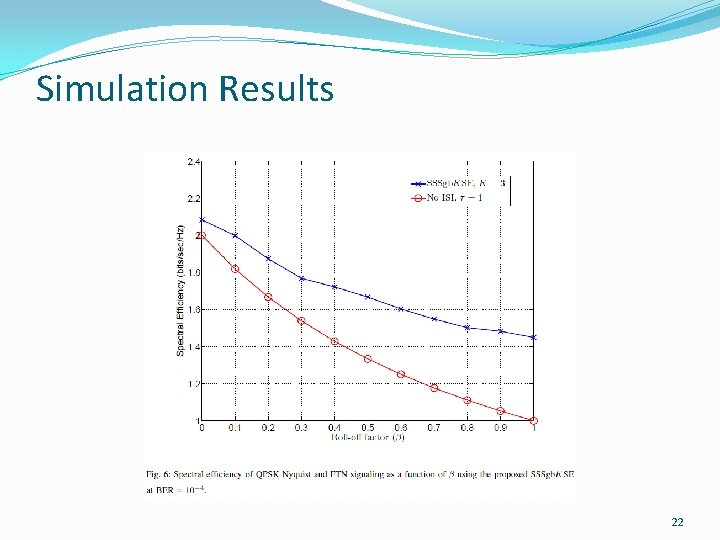
Simulation Results 22
Our FTN Signaling Contributions M-ary PSK Detection Ebrahim Bedeer, Halim Yanikomeroglu, and Mohamed H. Ahmed, “Low. Complexity Detection of M-ary PSK Faster-than-Nyquist Signaling”, IEEE WCNC 2019 Workshops, Marrakech, Morocco. 23
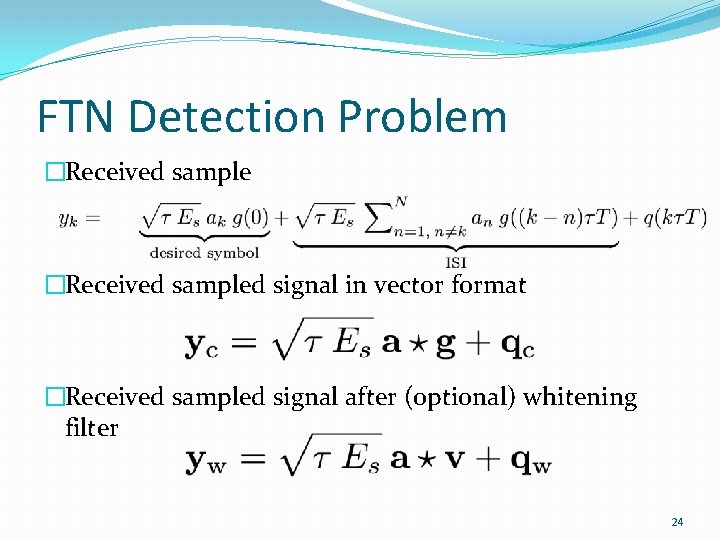
FTN Detection Problem �Received sampled signal in vector format �Received sampled signal after (optional) whitening filter 24
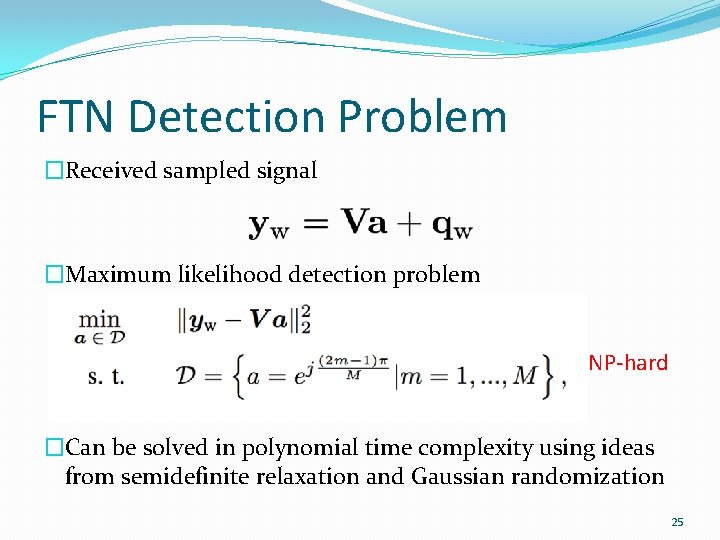
FTN Detection Problem �Received sampled signal �Maximum likelihood detection problem NP-hard �Can be solved in polynomial time complexity using ideas from semidefinite relaxation and Gaussian randomization 25
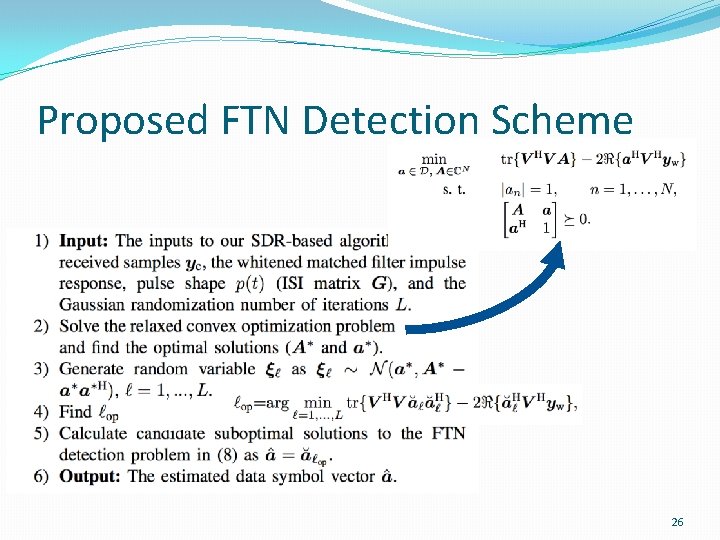
Proposed FTN Detection Scheme 26
![Simulation Results Spectral Efficiency SE= log 2(M) x [1/(1+b)] x (1/t) bits/s/Hz 8 -PSK](http://slidetodoc.com/presentation_image_h2/85ed43b5adff9e1c5ee2a72b5d9354e1/image-27.jpg "Simulation Results Spectral Efficiency SE= log 2(M) x [1/(1+b)] x (1/t) bits/s/Hz 8 -PSK")
Simulation Results Spectral Efficiency SE= log 2(M) x [1/(1+b)] x (1/t) bits/s/Hz 8 -PSK Roll-off factor: b = 0. 3 Mazo limit: t = 0. 802 SE = 2. 31 bits/s/Hz 17% increase in SE excellent 27
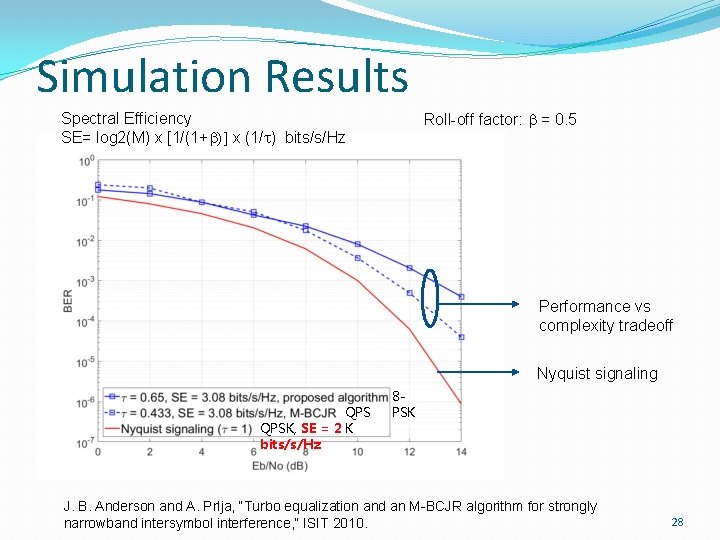
Simulation Results Roll-off factor: b = 0. 5 Spectral Efficiency SE= log 2(M) x [1/(1+b)] x (1/t) bits/s/Hz Performance vs complexity tradeoff Nyquist signaling QPSK, SE = 2 K bits/s/Hz 8 PSK J. B. Anderson and A. Prlja, “Turbo equalization and an M-BCJR algorithm for strongly narrowband intersymbol interference, ” ISIT 2010. 28
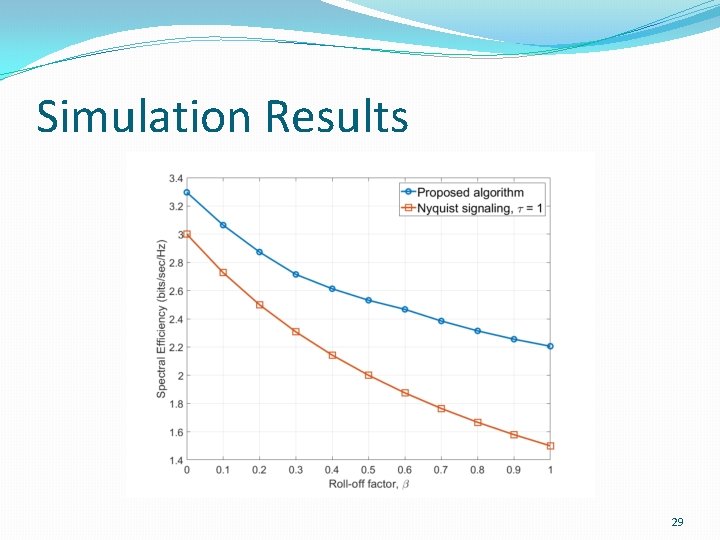
Simulation Results 29
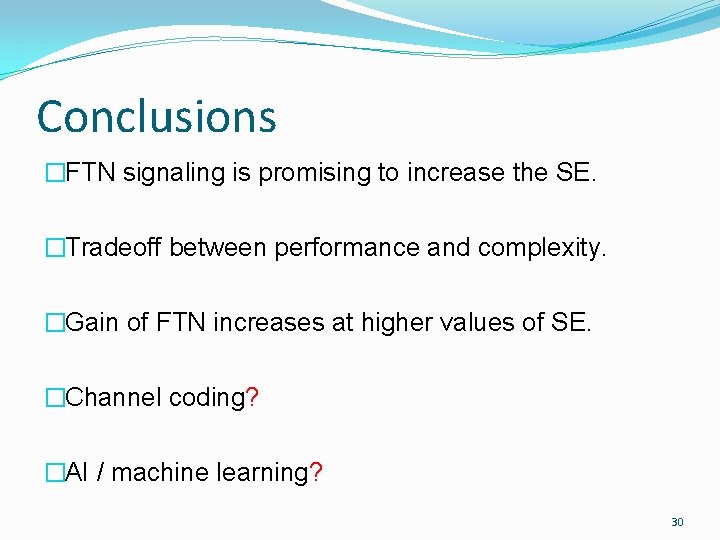
Conclusions �FTN signaling is promising to increase the SE. �Tradeoff between performance and complexity. �Gain of FTN increases at higher values of SE. �Channel coding? �AI / machine learning? 30
- Slides: 30